brake fluid AUDI A8 2012 User Guide
[x] Cancel search | Manufacturer: AUDI, Model Year: 2012, Model line: A8, Model: AUDI A8 2012Pages: 300, PDF Size: 75.06 MB
Page 231 of 300
scalding from hot coo lant by following
these steps.
- Turn
off the engi ne and a llow it to cool
down.
- Protect your face, hands and arms from
escapi ng fl uid and steam by cover ing
the cap with a large, thick rag .
- Turn the cap slowly and very ca refully
i n a cou nte r-clockw ise dir ect ion while
a pply ing lig ht, downwa rd p ress ure on
the top of the cap.
- T o avo id being burned, do no t sp ill an
tifree ze o r coolan t on t he exh aust sys
tem or ho t engine parts . Un der certain
conditions, the ethylene glyco l in en
gine coolant can catch fire .
- Antifree ze is poisono us. Always store an
tifreeze in its or iginal co ntainer and we ll
o ut o f the reac h of children.
- If you drain the coolant , it must be
caught and safely stored in a p roper con
tainer clear ly marked "poison".
(D Note
- Coolant po llutes the env ironment and
could ca use a n engine fire . Excess coo l
ant wi ll be forced out through the pres
sure re lief va lve in the cap when the en
gine becomes hot.
- If, in an emergency, only water can be
added , the correct ratio between water
and antifreeze¢
page 22 7 must be re
stored as soon as possib le .
@ For the sake of the environment
Drained coolant should not be re used . Al
ways dispose of used c oolant while observ
ing all envir onmental regulations .
Radiator fan
The radiator fan switches on automa tically by
itself
T he radiator fan is driven by the engine via the
V-be lt. The viscous clutch regulates the speed
of the fan according to the temperature of the
coolant .
Checkin g and fillin g 229
An auxiliary electric radiato r fan* sw itches on
and
off depending on coolant temperature
and othe r vehicle ope rat ing con ditions.
After yo u switc h the engi ne off, the aux iliary
f an can con tinue r unning for up to 10 minutes
- even with the ignition off. It can even switch
on again later by itself¢ & , if
- t he temperatu re of the engine coo lant rises
due to the heat b uild -up from the en gine in
the engi ne compartment, or
- the engine compartment heats up be cause
the vehicle is parked in intense sunlight.
A WARNING
- To reduce the risk of personal in jury nev
er touch the radiator fan.
- The a uxiliary electric fan is temperat ure
contro lled and can switch on sud denly
even when the engine is not running.
- The a uxiliary radiator fa n switches on a u
tomatically when the engine coo lant
reaches a certain temperature and will
continue to run until the coo lant temper
ature drops .
Brake fluid
Checking brake fluid level
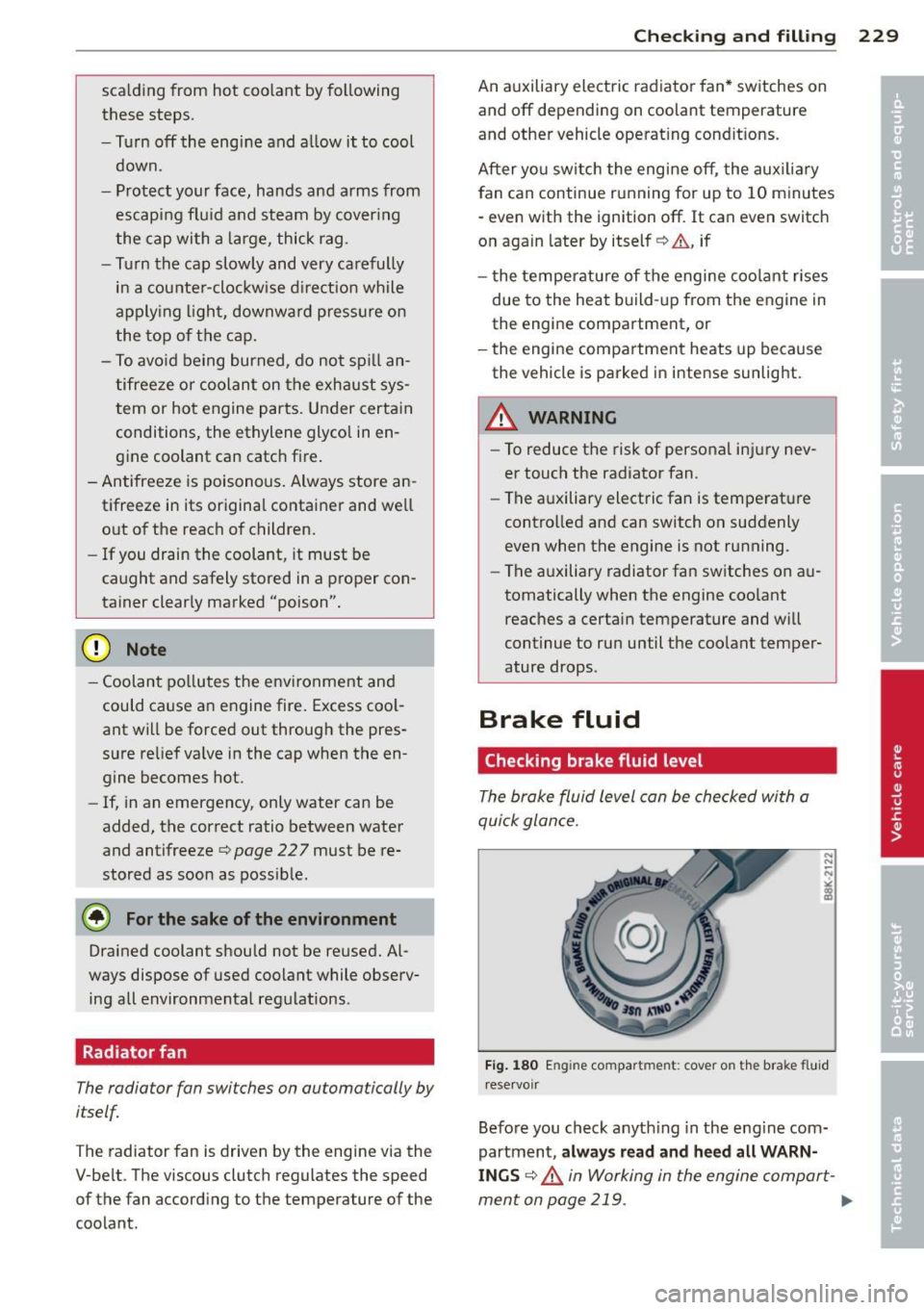
The brake fluid level can be checked with a
qui ck glance.
Fig. 180 En gin e compar tment: cov er o n th e bra ke fluid
r ese rvoir
Befo re you check anyth ing in the eng ine com
partment ,
always re ad and heed all WARN
INGS c::> ,& in Working in the engine compar t-
ment on page 219 . .,..
Page 232 of 300
230 Check ing and filling
• Read the brake fluid level from the brake
fluid reservoi r¢
fig. 180, ¢ page 221. The
brake f lu id leve l must be between the "MIN"
and "MAX" markings.
The location of the brake fluid reservoir can be
seen in the engine compartment illustration
co page 221.
The fl uid level may drop slightly after some
time due to the automatic adjustment of the brake pads . This is not cause for alarm .
I f the brake fluid level falls
considerably be
l ow the "MIN" mark, the brake wa rning/indi
cator light- (U.S.
models) ;II (Canadian
models) will come on ¢
page 14. Do not con
tinue to operate the vehicle. The comp lete
brake system should be thoroughly checked
by an authorized Audi dealer or other quali
fied fac ility and the cause corrected. If the
brake fluid level is too low, the brake war ning/
in dicato r light w ill illuminate . Contact an au
thor ized A udi dealer
immediately .
Changing brake fluid
Have the brake fluid changed by an experi
enced technician .
Brake fluid absorbs moistu re from the a ir . If
the water content in the brake fluid is too
h igh, corrosion in the brake system may result
after a per iod of t ime . The bo iling po int of the
b rake fluid w ill also decrease considerably and
dec rease braking per formance.
Therefore, the brake flu id must be changed
e ver y two yea rs. A lways use new b rake fluid
which confo rms to Fede ral Motor Vehicle
Standard "FMVSS 1 16 DO T 4".
The brake flu id rese rvoi r ca n be difficult to
r ea ch, therefo re , we re commend that yo u
have the brake fl uid changed by yo ur a utho r
ized
Audi dealer. Your dea ler has the correct
too ls, the right brake fluid and the know-how
to do this for you .
A WARNING
-Brake flu id is poisonous. It must be stor
ed only in the closed or iginal conta iner
out of the reach of children!
- Brake failure can resu lt from o ld or inap
prop riate brake flu id . Obse rve these pre
cautions:
- Use only brake fluid that meets SA E
specification
J 1703 and conforms to
Federa l Moto r Ve hicle Standard 1 16 .
A lways check with your authorized A udi
dealer to make sure you are using the
correct brake fluid . The cor rect type of
brake flu id is also ind icated on the
brake flu id rese rvoir .
- The brake fluid must be new . Heavy use
of the brakes can cause a vapo r lock if
the b ra ke fluid is left i n the system too
l o ng. This can se riously affect the effi
c iency of the br akes as well as your
sa fety. This co uld resu lt in an accident.
(D Note
Brake fluid will damage the pai nt of you r
vehicle.
@ For the sake of the environment
Because of the p rob lem of proper disposal
of b ra ke fluid as well as the spec ial too ls
r equired and the nece ssary expe rti se, we
r ecommend that yo u have the brake fl uid
changed by yo ur authorized Aud i dea ler.
Battery
General information
U nder normal operat ing cond itions, the bat
te ry in yo ur Audi does not need any ma inte
nance . With
high outside temperatures or
l o ng da ily d rives we recommend that you have
the e lec trolyte leve l checked by a serv ice fa
c ility. The electrolyte leve l should also be
checked each time the battery is cha rged
¢ page 233. .,..
Page 237 of 300
Tires and wheels
Tires
General notes
Tires may be the least appreciated and most
abused parts of a motor vehicle .
Tires may be the least appreciated and most
abused parts of a motor vehicle . T ires are,
however, one of the most important parts of a
vehicle, particularly considering the compara
tively small patch of rubber on eac h tire that
assures that a ll- important contact between
you, you r vehicle and the road.
Maintaining the correct tire pressure, mak ing
sure that your vehicle and its tires do not have
to carry mo re weight than they can safely han
d le, avoiding damage from road hazards and
r eg ularly inspec ting t ires for damage i nclud
ing cuts, slashes irregu la r wear and ove rall
condition are the most important things that
you can do to he lp avoid sudden tire failure in
cluding tread separat ion and blowouts.
Avoiding damage If you have to d rive over a curb or similar ob
stacle, drive very slow ly and as close as possi
b le at a right angle to the curb.
A lways keep chemicals includ ing grease, o il ,
gasoline and brake fluid off the t ires .
I nspect the t ires regularly for damage (cuts,
cracks or b listers, etc.). Remove any fo reign
bod ies embedde d in the treads.
Storing tires Mark tires when you remove them to indicate
the direction of rotation . T his ensures you to
be ab le to mount them correctly when you re
i nstall them .
When removed, the whee ls or t ires should be
sto red in a cool, d ry and preferably dark place .
Store tires in a vertical pos ition if they are not
mounted on rims, in a horizontal pos it ion if
they are mounted on rims .
Tires an d wheel s 235
New tires
New tir es have to be broken in ¢ & .
The tread depth of new t ires may vary, accord
ing to the type a nd make of t ire and the tread
pa tte rn.
Hidden damage
Damage to tires and r ims is ofte n not readily
visible . If you notice unusual v ib rat io n or the
vehicle p ulls to one s ide, th is may ind icate
that one of the t ires has been damaged . T he
ti res m ust be chec ked immed iate ly by an au
thorized Audi dea le r or q ua lified wor kshop .
Unidirectional tires
A un idirectional tire can be identified by ar
rows on the s idewa ll, that po int in the direc
tion the t ire is designed to rotate. You mus t
f ol low the specified di rection o f rotation . T his
is necessary so that these tires can develop
their optimum characteristics regarding grip, road noise, wear and hydrop laning resistance.
For more information ¢
page 264.
A WARNING
New tires or t ires that are o ld, worn or
damaged cannot provide maximum con
trol and braking ability .
-
-New tires tend to be slippery and must
be broken in. To reduce the r isk of losing
control, a co llision and ser ious personal
in ju ries, d rive with special ca re fo r the
fi rst 350 m iles ( 560 km).
- Driving with worn or damaged tires can
lead to loss of control, sudden tire fail
ure, including a blowout and sudden de
fl ation, c ras hes and se riou s personal in
juries . Have wo rn or damaged t ires re
placed immediate ly.
- Ti res age even if they are not being used
and can fai l sudden ly, especially at hig h
spee ds. Tires that are more than 6 years
old can only be used in an emergency
and then w ith special care and at low
speed.
•
•
Page 245 of 300
@ For the sake of the environment
Underinflated tires will a lso increase the
fue l consumption .
Tires and vehicle load limits
There are limits to the amount of load or
weight that any vehicle and any t ire can carry.
A vehicle that is overloaded w ill not handle
well and is more difficult to stop. Overload ing
can not only lead to loss of vehicle control, but can a lso damage importan t pa rts of the
ve hicle and can lead to s udden tire failure, in
cluding a blowout and sudden deflation that
can cause the veh icle to crash.
Your safety and that of yo ur passenge rs a lso
depends on making s ure that load limits are
not exceeded. Vehicle load includes everybody
and everything in and on the vehicle. These
load limits are technica lly referred to as the
vehicle's
Gros s Vehicle We ight R ating
("GVWR").
The "GVWR" includes the weight of the basic
vehicle, all factory insta lled accessories, a full
tank of fue l, oil, coolant and other fluids plus
maximum load. The maximum load includes
the number of passengers that the vehicle is intended to carry ("seating capacity") with an
assumed weight of 150 lbs (68 kg) for each
passenger at a des ignated seat ing pos ition
and the total we ight of any l uggage in the ve
hi cle. If you tow a trailer, the weight of the
trailer hitch and the tongue weight of the loaded trailer must be included as part of the
vehicle load.
The
Gro ss Axl e W eight R ating ("GAWR") is
the maximum load that can be app lied at each
of the vehicle's two axles.
The Gross Vehicle Weight Rating and the
Gross Axle Weight Rating a re listed on the
safety compliance sticker labe l located on the
driver's side B -pillar . Your Audi has 5 seating
positions, 2 in the front and 3 in the rear for
total seating capacity of 5. Vehicles with pow
er individual rear seats* have 4 seating posi
tions, 2 in the front and 2 in the rear for total
Tire s an d wheel s 243
seating capacity o f 4 . Each seating position
has a safety belt~ page 134, Safety belts .
T he fact th at there is a n upper limit to yo ur
vehicle's G ross Vehicle Weight Rating means
that the total weight of whatever is being car
ried in the vehicle (including the weight of a
tra iler hitch and the tongue weight of the
l oaded tra iler) is lim ited. The more passen
gers in the vehicle or passengers who are
heavier than the standard we ights assumed
mea n that less we ight can be carried as lug
gage .
The tire pressure label on your Audi also lists
the maximum combined weight of all of the
occupants and luggage or other cargo that
the vehicle can carry . For the locat ion of the
label ~page239, fig.183.
A WARNING
Overloading a vehicle can cause loss of ve
hicle contro l, a crash or other accident, se
rious personal injury, and even death.
- Ca rrying more we igh t than your veh icle
was des igned to carry wi ll prevent the
vehicle from handling properly and in
crease the risk of the loss of vehicle con
trol.
- The brakes on a vehicle that has been
overloaded may not be able to stop the
veh icle w ith in a safe distance.
- Tires on a vehicle that has been over load
ed can fail suddenly, incl uding a blowout
and sudden deflation, causing loss of
control and a crash .
- Always make sure that the total load be
ing transported -includ ing the weight of
a trailer hitch and the tongue we ight of a
loaded trailer -does not make t he vehi
cle heavier than the vehicle's Gross Vehi
cle Weight Rating.
Determining correct load limit
U se the exa mple be lo w t o cal
c ulat e th e t otal weight of the
pa sse ngers a nd lu gg age or
•
•
Page 248 of 300

246 Tires and wheels
& WARNING
Sudden tire failure can lead to loss of con
trol, a crash and serious personal injury!
- Never drive a vehicle when the tread on
any tire is worn down to the wear indica
tors.
- Worn tires are a safety hazard, they do
not grip well on wet roads and increase
your risk of "hydroplaning" and loss of control.
- Always keep chemicals that can cause tire damage, such as grease, oil, gasoline
and brake fluid away from tires.
- Tires age even if they are not be ing used
and can fail suddenly, especially at high
speeds. Tires that are more than 6 years
old can only be used in an emergency
and then with special care and at lower
speeds.
- Never mount used tires on your vehicle if
you are not sure of their "previous histo
ry." Old used tires may have been dam
aged even though the damage cannot be
seen that can lead to sudden tire failure
and loss of vehicle control.
New tires and replacing tires and wheels
New tires and wheels have to be broken in .
Fig. 187 Tir e specificat ion codes on the s idewall of a
t ire
No. Description
(!) Passenger car tire (where applicable)
@ Nominal width of t ire in millimeters
@ Ratio of height to width (aspect ratio)
© Rad ial
® Rim diameter code
@ L oad index and speed rating
(J) U.S. DOT tire identification number
@ Audi Original tire
@ Sever snow conditions
@ T ire ply composition and materials
used
Maximum load rating
Treadwear, traction and temperature
grades
Maximum permissible inflation pres
sure
T he tires and rims are essential parts of the
vehicle 's design . The tires and rims approved
by Audi are spec ially matched to the charac
teristics of the vehicle and can make a major .,..
Page 269 of 300

Fuse s and bulb s 267
Luggage compartment fuse assignment
Fig. 207 Luggage compartment: fuse pa nel with plastic bracket
Fuse panel @ (black ) Fuse panel @ (b la ck)
No . Equi pment Amps No. Equipment Amps
[ru button, data logger, diag-
11 Dynamic
steering
5
l nostic connector, BCM -1,
5
Selector lever, BCM-2 5
adaptive light ing system
Audi side assist
5
2 Networking gateway 5
Engine control module 5
3 adaptive air suspension
5
Starter 40
4 Parking system 5
Left headlight/Headlight
16 10/5
5 Steer
ing column lever
5
range control system
Suspension control system
6 5 Fuse panel @ (red ) sensor
Belt tensioners, airbag con-
No. Equipment Amps
7
trol module 5 1 Left
reversible be lt tens ione r
25
Heated washer fluid nozzles, 2 Right reversible belt ten-
25
Homelink (garage door sioner
8 opener), night vision system
5 3 Starter diagnosis 5
control module, sport differ- 4 DC/DC converter
7,5
ential, ioni zer
5 Adaptive cruise contro l 7,5
9
Electromechan ica l parking
5 Right headlight (headlight
brake contro l modu le
6 with adaptive light) 10 -
10 Rear seat heating, cooler, in-
5 7 ESC co ntrol modu le 5 ... terior rearview mirror
Page 284 of 300
28 2 Con sum er Inf ormation
-Always make sure the transmission se
lector lever (automatic transmiss ion) is
in "P" (Park position) and the park brake
is f irmly app lied .
@) For the sake of the environment
-Changing the engine settings wi ll ad
versely affect em iss ion levels. This is det
rimental to the environment and increas
es fuel consumption .
- Always observe env ironmental regula
tions when dispos ing of old engine oil,
used brake fluid, dirty engine coolant,
spent batteries or worn out tires.
- Undeployed airbag modules and preten
s ioners might be classified as Perchlo
rate Material -spec ial handling may ap
ply, see www.dtsc.ca .gov/hazardous
was te/perch lorate . When the veh icle or
parts of the res traint system including
airbag modules safety belts wit h preten
sioners are scrapped, all applicable laws
and regulations must be observed. Your
authori zed Aud i dea ler is familiar with
these requirements and we recommend
that you have your dealer perform this
serv ice for you .
Additional accessories,
modifications and
parts replacement
Additional accessories and parts
replacement
Always consult an authorized Audi dealer be
fore purchasing accessories.
Your veh icle incorporates the latest safety de
sig n featu res ensu ring a high standard of a c
tive and passive safety .
This safety could be comp romised by non-ap
proved changes to the ve hicle. For this reason ,
if pa rts have to be replaced , please obse rve
the following points when install ing addition
a l accessories: Approved Audi accessories and genuine Aud
i
parts are available from authorized A udi deal
ers.
T hese dea le rs a lso have the necessary facili
ties, tools and tra ined specialists to install the
parts and acc essories proper ly .
A WARNING
-Using the wrong spare parts or using non-
approved accessories can cause damage to
the veh icle and ser ious persona l injury.
- Use on ly accessories express ly approved
by Audi and ge nuine Audi spare parts
- These parts and accessories have been
specia lly designed to be used on yo ur ve
h icle .
- Never install accessor ies such as tele
phone crad les or beverage ho lders on a ir
bag covers or within the airbag deploy
ment zones . Do ing so will increase the
risk of injury if a irbags are triggered in an
accident!
- Before you check anything in the engine
compa rtment, always read and heed a ll
WARNI NGS
9 page 213 .
(D Note
-If items other than genu ine Audi spare
parts, add-on equipment and accessory
items are used or if repair work is not
performed accord ing to specified meth
ods, this c an resu lt in seve re damage to
your vehicle's eng ine and body (such as
corrosion) and adversely affect yo ur vehi
cle's warranty .
- T he innovative a luminium concept of
your Audi AB means that all servicing, re
pairs or other work on the vehicle body
must be carr ied out exclusive ly by an Au
di workshop .
- If emergency repairs must be performed
elsewhere, have the veh icle examined by
an authorized Audi dealer as soon as
possible .
- The manufacturer cannot be held liable
for damage wh ic h occurs due to failure
to comply with these stipulations .
Page 288 of 300

286 Index .:..:..:..::....::.....:..._ ___________________________ _
Auto Safety Hotline ....... ... .. .... . 132
Average consumption ........... .. .... 24
Ave rage speed . . . . . . . . . . . . . . . . . . . . . . . 24
Avoid damaging the vehicle .. .. .. .... . 195
B
Battery ... .. .. . .. ..... ..... .. .. .. . 230
Charging . .. .. . ... ... .. .. .. .. .. .. . 233
Important warnings .. .... .. .. .... . 231
Location ... ... ............ .. .... . 231
low ..... .. ................ ..... . 192
Replacing the battery ....... ... ... . 234
State of cha rge .... .... ....... .. .. . 192
Winter operat ion .. ... .... .. .. .. .. . 230
Working on the battery .. ... ... .... . 231
Before driving .............. ... .... . 124
Blended gasoline ....... .... ... .. .. . 215
Blower (automatic climate control) . . . . . . 77
Body cavity sealing .. ..... .. .. .. .. .. . 208
Booster seats ................ ... ... 174
Brak e fluid
Ch anging the brake fluid ... .. .. .. .. .
230
Che cking the brake f luid level ... .. .. . 229
What is the correct brake flu id level? ..
229
What should I do if the brake fluid warn -
ing light comes on? ........ .... ....
229
Brake system
Anti-lock b raking sys tem ... .. .. .... ..
19
Brake a ssi st s ystem ...... ..... .. .. . 187
Brake booster ............. ... .. ... 190
Brake fluid .... ... .... ..... .. .. .. . 229
Brake fluid spec ificat ions for refill and re-
p lac ement ....... ....... .. .. .. .. .
230
Brake light defect ive .. .. .. .. .. .. .. . . 21
Brake pads ............... ... .... . 194
Electromechanica l parking brake .... .. 82
Fluid reservoir ............ ... .... . 229
How does moisture or road s alt affect the
br akes? .. ...... .. ... .... .. .. .. .. .
189
Warning/indicator lights .... .... ..... 14
Worn brake pads symbol ....... .. .... 19
braking guard .............. ... .... .. 87
Messages . . . . . . . . . . . . . . . . . . . . . . . . . 94
Se ttings . .. .. . .. ..... ..... .. .. .. .. 94
Break-in period .............. .. .... . 194
Brake pads ............... ... .... . 194
Tires 194
Bulbs ..... ..... .. ............. .... 269
C
Cal iforn ia Proposition 65 Warn ing . .. .. 220
Battery specific . .................. 232
Capacities .. .. .. .. .. ...... ..... .. .. 278
Engine oil ....... ................ . 222
Car care ...... .. .. .. ....... .... .... 203
Exterior ... .. .. .. ...... ..... .. .... 203
Interior .......... .... ........... . 209
Car carrier
Transporting your vehicle .......... .
274
Catalytic converter 195
Center armrest
Cockpit ...... ... .. .............. ..
5 7
Rear .... ... .. .. .. ...... ..... .. .. . 64
Central locking .. .. .... ... .. .. .. .. .. . 30
Eme rgency locking ... ... .... ... .. .. . 34
Certification .. .. . .. ... ..... ... ... .. 283
Chang ing a wheel .. .......... ...... . 259
Changing engine oil ................ . 226
Chassis (undercoating) .. ....... .... .. 208
Checking
Engine coolant level ............... .
227
Tire pressure ... .. ....... ...... .. .. 241
Child restraints
Danger of using child restraint s in the
front sea t . . . . . . . . . . . . . . . . . . . . . . . .
144
Where can I get additional information
about child restraints and the ir use? ..
184
Child restraint system anchors ..... ... 178
Child safety . .. .. .. ...... ..... .. .... 166
Convertib le locking retractor ..... .. .. 175
Guidance fixtures for lower anchorages 180
Important safety instructions for using
child saf ety seats ................. .
169
Important things to know when driving
wi th children .. .. ....... ...... ....
166
Tether anchors ... ....... ...... .. .. 1 82
Tether straps .. .. ................ . 182
Child safety lock
Rear doors (mechanical) . ..... .. .... .
37
Rear doors (power) ...... ..... ..... . 38
Child safety seats . ................. . 171
Booster seats .... ................. 174
Convertib le child sea ts . . . . . . . . . . . . . 172
Page 291 of 300
Pressure malfunction ............ .. .. 17
Recommended oil check int ervals .. .. . 224
Sensor defective . . . . . . . . . . . . . . . . . . . . 20
Specification and viscosity .. .. .. .. .. . 222
Engine speed limitation ....... .. .. .. .. 20
Engine start system (indicator lights) .. .. 17
Entry assistance . . . . . . . . . . . . . . . . . . . . . 60
Environment Break-in period ........... .... .. .. . 194
Catalytic converter ................. 195
Disposing of your vehicle battery . ... . 234
Driving at high speeds ........ ... .. . 197
Driving to minimize pollution and noise 196
Fuel . .... .. .. .. ........... .. .. ... 217
Fuel economy ............ .... .. .. . 196
Leaks under your vehicle ........ .... 219
Letting the vehicle stand and warm up . 197
Proper disposal of drained brake fluid . 230
Proper disposal of drained engine coo l-
ant . .. .. .. .... ............. .. .. . 228
Proper disposal of drained engine
oil . . . . . . . . . . . . . . . . . . . . . . . . . 225, 226
Recycling used engine oil ............ 225
Unleaded fuel ............ .... .. ... 215
What should I do with an old battery? . 234
ESC (Electronic Stability Control)
Warning/indicator lights ............. 18
Event Data Recorder (EDR) ........ .... 187
Exhaust tail pipes .......... .... .. .. . 209
Expansion tank .............. .. .. .. . 227
Exterior lighting ................. ... . 43
Exterior mirrors Adjusting .. .. ........... .. .. .. .... 51
Dimming . .. ............. .... .. .... 51
Heating .. .. ... ... .... ... .. .. .. .. .. 51
Exterior temperature display ....... .. .. 23
F
Fa stening
Booster seats .................. .. . 174
Convertible child safety seats . . . . . . . . 172
Infant seats . ............... ... ... 171
Floor mats . .. ............. .... .. .. . 130
Folding table . . . . . . . . . . . . . . . . . . . . . . . . 65
Foot pedals . ... .............. ... ... 129
Index 289
For the sake of the environment
Gasoline fumes and the environment .. 217
Reduc ing engine noise by early upshift-
ing ......... .. .. .................. 10
Refueling . .. .. .. .... ............. 217
Saving fuel by early upshifting ........ 10
Four zone automatic climate control ... .. 76
Front airbags Description . . . . . . . . . . . . . . . . . . . . . . . 146
How they work . .. .. . .......... .... 151
Frontal collisions and the laws of physics 135
Front passenger seat adjustment . . . . . . . 60
Front seats . . . . . . . . . . . . . . . . . . . . . . . . . 54
Adjust ing . .. .. .. .. .. ........... .. 126
Child restraints in the front seat ..... . 144
Fuel Additives ........ .. ............... 215
Blended gasoline . ................. 215
Current consumption ........... .. .. . 24
Fuel filler flap emergency release ... .. 218
Fuel filler neck ... .. .............. . 216
Fuel gauge . . . . . . . . . . . . . . . . . . . . . . . . 11
Gasoline .. .. .. .. .. ............... 215
Gasoline additives .... ......... .. .. 216
Low fuel level symbol . . . . . . . . . . . . . . . 21
Octane rating .. ... ...... ......... . 215
Recommendation ... . .. .... ........ 215
Refuelling ....... .. ............... 217
Reserve ... .. .. .. .... ............. . 11
Tank capac ity . . . . . . . . . . . . . . . . . 11,278
Fuses Assignment . .. .. .. ... ....... .... . 265
Replacing ....... .. ............... 265
G
Garage door opener (Homelink ®) .. ... . 121
Garment hooks . . . . . . . . . . . . . . . . . . . . . . 72
Gas discharge lamps ................. 269
Gauges Engine coolant temperature . . . . . . . . . . 10
Fuel gauge . . . . . . . . . . . . . . . . . . . . . . . . 11
Speedometer .. .. .. . .. .... ........ . 25
Tachometer . . . . . . . . . . . . . . . . . . . . . . . 11
Trip odometer . .. .................. 25
General illustration . . . . . . . . . . . . . . . . . . . 8
Generator (warning/indicator lights) .... 16
G lossary of tire and loading terminology 236
•
•