cooling AUDI A8 2012 User Guide
[x] Cancel search | Manufacturer: AUDI, Model Year: 2012, Model line: A8, Model: AUDI A8 2012Pages: 300, PDF Size: 75.06 MB
Page 215 of 300
-Wh en cl eaning your safety belts, inspect
them for damage. If you discover dam
age, see your Audi dealer .
- Always read and heed all WARNINGS and
other information ¢
page 203.
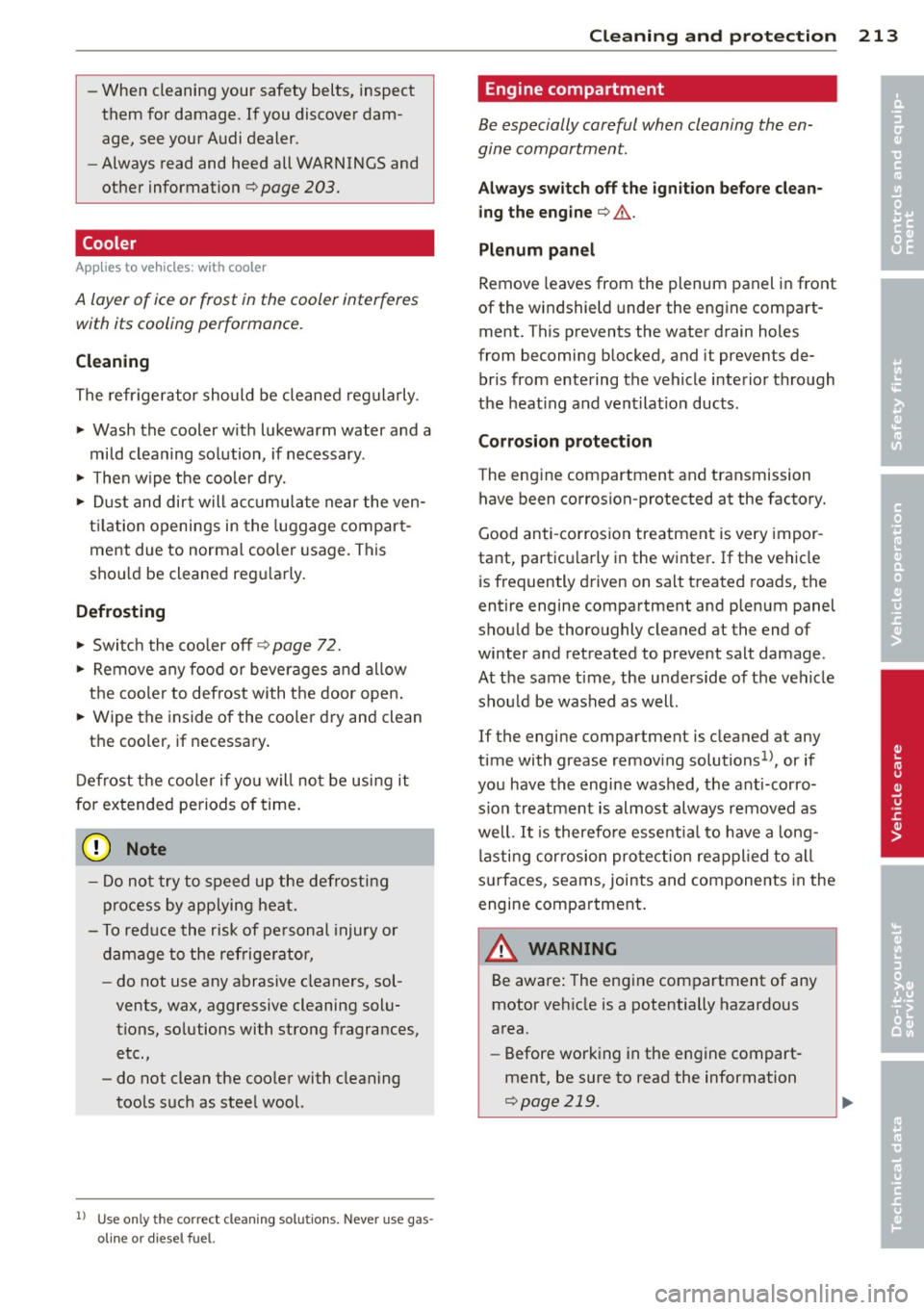
Cooler
Applies to veh icles: with coole r
A layer of ic e or frost in th e cool er interfer es
with its cooling performanc e.
Cleaning
The refr igerator sho uld be cleaned reg ula rly .
.,. Wash the cooler w ith lukewarm water a nd a
mild cleaning so lution, if necessary .
.,. The n w ipe the coole r dry.
.. Dust and dir t will acc umu late near the ven
t il ation openings in the luggage compar t
me nt due to normal coole r usage. This
sho uld be cleaned reg ularly.
Defrosting
.,. Switc h the coo ler off ¢ page 72.
.. Remove any food or beverages and al low
the coole r to defrost with the door open .
.. Wipe the inside of the coo ler dry and clean
the cooler , if necessary .
D efrost the cooler if yo u will no t be using it
for ex tended periods of time .
Q) Note
-Do no t try to speed up the defrosting
p rocess by applying heat.
- To red uce the risk of pe rsonal injury or
dam age to the refrige rator,
- do not use any abrasive cleaners, sol
vents, wax, aggressive cleaning solu
tions , so lutions with strong fragrances,
etc.,
- do not clean the coo ler with cleaning
tools such as stee l wool.
l ) U se o nly the co rr ec t cl ean in g so lu tio ns. Ne ve r use ga s
o line or d ie sel fuel.
Cleaning and protec tion 213
Engine compartment
Be especially careful when cleaning the en
gine compartment.
Always switch off the ignit ion before clean
ing the engine
¢ .& .
Plenum panel
Remove leaves from the plenum panel in front
of the windshield under the engin e compart
ment . This prevents the water drain holes
from becoming b locked , and it preve nts de
bris from entering the vehicle interio r through
the heat ing and ventilat ion ducts .
Corrosion protection
The eng in e compartm ent and transmission
have been corrosion-protected at the facto ry .
Good anti -corrosion treatment is very impor
tant , partic ularly in the w inte r.
If the vehicle
is frequently d riven on salt treated roads, th e
entire engine compartment and p lenum panel
shou ld be thoroughly cleaned at the end of
winter a nd retreated to p revent salt damage .
At the same time, the unde rside of the vehicle
shou ld be washed as well.
If the engine compar tment is cleaned at any
time with grease remov ing solutions
1> , or if
you have the engine washed, the ant i-corro
s io n treatment is almost always removed as
well.
It i s therefo re essentia l to have a long
lasti ng cor rosion pro tect ion rea pplied to all
s u rfaces , seams, joints and components in the
engine compartment .
A WARNING
Be aware: The engine com partment of any
motor veh icle is a potentially hazardous
area.
- Before work ing in the engine compart
ment, be sure to read the information
¢ page 219 .
•
•
Page 225 of 300

Only if the level of the oil is at or below the min imum mark -and no oil that expressly
conforms to Audi oil standard VW 502 00
specifications is available -may you top off
with a high quality engine oil, preferably syn
thetic -based, that meets ACEA A3 or API SM
specifications, but even then, only in viscosity
grades SAE SW-40, SAE SW-30, or SAE
OW-40. However, during the entire time be
tween oil change intervals, never top off with
more than a total of 0.5 qt/liter engine oil
that does not conform to Audi oil specification
vw 502 00.
For more information about engine oil that
has been approved for your vehicle, please
contact either your authorized Audi dealer or
Audi Customer Relations at 1 (800) 822-2834
or visit our web site at www.audiusa.com or
www.audicanada.ca. Here you will also find a current list of oils (manufacturers, brand
names etc .) that conform to Audi oil standard
vw 502 00.
Changing the engine oil
The engine oil and oil filter must be changed
according to the mileage (kilometers) and
time intervals specified in your vehicle's War ranty
& Maintenance booklet. Do not exceed
these intervals -harmful deposits from old
engine oil can reduce engine performance and
can lead to expensive engine repairs.
Changing the oil at the recommended inter
vals is so very important because the lubricat ing properties of oil decrease gradually during
normal vehicle use. If you are not sure when
you have your oil changed, ask your author ized Audi Service Advisor.
Under some circumstances the engine oil
should even be changed more frequently.
Change oil more often if you drive mostly
short distances, operate the vehicle in dusty
areas or mostly under stop-and-go traffic con
ditions, or when you use your vehicle where
temperatures stay below freezing point for
long periods.
Detergent additives in the oil will make fresh
oil look dark after the engine has been run-
Checking and filling 223
ning for a short time. This is normal and is not
a reason to change the oil more often than recommended.
Damage or malfunctions due to lack of
maintenance
It is essential that you change your oil at the
recommended intervals using only engine oil
that complies with Audi oil standard
VW 502 00. Your Limited New Vehicle War
ranty does not cover damage or malfunctions
due to failure to follow recommended mainte
nance and use requirements as set forth in
the Audi Owner's Manual and Warranty
&
Maintenance booklet . Your dealer will have to
deny warranty coverage unless you present to
the dealer proof in the form of Service or Re
pair Orders that all scheduled maintenance
was performed in a timely manner.
Engine oil consumption
The engine in your vehicle depends on an ade
quate amount of oil to lubricate and cool all
of its moving ports .
In order to provide effective lubrication and
cooling of internal engine components, all in
ternal combustion engines consume a certain
amount of oil. Oil consumption varies from
engine to engine and may change significantly
over the life of the engine. Typically, engines
with a specified break-in period (see
¢ page 194) consume more oil during the
break-in period than they consume after oil
consumption has stabilized.
Under normal conditions, the rate of oil con
sumption depends on the quality and viscosity
of the oil, the RPM (revolutions per minute) at
which the engine is operated, the ambient
temperature and road conditions. Further fac
tors are the amount of oil dilution from water
condensation or fuel residue and the oxida-
tion level of the oil. As any engine is subject to
wear as mileage builds up, the oil consump-
tion may increase over time until replacement
of worn components may become necessary. ..,.
•
•
Page 229 of 300
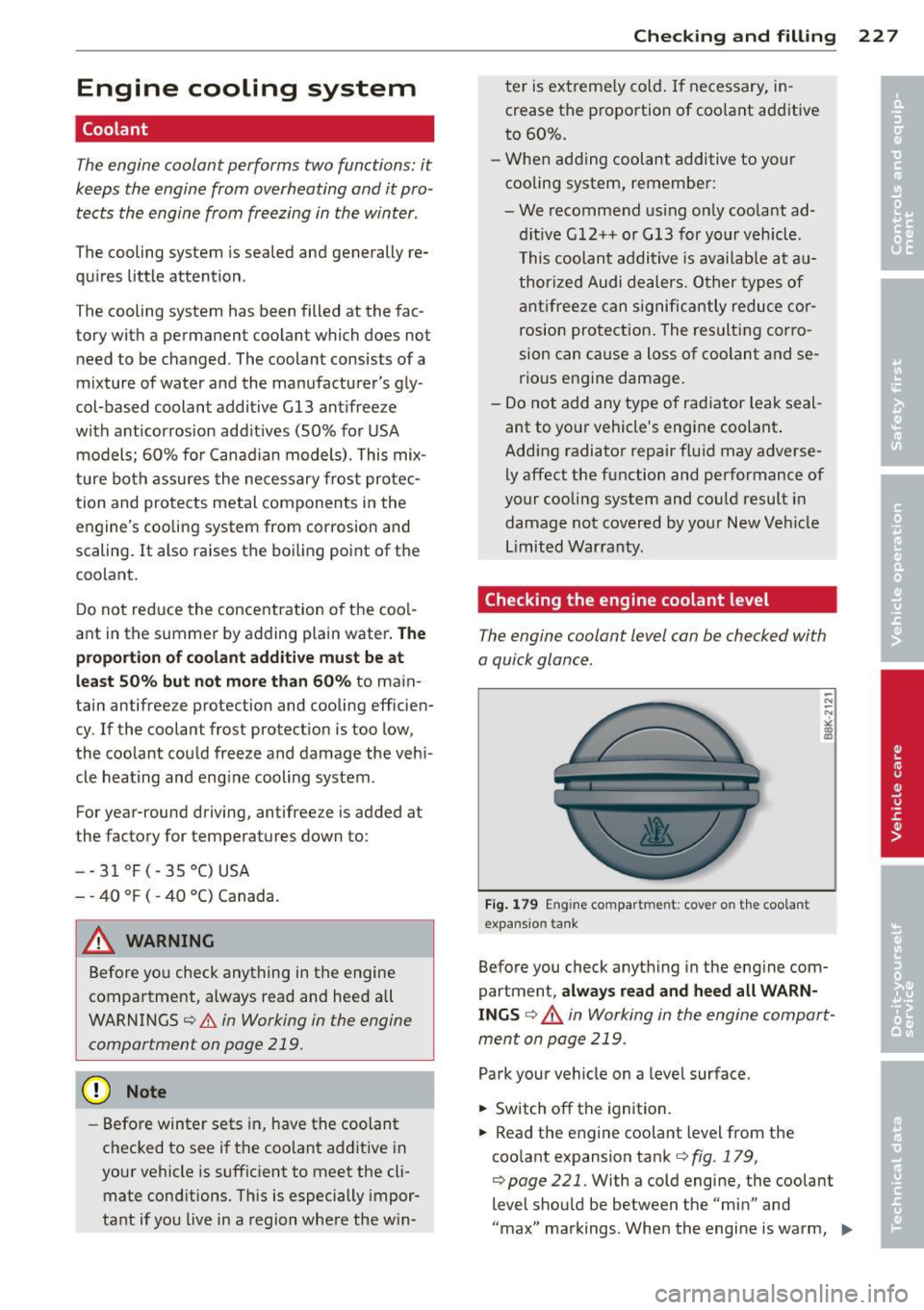
Engine cooling system
Coolant
The engine coolant performs two functions: it
keeps the engine from overheating and it pro
te cts the engine from freezing in the winter .
The cooling system is sealed and generally re
qu ires little attention .
The cooling system has been filled at the fac
tory with a permanent coolant which does not need to be changed. The coolant consists of a
mixture of water and the manufacturer's gly
col-based coolant additive G13 ant ifreeze
w ith anticorrosion add itives (SO% fo r USA
models; 60% for Canad ian models). This mix
ture bot h assu res the ne cessary frost protec
tion and protects metal components in the
engine's coo ling system from corrosion and
scaling. It also raises the boili ng po int of t he
coolant.
D o not red uce the concentration o f the coo l
ant in the summer by adding plain water .
The
proportion of coolant addit ive must be at
least 50% but not mo re than 60 %
to main
tain antifree ze protection and cooling efficien
cy. If the coolant frost protection is too low,
the coolant cou ld freeze and damage the veh i
cle heating and eng ine cooling system .
For year-round driving, antifree ze is added at
the factory for temperatures down to:
- -3 1°F (-3S°C)USA
- -40 ° F ( - 4 0 °C) Canada.
A WARNING
Before yo u check anything in the engine
compartment , always read and heed a ll
WARNINGS ¢
& in Working in the engine
compartment on page 219.
(D Note
- Befo re winter sets i n, have the coolant
chec ked to see i f th e coo lant ad dit ive i n
you r vehicle is suffic ient to meet the cli
mate cond itions . T hi s is especially impor
ta nt if yo u live in a regi on whe re the w in-
-
Checkin g and fillin g 22 7
ter is ex treme ly co ld. If necessary, i n
crease t he p ro po rtion of coo lant additive
to 60%.
- W hen a dding coolant additive to yo ur
cooling system , remembe r:
- We recommend us ing on ly coo la nt ad
di tive G 12++ or G 13 for your v ehicle .
T his co olan t ad ditive is av ailab le at au
t hor ized A udi dealers . O ther types of
an tifree ze can signi fican tly reduce cor
r osion pro te ction . The resulti ng cor ro
sion can ca use a loss of coolant a nd se
rious engine damage.
- Do not add any ty pe of rad iator leak seal
ant to you r vehicle's engine coo lant .
Add ing radiator repair flu id may adverse
ly affect t he fu nction and performance of
your cooling system and cou ld result in
damage not covered by yo ur New Ve hicle
L imited Warranty .
Checking the engine coolant level
The engine coolant level can be checked with
a quick glance.
Fig. 179 En gine co mpart ment: cover on t he coo la nt
expansio n ta nk
Before you check a nyth ing in the eng ine com
partment,
always read and heed all WARN
INGS <=>&.
in Working in the engine compart
ment on page 219 .
Park your vehicle on a level surface.
.., Switch off t he ignition.
.., Read t he engine coolant level from the
coo lant expansion tank¢
fig. 179,
¢ page 221 . With a cold engine, the coolant
level shou ld be between the "min" and
"ma x" markings . When the engi ne is warm, ..,.
Page 230 of 300

228 Checking and filling
the level may be slightly above the "max"
marking.
The location of the coolant expansion tank
can be seen in the engine compartment illus
tration
¢ page 221.
To obtain an accurate reading, the engine
must be switched off.
The expansion tank in your vehicle is equipped
with an electric coolant level sensor.
When the coolant level is too low, the warning light in the Auto-Check System¢
page 15 will
illuminate until you add coolant and the level
has been restored to normal. Even though
there is an electric coolant level sensor , we
still recommend you check the coolant level
from time to time.
Coolant loss
Coolant loss may indicate a leak in the cooling
system. In the event of coolant loss, the cool
ing system should be inspected immediately
by your authorized Audi dealer.
It is not
enough merely to add coolant.
In a
sealed system, losses can occur only if
the boiling point of the coolant is exceeded as
a result of overheating.
_& WARNING
The cooling system is under pressure and
can get very hot. Reduce the risk of scald
ing from hot coolant by following these
steps. -
- Turn off the engine and allow it to cool
down.
- Protect your face, hands and arms from
escaping fluid and steam by covering the
cap with a large, thick rag.
- Turn the cap slowly and very carefully in
a counter-clockwise direction while ap
plying light, downward pressure on the
top of the cap .
- To avoid being burned, do not spill anti freeze or coolant on the exhaust system
or hot engine parts. Under certain condi
tions, the ethylene glycol in engine cool
ant can catch fire .
(D Note
Do not add any type of radiator leak seal
ant to your vehicle's engine coolant. Add
ing radiator repair fluid may adversely af
fect the function and performance of your
cooling system and could result in damage not covered by your New Vehicle Limited
Warranty .
Adding coolant
Be very careful when adding engine coolant.
Before you check anything in the engine com
partment,
always read and heed all WARN
INGS ¢&. in Working in the engine compart
ment on page 219.
.. Turn off the engine .
.. Let the engine cool down.
.. Place a thick rag over the coolant expansion
tank
¢ page 227, fig . 179 and carefully
twist the cap counter-clockwise ¢,&. .
.,. Add coolant.
.. Twist the cap on again
tightly.
Replacement engine coolant must conform to
exact specifications
¢ page 22 7, Coolant. We
recommend using only coolant additive G12+
+, G3 or in an emergency G12+ . Do
not use a
different additive. In an emergency use plain
water until you can get the correct additive
and can restore the correct ratio. This should
be done as soon as possible .
If you have lost a considerable amount of
coolant , then you should add cold antifreeze
and cold water only when the engine is cold.
Always use
new engine coolant when refilling.
Do not fill coolant above the
"MAX" mark . Ex
cess coolant will be forced out through the
pressure relief valve in the cap when the en
gine becomes hot.
_& WARNING
-= -- The cooling system is under pressure and
can get very hot. Reduce the risk of ..,_
Page 289 of 300
Convertible locking retractor .... .. .. . 17 5
How do I prop erly install a child safety
seat in my vehicle? ....... ... .. .. .. .
169
Infant seats . . . . . . . . . . . . . . . . . . . . . . 171
Instal ling .. ............. .... .. ... 175
Instal ling a child restraint us ing the
L A T C H system .... .. ... ... .. .. .. .. .
18 1
LATCH system ................... .. 181
Lower ancho rages ........ .. .. .. .. . 179
M ounti ng and releas ing the anchorage
hook . ..... .. .. ... ..... ... .. .. ...
181
Safety instructions ..... ... .. .. .. .. . 169
C leaning and protection .............. 203
Alcantara (synthet ic suede) . .. .. .. .. . 2 12
Cooler . .. .. .... ........... .. .. ... 213
Eng ine compartment ... ... .. .. .. .. . 213
Exhaust tail p ipes . ..... ... .. .. .. .. . 209
Fabrics and fabric coverings . ... .. .. . 209
Instrument panel .................. 210
Interior .......................... 209
Leather . . . . . . . . . . . . . . . . . . . . . . . . . . 211
MMI disp lay/controls ............. .. 209
Plastic and v inyl .... ... ... .. .. .. .. . 206
Plastic pa rts ...................... 210
Safety belts . . . . . . . . . . . . . . . . . . . . . . 2 12
tr im str ips . ............. .... .. ... 207
Trim str ips .... .. ..... ... .. .. .. ... 20 6
Climate controls ............ ...... ... 75
C lock ... .... .. .. .. .. .... .. . .. .. .. .. 25
C losing
Panor amic su nroof ........ .. .. .. .. ..
4 1
Sliding/ tilting sun roof .. ... .. .. .. .. .. 4 0
Sun shade (panoramic sunroof) ... .. .. 42
Cold ti re i nflat ion p ressu re ... .. .. .. .. .
239
Coming home ............. .... .. .... 45
Compact spare tire . ..... ... .. .. .. .. .
258
Compartments ................... ... 7 1
Compass in the mirro r ... ... .. .. .. .. .. 52
Comp lian ce .. ............. .... .. ... 283
Consumer Information . . . . . . . . . . 132, 280
Consumption (fue l) . . . . . . . . . . . . . . . . . . 24
Contact ing N HTSA ................ ..
132
Conven ience key ........... .... .. .... 32
Starting the engine ................. 80
Stopping the engine (START ENGINE
STOP button) ......................
81 Inde
x 287
Switching the ignition on .... ... .. .. . 80
U nl ocking and locking vehicle . ... .. .. . 32
Conve rtib le child safety seats ......... 172
Convertible locking retractor
Activati ng ........................
177
Deact ivating ...... ........... ..... 178
U sing to secure a child safety seat 1.75, 17 7
Coolant
refer to Eng ine coolant ............. 227
Cooler ... .. .. .... ... .. .. ..... ... .. . 72
Cleaning . ... .... .. . .. .. ..... ... .. 213
Operation . . . . . . . . . . . . . . . . . . . . . . . . . 72
Cooling mode (automa tic climate cont rol) 76
Cornering light .. .. ................. 103
C ruise cont ro l
Changing speed .... . .. ..... ... .. .. .
85
Presetting your speed .. ..... ... .. .. . 86
Switch ing off .. .. ............... .. . 86
Switching on . .. .. ................. . 85
Cu pholder . . . . . . . . . . . . . . . . . . . . . . . . . . 71
D
Data .............................. 278
Data recorder . . . . . . . . . . . . . . . . . . . . . . 187
Date disp lay . ..... ... .. .. ..... ... .. . 25
Daytime runn ing lights .............. .. 43
Declarat ion of compliance
Adaptive cruise control .............
283
Audi side ass ist .............. .... . 283
Cell phone package . . . . . . . . . . . . . . . . 283
Convenience key .................. . 283
Electronic immob ilizer .......... .. .. 2 83
Homel in k® uni versal remote control .. 283
Remote con tro l key ... ...... ... .. .. 283
DEF
What does this mean when it appears in
t h e tr ip odometer display? ...........
25
Defective light bulb warning ........... 21
Defrosting (windows) .. .. ..... ... .. .. . 77
Del uxe a utomat ic cl imate control .. .. .. . 76
Determ ining correct load limit ........ 243
Digi tal compass . . . . . . . . . . . . . . . . . . . . .
52
Dimens ions ... .. .. .. . .. .... ...... .. 277
Dimming the rearview mirror .. ... .. .. . 51
Dista nce . .. .. .. .. .. ............... . 24
Door/rear lid warning ............ .. .. .
23
•
•
Page 298 of 300
296 Index
Weights ...... .. .......... .. .. .... . 276
What happens if you wear your safety belt
too loose? ........................ . 138
What happens to unbelted occupants? .. 135
What impairs driving safety? ... ... ... . 125
What should I do after changing a
wheel? .. .... .. .. ...... .... ... .. .. . 242
What should
I do after rep lacing wheels? 242
Wheel bolts Torqu e ..... ... .......... .. .. .... . 252
Wheels ... .. ............ ... .. .. ... 235
Cast alloy ... .............. .. .. .. . 208
Checking tire pressure ......... .... . 241
Cold tire inflat ion pressu re ..... .. .. . 239
General notes .. .......... .. .. .... . 235
Glossary of tire and loading termino lo-
gy .. . ... ... .. .......... .. .. .... . 236
New tires and wheels ...... .. .. .... . 246
Tires and vehicle load lim its .. .. ..... 243
When must a safety belt be replaced? .. 137
When must the airbag system be inspect-
ed? ... .. .. .. .. .. .... ... .. .. .. .. .. . 153
When should I ad just the tire pressures? 242
When should I check the tire pressures? . 242
Where are lower anchorages located? .. . 179
Wh ere can I find the tire pressu res for my
car? .... .......................... 241
Why safety belts? . . . . . . . . . . . . . . 134, 135
Windows Cleani ng ... ... .. .. ... ... ... ... .. . 207
defrosting ...... ...... ..... .. .. .. .. 77
Windshield Cleaning ... ....................... 48
defrosting .. .. .. ........ .... ... .. .. 77
Windshield washer system . ... .... .. . . 48
Washer fluid level . . . . . . . . . . . . . . . . . . 21
Washer reservoir ........... .. .. .. . 234
Windsh ield wipers
Folding up .... ........ .. .. .. .... .. 50
Indicator light ......... .. .. .. .... .. 21
Replacing windshie ld w iper blades ... .. 50
Switching on/off ............. ...... 48
Winter operation Batt ery ..... .. .......... .. .. .... . 230
Cooling system . ........ .. .. .. .... . 227
Defrosting windows . . . . . . . . . . . . . . . . . 77
Seat heating . . . . . . . . . . . . . . . . . . . . . . . 77 Steering
wheel heating ......... .. .. . 78
Tires ... .. .... .. .. ... ........ .. .. 191
Windows ..... .. .. ... ........ .. .. 207
W inter t ires ... .. .. ............. .. .. 250
All-wheel drive .................... 250
X
Xenon-Lights .... ............... .... 269
Xenon plus headlights ................ 43