engine oil AUDI A8 2012 User Guide
[x] Cancel search | Manufacturer: AUDI, Model Year: 2012, Model line: A8, Model: AUDI A8 2012Pages: 300, PDF Size: 75.06 MB
Page 197 of 300
Catalytic converter
It is very important that your emission control system (catalytic converter) is function
ing properly to ensure that your vehicle is run
ning in an environmentally sound manner .
.. Always use lead-free gasoline¢ page 215,
Fuel supply.
.,. Never run the tank down all the way to
empty.
.,. Never put too much motor oil in your en-
gine
¢ page 225, Adding engine oil~-
.,. Never try to push- or tow-start your veh icle.
The catalytic converter is an eff icient "clean
up" device built into the exhaust system of
the vehicle . The catalytic converter burns
many of the pollutants in the exhaust gas be
fore they are released into the atmosphere.
The exclusive use of unleaded fuel is critically
importa nt for the life of the cata lytic convert
e r and proper functioning of the engine.
A WARNING
-
- Do not park or operate the vehicle in
areas where the hot exhaust system may
come in contact with dry grass, brush,
fuel spill or other material which can cause a fire.
- Do not apply additional undercoating or
rustproofing on or near the exhaust
man ifold, exhaust pipes, catalytic con
verter or heat shields. During driving, the
substance used for undercoating cou ld
overheat and cause a fire.
0 Note
- Be aware that just one tank filling with
leaded fuel will already seriously de
grade the performance of the catalytic
converter.
- Do not exceed the correct engine oil level
¢ page 225.
-Do not drive until the fuel tank becomes
completely empty. The eng ine could mis
fire . U nburned fuel could a lso get i nto
Dri vin g and en vironm ent 195
the exhaust system and this cou ld cause
the catalytic converter to overheat .
- Do not switch off the ignit ion while the
vehicle is mov ing.
- Do not continue to ope rate your veh icle
unde r these conditions, as othe rwise fuel
can reach the catalytic converter. This
co uld result in overheating of the con
verter, requir ing its replacement .
- To assure efficient operation of the Emis
sion Control System:
- H ave your vehicle maintained prope rly
and in accordance w ith the se rv ice rec
ommendat ions in you r Warranty &
M aintenance boo klet.
- L ack of prope r maintenance as we ll as
improper use of the vehi cle w il l impair
the function of the em ission contro l
system and could lead to damage .
@ For the sake of the environment
Even when the Emiss ion Control System is
operat ing properly, the exha ust gas can
have a sul fur -li ke exhaust gas smell under
some operating states . This depends on
the sulfur content of the fuel being used .
Using a different brand of fue l may help,
or filling the tank with lead-free super
grade gasoline .
Avoid damaging the
vehicle
When you are drivi ng on poo r roads, or over
c ur bs, s teep ramps, etc., ma ke certai n that
low -lying parts s uch as spoilers and exhaust
system pa rts do not bottom o ut and get dam
aged.
T h is is espec ially true for veh icles w ith low
s lung chassis (spor ts chassis)* and fully load
ed vehicles. •
•
Page 199 of 300
Avoid full throttle
Driving at moderate speeds saves fuel and
improves your mileage.
"" Try and keep well below your car's maxi-
mum speed.
Accelerating gently reduces fuel consump tion, engine wear, and does not disturb the
environment.
F ue l consumption, exhaust emissions and en
g ine noise increase disproportionately at high
speeds. If you drive at approximately three
quarters of top speed, fuel consumption will be reduced by one half. Never drive faster
than the posted speed limit and weather con
d itions permit .
Reducing unnecessary idling
Even when your car is just idling it burns up
fuel.
"" Shut the engine off when you are not driv
ing the vehicle.
"" Do not warm up the veh icle by letting the
engine run at idle .
It makes sense to shut
off the engine in traff ic
jams, when waiting for trains to pass at ra il
road crossings, or at traffic lights that have
l ong wa its on red. Turning the engine
off fo r
just
30-40 seconds saves more fue l than is
bu rned starting the eng ine again .
It takes a long time for the engine to warm up
fu lly when it is running at idle. However, wear
and nox ious em issions are especially high
when the engine is warming up. So you should
drive away as soon as you start the engine and
avoid running at high rpms while the engine is
still warming up .
(D Note
Do not leave engine idling unattended af
ter starting . If warning lights should come
on to indicate improper operation, they
wou ld go unheeded. Extended idling also
produces heat, which cou ld result in over-
Dri vin g and en vironm ent 197
'
heating o r othe r damage to the veh icle or
other p roperty .
Regular maintenance
A badly tuned engine unnecessarily wastes a
lot of fuel.
"" Have your veh icle serviced at reg ular i nter-
vals.
By having your veh icle regu la rly serviced by an
Audi dealer he lps to ensu re that it runs prop
erly and economically. The condition of your
vehicle not only affects its sa fety and ability to
hold its value, it a lso affects
fuel con sump
tion .
Check your oil e ach t ime you fill your tank .
The amount of o il used is re lated to eng ine
load and speed .
It is normal for the oil consumption of a new
engine to reach its lowest value after a certa in
mileage has been driven .
You must drive your veh icle about 3,000 m iles
(5,000 kilometers) before you can properly
assess oil consumpt ion.
This also app lies to fue l consumption and en
gine output.
(U) Note
- Have your vehicle maintained properly
and in accordance with the service rec
ommendations in your Warranty
& Ma in
tenance booklet . Lack of proper mainte
nance as well as improper use of the ve
hicle will impair the function of the
em iss io n cont ro l system and cou ld lead
to damage.
- Do not alter or remove any component of
the Emission Control Sys tem unless ap
proved by the manufacture r.
- Do not alter or remove any device, such
as heat shie lds, swit ches, ign it ion w ires,
valves, which are designed to p rotec t
your vehicle's Emission Control System
and other important vehicle compo
nents .
•
•
Page 206 of 300
204 Cleaning and protec tio n
Automatic car wash
The vehicle can be washed in almost any
modern automatic car wash .
The vehicle paint is so durable that the vehicle
can normally be washed without problems in
an automatic car wash. However, the effect on
the paint depends to a large extent on the de
sign of the facility, the filte ring of the wash
water, the type of wash and care mater ial , etc.
I f the pa int has a dull appearance afte r going
through the car wash or is scratched, bring
this to the attention of the operator immedi
ately. If necessary, use a different car wash.
Before going through a car wash, be sure to
take the usual precautions such as closing the
windows and power roof . Factory installed an
tennas must not be removed.
I f you have installed additional accessor ies on
the vehicle - such as spoilers, roof rack, etc. -
it is best to ask the car wash operator if these
should be removed .
When driving through an automatic car wash,
fi rst se lect the N position and then switch the
engine off. If you switch the engine off when N is engaged, the transmission remains in N
for approximately 30 m inutes and then Pis
engaged.
Further information for automatic gearboxes
~ page 109.
A WARNING
Always read and heed all WARNINGS and
other information
r:::;, page 203.
- Fo ld the exterior mirrors - flat there is a
risk of damaging the exterior mirrors .
Power folding exterior m irrors must not
be folded in or out by hand. Use the pow
er function!
- Compare the track of your vehicle with
the d istance between the guide rails of
the facility - there is a risk of damage to
the wheels and tires . - Compa
re the height and width of your
vehicle with the height and width of the t u nnel at the facility .
· Washing the vehicle by hand
A lot of water is needed when washing a vehi
cle by hand.
.,. Before yo u start wash ing, make su re you
have read and understood the WARNINGS
r:::;, A in General information on page 203.
.,. First soak a ll dried dirt unt il it is soft , then
rinse it off.
.,. As you clean your vehicle, start with the
roof and work your way down to the bottom,
using a sponge, a sponge glove or a clean brush .
.,. Rinse the sponge or the sponge g love often,
flushing it clean eac h time.
.,. Use spec ial car shampoo only for very per
sistent di rt.
.,. Rinse the car thoroughly w ith water.
.,. Use a chamois leather to gently w ipe the ex-
terior dry.
Use a separate sponge for cleaning the
whee ls , door si lls and other regions exposed
to road dirt. In this way, you will not scratch
the pa int with coarse particles imbedded in
the sponge the next time you wash the car.
A WARNING
- Do not clean the underside of the chas
sis, fenders, wheel covers, or other hard
to reach parts without protect ing you r
hands and arms. You may cut yourself on
sha rp-edged metal parts .
- Always read and heed all WARNINGS and
other info rmation
c;, page 203.
(D Note
- Never try to remove dirt, mud or dust if
the surface of the veh icle is dry. Never
use a d ry cloth or sponge, s in ce this
co uld scratch your vehicle's paint or win -
-
dows. .,.
Page 222 of 300
220 Check ing and filling
- Never smoke or work near heaters or
open flames. Fluids in the engine com
partment could start a fire.
- Keep an approved fire extinguisher im
mediately available.
- To avoid electrical shock and persona l in
jury while the engine is running or being
started, never touch:
- Ignition cables
- Other components of the high voltage
electronic ignition system.
- If you must perform a check or repa ir
with the engine running:
- First, fully apply the parking brake,
move selector lever to "P" (Park) .
- Always use extreme caution to prevent
clot hing, jewe lry, or long hair from get
ting caught in the radiator fan, V-belts
or other moving parts, or from contact ing hot parts. Tie back hair before
start ing, and do not wear cloth ing that
will hang or d roop into the eng ine.
- Min imize exposure to emission and
chem ica l hazards c:> &. .
A WARNING
California Propos ition 65 Warning:
- Engine exhaust, some of its constituents,
and certa in veh icle compone nts co nta in
o r emit chemicals known to the State of
Californ ia to cause cancer and b irth de
fects a nd rep roduct ive ha rm. In addition,
c ertain f luids con ta ine d in vehicles and
c ertain pro ducts of component wear co n
tain or emi t chemicals known to the
State of California to cause cancer and
birth defects or other reproductive harm.
- Battery posts, terminals and re lated ac
cessories contain lead and lead com- pounds, chemica
ls known to the State of
California to cause cancer and reproduc
tive harms. Wash hands after handling.
(D Note
When adding f luids, always make su re that
they are poured into the proper conta iner
or f iller opening, otherwise serious dam
age to vehicle systems w ill occur.
® For the sake of the environment
To detect lea ks in time, inspect the vehicle
floor pan from underneath regularly. If
you see spots from oil or other veh icle flu
i ds, have you r vehicle inspected by a n au
thorized Audi dealer.
Closing the engine hood
.. Pull the hood down until the pressure from
the struts is reduced.
.. Let the hood
drop down an d latc h in place.
Do not try to push it shut; it may fail to en
gage 9 /]}. .
A WARNING ,_ -
A hood that is not completely latched
could fly up and b lock your view while dr iv
i ng.
- When you close the engine hood, check it to make sure the safety catch has properly engaged. The hood shou ld be flush
wit h the surrou nding vehicle body pa rts .
- If you notice while driv ing that the hood
is not secured properly, stop at once and
close it.
Page 224 of 300

222 Check ing and filling
(D Windshield/headlight washer
t . (
PP. ) con ainer ""' .......... ... . 234
@ Jump start point( -) with hex
head screw . .. .......... ... . 233 , 270
@ Jump start point( +) under a cov-
er . ..... .............. ... . 233, 270
© Eng ine oil filler cap(~) . . . . . 225
® Brake fluid reservo ir ((0)) . . . . . 229
® Coolant expansion tank (-L) . . . 227
0 Power steering reservoir . . . . . . 191
@ Oil dipstick . . . . . . . . . . . . . . . . . 225
The engine oil filler neck (item@) may be lo
cated in a different area depend ing on the ver
sion of the engine .
& WARNING
Before you check anything in the engine
compartment, always read and heed all
WARNINGS¢ .&.
in Working in the engine
compartment on page 219.
Engine oil
Engine oil specifications
The engine oil used in your Audi needs the
right kind of oil.
-
The engine in your Audi is a sophisticated
powerp lant that was built to exacting specifi
cations . This engine needs the r ight kind of
engine o il that meets spec ificat ions regarding
qua lity and viscos ity so that it can run
smoothly and reliably . Choos ing the righ t oi l
and changing oil within the time and mileage
interva ls printed in your vehicle 's Warranty
&
Maintenance book let matters a lot more to
day than it did years ago. Audi has developed
a special quality standard for engine oil that
will help assure that your veh icle's eng ine will
get the lubrication it needs for proper opera
tion.
Modern engine lubrication has taken a quan
tum leap in the last few years. Many synthetic
oils ava ilable today provide better engine lu
brication that can outlast trad itional petrole -u
m -based oils, making them a smart choice
for use throughout the life of your Audi.
Whether you use synthet ic o r petro le um
based eng ine oil, the oi l that you use m ust
conform to Audi's oi l quality standard
VW 502 00 to help keep your vehicle's engine runn ing smooth ly and help prevent the for
mation of harmfu l deposits, sometimes called
"sludge," that over time can lead to expensive
repairs.
At the time of printing, engine oils ava ilable in
the U.S. and Canada that meet the exacting
specifications of Audi oil standard VW 502 00
are synthet ic eng ine oils . Th is does not mean,
howeve r, that every synthetic engine oil will
meet Audi o il standard VW 502 00 . So always
be su re that you use an approved oil.
To help prevent the formation of harmfu l de
pos its use only o il w ith the following specifi
cations pr inted on the o il conta iner:
Audi oil standard VW 502 00
Oil container labels may carry the specifica
tion sing ly or in combination with other desig
nations and oil quality standards.
V is cos ity
Engine o ils are graded a ccord ing to their vis
cosity . The proper vis cos ity grade oil fo r yo ur
engine depends on climactic or seasona l con
ditions where you drive. You can use oil with a
viscosity grade of SAE 5W40 across a ll tem
perature ranges for norma l driving conditions.
However, if engine oil v iscosity g rade SA E
SW40 is not available , you can also use viscos
ity grade SAE SW-30 or SAE OW-40 as long as
it meets Audi oil qua lity standard VW 502 00
specifications.
Beca use engine oi l that meets the Audi oil
standard may not be availab le everywhere
when you need it, we strong ly recommend
that you a lways carry with you an extra quart
( li ter) of oil that express ly conforms to the
VW 502 00 spec ificat ion, in case you have to
top off the o il while o n the road . ..,_
Page 225 of 300

Only if the level of the oil is at or below the min imum mark -and no oil that expressly
conforms to Audi oil standard VW 502 00
specifications is available -may you top off
with a high quality engine oil, preferably syn
thetic -based, that meets ACEA A3 or API SM
specifications, but even then, only in viscosity
grades SAE SW-40, SAE SW-30, or SAE
OW-40. However, during the entire time be
tween oil change intervals, never top off with
more than a total of 0.5 qt/liter engine oil
that does not conform to Audi oil specification
vw 502 00.
For more information about engine oil that
has been approved for your vehicle, please
contact either your authorized Audi dealer or
Audi Customer Relations at 1 (800) 822-2834
or visit our web site at www.audiusa.com or
www.audicanada.ca. Here you will also find a current list of oils (manufacturers, brand
names etc .) that conform to Audi oil standard
vw 502 00.
Changing the engine oil
The engine oil and oil filter must be changed
according to the mileage (kilometers) and
time intervals specified in your vehicle's War ranty
& Maintenance booklet. Do not exceed
these intervals -harmful deposits from old
engine oil can reduce engine performance and
can lead to expensive engine repairs.
Changing the oil at the recommended inter
vals is so very important because the lubricat ing properties of oil decrease gradually during
normal vehicle use. If you are not sure when
you have your oil changed, ask your author ized Audi Service Advisor.
Under some circumstances the engine oil
should even be changed more frequently.
Change oil more often if you drive mostly
short distances, operate the vehicle in dusty
areas or mostly under stop-and-go traffic con
ditions, or when you use your vehicle where
temperatures stay below freezing point for
long periods.
Detergent additives in the oil will make fresh
oil look dark after the engine has been run-
Checking and filling 223
ning for a short time. This is normal and is not
a reason to change the oil more often than recommended.
Damage or malfunctions due to lack of
maintenance
It is essential that you change your oil at the
recommended intervals using only engine oil
that complies with Audi oil standard
VW 502 00. Your Limited New Vehicle War
ranty does not cover damage or malfunctions
due to failure to follow recommended mainte
nance and use requirements as set forth in
the Audi Owner's Manual and Warranty
&
Maintenance booklet . Your dealer will have to
deny warranty coverage unless you present to
the dealer proof in the form of Service or Re
pair Orders that all scheduled maintenance
was performed in a timely manner.
Engine oil consumption
The engine in your vehicle depends on an ade
quate amount of oil to lubricate and cool all
of its moving ports .
In order to provide effective lubrication and
cooling of internal engine components, all in
ternal combustion engines consume a certain
amount of oil. Oil consumption varies from
engine to engine and may change significantly
over the life of the engine. Typically, engines
with a specified break-in period (see
¢ page 194) consume more oil during the
break-in period than they consume after oil
consumption has stabilized.
Under normal conditions, the rate of oil con
sumption depends on the quality and viscosity
of the oil, the RPM (revolutions per minute) at
which the engine is operated, the ambient
temperature and road conditions. Further fac
tors are the amount of oil dilution from water
condensation or fuel residue and the oxida-
tion level of the oil. As any engine is subject to
wear as mileage builds up, the oil consump-
tion may increase over time until replacement
of worn components may become necessary. ..,.
•
•
Page 226 of 300

224 Check ing and filling
With all these variab les coming in to p lay, no
standard rate of oil consumption can b e es
tablished or specif ied. There is no alternative
to regular and frequent checking of the oi l lev
el, see
Note .
If the ye llow engin e oi l level warning symbol
in the instrument cluster
1\1 li ghts up, you
should check the o il level as soon as possible
¢
page 224 or ¢ page 225. Top off the oil at
your earliest convenience¢
page 225.
A WARNING
Before yo u check anything in the engine
compartment, always read and heed all
WARN INGS
¢ .&. in Working in the engine
compartment on page
219.
(D Note
Dr iving with an insuffic ient oi l level is like
ly to ca use seve re damage to the eng ine .
{D) Tips
-The oil pressure warning display. is
not an indicator of the oil lev el. Do not
r ely on it . Instead, check the oil level in
your engine at regular intervals, pref
erably ea ch time you refuel , and always
befor e going on a long trip .
-If yo u have the impres sion you r engine
consumes excessive amo unts o f oi l, we
r ecommend that yo u consult your Audi
dealer to have the ca use of yo ur concern
properly diagnosed . Keep in mind that
the accurate measurement of oil con
sumption requires great care and may
take some time . Your Audi dealer has in
str uctions about how to measure oil con
sumption accurate ly .
Checking the engine oil level
Applies to veh icles: w ith oil level indicator
Fig. 17 6 Display : o il leve l in dicator
.,. Par k yo ur vehicle on a level surface.
.,. Shut the eng in e off when it is warm.
.,. Switch on ly the ignition back on .
.,. Wait approx imately two minutes.
.,. Select:
!CAR ! function button> Car systems
contro l butto n > Servicing & che cks > Oil
level.
.,. Check the oil level i n the display ¢ fig. 176.
Add eng ine o il if the bar o f th e oil leve l ind i
cato r is near "min"¢
page 225.
Depend ing on the way the vehicle is dr iven
and t he ope ra ti ng cond it ions, oi l consu mption
can be up to 1/ 2 quart pe r 600 miles (0 .S liter
per 1,000 km) . Consumption may be hig her
within the first 3,000 miles (S ,000 km) .
(D Tips
The oil leve l indic ato r in t he MMI Disp lay is
on ly an information display.
If the oi l level
i s low, a minimum oil war ning appea rs in
the instr ument cluster. Add oil
¢
page 225. If the hood has been opened,
the cur rent oil level is shown in t he instru
ment cluster the next t ime the ignition is
swi tched on.
Page 227 of 300
Checking the engine oil level
App lies to vehicles: with o il dipstick
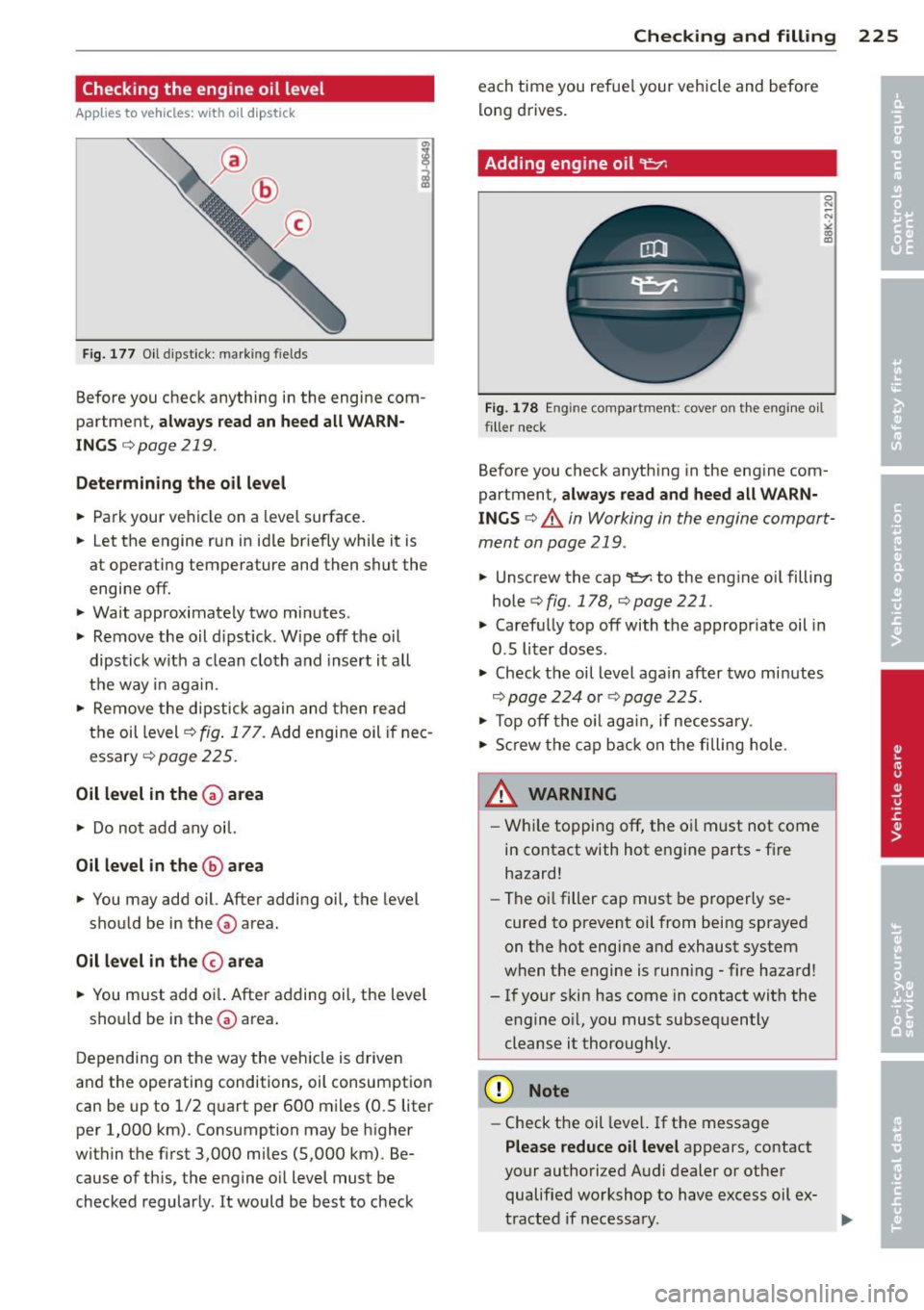
Fig. 177 Oil dips tick: mark ing fields
Before you check anything in the engine com
partment,
always read an heed all WARN
INGS
r=> poge 219.
Determining the oil level
• Park your vehicle on a leve l surface.
• let the engine run in idle briefly while it is
at operating temperature and then shut the
engine off.
• Wait approximately two minutes.
• Remove the oil d ipst ick . Wipe off the oil
dipstick with a clean cloth and insert it all
the way in aga in .
• Remove the dipstick again and then read
the oil level
r=> fig. 177. Add engine oil if nec
essa ry
r=> page 225.
Oil level in the G) area
• Do not add any oil.
Oil level in the @area
• You may add oil. After adding oil, the level
should be in the
G) area.
Oil level in the 0 area
• You must add oi l. After adding oil, the leve l
shou ld be in the
G) area .
Depending on the way the vehicle is driven
and the operating conditions, oil consumption
can be up to 1/2 quart per 600 miles (0.5 liter
per 1,000 km). Consumption may be higher
within the f irst 3,000 miles (5,000 km) . Be
cause of this, the engine oil level must be
checked regularly . It would be best to check
Checking and filling 225
each time you refue l your vehicle and before
long drives .
Adding engine oil~
Fig. 178 Eng ine co mpa rtment: cove r on th e engi ne oi l
filler neck
Before you check anyth ing in the engine com
partment,
always read and heed all WARN
INGS
r=> A in Working in the engine comport
ment on page 219 .
• Unscrew the cap "l!:;r; to the engine oil filling
hole
r=> fig. 178, r=> page 221.
• Carefully top off with the appropr iate oil in
0 .5 liter doses .
• Check the oil level aga in after two minutes
,:;> page 224 or r=> page 225.
• To p off the oil again, if necessary.
• Sc rew the cap back on the filling hole .
8_ WARNING
-While topping off, the oi l must not come
in contact with hot engine parts -fire
hazard!
- The oi l filler cap must be properly se
cured to prevent oil from being sprayed
on the hot engine and exhaust system
when the engine is running -fire hazard!
- If your skin has come in contact with the
engine oil, you must subsequently
cleanse it thoroughly.
(D Note
- Check the oil leve l. If the message
Please reduce oil level appears, contact
your authorized Audi dealer or other
qualified workshop to have excess oil ex-
tracted if necessary .
IJJJ,
Page 228 of 300

226 Check ing and filling
- Audi d oes not recommend th e use of oil
a dd itiv es. T he y ma y damage the e ngine
and ad ve rs ely affect you r New Vehicle
Wa rrant y.
@ For the sake of the environment
- Under no circumstances can the oil come
in contact with the sewage network or
the soil.
- Observe and fo llow lega l regu lations
when disposing of empty oil containers.
Changing the engine oil
We recommend thot have your oil changed by
an authorized Audi dealer or a qualified serv
ice station.
Before you check anything in the engine com
partment,
a lw ays r ea d and heed all WARN
I NG S
¢ & in Working in the engine compart
ment on page 219.
The engine oil must be changed according to
the intervals specified in your Warranty
&
Maintenance book let. This is very important
because the lubricating properties of oil di
minish gradually dur ing normal veh icle use .
Under some circ umstances the engine oi l
should be changed more frequently . Change
oil more often if you drive mostly short dis
tances, operate the vehicle in dusty areas or under predominantly stop-and -go traffic con
d itions, or have your veh icle where tempera
tures remain below freez ing fo r extended pe
r iods.
Detergent addit ives in the o il w ill make fresh
oil look dark after the eng ine has been run
n ing fo r a short time. This is norma l and is not
a reason to change the oil mo re often than
recommended.
Because of the problem of proper disposal ,
a long w ith the special tools and necessary ex
pe rtise requi red, we strong ly recommend that
you have yo ur o il changed by an authorized
Audi deal er or a qualified service station.
If yo u choo se to ch ange your oil yours elf ,
please note the fo llowing important informa
t ion:
A WARNING "--
To reduce the risk of personal injury if you
must change the eng ine oil in your vehicle
yourself:
- Wear eye protect ion.
- To reduce the risk of burns from hot en-
g ine oil, let the engine cool down to the
touch.
- When removing the oil dra in p lug with
your fingers, stay as far away as possible.
Always keep your forearm parallel to the ground to help prevent hot oil from runn ing down your arm.
- Dra in the oil into a container designed
for this purpose, one large enough to hold at least the tota l amount of o il in
your engine.
- Engine oil is poisonous . Keep it wel l out
of the reach of children.
- Continuous contact with used eng ine o il
is harmful to your sk in . Always protect
your skin by washing oil off tho roughly
wit h soap and wate r.
(D Note
Neve r mix oil additives with your engine
oil. These additives can damage your en
gine and adversely affect your Audi Limit
ed New Veh icle War ranty.
@ For the sake of the environment
- Before changi ng your oil, first make sure
you know where you can prope rly dispose
of the used oil.
- Always dispose of used eng ine oi l proper
ly. Do not dump it on garden soil, wood
ed areas, into open streams o r down
sewage drains.
- Recycle used engine oil by taking it to a
used eng ine oil collect ion fac ility in you r
area, or contact a service station.
Page 229 of 300
Engine cooling system
Coolant
The engine coolant performs two functions: it
keeps the engine from overheating and it pro
te cts the engine from freezing in the winter .
The cooling system is sealed and generally re
qu ires little attention .
The cooling system has been filled at the fac
tory with a permanent coolant which does not need to be changed. The coolant consists of a
mixture of water and the manufacturer's gly
col-based coolant additive G13 ant ifreeze
w ith anticorrosion add itives (SO% fo r USA
models; 60% for Canad ian models). This mix
ture bot h assu res the ne cessary frost protec
tion and protects metal components in the
engine's coo ling system from corrosion and
scaling. It also raises the boili ng po int of t he
coolant.
D o not red uce the concentration o f the coo l
ant in the summer by adding plain water .
The
proportion of coolant addit ive must be at
least 50% but not mo re than 60 %
to main
tain antifree ze protection and cooling efficien
cy. If the coolant frost protection is too low,
the coolant cou ld freeze and damage the veh i
cle heating and eng ine cooling system .
For year-round driving, antifree ze is added at
the factory for temperatures down to:
- -3 1°F (-3S°C)USA
- -40 ° F ( - 4 0 °C) Canada.
A WARNING
Before yo u check anything in the engine
compartment , always read and heed a ll
WARNINGS ¢
& in Working in the engine
compartment on page 219.
(D Note
- Befo re winter sets i n, have the coolant
chec ked to see i f th e coo lant ad dit ive i n
you r vehicle is suffic ient to meet the cli
mate cond itions . T hi s is especially impor
ta nt if yo u live in a regi on whe re the w in-
-
Checkin g and fillin g 22 7
ter is ex treme ly co ld. If necessary, i n
crease t he p ro po rtion of coo lant additive
to 60%.
- W hen a dding coolant additive to yo ur
cooling system , remembe r:
- We recommend us ing on ly coo la nt ad
di tive G 12++ or G 13 for your v ehicle .
T his co olan t ad ditive is av ailab le at au
t hor ized A udi dealers . O ther types of
an tifree ze can signi fican tly reduce cor
r osion pro te ction . The resulti ng cor ro
sion can ca use a loss of coolant a nd se
rious engine damage.
- Do not add any ty pe of rad iator leak seal
ant to you r vehicle's engine coo lant .
Add ing radiator repair flu id may adverse
ly affect t he fu nction and performance of
your cooling system and cou ld result in
damage not covered by yo ur New Ve hicle
L imited Warranty .
Checking the engine coolant level
The engine coolant level can be checked with
a quick glance.
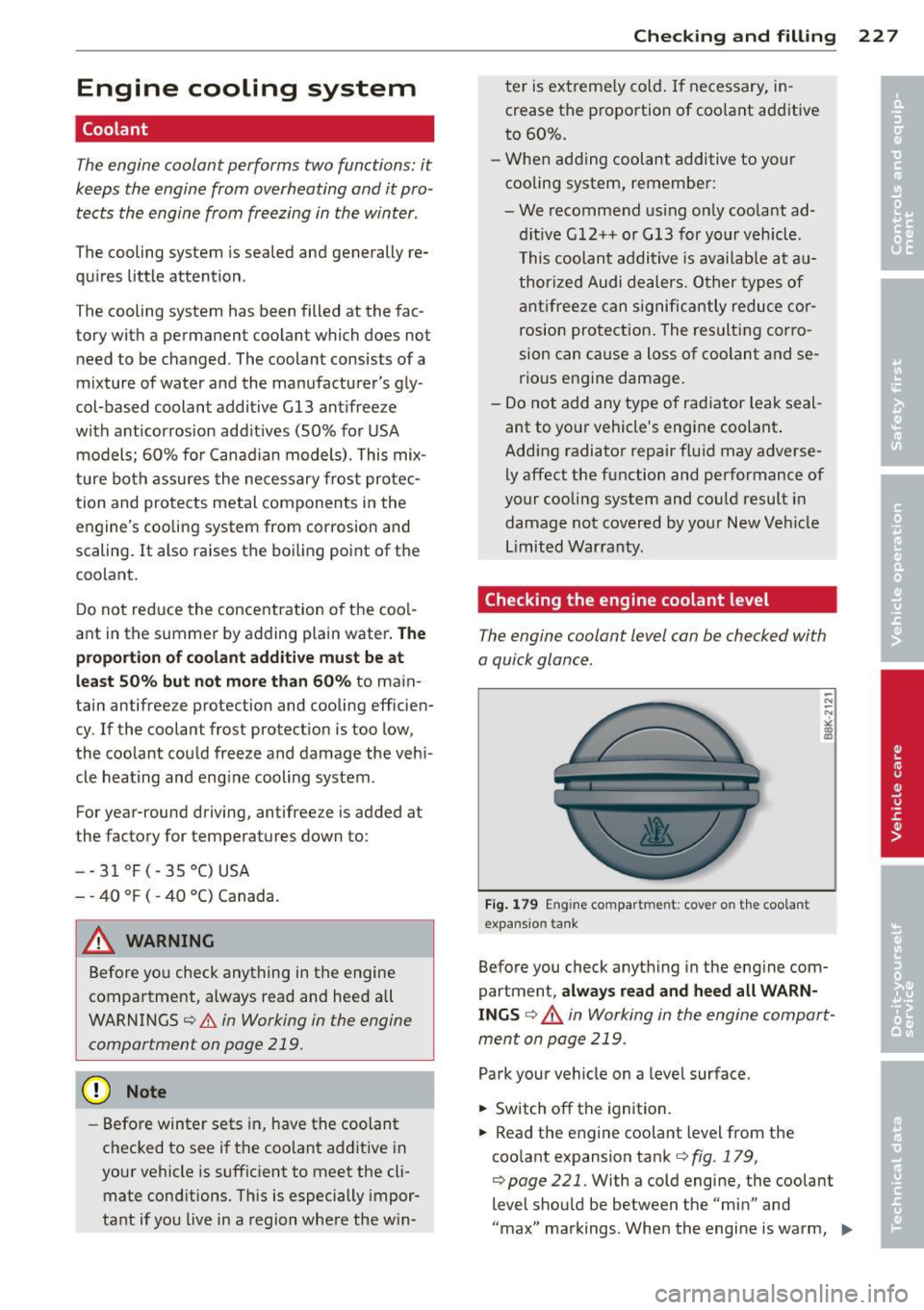
Fig. 179 En gine co mpart ment: cover on t he coo la nt
expansio n ta nk
Before you check a nyth ing in the eng ine com
partment,
always read and heed all WARN
INGS <=>&.
in Working in the engine compart
ment on page 219 .
Park your vehicle on a level surface.
.., Switch off t he ignition.
.., Read t he engine coolant level from the
coo lant expansion tank¢
fig. 179,
¢ page 221 . With a cold engine, the coolant
level shou ld be between the "min" and
"ma x" markings . When the engi ne is warm, ..,.