seats AUDI A8 2012 User Guide
[x] Cancel search | Manufacturer: AUDI, Model Year: 2012, Model line: A8, Model: AUDI A8 2012Pages: 300, PDF Size: 75.06 MB
Page 66 of 300
64 Seats and storage
Full-length center
console
Overview
Appl ies to vehicles: with full-len gth ce nter console
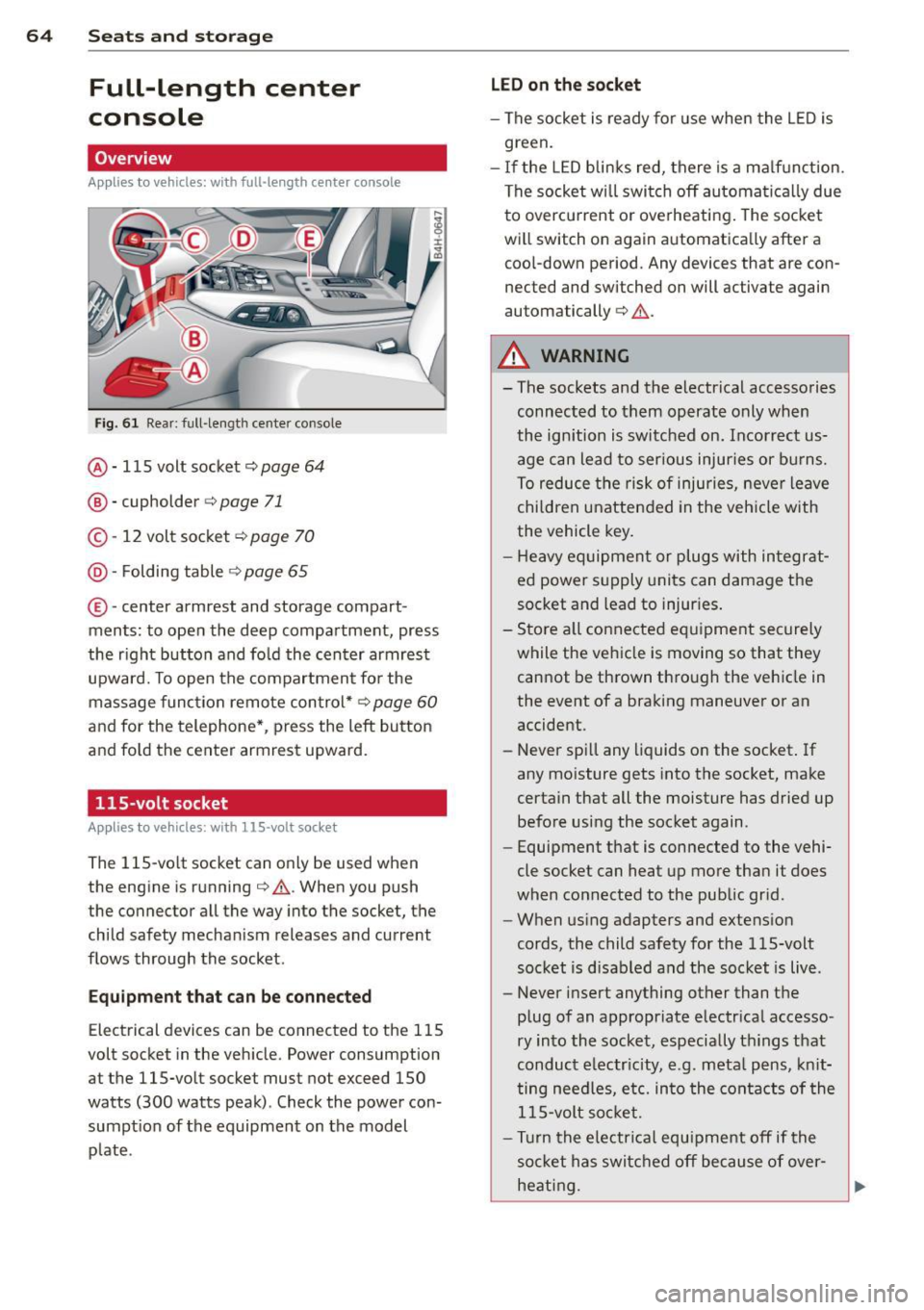
Fig. 61 Rear: full -length center console
@ · 115 volt socket ¢ page 64
@ · cupholder <=> page 71
© · 12 volt socket c:> page 70
@ · Folding table ¢ page 65
®·center armrest and storage com part ·
ments: to open the deep compartment, press
the right button and fold the center armrest
upward. To open the compartment for the
massage function remote control*
c:> page 60
and for the telephone*, press the left button
and fold the center armrest upward.
115-volt socket
Applies to vehicles: with 115 -vo lt socket
The 115-volt socket can only be used when
the engine is running¢
A. When you push
the connector all the way into the socket, the
child safety mechanism releases and current
flows through the socket .
Equipment that can be connected
Electrical devices can be connected to the 115
volt socket in the vehicle. Power consumption
at the 115-volt socket must not exceed 150
watts (300 watts peak) . Check the power con·
sumption of the equipment on the model
plate .
LED on the socket
-The socket is ready for use when the LED is
green.
- If the LED blinks red, there is a malfunction.
The socket will switch off automatically due
to overcurrent or overheating. The socket
will switch on again automatically after a cool-down period. Any devices that are con
nected and switched on will activate again
automatically
c:> A .
A WARNING
-
- The sockets and the electrical accessories
connected to them operate only when
the ignition is switched on. Incorrect us
age can lead to serious injuries or burns.
To reduce the risk of injuries, never leave
children unattended in the vehicle with
the vehicle key.
- Heavy equipment or plugs with integrat
ed power supply units can damage the
socket and lead to injuries.
- Store a ll connected equipment securely
while the vehicle is moving so that they
cannot be thrown through the vehicle in
the event of a braking maneuver or an
accident.
- Never spill any liquids on the socket. If
any moisture gets into the socket, make
certain that all the moisture has dried up before using the socket again.
- Equipment that is connected to the vehi·
cle socket can heat up more than it does
when connected to the public grid .
- When using adapters and extension
cords, the child safety for the 115-volt
socket is disabled and the socket is live.
- Never insert anything other than the
plug of an appropriate electrical accesso·
ry into the socket, especially things that
conduct electricity, e.g. metal pens, knit
ting needles, etc. into the contacts of the
115-volt socket.
- Turn the electrical equipment off if the
socket has switched off because of over·
heating.
Page 67 of 300
(D Note
-Always follow the manufacturer's in
structions for all electrical accessories
you want to use with the electrical sock
et!
- Do not connect lamps that contain a ne
on tube. For technical reasons the lamp
may be damaged.
- Do not connect any 230-volt equipment
to the 115-volt socket. The equipment
may be damaged. If necessary, check the
permissible voltage for the equipment
on the mode l label.
- In the case of some power packs, e.g . for
a laptop computer, the bu ilt-in overcur
rent shutoff prevents it from be ing
swi tch ed on because of excessive start
up current. In this case, disco nnect the
power pack from the consumer and re
connect it after about 10 seconds.
(I) Tips
- Unshielded equipment may cause inter
ference in the radio and the vehicle elec
tronics.
- Some eq uipment may work properly be
cause of the reduced power (wattage),
available from the socket.
Folding table in the center console
Applies to vehicles: with fold ing table in the center con·
so le
The folding table is stored in the front area of
the center console .
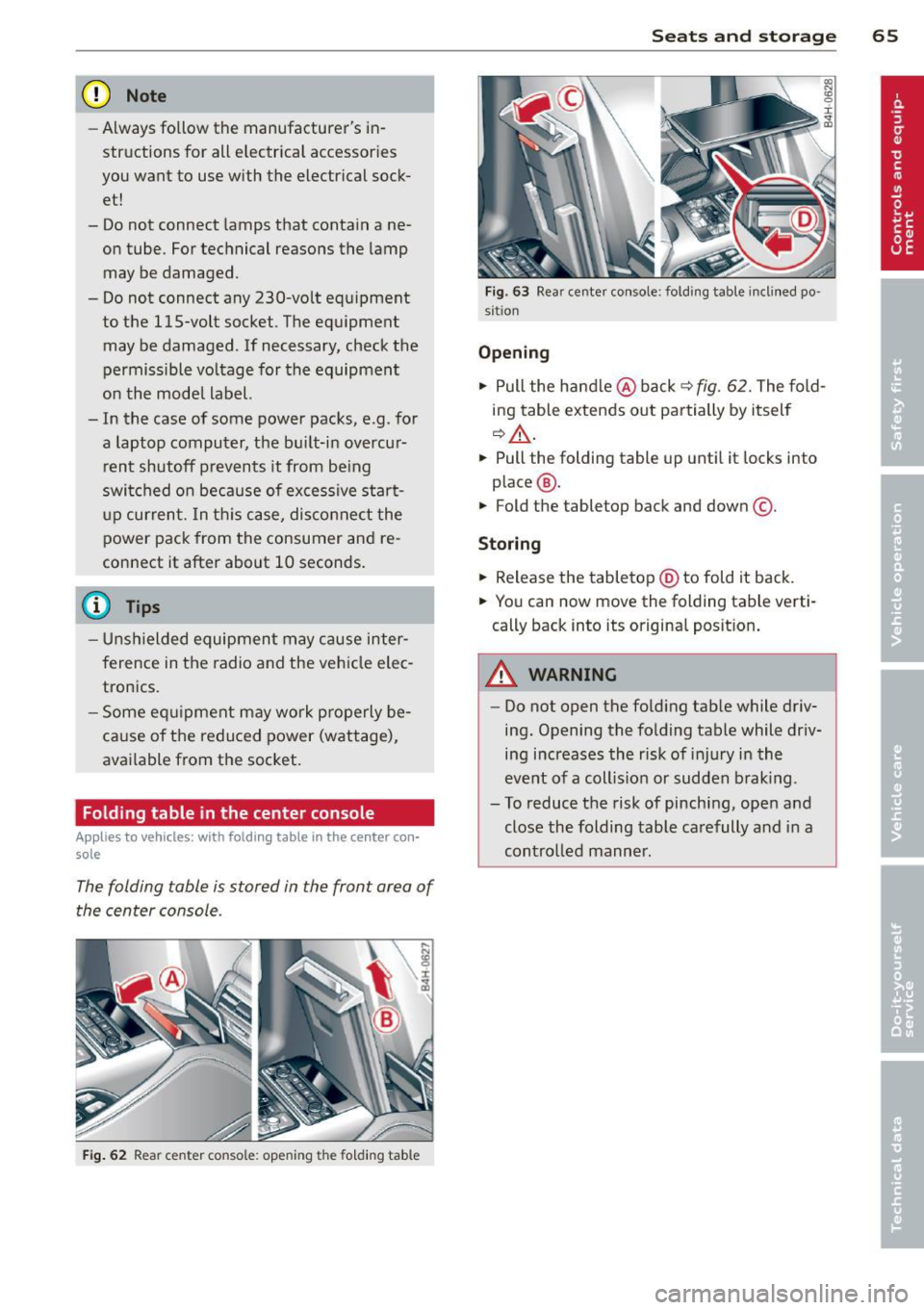
Fig . 62 Rear center console: opening th e fo ld in g table
Seats and storage 65
Fig. 63 Rear center console: fold ing table inclined po ·
s itio n
Opening
.,. Pull the handle @back q fig. 62. The fold
ing table extends out partially by itself
~.&. -
.. Pull the folding table up until it locks into
place @.
.. Fold the tabletop back and down©-
Storing
.. Release the tabletop @to fold it back.
.. You can now move the folding table verti·
cally back into its original posit ion .
A WARNING
-Do not open the folding tab le while driv
ing. Opening the folding table while driv
ing increases the risk of injury in the
event of a coll is ion or sudden braking .
- To reduce the risk of pinching, open and
close the folding table carefully and in a
contro lled manner .
Page 68 of 300
66 Seats and storage
Luggage compartment
Tie-downs and luggage compartment
net
The luggage compartment net prevents small
objects from sliding.
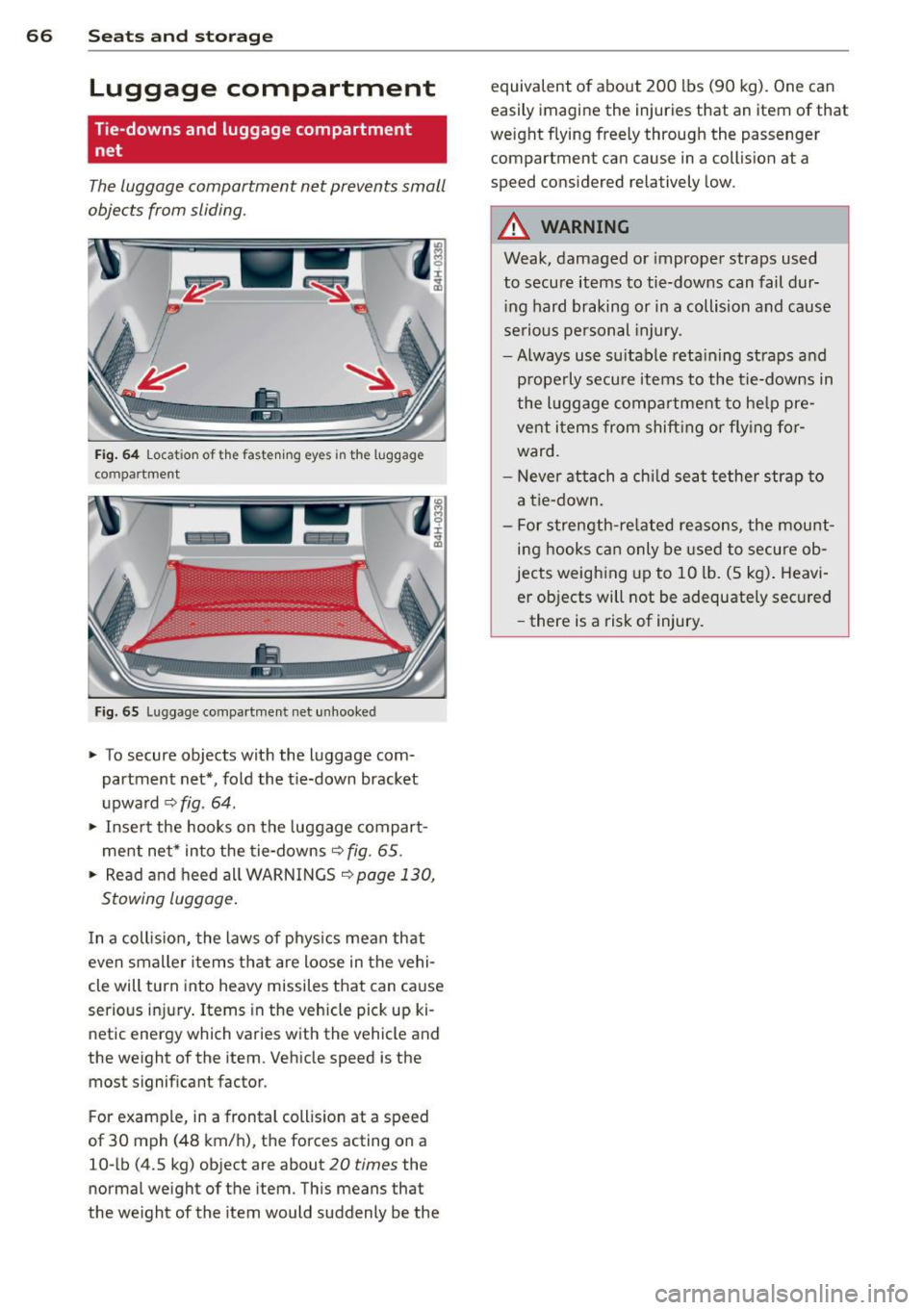
Fig. 64 Locat ion of the faste ning eyes in the luggag e
compartment
Fig. 65 Luggage compartment net unhooked
" To secure objects with the luggage com
partment net*, fold the t ie-down bracket
upward
9 fig . 64 .
" Insert the hooks on the luggage compart
ment net* into the tie-downs
9 fig. 65.
" Read and heed all WARNINGS 9page 130,
Stowing luggage.
In a collis ion, the laws of phys ics mean that
even smaller items that are loose in the vehi
cle will turn into heavy missiles that can cause
serio us injury . Items in the vehicle pick up ki
netic energy which varies w ith the vehicle and
the weight of the item. Vehicle speed is the
most signif icant factor.
F or example, in a frontal collis ion at a speed
of 30 mph (48 km/h), the forces acting on a
10 -lb (4.5 kg) object are about
20 times the
normal weight of the item . This means that
the we ight of the item would suddenly be the equivalent of about
200 lbs (90 kg). One can
easily imagine the injuries that an item of that
weight flying freely through the passenger compartment can cause in a collision at a
speed considered relatively low.
A WARNING
-Weak, damaged or improper straps used
to secure items to tie-downs can fail dur
in g hard braking or in a collision and cause
serious personal injury.
- Always use su itable retaining straps and
p roperly secu re items to the tie-downs in
the lu ggage compartment to help pre
vent it ems from shifting or flying for
ward.
- Never attach a child seat tether strap to
a tie-down.
- Fo r strength-related reasons, the mount
ing hooks can only be used to secure ob
jects weighing up to 10 lb. (5 kg) . Heavi
er objects will not be adequately secured
- there is a risk of injury.
Page 69 of 300
Pass-through with ski
sack
Preparing the pass-through
Applies to vehicles: with pass-through and ski sack
Long objects such as skis can be transported
in the ski sack.
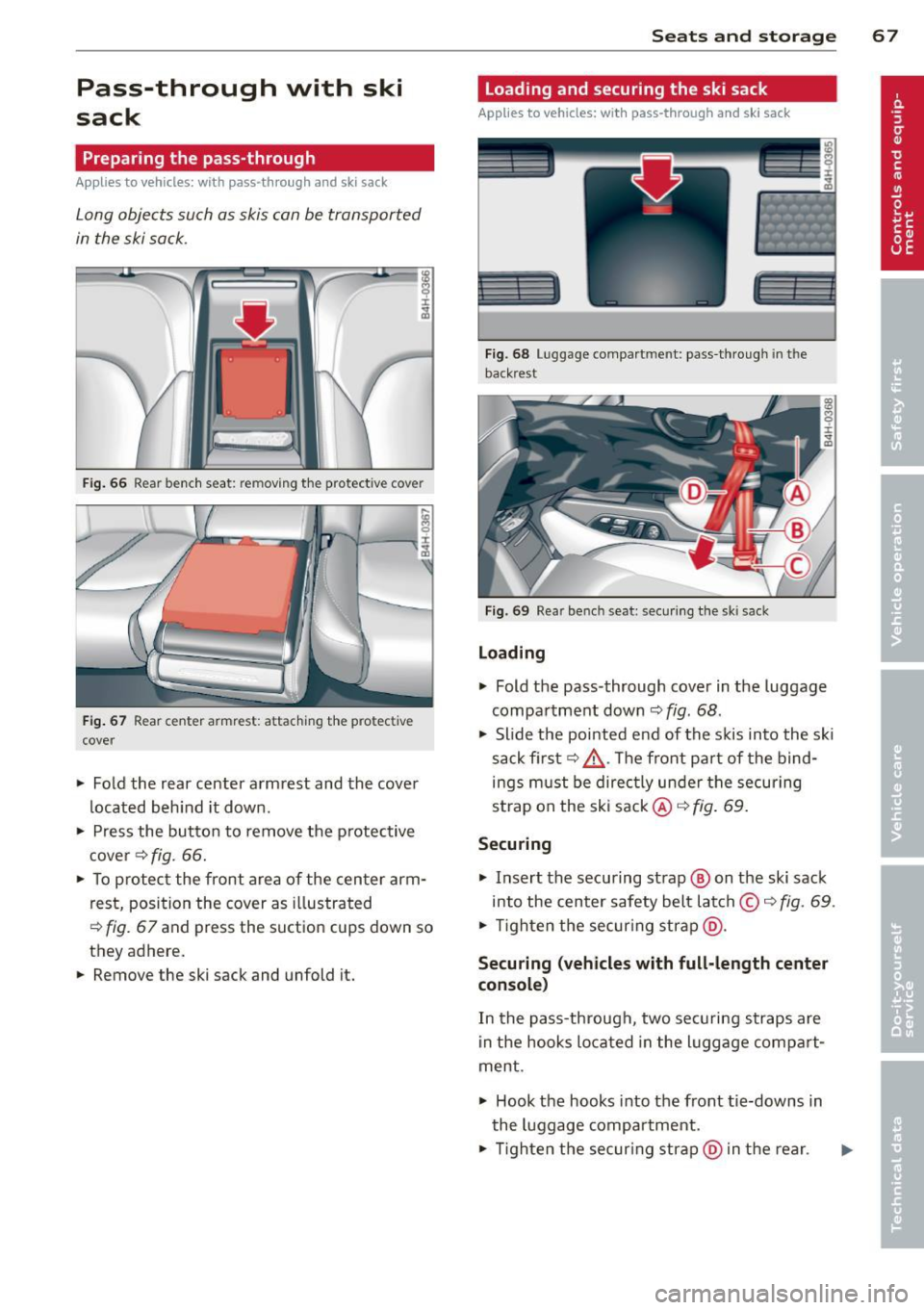
Fig. 66 Rear bench seat: removing the protect ive cover
Fig. 67 Rear center armrest: attaching the protective
cover
~ Fold the rear center armrest and the cover
located behind it down.
~ Press the button to remove the p rotective
cover ¢
fig. 66.
~ To protect the front area of the center arm
rest, position the cover as illustrated
¢
fig. 67 and press the suction cups down so
they adhere.
~ Remove the ski sack and unfold it.
Seats and storage 67
Loading and securing the ski sack
Applies to vehicles: with pass -through and ski sack
--~ --
·-- --· ----~-
Fig. 68 Luggage compartment: pass-through in th e
backrest
Fig. 69 Rear bench seat: sec uring the sk i sack
Loading
~ Fold the pass-through cover in the luggage
compartment down
<=:> fig. 68.
~ Slide the pointed end of the skis into the sk i
sack first
c:> ,&. . Th e front pa rt of the bind
ings must be directly under the securing
strap on the ski sack@<=:>
fig. 69.
Securing
~ Insert the securing strap @ on the ski sack
into the center safety belt latch ©
c:> fig. 69.
~ Tighten the secur ing strap @.
Securing (vehicles with full-length center
console)
In the pass-through, two securing straps are
in the hooks located in the luggage compart
ment .
~ Hook the hooks into the front tie-downs in
the luggage compartment.
~ Tighten the securing strap@in the rear .
Page 70 of 300
68 Seats and storage
& WARNING
- The ski sack is intended only for the
transportation of skis and other light ob
jects . To reduce the risk of serious per
sonal in jury, never t ransport heavy or
poin ted objects in the ski sa ck.
- When brak ing rapidly or during an acci
dent, the load could be displaced and
cause injury to occupants.
- Sharp edges on the load must be cove red
for protect ion. Always fasten the belt
ti gh tly around the sack and its contents
¢ fig. 69.
-For safety reasons, do not t ransport
more than two pairs of skis in the ski
sac k.
- You m ust sec ure the ski sack with t he
strap after loading.
- Make sure a ll objects that you are trans
porting in the pass-through are secured.
Otherwise they cou ld slide around during
sudden braking maneuvers and cause in
jury.
@ Tips
- Never stow the sk i sack away whe n it is
still wet or damp (for examp le, snow
melt ing from sk is) . Allow it to dry com
plete ly before stowing it away .
- Position skis in the ski sack with the pointed ends facing t he front and ski
po les w ith the pointed ends facing the
rear.
Roof rack
Description and mounting locations
Additional cargo can be carried wi th a roof
luggage rack .
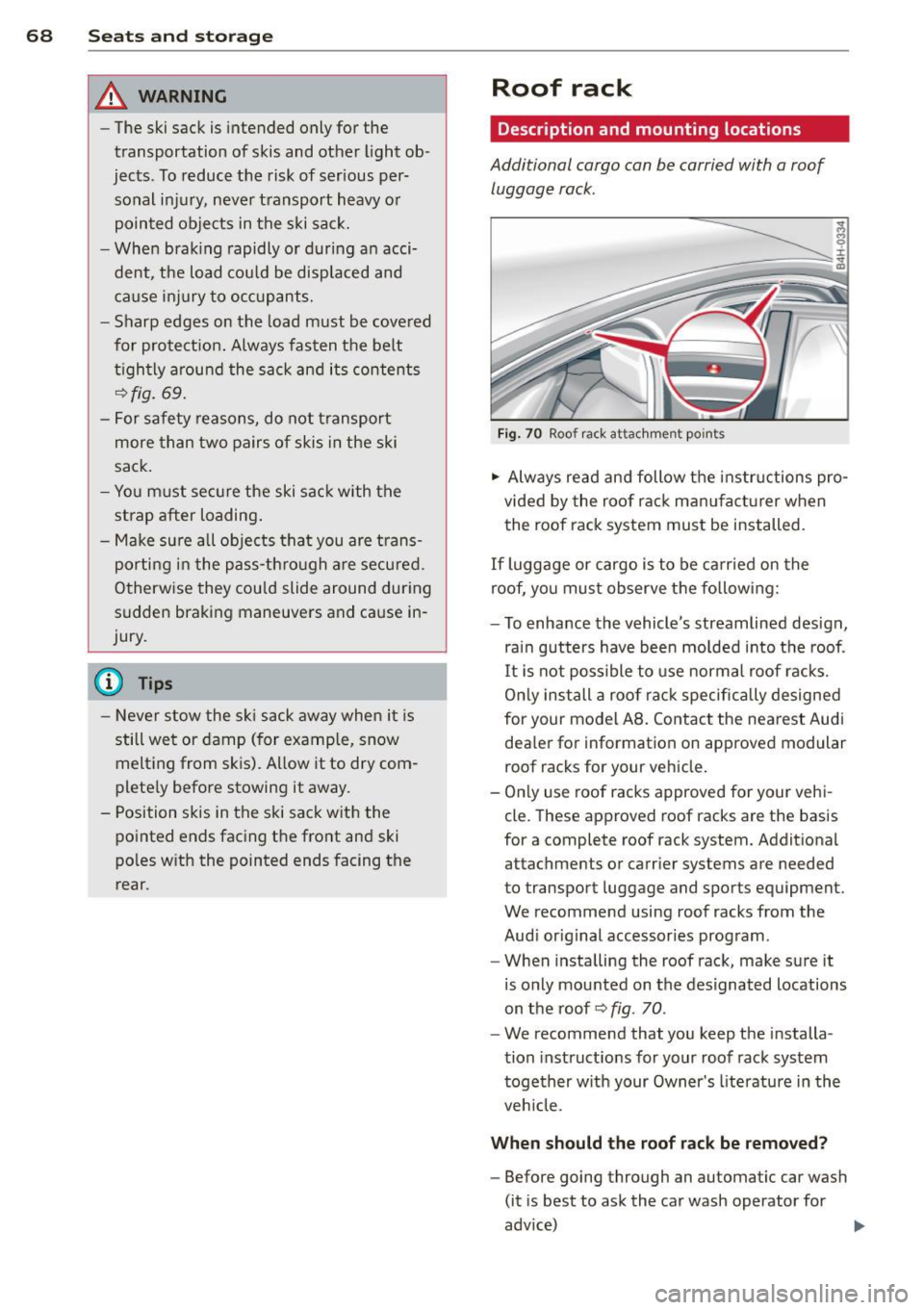
Fig . 70 Roo f ra ck attac hment po ints
.,. Always read and follow the instructions pro
vided by the roof rack man ufactu rer when
the roof rack system mus t be install ed .
If luggage or cargo is to be ca rried on the
roof, yo u mus t observe the follow ing:
- To enhance the vehicle 's streamlined design,
ra in gutters have been mo lded i nto t he roof .
I t is not poss ible to use normal roof ra cks.
O nl y install a roof ra ck specific ally designed
for your model AB . Contact the nea re st Audi
dea ler for information on approved modular
roof racks for your v ehicle.
- On ly use roof racks approved for your vehi
cl e. These approved roof racks are the basis
fo r a complete roof rack system. Addition al
a tta chmen ts or carr ier systems are needed
t o transpor t luggage and spor ts equipment.
We recommend using roof rack s from the
Aud i original accessories program.
- When insta lling the roof rack, make sure it
is o nly mounted on the designated locations
on the roof~
fig. 70.
- We recommend that you keep the i nstalla
tion instruct ions for your roof rack system
together w ith your Owner's literature in the
ve hicle.
When should the roof rack be removed?
- Before go ing through an automatic car wash
(it is best to ask the ca r wash operator for
adv ice)
...
Page 72 of 300
70 Seats and storage
-Never exceed the maximum permissible
load carrying capacity of the roof of your
vehicle, the permissible axle weights and
the permissible total weight of your vehi cle
c::, page 276, Weights .
@ For the sake of the environment
As a result of the increased wind resist
ance created by a roof rack, your vehicle is
using fuel unnecessarily. So remove the
roof rack after using it.
12-volt sockets
Applies to vehicles: 12-volt soc kets
Electrical accessories can be connected to ev
ery 12-volt socket.
Fig. 71 Sect io n of the trim panel of th e lu ggage com
part ment: 12 -vol t soc ket
Fig. 72 Rear center conso le: 12-vo lt soc ket
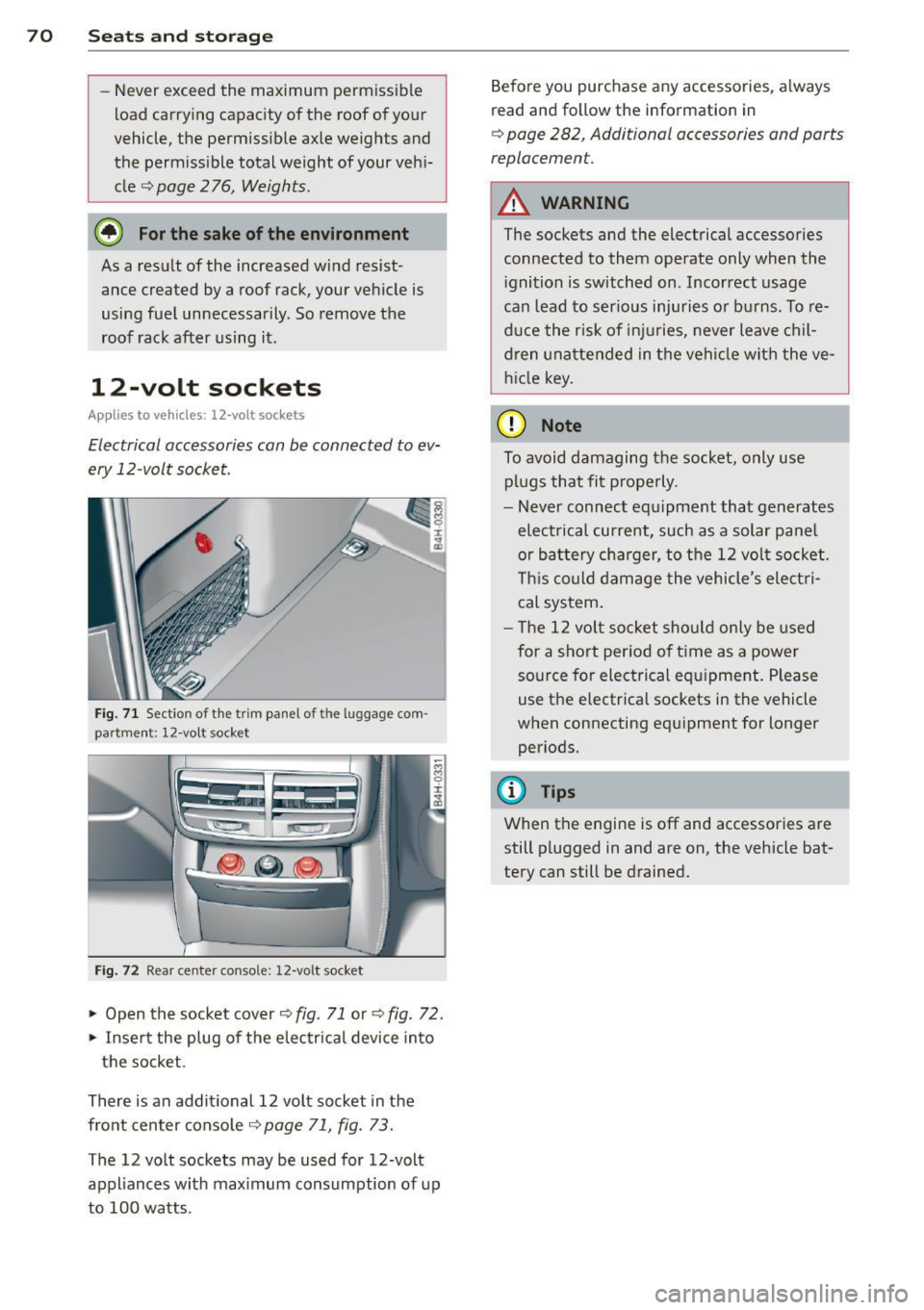
... Open the socket cover c::, fig. 71 or c::, fig. 72 .
... Insert the plug of the electrical device into
the socket.
There is an additional 12 volt socket in the
front center console~
page 71, fig. 73.
The 12 volt sockets may be used for 12-volt
appliances with maximum consumption of up
to 100 watts . Before you purchase any accessories, always
read and follow
the information in
c::, page 282, Additional accessories and parts
replacemen t.
A WARNING
The sockets and the electrical accessories
connected to them operate only when the ignition is switched on . Incorrect usage
can lead to serious injuries or burns. To re
duce the risk of injuries , never leave chil
dren unattended in the vehicle with the ve
hicle key.
(D Note
To avoid damaging the socket, only use plugs that fit properly.
- Never connect equipment that generates
electrical current, such as a solar panel
or battery charger, to the 12 volt socket .
This could damage the vehicle 's electri
cal system.
- The 12 volt socket should only be used
for a short period of ti me as a power
source for electrical equipment. Please
use the electrical sockets in the vehicle
when connecting equipment for longer periods.
@ Tips
When the engine is off and accessories are
still plugged in and are on, the vehicle bat
tery can still be drained.
Page 73 of 300
Storage
(upholder
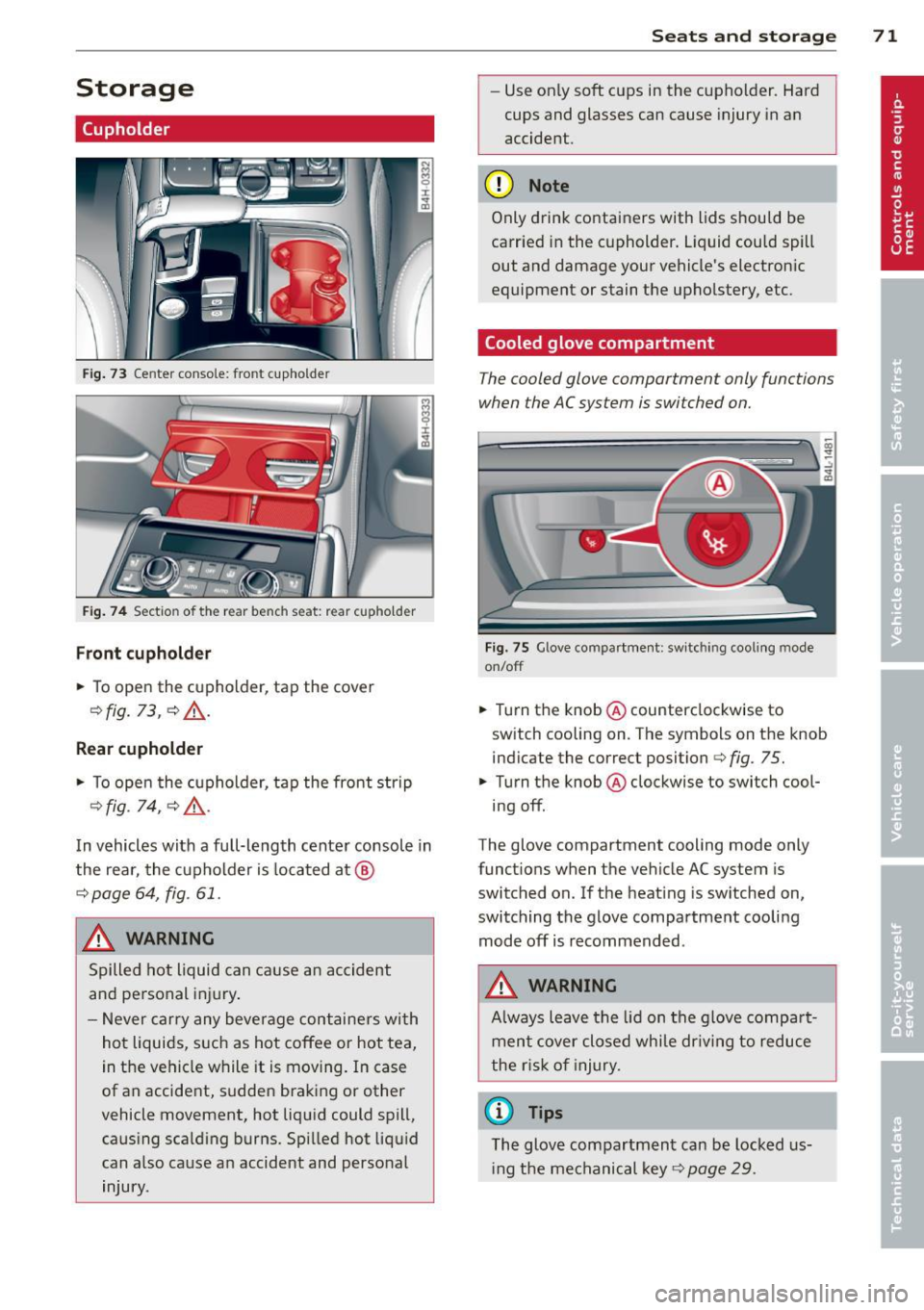
Fig. 73 Center console: front cupho lder
Fig. 74 Section of the rear bench seat: rear cupholder
Front cupholder
.,. To open the cupholder, tap the cover
¢fig . 73, ¢ &, .
Rear cupholder
.,. To open the cupholder, tap the front strip
¢fig. 14, QA .
In vehicles with a full-length center console in
the rear, the cupholder is located at @
¢ page 64, fig. 61.
A WARNING
Spilled hot liquid can cause an accident
and personal injury .
- Never carry any beverage containers with
hot liquids, such as hot coffee or hot tea,
in the vehicle while it is moving. In case
of an accident, sudden braking or other
vehicle movement, hot liquid could spill, causing scalding burns. Spilled hot liquid
can also cause an accident and personal
injury.
Seats and storage 71
-Use on ly soft cups in the cupholder. Hard
cups and glasses can cause injury in an
accident.
(D Note
Only drink containers with lids should be
carried in the cupholder. Liquid could spill
out and damage your vehicle's electronic
equipment or stain the upholstery, etc.
Cooled glove compartment
The cooled glove compartment only functions
when the AC system is switched on.
Fig. 75 Glove compar tment: switc hing cool ing mode
on/off
.,. Turn the knob ® counterclockwise to
switch cooling on . The symbols on the knob
ind icate the correct position¢
fig. 75 .
.,. Turn the knob ® clockwise to switch cool-
ing off.
The glove compartment cooling mode only
functions when the vehicle AC system is
switc hed on. If the heating is switched on,
switching the glove compartment cooling mode off is recommended .
A WARNING
Always leave the lid on the glove compart
ment cover closed while dr iving to reduce
the risk of injury.
a) Tips
The glove compartment can be locked us
i ng the mechanical key¢
page 29.
Page 74 of 300
72 Seats and stor age
Addit ional storage
There are a variety of storage compartments
and fasteners in various places in the vehicle.
- Storage compartments in the doors
- Net in the front passenger footwell
- Eyeglasses compartment in the headliner (near the rearview mirror)
- Storage compartments under the center
armrests
- Compartments* on the back of the front
seat backrests
- Garment hooks over the rear doors
- Compartment in the center console with
pass-through)* (rear)
- Compartment behind the rear center arm
rest (in vehicles without the pass-through*
or refrigerator*)
- Bag hooks in the luggage compartment
A WARNING
-When driving, do not leave any hard ob
jects on the rear window shelf or allow
your pet to sit on the shelf. They could
become a hazard for vehicle occupants in
the event of sudden braking or a crash .
- Always remove objects from the instru
ment panel. Any items not stored could
slide around inside the vehicle while driv
ing or when accelerating or when apply
ing the brakes or when driving around a
corner.
- When you are driving make sure that
anything you may have placed in the cen
ter console or other storage locat ions
cannot fall out into the footwells. In case
of sudden braking you would not be able
to brake or accelerate.
- Any articles of clothing that you have
hung up must not interfere with the driv
er's view. The coat hooks are designed
only for lightweight clothing. Never hang
any clothing with hard, pointed or heavy
objects in the pockets on the coat hooks.
During sudden braking or in an accident -
especially if the airbag is deployed - these objects could injure any passen
gers
inside the vehicle.
- To reduce the risk of personal injury in an
accident or sudden stop, always keep the
glove compartment closed while driving.
- Read and follow all WARNINGS
c:> page 161, Important safety instruc
tions on the side airbag system.
- Hang clothes in such a way that they do
not impair the driver's vision.
- The coat hooks must only be used for
lightweight clothing. Do not leave any
heavy or sharp edged objects in the pock
ets which may interfere with the side cur
tain airbag deployment and can cause personal injury in a crash.
- Do not use coat hangers for hanging clothing on the coat hooks as this can in
terfere with proper deployment of the
side curta in airbags in an acc ident.
- Do not hang heavy objects on the coat
hooks, as they could cause personal in
jury in a sudden stop.
@ Note
Objects located on the rear shelf that rub
against the rear window could damage the
heating wires for the rear window defog
ger .
(D Tips
-A vent slot is located between the shelf
and the rear window. Do not block the
vent with any items you may place on the
rear window she lf.
- Do not place bulky items on the rear win
dow shelf as they could restrict or block
the driver's vision in the rear view mirror.
Cooler
Introduction
App lies to vehicles: wit h coo ler
Please clean the cooler before using it for the
first time
c:> page 213.
You can only switch on the cooler if ...
Page 75 of 300
- the temperature in the luggage compart
ment is below 131 °f (55 °C). The cooler
switches off automatically if the tempera
ture in the luggage compartment exceeds
131 °f (55 °C) . Once the temperature falls
below 131 °f (55 °C) again, the cooler
switches on aga in automatically .
- the battery is adequately charged . The cool
er switches off automatically if the vehicle
battery voltage falls below a minimum lev
el. This prevents the battery from discha rg
i ng . The cooler switches back on again auto
matically when the battery voltage increases
again (e.g . after starting the engine).
The cooler cools to 42.8 °f
(+ 6 °C) and the
freezer cools to 21.2 °f (-6 °C) in opt imum
cooling cond itions . Th e cooling performance
is affected by the temperature in the luggage
compartment. The temperature inside the
cooler will be higher if the luggage compart
ment is hot.
A WARNING
To avoid putting the occupants at any risk,
please observe the following safety rules:
- The maximum capacity is 2.5 kg (5.5
lbs.).
- Never overload the cooler. This could
cause injury in the event of a collision or
sudden braking.
- The coo ler lid must always be kept closed
while you are driving. Make sure the re
taining catch is securely engaged. The
contents of the coo ler could be thrown
forward into the passenger compart
ment in the event of a collision or under
sudden braking - risk of injury!
- Inflammable liquids, gas canisters, etc.
must not be stored in the cooler -risk of
exp losion! This also includes any prod
ucts that might emit volatile or inflam
mable gases.
- Liquids will freeze at temperatures at or
below 32 °f (0 °C) and may cause glass
bottles to burst!
Seats and storage 73
(D Note
-The venti lation openings for the cooler
are located on the back pane l trim in the
luggage compartment and
must be kept
clear at all t imes.
- If the cooler is not functioning properly,
switch it off to prevent further damage.
Have it checked by a qualified workshop .
Operation
Applies to vehicles: wit h coo ler
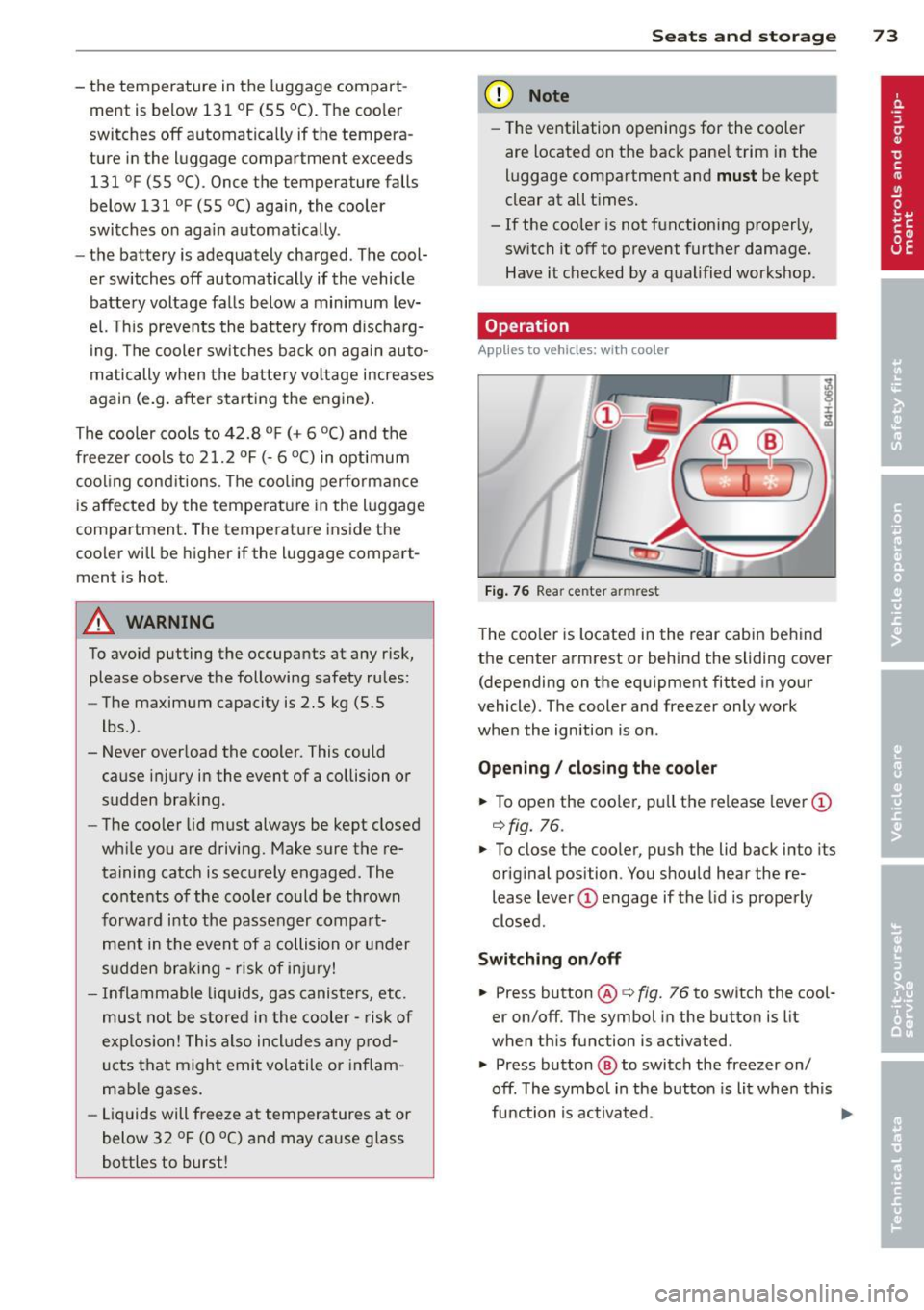
Fig. 76 Rea r ce nte r armre st
The cooler is located in the rear cabin behind
the center armrest or behind the sliding cover (depending on the equipment fitted in your
vehicle) . The cooler and freezer only work
when the ignition is on .
Opening / closing the cooler
.,. To open the cooler, pull the release lever@
~ fig. 76.
.,. To close the cooler, push the lid back into its
original position. You should hear the re
lease lever
(D engage if the lid is properly
closed.
Switching on /off
.,. Press button @ 9 fig. 76 to sw itch the cool
er on/off. The symbol in the button is lit
when this function is activated .
.,. Press button
@ to switch the freezer on/
off . The symbol in the button is lit when this
function is activated .
Page 76 of 300
7 4 Seats and stor age
- Always try to leave the lid open for as
short a time as poss ible to prevent con
densation b uildup.
- Do not put hot food o r drinks in the cool
er .