seats AUDI A8 2012 Workshop Manual
[x] Cancel search | Manufacturer: AUDI, Model Year: 2012, Model line: A8, Model: AUDI A8 2012Pages: 300, PDF Size: 75.06 MB
Page 180 of 300
178 Child Saf ety
8_ WARNING ,~
Using th e wrong child restraint or an im
prope rly insta lled child rest raint can cause
ser ious perso nal in jury or death in a cras h.
- Always make sure that the safety belt re-
tractor is locked when installing a child
safety seat. An unloc ked safety belt re
t ractor ca nnot ho ld the child safety seat
in pla ce d uring norm al driv ing or i n a
c rash.
- Alway s bu ckl e the child safety seat firmly
in pla ce even if a child is not s itting in i t.
A loose ch ild safety sea t ca n fly around
dur ing a sud den s top or in a crash .
- Alw ays m ake su re the se at backrest to
wh ich the child restrain t is ins talled is in
an upr ight position and sec urely latched
into p lace and cannot fo ld forward. Oth
erwise, the seatback w ith the chi ld safety
seat attached to it could fly forward in
the event of an acc ident or other emer
gency situation.
- Always read and heed all WARNI NGS
w henever using a child restrained in ave
hicle is bei ng used
r::;, page 166 . Special
precautions apply whe n installing a c hild
safety seat on t he fro nt pas senge r seat
r::;, page 1 44, Child restrain ts on the fron t
seat -some imp ortant things to know.
Deactivating the convertible locking
retractor
T he convertible locking retractor for child re
straints will be deactivated automatically
when the belt is wound all the way back into the retractor.
• Press the red button on the safety be lt
buck le . The belt tongue wi ll pop out of the
buck le .
.. Gui de the safety belt a ll the way back into
its stowed posit io n.
A lways let the safety belt retract comp lete ly
into its stowed posit ion. The safety belt can
now be used as an ordinary safety belt with
out the convert ib le lock ing retractor for chi ld
restra ints .
-
If the conve rtib le locking retractor sho uld be
activated inadvertent ly, the safety be lt must
be unfastened and gu ided comp lete ly back in
to its stowed posit ion to deactivate this fea
tu re. If the convert ible locking retractor is not
deact ivated, the safety belt w ill gradua lly be
come tig hte r and uncomfortable to wear .
8_ WARNING
=
Im properly installed ch ild safety seats in-
crease the r is k of serious pe rson al injury
a nd dea th in a co llision.
- Neve r unfasten the safety belt to deacti
vate the conve rtible locking retrac to r f or
child res traints whi le the vehi cle is mov
ing . You would not be restrained and
could be se rious ly in jured in an accide nt.
- Always rea d and heed all WARNIN GS
wheneve r using a chi ld res traine d in ave
h icle is being used
r::;, page 166. Special
preca utions app ly when insta lling a child
safety seat on the front passenger seat
r::;, page 144, Child restraints on the front
seat -some important things to know .
LATCH Lower
anchorages and tethers
for children
Child Restraint System anchors and how
are they related to child safety
T o p rov ide a simple r and more pr acticable w ay
to attach the child restraint on the vehi cle
seat, Federal regulat ions req uire spec ia l lowe r
anchorages in vehicles and devices on new
ch ild restra ints to attach t o the ve hicle ancho
rages.
T he combi nation of t he tether anchorages and
the lowe r anchorages is now generally ca lled
t h e
LATCH system for " Lower Anchorages and
T ethers for Children ."
Forward-facing chi ld restraints man ufactured
after September 1, 1999, are requ ired by U.S.
federa l reg ulations to comply with new child
head movement performance req uirements . .,._
Page 181 of 300
These new performance requirements make a
tethe r necessary on most new chi ld seats.
I ns tal ling a child restraint that req uires a top
tether witho ut one can serio usly impair the
performance of the child restraint and its abil
ity to protect the child i n a co llision . Installing
a child restraint that requires a top tether
wi thout the top tether may be a vio lation of
state law.
Child restraint manufacturers offer LATCH lower anchorages on the ir ch ild seats with
hook-on or push-on connectors attached to
adjustable straps.
In addition to the LATCH lower anchorages,
these child restraint systems usually require
the use of tether straps to help keep the child
restraint firmly in place.
A WARNING
Improper installation of child restraints
w ill increase the risk of injury and death in
a crash .
- Always follow the instructions prov ided
by the manufacturer of the ch ild re
st raint you intend to install in your veh i
cle.
- Never install a child restraint witho ut a
properly attached top tether s trap if the
child restrain t manufacturer's instruc
t ions requ ire the top tether strap to be
used.
- Improper use of c hild restra int LA TCH
lower anchorage points can lead to injury
in a collision . The LA TCH lower anchorage
points are des igned to w ithstand only
those loads imposed by correct ly fitted
child restraints.
- Never mount two chi ld restraint systems
on one LATCH lower anc horage point.
- Never secure o r attach any l uggage or
other item to the LATCH lower anchorag
es.
(D Tips
- In Canada, the terms "top tether" with
"lower universa l anchorages" (or "lower
-
Child S afety 1 79
universal anchorage bars") a re used to
describe the system .
- In o ther coun tries, the term " ISOFIX" is
used to describe the lower anchorages .
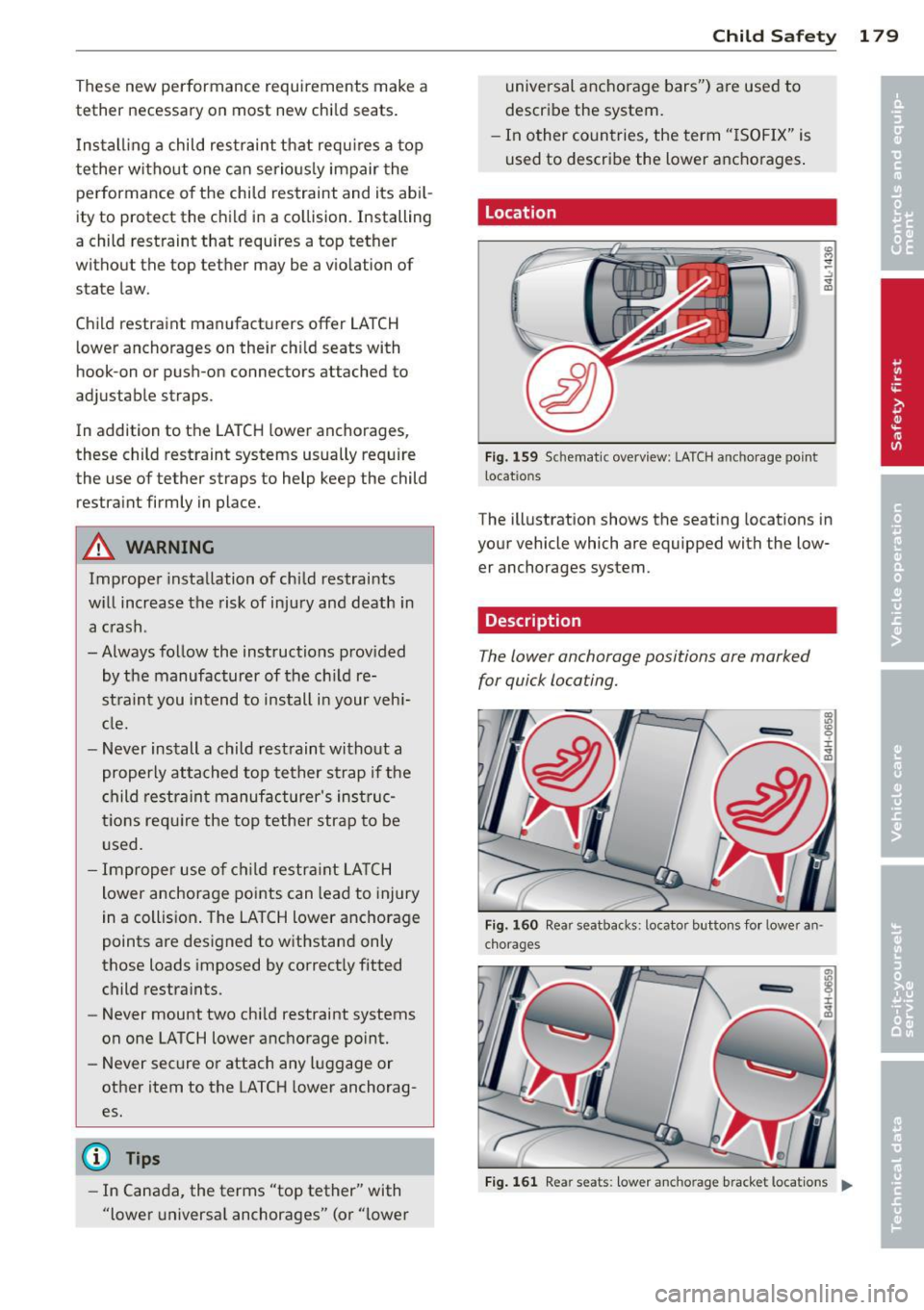
Location
Fig. 159 Sc hemat ic ove rv iew : LAT CH a nch orag e poin t
l ocat io n s
T he illustration shows the seating locations in
your vehicle which are equipped with the low
er anchorages system .
Description
The lower anchorage positions are marked
for quick loca ting.
Fig. 160 Rea r seat backs : locato r but tons fo r lowe r an ·
cho ra g es
r
~ I
Fi g. 1 61 Re ar seat s: low er an cho rage bra cket lo cat ion s IJI,-
Page 182 of 300
180 Child Safety
Attachment locator markers for lower
anchorages
Circular locator buttons on the rear seatback
indicate the lower anchorage locations on the
rear seating positions¢
fig. 160 .
Lower anchorages
The lower anchorage attachment points are
located between the rear seatback and rear
seat cushion
¢ fig . 161.
Lower anchorages secure the child restraint in
the seat witho ut using the vehicle 's safety
belts. Anchorages provide a secure and easy
to-use attachment and minimize the possibili
ty of improper chi ld restraint installation.
All chi ld restraints manufact ured after Sep
tember 1, 2002, must have lower anchorage
attachments for the
LATCH system.
Remember that the lower anchorage points
are only intended for installation and attach
ment of child restraints specifically certified
for use with
LATCH l ower anchorages. Child
restraints that are not equipped with the low
er anchorage attachments can still be instal led in compliance with the c hild restra int
manufacturer's instructions on using vehicle
safety belts.
,&. WARNING
Improper use of LATCH lower anchorages
can cause serious personal injury in an ac
cident .
- Always carefully follow the child re
straints manufacturer's instructions for
proper installation of the child restraint
and proper use of the lower anchorages
or safety belts in your vehicle .
- Never secure or attach any luggage or
other items to the
LATCH lower ancho
rages.
-Always read and heed the important in
formation about child restraints in this
chapter and WARNINGS
¢page 166,
Child Safety.
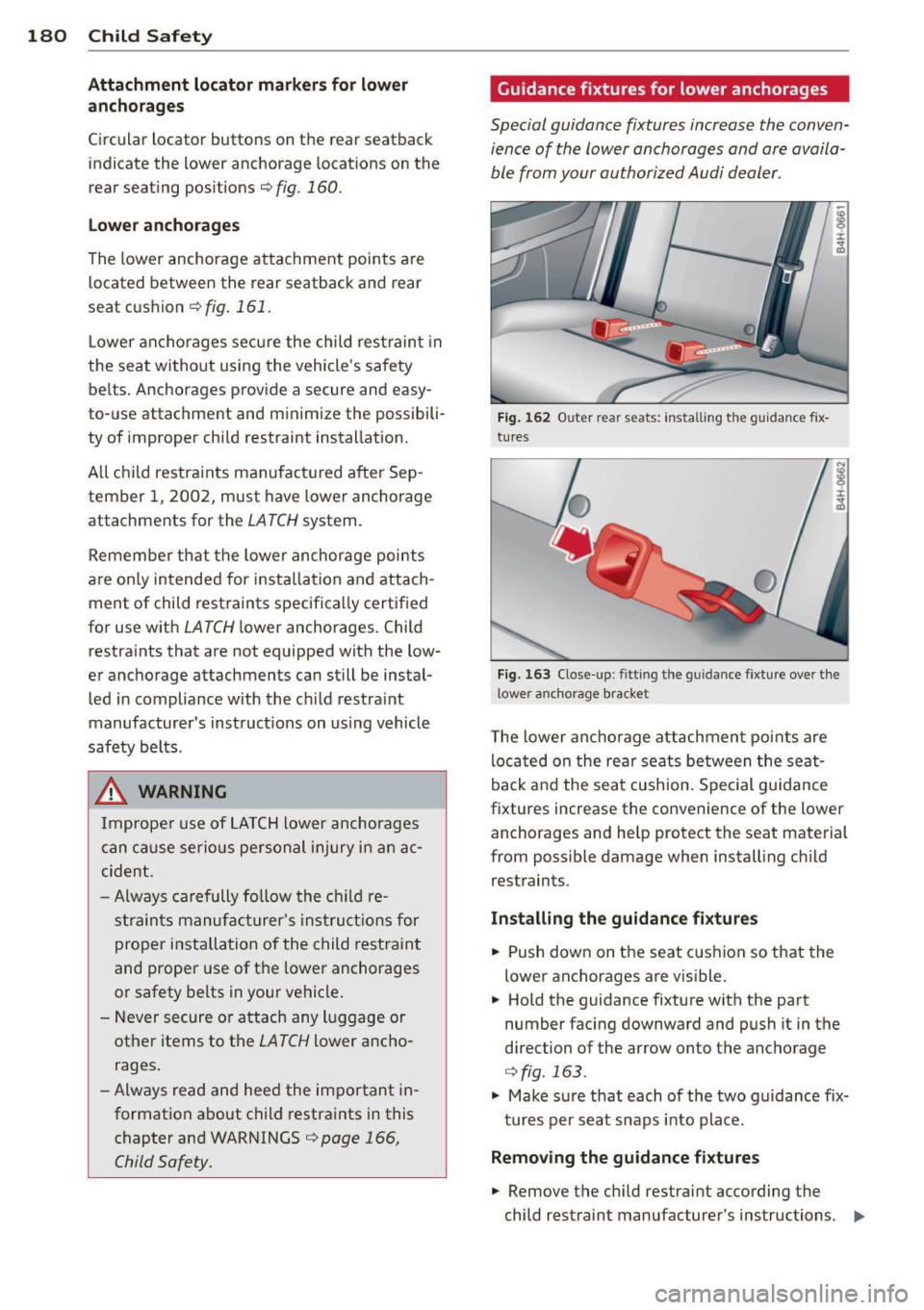
Guidance fixtures for lower anchorages
Special guidance fixtures increase the conven
ience of the lower anchorages and are availa
ble from your authorized Audi dealer.
Fig. 1 62 Outer rear seats: inst all ing th e guidanc e fix
tures
Fig . 163 Close-up: fitting th e g uida nce fixture over t he
lower anchorage bracket
T he lower anchorage attachment points are
located on the rear seats between the seat
back and the seat cush ion. Special guidance
fixtures increase the convenience of the lower anchorages and help protect the seat material
from possible damage when installing ch ild
restraints.
Installing the guidance fixtures
.,. Push down on the seat cushion so that the
lower anchorages are visible.
.,. Hold the guidance fixture with the part
number facing downward and push it in the
direction of the arrow onto the anchorage
¢fig . 163 .
.,. Make su re that each of the two guidance fix
tures per seat snaps into place .
Removing the guidance fixtures
.,. Remove the chi ld restraint according the
child restraint manufacturer's instructions. ..,.
Page 183 of 300
.. Push down on the seat cushion so that the
lower anchorages are visib le .
.. Pull
off the guidance f ixtures from the low
er anchorages.
.. Always remove the guidance fixtures and
keep them in a safe place when not in use .
You may find it easier to install child re
straints equipped with hooks attached to
straps without the guidance f ixtures in place.
If th is is the case, remove the guidance fix
tures by pull ing them
off the anchorages .
H owever, the guidance fixtures can help you
to locate the
LATCH anchorages.
& WARNING
Imprope r use of tether anchorages or low
er anchorages can cause serious persona l
injury in a crash .
- Always carefully fo llow the child re
straint manufacturer's instruct ions for
proper installation and use of child re
straint systems .
- Never use the
LATCH or tethe r anchorag
es to attach safety belts or other kinds of
occupant restraints.
- Child restraint tether attachments and
lower attachments are only designed to
secure a child restraint that has bee n
equipped to use these anchorages.
- Tether anchorages and lower anchorages
are designed to withstand only those
loads imposed by correctly fitted chi ld
res traints. Under no circumstances can
they be used safely for adu lt or ch ild
safety belts o r harnesses.
- Never mount more than one ch ild re
straint to a sing le te ther or to a lower an
c ho rage point. A ttaching two child re
strain ts to a single anchor age point can
cause the anchorage to fail and cause se
rious persona l injury in a crash .
(D Note
-Remove the guidance fix ture s before
fo ld ing the rea r seatback to p reven t
damag ing t he seat c ushion .
Child S afety 181
- To attach the chi ld restraint sec urely, the
seat must be moved to the farthest rear
position, the seat he ight set to the low
est position and the head restraint must
be adjusted to the vertical pos ition
9 page 57.
-If you leave the guidance fixtures instal
led for several days, they could leave a
mark on the upholstery on the seat cush
ion and back rest in the area that the
guidance f ixtures were installed. The up
holste ry would also be permanen tly
st re tched aro und the guidance fixtures.
T his app lies especia lly to leather seats .
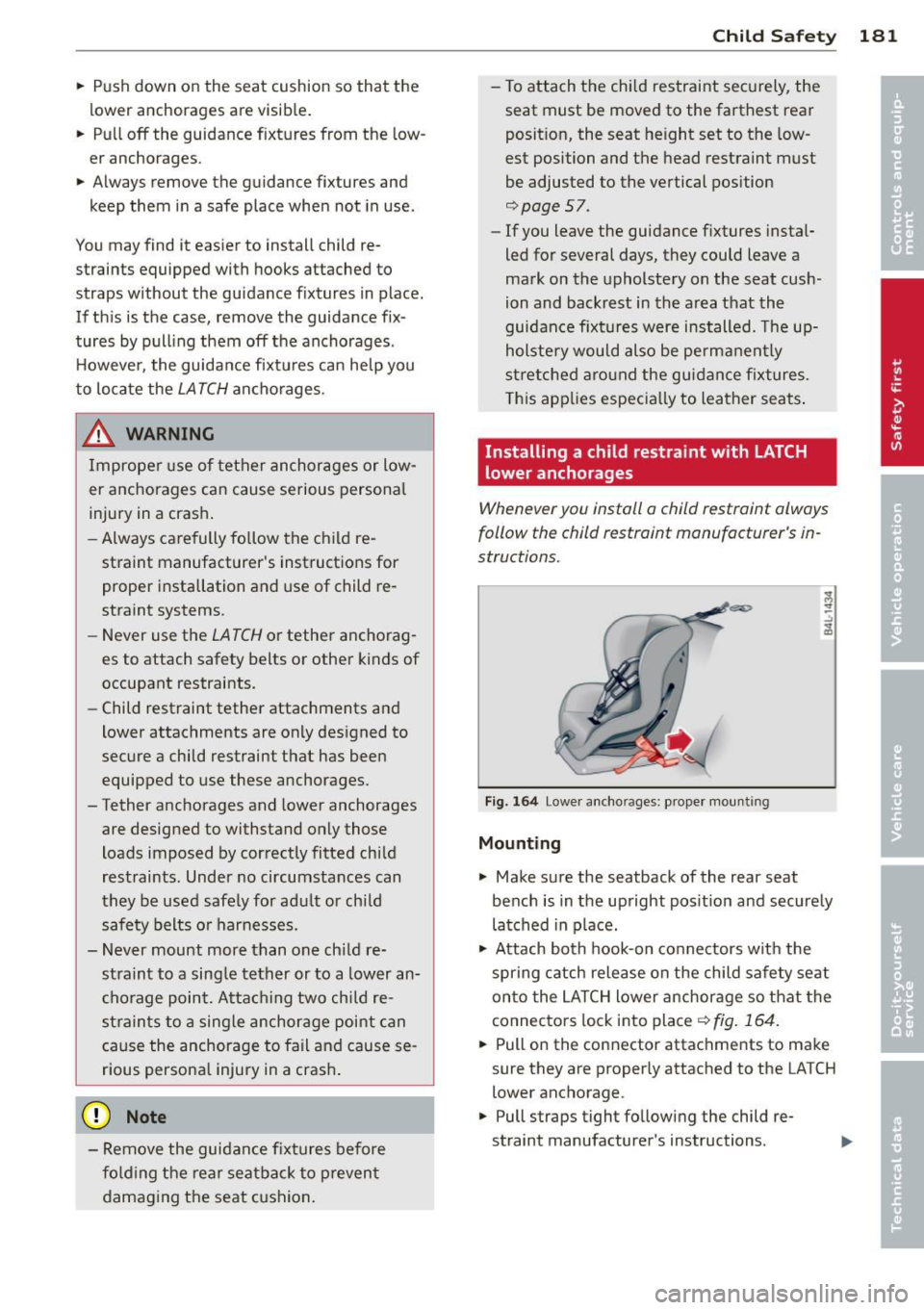
Installing a child restraint with LATCH
lower anchorages
Whenever you install a child restraint always
follow the child restraint manufacturer's in
structions.
F ig. 164 Lowe r anchorages: prope r mount ing
Mounting
.. Make sure the seatback of the rear seat
bench is in the upright pos it ion and securely
latched in place.
.,. Attach both hook-on co nnectors wit h the
spring catch release on the child safety seat
onto the LATCH lower anchorage so that the
connectors lock into place
9 fig. 164.
.. Pull on the connector attachments to make
sure they are proper ly attached to the LATCH
lower anchorage .
.. Pull straps tight following the child re
straint manufacturer's instructions .
Page 184 of 300
182 Child Safet y
Relea sin g
.,. Loosen the tension on the straps following
the chi ld restraint manufacturer's instruc
tions.
.,. Depress the spring catches to release the
anchorage hooks from the lower anchorag
es.
Remember: Use tether straps to help keep the
child restraint firmly in p lace.
A WARNING
Improper use of the LATCH system can in
crease the risk of serious personal injury
and death in an acc ident.
- These anchors were developed only for
child safety seats us ing the "LATCH" sys
tem .
- Never attach other child safety seats,
belts or other objects to these anchors .
- Always make sure that you hear a click
when latching the seat in place. If you do
not hear a click the seat is not secure and
could fly forward and h it the interior of
the vehicle, or be ejected from the vehi
cl e.
&_ WARNING
Imprope r insta llation of chi ld restrai nts
w ill increase the risk of inju ry in an acc i
dent.
- Always fo llow the child restraint system
man ufa cturer's instr uctions for proper
installation of the child restraint system
and proper use of tether straps as we ll as
the lower anchorages or sa fety belts in
your vehicle .
- Always read and heed the important in
format ion and WARNINGS about child
safety and the installation of child re
straint systems
c:> page 166, Child Safe
ty.
(D Note
On veh icles with p ower adjustable rear
seats* some criteria must be observed when attaching the chi
ld restraint using
the
LATCH system:
- T o attach t he ch ild restraint sec urely, the
seat must be moved to the farthest rear
posit ion, the seat he ight set to the low
est position and the head restraint must
be adjusted to the vertical position
c:>page 57.
- If a child safety seat is attached to one of
the rear seats, this seat must not be ad
justed us ing the power controls under
any c ircumstances . T he
Entry as sistanc e
for this seat must also be deactivated in
the MM I
c:> page 60. The child safety seat
a s well as the rear se at can be damaged
by the adj ustment process .
Tether anchors and tether straps
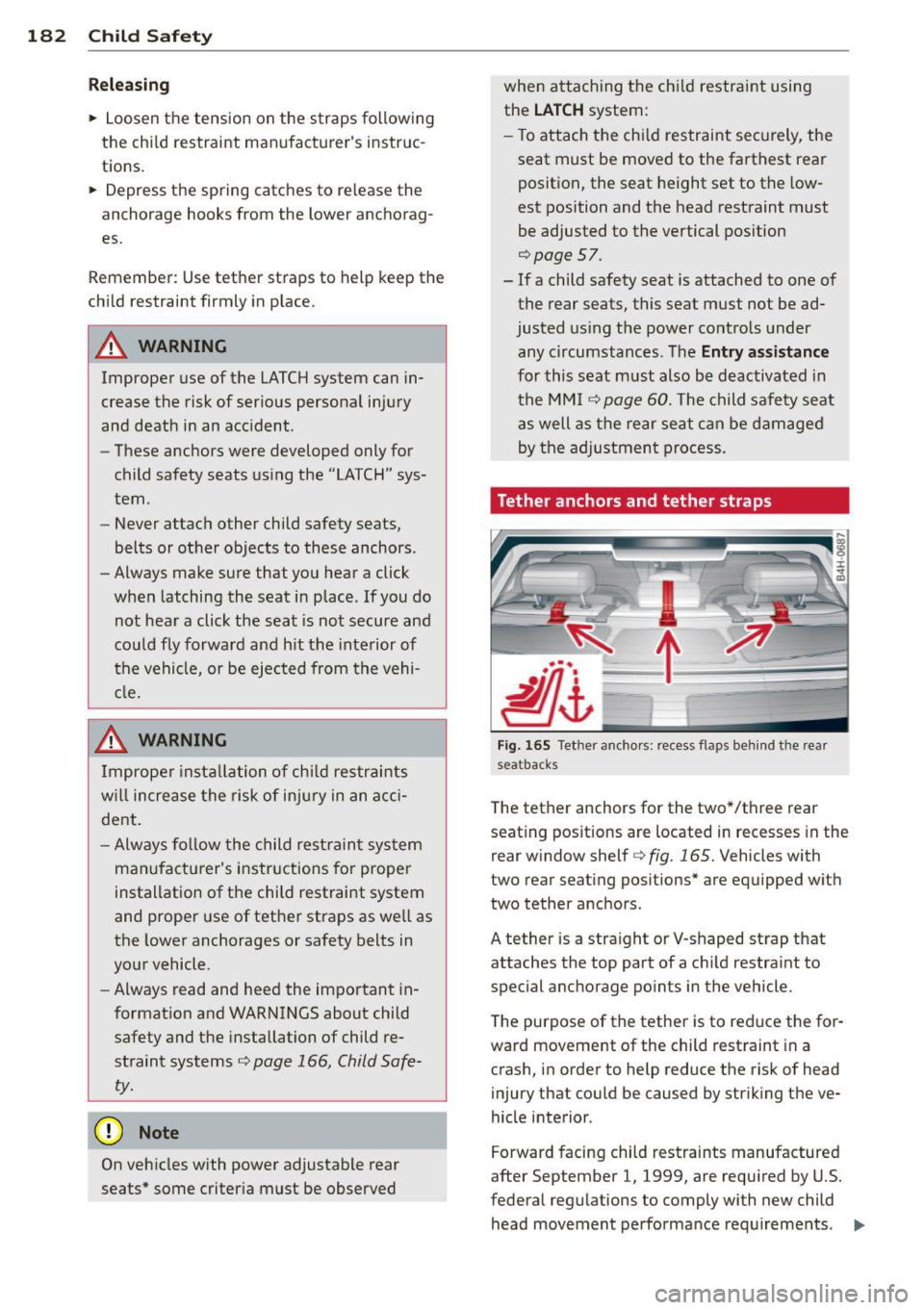
Fig. 1 65 Tet her ancho rs: recess flaps behind th e rea r
seatbacks
T he tether anchors for the two* /three rear
seat ing positions are located in recesses in the
rear w indow shelf
c:> fig . 165. Vehicles with
two rear seating positions* are equipped wit h
two tether anchors .
A tether is a stra ight or V-shaped strap that
attaches the top part of a ch ild restra int to
special anchorage po ints in the vehicle.
T he purpose of the tether is to reduce the for
ward movement of the child restraint in a crash, in order to help reduce the risk of head
injury that could be caused by strik ing t he ve
hicle interior .
Forward facing child restraints manufactured
after September 1, 1999, are requ ired by U.S.
federal regulations to comply with new child
head movement performance requirements . .,..
Page 185 of 300
These new performance requirements make a
tether necessary on most new chi ld safety
seats.
.&_ WARNING
Improper installation of child restraints
will increase the risk of injury and death in a crash.
- Always follow the instructions provided
by the manufacturer of the ch ild re
straint you intend to install in your Audi.
- Improper use of c hild restraint anchors
(including tether anchors) can lead to in
jury in a collision. The anchors are de
signed to withstand only those loads im
posed by correctly fitted ch ild restraints.
- Never mount two chi ld restraint systems
on one LATCH lower anc hor po int.
- Never attach two child restraint systems
to one tethe r strap or tether anchorage.
- Never attach a tether strap to a tie-down
hook in the luggage compartment .
- Never use child restraint tether ancho
rages to secure safety belts or other
k inds of occ upant restra ints.
- Never secure or attach any luggage or other items to the LATCH lowe r ancho
rages or to th e tethe r ancho rs.
- If a tether or other strap is used to at tach a child restraint to the front passen
ger seat, make sure that it is not so
t ight, that it causes the weight -sensi ng
mat to measu re mo re weight than is ac
t u a lly on the seat.
- T he he avier weig ht reg iste red ca n make
the Advanced Airbag Sys tem work as
tho ugh an adult were on the seat and de
ploy the Advanced Airbag w hen it must
be s uppressed causing serious or
even
fatal injury to the child .
- If you must install a rearward facing
child safety seat on the front passenger
seat because of exceptional circumstan
ces and the
PASS ENG ER AIR BAG OFF
light does not come on and stay on, im
med iate ly install the rear-facing chi ld
safety seat in a rear seating posit ion a nd
-
Child S afety 183
have the airbag system inspected by your
Aud i dealer.
Installing the upper tether strap on the
anchorage
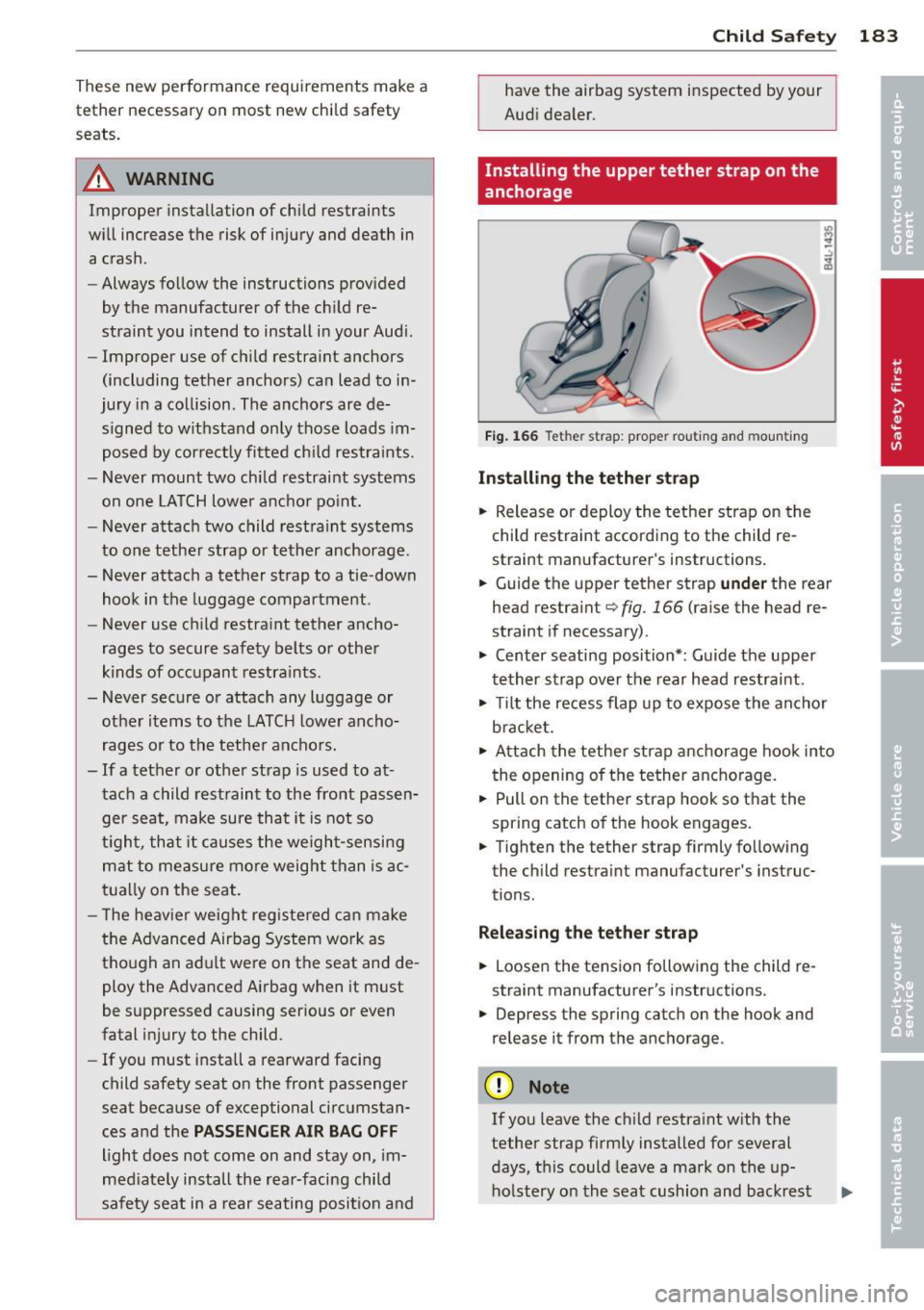
F ig . 1 66 Tet her st rap: proper ro uting and mounting
Installing the t eth er strap
.. Release or deploy the tether strap on the
child restraint according to the child re
straint manufacturer's instructions.
.. Guide the upper tether strap
unde r the rear
head restra int
qfig. 166 (ra ise the head re
straint if necessa ry) .
.. Center seating position*: Guide the upper
tether strap over the rear head restra int .
.. Til t the recess flap up to expose the an chor
bra cket.
.. Attach the tether strap anchorage hook into
the opening of the tether ancho rage .
.. Pull on the tether strap hook so that the
spring catch of the hook engages .
.. Tighten the tether strap firmly follow ing
the child restraint manufacturer's instruc
tions .
Relea sing the tether strap
.. Loosen the tension following the child re
straint manufacturer's instructions.
.. Depress the spring catch on the hook and
release it from the anchorage .
Q) Note
If you leave the child restraint w ith the
tether strap firmly installed for several
days, t his could leave a mark on the up
ho lstery o n the seat cushion and backrest
Page 186 of 300
184 Child Saf ety
in the area whe re the tether strap was in
stalled. The upholstery would a lso be per
manently stretched around the tether
strap. This applies especially to leather
seats.
Using tether straps on rearward-facing
child restraints
Currently , few rear-facing child rest rain t sys
tems come with a tether. P lease read and
heed the child restraint system manufactur
er's instructions carefully to determine how to
properly install the tether .
A WARNING
A child in a rearward -facing child safety
seat installed on the front passenger seat
w ill be seriously injured and can be k illed if
the front a irbag inflates -even with an Ad
vanced Airbag System .
- The inflating a irbag will hit the child
safety seat or infant carrier with great
force and w ill smash the ch ild safety seat
and child against the backrest, cente r
armrest, or door.
- A tight tet her or ot her st rap on a rear
wa rd-fa cing child restra int attached to
the front p assenger sea t ca n put too
much pressure on the weight -ma t in the
seat and register a heavier weight in the
Advanced Airbag System. The heavier
we ight registered can make the system
work as though an adu lt were on the seat
and dep loy the Advanced Airbag when it
must be suppressed ca using se rious or
even fatal injury to the child .
- If you must install a rearward facing child safety seat on the front passenger
seat because of exceptional circ umstan
c es and the
PASSENGER AIR BAG OFF
ligh t does no t come on and stay on, im
med iately install the rear -facing child
safety seat in a rear seating position and
have the a irbag system inspected by yo ur
Audi dealer.
Additional Information
Sources of information about child
restraints and their use
T he re a re a number o f sou rces of add itiona l
information abo ut child rest raint se lection, in
sta llation and use:
N HT SA advises that the bes t ch ild safety seat
is the one that fits your ch ild an d fits in you r
vehicle, and that yo u will use correct ly and
consistently .
T ry before yo u buy!
U.S National Highway Traffic Safety Admin
i s tration
T el.: 1-888-3 27-4 236 (TIY: 1-800- 424-9153)
www.n htsa.gov
National SAFE KIDS Campaign
T el.: (202) 662-0600
www.safe kids.o rg
Safety BeltSaf e U.S .A
Tel.: (800) 745-SAFE (English)
Te l.: (800) 7 47-SANO (Span is h)
www. carseat .org
Transport Canada Information C entre
Tel.: 1-800-333-0371 o r call
1-6 13-998-86 16 if you a re i n the Ottawa area
http://www.tc.gc.ca/e ng/ roadsafe ty/
men u.h tm
Audi Cu stomer R elation s
Tel.: (800) 822-2834
Page 187 of 300
Audi pre sense Preventative passenger
protection
App lies to veh icles: with Audi p re se nse
Audi pre sense can initiate steps to help pro
tect vehicle occupants in certain situations.
The funct ions descr ibed depend on equipment
installed in your vehicle:
Audi pre sense basic
The following functions can be triggered in
certain driving situations:
- Tightening of the safety belts (for example,
during heavy braking) : the front safety belts
have reversible belt pretensioners. If a colli
sion does not occur, the safety belts loosen
slightly and are ready to be tightened again.
- Closing the windows and the sunroof*: the
windows and the sunroof" close leaving a
small open gap .
Audi pre sense basic functions can be trig
gered at speeds above 20 mph (30 km/h).
Vehicles with Audi drive select*: the deploy
ment time is adapted in dynamic mode.
Audi pre sense front (vehicles with
adaptive cruise control*)
Audi pre sense front includes the functions in
Audi pre sense basic. In addition, within the
limits of the system, the likelihood of a colli
sion with the vehicle immediately ahead is al
so calculated . If the system senses an immi
nent collision the following functions can be
tr iggered:
- Audi braking guard
c> page 93
-Tightening the safety belts
- Closing the windows and the sunroof* ( leav-
ing a small open gap)
Audi pre sense rear (vehicles with Audi
side assist*)
Audi pre sense rear includes the functions in
Audi pre sense basic. In addition, the likeli
hood of a rear-end col lision with the vehicle
coming from behind is also calculated. If the
Audi pre sense 185
risk of a collision is detected, the following
functions can be triggered:
- Tightening the safety belts
- Closing the windows and the sunroof* (leav-
ing a small open gap)
- Adjusting the seats: the settings for the
power head restrains, the upper sections of
the backrests and the pneumatic side bol
sters* are optim ized for the front seats and
the outboard rear seats*. If a collision does
not occur, the previous seat settings are re
stored.
Audi pre sense plus
Audi pre sense plus includes the funct ions in
Audi pre sense front and Audi pre sense rear.
Error message
Audi pre sense: not available
Preventative passenger protection is not avail
able. See your authorized Audi dealer immedi
ately to have the malfunction corrected .
A WARNING
Audi pre sense cannot overcome the laws
of physics.
It cannot prevent a collision. Do
not let the increased safety provided
tempt you to take risks. This will increase
the risk of a collision and serious personal
injuries.
- The sensors cannot always detect all ob
jects . This increases the risk of a colli
sion.
-Audi pre sense does not detect people or
animals or objects that are crossing the
veh icle's path
c> page 87.
- The radar sensor's vision can be reduced
by heavy rain, ice, snow, heavy road spray
and reflections from guard rails, tunnel
entrances, etc. These and similar condi
tions can prevent vehicles from be ing ac
curately detected and in some cases they
may not be detected at all.
Ill-
•
•
Page 195 of 300

than is being generated and ensures an optimal state of charge for the battery.
@ Tips
- But even energy management cannot
negate the limits o f physics. Consider
that the power and life of a battery are
li mited.
- If starting ab ility is threatened, the indi
cator light
(•i appears ~ page 16, 0
Battery.
What you should know
The highest priority is given to maintaining
starting capability.
The battery is severely taxed in short-dis tance
d riving, in city traffic and during the co ld time
of year . Abundant e lectrica l energy is re
q ui red, but only a litt le is generated. It is also
cr itical if the engine is not runn ing and electri
cal components are turned on. In th is in
stance energy is being consumed but none is
be ing generated .
It is in precisely these situations that you w ill
notice energy management actively regulat
i ng the distribution of energy.
Vehicle sta nds for an ext ended p eriod
If you do not drive you r vehicle over a period
of several days or weeks, electrical compo nents are grad ually cut back or switched
off .
This reduces energy consumption and main
tains sta rting capab ility over a longer per iod.
Some of the conven ience f unctions may not
ope rate, such as the inter ior lig hts or the
power sea t adjustment. The conven ien ce
f u nctions w ill be ava ilable again when you
switch on the ignit ion and start the engine .
With the engine turned off
If you listen to the radio, for example, with
the engine turned
off or use other MMI func
tions, the battery is being discharged .
If starting capability is jeopa rdized due to en
ergy consumpt ion, the fo ll ow ing warning ap
pears in the MMI display :
Intellig ent technolog y 193
Plea se start the engine soon or the sy stem
will be turned off .
The wa rni ng ind ic ates that the system wi ll be
tu rned
off automatically a fter 3 minu tes. If
you w ish to continue using the funct ions, yo u
have to start the engine.
With the engine running
Althoug h elec trical energy is generated when
t h e ve hicl e is being driven, t he battery can be
come d ischarged. This happe ns mostly when
little energy is being generated and a great
deal consumed and the battery's state of
charge is not opt imal.
T o b ring the energy ba lance back in to equili
brium, consumers which require especially
l a rge amounts of energy a re temporari ly cut
back or sw itched
off. Heat ing systems in par
ticular require a great deal of energy. If you notice, for example, that the heated seats* or
the heated rear window are not heating, they
have been temporarily cut back or switched
off . These systems w ill be available again as
soon as the ene rgy balance has been restored.
You w ill also notice that engine id le speed has
been increased slightly . Thi s is normal and not
a cause for concern. By inc reasing engi ne id le
speed the additional e nergy requi red is gene r
ated and the b attery is charged.
•
•
Page 211 of 300
substance use d for u ndercoating cou ld
overheat an d cause a fire.
- Always read and heed all WARNINGS and
other information
¢ page 203.
Exhaust tail pipes
Road sa lt and other corros ive materials will
damage the mater ial in the exhaust tail p ipes
if they are not cleaned regu larly . Do not clean
the ta il p ipes with wheel cleaner, paint polish,
chrome polish or othe r abrasive cleaners .
C lean the tail p ipes with ca r ca re products
that are s uita ble for stain less stee l.
Your authorized Audi dealer can provide clean i ng p rod ucts that have been tested and ap
p roved fo r your vehicle.
Care of interior
Infotainment components
The MMI/RSE* disp lay may be cleaned with a
soft cloth and commercially-ava ilable "LCD
cleaner" . The cloth should be coated light ly
when the clean ing solution when cleani ng the
d isplay.
The MMI/RSE* contro ls must be cleaned first
with a brush so that dirt does not enter the
un it o r enter between the buttons and the
h ousing. Then w iping the controls with a clot h
dampened wi th d ish dete rgent and water is
recommended.
(D Note
To preve nt sc ratches, only clean the dis
p lay when it is d ry.
- To p reven t damage, ma ke s ure fluids do
not enter the cont rols.
Aluminum trim
Use only neutral-pH produc ts to remove spots
and depos its from alum in um s urfaces.
C hr ome ca re products and alkaline cleaners
will attack alum in um s urfaces and can dam
age them over time.
Cleaning and protec tion 209
A WARNING
A lways read and heed all WARNINGS and
other information
¢page 203.
Fabrics and fabric coverings
Fabr ics and fabric cover ings (e.g. seats, door
trim pa ne ls, etc.) shou ld be cleaned at regular
i n tervals w it h a vac uum cleaner. This removes
s ur face di rt particles which cou ld become em
bedded in the fabri c throug h use. Ste am
cleaners sho uld not be used, beca use the
steam tends to p ush the dirt deeper into the
fabric and lock it there .
Normal cleaning
Generally, we recommend using a soft sponge
o r a lint -free microfibe r clo th to the clean fab
ric. Br ushes shou ld only be used for carpets
and floor mats, since other fabric surfaces
could be harmed by br ushes.
Norma l su rface s tains c an be cleaned using a
commerc ially availab le foam cleaner . Spread
the foam on the s urface of t he fabric with a
soft sponge and work it in gently. Do not satu
rate the fabric. T hen pat the foam dry us ing
absorbe nt, dry cloths (e.g. m icrofiber cloth)
and vacuum it after it has dried completely.
Cleaning stains
Stains caused by beverages (e .g. coffee, fr uit
juice, etc.) can be treated with a mild deter
gent solution. Apply the detergent sol ution
with a spo nge. In the case of stubborn stains,
a detergent paste can be applied directly to
the stain and worked into the fabric. After
wards, use copious amounts of clean water to
remove the rem aining de terge nt. Apply the
w at er wit h a d am p clot h or sponge a nd pat
the fabric dry with an abso rbent, dry clot h.
Stains from choco late or makeup should have
de terge nt pa ste (e.g. o x-gall soa p) rubbed i n
to them. Afterwa rds, remove the soap wi th
wa ter (damp sponge) .
Alcohol can be used to treat stains from grease, o il , lipstic k or a ballpoin t pen. M elted ..,_ •
•