ECU AUDI A8 2012 Owner's Manual
[x] Cancel search | Manufacturer: AUDI, Model Year: 2012, Model line: A8, Model: AUDI A8 2012Pages: 300, PDF Size: 75.06 MB
Page 140 of 300
138 Safet y belt s
To provide maximum protection, sa fety belts
must always be positioned correctly on the
wearer 's body .
.,. Adjust the front seat and head restra int
properly ¢
page 54, General recommenda
t ions .
.,. Hold the be lt by the tongue and pull it
evenly across the chest and pelvis ¢
_&..
.,. Insert the tongue into the correct buckle of
your seat until you hear it latch securely
¢ fig . 141.
.,. Pull on the be lt to make sure that it is se-
cu rely latched in the buckle .
Automatic safety belt retractors
Every safety belt is equipped w ith an automat
i c belt retractor on the shoulder belt. Th is fea
ture locks the be lt when the belt is pulled out
fast, dur ing hard braking and in an accident.
The belt may also lo ck when you drive up or
down a steep hill or throug h a sharp curve.
During normal driving the belt lets you move
freely.
Safet y belt pretensioner s
The safety belts are equipped with a be lt p re
tensione r that helps to t ighten the safety bel t
and remove s lack when the pretensio ner is ac
tivated ¢
page 140. The function of the pre
tensioner is monitored by a warning light
c:;, page 18 .
Switchable locking feature
E very safe ty belt excep t the one on the driver
seat is eq uipped w ith a swit chab le locking fea
ture that
mus t be used when the safety bel t is
used to attach a child seat . Be s ure to read the
important information abo ut this feat ure
¢ page 175.
A WARNING
Improperly positioned safety belts can
cause-se rious injury in an accident
¢ page 138, Safety belt position .
-Safety belts offer optimum pr otection
only when the seatback is upright and
belts are prope rly positioned on the
body.
-
- Never attach the safety belt to the buck
le for another seat. Attaching the belt to
the wrong buckle will reduce safety be lt
effectiveness and can cause serio us per
sonal injury .
- A passenger who is not properly restrain
ed can be seriously injured by the safety
be lt itself when it moves from the stron
ge r parts of the body into cr itica l ar eas
like the abdomen.
- Always lock the conve rtible locking re
t ra cto r when you are se cu ring a c hild
s eat in the veh icle ¢
page 177.
(D Tips
For i nforma tion on safety belt pretension
ers, refer to¢
page 140.
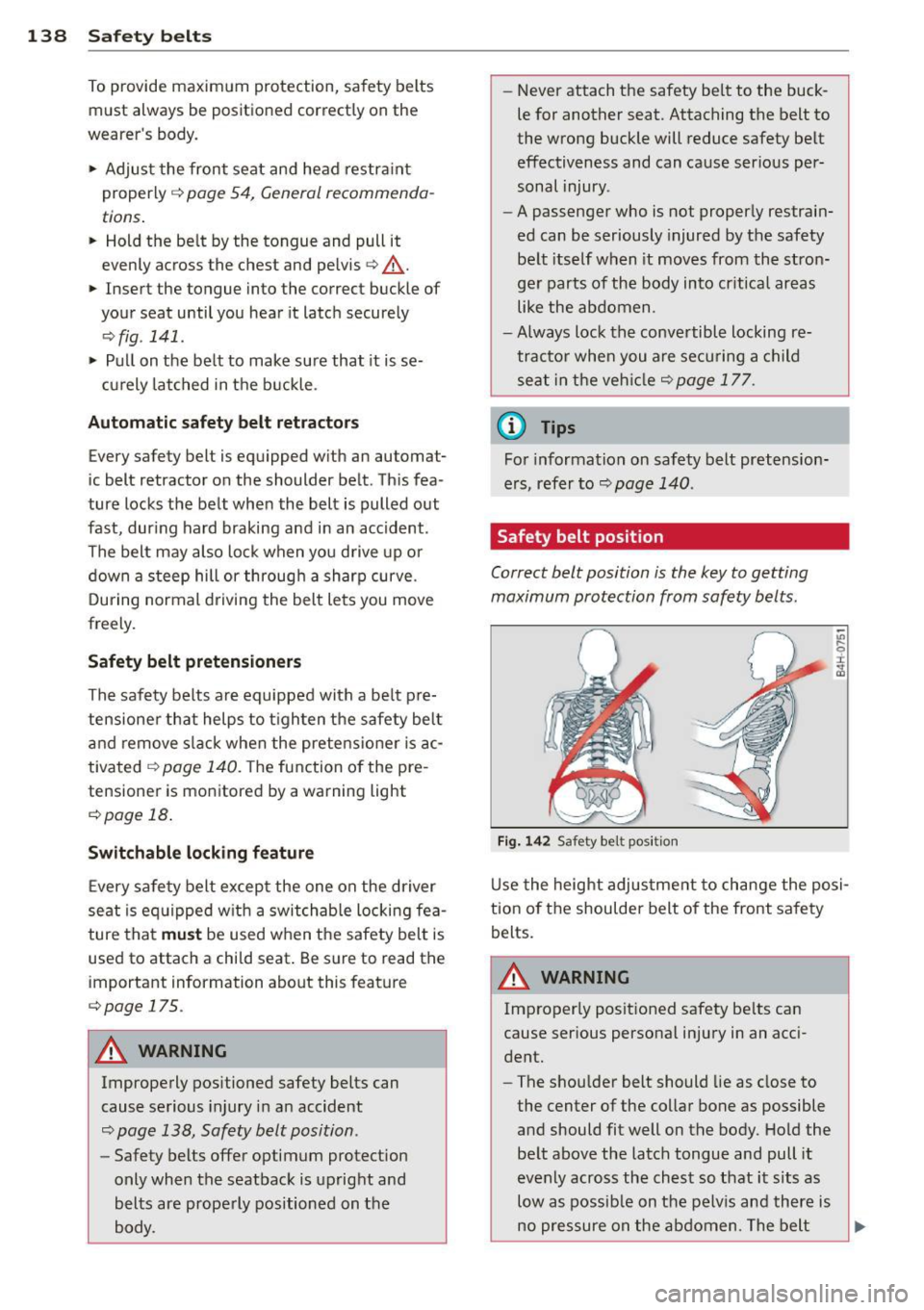
Safety belt position
Correct belt position is the key to getting
maximum protection from safety belts.
F ig . 14 2 Safety bel t pos it ion
U se the heig ht adjus tme nt to ch ange the posi
tio n of the shoulder belt of the front sa fety
belts.
A WARNING
'-
Improperly positioned safety be lts can
cause ser ious personal inju ry in an acc i
dent.
-
- The shou lder belt should lie as close to
the center of the collar bone as possible
and should fit well on t he body. Hold the
be lt above the latch tongue and pull it
evenly across the chest so that it sits as low as possib le on the pelv is an d th ere is
no pressure o n the abdomen. The belt ..,.
Page 141 of 300
should a lways fit snugly¢ fig. 142. Pull
on the belt to tighten if necessary.
- A loose-fitting safety be lt ca n cause seri
o us injuries by s hifting its position on
your body from the strong bones to more vulnerab le , soft tissue and cause serious
injury .
- Always read and heed all WARNINGS and
other impo rtant information
¢ page 137.
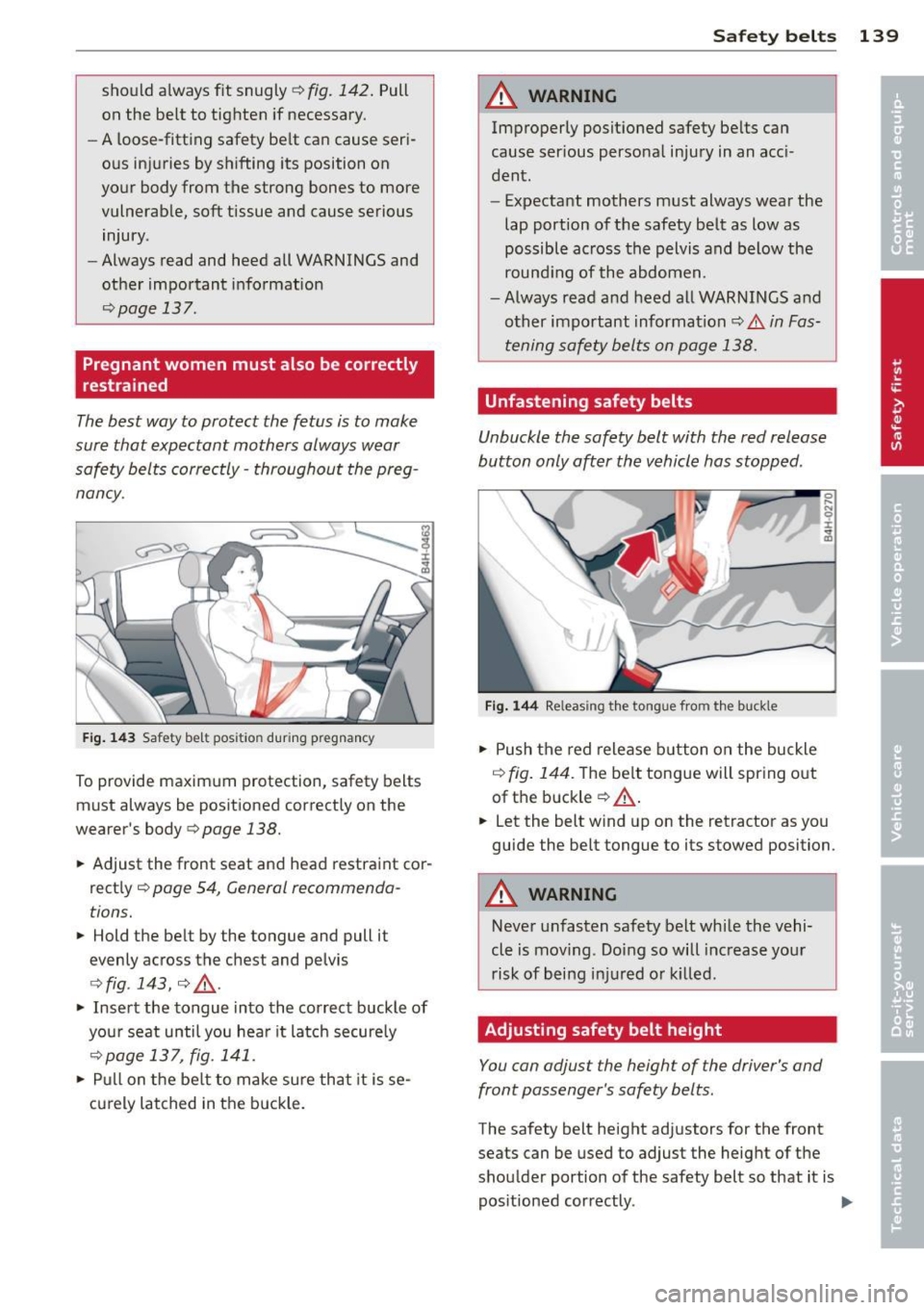
Pregnant women must also be correctly
restrained
The best way to protect the fetus is to make
sure that expectant mothers always wear
safety belts correctly -throughout the preg
nancy.
F ig . 14 3 Safety belt pos it io n during p regna ncy
To provide maxim um protection, safety belts
must always be posit ioned correctly on the
wearer's body
c> page 138.
.,. Adjust the front seat and head restra int cor
rect ly ¢
page 54, General recommenda
tions.
.,. Hold the belt by the tongue and pull it
evenly ac ross the chest and pelvis
¢ fig . 143, ¢ &_ .
.,. Insert the tongue into the correct buckle of
your seat until you hea r it latch securely
¢page 137, fig. 141.
.,. Pull on the be lt to make sure that it is se
c u rely latched in the buckle.
Safety belts 139
A WARNING
Improperly positioned safety be lts can
cause ser ious perso nal inju ry in an acc i
dent.
- Expectant mothers must always wear the
lap portion of the safety belt as low as
possible across the pelvis and below the
round ing of the abdomen.
- Always read and heed all WARNINGS and
other important information¢
& in Fas
tening safety belts on page 138.
Unfastening safety belts
Unbuckle the safety belt with the red release
button only a~er the vehicle has stopped .
Fig . 144 Re leas ing the tong ue fro m the bu ckle
.,. Push the red release b utton on the buckle
o:::> fig. 144. T he be lt tongue will spring out
of the buckle
¢ .&_ .
0 .... N 9 I ;&
.,. Let the belt w ind up on the retractor as you
guide the belt tongue to its stowed position .
A WARNING
=
Never unfasten safety belt while the vehi-
cle is mov ing . Doing so will increase your
risk of being inj ured o r killed.
Adjusting safety belt height
You can adjust the height of the driver's and
front passenger 's safety belts.
The safety belt height adjustors for the front
seats can be used to adjust the height of the
shou lder portion of the safety belt so that it is
pos itioned correctly . .,,..
Page 177 of 300

the child's body and the front of the passen
ger compartment, the airbag can inflate com
p letely and provide supplemental protection
in certa in frontal col lisions .
_&. WARNING
Not using a booster seat, us ing the boos
ter seat improperly, incorrect ly installing a
booster seat or using the vehicle safety
belt improperly increases the risk of seri
ous personal injury and death in a collision
or other eme rgency s ituation. To help re
duce the risk of serious persona l injury
and/or death:
- T he shoulder be lt mus t lie as close to the
center of the child's co llar bone as possi
ble and must lie flat and sn ug on the up
per body . It must never lie across the
throat or neck. The lap belt must lie across the pelvis and never across the
stomach or abdomen . Make sure that the
belt lies flat and snug. Pull on the belt to
t ighten if necessary.
- Failure to properly route safety belts over a ch ild's body will cause severe inju
ries in an acc ident or other emergency
situation ¢
page 134 .
-The rea r side of the child safety seat
sho uld be positioned as close as possible
to the backrest on the ve hicle seat. Ad
just the rear se at head res traint if it is
difficult to install the child seat w ith the
head restraint in place¢
page 128. Driv
ing with head restraints that are not
properly ad justed increases the risk of
serious or fatal neck injury dramatically.
- Children on the front seat of any car,
even with Advanced A irbags, can be seri
ous ly injured or even killed when an a ir
bag inflates.
- Never let a child stand or knee l on any
seat, for examp le the front seat.
- Never let a child ride in the cargo area of
your vehicle.
-Always remember that a ch ild lean ing
forward, sitt ing s ideways or out of posi
t io n in any way during an acc ident can be
Child Sa fet y 175
struck by a dep loying a irbag . This will re
sult in ser ious personal injury or death.
- If you must install a booster seat on the
front passenger seat because o f excep
tional circumstances the
PASSENGER
AIR BAG OFF
li ght must come on and
stay on, whenever the ignition is switch
ed on.
- If the
PASSENGER AIR BAG OFF light
does not come on and stay on, pe rform
the checks descr ibed¢
page 153, Moni
toring the Advanced Airbag System.
- Take t he chi ld restraint off the front pas
senger seat and install it prope rly at one
of t he rear seat positions if the
PASSEN
GER AIR BAG OFF
light does not stay on
whenever the ignit ion is switched on .
- Always rea d and heed all WAR NIN GS
wheneve r using a child res tra ine d in ave
hicle is being used
¢ page 134, Safety
belts,
¢ page 142, Airbag system and
¢ page 166 , Important things to know .
Installing a child safety
seat
Securing a child safety seat using a
safety belt
Safety belts for the rear seats and the front
passenger can be locked with the convertible locking retractor to properly secure child
safety seats.
The safety belts emergency locking retractors
for the rear seats safety belts and for the
front passenger's seat safety belt have a con
vertib le locking retractor for child restraints.
The safety belt must be locked so that be lt
webb ing cannot unreel. The retractor can be
activated to loc k the safety belt and prevent
the safety be lt webb ing from loosening up
dur ing norma l dr iving . A ch ild safety seat can
o nl y be properly installed when t he safety bel t
is loc ked so that t he chi ld and child sa fety
seat w ill stay in place.
Always remember: Even tho ugh you r vehicle is
equipped wi th an Advanced Airbag system, all
c hil dren, especially those 1 2 years and .,. •
•
Page 178 of 300
176 Child Safety
younger, should always ride in the back seat properly restrained for their age and size.
A WARNING
Improperly installed child safety seats in
crease the risk of serious personal injury
and death in a collision .
-Always make sure that the safety belt re tractor is locked when installing a child safety seat. An unlocked safety belt re
tractor cannot hold the child safety seat
in place during normal driving or in a
crash .
- Always buckle the child safety seat firmly
in place even if a child is not sitting in it .
A loose child safety seat can fly around
during a sudden stop or in a collision.
- Always make sure that the rear seat
backrest to which the center rear safety
belt is attached is securely latched when
ever the rear center safety belt is being
used to secure a child restraint.
- If the backrest is not securely latched,
the child and the child restraint will be
thrown forward together with the back rest and will strike parts of the vehicle
interior. The child can be seriously in
jured or killed.
- Never install rear-facing child safety
seats or infant carriers on the front pas senger seat . A child will be seriously in
jured and can be killed when the passen
ger airbag inflates .
- The inflating airbag will hit the child
safety seat or infant carrier with great
force and will smash the child safety seat
and child against the backrest, center
armrest, door or roof.
- Always install rear-facing child safety
seats or infant carriers on the rear seat.
- Forward-facing child safety seats or in
fant carriers installed on the front pas
senger's seat may interfere with the de
ployment of the airbag and cause serious
injury to the child.
- It is safer to install a forward-facing
child safety seat on the rear seat. -
Always read and heed all WARNINGS
whenever using a child restrained in ave
hicle is being used
c> page 166. Special
precautions apply when installing a child
safety seat on the front passenger seat
c:> page 144, Child restraints on the front
seat -some important things to know.
A WARNING
-
Always take special precautions if you
must install a forward or rearward-facing
child restraint on the front passenger's
seat in exceptional situations:
- Whenever a forward or rearward-facing
child restraint is installed on the front
passenger seat, the
PASSENGER AIR
BAG OFF
light must come on and stay on
whenever the ignition is switched on.
- If the
PASSENGER AIR BAG OFF light
does not come on and stay on, perform
the checks described
c> page 153, Moni
toring the Advanced Airbag System.
- Take the child restraint off the front pas
senger seat and install it properly at one
of the rear seat positions if the PASSEN
GER AIR BAG OFF
light does not stay on
whenever the ignition is switched on.
- Improper installation of child restraints
can reduce their effectiveness or even
prevent them from providing any protec
tion.
-An improperly installed child restraint
can interfere with the airbag as it de ploys and seriously injure or even kill the
child.
- Always carefully follow the manufactur
er's instructions provided with the child
safety seat or carrier.
- Never place additional items on the seat
that can increase the total weight regis
tered by the weight-sensing mat and can
cause injury in a crash.
A WARNING
Forward-facing child restraints:
Page 181 of 300
These new performance requirements make a
tethe r necessary on most new chi ld seats.
I ns tal ling a child restraint that req uires a top
tether witho ut one can serio usly impair the
performance of the child restraint and its abil
ity to protect the child i n a co llision . Installing
a child restraint that requires a top tether
wi thout the top tether may be a vio lation of
state law.
Child restraint manufacturers offer LATCH lower anchorages on the ir ch ild seats with
hook-on or push-on connectors attached to
adjustable straps.
In addition to the LATCH lower anchorages,
these child restraint systems usually require
the use of tether straps to help keep the child
restraint firmly in place.
A WARNING
Improper installation of child restraints
w ill increase the risk of injury and death in
a crash .
- Always follow the instructions prov ided
by the manufacturer of the ch ild re
st raint you intend to install in your veh i
cle.
- Never install a child restraint witho ut a
properly attached top tether s trap if the
child restrain t manufacturer's instruc
t ions requ ire the top tether strap to be
used.
- Improper use of c hild restra int LA TCH
lower anchorage points can lead to injury
in a collision . The LA TCH lower anchorage
points are des igned to w ithstand only
those loads imposed by correct ly fitted
child restraints.
- Never mount two chi ld restraint systems
on one LATCH lower anc horage point.
- Never secure o r attach any l uggage or
other item to the LATCH lower anchorag
es.
(D Tips
- In Canada, the terms "top tether" with
"lower universa l anchorages" (or "lower
-
Child S afety 1 79
universal anchorage bars") a re used to
describe the system .
- In o ther coun tries, the term " ISOFIX" is
used to describe the lower anchorages .
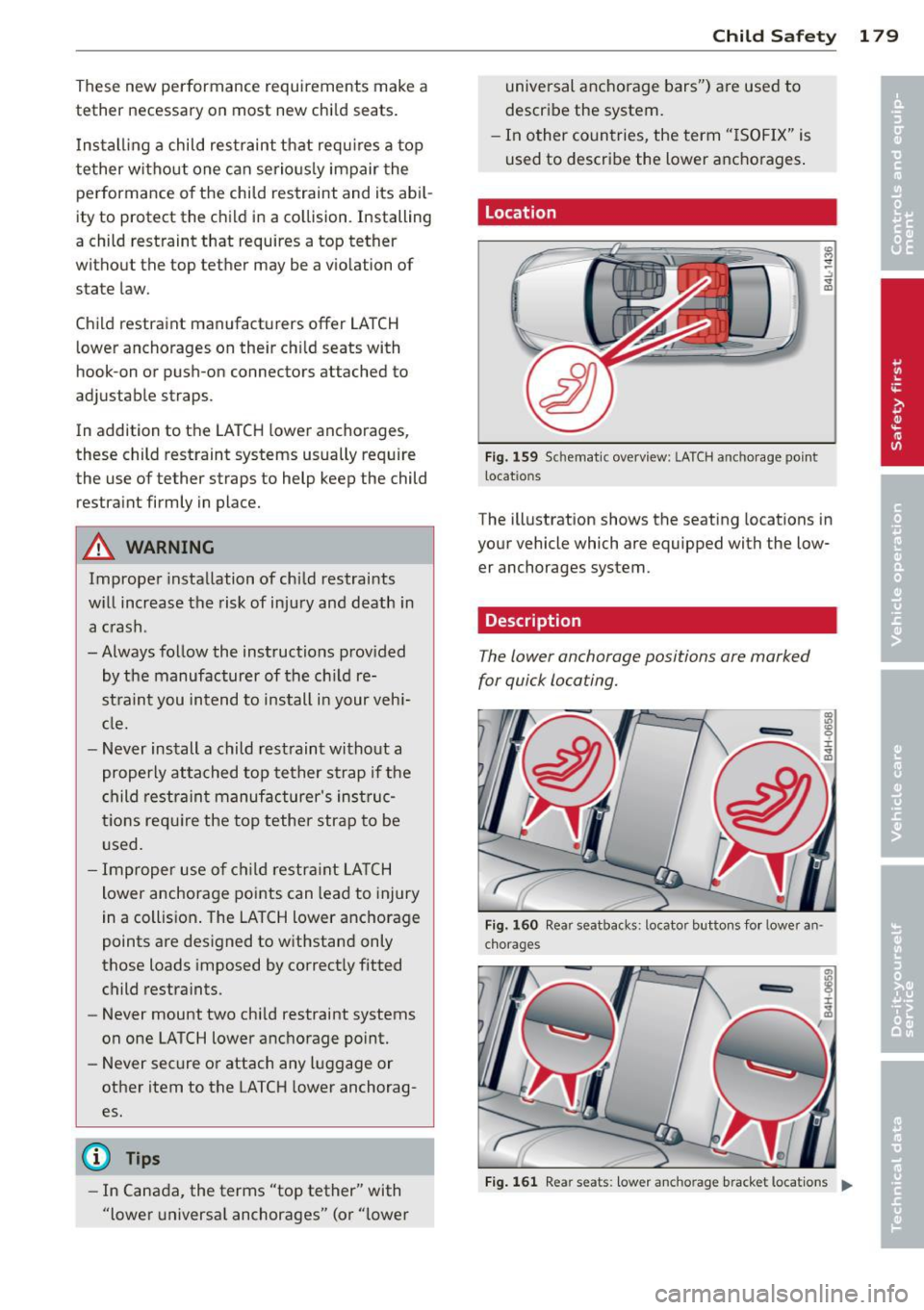
Location
Fig. 159 Sc hemat ic ove rv iew : LAT CH a nch orag e poin t
l ocat io n s
T he illustration shows the seating locations in
your vehicle which are equipped with the low
er anchorages system .
Description
The lower anchorage positions are marked
for quick loca ting.
Fig. 160 Rea r seat backs : locato r but tons fo r lowe r an ·
cho ra g es
r
~ I
Fi g. 1 61 Re ar seat s: low er an cho rage bra cket lo cat ion s IJI,-
Page 182 of 300
180 Child Safety
Attachment locator markers for lower
anchorages
Circular locator buttons on the rear seatback
indicate the lower anchorage locations on the
rear seating positions¢
fig. 160 .
Lower anchorages
The lower anchorage attachment points are
located between the rear seatback and rear
seat cushion
¢ fig . 161.
Lower anchorages secure the child restraint in
the seat witho ut using the vehicle 's safety
belts. Anchorages provide a secure and easy
to-use attachment and minimize the possibili
ty of improper chi ld restraint installation.
All chi ld restraints manufact ured after Sep
tember 1, 2002, must have lower anchorage
attachments for the
LATCH system.
Remember that the lower anchorage points
are only intended for installation and attach
ment of child restraints specifically certified
for use with
LATCH l ower anchorages. Child
restraints that are not equipped with the low
er anchorage attachments can still be instal led in compliance with the c hild restra int
manufacturer's instructions on using vehicle
safety belts.
,&. WARNING
Improper use of LATCH lower anchorages
can cause serious personal injury in an ac
cident .
- Always carefully follow the child re
straints manufacturer's instructions for
proper installation of the child restraint
and proper use of the lower anchorages
or safety belts in your vehicle .
- Never secure or attach any luggage or
other items to the
LATCH lower ancho
rages.
-Always read and heed the important in
formation about child restraints in this
chapter and WARNINGS
¢page 166,
Child Safety.
Guidance fixtures for lower anchorages
Special guidance fixtures increase the conven
ience of the lower anchorages and are availa
ble from your authorized Audi dealer.
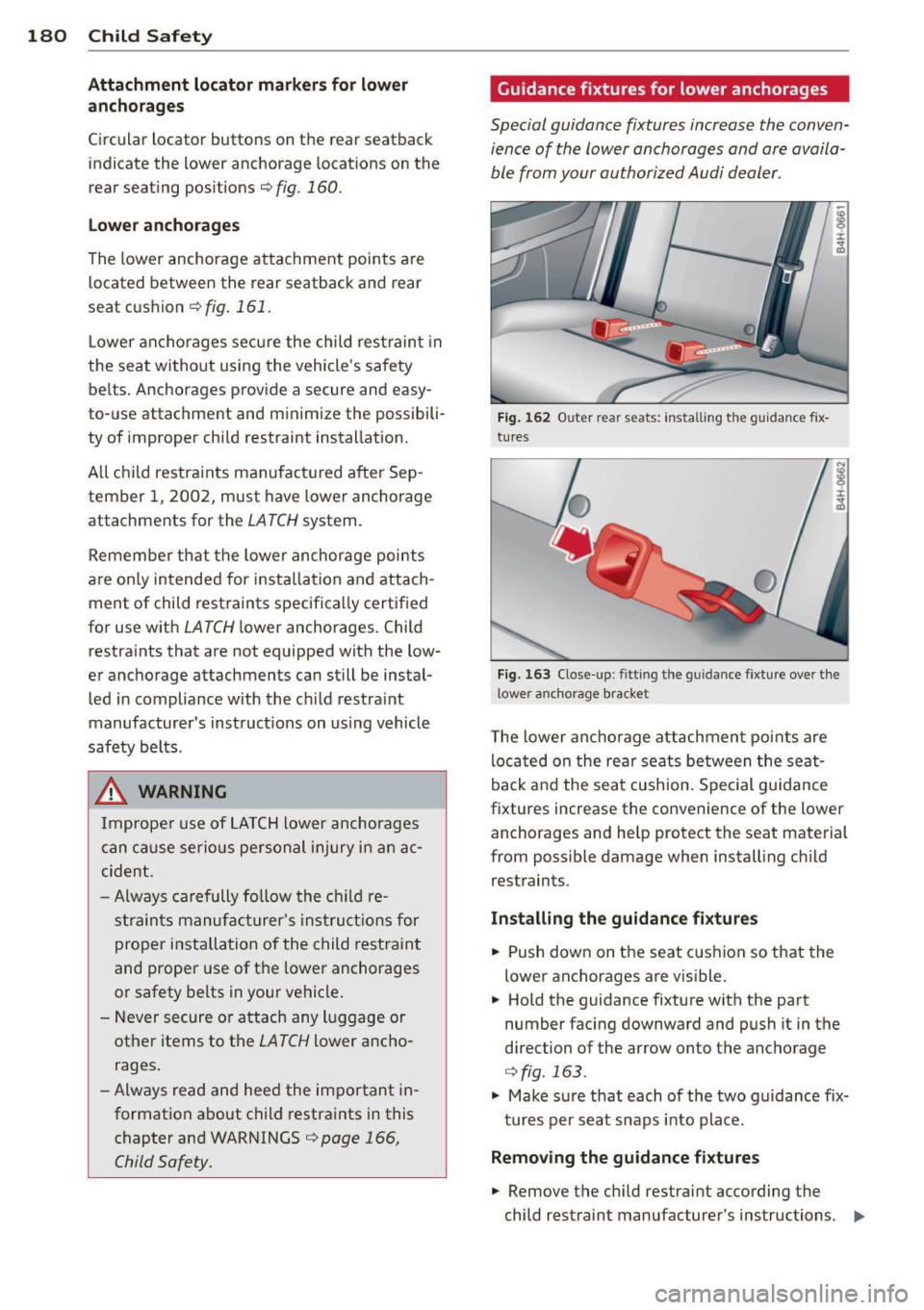
Fig. 1 62 Outer rear seats: inst all ing th e guidanc e fix
tures
Fig . 163 Close-up: fitting th e g uida nce fixture over t he
lower anchorage bracket
T he lower anchorage attachment points are
located on the rear seats between the seat
back and the seat cush ion. Special guidance
fixtures increase the convenience of the lower anchorages and help protect the seat material
from possible damage when installing ch ild
restraints.
Installing the guidance fixtures
.,. Push down on the seat cushion so that the
lower anchorages are visible.
.,. Hold the guidance fixture with the part
number facing downward and push it in the
direction of the arrow onto the anchorage
¢fig . 163 .
.,. Make su re that each of the two guidance fix
tures per seat snaps into place .
Removing the guidance fixtures
.,. Remove the chi ld restraint according the
child restraint manufacturer's instructions. ..,.
Page 183 of 300
.. Push down on the seat cushion so that the
lower anchorages are visib le .
.. Pull
off the guidance f ixtures from the low
er anchorages.
.. Always remove the guidance fixtures and
keep them in a safe place when not in use .
You may find it easier to install child re
straints equipped with hooks attached to
straps without the guidance f ixtures in place.
If th is is the case, remove the guidance fix
tures by pull ing them
off the anchorages .
H owever, the guidance fixtures can help you
to locate the
LATCH anchorages.
& WARNING
Imprope r use of tether anchorages or low
er anchorages can cause serious persona l
injury in a crash .
- Always carefully fo llow the child re
straint manufacturer's instruct ions for
proper installation and use of child re
straint systems .
- Never use the
LATCH or tethe r anchorag
es to attach safety belts or other kinds of
occupant restraints.
- Child restraint tether attachments and
lower attachments are only designed to
secure a child restraint that has bee n
equipped to use these anchorages.
- Tether anchorages and lower anchorages
are designed to withstand only those
loads imposed by correctly fitted chi ld
res traints. Under no circumstances can
they be used safely for adu lt or ch ild
safety belts o r harnesses.
- Never mount more than one ch ild re
straint to a sing le te ther or to a lower an
c ho rage point. A ttaching two child re
strain ts to a single anchor age point can
cause the anchorage to fail and cause se
rious persona l injury in a crash .
(D Note
-Remove the guidance fix ture s before
fo ld ing the rea r seatback to p reven t
damag ing t he seat c ushion .
Child S afety 181
- To attach the chi ld restraint sec urely, the
seat must be moved to the farthest rear
position, the seat he ight set to the low
est position and the head restraint must
be adjusted to the vertical pos ition
9 page 57.
-If you leave the guidance fixtures instal
led for several days, they could leave a
mark on the upholstery on the seat cush
ion and back rest in the area that the
guidance f ixtures were installed. The up
holste ry would also be permanen tly
st re tched aro und the guidance fixtures.
T his app lies especia lly to leather seats .
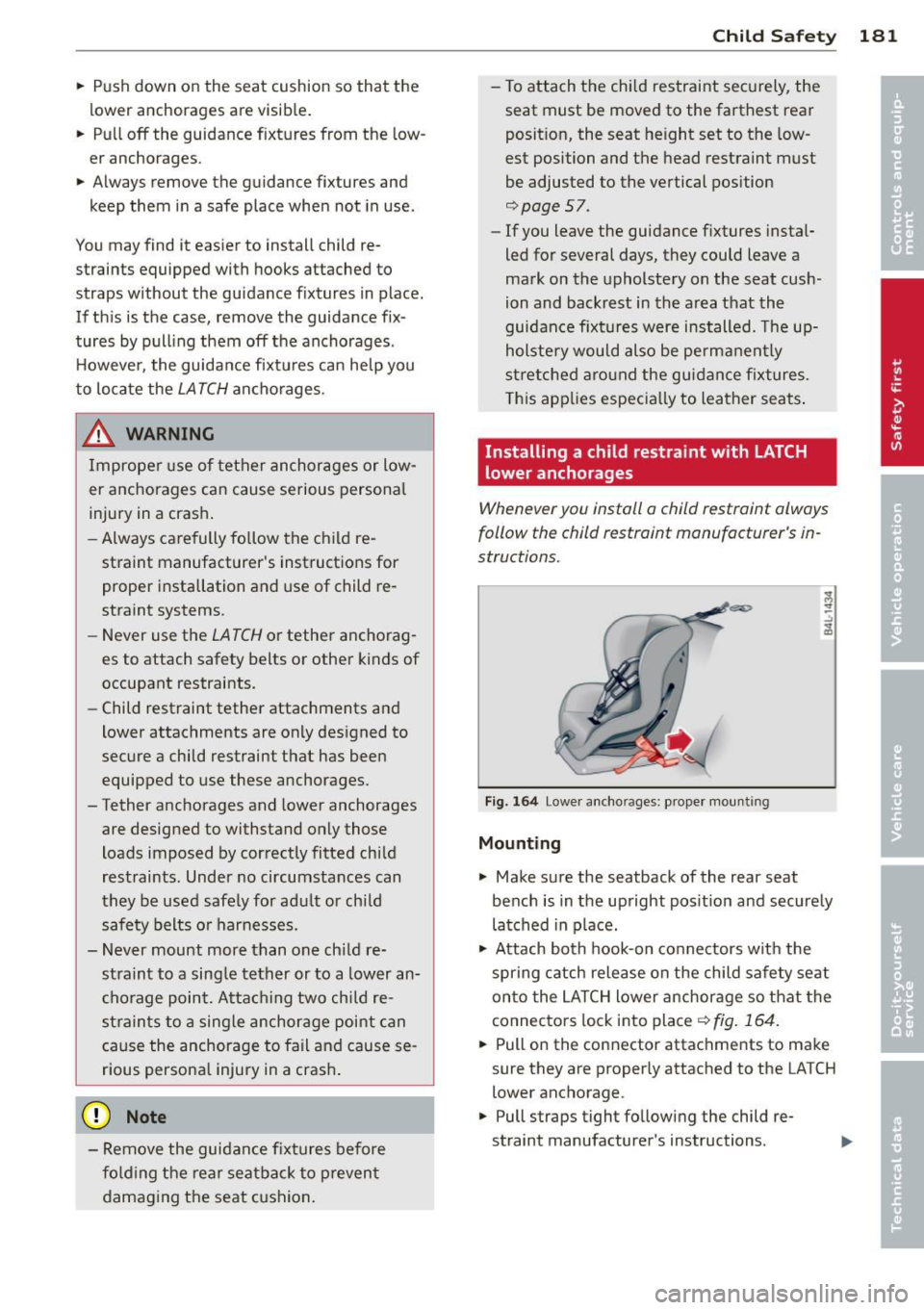
Installing a child restraint with LATCH
lower anchorages
Whenever you install a child restraint always
follow the child restraint manufacturer's in
structions.
F ig. 164 Lowe r anchorages: prope r mount ing
Mounting
.. Make sure the seatback of the rear seat
bench is in the upright pos it ion and securely
latched in place.
.,. Attach both hook-on co nnectors wit h the
spring catch release on the child safety seat
onto the LATCH lower anchorage so that the
connectors lock into place
9 fig. 164.
.. Pull on the connector attachments to make
sure they are proper ly attached to the LATCH
lower anchorage .
.. Pull straps tight following the child re
straint manufacturer's instructions .
Page 184 of 300
182 Child Safet y
Relea sin g
.,. Loosen the tension on the straps following
the chi ld restraint manufacturer's instruc
tions.
.,. Depress the spring catches to release the
anchorage hooks from the lower anchorag
es.
Remember: Use tether straps to help keep the
child restraint firmly in p lace.
A WARNING
Improper use of the LATCH system can in
crease the risk of serious personal injury
and death in an acc ident.
- These anchors were developed only for
child safety seats us ing the "LATCH" sys
tem .
- Never attach other child safety seats,
belts or other objects to these anchors .
- Always make sure that you hear a click
when latching the seat in place. If you do
not hear a click the seat is not secure and
could fly forward and h it the interior of
the vehicle, or be ejected from the vehi
cl e.
&_ WARNING
Imprope r insta llation of chi ld restrai nts
w ill increase the risk of inju ry in an acc i
dent.
- Always fo llow the child restraint system
man ufa cturer's instr uctions for proper
installation of the child restraint system
and proper use of tether straps as we ll as
the lower anchorages or sa fety belts in
your vehicle .
- Always read and heed the important in
format ion and WARNINGS about child
safety and the installation of child re
straint systems
c:> page 166, Child Safe
ty.
(D Note
On veh icles with p ower adjustable rear
seats* some criteria must be observed when attaching the chi
ld restraint using
the
LATCH system:
- T o attach t he ch ild restraint sec urely, the
seat must be moved to the farthest rear
posit ion, the seat he ight set to the low
est position and the head restraint must
be adjusted to the vertical position
c:>page 57.
- If a child safety seat is attached to one of
the rear seats, this seat must not be ad
justed us ing the power controls under
any c ircumstances . T he
Entry as sistanc e
for this seat must also be deactivated in
the MM I
c:> page 60. The child safety seat
a s well as the rear se at can be damaged
by the adj ustment process .
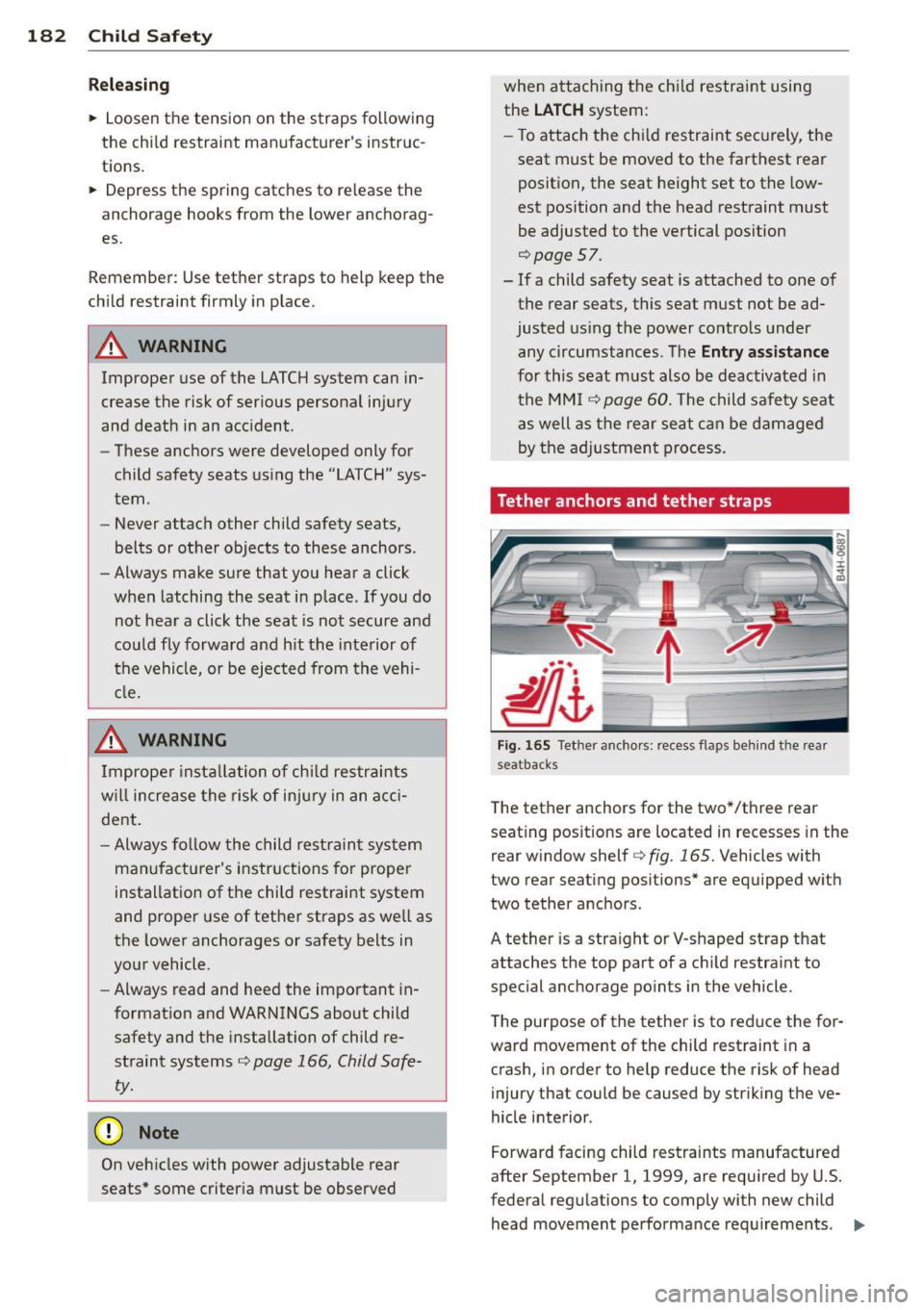
Tether anchors and tether straps
Fig. 1 65 Tet her ancho rs: recess flaps behind th e rea r
seatbacks
T he tether anchors for the two* /three rear
seat ing positions are located in recesses in the
rear w indow shelf
c:> fig . 165. Vehicles with
two rear seating positions* are equipped wit h
two tether anchors .
A tether is a stra ight or V-shaped strap that
attaches the top part of a ch ild restra int to
special anchorage po ints in the vehicle.
T he purpose of the tether is to reduce the for
ward movement of the child restraint in a crash, in order to help reduce the risk of head
injury that could be caused by strik ing t he ve
hicle interior .
Forward facing child restraints manufactured
after September 1, 1999, are requ ired by U.S.
federal regulations to comply with new child
head movement performance requirements . .,..
Page 185 of 300
These new performance requirements make a
tether necessary on most new chi ld safety
seats.
.&_ WARNING
Improper installation of child restraints
will increase the risk of injury and death in a crash.
- Always follow the instructions provided
by the manufacturer of the ch ild re
straint you intend to install in your Audi.
- Improper use of c hild restraint anchors
(including tether anchors) can lead to in
jury in a collision. The anchors are de
signed to withstand only those loads im
posed by correctly fitted ch ild restraints.
- Never mount two chi ld restraint systems
on one LATCH lower anc hor po int.
- Never attach two child restraint systems
to one tethe r strap or tether anchorage.
- Never attach a tether strap to a tie-down
hook in the luggage compartment .
- Never use child restraint tether ancho
rages to secure safety belts or other
k inds of occ upant restra ints.
- Never secure or attach any luggage or other items to the LATCH lowe r ancho
rages or to th e tethe r ancho rs.
- If a tether or other strap is used to at tach a child restraint to the front passen
ger seat, make sure that it is not so
t ight, that it causes the weight -sensi ng
mat to measu re mo re weight than is ac
t u a lly on the seat.
- T he he avier weig ht reg iste red ca n make
the Advanced Airbag Sys tem work as
tho ugh an adult were on the seat and de
ploy the Advanced Airbag w hen it must
be s uppressed causing serious or
even
fatal injury to the child .
- If you must install a rearward facing
child safety seat on the front passenger
seat because of exceptional circumstan
ces and the
PASS ENG ER AIR BAG OFF
light does not come on and stay on, im
med iate ly install the rear-facing chi ld
safety seat in a rear seating posit ion a nd
-
Child S afety 183
have the airbag system inspected by your
Aud i dealer.
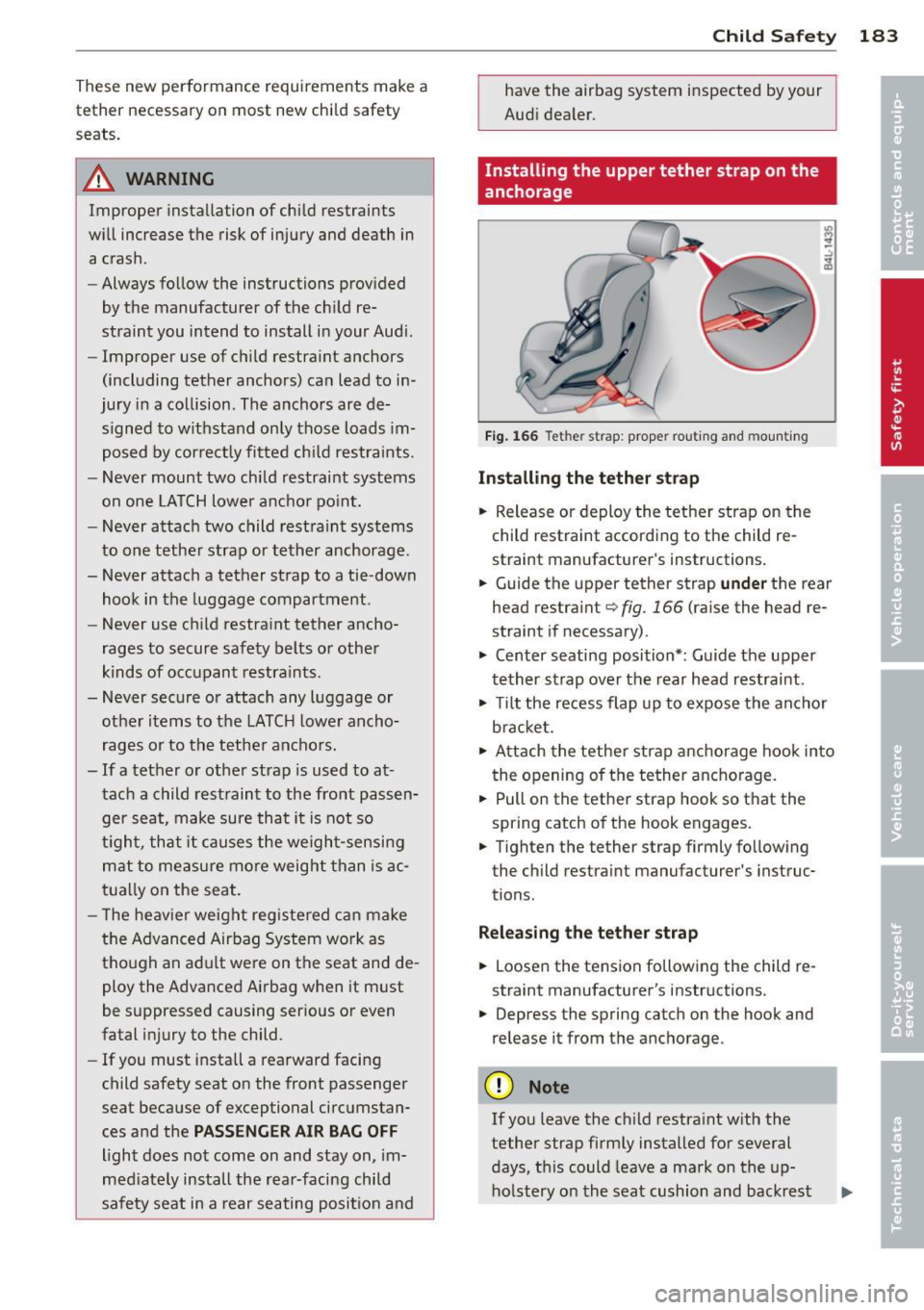
Installing the upper tether strap on the
anchorage
F ig . 1 66 Tet her st rap: proper ro uting and mounting
Installing the t eth er strap
.. Release or deploy the tether strap on the
child restraint according to the child re
straint manufacturer's instructions.
.. Guide the upper tether strap
unde r the rear
head restra int
qfig. 166 (ra ise the head re
straint if necessa ry) .
.. Center seating position*: Guide the upper
tether strap over the rear head restra int .
.. Til t the recess flap up to expose the an chor
bra cket.
.. Attach the tether strap anchorage hook into
the opening of the tether ancho rage .
.. Pull on the tether strap hook so that the
spring catch of the hook engages .
.. Tighten the tether strap firmly follow ing
the child restraint manufacturer's instruc
tions .
Relea sing the tether strap
.. Loosen the tension following the child re
straint manufacturer's instructions.
.. Depress the spring catch on the hook and
release it from the anchorage .
Q) Note
If you leave the child restraint w ith the
tether strap firmly installed for several
days, t his could leave a mark on the up
ho lstery o n the seat cushion and backrest
Page 201 of 300

Trailer towing Driving with a trailer
General information
Your Audi was designed primarily for passen
ger transportation .
If you plan to tow a trai ler, p lease remember
that the addit ional load will affect durab ility,
economy and performance .
Trailer towing not on ly places more stress on
the vehicle, it also calls for more concentra
tion from the driver.
F or this reason, a lways fo llow the operating
and d riving instr uctions provided and use
common sense.
(D Note
If you are going to tow a trai ler, you must
activate the trailer operat ion mode
~ page 199, Operating instructions.
Technical requirements
Trailer hitch
Use a weight-carrying hitc h co nforming to the
gross trailer we ight. The hitch must be suita
b le for your veh icle and trailer and must be
mounted secure ly on the veh icle's chassis at a
technically sound location . Use only a trailer
hi tch wit h a removab le ball moun t. A lways
check with t he trail er hitch ma nufactur er to
make sure tha t you are using the corre ct
hi tch.
Do not use a bumper hitch.
The hitc h must be installed in such a way that
i t does not interfere with the impac t-absorb
i ng bumpe r sys tem. No mod ifica tio ns should
be made to the vehicle exh aust a nd brake sys
tems . From time to time, check that a ll hitch
mo unt ing bolts remain securely fastened.
W hen you are not towing a trail er, remove the
traile r hitch ball mount. Th is prevents the
hi tch from causing damage sho uld your ve hi
cle be str uck from behind ¢& .
Trailer towin g 199
Trailer brakes
If your trailer is equippe d wi th a br akin g sys
tem, check to be s ure that i t conforms to all
r egulations .
T he trailer hy draul ic brak e sys tem mus t not be
direc tly connec ted to the vehi cle' s h ydraulic
brake system .
Safety chains
Always use safety chains between your veh icle
and the tra ile r.
Trailer lights
Trai ler lights must meet all regu lations. Be
su re to check with your Audi dealer for cor rect
wir ing, swi tches and relays .
Mirrors
If you are unable to see the traffic behind you
us ing the reg ular o utside mirrors, then you
must insta ll extended mirrors. It is imp ortant
that you
always have clea r v is ion to the rear.
A WARNING ...__ -
Afte r removing the trailer hitch, do not
stor e it i n yo ur v ehicl e. In cas e o f sudden
b ra king, the hitch co uld fly forwar d and in
ju re you or your p ass en ger s.
Operating instructions
Fi g. 168 MM I dis pl ay: tow ing mode on
Ma ximum trailer weight
A trai ler fo r you r vehicle is limited to a typical
class 1 or class 2 tra iler.
ll>