control arm AUDI A8 2012 Owner's Manual
[x] Cancel search | Manufacturer: AUDI, Model Year: 2012, Model line: A8, Model: AUDI A8 2012Pages: 300, PDF Size: 75.06 MB
Page 199 of 300
Avoid full throttle
Driving at moderate speeds saves fuel and
improves your mileage.
"" Try and keep well below your car's maxi-
mum speed.
Accelerating gently reduces fuel consump tion, engine wear, and does not disturb the
environment.
F ue l consumption, exhaust emissions and en
g ine noise increase disproportionately at high
speeds. If you drive at approximately three
quarters of top speed, fuel consumption will be reduced by one half. Never drive faster
than the posted speed limit and weather con
d itions permit .
Reducing unnecessary idling
Even when your car is just idling it burns up
fuel.
"" Shut the engine off when you are not driv
ing the vehicle.
"" Do not warm up the veh icle by letting the
engine run at idle .
It makes sense to shut
off the engine in traff ic
jams, when waiting for trains to pass at ra il
road crossings, or at traffic lights that have
l ong wa its on red. Turning the engine
off fo r
just
30-40 seconds saves more fue l than is
bu rned starting the eng ine again .
It takes a long time for the engine to warm up
fu lly when it is running at idle. However, wear
and nox ious em issions are especially high
when the engine is warming up. So you should
drive away as soon as you start the engine and
avoid running at high rpms while the engine is
still warming up .
(D Note
Do not leave engine idling unattended af
ter starting . If warning lights should come
on to indicate improper operation, they
wou ld go unheeded. Extended idling also
produces heat, which cou ld result in over-
Dri vin g and en vironm ent 197
'
heating o r othe r damage to the veh icle or
other p roperty .
Regular maintenance
A badly tuned engine unnecessarily wastes a
lot of fuel.
"" Have your veh icle serviced at reg ular i nter-
vals.
By having your veh icle regu la rly serviced by an
Audi dealer he lps to ensu re that it runs prop
erly and economically. The condition of your
vehicle not only affects its sa fety and ability to
hold its value, it a lso affects
fuel con sump
tion .
Check your oil e ach t ime you fill your tank .
The amount of o il used is re lated to eng ine
load and speed .
It is normal for the oil consumption of a new
engine to reach its lowest value after a certa in
mileage has been driven .
You must drive your veh icle about 3,000 m iles
(5,000 kilometers) before you can properly
assess oil consumpt ion.
This also app lies to fue l consumption and en
gine output.
(U) Note
- Have your vehicle maintained properly
and in accordance with the service rec
ommendations in your Warranty
& Ma in
tenance booklet . Lack of proper mainte
nance as well as improper use of the ve
hicle will impair the function of the
em iss io n cont ro l system and cou ld lead
to damage.
- Do not alter or remove any component of
the Emission Control Sys tem unless ap
proved by the manufacture r.
- Do not alter or remove any device, such
as heat shie lds, swit ches, ign it ion w ires,
valves, which are designed to p rotec t
your vehicle's Emission Control System
and other important vehicle compo
nents .
•
•
Page 211 of 300
substance use d for u ndercoating cou ld
overheat an d cause a fire.
- Always read and heed all WARNINGS and
other information
¢ page 203.
Exhaust tail pipes
Road sa lt and other corros ive materials will
damage the mater ial in the exhaust tail p ipes
if they are not cleaned regu larly . Do not clean
the ta il p ipes with wheel cleaner, paint polish,
chrome polish or othe r abrasive cleaners .
C lean the tail p ipes with ca r ca re products
that are s uita ble for stain less stee l.
Your authorized Audi dealer can provide clean i ng p rod ucts that have been tested and ap
p roved fo r your vehicle.
Care of interior
Infotainment components
The MMI/RSE* disp lay may be cleaned with a
soft cloth and commercially-ava ilable "LCD
cleaner" . The cloth should be coated light ly
when the clean ing solution when cleani ng the
d isplay.
The MMI/RSE* contro ls must be cleaned first
with a brush so that dirt does not enter the
un it o r enter between the buttons and the
h ousing. Then w iping the controls with a clot h
dampened wi th d ish dete rgent and water is
recommended.
(D Note
To preve nt sc ratches, only clean the dis
p lay when it is d ry.
- To p reven t damage, ma ke s ure fluids do
not enter the cont rols.
Aluminum trim
Use only neutral-pH produc ts to remove spots
and depos its from alum in um s urfaces.
C hr ome ca re products and alkaline cleaners
will attack alum in um s urfaces and can dam
age them over time.
Cleaning and protec tion 209
A WARNING
A lways read and heed all WARNINGS and
other information
¢page 203.
Fabrics and fabric coverings
Fabr ics and fabric cover ings (e.g. seats, door
trim pa ne ls, etc.) shou ld be cleaned at regular
i n tervals w it h a vac uum cleaner. This removes
s ur face di rt particles which cou ld become em
bedded in the fabri c throug h use. Ste am
cleaners sho uld not be used, beca use the
steam tends to p ush the dirt deeper into the
fabric and lock it there .
Normal cleaning
Generally, we recommend using a soft sponge
o r a lint -free microfibe r clo th to the clean fab
ric. Br ushes shou ld only be used for carpets
and floor mats, since other fabric surfaces
could be harmed by br ushes.
Norma l su rface s tains c an be cleaned using a
commerc ially availab le foam cleaner . Spread
the foam on the s urface of t he fabric with a
soft sponge and work it in gently. Do not satu
rate the fabric. T hen pat the foam dry us ing
absorbe nt, dry cloths (e.g. m icrofiber cloth)
and vacuum it after it has dried completely.
Cleaning stains
Stains caused by beverages (e .g. coffee, fr uit
juice, etc.) can be treated with a mild deter
gent solution. Apply the detergent sol ution
with a spo nge. In the case of stubborn stains,
a detergent paste can be applied directly to
the stain and worked into the fabric. After
wards, use copious amounts of clean water to
remove the rem aining de terge nt. Apply the
w at er wit h a d am p clot h or sponge a nd pat
the fabric dry with an abso rbent, dry clot h.
Stains from choco late or makeup should have
de terge nt pa ste (e.g. o x-gall soa p) rubbed i n
to them. Afterwa rds, remove the soap wi th
wa ter (damp sponge) .
Alcohol can be used to treat stains from grease, o il , lipstic k or a ballpoin t pen. M elted ..,_ •
•
Page 216 of 300
214 Cleaning and protec tio n
- Before reaching into the front pane l, al
ways switch off the ignition. Otherwise,
the windshield wiper system could un in
tent ionally be switched on, possib ly
causing personal injury from the moving
wiper linkage .
- Never reach into the area around or
touch the radiator fan. The auxiliary fan is temperature controlled and can switch
on suddenly- even when the ignit ion is
off.
- Do not wash, wax or d ry the engine w ith
the engine running. Moving or ho t pa rts
cou ld inju re you .
- Do not clean the underside of the chas
sis, fenders , wheel cove rs, or other hard
to reach parts w ithout protecting your
hands and arms . You may cut yourse lf on
sharp-edged metal parts.
- Always read and heed all WARNINGS and other information
c::> page 203 .
Page 221 of 300
Checking and filling Engine hood
Releasing the engine hood
The engine hood is released from inside the
vehicle .
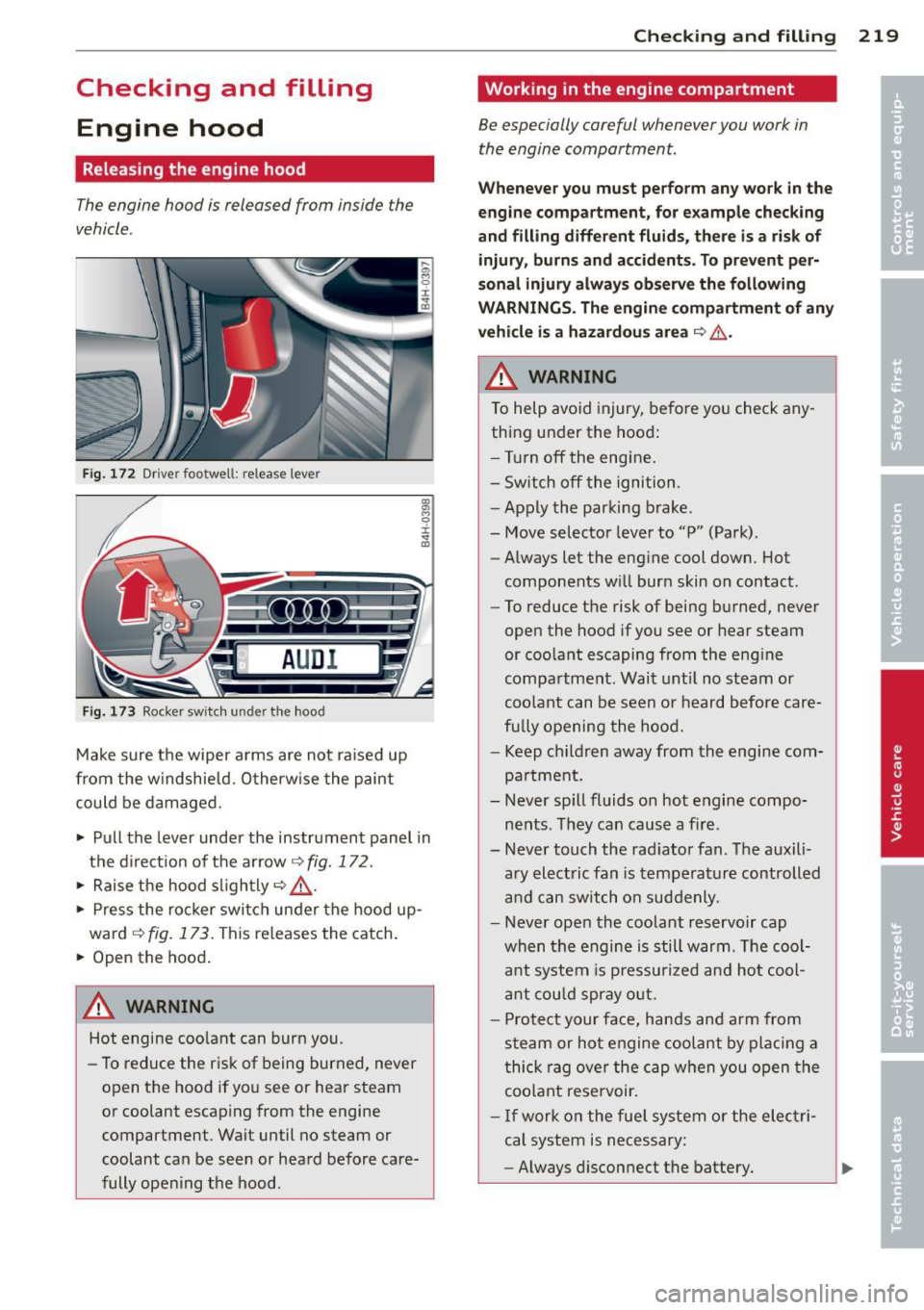
Fig. 172 Dr iver footwell: release lever
AUD I
Fig. 173 Rocker switch under the hood
Make sure the wiper arms are not raised up
from the w indshield. Otherw ise the paint
could be damaged.
.. Pull the lever under the instrument panel in
the d irect ion of the arrow
<=> fig. 172.
.. Raise the hood slightly<=> _&.
.. Press the rocke r switc h under the hood up
ward
<=> fig. 173. This re leases the catch .
.. Open the hood .
A WARNING
Hot engine coo lant can burn you.
- To reduce the r isk of being burned, never
open the hood if you see or hear steam
or coolant escaping from the engine
compartment . Wait until no steam or
coolant can be seen or heard before care
fully opening the hood.
Checkin g and fillin g 219
Working in the engine compartment
Be especially careful whenever you work in
the engine compartment.
Wh ene ve r y ou must perform an y wo rk in the
eng ine com pa rtm ent , for e xample checking
a nd filling diff ere nt fluids, th ere is a risk of
inju ry, burn s and accid ent s. To pr event per
so nal injury alwa ys observe the foll owing
WARNING S. The engin e compartment of an y
v e hicle i s a h az a rdou s are a
<=> ,&.
_&. WARNING
To help avoid injury, be fore yo u check any
thing under the hood:
- Turn off the engine .
- Sw itch off the ignition.
- Apply the parki ng brake.
- Move selector leve r to "P" (Park).
- Always let the engine cool down. Hot
components w ill burn skin on contact .
- To reduce the risk of being burned, never
open the hood if you see or hear steam
or coo la nt escaping from the engine
compa rtment. Wait unt il no steam or
coolant can be seen o r heard before care
fu lly opening the hood.
- Keep ch ildren away from the engine com
pa rtment.
- Never sp ill fluids on hot engine compo
nents . They can cause a fire .
- Never touch the rad iator fan. The auxili
ary electric fan is temperat ure controlled
a nd can sw itch on suddenly .
- Never open the coolant reservoir cap
when the engine is still warm. The cool
a nt system is p ressu rized and hot cool
a nt cou ld spray o ut.
- Protect your face, hands and arm from
steam or hot engine coolant by plac ing a
thick rag ove r the cap when you open the
coo lant rese rvoir.
- If work on the fue l system o r the elec tri
cal system is necessary:
- Always disconnect the battery.
Page 243 of 300
vehicle from handling properly and increase the risk of a loss of veh icle con
tro l.
- The brakes on a veh icle that has been
overloaded may not be able to stop the
vehicle within a safe distance.
- Tires on a vehicle that has been overload ed can fail suddenly causing loss of con
tro l and a crash .
- Always make sure that the tota l load be
ing transported -including the we ight of
a tra ile r hitch and the tongue weight of a
loaded trailer -does not make the veh i
cle heav ier than the veh icle's Gross Vehi
cle Weight Rating.
A WARNING
- Incorrect tire pressures and/or underin
flation can lead to a serious o r fatal acci
dent.
- Incorrect tire pressures and/or underin
flation cause increased tire wear and can
affect the handling of the vehicle .
- Incorrect tire pressures and/or underin
flation can also lead to sudden tire fa il
ure, including a blowo ut and sudden de
flation, causing loss of vehicle control.
Checking tire pressure
.
The correct tire pressure for the tires original
ly installed on your vehicle is listed on the tire
pressure Lobel located on driver's side 8-pil
lor.
The recommended tire pressures are on the
tire pressure labe l and in the tab le
c:> page 239, Cold tire inflation pressure .Th is
means that the pressure must be checked and
adjusted when the tire has not been driven for
more than a couple of m iles (kilometers) at
low speeds during the previous three hours.
Air in the tires expands when the tire heats up
as a result of inte rna l fr iction as it flexes in
use. The ti re p ress ure is higher when the tire
h as warmed up than when it is "cold."
It is the inflat ion pressure in a "cold " tire that
counts. Therefo re, you shou ld neve r let air out
Tire s an d wheel s 241
of a wa rm tire to match "Cold tire inflat ion
pressure" recommendations
c:> page 239. T he
tires wou ld then be underinflated and cou ld
fail suddenly .
T he t ire pressure label on your Audi lists the
recommended co ld tire inflation pressures at
maximum capacity for the new, orig inal
equipment tires that were on your vehicle at
the time it was manufactured. For the loca
tion of the labe l
c:>poge 239, fig . 183 .
Most tires lose air natura lly over t ime. They
can a lso lose some air if you drive over a pot
hole or hit a curb while park ing. It is usually
not possible to see whether the rad ia l tires
used today are underinflated just by looking
at them.
Therefore, be sure to check t ire pressures at
least once a mo nth and a lways before going
o n a long tr ip . Make sure to take the number
of peop le and the amount of luggag e into ac
count when adjust ing tire p ressu re for a trip -
even one th at yo u wo uld not conside r to be
"long." See¢
page 243, Tires and vehicle
load limits
for mo re important information .
Always use an accura te ti re pressu re gauge
whe n checking and adj usting i nflation pres
s ur es . Check a ll of the tires and be sure not to
forget the spare tire.
If the pressure in any tire
is too high when the ti re is "cold," let air o ut
of the t ire s low ly w ith the edge of the tire
gauge and keep checking the pressure until
you reach the pressure that is correct for the load (passengers and luggage) and k ind of
driv ing you plan to do .
If the pressure in any tire is too low, note the
difference be tween the pressure in the cold
ti re and the pressure you need and add the air
that you need to reach the correct pressure for
the ve hicle load (passengers and luggage) for
t h e tires on you r veh icle as l isted on the on
you r vehicle and in this ma nual a nd the k ind
of driving you plan to do.
Nev er e xceed the ma ximum inflation pre s
s ure lis te d on the tir e sidewall for any re a
son.
•
•
Page 244 of 300
24 2 T ire s and wheel s
Remember that the vehicle manufacturer, not
the tire manufacturer, determines the correct
tire pressure for the t ires on your vehicle.
I t is important to check the tire pressu re when
the tires a re cold.
- Read the requ ired t ire pressure from the tire
pressure label. The tire pressure labe l is lo
cated on the drive r's side 8-p illar.
- T urn the valve stem cap counter-clockwise
to remove it from the tire valve.
- Place the air pressu re gauge on the valve.
- The tire pressures should only be checked
and adjusted when the tires are cold. The
sl igh tly ra ised p ressu res of warm tires must
not be reduced.
- Adjust the tire pressure to the load you are
carrying.
- Re insta ll the va lve stem cap on the valve .
When should I check the ti re pres sure ?
The correct tire pressure is especially impor
tant at high speeds. The pressure should
therefore be checked at least once a month
and always before start ing a jou rney. Do not
fo rget to check the tire pressure for the spare
wheel
i::!> page 258.
When should I adju st the tire p re ss ure s?
Adjust the tire pressure to the load you are
carry ing . After changing a wheel
or replacing
wheels you have to adjust the tire pressures
on all wheels. In addition, you must then
sto re t he new ti re press ures in the t ire pres
sure mon itor ing system*
i::?> page 253.
_8 WARNING
Incorrect tire pressures and/or underinf la
tion can lead sudden tire failure, loss of
contro l, co llision, ser ious persona l injury
or even death.
- When the warning symbo l
RI] appears in
the instrument cluster, stop and inspect
the tires.
- Incorrect tire pressure and/or underinfla
t ion can cause increased t ire wear and
can affect the handling of the veh icle and
stopp ing ability. -
Incorrect tire pressures and/or underin
f lation can a lso lead to s udden t ire fail
ure, including a blowout and sudden de
flation, caus ing loss of veh icle control.
- The driver is responsible for the correct
tire pressures for all tires on the veh icle.
The applicable pressure values are locat ed on a sticke r on the dr iver's s ide 8-pil
lar.
- Only when all tires on the vehicle are fil led to the correct pressure, the t ire pres
sure mon itor ing* system can work cor
rectly.
- The use of incorrect t ire p ressure va lues
can lead to acc idents or other damage.
Therefore it is essential t hat the drive r
observe the spec ified tire pressure values
for the tires and the correct pressures for
the function of the t i re press ure monitor
ing system*.
- Always inflate tires to the recommended
and correct ti re press ure before driving
off.
- Driving with underinflated tires bend
more, letting them get too hot resulting
in tread separation, sudden tire failure
and loss of control.
- Excessive speed and/overloading can
cause heat build-up, sudden tire failure
and loss of control.
- If the tire pressure is too low or too high,
the t ires will wear prematurely and the
veh icle w ill not handle well.
- If the tire is not flat and you do not have
to change a wheel immediately, drive at
reduced speed to the nearest service sta
tion to check the t ire p ress ure and add
a ir as req uired.
Q) Note
Driving w ithout valve stem caps can cause
damage to the tire valves. To prevent this,
always make sure that factory insta lled
valve stem caps o n all whee ls are sec urely
mounted on the valve.
Page 264 of 300

262 What do I do now ?
ho ld on to the car to keep your ba lance
and take care not to slip .
Raising the vehicle
The vehicle must be lifted with the jack first
before the wheel can be removed .
Fig. 199 Sill panels: markings
Fig. 200 Sill: posit ion ing t he veh icle jack
.. Activate the vehicle jack mode in the MMI:
I CAR ! function button > Ca r sys te m s control
button>
S ervic ing & c h ecks > Air susp .:
jack mod e > On .
.. Engage the par king brake to prevent your
vehicle from ro lling u ninten tionally.
.. Move the
se lector l ever to po siti on P .
.. Find the marking (imprint) on the sill that
is nearest the wheel that will be changed
o fig. 199 . Behind the marking, there is a
lifting point on the s ill for the vehicle jack .
.. Turn the
ve hicle jack located under the lift
ing point on the si ll to raise the jack until its
arm @
o fig. 200 is located under the des
i gnated plastic mount
o ,& o0.
.. Align the jack so that its arm @ o fig. 200
engages in the designated lifting po int in
the door sill and the movable base @ lies
flat on the ground. The base @ must be
ver
tical
under the lifting point @. ..
Wind the jack up fu rther until the f lat tire
comes off the ground
o .&, .
Position t he vehicle jack o nly under the desig
nated lifting points on the si ll
¢fig. 199.
There is exactly one location for each wheel.
The jack must not be positioned at any other location
c:> .&, c:>Q).
An un sta ble surf ace under the jack ca n cause
the vehicle to slip off the jack . Always provide
a firm base for the jack on the ground . If nec
essary place a sturdy board or similar support
under the jack. On
hard, sl ipp ery su rfaces
(such as tiles) use a rubbe r mat or similar to
prevent the jack from slipping
c:> .&, .
A WARNING ~
-You or your passengers could be injured
while changing a wheel if you do not fo l
low these safety preca utio ns:
- Position the vehicle jack on ly at the
designated lifting points and align the
jack. Otherwise, the vehicle jack could slip and cause an injury if it does not
have sufficient hold on the vehicle.
- A soft or unstable surface under the
jack may cause the vehicle to slip off
the jack . Always provide a firm base for
the jack on the ground. If necessa ry,
use a stu rdy board under the jack.
- On hard, s lippery surface (such as t iles)
use a rubber mat or simi lar to prevent
the jack from slipping.
- To help prevent injury to yourself and
your passe ngers:
- Do not raise the vehicle until you are
sure the jack is securely engaged.
- Passengers must not remain in the ve
hicle when it is jacked up.
- Make sure that passengers wait in a
safe place away from the vehicle and
well away from the road and traffic .
- Make sure jack pos ition is correct, ad
just as necessary and then continue to raise the jack.
- Changes in temperature or load can af
fect the height of the vehicle.
Page 268 of 300

266 Fuses and bulbs
Fuse panel @ (brown)
No. Equipment
1 Headlight control switch
2 Emergency start coil (key
identification)
3 Rear door
control module
(driver's side)
5 Horn
6 Interior lights
(headliner)
Steering column lever, mul-
8
tifunction steering wheel
controls, steering wheel
I heating
10 Power steering column ad-
justment
11 Driver door control module
12 Diagnost
ic connector, light/
rain sensor
14 Power steering column ad-
justment
15 Power
steering, AC compres-
sor
16 Brake booster
Fuse panel © (black)
No. Equipment
1 Front seat heating
2 Windshield wiper
3 Front exterior lighting
4 Sun roof
5 Driver power window
6 Driver seat (pneumatic)
7 Panoramic
sunroof
8 Dynamic steering
9 Front exterior lighting
10 Windshield/headlight
wash-
er system
11 Rear power window (driver's
side)
Panoramic sunroof
Amps
5
5
7,5 15
7,5
10/5
5
7,5 10
25
20 15
Amps
30
30
30 20
30 15
20
35
30
35
30
40
Front passenger side cockpit fuse
assignment
Fig. 206 Front passe nger side cockpit: fuse pane l with
plastic bracket
Fuse panel ® (black)
No. Equipment Amps
1 Anti-theft alarm system
5
2 T
ransmission control mod-
15
ule
3 Front climate control fan 40
4 Engine supply 35
6 Engine
control module
5
7 Front passenger door con-
7,5
trol module
8 Front passenger
power win-
30
dow
9 ESC control module 10
10 E5C control modu le 25
11 Right rear power window
30
12 Front
passenger seat (pneu -
15
matics)
Page 276 of 300

2 7 4 Emergency situations
@ Tips
Check carefully to make sure the hook-up
is secure before moving the car up the flat
bed truck ramp.
Vehicle transport
Whenever you have your vehicle transported,
be sure to note the following:
(D Note
Mount the tie-down chains/cables over the
running surface (circumference) of the
tires. Never secure the vehicle by the axle,
the suspension struts or the front or rear
towline eye. For technical reasons, the
pressure in the suspension struts may
change during the transport and this will
adversely affect vehicle handling.
Lifting vehicle
Lifting with workshop hoist and with
floor jack
The vehicle may only be lifted at the lifting
points illustrated.
Fig. 215 Front lift in g po int
Fig. 216 Rear lifti ng point
.,. Read and heed WARNING ¢ _&.
.,. Activate the vehicle jack mode in the MMI :
!CARI function button > Car systems control
button
> Servicing & checks > Air susp.:
jack mode
> On.
.,. Locate lifting points ¢ fig . 215 and
¢fig. 216 .
.,. Adjust lifting arms of workshop hoist or
floor jack to match veh icle lifting points .
.,. Insert a rubber pad between the floor jack/
wo rkshop hoist and the lifting points.
The vehicle jack mode must be act ivated so
that the automat ic adjustment of the Adap
tive Ai r Suspens ion does not make it more dif
ficult to raise the vehicle with the floor jack.
If you must lift your vehicle with a floor jack
to work underneath, be sure the vehicle is
safely supported on stand s intended for this
purpose.
Front lifting point
The lifting point is located on the floor pan re
i nforcement about at the same level as the
jack mounting point
¢ fig. 215 . Do not lift
the vehicle at the vertical sill reinforcement.
Rear lifting point
The lifting point is located on the vertical rein
forcement of the lower sill for the on-board
jack
¢fig. 216.
Lifting with vehicle jack
Refer to ¢page 262.
A WARNING ,= -
-To reduce the risk of serious injury and
veh icle damage.
- Always lift the vehicle only at the spe
cia l workshop hoist and floor jack lift
points illustrated
¢ fig . 215 and
¢ fig. 216 .
-Failure to lift the vehicle at these
points could cause the vehicle to tilt or
fall from a lift if there is a change in ve
hicle weight distribution and balance.
This might happen, for example, when heavy components such as the eng ine
block or transmission are removed .
Page 285 of 300
Technical Modifications
Our guidelines must be complied with when
technical modifications are made.
Always consult an authorized Audi dealer be
fore starting work on any modifications.
This will he lp ensure that vehicle function,
performance and safety are not impaired
¢ .&..
Attempting to work on electronic components
and the software used with them can cause
malfunctions. Beca use of the way electronic
components are interconnected with each
other, such malfunctions can also have an ad
verse affect on other systems that are not di rectly involved. Th is means that you r isk both
a substantial reduction in the operational
safety of you r vehicle and an inc reased wea r of
vehi cle parts¢ _&..
Author ized Audi dealers w ill perform th is
wo rk in a professiona l and competent ma nner
or, in spec ial cases, refer you to a p rofessional
company that specializes in such mod ifi ca
tions .
_& WARNING t= -
Improper repairs and modifications can
change the way vehicle systems wo rk and
cause damage to the veh icle and ser ious
personal injury.
(D Note
If emergency repairs must be performed
elsewhere, have the veh icle examined by
an authorized A udi dealer as soon as possi
ble.
Con sumer In formation 283
Declaration of
Compliance, Telecom
munication or
Electronic Systems
Radio Frequency Devices and Radiocommuni
cation Equipment User Manual Notice.
The manufacturer is not responsib le for any
radio or TV interference caused by unauthor
ized modifications to this equipment.
Device s
The following devices each comply wi th FCC
Part 15 .19, FCC 15.2 1 and RSS -Gen Issue 1:
- Adaptive cru ise control
- Aud i side assist
- Cell phone package
- Convenience key
- Electron ic immobilizer
- Homelink ® universa l remote control
- Remo te control key
FCC Part 15.19
This device complies with part 15 of the FCC
Ru les. Operation is subject to the fo llow ing
two conditions:
(1) This device may not cause harmful in ter
fere nce, and
(2) this device must accept any interference
received, including interference that may
cause undes ired operation .
FCC Part 15.21
CAUTION:
Changes or mod ifi cat ions not expressly ap
proved by the p arty responsible for compli
ance could vo id the user's autho rity to ope rate
the equipment .
RSS-Gen Issue 1
Operation is subject to the fo llow ing two con
d it ions:
(1) this device may not cause interference,
and
•
•