control arm AUDI A8 2012 User Guide
[x] Cancel search | Manufacturer: AUDI, Model Year: 2012, Model line: A8, Model: AUDI A8 2012Pages: 300, PDF Size: 75.06 MB
Page 79 of 300
airflow and air distribution are controlled au
tomatically.
Adjusting the temperature
Temperatu res between 60 °F (+16 °() and
84 °F (+28 °C) can be set. O uts ide of this
range,
lo or hi will appear in the climate con
trol system disp lay. At both of these settings,
the climate control system runs continuously
at maximum coo ling or heating power. There
is no temperature regulation.
[!] Adjusting the airflow
You can ad just the airf low manually to suit
your needs . To have the airflow regulated au
tomatically, press the
! AUTO ! button.
~ Adjusting the air distribution
You can manually se lect the vents where the
air will flow. To have the air distribution regu
l ated automatically, press the
!AUTOI button.
~ I lil* Adjusting Seat heating/
ventilation*
Pressing the button switches the seat heat
ing/ventilation on at the highest setting ( level
3). The LEDs indicate the temperature leve l.
To reduce the temperature, press the button
again . To switch the seat heating/ventilation
off, press the button repeatedly until the LED
turns off.
After 10 minutes, the seat heating/ventilation
automatically switches from level 3 to level 2.
I n vehicles without the four zone automat ic
climate contro l*, buttons in the rear center
console control the seat heating for both out
er rear seats*.
~ Switch the defroster on/off
The windsh ield and sid e windows are defrost
ed or cleared o f condensation as quickly as
possible. The maximum amount of air flows
mainly from the vents be low the windshield.
Recirculation mode switches off . The tempera
ture is controlled automatically.
The
IAU TOI button switches the defroster off.
Warm and cold 77
~ Switching rear window heater on/off
The rear window heater only operates when
the engine is running. It switches off auto
matically after 10 to 20 minutes, depending
on the outside temperature.
T o p revent the rear window heater from
switching off automatically, press and hold
the ~ button for more than 2 seconds . This
remains stored until the ignition is switched
off .
I SYNC I Synchronization*
When synchronization is switched on, the set
tings for the driver's side are applied to the
front passenger's side (except for seat heat
i ng/venti lation*) . The rear seat is also
synchronized in vehicles with the 4-zone de
luxe automatic climate control system* . Syn
chronization switches off if the sett ings are
adjusted on the front passenger's side or in
the rear* .
You can synchronize the settings in a row by
pressing and holding a knob. For example, to
apply the settings for the front passenger's s ide to the driver's side, press and hold the
knob on the front passenger's s ide.
Air vents
You can open or close the center and rear
vents in the cockpit and the vents in the rear
center console and door pillars us ing the
ridged thumbwheels. The levers adjust the di
rection of the airflow from the vents.
,&. WARNING
-Do not use the recirc ulation mode for ex
tended periods of time. The windows
could fog up since no fresh air can enter
the vehicle. If the windows fog up, press
the air recircu lation button again imme
diately to switch off the air recirculation
function or select defrost .
- Individuals w ith reduced sensitivity to
pa in or temperature could deve lop burns
when using the seat heating function . To
reduce the risk of injury, these indiv idu-
als shou ld not use seat heating. ..,.
Page 80 of 300
78 Warm and cold
(D Note
To avoid damage to the heating e lements
in the seats, do not kneel on the seats or
place heavy loads on a small area of the
seat .
Setup
The climate control system setup is accessed
through the MMI.
.. Se lect: I CARI function button > Car systems
control button > AC.
Rear cabin settings*
When this function is selected, all settings for
the rear can be adjusted through the climate
contro l system in the cockpit . The climate
control system settings cannot be adjusted in
the rear seat at the same time. This function
switches off after a certain period of time or
when one of the dials in the cockp it is press
ed.
Auto recirculation*
The sensitivity level of the automatic reci rcu
l ation mode can be set at various leve ls from
off to sensitive . The recirculation mode 1...,1 is
controlled on automatically. You must press
the ~ button if fog forms on the w indows.
Footwell temperature
You can adjust the footwell temperat ure so
that it is cooler or warmer.
AC mode
The strength of the airflow can be adjusted to
light, med ium or strong .
Windshield heat*
When the defroster~ is switched on and the
Auto setting is selected, the windshield de
froster is controlled automatically.
Solar roof*
When the ignit io n is off, so lar-powered park
ing vent ilation may switch on, as long as
- there is sufficient sunlight, -
the outside temperature is not too low,
- t he center vents are open,
- the sunroof is closed or tilted and
- recirculation mode
1...,1 (climate control sys-
tem) and
Auto (MMI) are selected .
Parking ventilation is contro lled automatically
i n the
Auto sett ing.
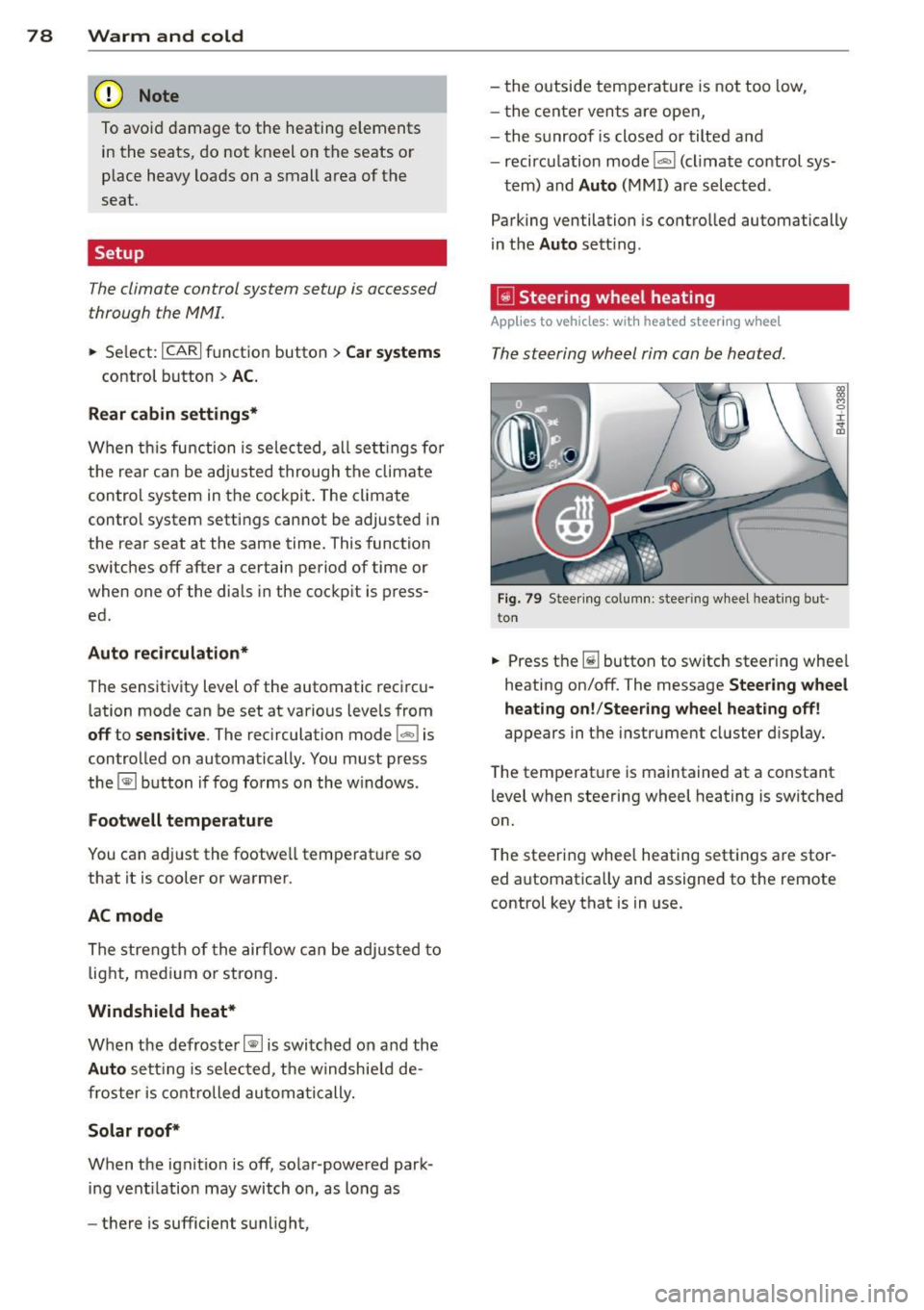
~ Steering wheel heating
Applies to vehicles: with heated steering wheel
The steering wheel rim can be hea ted .
Fig . 79 Stee ring column : steeri ng wheel heati ng but
t on
.. Press the~ button to switch steer ing whee l
heating on/off. The message
Steering wheel
heating on! /Steering wheel heating off!
appears in t he instrument cluster display.
The temperat ure is maintained at a constant
level when steering wheel heating is switched
on.
T he steering wheel heating settings are stor
ed automatically and assigned to the remote control key that is in use.
Page 81 of 300
On the road
Steering
Adjusting steering wheel position
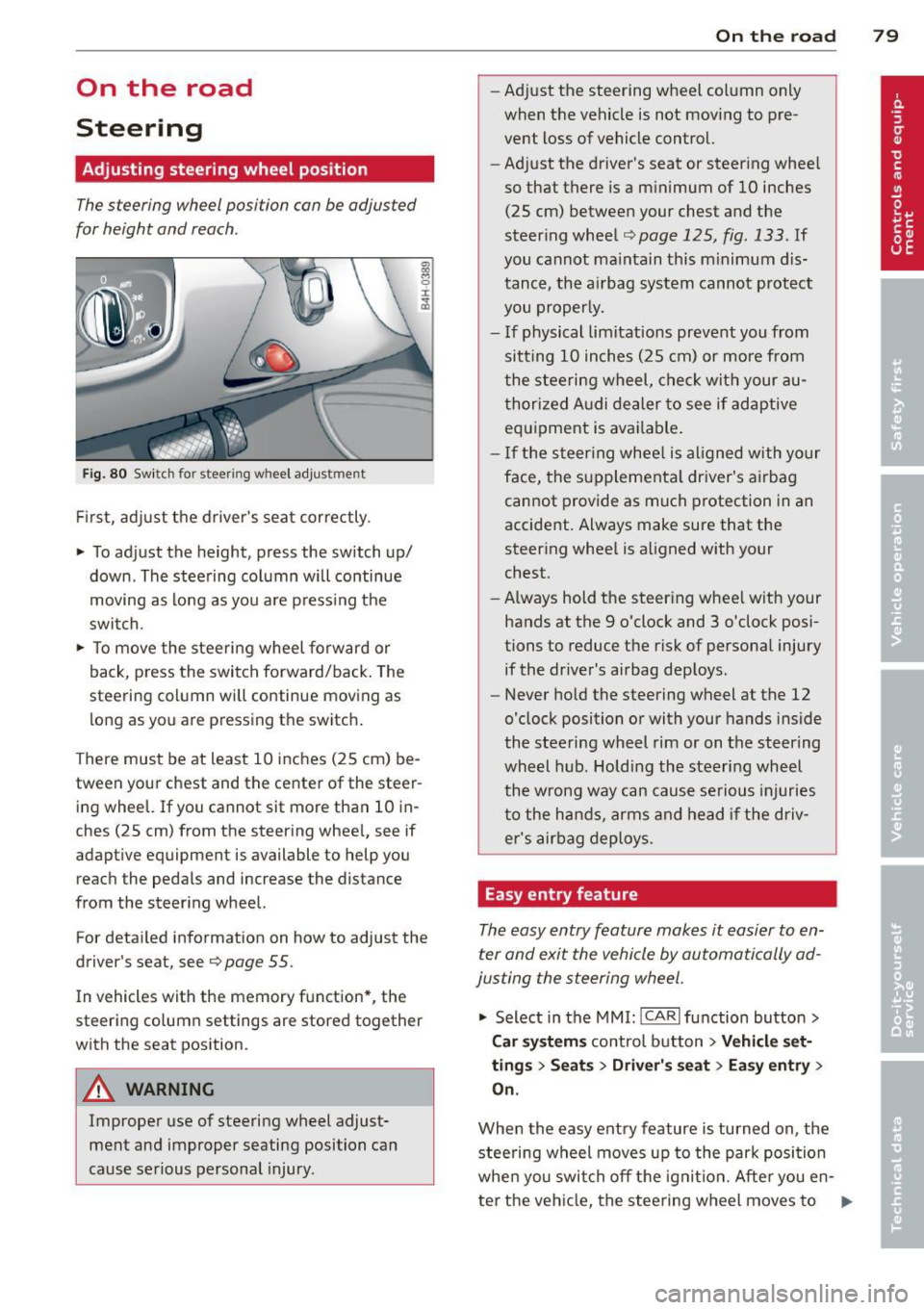
The steering wheel position can be adjusted
for height and reach .
Fig. 80 Switch for steer ing w heel adjustment
First, adjust the driver's seat correctly.
• To adjust the height, press the switch up/
down . The steering column will continue
moving as long as you are pressing the
switch.
• To move the steering wheel forward or
back, press the switch forward/back. The
steering column will continue moving as long as you are pressing the switch.
There must be at least 10 inches (25 cm) be
tween your chest and the center of the steer ing wheel. If you cannot sit more than 10 in
ches (25 cm) from the steering wheel, see if
adaptive equipment is available to help you
reach the pedals and increase the distance
from the steering wheel.
For detailed information on how to adjust the
driver's sea t, see
Q page 55.
In vehicles with the memory function*, the
steering column settings are stored together
with the seat position .
A WARNING
Improper use of steering wheel adjust
ment and improper seating position can
cause serious personal injury.
-
On the road 79
-Adjust the steering wheel column only
when the vehicle is not moving to pre
vent loss of vehicle control.
- Adjust the driver 's seat or steering wheel
so that there is a minimum of 10 inches (25 cm) between your chest and the
steering wheel
~ page 125, fig . 133 . If
you cannot maintain th is m inimum dis
tance, the airbag system cannot protect
you properly.
- If physical limitations prevent you from
sitt ing 10 inches (25 cm) or more from
the steering wheel, check with your au
thorized Audi dealer to see if adaptive
equipment is available .
- If the steering wheel is al igned with yo ur
face, the supplementa l driver's airbag
cannot provide as much protection in an
accident. Always make sure that the
steering whee l is aligned with your
chest.
- Always hold the steering whee l with your
hands at the 9 o'clock and 3 o'clock posi
tions to reduce the risk of personal injury
if the driver's airbag deploys.
- Never hold the steering wheel at the 12
o'clock position or with your hands inside
the steering wheel rim or on the steering
wheel hub. Holding the steering wheel
the wrong way can cause serious injuries
to the hands, arms and head if the driv
er's airbag deploys.
Easy entry feature
The easy entry feature makes it easier to en
ter and exit the vehicle by automatically ad
justing the steering wheel.
"' Select in the MMI: ICARI function button >
Car systems control button > Vehicle set
tings > Seats > Driver' s seat > Easy entry >
On.
When the easy entry feature is turned on , the
stee ring wheel moves up to the park position
when you swit ch off the ignition. After you en -
ter the vehicle, the steering wheel moves to ..,..
Page 122 of 300

120 Advanc ed Parking S ystem
Off -when the parking system is switched off,
only audible signa ls are given.
Warning tones
Front v olume -front sensor volume
Rea r vo lu m e -rear sensor volume
Front frequ ency -front sensor frequency
Rea r frequ enc y -rear sensor frequency
Mu sic vo lume whil e parking -when the park
ing system is switched on, the volume of the
active audio sou rce is lowered.
The newly adjusted value is briefly heard from
the signa l generator.
(Di Tips
- The warning tones can a lso be adjusted
directly by the v isual display or the p ic
ture from the rear v iew camera. Simp ly
press the
S ett ing s cont ro l button.
- Changed settings are activated when
parking system is switched on again .
-The sett ings are automatically stored
and ass igned to the remote control key .
Error messages
Applies to vehicles: with parking system advanced
There is an error in the system if the LED on
the
P'ljA switch is blinking and you hear a con
tinuous alarm for a few seconds afte r switch
ing on the parking system or when the pa rk
ing system is already act ivated. Have your au
thor ized Audi dealer correct the error .
(D Tips
If
the error is not corrected before you
switch off the ignition, when you switch on
the par king system aga in , the LED in the
? ljA switch will blink.
Page 128 of 300
126 Driving Safely
• Always keep both feet in the footwell so
that you are in control of the vehicle at all
times.
For detailed information on how to adjust the
driver's seat, see
r:::> page 55.
A WARNING
Drivers who are unbelted, out of position
or too close to the airbag can be seriously
injured by an airbag as it unfolds. To help
reduce the risk of serious personal injury:
- Always adjust the driver's seat and the
steering wheel so that there are at least
10 inches (25 cm) between your breast
bone and the steering wheel.
- Always adjust the driver's seat and the
steering wheel so that there are at least
4 inches (10 cm) between the knees and
the lower part of the instrument panel.
- Always hold the steering wheel on the
outside of the steering wheel rim with
your hands at the 9 o'clock and 3 o'clock positions to help reduce the risk of per
sonal injury if the driver's airbag inflates.
- Never hold the steering wheel at the
12 o'clock position or with your hands at
other positions inside the steering wheel
rim or on the steering wheel hub. Hold
ing the steering wheel the wrong way
can cause serious injuries to the hands,
arms and head if the driver's airbag in
flates.
- Pointing the steering wheel toward your
face decreases the ability of the supple
mental driver's airbag to protect you in a
collision.
- Always sit in an upright position and nev
er lean against or place any part of your
body too close to the area where the air
bags are located.
- Before driving, always adjust the front
seats and head restraints properly and
make sure that all passengers are prop
erly restrained.
- Never adjust the seats while the vehicle
is moving. Your seat may move unexpect- edly and you could lose control of the ve
hicle .
- Never drive with the backrest reclined or
tilted far back! The farther the backrests
are tilted back, the greater the risk of in
jury due to incorrect positioning of the safety belt and improper seating posi
tion .
- Children must always ride in child seats
r:::> page 166. Special precautions apply
when installing a child seat on the front passenger seat¢
page 142.
Proper seating position for the front
passenger
The proper front passenger seating position
is important for safe, relaxed driving .
For your own safety and to reduce the risk of
injury in the event of an accident, we recom
mend that you adjust the seat for the front
passenger to the following position :
• Adjust the angle of the seatback so that it is
in an upright position and your back comes in full contact with it whenever the vehicle is
moving.
• Adjust the head restraint so the upper edge
is as even as possible with the top of your
head. If that is not possibl e, try to adjust
the head restraint so that it is as close to
this position as possible¢
page 128.
• Keep both feet flat on the floor in front of
the front passenger seat .
• Fasten and wear safety belts correctly
r:::> page 13 7.
For detailed information on how to adjust the
front passenger's seat, see
r:::> page 54 .
A WARNING
-
Front seat passengers who are unbelted,
out of position or too close to the airbag
can be seriously injured or killed by the air
bag as it unfolds. To help reduce the risk of
serious personal injury:
Page 144 of 300
142 Airbag sys te m
Airbag system
Important things to know
Importance of wearing safety belts and
sitting properly
Airbags are only supplemental restraints. For
airbags to do their job , occupants must al
ways properly wear their safety belts and be
in a proper seating position.
F or your safety and the safety of your passen
gers, before driving off, always:
• Adjust the dr iver's seat and steering wheel
properly ¢
page 125,
• Adjust the front passenger's seat properly
r=;page 55,
• Wear safety be lts properly r=; page 13 7,
• Always properly use the proper child re-
stra int to protect children¢
page 166.
In a collision, airbags must inflate within the
blink of an eye and with considerable force .
The supplementa l airbags can cause injuries if
the dr iver or the front seat passenger is not
seated properly . Therefore in order to he lp the
a irbag to do its job, it is important, both as a
d river and as a passenger to sit properly at all
times.
By keeping room between your body and the
steering wheel and the front of the passenger
compartment, the airbag ca n inflate fully and
comp letely and provide supp lemental protec
tion in certain frontal collisions¢
page 125,
Proper occupant seating positions .
For detai ls
on the operat ion of the seat adjustment con
trols ¢
page 55.
It's especially important that children a re
properly restrained ¢
page 166.
There is a lot that the driver and the passen
gers can and must do to help the individua l
safety features ins talled in your A udi work to
gether as a system.
Prope r seat ing pos ition is important so that
the front airbag on the driver s ide can do i ts
job. If yo u have a physical impa irment or con- dition that prevents you from sitting properly
on the driver seat with the safety belt properly
fastened and reaching the peda ls , or if you
have concerns with regard to the function or
operation of the Advanced Airbag System,
please contact your author ized Audi dealer or
qualified workshop, or call Audi Customer Re
lations at 1-800-822-2834 for poss ible modi
ficat ions to your ve hicle.
When the airbag system deploys, a gas gener
ator will f il l the a irbags, break open t he pad
ded cove rs, and i nflate between the steer ing
whee l and the dr iver and between the instru
ment pane l and the front passenger. The a ir
bags will deflate immediately after dep loy
ment so that the front occupants can see
t h rough the windshie ld again witho ut inter
ruption .
All of th is takes p lace in the b link of an eye, so
fast that many peop le don't even realize tha t
the airbags have deployed. The airbags a lso
inflate with a great dea l of force and nothing
shou ld be in their way when they deploy.
Front airbags in combination with properly
wor n safety belts slow down and lim it the oc
cupant's forward movement . T ogether they
help to prevent the drive r and front seat pas
senger from hitting pa rts of the inside of the
vehicle while reducing the forces acting on the
occupant dur ing the crash . In this way they
help to reduce the risk of injury to the head
and upper body in the crash. A irbags do not
protect the arms or the lower parts of the
body.
Both front airbags wi ll not inflate in all fronta l
collisions . The t riggering of the airbag system
depends on the vehicle dece lerat ion rate
caused by the co llision and registered by the
electron ic control unit. If th is rate is below
the reference value programmed into the con
t rol unit , the airbags will not be trigge red,
even though the car may be badly damaged as
a res ult of the co llision . Ve hicl e damage, re
pair costs or even the lack of ve hicle damage
is not necessari ly an indication of whether an
airbag shou ld inflate or not .
IJll-
Page 147 of 300
as defined in the electronic control unit
¢ page 153, PASSENGER AIR BAG OFF light .
Always remember, a chi ld seat or infant ca rri
e r i nsta lled on the front seat may be struck
and knocked out of position by the rapidly in
flating passenger's airbag in a frontal colli
sion. The airbag could greatly red uce the ef
fectiveness of the child restraint and even se riously injure the child during inflat ion.
F or this reason, and because the back seat is
the safest p lace for children -when properly
restra ined accord ing to their age and si ze -we
strongly recommend that children always sit
in the back seat
¢ page 166, Child Safety.
A WARNING
A child in a rearward-facing child seat in
stalled on the front passenger seat will be
ser iously injured and can be killed if the
front airbag inflates -even with an Ad
vanced Airbag System .
- The inflating a irbag w ill hit the child seat
or infant carrier w ith great force and w ill
smash the ch ild seat and child against
the backrest, center armrest, door or
roof .
- Always install rear -facing child seats on
the rear seat .
- If you mus t install a rearward facing
child seat on the front passenge r seat
because of exceptiona l circumstances
and the
PASSENGER AIR BAG OFF light
does not come on and stay on, immedi
ately install the rear-facing chi ld seat in a
rear seating position and have the airbag
system inspected by your Aud i deale r.
- Forward-fac ing ch ild seats installed on
the front passenger's seat may interfere
with the deployment of the airbag and cause serious pe rsonal injury to the
child.
A WARNING
If, in exceptional c ircumstances, you mus t
install a forwa rd-facing child restra int on
the front passenger's seat:
A irbag system 145
-Always make sure the forward-facing
seat has been designed and certified by
its manufacturer for use on a front seat
with a passenger front and s ide a irbag.
- Never put the forward-facing child re
straint up against or very near the instru ment panel.
- Always move the passenger seat into its
rearmost position in the seat's fore and
aft adjustment range, as fa r away from
the airbag as possible before installing
the forward-fa cing ch ild restra int. The
backrest mu st be ad justed to an upright
posi tion.
- Ma ke sure that the
PASSENGER AIR BAG
OFF
li ght comes on and stays on all the
time wheneve r the ignit ion is swi tched
on.
A WARNING
To reduce the risk of serious injury, make
sure that the
PASSENGER AIR BAG OFF
light will be displayed whenever a child re
straint is installed on the front passenger
seat and the ignition is sw itched on.
- If the
PASSENGER AIR BAG OFF light
does not stay on, perform the checks de
scribed
¢ page 153, Monitoring the Ad
vanced Airbag System .
-Take t he chi ld restraint off the front pas
senger seat and install it properly at one
of the rear seat positions if the
PASSEN
GER AIR BAG OFF
light does not stay on.
- Have the airbag system inspected by
your Aud i dea le r i mmediately.
- Always carefully follow instr uctions from
child restraint manufacture rs when in
stalling c hild restra ints.
A WARNING
If, in e xcept io na l circumstances, you must
ins tall a forward o r rearwa rd-facing child
restra int on the front passenger's se at:
- Imp roper install ation of ch ild restrai nts
can reduce their effec tiveness o r even
preven t them from providing any protec
tion. •
•
Page 150 of 300

148 Airbag sys tem
an impact that meets the conditions stored in
its memory .
I f the tota l weight on the front passenger
seat is more than that of a typical 1 year-o ld,
but less than the weight of a small adu lt, the
front airbag on the passenger side may deploy (the
PASSENGER AIR BAG OFF light does not
come on).
For e xample , the a irbag may depl oy if :
- a small child that is heavier than a typical 1
year-o ld child is on the front p assenger seat
(regardless of whe ther the child is in one of
the chi ld seats listed
¢ page 168),
- a ch ild who h as o utg rown child rest raints is
on the front passenger seat.
If the front passenger airbag is turned off, the
PASSENGER AIR BAG OFF l ight in the cente r
of the inst rument panel w ill come on and stay
on.
The front a irbag on the passeng er side may
not dep loy (the PAS SENGER AIR BAG OFF
light does not ill umin ate and stay lit) if:
- a small adult or teenager is o n the front pas
senger seat
- a passenger who is not sitt ing upright wit h
their back against a non-reclined backrest
with their feet on the veh icle floo r in front
of the seat is on the front passenge r seat.
If the front passenger airbag deploys, the Federal Standard requires the a irbag to meet
the " low risk" deployment criteria to help re
d uce the risk of inj ury through inter action
with the airbag. " Low r isk" deployment occurs
in those crashes that take place at lower de
celerations as defined in the e lectronic control
un it
¢ page 153.
Alwa ys remember : Even though yo ur vehicle
is equipped with Advanced Airbags, the safest
p lace for children is properly restrained on the
bac k seat . Please be sure to read the impor
tant information in the sect ions that follow
and be sure to heed a ll of the WARNINGS.
A WARNING
To reduce the risk of injury when an a irbag
i nflates, always wear safety be lts properly.
- If you are unrestra ined, leaning forward,
sitt ing s ideways or out of pos ition in any
way, your risk of injury is much h igher.
- You will a lso receive serious injuries and
could even be killed if you are up aga inst
the airbag or too close to it when it in
flates -even w ith an Advanced A irbag
¢ page 142.
A WARNING
A child in a rearward-fac ing ch ild seat in
stalled on the front pa ssenger se at will be
se riously in jured and can be killed if the
front airbag inflates -even with an Ad
vanced Airbag System.
- Al tho ugh the Advan ced Airbag Sys tem in
your veh icle is designe d to turn off the
front airbag when a rearward-facing
child restraint has been installed on the
front passenger seat, nobody can abso
lutely g uarantee that dep loyment is im
possible in all conceivable situations that
may happen dur ing the usefu l life of your
veh icle.
- The inflating airbag will h it the ch ild seat
or infant car rier with g reat force and will
smash the child seat and child against
the backrest, center armrest, door, or
roof.
- Always inst all rearward-fa cing ch ild re
s traints on the rear seat.
- I f you must ins tall a rearwa rd fa cing
child sea t on the fron t passenger seat
because of exceptional circumstan ces
an d the
PASSENGER AIR BAG OFF light
does not come on and stay on, imme di
ately insta ll the rear-facing child seat in a
rear seat ing pos ition and have the airbag
system inspected by your Audi dealer.
A WARNING
If, in except ional circumstances, you must
i nstall a forward-facing child restraint on
the front passenge r's seat:
-
Page 151 of 300

-Always make sure the forward-facing
seat has been des igned and certified by
its manufacturer for use on a front seat
with a passenger front and side airbag.
- Never put the forward-facing child re
straint up aga inst or very near the instru
ment panel.
- Always move the passenger seat into its
rearmost position in the seat's fore and
aft adjustment range, as far away from
the a irbag as poss ible, before insta lling
the fo rward -facing child restraint. T he
b ackres t m ust be adjus ted to an upr igh t
posit ion.
- Make su re that the
PASSENGER AIR BAG
OFF
light comes on and s tays on all the
t ime whenever the ignition is switched
on .
Advanced Airbag System components
The front passenger seat in your vehicle has a
l ot of very important parts of the Advanced
Airbag System in it. These parts include the
weight-sens ing mat, sensors, wiring, brack
ets, and more . The function of the system in
the front passenger seat is checked by the
e lectronic control un it when the ign it ion is on .
The control un it mon itors the Advance d Air
bag Sys tem and turn s the a irbag i ndica tor
light on when a ma lfunction in t he system
compo nents is detected . The function of the
ai rbag indicator light is described in greater
deta il below. Because the front passenger
seat contains important parts of the Ad
va nced A irbag System, you must take care to
prevent it from being damaged . Damage to
the seat may p revent the Advanced A irbag for
the front passenger seat from doing its job in
a crash .
The front Advanced Airb ag System
consists of the following:
- Crash senso rs in the front of the veh icle that
measu re ve hicle accelera tion/decele ra ti on
to provide info rm ation to the Advanced Air
bag System abo ut the severity of the crash.
A irbag system 149
-An elect ron ic cont ro l unit, with integrated
crash sensors for front and side impacts .
The control un it "decides" whether to f ire
the front a irbags based on the informat ion
received from the crash sensors. The control
unit also "decides" whether the safety belt
prete nsione rs shou ld be act iva ted.
- An Advanced A irbag w it h gas generator and
cont ro l valve for the d river ins ide the steer
ing wheel h ub.
- An Advanced A irbag w ith gas generator and
cont ro l valve inside the instrument pa ne l for
the front passenger .
- A weight -sensing mat unde r the upho lstery
padding of the front passenge r seat cushion
that measures the to tal weight o n the seat.
The info rmat ion reg iste red is sent continu
ously to the elect ronic con trol u nit to regu
la te deployment of the front Advanced Air
bag on the passenger side .
- An airbag moni tor ing sys tem and ind icator
light in the instr ument cluster
¢ page 153.
-A sen sor in each fron t seat regis ters the dis
t ance betwee n the respec tive seat and the
steering whee l or instrument panel. The i n
formation registered is sent cont inuo usly to
the electron ic contro l unit to regulate de
ployment of the front Advanced A irbags .
- The
PASSENGER AIR BAG OFF light comes
on and stays on in the center o f the instr u
ment panel¢
page 153, fig. 148 and tells
you whe n the front Advanced Airbag on the
passe nger side has been tu rned off.
- A sensor below the safety belt latch for the
front seat passenger to measure t he tension
on the safety belt. The tension o n the safety
be lt and the weight regis tered by the
weigh t-sensi ng ma t he lp the control uni t
"de cide" whe ther the front airbag fo r the
front passenge r seat should be turned off or
not ~
page 144, Child restraints on the
front seat -some important things to
know.
- A sensor in t he safety be lt latch fo r the d riv
er and for the front seat passenger that
senses w hethe r th at safety belt is latched or
not and transmits this information to the
electronic control unit.
•
•
Page 153 of 300
amount prog rammed in the e lec tronic control
u nit. The front airbag on the passe nger side
will also be turned off if one of the ch ild seats
that has been certified u nder Fede ral Motor
Vehicle Safety Standard 208 has been recog n ized o n the seat. The
PASS ENGER AIR BAG
OFF li gh t comes on and stays on to tell you
when the front Advanced A irbag on the pas
se nger side has been tu rned off
Q page 144,
Child restraints on the front seat -some im
portant things to know.
A WARNING
To reduce the risk of injury when an airbag
inf lates, a lways wear safety belts properly.
- If you are unrestrained, lean ing fo rward,
sitting sideways or out of position in any
way , yo ur risk of inj ury is much higher.
- You wi ll also receive serio us injuries and
cou ld even be killed if you are up against
the a irbag or too close to it when it in
flates -even with an Advanced Airbag
Qpage 142.
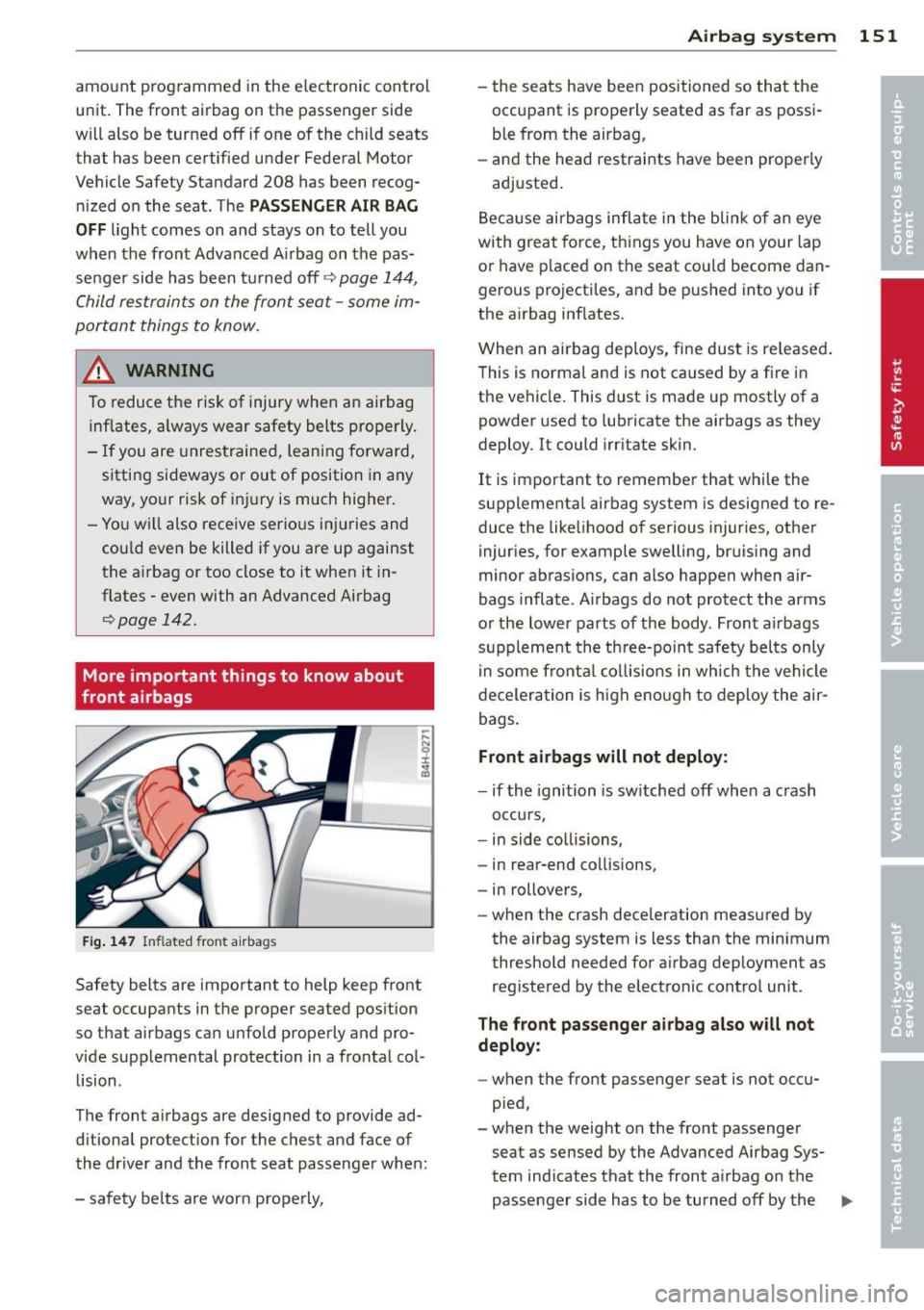
More important things to know about
front airbags
F ig. 14 7 Inflated front a irbags
Safety belts are important to help keep front
seat occupants in the proper seated pos ition
so that airbags can unfo ld properly and pro
v ide supplemental protection in a fronta l co l
lision .
The front a irbags are designed to provide ad
d itiona l protection for the chest and face of
the dr iver and the front seat passenger when :
- safety be lts are worn properly,
A irba g sy stem 151
- the seats have been positioned so that the
occ upant is properly seated as far as possi
ble from the airbag,
- and the head restrai nts have been properly
adjusted .
Beca use ai rb ags infl ate i n t he bli nk o f an eye
wi th great fo rce, th ings you have on your lap
or have p laced on the seat co uld become dan
gerous p ro jecti les, and be p ushed into you if
the a irbag inflates.
When an airbag deploys, fine dust is re leased .
T his is norma l and is not ca used by a fi re in
the ve hicle . This dust is made up mostly of a
powder used to lubricate the airbags as they
deploy. It could irr itate skin.
It is important to remember that wh ile the
s u pplementa l airbag system is designed to re
duce the like lihood of serious injur ies , other
injuries, for example swelling, bru is ing and
minor abrasions, can also happen when air
bags i nflate . A irbags do not protect the arms
or the lower parts of the body. Front a irbags
suppleme nt the th ree-point safety be lts only
i n some fronta l colli sions in which the vehicle
deceler ation is high e nough to deploy the air
bags .
Front airbags will not deploy :
-if the ignition is sw itched off when a c rash
o ccur s,
- in side co llisions,
- in rear-end coll is ions,
- in rollovers,
- when the crash deceleration measu red by
the airbag system is less than the minimum
threshold needed for a irbag deployment as
reg istered by the electro nic contro l unit .
The front passenger airbag also will not
deploy:
-when the front passenger seat is not occu
pied,
- when the weight on the front passenger seat as sensed by the Advanced Airbag Sys
tem ind icates that the front a irbag on the
passenger side has to be turned off by the
II>