seat adjustment AUDI A8 2013 User Guide
[x] Cancel search | Manufacturer: AUDI, Model Year: 2013, Model line: A8, Model: AUDI A8 2013Pages: 318, PDF Size: 79.34 MB
Page 161 of 318
-Always make sure the forward-facing
seat has been des igned and certified by
its manufacturer for use on a front seat
with a passenger front and side airbag.
- Never put the forward-facing child re
straint up aga inst or very near the instru
ment panel.
- Always move the passenger seat into its
rearmost position in the seat's fore and
aft adjustment range, as far away from
the a irbag as poss ible, before insta lling
the fo rward -facing child restraint. T he
b ackres t m ust be adjus ted to an upr igh t
posit ion.
- Make su re that the
PASSENGER AIR BAG
OFF
light comes on and s tays on all the
t ime whenever the ignition is switched
on .
Advanced Airbag System components
The front passenger seat in your vehicle has a
l ot of very important parts of the Advanced
Airbag System in it. These parts include the
weight-sens ing mat, sensors, wiring, brack
ets, and more . The function of the system in
the front passenger seat is checked by the
e lectronic control un it when the ign it ion is on .
The control un it mon itors the Advance d Air
bag Sys tem and turn s the a irbag i ndica tor
light on when a ma lfunction in t he system
compo nents is detected . The function of the
ai rbag indicator light is described in greater
deta il below. Because the front passenger
seat contains important parts of the Ad
va nced A irbag System, you must take care to
prevent it from being damaged . Damage to
the seat may p revent the Advanced A irbag for
the front passenger seat from doing its job in
a crash .
The front Advanced Airb ag System
consists of the following:
- Crash senso rs in the front of the veh icle that
measu re ve hicle accelera tion/decele ra ti on
to provide info rm ation to the Advanced Air
bag System abo ut the severity of the crash.
A irbag system 159
-An elect ron ic cont ro l unit, with integrated
crash sensors for front and side impacts .
The control un it "decides" whether to f ire
the front a irbags based on the informat ion
received from the crash sensors. The control
unit also "decides" whether the safety belt
prete nsione rs shou ld be act iva ted.
- An Advanced A irbag w it h gas generator and
cont ro l valve for the d river ins ide the steer
ing wheel h ub.
- An Advanced A irbag w ith gas generator and
cont ro l valve inside the instrument pa ne l for
the front passenger .
- A weight -sensing mat unde r the upho lstery
padding of the front passenge r seat cushion
that measures the to tal weight o n the seat.
The info rmat ion reg iste red is sent continu
ously to the elect ronic con trol u nit to regu
la te deployment of the front Advanced Air
bag on the passenger side .
- An airbag moni tor ing sys tem and ind icator
light in the instr ument cluster
¢ page 163.
-A sen sor in each fron t seat regis ters the dis
t ance betwee n the respec tive seat and the
steering whee l or instrument panel. The i n
formation registered is sent cont inuo usly to
the electron ic contro l unit to regulate de
ployment of the front Advanced A irbags .
- The
PASSENGER AIR BAG OFF light comes
on and stays on in the center o f the instr u
ment panel¢
page 163, fig. 168 and tells
you whe n the front Advanced Airbag on the
passe nger side has been tu rned off.
- A sensor below the safety belt latch for the
front seat passenger to measure t he tension
on the safety belt. The tension o n the safety
be lt and the weight regis tered by the
weigh t-sensi ng mat he lp the cont rol uni t
"de cide" whe ther the front airbag fo r the
front passenge r seat should be turned off or
not
~ page 154, Child restraints on the
front seat -some important things to
know.
- A sensor in t he safety be lt latch fo r the d riv
er and for the front seat passenger that
senses w hethe r th at safety belt is latched or
not and transmits this information to the
electronic control unit.
•
•
Page 179 of 318
-Always install rear-facing child safety
seats on the rear seat.
- If you must install a rearward facing
child safety seat on the front passenger
seat in exceptional circumstances and
the
PASSENGER AIR BAG OFF light does
not come on and stay on, immediately
install the rear-facing child safety seat in
a rear seating position and have the air
bag system inspected immediately by
your Audi dealer.
_& WARNING
If, in exceptional circumstances, you must
install a forward-facing child restraint on
the front passenger's seat:
- Always make sure the forward-facing
seat has been designed and certified by its manufacturer for use on a front seat
with a passenger front and side airbag.
- Always follow the manufacturer's in
structions provided with the child safety
seat or carrier.
- Always move the passenger seat into its
rearmost position in the seat's fore and
aft adjustment range, as far away from
the airbag as possible before installing
the child restraint. The backrest must be
adjusted to an upright position .
- Always make sure that the
PASSENGER
AIR BAG OFF
light comes on and stays
on all the time whenever the ignition is
switched on.
(D Tips
Always replace child restraints that were
installed in a vehicle during a crash. Dam
age to a child restraint that is not visible
could cause it to fail in another collision
situation.
Advanced front airbag system and children
Your vehicle is equipped with a front "Ad
vanced Airbag System" in compliance with United States Federal Motor Vehicle Safety
Child Safety 177
Standard (FMVSS) 208 as applicable at the
time your vehicle was manufactured.
The Advanced Airbag system in your vehicle
has been certified to meet the "low-risk" re
quirements for 3- and 6-year old children on
the passenger side and small adults on the driver side. The low risk deployment criteria
are intended to reduce the risk of injury
through interaction with the airbag that can
occur, for example, by being too close to the
steering wheel and instrument panel when
the airbag inflates . In addition, the system
has been certified to comply with the "sup
pression" requirements of the Safety Stand
ard, to turn off the front airbag for infants up
to 12 months who are restrained on the front
passenger seat in child restraints that are list
ed in the Standard.
Even though your vehicle is equipped with an
Advanced Airbag system, all children, espe cially those 12 years and younger, should al
ways ride in the back seat properly restrained
for their age and size. The airbag on the pas
senger side makes the front seat a potentially dangerous place for a child to ride . The front
seat is not the safest place for a child in a for
ward-facing child safety seat. It can be a very
dangerous place for an infant or a larger child
in a rearward-facing seat .
Advanced Airbags and the weight
sensing mat in the front seat
The Advanced Airbag System in your vehicle
detects the presence of an infant or child in a
child restraint on the front passenger seat us
ing the weight -sensing mat in the seat cush
ion and the sensor below the safety belt latch
on the front passenger seat that measures the
tension on the safety belt.
The weight -sensing mat measures total
weight of the child and the child safety seat
and a child blanket on the front passenger seat. The weight on the front passenger seat
is related to the design of the child restraint
and its "footprint", the size and shape of the
bottom of the child restraint as it sits on the ..,.
•
•
Page 182 of 318
180 Child Safety
&_ WARNING
Not using a child safety seat, using the
wrong child safety seat or improperly in
stalling a child restraint increases the risk
of serious personal injury and death .
-All vehicle occupants and especially chil
dren must always be restrained properly
whenever riding in a vehicle.
-
- An unrestrained or improperly restrain
ed child can be injured or killed by be
ing thrown against the inside of the ve
hicle or by being ejected from it during
a sudden maneuver or impact .
- An unrestrained or improperly restrain
ed child is at much greater risk of injury
or death by being struck by an inflating
airbag.
- Commercially available child safety seats
are required to comply with U.S. Federal
Motor Vehicle Safety Standard (FMVSS)
213 (in Canada CMVSS 213).
- When buying a child restraint, select
one that fits your child and the vehicle.
- Only use child restraint systems that
fully contact the flat portion of the
seat cushion. The child restraint must not tip or lean to either side. Audi does
not recommend using child safety
seats that rest on legs or tube -like
frames . They do not provide adequate
contact with the seat.
-Always heed all legal requirements per
taining to the installation and use of
child safety seats and carefully follow
the instructions provided by the manu
facturer of the seat you are using.
- Never allow children under 57 inches
(1.45 meters) to wear a normal safety
belt. They must always be restrained by a
proper child restraint system. Otherwise,
they could sustain injuries to the abdo
men and neck areas during sudden brak
ing maneuvers or accidents.
- Never let more than one child occupy a
child safety seat . -
Never let babies or older children ride in
a vehicle while sitting on the lap of an
other passenger .
- Holding a child in your arms is never a
substitute for a child restraint system.
- The strongest person could not hold
the child with the forces that exist in
an accident. The child will strike the in
terior of the vehicle and can also be
struck by the passenger.
- The child and the passenger can also
injure each other in an accident.
- Never install rear-facing child safety
seats or infant carriers on the front pas
senger seat. A child will be seriously in
jured and can be killed when the passen
ger airbag inflates -even with an Ad
vanced Airbag System .
- The inflating airbag will hit the child
safety seat or infant carrier with great
force and will smash the child safety seat
and child against the backrest, center
armrest, door or roof.
-Always install rear-facing child safety
seats or infant carriers on the rear seat .
- Forward-facing child safety seats instal
led on the front passenger's seat can in
terfere with the airbag when it inflates
and cause serious injury to the child. Al
ways install forward-facing child safety
seats on the rear seat.
- If exceptional circumstances require the
use of a forward-facing child restraint on
the front passenger's seat, the child's
safety and well-being require that the
following special precautions be taken :
- Make sure the forward-facing seat has
been designed and certified by its man
ufacturer for use on a front seat with a
passenger front and side airbag.
-Always carefully follow the manufac
turer's instructions provided with the child safety seat or carrier.
- Always move the front passenger seat
into the rearmost position of the pas
senger seat's fore and aft adjustment range, and as far away from the airbag
Page 183 of 318
as possible before installing the child
restraint.
- Always make sure that nothing pre
vents the front passenger's seat from
be ing moved to the rearmost position
in its fore and aft adjustment range.
- Always make sure that the backrest is
in the upr ight position.
- Always buck le the child safety seat firmly
in place even if a child is not sitting in it.
A loose ch ild safety seat can fly around
dur ing a sudden stop or in a col lision .
- Always read and heed all WARNINGS
whenever using a child restrained in ave
hicle is being used
c::> page 144, Safety
belts,
c::> page 152, Airbag system and
c::> page 176, Child Safety.
A WARNING
T o reduce t he ris k of serious injury, make
sure that the
PASSENGER AIR BAG OFF
light comes on and stays on whenever a
child rest raint is installed on the front pas
senger seat and the ignition is switc hed
on.
- Take the child restraint off t he fro nt pas
senger seat and install it properly at one
of the rear seat positions if the
PASSEN ·
GER AIR BAG OFF
light does not stay on.
- Have the airbag system inspected by
your authorized Aud i dealer immediate
ly.
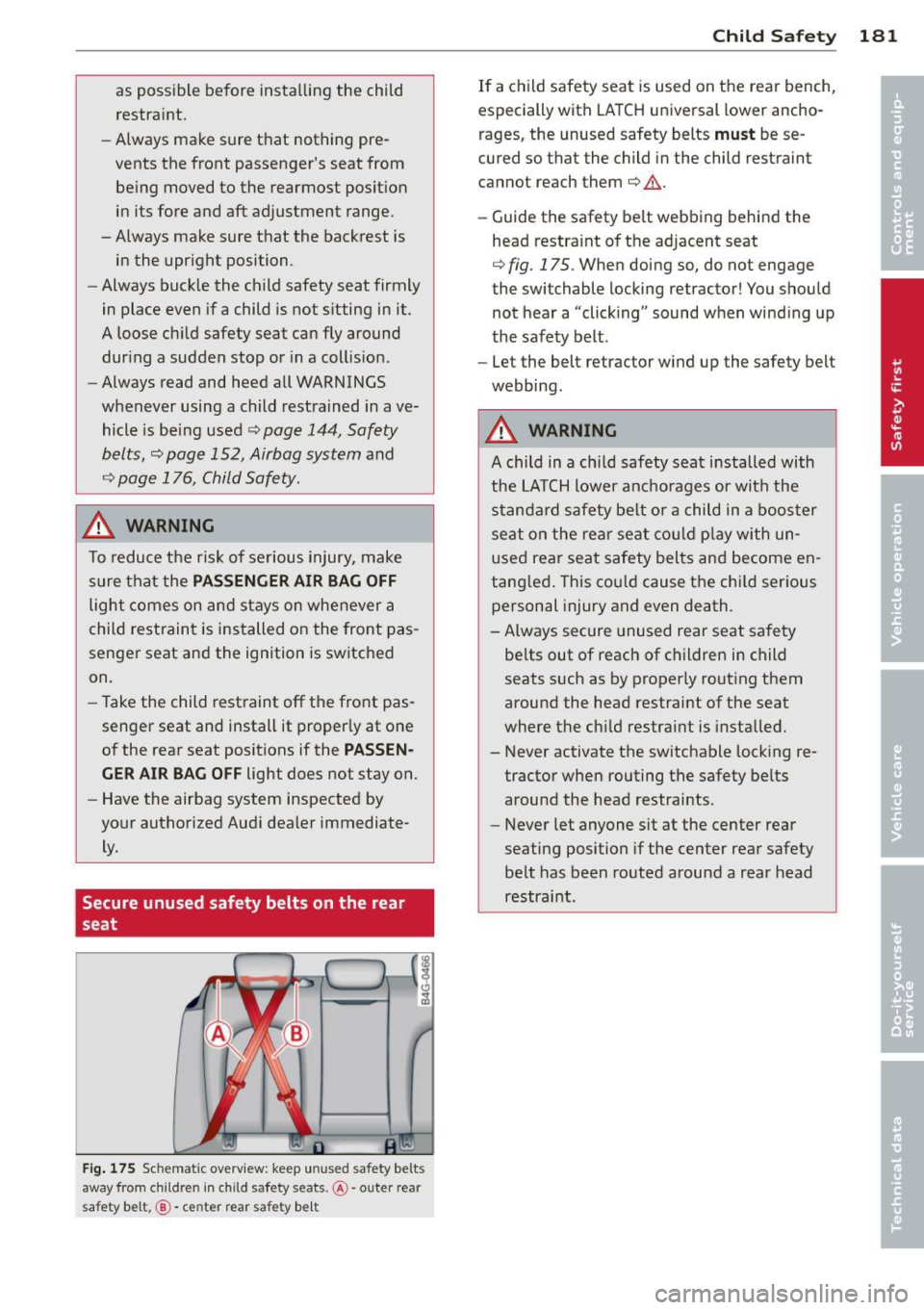
Secure unused safety belts on the rear
seat
F ig. 175 Schematic overv iew : keep un used safety belts
away from children in child safety seats.@-oute r rear
safety belt,
@ -center rear safety belt
Child S afety 181
If a child safety seat is used on the rea r bench,
especially with LATCH universal lower ancho
rages, the unused safety belts
must be se
cured so that the child in the child restraint
cannot reach them
c::> &.
-Guide the safety belt webbing behind the
head restra int of the ad jacent seat
c::> fig. 175. When doing so, do not engage
the switchable locking retractor! You shou ld
not hear a "click ing" sound when wind ing up
the safety belt .
- Let the belt retractor wind up the safety belt
webbing.
A WARNING
A child in a chi ld safety seat installed with
the LA TCH lower anc horages or with the
standa rd safety be lt or a child in a booster
se at o n the rea r seat co uld play with un
used rear seat safety belts and become en
tang led . This cou ld cause the chi ld ser ious
personal injury and even death.
-A lways secure unused rear seat sa fe ty
be lts out of reach of children in child
seats such as by proper ly rout ing them
around the head restraint of the seat
where the ch ild restraint is installed.
- Never activate the switchable locking re
tracto r when routing the safety belts
around the head restraints.
- Never let anyone s it at the center rear
seating position if the center rear safety
be lt has been routed around a rear head
restra int .
Page 186 of 318
184 Child Safet y
to the backrest on the veh icle seat. Ad
just the rear seat head restraint if it is difficult to install the child seat w ith the
head restraint in place <=>
page 138. Driv
ing with head restraints that are not
properly ad justed increases the risk of
serious o r fa tal neck injury dramatically.
- Always read and heed all WARNINGS
whenever using a child restrained in ave
hicle is being use d
¢page 144, Safety
belts,
¢ page 152, Airbag system and
¢ page 176, Important things to know.
_& WARNING
If except ional circumstances requ ire the
use of a forward-facing child restraint on
the front passenger's seat, the ch ild's safe
ty and well -being require that the follow
ing special precautions be taken :
- Make sure the forward-facing seat has
been designed and certif ied by its manu
facturer for use on a front seat with a
passenger front and side a irbag.
- Always follow the manufacturer's in
struct ions provided with the child safety
seat or infant carrier .
- Always move the front passenger seat in
to the rearmost posit ion of the passen
ger seat's fore and aft adjustment range,
and as far away from the airbag as possi ble before installing the child restraint .
- Always make su re that noth ing prevents
the front passenger's seat from being
moved to the rearmost position in its
fore and aft adjustment range.
- Always make sure the backrest is in an
upr ight position .
- Make sure that the
PASSENGER AIR BAG
OFF
light comes on and stays on all the
t ime whenever the ignition is switc hed
on.
- If the light does no t stay on, pe rform the
chec ks
¢ page 163, Monitoring the Ad
vanced Airbag System.
- T ake the child restraint off the front pas
senger seat and install it properly at one
of the rear seat positions if the
PASSEN· GER AIR BA
G OF F
light does not stay on
whenever the ignit ion is switched on.
Booster seats and safety belts
Properly used booster seats can help protect
children weighing between about 40 lbs. and
80 lbs. (18 kg and 36 kg) who are less than 4
ft. 9 in . (57 in ches/1.45 meters) tall.
:e N 0 ±
i'il
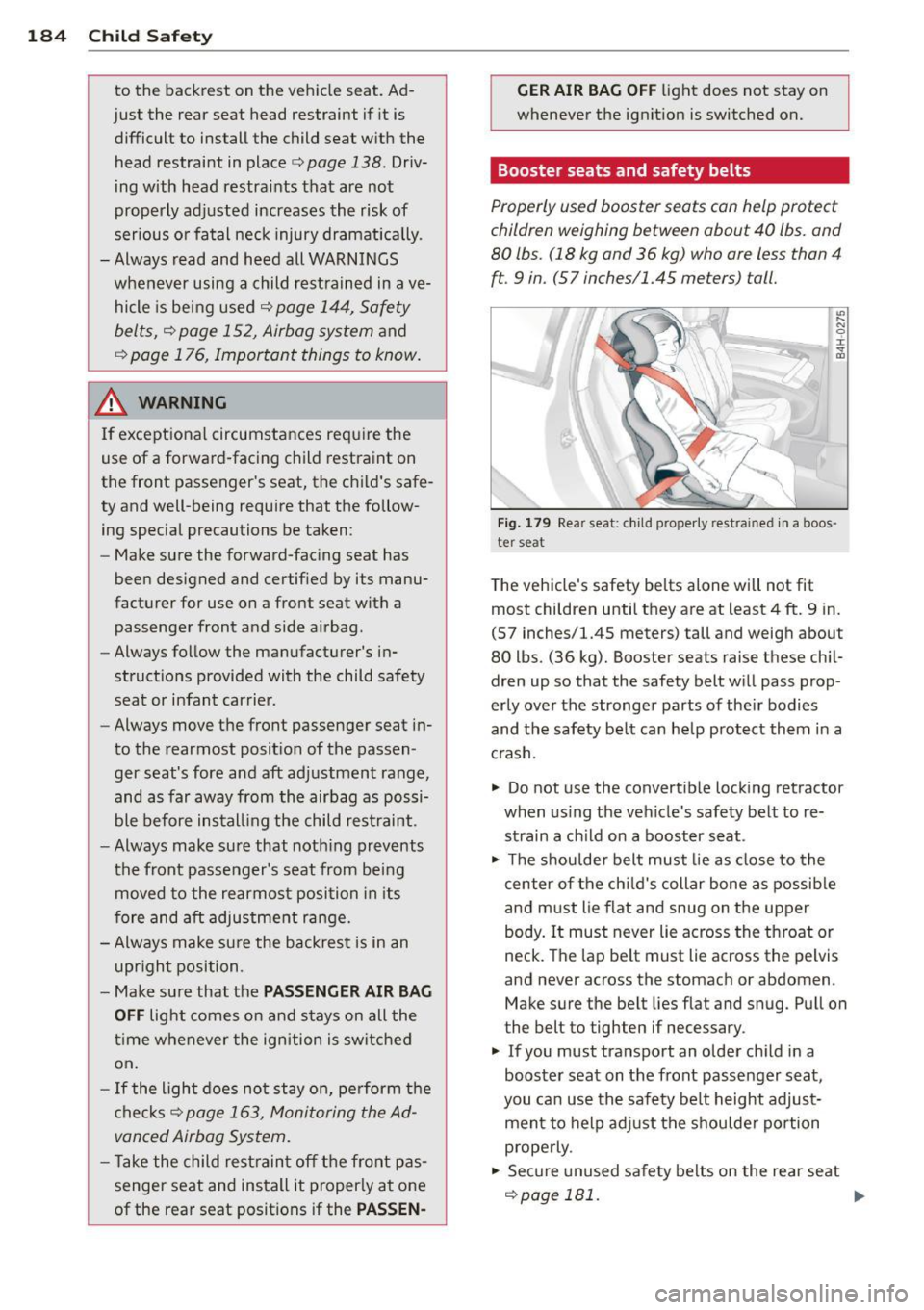
F ig. 179 Rea r seat: c hild p roperly rest rai ned in a boos
ter se at
T he vehicle 's safety belts a lone will not fit
most children until they are at least 4 ft. 9 in.
(57 inches/1.45 meters) tall and weigh about
80 lbs. (36 kg). Booster seats raise these chil
dren up so that the safety belt will pass prop
erly over the stronger parts of the ir bodies
and the safety be lt can he lp protect them in a
c rash .
.,. Do not use the convertible lock ing retractor
when us ing the vehicle's safety belt to re
strain a ch ild on a booster seat .
.,. The shou lde r belt must lie as close to the
center of the ch ild's collar bone as possible
and must lie flat and snug on the upper
body. It must never lie across the throat or
neck. The lap be lt must lie across the pelvis
and never across the stomach or abdomen .
Make sure the belt lies flat and snug. Pull on
the belt to tighten if necessary .
.,. If you must transport an older child in a
booster seat on the front passenger seat,
you can use the safety be lt height adjust
ment to help adj ust the shou lder portion
properly .
.. Secure unused safety belts on the rear seat
¢page 181. ..,_
Page 189 of 318
-Forward-facing child safety seats or in
fant carriers installed on the front pas
senger's seat may interfere with the de ployment of the airbag and cause serious
injury to the child.
- It is safer to install a forward-facing
child safety seat on the rear seat .
- Always read and heed all WARNINGS
whenever using a child restrained in ave
hicle is being used
c:::;, page 176 . Special
precautions apply when installing a child
safety seat on the front passenger seat
c:::;, page 154, Child restraints on the front
seat -some important things to know.
A WARNING
-
Always take special precautions if you
must install a forward or rearward-facing
child restraint on the front passenger's
seat in exceptional situations:
- Whenever a forward or rearward-facing
child restraint is installed on the front
passenger seat, the
PASSENGER AIR
BAG OFF light must come on and stay on
whenever the ignition is switched on.
- If the
PASSENGER AIR BAG OFF light
does not come on and stay on, perform
the checks described
c> page 163, Moni
toring the Advanced Airbag System .
-Take the child restraint off the front pas
senger seat and install it properly at one
of the rear seat positions if the
PASSEN
GER AIR BAG OFF
light does not stay on
whenever the ignition is switched on.
- Improper installation of child restraints
can reduce their effectiveness or even
prevent them from providing any protec
tion.
- An improperly installed child restraint
can interfere with the airbag as it de
ploys and seriously injure or even kill the
child.
- Always carefully follow the manufactur
er's instructions provided with the child
safety seat or carrier.
- Never place additional items on the seat
that can increase the total weight regis-
Child Safety 187
tered by the weight-sensing mat and can
cause injury in a crash.
A WARNING
Forward-facing child restraints:
- Always make sure the forward-facing
seat has been designed and certified by
its manufacturer for use on a front seat
with a passenger front and side airbag.
- Never put the forward-facing child re
straint up, against or
very near the in
strument panel.
- Always
move the passenger seat into its
rearmost position in the seat 's fore and
aft adjustment range, as far away from
the airbag as possible before installing
the forward-facing child restraint . The
backrest must be adjusted to an upright
position.
- Make sure that the
PASSENGER AIR BAG
OFF
light comes on and stays on all the
time whenever the ignition is switched
on.
A WARNING ...==-
Rearward-facing child restraints:
-A child in a rearward-facing child safety
seat installed on the front passenger
seat will be seriously injured and can be
killed if the front airbag inflates -
even
with an Advanced Airbag System.
- The inflating airbag will hit the child
safety seat or infant carrier with great
force and will smash the child safety seat
and child against the backrest, center
armrest, door or roof .
- Always be especially careful if you must
install a rearward facing child safety seat
on the front passenger seat in exception
al circumstances .
- A tight tether strap on a rearward-facing
child restraint attached to the front pas
senger seat can put too much pressure
on the weight-mat in the seat and regis
ter a heavier weight in the Advanced Air
bag System. The heavier weight regis
tered can make the system work as •
•
Page 195 of 318
-Always read and heed the important in
formation and WARNINGS about child
safety and the installation of child re
straint systems
c:> page 176, Child Safe
ty.
(D Note
On vehicles with power adjustable rear
seats* some criteria must be observed
when attaching the child restraint using the
LATCH system:
- To attach the child restraint securely, the
seat must be moved to the farthest rear
position, the seat height set to the low
est position and the head restraint must be adjusted to the vertical position
¢ page 60.
-If a child safety seat is attached to one of
the rear seats, this seat must not be ad
justed using the power controls under
any circumstances. The
Entry assistance
for this seat must also be deactivated in
the MMI
¢ page 63. The child safety seat
as well as the rear seat can be damaged by the adjustment process.
Tether anchors and tether straps
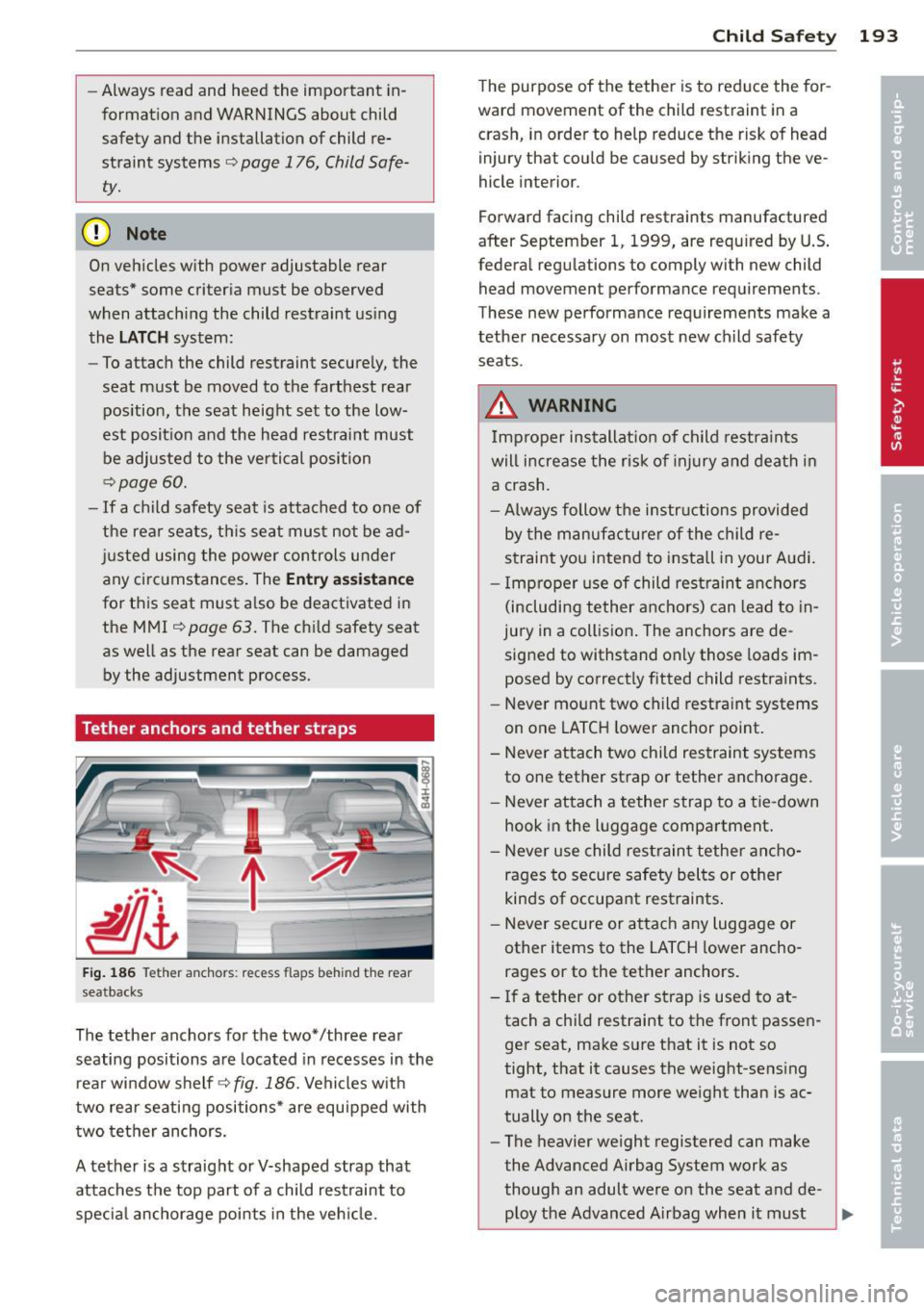
Fig. 186 Tether an cho rs: reces s fl ap s b ehin d th e re ar
seatbacks
The tether anchors for the two* /three rear
seating positions are located in recesses in the
rear window shelf ¢
fig. 186. Vehicles with
two rear seating positions* are equipped with two tether anchors .
A tether is a straight orV-shaped strap that
attaches the top part of a child restraint to
special anchorage points in the vehicle.
Child Safety 193
The purpose of the tether is to reduce the for
ward movement of the child restraint in a
crash, in order to help reduce the risk of head
injury that could be caused by striking the ve
hicle interior .
Forward facing child restra ints manufactured
after September 1, 1999, are required by U.S.
federal regulations to comply with new child
head movement performance requirements.
These new performance requirements make a
tether necessary on most new child safety
seats .
.&_ WARNING
Improper installation of child restraints
will increase the risk of injury and death in
a crash.
- Always follow the instructions provided
by the manufacturer of the child re
straint you intend to install in your Audi.
- Improper use of child restraint anchors
(including tether anchors) can lead to in
jury in a collision . The anchors are de
signed to withstand only those loads im
posed by correctly fitted child restraints .
- Never mount two child restraint systems
on one LATCH lower anchor point.
- Never attach two child restraint systems to one tether strap or tether anchorage.
- Never attach a tether strap to a tie-down
hook in the luggage compartment.
- Never use child restraint tether ancho
rages to secure safety belts or other
kinds of occupant restraints.
- Never secure or attach any luggage or
other items to the LATCH lower ancho rages or to the tether anchors .
- If a tether or other strap is used to at
tach a child restraint to the front passen ger seat, make sure that it is not so
tight, that it causes the weight -sensing
mat to measure more weight than is ac
tually on the seat .
- The heavier weight registered can make
the Advanced Airbag System work as
though an adult were on the seat and de -
ploy the Advanced Airbag when it must ..,
Page 206 of 318
204 Intelligent technology
temperature. This determines the current
state of charge and the power of the battery .
Idling current management
Idling current management reduces energy
consumption while the vehicle is stand ing.
With the ignition switched off, it contro ls the
energy supply to the various e lectrica l compo
nents. Data from battery diagnosis is consid
ered.
Depending on the battery's state of charge,
individual consumers are gradually turned off
to prevent excessive discharge of the battery
and thus maintain starting capability.
Dynamic energy management
While the vehicle is being driven, dynamic en
e rgy management distributes the energy gen
erated according to the needs of the individu
al components. It regu lates consumption, so
that more electrical energy is not being used
than is being generated and ensures an opti
mal state of charge for the battery.
Q) Tips
- But even energy management cannot negate the limits of physics. Consider
that the power and life of a battery are
li mited.
- If starting ability is threatened, the indi
cator light[•) appears
Q page 16, D
Battery.
What you should know
The highest priority is given to maintaining
starting capability.
The battery is severely taxed in short-distance
driving, in city traffic and during the cold time
of year. Abundant electrical energy is re
qu ired, but only a little is generated.
It is also
cr itica l if the engine is not running and electri
cal components are turned on. In this in
stance energy is being consumed but none is
being generated .
It is in precise ly these situations that you will
notice energy management active ly regu lat
ing the d istribution of energy.
Vehicle stands for an extended period
If you do not drive your vehicle over a period
of seve ral days or weeks, e lectr ica l compo
nents are gradually cut back or switched off .
This reduces energy consumption and main
tains starting capability over a longer period .
Some of the convenience functions may not
operate, such as the interior lights or the
power seat adjustment . The convenience
funct ions will be available again when you
switch on the ignition and start the engine.
With the engine turned off
If you listen to the radio, for example, with
the engine turned off or use other MMI func
tions, the battery is being discharged .
If starting capab il it y is jeopardized due to en
ergy consumption, the following warning ap
pears in the MMI display:
Please start the engine soon or the system
will be turned off.
The warn ing ind icates that the system will be
turned off automatically after 3 minutes. If
you w ish to continue using the functions, you
have to sta rt the eng ine .
With the engine running
Although electrical energy is generated when
the vehicle is being driven, the battery can be
come discharged. This happens mostly when
little energy is being generated and a grea t
deal consumed and the battery's state of
charge is not optimal.
T o b ring the energy bala nce back into equili
brium, consumers which req uire espec ially
large amounts of energy are temporarily cut
back or switched off . Heating systems in par
ticular require a great deal of energy. If you
notice, for examp le, that the heated seats* or
the heated rear window are not heating, they
have been temporarily cut back or switched .,.
Page 246 of 318

244 Checking and filling
Have the battery checked when you take your
vehicle in for service. You are well advised to replace a battery that is older than 5 years .
W ith certa in types o f airbag deployment, the
battery is disconnected from the vehicle elec
trica l system for safety reasons¢
& in Re
pair, core and disposal of the airbags on
page 166.
Disconnecting the battery terminals
Some veh icle functions (power window regu
lators, for example) are lost if the battery ter
minals are disconnected. These functions have
to be re learned after the battery terminals are
connected again. To prevent this, the battery
should only be disconnected from the vehicle
electrical system when absolutely necessary
for repairs .
Vehicles not driven for long period s
If you do not drive your vehicle over a period
of several days or weeks, electrical compo
nents are gradually cut back or switched off.
This reduces energy consumption and main
tains starting capability over a longer period
¢
page 203. Some of the convenience func
tions may not operate, such as the inte rior
lights or the power seat adjustment . Th e con
venience functions will be available again
when you switch on the ignition and start the
engine.
Winter operation
During the winter months, battery capacity
tends to decrease as tempe rat ures drop . This
is because more powe r is also consumed while
starting , and the headlights, rear window de
fogger, etc., are used more often.
Avoid unnecessary power consumption, par
ticular ly in city traffic or when traveling on ly
short distances. Let your authorized Audi
dealer check the capacity of the vehicle bat
tery before winter sets in
¢ page 246. A well
charged battery w ill not only prevent starting
prob lems when the weather is cold, but will
also last longer .
(D Tips
If your vehicle is left standing for seve ral
weeks at extremely low temperatures, the
vehicle battery sho uld be removed and
stored where it w ill not freeze . This will
prevent it from being damaged and having
to be replaced .
Working on the battery
Be especially careful when working on or near
the battery.
The battery is located in the luggage compart
ment under the floor. Before you check any
th ing in the luggage compartment,
read and
heed all WARNINGS
¢ ,& .
Always heed the safety warnings, when work
ing on the vehicle battery or the vehicle elec
trical system to prevent injury.
The following WARNINGS are very
important when working on the battery:
Always heed the following WARNING SYMBOLS and safety precautions when working
on the battery.
®
Always wear eye protection.
Battery acid contains sulfuric acid.
Always wear gloves and eye protec
tion.
No
- sparks
- flames
- smoking.
When a battery is charged, it produ
ces hydrogen gas which is explosive
and could cause personal injury.
Always keep the battery well out of
I
reach of children .
_&. WARNING ~
Whenever working on the battery or on
the electrical system, there is the risk of
injury, accident and even fire . Read and
heed the following WARNINGS:
-
Page 284 of 318

282 Fuses and bulb s
Fuse panel
® (red)
No. Equipment
=
I 6
Right headlight (headlight
with adaptive light)
7 ESC control module
8
Sound actuator, AEM control module
9 Adaptive cruise control
10 Transmission control mod
-
ule
11 Climate control system sen-
sors
Fuse panel © (brown)
No. Equipment
1
Electromechanical parking
brake
2 Suspension control system
sensor
3
Right rear door control mod-
ule
Smart modul tank
5
Front cl imate control system
contro ls
6
Rear climate control system
controls
7 Networking gateway
8 Cooler
9
Interface for specia l func-
tions
10 Cell phone adapter, Blue-
tooth handset
11 AEM contro
l module
12
13 Ambient
lighting
14 Rear exterior lighting
15 Fuel pump
I 16 Electromechanical parking
brake
Amps
=
10
5
7,5
10
5
5
5
5
7,5
5
15
10
5
15
5
5
15
10
10
20
25
30
-
Fuse panel @ (black)
No. Equipment
1
3
5
6
7
Automatic luggage com partment lid
Rear sockets
adaptive air suspens ion
115-V socket
Electromechanical parking
brake
8 Rear seat heating
9 Rear exterior lighting
10 Rear climate control system
blower
Rear sun shade, closing aid,
11 luggage compartment lock,
keyless go/entry, fuel filler
door
12 Luggage
compartment lid
control module
Fuse panel E (red)
No. Equipment
1 Rear seat adjustment but-
tons
3 Left rear seat (pneumatics)
5 Tra iler hitch control modu le*
6 Left rear seat
7 Right rear seat
8 Trailer hitch control module*
9 Trai ler hitch control modu le*
10 Right rear seat (pneumatics)
Fuse panel
® (brown)
No. Equipment
1 Start-Stop-System,
Radio re-
ceiver/sound amplifier
Sound amplifier
Start-Stop-System, Rear
3 Seat Entertainment, radio
receiver/sound amplifier
5 Automatic dimming interior
rearview mirror
6 DVD changer
Amps
5
20
15
25
30
25
20
20
20
30
Amps
5
7,5 20
30
30
20 15
7,5
Amps
30
30
10
5
5