child seat AUDI A8 2013 Owner's Guide
[x] Cancel search | Manufacturer: AUDI, Model Year: 2013, Model line: A8, Model: AUDI A8 2013Pages: 318, PDF Size: 79.34 MB
Page 163 of 318
amount prog rammed in the e lec tronic control
u nit. The front airbag on the passe nger side
will also be turned off if one of the ch ild seats
that has been certified u nder Fede ral Motor
Vehicle Safety Standard 208 has been recog n ized o n the seat. The
PASS ENGER AIR BAG
OFF li gh t comes on and stays on to tell you
when the front Advanced A irbag on the pas
se nger side has been tu rned off
Q page 154,
Child restraints on the front seat -some im
portant things to know.
A WARNING
To reduce the risk of injury when an airbag
inf lates, a lways wear safety belts properly.
- If you are unrestrained, lean ing fo rward,
sitting sideways or out of position in any
way , yo ur risk of inj ury is much higher.
- You wi ll also receive serio us injuries and
cou ld even be killed if you are up against
the a irbag or too close to it when it in
flates -even with an Advanced Airbag
Qpage 152.
More important things to know about
front airbags
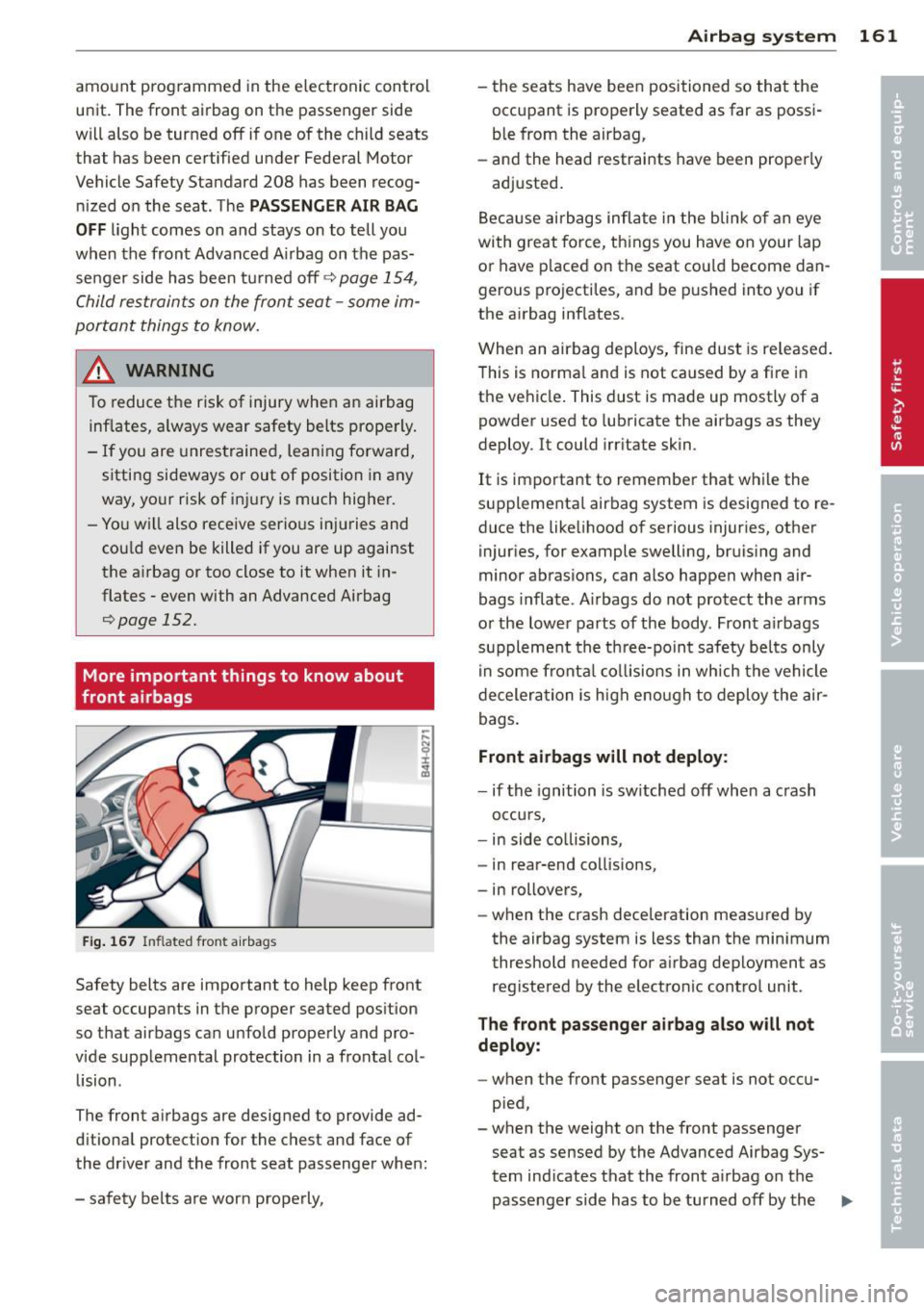
F ig. 167 Inflated front a irbags
Safety belts are important to help keep front
seat occupants in the proper seated pos ition
so that airbags can unfo ld properly and pro
v ide supplemental protection in a fronta l co l
lision .
The front a irbags are designed to provide ad
d itiona l protection for the chest and face of
the dr iver and the front seat passenger when :
- safety be lts are worn properly,
A irba g sy stem 161
- the seats have been positioned so that the
occ upant is properly seated as far as possi
ble from the airbag,
- and the head restrai nts have been properly
adjusted .
Beca use ai rb ags infl ate i n t he bli nk o f an eye
wi th great fo rce, th ings you have on your lap
or have p laced on the seat co uld become dan
gerous p ro jecti les, and be p ushed into you if
the a irbag inflates.
When an airbag deploys, fine dust is re leased .
T his is norma l and is not ca used by a fi re in
the ve hicle . This dust is made up mostly of a
powder used to lubricate the airbags as they
deploy. It could irr itate skin.
It is important to remember that wh ile the
s u pplementa l airbag system is designed to re
duce the like lihood of serious injur ies , other
injuries, for example swelling, bru is ing and
minor abrasions, can also happen when air
bags i nflate . A irbags do not protect the arms
or the lower parts of the body. Front a irbags
suppleme nt the th ree-point safety be lts only
i n some fronta l colli sions in which the vehicle
deceler ation is high e nough to deploy the air
bags .
Front airbags will not deploy :
-if the ignition is sw itched off when a c rash
o ccur s,
- in side co llisions,
- in rear-end coll is ions,
- in rollovers,
- when the crash deceleration measu red by
the airbag system is less than the minimum
threshold needed for a irbag deployment as
reg istered by the electro nic contro l unit .
The front passenger airbag also will not
deploy:
-when the front passenger seat is not occu
pied,
- when the weight on the front passenger seat as sensed by the Advanced Airbag Sys
tem ind icates that the front a irbag on the
passenger side has to be turned off by the
II>
Page 164 of 318
162 Airbag sys tem
electronic contro l uni t (the PAS SENGER AIR
BAG OFF
light comes on and stays on) .
A WARNING
Sitting in the wrong position can increase
the risk of serious injury in crashes.
- To reduce the risk of injury when the air
bags inflate, the driver and passengers
must always sit in an upright position,
must not lean against or place any part
of the ir body too close to the area where
the a irbags are located .
- Occupants who are unbelted, out of posi
t ion or too close to the airbag can be se
riously injured by an airbag as it unfolds
with great force in the blink of an eye
~page 154.
A WARNING
-
A child in a rearward -facing child sea t in
stalled on the front passenger seat will be
seriously injured and can be killed if the
front airbag inflates -even with an Ad
vanced Airbag System.
-The inflating ai rbag will hit the child seat
or infant carrier with great force and will
smash the ch ild seat and child against
the backrest , center armrest, door or
roof .
- Always install rear-facing child seats on
the rear seat.
- If you must install a rearward facing child seat on the front passenger seat
because of except iona l circumstances
and the
PASSENGER AIR BAG OFF light
does not come on and stay on, immedi
ately i nstall the rea r-facing chi ld seat in a
rear seating position and have the ai rbag
system inspected by your Au di dealer.
A WARNING
Objects be tween you and the a irbag will
increase the risk of in jury in a c rash by in
terfering with the way the airbag unfolds
or by being pushed into yo u as the a irbag
inf lates. -
Never hold things in you r hands o r on
your lap when the veh icle is in use.
- Never transpo rt items on or in t he a rea
of the front passenger seat. Objects
could move into the area of the front air
bags during braking or other sudden ma
neuvers and become dangero us projec
tiles that can cause ser ious personal in
jury if the a irbags inf late .
- Never p lace or attach accesso ries o r oth
er objects (such as cup hold ers, te le
phone b ra ck ets, large, heavy or bulky ob
jects) on the doors, ove r o r ne ar the are a
marked "AIRBAG" on the s teer ing whee l,
instr ument panel, sea t bac krests o r be
tween those areas and yourself. T hese
objects could ca use in jury in a crash, es
pecially when the airbags inflate.
- Never recline the front passenger 's seat
to transport objects. Items can a lso
move into the area of the s ide airbag or
the front a irbag during braki ng or in a
sudden maneuve r. Objects near the air
bags can become projectiles and cause
in jur y, partic ularly when the seat is re
clined.
A WARNING
The fine dus t create d when air bags deploy
c a n cause breathing p rob lems fo r people
wi th a history of as thma or other breath
i ng cond itions.
- T o reduce the risk of breath ing pro blems,
those with asthma or othe r respiratory
conditions s hou ld get fresh air right
away by getting o ut o f the veh icle or
open ing windows or doors .
- If you are in a collision in which airbags
deploy, wash your hands and face with
mild soap and water before eating.
- Be careful not to get the dust into your
eyes, or into any c uts or scratches.
- If the res id ue should get into your eyes,
f lush them w ith water.
Page 165 of 318
Monitoring the
Advanced Airbag
System
I ( USA models) /!{ (Canada models )
Airbag monitoring indicator light
Two separate indicators monitor the function
of the Advanced Airbag System: the airbag
monitoring indicator light and the
PASSEN
GER AIR BAG OFF
light.
The Advanced Airbag System (including the
electronic control un it, sensor circuits and sys
tem wiring) is monitored continuously to
make sure that it is functioning properly
whenever the ignit ion is on. Each time you
switch on the ignition, the airbag monitoring
indicator light
I (USA models)/ m (Canada
models) will come on for a few seconds (self
diagnost ics).
The system must be inspected when the
indicator light
I (USA models)/fll
(Canada models):
-does not come on when the ignition is
switched on ,
- does not go out a few seconds after you
have switched on the ignition, or
- comes on while driving.
If an airbag system malfun ction is detected,
the indicator light will first start flashing to
catch the driver's attention and then stay on
continuously to serve as a constant reminder
to have the system inspected immediately.
If a malfunction occurs that turns the front
airbag on the passenger side
off, the PASSEN
GER AIR BAG OFF
light will come on and stay
on whenever the ignition is on.
A WARNING
An airbag system that is not funct ioning
properly cannot provide supplemental pro
tection in a frontal crash.
- If the airbag indicator light
c:> page 18
comes when the vehicle is be ing used,
have the system inspected imm ediately
by your autho rized Audi dealer.
It is pos-
Airbag system 163
sible that the airbag will inflate when it
is not supposed to, or will not inflate
when it should.
PASSENGER AIR BAG OFF light
Fig. 168 Sect io n from the instrument pane l: PASSEN·
GER AIR BAG OFF light
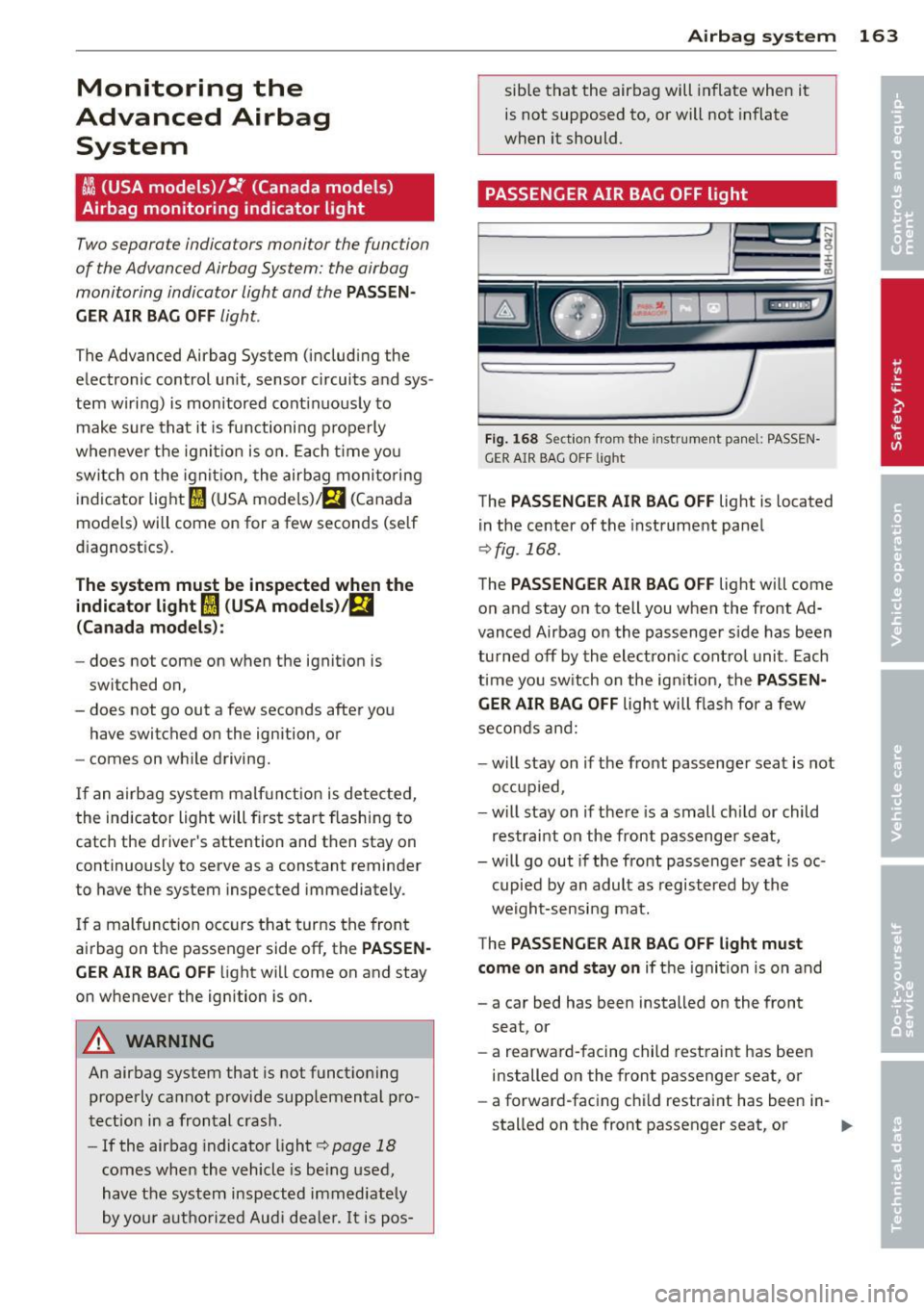
The PASSENGER AIR BAG OFF light is located
in the center of the instrument panel
c:>fig . 168.
The PASSENGER AIR BAG OFF light will come
on and stay on to tell you when the front Ad
vanced Airbag on the passenger s ide has been
turned
off by the electron ic control unit. Each
time you switch on the ignition, the
PASSEN
GER AIR BAG OFF
light will flash for a few
seconds and:
- will stay on if the front passenger seat is not
occupied,
- will stay on if there is a small ch ild or child
restraint on the front passenger seat,
- w ill go out if the front passenger seat is oc·
cupied by an adult as registered by the
weight-sensing mat.
The
PASSENGER AIR BAG OFF l ight must
come on and stay on
if the ignition is on and
- a car bed has been installed on the front seat, or
- a rearward-facing child restraint has been
installed on the front passenger seat, or
- a forward-facing child restraint has been in·
stalled on the front passenger seat, or
Page 166 of 318
164 Airbag sys te m
- the weight regis tered on the front passen
ger seat is equa l to or less tha n the com
bined weight of a ty pical 1 year-old restrain
ed in one of the rear-facing or forward
facing infant restraints listed in Federal Mo
tor Vehicle Safety Standard 208 with which
the Advanced Airbag System in your vehicle
was certified .
If the front passenger seat is not occupied,
the front airbag will not deploy, and the
PA S
SENGER AIR BAG OFF
li ght w ill stay on. Nev
e r i nsta ll a rearwa rd-fac ing ch ild restra int on
the front passenger seat, the safest place fo r
a child in any kin d of child restraint is at o ne
of the seat ing positions on the rear seat
¢ page 154, Child restraints on the front seat
- some important things to know
and
¢ page 176, Child Safety .
If the PASSENGER AIR BAG OFF light c om es
on
when one o f the conditions listed above is
met, be sure to check the light regularly to
make certa in that the
PASSENGER AIR BAG
OFF
light stays on cont inuo usly whenever the
ignit io n is on. If the
PASSENGER AIR BAG
OFF light does not appear on and does not
stay on all the time, stop as soon as it is safe
to do so and
- react ivate the system by switc hing the igni
t ion off and then switch ing it on again;
- remove and re install the child restraint.
Make sure that the child restraint is properly
installed and that the safety be lt fo r the
front passenger seat has been correct ly
r o uted throug h the child rest raint as descri
bed in the chi ld restrai nt ma nufactu rer's i n
stru ct ions;
- make su re that the convertible locking fea
t u re on the sa fe ty be lt for the front p assen
ger seat has been activated and that the
safety belt has been pulled tight . The belt
must not be loose or have loops of slack so
that the sensor below the safety be lt latch
on the seat can do its job
¢ page 186.
- ma ke sure that th ings that may increase the
weight of the chi ld and child seat are not be
ing transported on the front passenger seat; -
make sure that the sa fety belt tension sen
sor is not blocked. S hake the safety be lt
latch on the front passenger seatback and
forth;
- If a strap or tether is be ing used to tie the
child seat to the front passenger seat, make
sure that it is not so t ight that it causes the
weight-sensi ng mat to measure more
weight than is actually on the seat .
If the PASSENGER AIR BAG OFF light still
does not come on
and does not stay on con
t in uous ly (when the ignition is switched on),
- take the child restraint off the front passen -
ger seat and install it proper ly at one of the
rear seat positions. Have the airbag system
inspected by your Audi dealer immed iate ly.
- move the child to a rear seat position and
make sure that the child is properly restra in
ed in a ch ild restra int that is appropriate for
its s ize and age.
The
PASSENGER AIR BAG OFF light should
NOT come on when t he ignit ion is on and an
adult is s itting in a proper seating position on
the front passenge r seat. If the
PASSENGER
AIR BAG OFF
light comes on and stays on o r
flashes fo r about 5 seconds w hile d riving, un
der these c ircumstances, make sure tha t:
- the adult on the front passenge r seat is
prope rly seated on the cente r of the sea t
cushion with his or her back up aga inst the
backrest and the backrest is not re cli ned
¢ page 135, Proper occupan t seating posi
tions,
- t he adult is not tak ing we ight off the sea t by
holding on to the passenger assis t handle
above the front passenger door or s upport
ing their weight on the armrest,
- t he sa fety belt is being properly worn and
that the re is not a lot of s lack in the safety
be lt webb ing,
- accesso ry seat covers or cushions or other
things that may cause an incorrect reading
or impression on the weight-sensing mat
under the upho lstery of the seat have been
removed from the front passenger seat, .,..
Page 167 of 318
-a safety be lt extender has not been left in
the safety belt latch for the front passenger
seat .
I n addition to the
P ASS ENGER AIR B AG OFF
light in the center of the instrument panel,
the message
PA SSENGE R AIR BAG OFF or
PASSENGER AI R BAG ON will briefly appear
in the instrument cluster display . Th is is to in
form the driver of the current front passenger
airbag status .
Important safety instructions on
monitoring the Advanced Airbag System
A WARNING
An airbag system that is not functioning
properly cannot provide supplemental pro
tection in a frontal crash.
- If the airbag indicator light
c:> page 18
comes when the vehicle is be ing used,
have the system inspected immediately
by your authorized Aud i deale r. It is pos
sible that the a irbag will inf late when it
is not supposed to, or w ill not inflate
when it sho uld.
A WARNING
If the front airbag inflates, a ch ild without
a child restraint, or in a rearward-facing
child safety seat, or in a forward-facing
child restraint that has not been properly
installed will be serio usly injured and can
be killed.
- Even though your vehicle is equipped
with an Advanced Airbag System, make certain that all children, especially 12
years and younger, always ride on the
back seat properly restrained fo r their
age and size .
- Always install forward or rear-facing
child seats on the rea r seat -even w ith
an Advanced Airbag System.
- If you must install a rearward-facing
child seat on the front passenge r seat
because of exceptiona l circumstances
and the
PASSENGER AIR BAG OFF l igh t
does not appea r and s tay on, immediate-
A irbag system 165
ly insta ll the rear-facing child seat in a
rear seat ing pos ition and have the airbag
system inspected by your Audi dealer.
- A tight tether or other strap on a rear
ward-facing child restraint attached to
the front passenger seat can put too
much pressure on the weight-sensing
mat in the seat and reg ister more weight
than is actually on the seat. The heavier
weight registered can make the system
work as tho ugh an adult were on the seat
and deploy the Advanced Airbag when it
m ust be suppressed causing serious or
even fata l injury to the chi ld .
- If, in exceptiona l circumstances, you
m ust install a forward-facing child re
straint on the front passenger seat, al
ways move the seat into its rearmost po sition in the seat's fore and aft adjust
ment range, as fa r away from the a irbag
as poss ible . The backrest must be ad just
ed to an upright pos ition. Make sure that
the
PASSENGER AIR BAG OFF light
comes on and stays on a ll t he time when
ever the ignit ion is switched on .
A WARNING
=
-If the PASSENGER AIR BAG OFF light
does not go out when an ad ult is sitting
on the front passenger seat after taking
the steps described above, make sure the
adu lt is properly seated and restra ined at
one of the rear seat ing pos itions.
- Have the airbag system inspected by
your Aud i dea ler before transporting
anyone on the front passenger seat.
(D Tips
If the weight-sensing mat in the front pas
senger seat detects an empty seat, the
front airbag on the passenger side will be
turned off, and the
PASS ENGER AIR BAG
OFF
light will stay on .
Repair, care and disposal of the airbags
Parts of the airbag system are i nstalled at
many diffe rent p laces o n your Aud i. Insta lling, .,.
•
•
Page 171 of 318
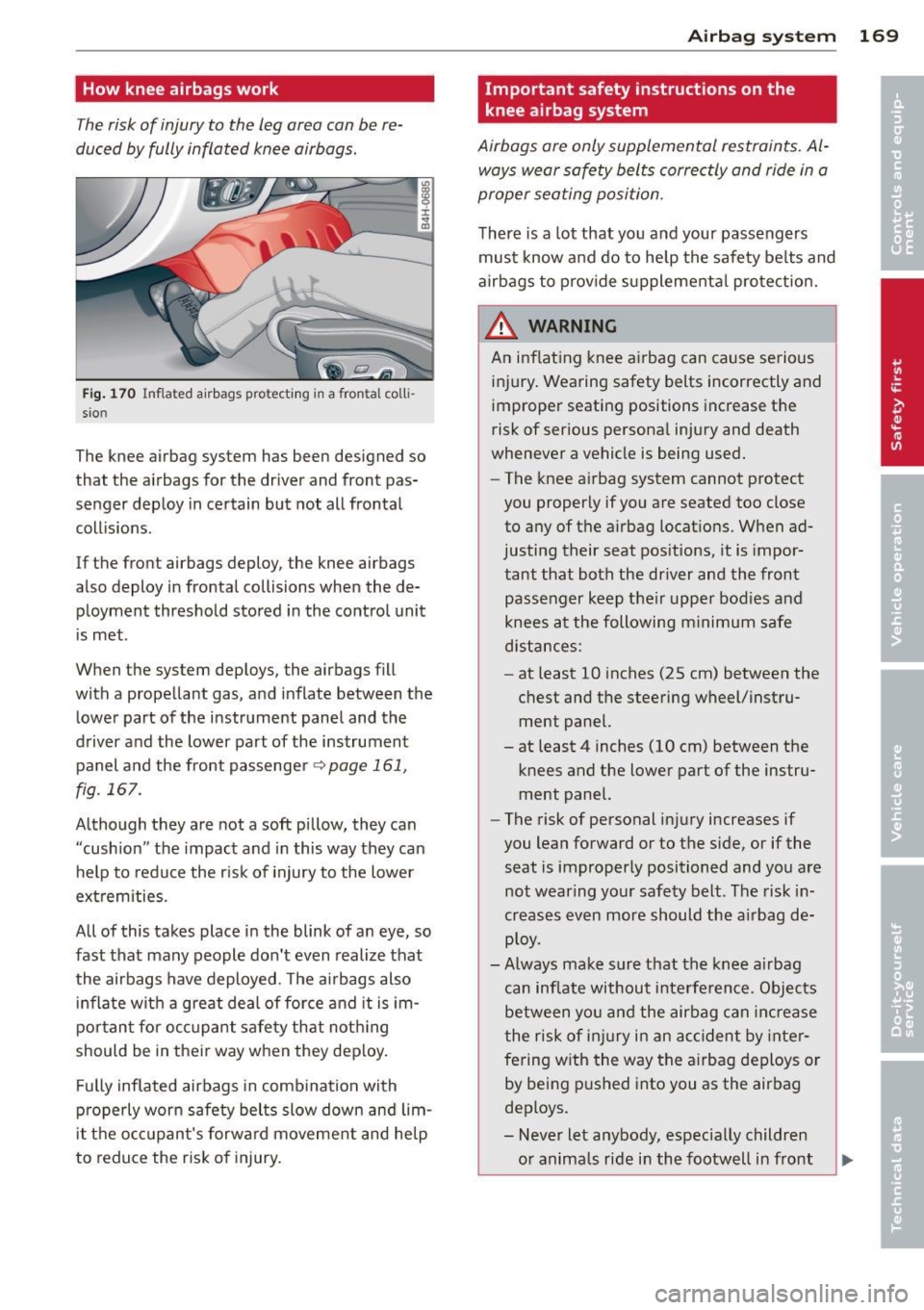
How knee airbags work
The risk of injury to the leg area con be re
duced by fully inflated knee airbags.
Fig. 170 Inflated airbags protecting in a fro ntal coll i
sio n
The knee airbag system has been designed so
that the airbags for the driver and front pas
senger deploy in certain but not all frontal
collisions .
If the front airbags deploy, the knee airbags
also deploy in frontal collisions when the de
ployment threshold stored in the control unit
is met .
When the system deploys, the airbags fill
with a propellant gas, and inflate between the
lower part of the instrument panel and the
driver and the lower part of the instrument
panel and the front passenger~
page 161,
fig . 167.
Although they are not a soft pillow, they can
"cush ion" the impact and in this way they can
help to reduce the risk of injury to the lower
extremities.
All of this takes place in the blink of an eye, so
fast that many people don't even realize that
the airbags have deployed . The airbags also
inflate with a great deal of force and it is im
portant for occupant safety that nothing
should be in their way when they deploy.
Fully inflated airbags in combination with
properly worn safety belts slow down and lim
it the occupant's forward movement and help
to reduce the risk of injury.
Airbag system 169
Important safety instructions on the
knee airbag system
Airbags ore only supplemental restraints . Al
ways wear safety belts correctly and ride in a
proper seating position .
There is a lot that you and your passengers
must know and do to help the safety belts and
airbags to provide supplemental protection.
_& WARNING
An inflating knee airbag can cause serious injury. Wearing safety belts incorrectly and
improper seating positions increase the
risk of serious personal injury and death
whenever a vehicle is being used.
- The knee airbag system cannot protect
you properly if you a re seated too close
to any of the airbag locations. When ad
justing their seat positions, it is impor
tant that both the driver and the front
passenger keep their upper bodies and
knees at the following minimum safe
distances:
- at least 10 inches (25 cm) between the
chest and the steering wheel/instru
ment panel.
- at least 4 inches (10 cm) between the
knees and the lower part of the instru
ment panel.
- The risk of personal injury increases if
you lean forward or to the side, or if the
seat is improperly positioned and you are not wearing your safety belt. The risk in
creases even more should the airbag de ploy.
- Always make sure that the knee airbag
can inflate without interference. Objects
between you and the airbag can increase
the risk of injury in an accident by inter
fering with the way the airbag deploys or
by being pushed into you as the airbag
deploys.
- Never let anybody, especially children
or animals ride in the footwell in front
Page 172 of 318
1 7 0 Airbag system
of the passenger seat. If the airbag de
ploys, this can resu lt in serious or fata l
injuries.
- Never carry objects of any kind in the
footwell area in front of the driver's or
passenger's seat. Bulky objects (shop
p ing bags, for examp le) can interfere
with or p revent proper dep loyment of
the airbag . Small objects can be
thrown through the vehicle i f the a ir
bag deploys and injure you or yo ur pas
sengers.
- Make sure there are no cra ck s, deep
scratches or ot her damage in the area of
the instrument pane l where the knee air
bags are located .
- If children are incorrect ly sea ted, their
risk of inj ury i ncreases in a collision
¢ page 176, Child Safety .
Side airbags
Description of side airbags
The airbag system can provide supplemental
protection to properly restrained occupants.
----
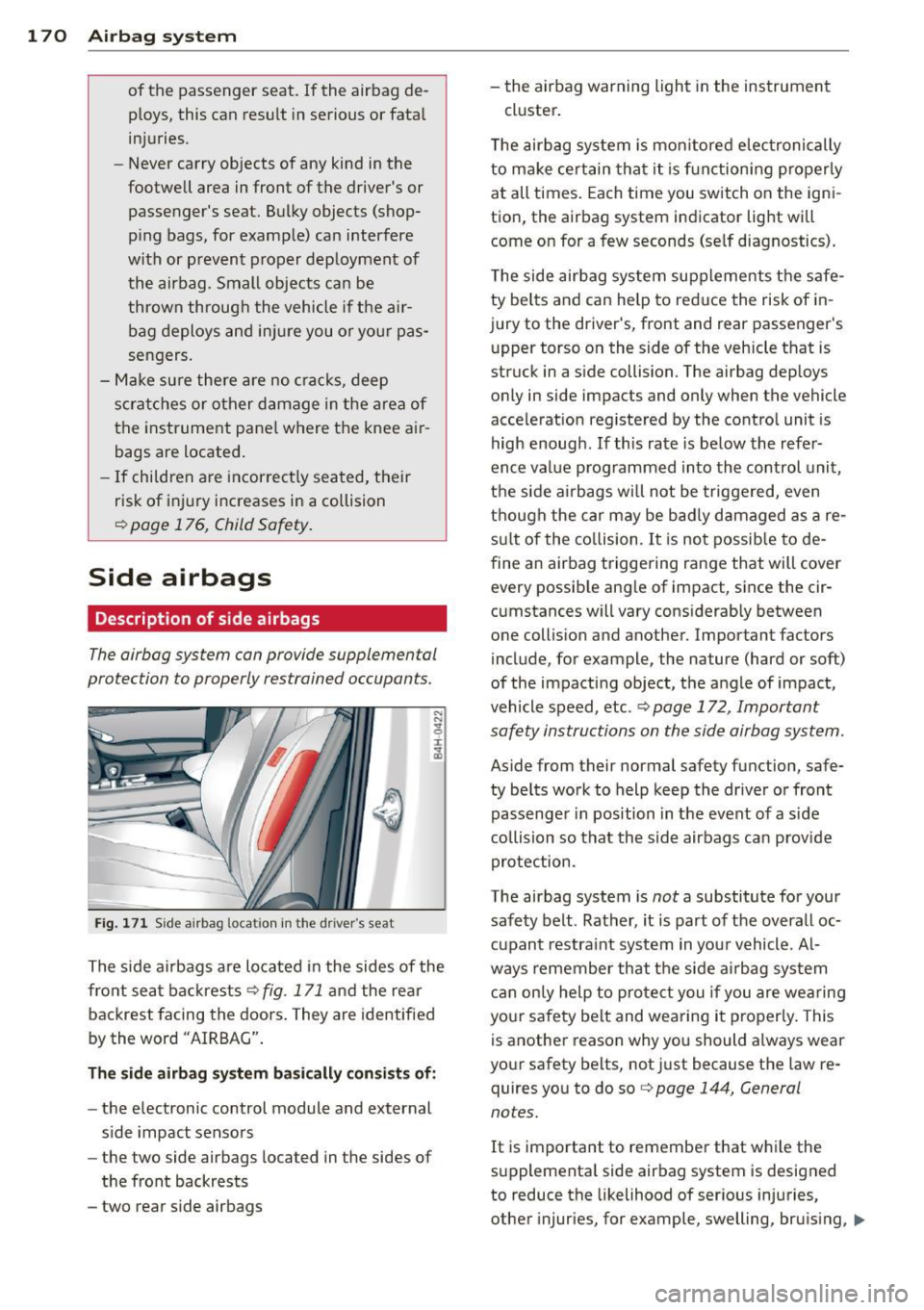
Fi g. 1 71 Side a irbag loca tion in the driver's seat
The side airbags are lo cated i n the sides of the
front seat ba ckrests
¢fig. 171 and the rear
backrest facing the doors. They are identified
by the word "AIRBAG" .
The s ide airbag system ba sically consis ts of :
-the electronic control module and external
s ide impact sensors
- the two side airbags located in the sides of
the front backrests
- two rear side airbags -
the airbag warning light in the ins trument
cluster .
T he airbag system is mon itored elec tronically
to make certain tha t it is f unctioning p roperly
at all times. Each time you switch on the igni
tion, the airbag system indicator light will
come on for a few seconds (se lf diagnostics) .
T he side airbag system supplements the safe
ty belts and can help to reduce the risk of in
jury to the driver's, front and rear passenger's
u pper torso on the side of the vehicle that is
struck in a side collision. The airbag dep loys
only in side impacts and only when the vehicle
acce lerat ion reg istered by the contro l unit is
high enough. If this rate is be low the refe r
ence value p rog rammed into the control unit,
the side ai rbags will not be triggered, even
t h ough the car may be bad ly damaged as a re
s ul t of the co llision. It is not possib le to de
fine an airbag triggering range that will cover every possib le ang le of impact, since the cir
cumstances will vary cons iderably between
one collis ion and another. Important factors
include, for example, the nature (hard or soft)
of the impacting object, the angle of impact,
vehicle speed, etc. ¢
page 172, Important
safety instructions on the side airbag system .
Aside from their normal safety function, safe
ty be lts work to help keep the driver or front
passenge r in position in t he event of a s ide
co llision so that the side airbags can provide
protection.
The airbag system is
not a substitute for your
safety belt . Rather, it is part of the overa ll oc
c u pant restraint system in you r vehicle . A l
ways remember that t he side ai rbag system
c a n only help to protect you if you are wea ring
your sa fety be lt and wearing it p roperly. This
is another reason why you should always wear
your safety belts, not j ust because the law re
quires yo u to do so¢
page 144, General
notes.
It is important to remembe r that w hile the
supplementa l side airbag system is designed
to reduce the likelihood of ser ious injuries,
other injur ies, for example, swelling, bru is ing, ..,..
Page 173 of 318
and minor abrasions can also be associated
with deployed side airbags. Remember too,
side airbags will deploy only once and on ly in
certain k inds of accidents -your safety belts
are always there to offer protect ion.
Vehicle damage, repair costs or even the lack
of vehicle damage are not necessar ily an indi
cation of over-sensitive or failed airbag activa
tion . In some collisions, both front and s ide
a irbags may inf late . Remember too, that air
bags will deploy only once and only in certain
kinds of collisions -your safety belts are al
ways there to offer protect ion in those acci
dents in wh ic h airbags are not supposed to
deploy or w hen they have already deployed .
The side airbag system will not depl oy :
- when the ignition is switched off
- in s ide collisions when the acceleration
measured by the sensor is too low
- in front-end collisions
- in rear-end collisions
- in ro llovers.
I n some types of a ccidents the front a irbags,
side curta in a irbags and side airbags may be
triggered together.
A WARNING
- Safety belts and the airbag system will
only provide protection when occupants
are in the proper seating posit ion
<=)page 172.
- If the airbag indicator light Q page 18
comes when the vehicle is be ing used,
have the system inspected immediately
by you r aut ho rized Aud i dealer. It is pos
sible that the a irbag will inflate when it
is not supposed to, or w ill not inflate
when it should.
-
A irba g sy stem 1 71
How supplemental side airbags work
Side airbags deploy instantly and can help re
duce the risk of upper torso injuries for occu
pants who are properly restrained.
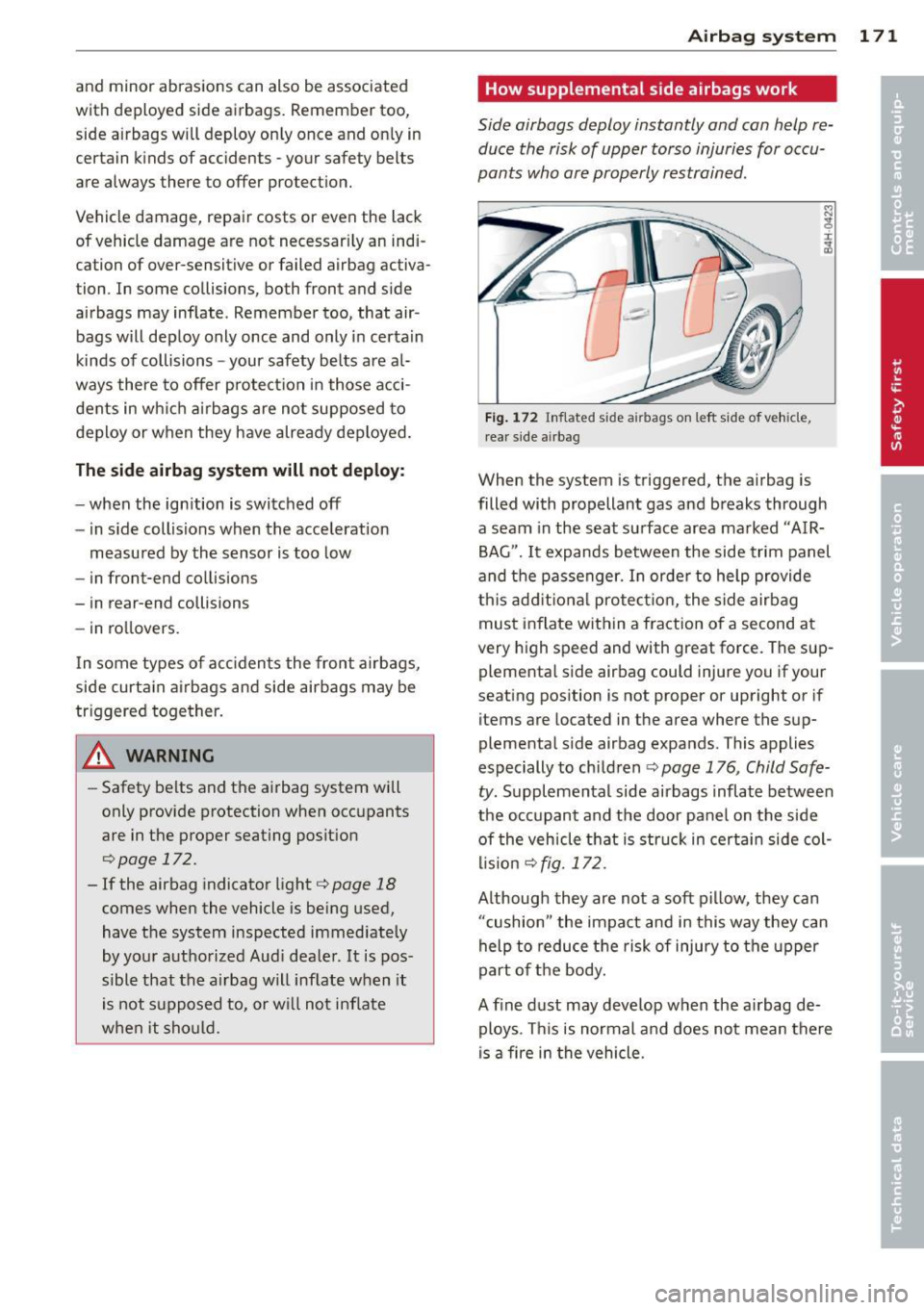
Fig . 1 72 Inflated side a irbags on left side of vehicle ,
rear side airbag
When the system is triggered, the a irbag is
filled with propellant gas and breaks through
a seam in the seat surface area ma rked ''AIR
BAG".
It expands between the side trim panel
and the passenger. In orde r to help provide
th is add it ional protect ion, the side airbag
must inflate within a fraction o f a second at
very high speed and with great force. The sup
plementa l side airbag could injure you if your
seat ing position is not proper or upright or if
items are located in the area where the sup
plementa l side airbag expands . This applies
especially to child ren
Q page 176, Child Safe
ty. Supplemental side airbags inflate between
the occupant and the door panel on the side
of the vehicle that is struck in certa in side co l
lis ion
Q fig. 172.
Although they are not a soft pi llow, they can
"cushion" the impa ct and in this way they can
help to reduce t he risk of injury to the upper
part o f th e body.
A fine dust may deve lop when the airbag de
ploys . This is normal and does not mean there
is a fire in the vehicle.
Page 174 of 318
172 Airbag system
Important safety instructions on the
side airbag system
Airbags are only supplemental restraints. Al
ways properly wear safety belts and ride in a
proper seating position.
There is a lot that you and your passengers
must know and act accordingly to help the
safety belts and airbags do their job to pro
vide supplemental protection.
& WARNING
An inflating side airbag can cause serious
or fatal injury. Improperly wearing safety
belts and improper seating positions in
crease the risk of serious personal injury
and death whenever a vehicle is being
used.
- In order to reduce the risk of injury when
the supplemental side airbag inflates:
- Always sit in an upright position and
never lean against the area where the
supplemental side airbag is located.
- Never let a child or anyone else rest
their head against the side trim panel
in the area where the supplemental
side airbag inflates.
-Always make sure that safety belts are worn correctly,
- Do not let anyone sitting in the front
seat put their hand or any other parts
of their body out of the window.
-Always make sure that the side airbag can inflate without interference.
- Never install seat covers or replace
ment upholstery over the front seat
backs that have not been specifically
approved by Audi.
- Never use additional seat cushions that
cover the areas where the side airbags
deploy.
- Damage to the original seat covers or
to the seam in the area of the side air
bag module must always be repaired
immediately by an authorized Audi
dealer. -
Objects between you and the airbag can
increase the risk of injury in an accident
by interfering with the way the airbag
unfolds or by being pushed into you as
the airbag inflates.
- Never place or attach accessories or
other objects (such as cup holders, tel
ephone brackets, or even large, bulky
objects) on the doors, over or near the
area marked "AIRBAG" on the seat backrests.
- Such objects and accessories can be come dangerous projectiles and cause
injury when the supplemental side air
bag deploys.
- Never carry any objects or pets in the
deployment space between them and
the airbags or allow children or other passengers to travel in this position.
-Always use the built-in coat hooks only for lightweight clothing. Never leave any
heavy or sharp-edged objects in the
pockets that may interfere with side air
bag deployment and can cause personal
injury in an accident.
- Always prevent the side airbags from be
ing damaged by heavy objects knocking
against or hitting the sides of the seat
backs.
- The airbag system can only be triggered
once. If the airbag has been triggered,
the system must be replaced by an au
thorized Audi dealership.
- Damage (cracks, deep scratches etc.) to
the original seat covers or to the seam in
the area of the side airbag module must always be repaired immediately by an au
thorized Audi dealer.
- If children are seated improperly, their
risk of injury increases in the case of an
accident
~ page 176, Child Safety.
- Never attempt to modify any compo
nents of the airbag system in any way .
- In a side collision, side airbags will not
function properly if sensors cannot cor rectly measure increasing air pressure in-
side the doors when air escapes through ..,.
Page 178 of 318
176 Child Saf ety
Child Safety
Important things to
know
Introduction
The rear seat is generally the safest place in a
collision.
The physical principles of what happens when
your veh icle is in a crash app ly also to chi ldren
~ page 145, What happens to occupants not
wearing safety belts?.
But unlike adults and
teenagers, their muscles and bones are not
fu lly developed. In many respects children are
at greater risk of serious injury in crashes than
adults.
Because children's bodies are not fully deve l
oped, they require restraint systems especial
ly designed for their size, weight, and body
structure. Many countries and all states of the
United States and provinces of Canada have
laws requiring the use of approved child re
straint systems for infants and small ch ildren.
In a fronta l crash at a speed of 20 -35 mph
(30-56 km/h) the forces acting on a 13-pound
(6 kg) infant w ill be more than 20 t imes the
weight of the child. This means the weight of
the child would suddenly be more than 260 pounds (120 kg). Under these conditions,
only an appropriate ch ild restraint properly
used can reduce the risk of ser ious injury.
Child restraints, like adult safety belts, must
be used properly to be effective. Used improp
erly, they can increase the risk of serious in
jury in an accident.
Consult the child safety seat manufacturer's instructions in order to be sure the seat is
right for your ch ild's size ~
page 179, Impor
tant safety instructions for using child safety
seats.
Please be sure to read and heed all of
the important information and WARNINGS
about child safety, Advanced A irbags, and the
installation of child restraints in this chapter .
There is a lot you need to know about the Ad
vanced Airbags in your vehicle and how they
work when infants and children in child re- straints are on the front passenger seat
. Be
cause of the large amount of important infor
mation, we cannot repeat it all here . We urge
you to read the detailed information in this
owner's manual about airbags and the Ad
vanced Airbag System in your vehicle and the
very important information about transport
ing children on the front passenger seat.
Please be sure to heed the WARNINGS -they
are extremely important for your safety and
the safety of your passengers, especially in
fants and small children.
A WARNING
-Accident statistics have shown that chil
dren are generally safer in the rear seat
area than in the front seating position.
Always restrain any child age 12 and un
der in the rear.
- All vehicle occupants and especially chil
dren must be restrained properly when
ever riding in a vehicle. An unrestrained
or improperly restrained chi ld could be
injured by str iking the i nterior or by be
ing ejected from the vehicle during a
sudden maneuver or impact. An unre
strained or improperly restrained chi ld is
also at greater risk of injury or death
through contact with an inflating airbag.
- A suitable chi ld restraint properly instal
led and used at one of the rear seating positions provides the highest degree of
protection for infants and small children
in most accident situations.
A WARNING ,_
Children on the front seat of any car even
with Advanced Airbags can be ser iously in
jured or even killed when an airbag in
flates. A child in a rearward-facing child
safety seat installed on the front passen
ger seat will be ser iously injured and can
be killed if the front airbag inflates.
- The inflating airbag will hit the child
safety seat or infant carrier with great
force and will smash the child safety seat and child against the backrest, center
armrest, or door.
II>-