child seat AUDI A8 2013 Workshop Manual
[x] Cancel search | Manufacturer: AUDI, Model Year: 2013, Model line: A8, Model: AUDI A8 2013Pages: 318, PDF Size: 79.34 MB
Page 189 of 318
-Forward-facing child safety seats or in
fant carriers installed on the front pas
senger's seat may interfere with the de ployment of the airbag and cause serious
injury to the child.
- It is safer to install a forward-facing
child safety seat on the rear seat .
- Always read and heed all WARNINGS
whenever using a child restrained in ave
hicle is being used
c:::;, page 176 . Special
precautions apply when installing a child
safety seat on the front passenger seat
c:::;, page 154, Child restraints on the front
seat -some important things to know.
A WARNING
-
Always take special precautions if you
must install a forward or rearward-facing
child restraint on the front passenger's
seat in exceptional situations:
- Whenever a forward or rearward-facing
child restraint is installed on the front
passenger seat, the
PASSENGER AIR
BAG OFF light must come on and stay on
whenever the ignition is switched on.
- If the
PASSENGER AIR BAG OFF light
does not come on and stay on, perform
the checks described
c> page 163, Moni
toring the Advanced Airbag System .
-Take the child restraint off the front pas
senger seat and install it properly at one
of the rear seat positions if the
PASSEN
GER AIR BAG OFF
light does not stay on
whenever the ignition is switched on.
- Improper installation of child restraints
can reduce their effectiveness or even
prevent them from providing any protec
tion.
- An improperly installed child restraint
can interfere with the airbag as it de
ploys and seriously injure or even kill the
child.
- Always carefully follow the manufactur
er's instructions provided with the child
safety seat or carrier.
- Never place additional items on the seat
that can increase the total weight regis-
Child Safety 187
tered by the weight-sensing mat and can
cause injury in a crash.
A WARNING
Forward-facing child restraints:
- Always make sure the forward-facing
seat has been designed and certified by
its manufacturer for use on a front seat
with a passenger front and side airbag.
- Never put the forward-facing child re
straint up, against or
very near the in
strument panel.
- Always
move the passenger seat into its
rearmost position in the seat 's fore and
aft adjustment range, as far away from
the airbag as possible before installing
the forward-facing child restraint . The
backrest must be adjusted to an upright
position.
- Make sure that the
PASSENGER AIR BAG
OFF
light comes on and stays on all the
time whenever the ignition is switched
on.
A WARNING ...==-
Rearward-facing child restraints:
-A child in a rearward-facing child safety
seat installed on the front passenger
seat will be seriously injured and can be
killed if the front airbag inflates -
even
with an Advanced Airbag System.
- The inflating airbag will hit the child
safety seat or infant carrier with great
force and will smash the child safety seat
and child against the backrest, center
armrest, door or roof .
- Always be especially careful if you must
install a rearward facing child safety seat
on the front passenger seat in exception
al circumstances .
- A tight tether strap on a rearward-facing
child restraint attached to the front pas
senger seat can put too much pressure
on the weight-mat in the seat and regis
ter a heavier weight in the Advanced Air
bag System. The heavier weight regis
tered can make the system work as •
•
Page 190 of 318
188 Child Safety
though an adult were on the seat and deploy the Advanced Airbag when it must
be suppressed causing serious or even
fatal injury to the child .
- Make sure that the
PASSENGER AIR BAG
OFF
light comes on and stays on all the
time whenever the ignition is switched
on.
- If the
PASSENGER AIR BAG OFF light
does not come on and stay on, immedi
ately install the rear-facing child safety
seat in a rear seating position and have
the airbag system inspected by your Audi dealer.
Activating the convertible locking retractor
Use the convertible locking retractor to se
cure a child restraint.
Always heed the child safety seat manufactur
er's instructions when installing a child re
straint in your vehicle. To activate the conver
tible locking retractor:
"" Place the child restraint on a seat, prefera
bly on the rear seat.
"" Slowly pull the belt
all the way out.
"" Route it around or through the child re
straint belt path¢&_ .
"" Push the child safety seat down with your
full weight to get the safety belt really tight.
"" Insert the belt tongue into the buckle for
that seating position.
"" Guide the safety belt back into the retractor
until the belt lies flat and snug on the child
safety seat.
"" You should hear a "clicking" noise as the
belt winds back into the inertia reel. Test the
convertible locking retractor by pulling on
the belt. You should no longer be able to
pull the belt out of the retractor. The con
vertible locking retractor is now activated.
"" Make sure that the red release button is fac
ing away from the child restraint so that it
can be unbuckled quickly .
"" Pull on the belt to make sure the safety belt
is properly tight and fastened so that the seat cannot move forward or sideways more
than one inch (2.5 cm).
A WARNING ....__ -
Using the wrong child restraint or an im
properly installed child restraint can cause
serious personal injury or death in a crash.
- Always make sure that the safety belt re- tractor is locked when installing a child
safety seat. An unlocked safety belt re
tractor cannot hold the child safety seat
in place during normal driving or in a
crash.
- Always buckle the child safety seat firmly
in place even if a child is not sitting in it.
A loose child safety seat can fly around
during a sudden stop or in a crash.
- Always make sure the seat backrest to
which the child restraint is installed is in
an upright position and securely latched
into place and cannot fold forward. Oth
erwise, the seatback with the child safety
seat attached to it could fly forward in
the event of an accident or other emer
gency situation.
- Always read and heed all WARNINGS whenever using a child restrained in ave
hicle is being used
¢ page 176. Special
precautions apply when installing a child
safety seat on the front passenger seat
¢ page 154, Child restraints on the front
seat -some important things to know.
Deactivating the convertible locking
retractor
The convertible locking retractor for child re
straints will be deactivated automatically when the belt is wound all the way back into
the retractor.
"" Press the red button on the safety belt
buckle. The belt tongue will pop out of the
buckle.
"" Guide the safety belt all the way back into
its stowed position .
Always let the safety belt retract completely
into its stowed position. The safety belt can
1J1-
Page 191 of 318
now be used as an ordinary safety belt with
out the convertible locking retractor for child
restra ints.
I f the convertible locking retractor shou ld be
activated inadvertently, the safety belt must
be unfastened and guided completely back in
to its stowed position to deactivate this fea
ture.
If the convertib le locking retractor is not
deactivated, the safety belt will gradually be
come tighter and uncomfortable to wear .
A WARNING
Improperly installed child safety seats in
crease the risk of ser ious personal injury
and death in a collision.
- Never unfasten the safety belt to deacti
vate the convert ible lock ing ret ractor for
c hild restraints while the veh icle is mov
ing. You would not be restrained and
cou ld be ser iously injured in an accident.
- Always read and heed all WARN INGS
whenever using a child rest rained in ave
hicle is being used¢
page 176. Special
precautions apply when installing a chi ld
safety seat on the front passenger seat
¢ page 154, Child restraints on the front
seat -some important things to know.
LATCH Lower
anchorages and tethers
for children
Child Restraint System anchors and how
are they related to child safety
To provide a s imp le r and more pract icable way
to attach the ch ild res traint on the veh icle
seat, Federa l regu lations require specia l lower
anchorages in vehicles and devices on new
chi ld restraints to attach to the vehicle ancho
rages.
The combination of the tether anchorages and
the lower anchorages is now generally called
the
LA TCH system for "Lower Anchorages and
T ethers for Children."
F orward- facing child restraints manufactured
after September 1, 1999, are required by U.S.
Child Sa fet y 189
federa l reg ulations to comply with new child
head movement performance requirements.
These new performance requirements make a
tether necessary on most new child seats.
Installing a ch ild restra int that requires a top
tethe r without one can seriously impair the
performance of the c hild restra int and its abil
ity to protect the child in a collis ion. Insta lling
a child restraint that requires a top tether
without the top tether may be a violat ion of
state law.
Child restraint manufacturers offer LATCH
lower anchorages on their child seats with
hook-on or push-on connectors attached to
adjustable straps.
In add ition to the LATCH lower anchorages,
these child restraint systems usually require
the use of tether straps to help keep the ch ild
restraint firmly in place.
A WARNING
Imp roper installat ion of child restra ints
will increase the r isk of injury a nd death in
a cr ash.
- Always follow the instr uctions provided
by the manufa cture r of the child re
s traint yo u intend to install in your vehi
cle.
- Never inst all a child restraint withou t a
properly attached top tether strap if the
child restraint manufacturer's instruc
tions require the top tether strap to be
used.
- Improper use of child rest raint LATCH
lowe r ancho rage points can lead to injury
in a collision. The LATCH lower anchorage
points are designed to withstand on ly
those loads imposed by correctly fitted
child restraints.
- Never mount two child restra int systems
on one LATCH lower anchorage point.
- Never secure or attach any luggage or
other item to the LATCH lower anchorag-
-
es. Ill-
•
•
Page 192 of 318
190 Child Safe ty
@ Tips
- In Canada, the terms "top tether" with
"lower universa l anchorages" (or "lower
universal anchorage bars") are used to
describe the system.
- In other countries, the term "ISO FIX" is used to describe the lower anchorages .
Location
Fig. 180 Sch ematic overv ie w: LA TCH ancho rage point
l oca tion s
The illustration shows the seating locations in
your veh icle which are equipped w ith the low
e r anchorages system.
Description
The lower anchorage positions are marked
for quick locating .
Fig. 181 Re ar seatbacks : loca tor b utto ns fo r low er an
chor ages
Fig. 182 Rea r seats: lowe r an cho rage b racket loc ations
Atta chment l oca to r marker s fo r lowe r
anchor ages
Circular locator buttons on the rear seatback
indica te t he lower an chorage locations on the
rear seating posi tions
¢ fig. 181.
L o w er anch orages
The lower anchorage attachment points are
located between the rear seatback and rear
seat cushion
¢ fig . 182.
Lower anchorages secure the child res train t in
the seat without using the vehicle's safety belts . Anchorages provide a secure and easy
to-use attachment and minimize the possibili
ty of improper ch ild restra int installation.
All child restraints manufactured after Sep
tember 1, 2002 , must have lower anchorage
attachments for the
LATCH system.
Remember that the lower anchorage po ints
are o nly intended for installation and attach
ment of child restraints specifically certified
for use with
LATCH lower anchorages. Chi ld
rest raints that are not equipped with the low
er anchorage attachments can still be insta l
led in compliance with the child restraint
manufacturer 's instructions on us ing vehicle
safety belts .
Ln._ WARNING
-Improper use of LATCH lower anchorages
can cause serious personal injury in an ac
cident.
- Always carefu lly follow the child re
straints manufacturer's instructions for
proper installation of the child restraint
Page 193 of 318
and proper use of the lower anchorages
or safety belts in your vehicle.
- Never secure or attach any l uggage or
other items to the
LATCH lower ancho
rages .
- Always read and heed the important in
formation about child restra ints in this
chapter and WARNINGS
¢ page 176,
Child Safety.
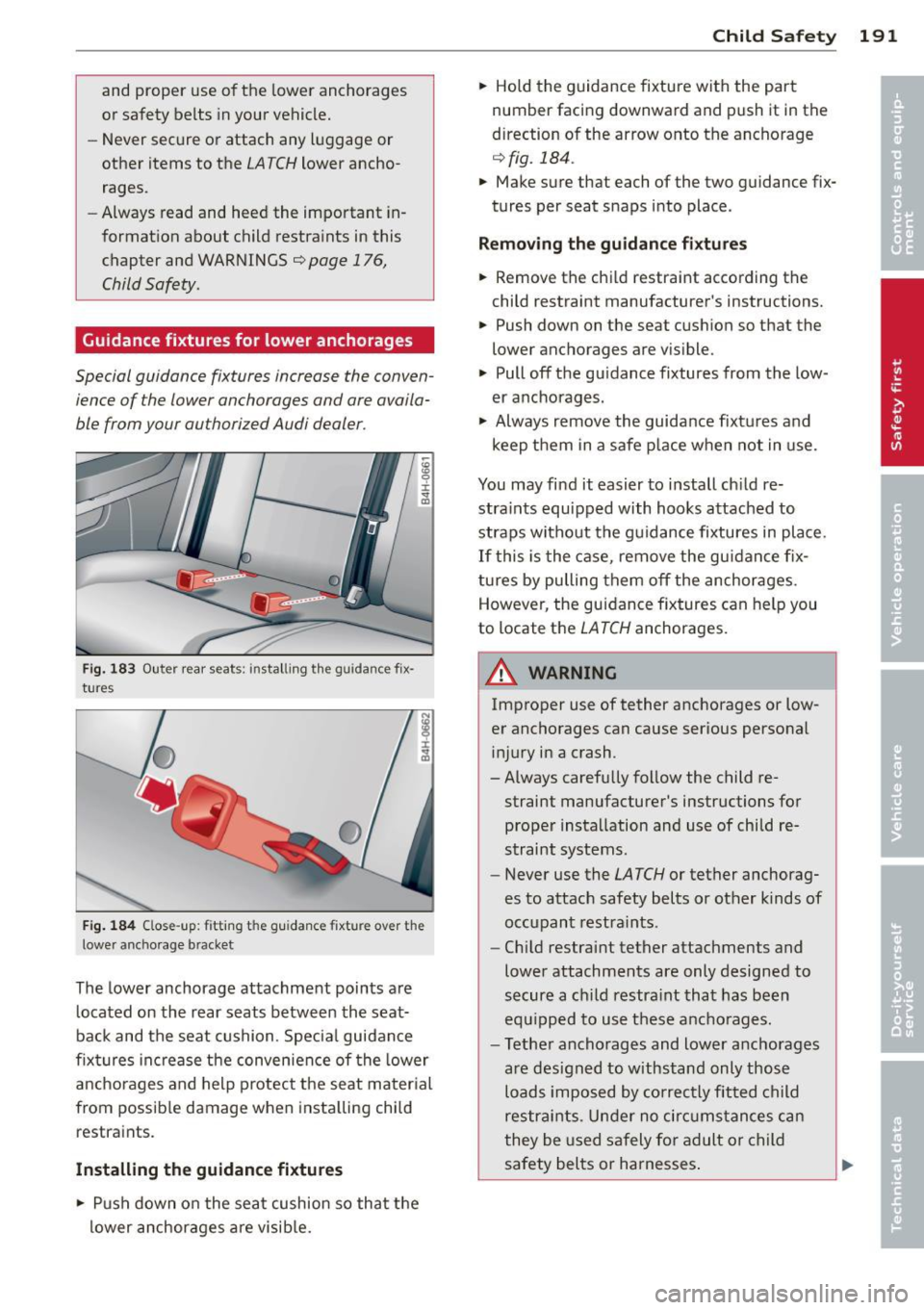
Guidance fixtures for lower anchorages
Special guidance fixtures increase the conven
ience of the lower anchorages and are availa
ble from your au thori zed Audi dealer .
Fig. 183 Outer rear seat s: in stallin g th e guid ance fix
tu res
F ig . 184 Clo se -up : fittin g the guidance fixt ur e ov er th e
l ower a nch o rage b rack et
The lower anchorage attachment points are
located on the rear seats between the seat
back and the seat cushion . Specia l guidance
fix tures increase the convenience of the lower
ancho rages and help protect the seat mater ial
from possib le damage when installing child
restraints.
Install ing th e guidance fixtures
.,. Push down on the seat cushion so that the
lower anchorages are visib le.
Child S afety 191
.,. Hold the guidance fixture with the part
number facing downward and push it in the
direction of the arrow onto the anchorage
¢ fig. 184.
.,. Make sure that each of the two guidance fix
tures per seat snaps into place .
Removing th e guid ance fixtures
.,. Remove the ch ild restraint according the
child restraint manufacturer's instructions .
.,. Push down on the seat cushion so that the
lower anchorages are v isible .
.,. Pull off the gu idance fixtures from the low
er anchorages .
.,. Always remove the guidance fixtures and
keep them in a safe p lace when not in use.
You may find it easier to install ch ild re
stra ints equipped with hooks attached to
straps without the guidance fixtures in place .
If this is the case, remove the guidance fix
tures by pulling them off the anchorages. However , the guidance fixtures can help you
to locate the
LATCH anchorages.
A WARNING
Improper use of tether anchorages or low
er anchorages can cause serious personal injury in a crash .
- Always carefully follow the child re straint manufacturer's instructions for proper insta llation and use of child re
straint systems.
- Never use the
LATCH or tether anchorag
es to attach safety belts or other k inds of
occupant restra ints .
- Ch ild restraint tether attachments and
lower attachments are only designed to
secure a ch ild restraint that has been
equ ipped to use these a ncho rages.
- Tethe r anchorages and lower anchorages
are designed to withstand only those loads imposed by correc tly fitted child
restraints. Under no ci rcumstance s can
they be used safely for adult or child
safety belts or harnesses .
Page 194 of 318
192 Child Safe ty
- Never mount more than one chi ld re
straint to a single tether or to a lower an
chorage point. Attaching two child re
straints to a single anchorage point can cause the anchorage to fail and cause se
rious personal inju ry in a crash.
(D Note
- Remove the guidance fixtures before
fold ing the rear seatback to prevent
damaging the seat cushion.
- To attach the child restraint secure ly, the
seat must be moved to the farthest rear pos ition, the seat height set to the low
est posit ion and the head restra int must
be adjusted to the verti cal position
¢page 60.
-If you leave the guidance fixtures instal
l ed for several days, they could leave a
mark on the upho lstery o n the sea t cush
i on and backrest in the a rea that the
guidance fixtures were insta lled . The up
ho lstery would also be permanently
stretched around the guidance fixtures.
This applies especially to leather seats.
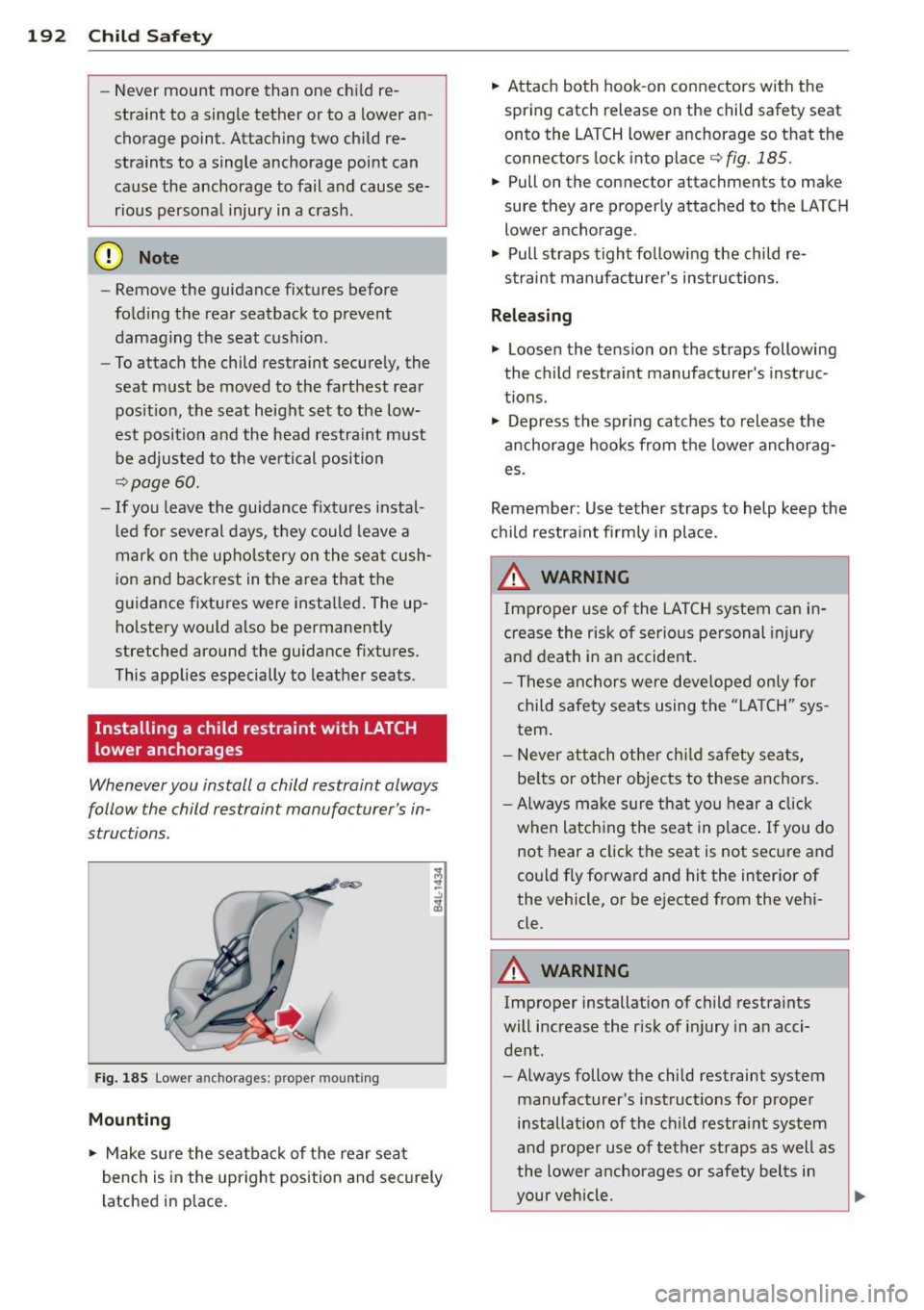
Installing a child restraint with LATCH
lower anchorages
Whenever you install a child restraint always
follow the child restraint manufacturer's in
structions.
F ig. 1 85 Lower a nchorages: proper mounting
Mounting
"" Make sure the sea tba ck of the rear sea t
bench is in the upright position and sec urely
l atched in place. ""
Attach both hook -on connectors with the
spring catch release on the child safety seat
onto the LATCH lower anchorage so that the
connectors lock into place¢
fig. 185.
"" Pull on the connector attachments to make
sure they are p roper ly attached to the LATCH
lower anchorage .
"" Pull straps tight fo llow ing the child re
straint manufacture r's instructions.
Releasing
"" Loosen the tension on the straps following
the ch ild restra int manufacturer's instruc
tions .
"" Depress the spring catches to release the
anchorage hooks from the lowe r anchorag
es.
Remember: Use tether straps to help keep the
ch ild restra int fi rm ly in pla ce.
.&_ WARNING
Improper use of the LATCH system ca n in
crease the risk of serious pe rsonal injury
and death in a n accident.
- These ancho rs were deve loped on ly for
child safety seats using the "LA TCH" sys
tem .
- Never at ta ch other ch ild safety sea ts,
be lts or other objects to these anchors.
- Always make sure that you hear a click
when latch ing the seat in place . If you do
not hear a click the seat is not secure and
could fly forward and hit the interior of
the vehicle, or be e jected from the vehi
cle .
.&_ WARNING
-
Improper installat ion of child restra ints
will increase the r isk of injury i n an acci
dent.
- Always follow the child restraint system
manufacturer's instruct ions for proper
i n stallation of the ch ild restra int system
and p roper use of teth er straps as well as
the lower anchorages or safety bel ts in
-
your veh icle. Ii-
Page 195 of 318
-Always read and heed the important in
formation and WARNINGS about child
safety and the installation of child re
straint systems
c:> page 176, Child Safe
ty.
(D Note
On vehicles with power adjustable rear
seats* some criteria must be observed
when attaching the child restraint using the
LATCH system:
- To attach the child restraint securely, the
seat must be moved to the farthest rear
position, the seat height set to the low
est position and the head restraint must be adjusted to the vertical position
¢ page 60.
-If a child safety seat is attached to one of
the rear seats, this seat must not be ad
justed using the power controls under
any circumstances. The
Entry assistance
for this seat must also be deactivated in
the MMI
¢ page 63. The child safety seat
as well as the rear seat can be damaged by the adjustment process.
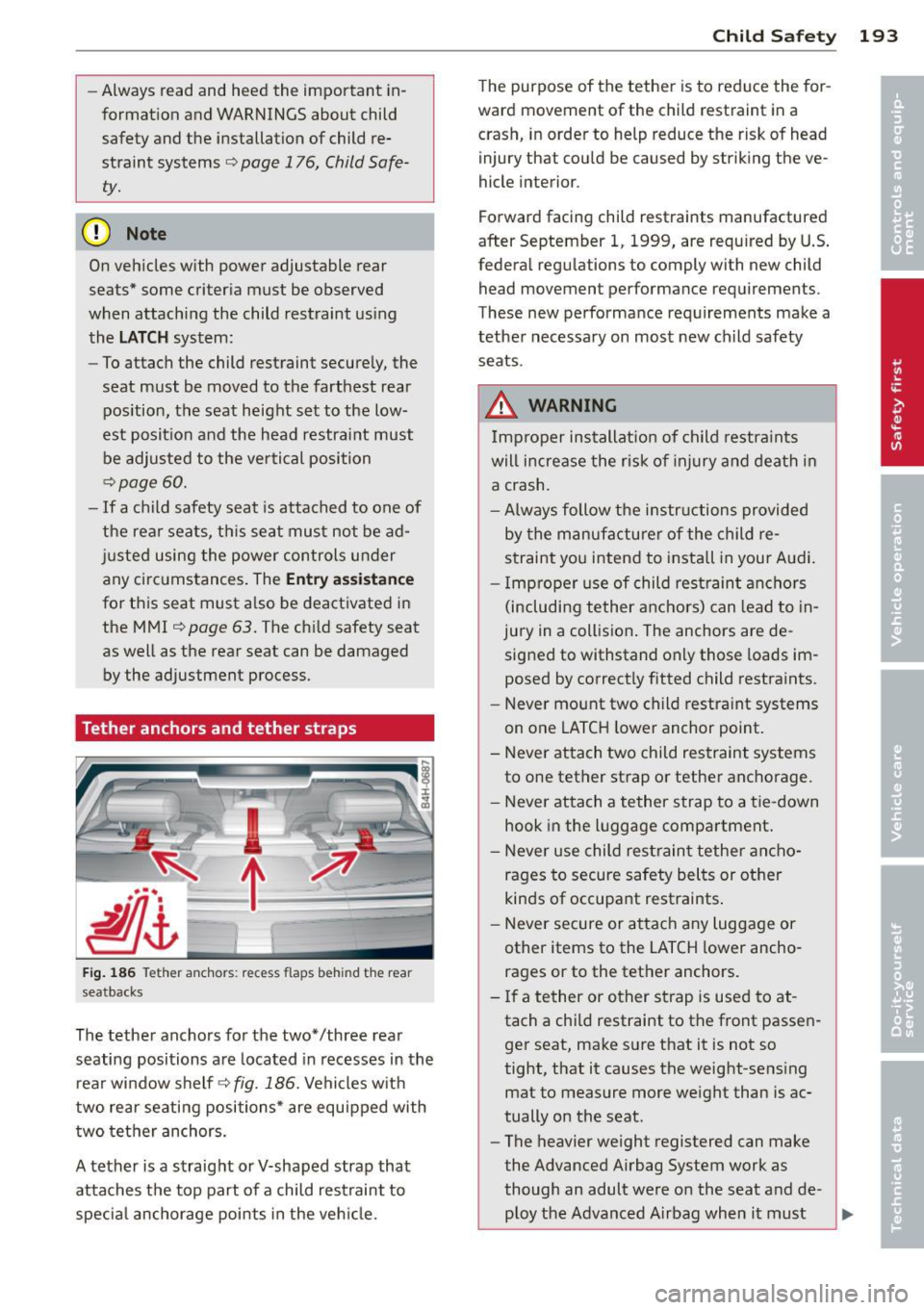
Tether anchors and tether straps
Fig. 186 Tether an cho rs: reces s fl ap s b ehin d th e re ar
seatbacks
The tether anchors for the two* /three rear
seating positions are located in recesses in the
rear window shelf ¢
fig. 186. Vehicles with
two rear seating positions* are equipped with two tether anchors .
A tether is a straight orV-shaped strap that
attaches the top part of a child restraint to
special anchorage points in the vehicle.
Child Safety 193
The purpose of the tether is to reduce the for
ward movement of the child restraint in a
crash, in order to help reduce the risk of head
injury that could be caused by striking the ve
hicle interior .
Forward facing child restra ints manufactured
after September 1, 1999, are required by U.S.
federal regulations to comply with new child
head movement performance requirements.
These new performance requirements make a
tether necessary on most new child safety
seats .
.&_ WARNING
Improper installation of child restraints
will increase the risk of injury and death in
a crash.
- Always follow the instructions provided
by the manufacturer of the child re
straint you intend to install in your Audi.
- Improper use of child restraint anchors
(including tether anchors) can lead to in
jury in a collision . The anchors are de
signed to withstand only those loads im
posed by correctly fitted child restraints .
- Never mount two child restraint systems
on one LATCH lower anchor point.
- Never attach two child restraint systems to one tether strap or tether anchorage.
- Never attach a tether strap to a tie-down
hook in the luggage compartment.
- Never use child restraint tether ancho
rages to secure safety belts or other
kinds of occupant restraints.
- Never secure or attach any luggage or
other items to the LATCH lower ancho rages or to the tether anchors .
- If a tether or other strap is used to at
tach a child restraint to the front passen ger seat, make sure that it is not so
tight, that it causes the weight -sensing
mat to measure more weight than is ac
tually on the seat .
- The heavier weight registered can make
the Advanced Airbag System work as
though an adult were on the seat and de -
ploy the Advanced Airbag when it must ..,
Page 196 of 318
194 Child Safe ty
be suppressed causing ser ious or even
fatal injury to the child .
- If you must install a rearward facing
child safety seat on the front passenger
seat because of exceptional circumstan
ces and the
P ASS ENGER AIR BA G OFF
light does not come on and stay on, im
med iately install the rear-facing child
safety seat in a rear seating position and
have the a irbag system inspected by your
Audi dealer.
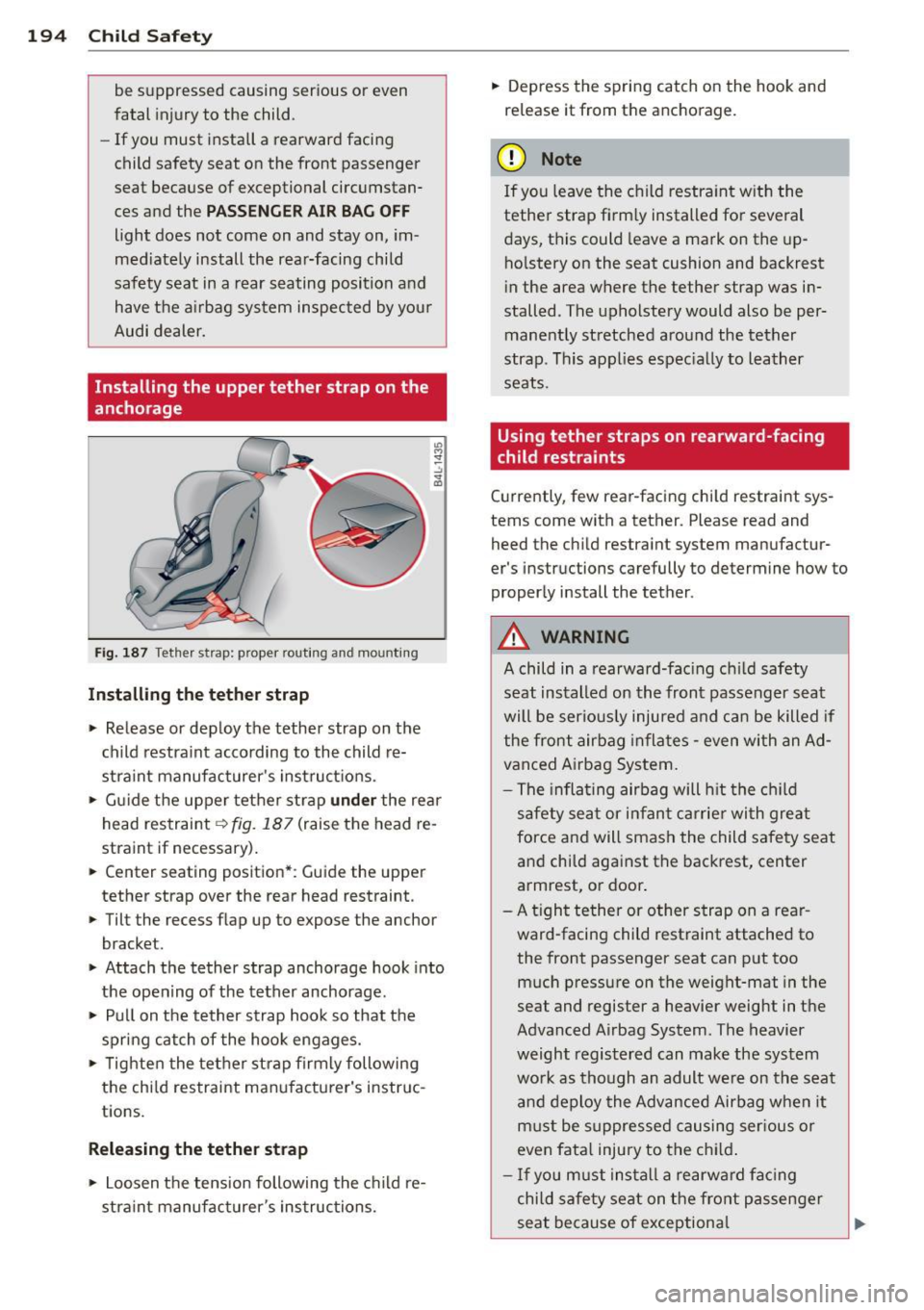
Installing the upper tether strap on the
anchorage
Fig. 187 Tet her st rap : proper ro uting a nd mountin g
Inst all ing th e teth er strap
.,. Release or deploy the tether strap on the
child restra int according to the child re
stra int manufac turer's instructions .
.,. Gu ide the upper tether strap
under the rear
head restraint ~
fig. 187 (raise the head re
straint if necessary).
.,. Center seating position* : Guid e the upper
tether strap over the rear head restraint.
.,. Til t the recess flap up to expose the anchor
br acke t.
.,. Attach the tether strap anchorage hook into
the opening of the tether anchorage .
.,. Pull on the tether strap hook so that the
spring catch of the hoo k engages.
.,. Tighten the tether strap firmly following
the chi ld restraint manufacturer's instr uc
tions.
Releasing the tether strap
.,. Loosen the tens ion following the c hild re
stra int manufacturer 's instructions. .,.
Depress the spring catch on the hook and
re lease it from the anchorag e.
(D Note
If you leave the child restra int w ith the
tether strap firm ly installed for several
days, this could leave a mark on the up
ho lstery on the seat cushion and backrest
i n the area where the tether strap was in
stalled . The upholstery would also be per
manently stretched around the tether
strap. This applies espec ia lly to leather
seats .
Using tether straps on rearward-facing
child restraints
Currently, few rear-facing chi ld restrai nt sys
tems come with a tether. Please read and heed the child rest raint system manufactur
er' s in structions carefully to determine how to
properly install the tether .
8.. WARNING
-A child in a rearward-facing ch ild safety
seat installed on the front passenger seat
will be serious ly injured a nd can be killed if
the front airbag inflates -even with an Ad
vanced Airbag System.
- The infla ting airbag will h it the ch ild
safety seat or infant carrie r wi th great
force and will smash the child safe ty seat
and child against the backrest, center
armrest, or door .
- A t ight tether or other strap on a rear
ward-facing child restraint attached to
the front passenger seat can p ut too
much pressure on the weight-mat in the
seat and register a heavier weight in the
Advanced Airbag System . The heavier
weight registered can make the system work as though an adult we re on the seat
and deploy the Advanced Airbag when it
m ust be suppressed causing ser ious or
even fata l injury to the chi ld .
- If you m ust insta ll a rearward fac ing
child safety seat on the front passenger
seat because of exceptiona l
Page 197 of 318
circumstances and the PASSENGER AIR
BAG OFF
li gh t does not come o n an d
stay on, immediately install the rear-fac
ing child safety seat in a rear seating po
sit ion and have the airbag system i n
spected by your Aud i deale r.
Additional Information
Sources of information about child
restraints and their use
There are a number of sources of additional
information about ch ild restraint select ion, in
stallat io n and use:
NHTSA advises that t he best child safety seat
is the one that fits your child and fits in your
ve hicle, and that you wi ll use correctly and
consisten tly.
Try before you buy!
U.S National Highway Traffic Safety Admin
i s tration
T e l. : 1 -888-327 -4236 (T TY : 1-800-424-9153)
www.nhtsa .gov
National SAFE KIDS Campaign
Te l.: (202) 662-0600
www.safekids.org
Safety BeltSafe U.S .A
Te l.: (800) 745 -SA FE (English)
Te l.: (800) 747 -SANO (Spanish)
www .carseat.org
Transpo rt Canada Info rm ation Cent re
Te l.: 1- 800 -333 -037 1 or call
1-613-998 -8616 if you are in the Ottawa area
http ://www.tc.gc.ca/eng/roadsafety/
menu .htm
Audi Customer Relations
Te l.: (800) 822 -2834
Child Sa fet y 195
•
•
Page 225 of 318
grease or dye must be patted off using ab
sorbent material. It may be necessary to re
treat the areas with detergent paste and wa
ter.
In the case of general soiling of the uphols
tery and cover material, we recommend hiring
a specialist that has the equipment to clean
the seat covers and other fabric surfaces by
shampooing and spray extraction.
A WARNING
Always read and heed all WARNINGS and
the information
Qpage 215.
Open Velcro fasteners on your clothing can
damage the seat cover. Please make sure
that Velcro fasteners are closed.
Plastic parts and instrument panel
Always use a clean cloth moistened in clear
water to clean these areas. For persistent dirt
use an Audi approved
solvent-free plastic
cleaner/protectant.
A WARNING
Solvents can change the properties of
some plastics and make it harde r for the
airbag to deploy.
- Never clean the instrument panel or the
surface of airbag modules with cleaning
products that contain solvents.
- Products containing solvents will make
the surface of this part porous.
- Serious injuries can result if plastic parts
come loose when the airbag is deployed.
- Always read and heed all WARNINGS and other information~
page 215.
(D Note
Cleaning agents containing solvents will
attack the material and can change the
way it behaves.
Cleaning and protection 223
Trim and molding
Trim and molding in the vehicle interior can
be cleaned with a dry microfiber cloth. To pre
vent scratches, do not use any cleaning solu
tions.
Natural leather
Appl ies to vehicles: with natural leather
Audi makes great efforts to maintain the
properties, natural look and feel of interior
leather.
General
We offer many different types of leathe r on
our vehicles. Most are different types of nappa l eather, which has a smooth surface and
comes in various colors.
Th e intensity of the color determines the visu
al characteristics and appearance. If the sur
face of the leather has a typical natural look,
then the leather is a nap pa leather that has
been left in a relatively natural condition. This
leather offers particularly good comfort and
breathes well. Fine veins, closed grains, insect
bites, skin folds, and subt le variations in color
remain visible. These characteristics demon
strate that the material is natural.
Natural nappa leather is not covered by a col
or finish. It is therefore more sensit ive to soil
ing and wear, which is something you need to
consider if children, animals or other factors
might prove to be particularly hard on the
leather .
By contrast, leather types that are covered by
a colored finish layer are more durable. This
has a positive effect on the leather 's resist
ance to wear and soiling in daily use. On the
other hand, the typical characteristics of natu
ral leather are barely or not apparent. Howev
er, this does not mean that the leather itself
is of inferior quality. •
•