window AUDI A8 2014 Owner's Manual
[x] Cancel search | Manufacturer: AUDI, Model Year: 2014, Model line: A8, Model: AUDI A8 2014Pages: 314, PDF Size: 78.47 MB
Page 196 of 314
194 Child Safety
-Always read and heed the important in
formation and WARNINGS about child
safety and the installation of child re
straint systems ~
page 177, Child Safe
ty.
d) Note
On vehicles with power adjustable rear
seats* some criteria must be observed
when attaching the child restraint using
the
LATCH system:
- To attach the child restraint securely, the
seat must be moved to the farthest rear
position, the seat height set to the low
est position and the head restraint must be adjusted to the vertical position
~ page 61.
-If a child safety seat is attached to one of
the rear seats, this seat must not be ad
justed using the power controls under
any circumstances . The
Entry assistance
for this seat must a lso be deactivated in
the MMI
r¢ page 64. The child safety seat
as well as the rear seat can be damaged by the adjustment process.
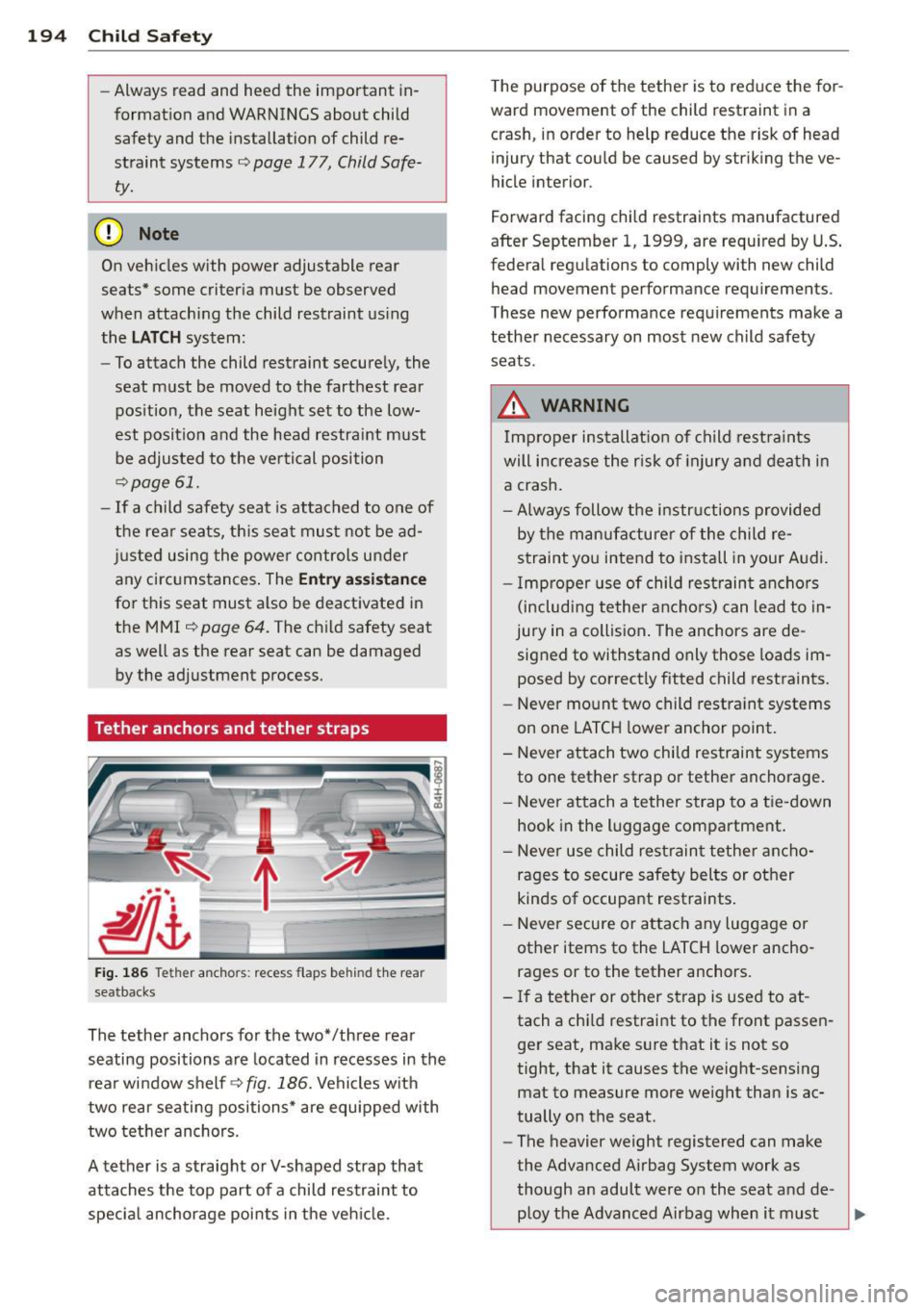
Tether anchors and tether straps
Fig. 186 Tet her ancho rs: r ece ss fla ps b ehin d th e re ar
sea tback s
The tether anchors for the two* /three rear
seating positions are located in recesses in the
rear window shelf~
fig. 186. Vehicles with
two rear seating positions* are equipped with two tether anchors .
A tether is a straight or V-shaped strap that attaches the top part of a child restraint to
special anchorage points in the vehicle. The
purpose of the tether is to reduce the for
ward movement of the child restraint in a crash, in order to help reduce the risk of head
injury that could be caused by st riking the ve
hicle in ter ior.
Forwa rd facing child restra ints manufactured
after September 1 , 1999, are required by U.S .
federal regulations to comply with new child
head movement performance requirements.
These new performance requirements make a
tether necessary on most new child safety
seats .
_&. WARNING
Improper installation of child restraints
will increase the risk of injury and death in
a crash.
- Always follow the instructions provided
by the manufacturer of the child re
straint you intend to install in your Audi.
- Improper use of child restraint anchors
(including tether anchors) can lead to in
jury in a collision. The anchors are de
signed to withstand only those loads im
posed by correctly fitted child restraints.
- Never mount two child restraint systems
on one LATCH lower anchor point.
- Never attach two child restraint systems to one tether strap or tether anchorage.
- Never attach a tether strap to a tie-down
hook in the luggage compartment.
- Never use child restraint tether ancho
rages to secure safety belts or other
kinds of occupant restraints.
- Never secure or attach any luggage or
other items to the LATCH lower ancho
rages or to the tether anchors.
- If a tether or other strap is used to at
tach a child restraint to the front passen
ger seat, make sure that it is not so
tight, that it causes the weight-sensing mat to measure more weight than is ac
tually on the seat .
- The heavier weight registered can make
the Advanced Airbag System work as though an adult were on the seat and de -
-
ploy the Advanced Airbag when it must ~
Page 199 of 314
Audi pre sense Preventative passenger
protection
App lies to veh icles: with Audi p re se nse
Audi pre sen se can ini tiate steps to help pro
t ect vehicle occupants in certain situations.
The funct ions descr ibed depend on equipment
installed in your vehicle:
Audi pre sense basic
The following functions can be triggered in
cert ain driving situations :
- Tightening of the safety belts (for example,
during heavy braking) : the front safety belts
have reversible belt pretensioners. If a colli
sion does not occur, the safety belts loosen
slightly and are ready to be tightened again .
- Closing the windows and the sunroof* : the
windows and the sunroof" close leaving a
small open gap .
Audi pre sense basic functions can be trig
gered at speeds above 20 mph (30 km/h) .
Vehicles with Audi drive select*: the deploy
ment time is adapted in dynamic mode.
Audi pre sense front (vehicles with
adaptive cruise control*)
Audi pre sense front includes the functions in
Audi pre sense basic. In addition, within the
limits of the system, the likelihood of a colli
sion with the vehicle immediately ahead is al
so calculated . If the system senses an immi
nent collision the following functions can be
tr iggered:
- Braking guard
¢ page 100
-Tightening the safety belts
- Closing the windows and the sunroof* ( leav-
ing a small open gap)
Audi pre sense rear (vehicles with Audi
side assist*)
Audi pre sense rear includes the functions in
Audi pre sense basic. In addition, the likeli
hood of a rear-end col lision with the vehicle
coming from behind is also calculated. If the
Audi pre sense 197
risk of a collision is detected, the following
functions can be triggered :
- Tightening the safety belts
- Closing the windows and the sunroof* (leav-
ing a small open gap)
- Adjusting the seats: the settings for the
power head restrains, the upper sections of
the backrests and the pneumatic side bol
sters* are optim ized for the front seats and
the outboard rear seats*. If a collision does
not occur, the previous seat settings are re
stored.
Audi pre sense plus
Audi pre sense plus includes the funct ions in
Audi pre sense front and Audi pre sense rear.
Error message
Audi pre sense: not available
Preventative passenger protection is not avail
able. See your authorized Audi dealer immedi
ately to have the malfunction corrected .
A WARNING
Audi pre sense cannot overcome the laws
of physics.
It cannot prevent a collision. Do
not let the increased safety provided
tempt you to take risks. This will increase
the risk of a collision and serious personal
injuries.
- The sensors cannot always detect all ob
jects . This increases the risk of a colli
sion.
-Audi pre sense does not detect people or
animals or objects that are crossing the
veh icle's path ¢
page 94.
- The radar sensor's vision can be reduced
by heavy rain, ice, snow, heavy road spray
and reflections from guard rails, tunnel
entrances, etc. These and similar condi
tions can prevent vehicles from be ing ac
curately detected and in some cases they
may not be detected at all.
Ill-
•
•
Page 207 of 314
temperature. This determines the current
state of charge and the power of the battery.
Idling current management
Idling current management reduces energy
consumpt ion while the vehicle is stand ing.
With the ignition switched off, it contro ls the
energy supply to the various e lectrica l compo
nents . Data from battery diagnosis is consid
ered.
D epending on the battery's state of charge,
individua l consumers are gradua lly turned off
to prevent excessive discharge of the battery
and thus maintain starting capability.
Dynamic energy management
While the veh icle is being driven, dynamic en
ergy management dist ributes the energy gen
erated according to the needs of the individu
a l components . It regu lates consumption, so
that more electrical energy is not being used
than is being generated and ensures an opti
mal state of charge for the battery.
- But even energy management cannot negate the limits of physics. Consider
that the power and life of a battery are
limited.
- If starting ab ility is threatened, the indi
cator light(•) appears
c> page 16, D
Battery.
What you should know
The highest priority is given to maintaining
starting capability .
The battery is severely taxed in short-distance
driving, in city traffic and during the co ld time
of year. Abundant electrical energy is re
qu ired, but only a little is generated. It is also
cr itica l if the engine is not running and electri
cal components are turned on. In th is in
stance energy is being consumed but none is
be ing generated .
Intelligent technology 205
It is in precisely these situations that you will
notice energy management active ly regu lat
ing the distribution of energy.
Vehicle stands for an extended period
If you do not drive your vehicle over a period
of several days or weeks, e lectrica l compo
nents are gradually cut back or switched off.
This reduces energy consumption and main
tains starting capability over a longer period .
Some of the convenience functions may not
operate, such as the interior lights or the
power seat adjustment . The convenience
functions will be available again when you
switch on the ignition and start the eng ine.
With the engine turned off
If you listen to the radio, for example, with
the engine turned off or use other MMI func
tions, the battery is being discharged.
If starting capability is jeopardi zed due to en
ergy consumption, the following warning ap
pears in the MM I display:
Please start the engine soon or the system
will be turned off.
The warning indicates that the system will be
turned off automatically after 3 minutes. If
you w ish to continue using the functions, you
have to start the engine.
With the engine running
Although electrical energy is generated when
the vehicle is being driven, the battery can be
come discharged. This happens mostly when
li ttle energy is being generated and a great
deal consumed and the battery's state of
charge is not optimal.
T o b ring the energy ba lance back into equili
brium, consumers wh ich requ ire espe cially
large amounts of energy are temporarily cut
back or switched off . Heating systems in par
ticular require a great deal of energy. If you
notice, for examp le, that the heated seats* or
the heated rear window are not heating, they
have been temporarily cut back or switched .,.
•
•
Page 218 of 314

216 Vehicl e c are and cle aning
Vehicle care and
cleaning
General information
Regular, proper care helps to maintain your
vehicle 's value. It can also be a requirement
when subm itting warranty claims for corro
sion damage and paint defects on the body .
The required cleaning and care products can be obtained from your authorized Audi dealer
or a qualified workshop. Read and follow the
instructions for use on the packaging .
A WARNING
-Us ing cleaning and care products incor
rectly can be dangerous to your hea lth .
- Always store cleaning and care products
o ut of reach of children to reduce the r is k
of po ison ing.
@) For the sake of the environment
- Preferably use environmentally-friendly
products when buying cleaning agents .
- Do not d ispose of leftover cleaning and
ca re p rod ucts with household trash .
Car washes
-
The longer that deposits such as insects, bird
droppings , tree sap o r road salt rema in on the
ve hicle, the more the surface can be dam
aged. High temperatures such as those
caused by s unligh t increase the corrosive ef
fect.
Before washing, wet heavy deposits w ith p le n
ty of water.
A lso, wash the underside of your vehicle once
road salt stops be ing used for the season .
Pressure wa sher s
When washing your vehicles w ith a pressure
washer, always follow the operating instruc
tions provided w ith the pressure washer. Th is
is especially important in rega rd to the pres
sure and spray ing distance . Do not aim the
spray d irectly at seals on side w indows, doors, the hood, the
rear lid o r the sunroof* or at
tires, rubber hoses, insu lating material, sen
sors * or camera lenses* . Keep a d istance of at
least 16 inches (40 cm).
Do not remove snow and ice with a pressu re
washer .
Never use rota ry no zzles or high pressure noz
z les.
T he water temperature must not be above
140 °F (60 °C) .
Automatic car washes
Spray off the ve hicle before washing.
Make sure that the windows and roof * are
closed and the winds hield wipers are off . Fo l
l ow instructions from the car wash operator,
especially if there are accessories attached to
your vehicle.
If possible, use car washes that do not have
brushes .
Only use car washes where the vehicle re
mains stationary an d the washing equipment
moves aro und the vehicle when washing and
drying. Car washes that move the vehicle
t h rough the car wash using a chain are not
recommended.
Wa shing by hand
Clean the ve hicle starting from the top and
working down using a soft sponge or cleaning
brush. Use solvent-free clean ing products .
Washing vehicles with matte finish paint
by hand
To avoid damaging the paint when washing,
first remove dust and large particles from
your vehicle. Insects, grease spots and finger
pr ints are best removed with a spec ial cleane r
for matte finish paint .
Apply the product us ing a microfiber cloth. To
avo id damaging the paint surface, do not use
too much pressure.
Rinse the vehicle thoroughly with water. Then
clean using a neutral shampoo and a soft mi-
crofiber cloth. ..,.
Page 222 of 314

220 Vehicle care and cleaning
-Wheels
-Never use any paint polish or other
abrasive materials.
- Damage to the protective layer on the
rims such as stone chips or scratches
must be repaired immediately.
- Sensors/camera lenses
- Never use warm or hot water to re-
move snow or ice from the camera
lens. This could cause the lens to crack.
- Never use abrasive cleaning materials
or alcohol to clean the camera lens.
This could cause scratches and cracks.
-Windows
- Remove snow and ice on windows and
exterior mirrors with a plastic scraper.
To avoid scratches, move the scraper only in one direction and not back and
forth.
- Never remove snow or ice from win
dows and mirrors using warm or hot
water because this could cause cracks
to form.
- To avoid damage to the rear window
defogger, do not apply any stickers on
the heating wires on the inside of the
window.
- Decorative parts/trim
- Never use chrome care or cleaning
products.
- Paint
-To reduce the risk of scratches, the ve-
hicle must be free of dirt and dust be
fore polishing or waxing.
- To prevent paint damage, do not polish
or wax the vehicle in direct sunlight.
- To reduce the risk of paint damage, do
not polish away rust film.
- Trim
- To reduce the risk of damage, do not
treat the trim around the panorama
sunroof with paint polish.
- Decorative decals
-To reduce the risk of damage, do not
use any rough powder or abrasive
cleaning products. - To reduce the risk of damage, do not
polish decorative parts that have a
matte finish.
-Displays
-To avoid scratches, do not use dry
cleaning methods on displays.
- Controls
- Make sure that no fluids enter the con-
trols, because this could cause dam
age.
- Safety belts
- Do not remove the safety belts to clean
them.
- Never clean safety belts or their com
ponents chemically or with corrosive
fluids or solvents and never allow
sharp objects to come into contact
with the safety belts. This could cause
damage to the belt webbing.
- If there is damage to the webbing, the
connections, the retractors or the buck
les, have them replaced by an author
ized Audi dealer or a qualified work
shop.
- Textiles/Vinyl/Alcantara
- Never treat Vinyl/Alcantara with leath-
er care products, solvents, floor polish,
shoe polish, stain remover or similar products.
- To avoid damage, have stubborn stains
removed by an authorized Audi dealer
or a qualified workshop.
- Never use steam cleaners, brushes,
hard sponges, etc. when cleaning.
- Objects with sharp edges such as zip
pers, rivets on clothing or belts can
cause damage to the surface.
- Open hook and loop fasteners, for ex
ample on clothing, can damage seat
covers. Make sure hook and loop fas
teners are closed .
-Natural leather
- Never treat leather with solvents, floor
polish, shoe polish, stain remover or
similar products.
Page 245 of 314
long. This can seriously affect the effi
ciency of the brakes as well as yo ur
safety. This could result in an acc ident.
0 Note
Brake f luid will damage the paint of your
vehicle.
@ For the sake of the environment
Because of the problem of proper d isposa l
of brake fl uid as we ll as the special tools
req uired and the necessa ry expert ise, we
recommend that you have the brake fluid
changed by your author ized Audi dealer.
Battery
General information
Under normal operating conditions, the bat
tery in your A udi does not need any mainte
nance . With
high outside temperatures or
long dai ly dr ives we recommend that you have
the electro lyte level checked by a service fa
cility. T he electrolyte level shou ld also be
checked each time the battery is charged
-:;, page 245.
Have the battery checked when you take your
ve hicle in for service. You are well adv ised to
replace a battery that is older than 5 years.
W ith certa in types o f airbag deployment, the
battery is d isconnected from the vehicle elec
tr ica l system for safety reasons¢
& in Re
pair, care and disposal of the airbags on
page 167.
Disconnect ing the battery terminals
Some vehicle functions (power w indow regu
lators, for example) are lost if the battery ter
minals a re d isconnected. These functions have
to be relearned after the battery terminals a re
connected again . To prevent this, the battery
should only be d isconnected from the vehicle
e lec trica l system whe n absolu tely ne cessa ry
f or repairs.
Checkin g and fillin g 243
Vehicles not driven for long periods
If you do no t drive your vehicle over a period
of seve ra l days o r weeks, e lectr ica l compo
nents are g radually cut back or switched off .
This reduces energy consumption and main
ta ins starting capability over a longer period
¢
page 204. Some of the convenience func
tions may not operate, such as the inter ior
l igh ts or the power seat adjus tment. The con
venience functions will be ava ilab le aga in
whe n you swi tch on the ignition and sta rt the
engine.
Winter operation
During the winte r months, battery capacity
tends to dec rease as temperatures drop. This
i s because more power is a lso consumed wh ile
s ta rt ing, and the headlight s, rea r window de
fogger, e tc., are used more ofte n.
Avoid unnecessary powe r consumpt ion, par
ticu larly in city traffic o r when traveling only
sho rt distances. Let yo ur au thoriz ed Aud i
de aler check the cap acity of the vehicle b at
tery before winter sets in~ page 245. A well
charged bat tery will not on ly prevent starting
problems w hen the weather is cold, but w ill
a lso last longer.
{!) Tips
If yo ur vehicle is left s tandin g for seve ral
weeks at extreme ly low tem peratures, the
vehicle battery sho uld be removed and
stored w here it w ill not freeze . T his will
prevent it from be ing damaged and having
to be replaced.
Working on the battery
Be especially careful when working on or near
the battery.
The battery is located in the luggage compart
ment under the floor. Before you check any
th ing in the luggage compartment,
read and
heed all WARNINGS
¢ .&_ .
Always heed the safety warnings , when work
ing on the vehicle battery or the vehicle e lec
trical system to prevent injury. •
•
Page 251 of 314
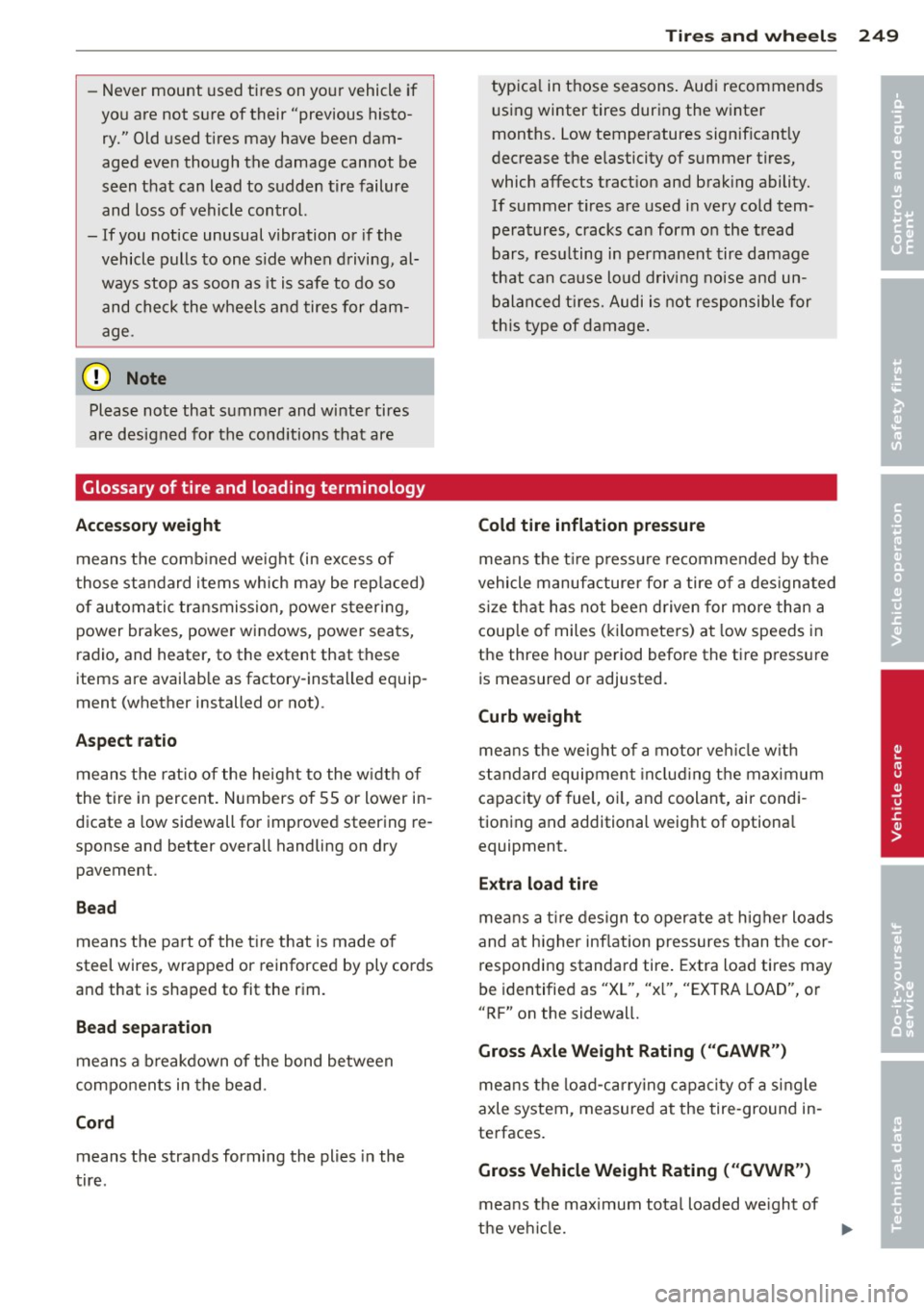
-Never mount used tires on yo ur vehicle if
yo u are not sure of their "previous histo
ry." Old used tires may have been dam
aged even though the damage cannot be
seen that can lead to sudden tire failure
and loss of vehicle control.
- If you notice unusual vibration or if the
vehicle pulls to one side when d riving, al
ways stop as soon as it is safe to do so
and check the wheels and tires for dam
age .
(D Note
Please note that summe r and wi nte r tires
are designed for the cond itions that are
Glossary of tire and loading terminology
Accessory weight means the comb ined weight (in excess of
those sta ndard items which may be rep laced)
of au toma tic transmission, power steer ing ,
power brakes, power windows, power seats,
radio, and heater, to the extent that these
items are availab le as factory-installed equip
ment (whether installed or not) .
Aspect ratio
means the rat io o f the height to the w idth of
the tire in percent . Numbers of 55 or lower in
dicate a low sidewall for improved steering re
sponse and better overa ll handling on dry
pavement .
Bead
means the part of the t ire t hat is made o f
steel wires, wrapped or reinforced by ply cords
and that is shaped to fit the r im.
Bead separation
means a b reakdown of the bond between
components in the bead .
Cord means the strands forming the plies in the
tire.
Tire s an d wheel s 249
typica l in those seasons . Aud i recommends
using winter tires during the winter
months . Low temperatures signif icant ly
dec rease the e lasticity of summer t ires,
which affects tract ion and brak ing ability.
If summer t ires are used i n very co ld tem
peratures, cracks ca n form o n the tread
bars , res ulting in perma nen t tire damage
that can cause loud driving noise and un
bala nced ti re s. Audi i s not respon sible for
th is type of damage .
Cold tire inflation pressure
means the t ire p ress ure recommended by t he
vehicle manufacture r fo r a tire o f a des ignated
s ize t hat has not bee n driven for more than a
coup le o f miles (k ilometers) at low speeds in
the three hour period before the tire press ure
is m easured or adjusted.
Curb weight
me ans the we ight of a motor ve hicle with
st andard equipmen t incl ud ing the max imum
capacity of fuel, oi l, and coolant, air condi
tioning and additional weig ht of optiona l
equipment.
Extra load tire
means a t ire design to oper ate a t higher load s
and at higher inflation pressures than the cor
responding standa rd tire . Extra load tires may
be identified as "XL", "x l", "EXTRA LOAD", o r
"RF" on the sidewal l.
Gross Axle Weight Rating ("GAWR")
me ans the load-ca rry ing capac ity of a single
axle system , measured at the tire -ground in
te rfaces.
Gross Vehicle Weight Rating ( "GVWR ")
mea ns the maximum total loaded we ight of
the ve hicl e. .,..
•
•
Page 281 of 314
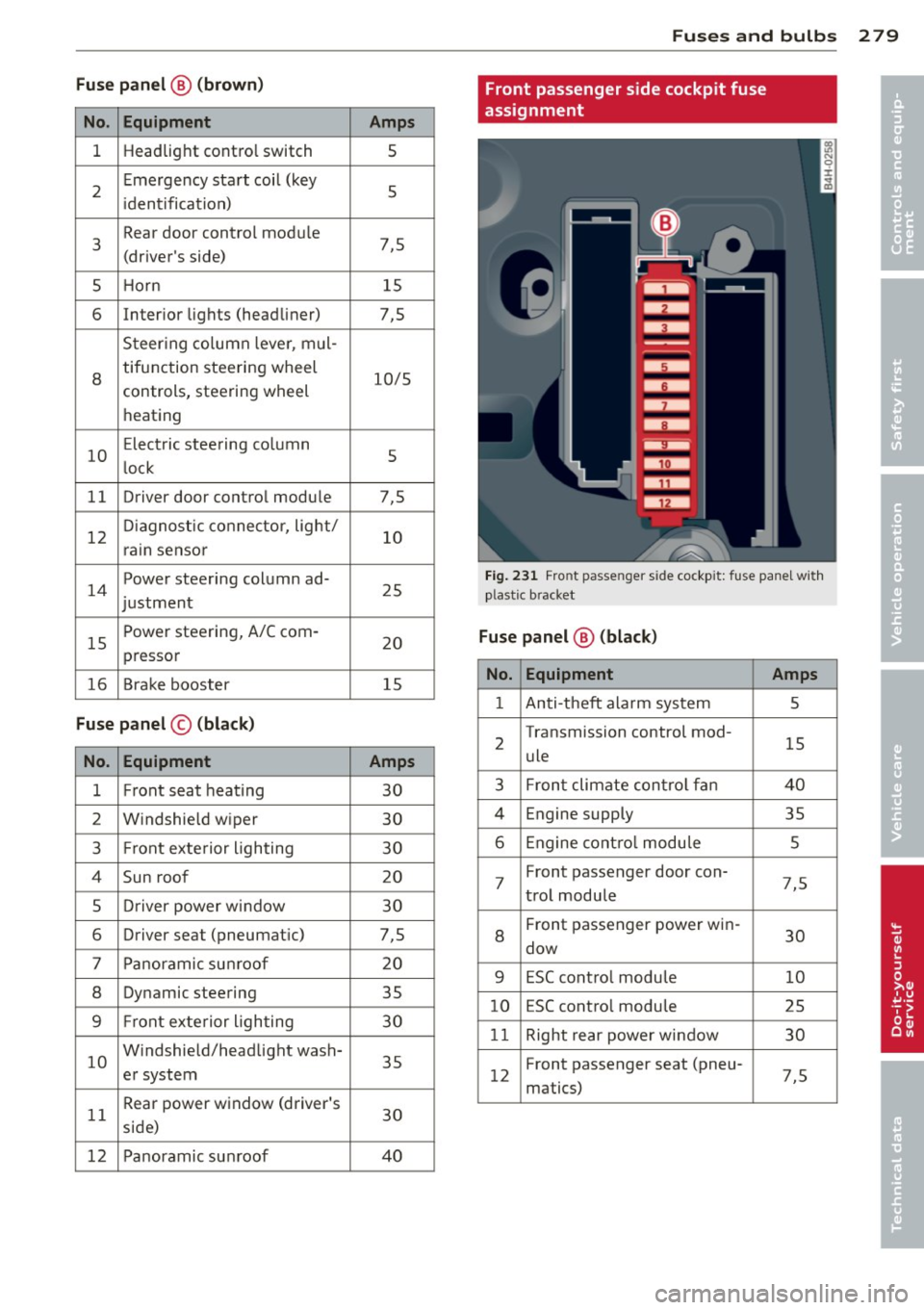
Fuse pa nel @ (brown )
No . Equipment
1 Headlight contro
l switch
2 Emergency
start coil (key
i dentification)
3 Rear door
control module
(driver's side)
5 Horn
6 Interior
lights (headliner)
Steer ing column leve r, mul-
8
tifunction steering wheel
controls, steering wheel
heating
10 E
lectric steering column
l ock
11 Driver door
control module
12 D
iagnostic connector, light/
rain sensor
14 Powe
r steering column ad-
justment
15 Power steering, A/C com-
presser
16 Brake booster
Fu se p anel © (black )
No. Equipment
1 Front seat heating
2 Windshield
wiper
3 Front exte rior lighting
4 Sun roof
5 D river power window
6 Driver
seat (pneumatic)
7 Pano ramic sunroof
8 Dynamic
steering
9 Front exterior lighting
10 W
indshield/headlight wash-
er system
11 Rear power
window (driver's
side)
12 Panoramic sunroof
Amp s
5
5
7,5 15
7,5
10/5
5
7,5
10
25
20 15
Amp s
30
30 30
20
30
7,5 20
35
30
35
30
40
Fu ses and bulb s 2 79
Front passenger side cockpit fuse
assignment
Fig . 231 Front passenger side cockpit: f use pane l with
plast ic bracket
Fu se panel @ (bl ac k)
No. Equipment Amps
1 Anti-theft alarm system 5
2 Transmission control
mod-
15
ule
3 Front climate control fan
40
4 Engine supply 35
6 Engine cont ro l modu le 5
7 Front
passenger door con-
7,5
trol module
8
Front passenger power win-
30
dow
9 E5C contro l module 10
10 ESC
contro l modu le
25
1 1 Right rear power window 30
1 2 Front
passenger seat (pneu-
7,5
matics)
•
•
Page 302 of 314
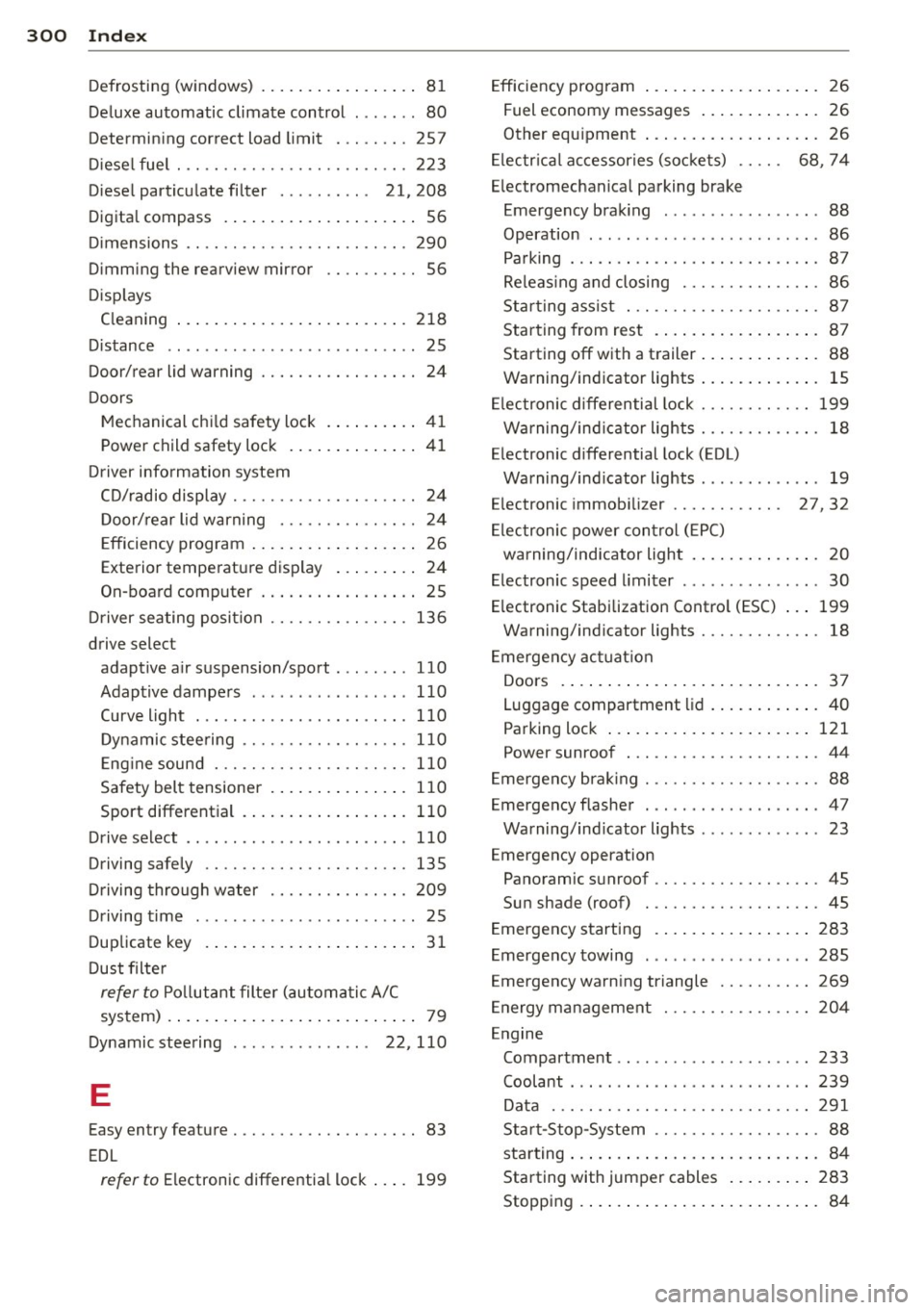
300 Index
Defrosting (windows) ......... .. .... .. 81
Deluxe automatic climate control . . . . . . . 80
Determining co rrect load limit ... ..... 257
D iese l fue l ..... ........... .... .... . 223
Diesel particulate filter . . . . . . . . . . 21,208
Digita l compass ............ ... .... .. 56
Dimensions .... ............. .. .... . 290
Dimming the rearview mirror .. .. ...... 56
Disp lays
C leaning ... ................ ..... . 218
Distance
. ... .......... ...... ... .. .. 25
Door/rear lid warning . . . . . . . . . . . . . . . . .
24
Doors
Mechanical child safety lock . ..... .. .. 41
Power child safety lock ........ .... . . 41
Driver information system
CD/radio display . . . . . . . . . . . . . . . . . . . . 24
Door/rear lid warning . . . . . . . . . . . . . . . 24
Efficiency program . . . . . . . . . . . . . . . . . . 26
Exterior temperature display ..... .. .. 24
On-board computer . . . . . . . . . . . . . . . . . 25
Driver seating position
drive select
adaptive air suspension/sport ... .. .. .
Ad . d
apt,ve ampers ......... ... .. .. .
Curve light . ... . ...... ... .. .. .. .. .
D . t . ynam,c s eering ....... .. .. .. .. .. .
Eng ine sound ............ .. .. .. .. .
Safety belt tensioner ....... ... .... .
Sport differential .......... ... .... .
Drive select .. ... .. ..... ... .. .. .. .. .
Driving safely .. ........... .. .. .... . 136
110
110
110
110
110
110
110
110
135
Driving through water ........ .. .. .. . 209
Driving time . . . . . . . . . . . . . . . . . . . . . . . . 25
Duplicate key . . . . . . . . . . . . . . . . . . . . . . . 31
Dust filter
refer to Pol lutant filter (automatic A/C
system) .... ................ ..... .. 79
Dynamic steering . . . . . . . . . . . . . . . 22, 110
E
Easy entry feature ............ .. .... .. 83
EDL
refer to E lectronic differentia l lock ... . 199 Efficiency
program . . . . . . . . . . . . . . . . . . . 26
Fuel economy messages . . . . . . . . . . . . . 26
Other equ ipment ................. .. 26
E lectr ica l accessories (sockets) . . . . . 68, 74
Electromechanical parking brake Emergency braking ............... .. 88
Operation . . . . . . . . . . . . . . . . . . . . . . . . . 86
Parking ... .. .. .. .. ........... .. .. . 87
Re leas ing and closing .............. . 86
Starting assist ... ............. .. .. . 87
Starting from rest ................ .. 87
Starting
off with a trailer ............. 88
Warning/indicator lights ........ ... .. 15
E lectronic differential lock .......... .. 199
Warning/ind icator lights ........ .... . 18
Electronic differential lock (EDL)
Warning/ind icator lights . ............ 19
E lectronic immobilizer . . . . . . . . . . . . 27, 32
E lectronic power control (EPC)
warning/indicator light . . . . . . . . . . . . . . 20
Electronic speed limiter ............. .. 30
E lectronic Stabilization Contro l (ESC) . .. 199
Warning/indicator lights ............ . 18
Emergency actuat ion
Doors ........ .. ............. ... .. 37
Luggage compartment lid .......... .. 40
Parking lock ..... ................ . 121
Power sunroof .................. .. . 44
Emergency brak ing . ... .......... .. .. . 88
Emergency flasher . ................ .. 47
Warning/ind icator lights ..... ... .. .. . 23
Emergency operation
Panoramic sunroof ............. .. .. . 45
Sun shade (roof) .............. .... . 4S
Emergency starting ................ . 283
Emergency towing ...... ........... . 285
Emergency warn ing triangle ...... .... 269
Energy management
Engine 204
Compartment .. .. ..... ........... . 233
Coolant ...... ... .. .............. . 239
Data ....... .. .. .. ........... .... 291
Start-Stop-System ............. .. .. . 88
starting ....... .. .. .............. .. 84
Starting with jumper cables ...... ... 283
St .
opping .. .... .. .. .............. .. 84
Page 306 of 314
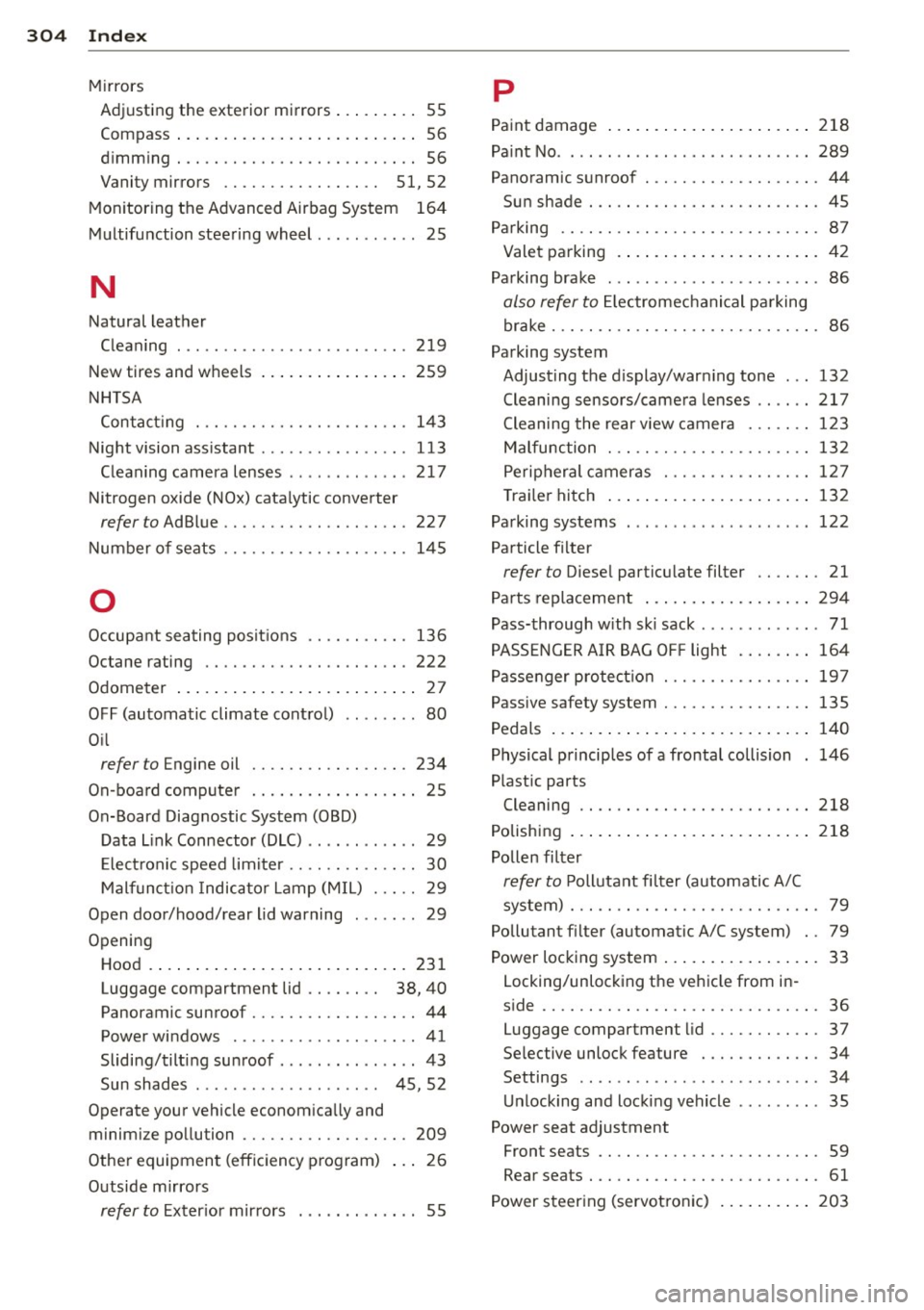
304 Index
Mirrors Adjusting the exterior mirrors ..... .. .. 55
Compass ... ... ... ...... .... ..... .. 56
d' . 1mming ................ .. .. .... .. 56
Vanity mirrors . . . . . . . . . . . . . . . . .
51, 52
Monitoring the Advanced Airbag System 164
Multifunction stee ring wheel ..... .. .... 25
N
Natural leather
Cleaning
New tires and wheels
NHTSA Contact ing
Night vision ass istant ........ ... .. .. .
C lean ing camera lenses . ... .. .. .. .. .
Nitrogen oxide (NOx) cata lytic converter
refer to Ad Blue ........... .. .. .... .
219
259
143 113
2 17
227
Number o f seats ......... .. .. .. .. .. . 145
0
Occupa nt sea ting pos it io ns .. .. .. .. .. . 136
Octane rating ............. .. .. .. ... 222
Odometer .... .. .. ..... ... .. .. .... .. 2 7
OFF (automatic climate contro l) . . . . . . . . 80
O il
refer to Engine oil ........ .. .. .... . 234
On-board compute r . . . . . . . . . . . . . . . . . . 2 5
On-Board Diagnostic System (OBD)
Data L ink Connector (DLC) ...... .. .. ..
29
Elec tron ic speed lim iter . . . . . . . . . . . . . . 30
M alfunc tion I ndicator Lamp (M IL) . . . . . 29
Open door/hood/rear lid warning . . . . . . . 29
Opening
Hood . ..... ... . ...... ... .. .. .... .
231
Luggage compartment lid . . . . . . . . 38, 40
Panoramic sunroof ........ .. .. .... .. 44
Power windows . .......... ... .. .. .. 41
Sliding/tilting su nroof ...... ... .. ... . 43
Sun shades . . . . . . . . . . . . . . . . . . . . 4 5, 52
Operate your vehicle econom ica lly and
minim ize po llution ......... .. .. .... .
209
Other equipmen t (effic iency p rogram) 2 6
Outside mi rrors
refer to Exter ior mirrors . . . . . . . . . . . . . 55
p
Pa int damage ..... ... .. ..... .... . .. 2 18
Pa int No . ..... .. .. .. ... .. ... ..... .. 289
Panoramic s unroof . ............. .. .. . 44
Sun shade . .... .. .. ........... .... . 45
Parking .. .. .. .. . .............. .. .. . 87
Valet pa rking .... .. ... ..... ... .. .. . 42
Pa rking brake . .. .. .......... ...... .. 86
also refer to El ectromec hanical pa rking
brake . .. .. .. .. .. .. ........... .. .. .
86
Parking system
Adjusting the d isplay/war ning tone ...
132
Cleaning sensors/came ra lenses ...... 217
Cleaning the rear view camera . .. .. .. 123
Malfunction ... .. ............. .... 132
Peripher al c ameras . ........... .. .. 12 7
Tra ile r hitch ..... ... .. ..... .... . .. 132
Pa rking systems ... ... .. .. ... ..... .. 122
Particle fi lter
refer to Diese l particu late filter .. .. .. . 21
Pa rts replacement ... .... .... ... .. .. 294
Pass-through w ith sk i sack ..... .... ... . 71
PASSENGER AIR BAG OFF light . ... .. .. 164
Passenger protect io n .............. .. 19 7
Passive safety system .............. .. 135
Pedals ... .. .... .. .. ... ..... ... .. .. 140
Physical p rinciples of a frontal collision 146
Plastic parts
Cleaning .. .... .. ............. ....
218
Polishing ... .... .. .. .... .... ... .. .. 218
Pollen filter
re fer to P oll utant fi lter (automatic A/C
system) . .. .... .. ............. .... .
79
Pollutant filter (automatic A/C system) . . 79
Power locking system .... ..... ... .. .. . 33
Locking/unlock ing the ve hicle from in -
s ide .. .... .... .. ............. .... .
36
Luggage compartment lid ....... .... . 37
Selective unlock feature ...... .. .. .. . 34
Settings . . . . . . . . . . . . . . . . . . . . . . . . . . 34
U nlocking and loc king vehicle .. ... ... . 35
Power seat adjustment
Front seats . . . . . . . . . . . . . . . . . . . . . . . .
59
Rear seats . . . . . . . . . . . . . . . . . . . . . . . . . 61
Power steer ing (servot ronic) ... ... .. .. 203