window AUDI A8 2014 User Guide
[x] Cancel search | Manufacturer: AUDI, Model Year: 2014, Model line: A8, Model: AUDI A8 2014Pages: 314, PDF Size: 78.47 MB
Page 82 of 314
80 Warm and cold
Operation
We recommend pressing the
IAUTOI button and setting the temperature to 72 °F (22 °C) .
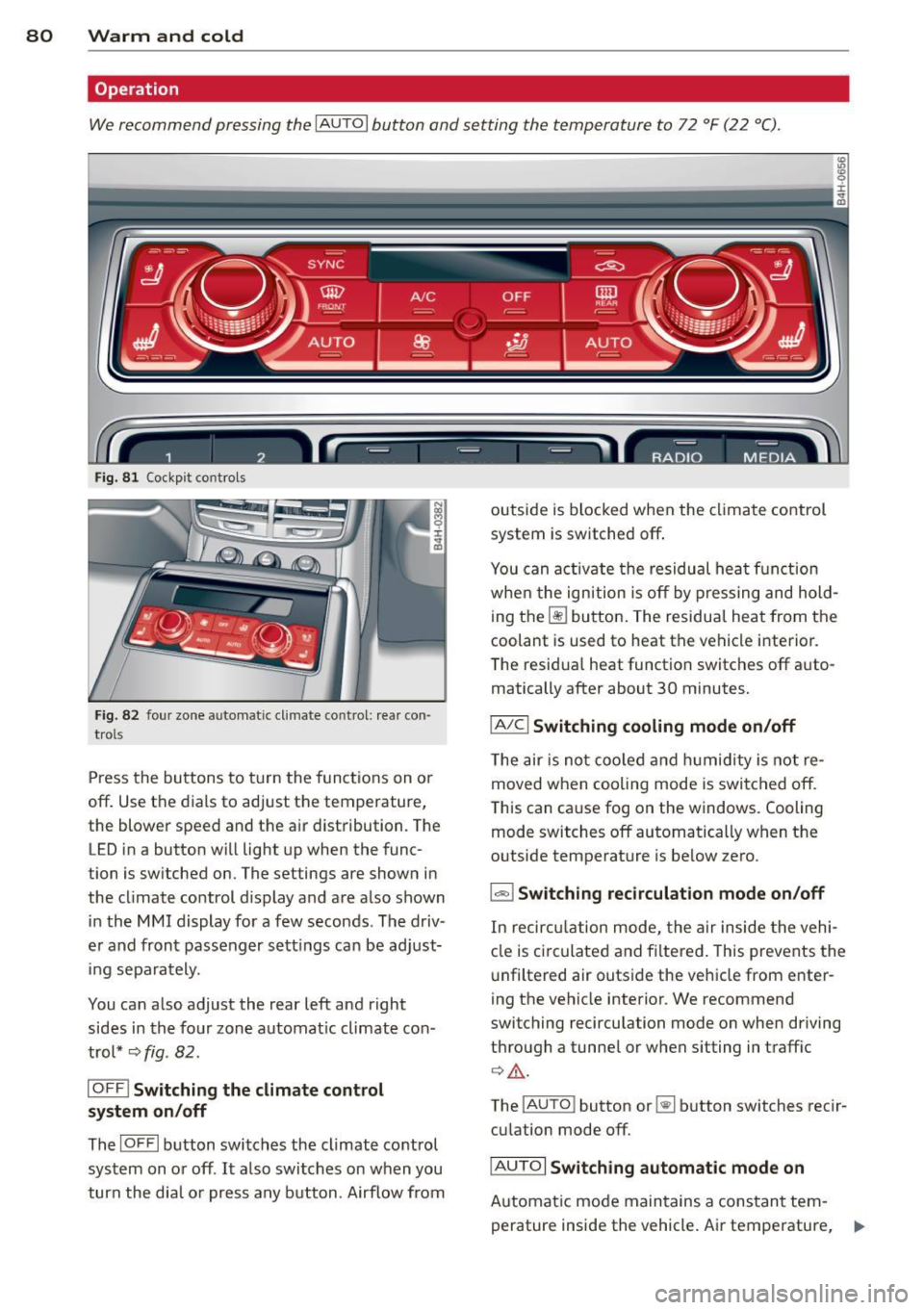
Fig. 81 Cockp it co ntrols
Fig. 82 four zone automat ic climate co ntrol: rea r con ·
trols
Press the buttons to turn the functions on o r
off . Use the dials to adjust the temperature,
the blower speed and the air distribution. The
LED in a button will light up when the func
tion is sw itched on. The settings are shown in
the climate control display and are also shown in the MMI display for a few seconds . The driv
e r and front passenger sett ings can be adjust
ing separately.
You can also adjust the rear left and right
sides in the four zone automat ic climate con
trol*
~ fig . 82.
IOFF i Switching the climate control
system on/off
The I O FFI button switches the climate co ntrol
system on or off .
It also switches on when you
turn the dial or press any button. Airflow from outside is
blocked when the climate control
system is switched off .
You can activate the residual heat function
whe n the ignition is off by pressing and hold
ing the ~ button. The residual heat from the
coolant is used to heat the vehicle interior .
The resid ua l heat function switches off a uto
matically after about 30 minutes.
iAIC i Switching cooling mode on/off
The air is not coo led and humidity is not re
moved when cooling mode is switched off.
T his can cause fog on the windows. Cooling
mode switches off automatically when the
outside temperature is be low zero .
1-1 Switching recirculation mode on/off
In recircu lation mode, the air inside the vehi
cle is circulated and filtered . This prevents the
u nfiltered air outside the vehicle from enter
ing the vehicle interior . We recommend
switching recirculation mode on when driving
through a tunne l or when sitting in traffic
q .&. .
The !AUTO I button or~ button switches reci r
cu lation mode off.
iAUTOi Switching automatic mode on
Automat ic mode maintains a constant tem
perature inside the vehicle. Air temperature, .,._
Page 83 of 314
airflow and air distribution are controlled au
tomatically.
Adjusting the temperature
Temperatu res between 60 °F (+16 °() and
84 °F (+28 °C) can be set. O uts ide of this
range,
lo or hi will appear in the climate con
trol system disp lay. At both of these settings,
the climate control system runs continuously
at maximum coo ling or heating power. There
is no temperature regulation.
[!] Adjusting the airflow
You can ad just the airf low manually to suit
your needs . To have the airflow regulated au
tomatically, press the
I AUTO I button.
~ Adjusting the air distribution
You can manually se lect the vents where the
air will flow. To have the air distribution regu
l ated automatically, press the
IAUTOI button.
~ I lil* Adjusting Seat heating/
ventilation*
Pressing the button switches the seat heat
ing/ventilation on at the highest setting ( level
3). The LEDs indicate the temperature leve l.
To reduce the temperature, press the button
again . To switch the seat heating/ventilation
off, press the button repeatedly until the LED
turns off.
After 10 minutes, the seat heating/ventilation
automatically switches from level 3 to level 2.
I n vehicles without the four zone automat ic
climate contro l*, buttons in the rear center
console control the seat heating for both out
er rear seats*.
~ Switch the defroster on/off
The windsh ield and sid e windows are defrost
ed or cleared o f condensation as quickly as
possible. The maximum amount of air flows
mainly from the vents be low the windshield.
Recirculation mode switches off . The tempera
ture should be set to 72 °F (22 °C) or higher.
The temperature is controlled automatically .
The
IAU TOI button switches the defroster off.
Warm and cold 81
~ Switching rear window heater on/off
The rear window heater only operates when
the engine is running. It switches off auto
matically after 10 to 20 minutes, depending
on the outside temperature.
T o p revent the rear window heater from
switching off automatically, press and hold
the ~ button for more than 2 seconds . This
remains stored until the ignition is switched
off .
I SYNC I Synchronization*
When synchronization is switched on, the set
tings for the driver's side are applied to the
front passenger's side (except for seat heat
i ng/venti lation*) . The rear seat is a lso
synchronized in vehicles with the 4-zone de
luxe automatic climate control system* . Syn
chronization switches off if the sett ings are
adjusted on the front passenger's side or in
the rear* .
You can synchronize the settings in a row by
pressing and holding a knob. For example, to
apply the settings for the front passenger's s ide to the driver's side, press and ho ld the
knob on the front passenger's s ide.
Air vents
You can open or close the center and rear
vents in the cockpit and the vents in the rear
center console and door pillars us ing the
ridged thumbwheels. The levers adjust the di
rection of the airflow from the vents.
,&. WARNING
-Do not use the recirc ulation mode for ex
tended periods of time. The windows
could fog up since no fresh air can enter
the vehicle. If the windows fog up, press
the air recircu lation button again imme
diately to switch off the air recirculation
function or select defrost .
- Individuals w ith reduced sensitivity to
pa in or temperature could deve lop burns
when using the seat heating function . To
reduce the risk of injury, these indiv idu-
als shou ld not use seat heating. ..,.
Page 110 of 314

108 Audi side assist
-Improper reliance on the side assist sys
tem can cause collisions and serious
personal injury:
- Never rely only on side assist when
changing lanes.
- Always check rear view mirrors to make
sure that it is safe to change lanes.
- Side assist cannot detect all vehicles un
der all conditions- danger of accident!
- Please note that side assist indicates
there are approaching vehicles, or
vehicles in your blind spot, only after
your vehicle has reached a driving speed of at least 19 mph (30 km/h).
- In certain situations, the system may not
function or its function may be limited.
For example:
- if veh icles are approaching or being left
behind very quickly . The display may
not turn on in time.
- in poor weather conditions such as
heavy rain, snow or heavy mist .
- on very wide lanes, in tight curves or if
there is a rise in the road surface.
Vehicles in the adjacent lane may not
be detected because they are outside
of the sensor range.
(D Note
The sensors can be displaced by impacts or
damage to the bumper, wheel housing and
underbody . This can affect the system.
Have your authorized Audi dealer or au
thorized Audi Service Facility check their
function.
@ Tips
- If the window glass in the driver's door
or front passenger's door has been tint ed, the display in the exterior mirror may
be misinterpreted.
- For Declaration of Compliance to United
States FCC and Industry Canada regula
tions¢
page 295.
Activating and deactivating
Applies to vehicles: with side assist
Fig. 112 Driver 's doo r: Side ass ist butto n
.. Press the button c> A in General informa
tion on page
107to switch the system on/
off. The LED in the button turns on when
side assist is switched on.
Adjusting the display brightness
Applies to vehicles: wit h side assist
The brightness setting can be adjusted via the
MMI.
.. Select: !CAR I function button> Car systems
control button > Driver assist > Audi side
assist .
The display brightness adjusts automatically
to the brightness of the surroundings, both in
the information and in the warning stage. In
very dark or very bright surroundings, the dis
play is already set to the minimum or maxi
mum level by the automatic adjustment . In
such cases, you may notice no change when
adjusting the brightness, or the change may
only be noticeable once the surroundings
change.
Adjus t the brightness to a level where the dis
play in the informa tion stage will not disrupt
yo ur view forward. If you change the bright
ness, the display in the exterior mirror will
briefly show the brightness leve l in the infor
mation stage. The brightness of the warning
stage is linked to the brightness in the infor
mation stage and is adjusted along with the
information stage adjustment .
Page 142 of 314

140 Driving Safely
The following bulletins list only some sample
positions that wi ll increase the risk of serious
in jury and death . Our hope is that these exam
p les w ill make you more aware of seating po
sitions that are dangerous.
The ref ore, whenever th e vehicle i s
moving :
- never stand up in the vehicle
-never stand on the seats
- never knee l on the seats
- never ride with the seatback reclined
- never lie down on the rear seat
- never lean up aga inst the instrument panel
- never sit o n the edge of the seat
- never sit s ideways
- never lean out the window
- never put yo ur feet out the window
- never put yo ur feet o n the ins trumen t panel
- never rest your feet on the seat cushion o r
back of the seat
- never ride in the footwe ll
- never ride in the cargo area
.&, WARNING
Imprope r seat ing pos itions increase the
r isk of se rious personal injury and death
whenever a veh icle is being used.
- Always make sure that a ll vehicle occu-
pa nts stay in a p roper seating pos it io n
and are properly restra ined whenever the
vehicle is be ing used.
Driver and passenger
side footwell
Important safety instructions
.&, WARNING
Always make sure that the knee a irbag can
inf late w ithout interference. Objects be
tween yourself and the airbag can increase
the risk of injury in an acc ident by interfer
ing w ith the way the a irbag deploys or by
being p ushed into you as the airbag de
ploys.
-
- No persons (children) or animals shou ld
ride in the footwell in front of the pas
senger seat. If the airbag dep loys, this
can result in ser ious or fatal injuries.
- No objects of any kind should be carried
in the footwell area in front of the driv
er 's or passenge r's seat. Bulky objects
(shopping bags, fo r example) can ha m
pe r o r prev ent proper deployment of the
ai rbag. Small obje cts can be thrown
through the vehicle if the airbag deploys
and in jure you or yo ur passenge rs .
Pedal area
Pedals
The pedals must always be free to move and
must never be interfered with by a floor mot
or any other object.
Make sure that a ll peda ls move free ly without
interference and that nothing prevents them
from return ing to their orig inal positions.
Only use floor mats t hat leave t he pedal area
free and can be secu red with floor mat fasten
ers.
If a brake circ uit fa ils, inc reased brake pedal
trave l is required to bring the vehicle to a f ull
stop .
.&, WARNING ,-
Pedals that cannot move free ly can cause
l oss of vehicle control and increase the risk
of ser ious injury.
- Never p lace any objects in the drive r's
footwell. An object co uld get into the
pedal area and interfere with pedal func
tion . In case of sudde n brak ing o r an ac
cident, yo u wou ld not be able to b rake or
accelerate!
- Always make sure that no thing can fall
or move into the driver's footwel l.
Page 144 of 314
142 Driving Safely
-Always distribute the load as evenly as
possible.
- Place heavy objects as far forward in
the luggage compartment as possible.
- Never exceed the Gross Axle Weight Rat
ing or the Gross Vehicle Weight Rating
specified on the safety compliance stick
er on the left door jamb. Exceeding per
missible weight standards can cause the
vehicle to slide and handle differently.
- Please observe information on safe driv
ing
q page 135.
A WARNING
-
To help prevent poisonous exhaust gas
from being drawn into the vehicle, always keep the rear lid closed while driving.
- Never transport objects larger than those fitting completely into the luggage
area because the rear lid cannot be fully
closed.
- If you absolutely must drive with the rear
lid open , observe the following notes to
reduce the risk of poisoning:
- Close all windows,
- Close the power roof,
- Open all air outlets in the instrument
panel,
- Switch off the air recirculation,
- Set the fresh air fan to the highest
speed.
A WARNING
Always make sure that the doors, all win
dows, the power roof and the rear lid are
securely closed and locked to reduce the
risk of injury when the vehicle is not being
used.
- After closing the rear lid, always make
sure that it is properly closed and locked.
- Never leave your vehicle unattended es pecially with the rear lid left open. A
child could crawl into the vehicle through
the luggage compartment and close the
rear lid becoming trapped and unable to
get out . Being trapped in a vehicle can
Lead to serious personal injury .
-
-Never let children play in or around the
vehicle.
- Never let passengers ride in the luggage
compartment. Vehicle occupants must
always be properly restrained in one of
the vehicle's seating positions .
(D Tips
-Air circulation helps to reduce window
fogging. Stale air escapes to the outside
through vents in the trim panel, on the
Left side of the Luggage compartment.
Be sure to keep these slots free and
open .
- The tire pressure must correspond to the
load . The tire pressure is shown on the
tire pressure label. The tire pressure la
bel is located on the driver's side B-pillar.
The tire pressure Label lists the recom
mended cold tire inflation pressures for
the vehicle at its maximum capacity
weight and the tires that were on your
vehicle at the time it was manufactured.
For recommended tire pressures for nor
mal Load conditions, please see chapter
<=> page 252 .
Tie -downs
The luggage compartmen t is equipped wi th
four tie-downs to secure luggage and o ther
items.
Use the tie-downs to secure your cargo p rop
erly
c> page 141, Loading the luggage com
partment.
In a collision, the laws of physics mean that
even smaller items that are loose in the vehi
cle will become heavy missiles that can cause
serious injury. Items in the vehicle possess en
ergy which vary with vehicle speed and the
weight of the item. Vehicle speed is the most significant factor.
For example, in a frontal collision at a speed
of 30 mph (48 km/h), the forces acting on a 10-lb (4 .5 kg) object are about 20 times the
normal weight of the item. This means that
the weight of the item would suddenly be
Page 150 of 314

148 Safety belts
Important safety instructions about
safety belts
Safety belts must always be correctly posi
tioned across the strongest bones of your
body.
,.. Always wear safety belts as illustrated and
described in this chapter.
,.. Make sure that your safety belts are always
ready for use and are not damaged.
A WARNING
Not wearing safety belts or wearing them
improperly increases the risk of serious
personal injury and death. Safety belts can
work only when used correctly .
- Always fasten your safety belts correctly
before driving
off and make sure all pas
sengers are correctly restrained.
- For maximum protection, safety belts must always be positioned properly on
the body .
- Never strap more than one person , in
cluding small children, into any belt.
- Never place a safety belt over a child sit ting on your lap.
- Always keep feet in the footwell in front
of the seat while the vehicle is being driv
en .
- Never let any person ride with their feet on the instrument panel or sticking out
the window or on the seat.
- Never remove a safety belt while the ve
hicle is moving. Doing so will increase
your risk of be ing injured or killed.
- Never wear belts twisted.
- Never wear belts over rigid or breakable
objects in or on your clothing, such as
eye glasses, pens, keys, etc., as these
may cause injury.
- Never allow safety belts to become dam
aged by being caught in door or seat
hardware .
- Do not wear the shoulder pa rt of the belt
under your arm or otherwise out of pos i
tion . -
Several layers of heavy clothing may in
terfere with correct positioning of belts
and reduce the overall effectiveness of
the system .
- Always keep belt buckles free of anything
that may prevent the buckle from latch
ing securely .
- Never use comfort clips or devices that
create slack in the shoulder belt . Howev
er, special clips may be required for the
proper use of some child restraint sys
tems .
- Torn or frayed safety belts can tear, and
damaged belt hardware can break in an
accident. Inspect belts regularly .
If web
bing, bindings, buck les, or retractors are
damaged, have belts replaced by an au
thorized Audi dealer or qualified work
shop.
- Safety belts that have been worn and
loaded in an accident must be replaced
with the correct replacement safety belt
by an authorized Audi dealer. Replace
ment may be necessary even if damage
cannot be clearly seen . Anchorages that
were loaded must also be inspected.
- Never remove, modify, disassemble, or
try to repair the safety belts yourself.
- Always keep the belts clean. Dirty belts
may not work properly and can impair
the function of the inert ia reel
c::> ta
ble Cleaning interior on page 218 .
Safety belts
Fastening safety belts
Safety first -everbody buckle up!
Fig. 161 Belt buc kle and to ngue on t he d rive r's se at
Page 165 of 314
electronic control unit (the PA SS ENGE R AIR
BAG OFF
light comes on and stays on).
A WARNING
Sitting in the wrong position can increase
the risk of serious injury in crashes.
- To reduce the risk of injury when the air
bags inflate, the driver and passengers
must always sit in an upright posit ion,
must not lean against or place any part
of the ir body too close to the area where
the a irbags are located .
- Occupants who are unbelted, out of posi
t ion or too close to the airbag can be se
riously injured by an airbag as it unfolds
with great force in the blin k of an eye
¢page 155.
A WARNING
A child in a rearward-facing child sea t in
stalled on the front passenger seat will be
seriously injured and can be killed if the
front airbag inflates -even with an Ad
vanced Airbag System.
- The inflating airbag will hit the child seat
o r infant carrier with great force and w ill
smash the ch ild seat and child against
the backrest, center armrest, door or roof.
- Always install rear-facing child seats on
the rear seat.
- If you must install a rearward facing
child seat on the front passenger seat
because of exceptiona l circumstances
and the
PASSENGER AIR BAG OFF light
does not come on and stay on, immedi
ately install the rea r-facing chi ld seat in a
rear seating position and have the airbag
system inspected by your Aud i deale r.
A WARNING
Objects be tween you and the a irbag will
increase the risk of in jury in a crash by in
terfering with the way the air bag unfolds
or by being pushed into you as the a irbag
inflates.
-
A irbag system 163
-Never hold things in you r hands o r on
your lap when the veh icle is in use.
- Never transport items on or in the area
of the front passenger seat. Objects
could move into the area of the front air
bags during braking or other sudden ma
neuvers and become dangerous projec
tiles that can cause ser ious personal in
jury if the a irbags inf late.
- Never place or attach accesso ries o r oth
er objects (such as cup holders, te le
phone b rac kets, large, heavy or bulky ob
jects) on the doors, ove r o r near the are a
marked "AIRBAG" on the steering wheel,
instrument panel, seat backrests or be
tween those areas and yo urself. These
objects could cause in ju ry in a c rash, es
pecially when the airbags inflate.
- Never recline the front passenger 's seat
to transport objects. Items can a lso
move into the area of the s ide a irbag or
the front a irbag during braking or in a
sudden maneuver. Objects near the air bags can become projectiles and cause
i nj ury, partic ula rly when the seat is re
clined.
A WARNING
T he fine dus t create d when airbag s deploy
can cause breathing prob lems fo r people
with a history of as thma or ot her breat h
ing cond itions.
- T o reduce the ri sk of breath ing problems,
those with asthma or other respiratory
conditions s hou ld get fresh air r ight
away by getting o ut o f the veh icle or
open ing windows or doors.
- If you are in a collision in which airbags
deploy, wash your hands and face with mild soap and water before eating.
- Be careful not to get the dust into your
eyes, or into any c uts or scratches .
-If the resi due should get into your eyes,
f lush them with water.
•
•
Page 175 of 314

Important safety instructions on the
side airbag system
Airbags are only supplemental restraints. Al
ways properly wear safety belts and ride in a
proper seating position.
There is a lot that you and your passengers
must know and act accordingly to help the
safety belts and airbags do their job to pro
vide supplemental protection .
A WARNING
An inflating side airbag can cause serious
or fatal injury. Improperly wearing safety
belts and improper seating positions in
crease the risk of serious personal injury
and death whenever a vehicle is being
used .
- In order to reduce the risk of injury when
the supplemental side airbag inflates:
-Always sit in an upright position and
never lean against the area where the
supplemental side airbag is located.
- Never let a child or anyone else rest
their head against the side trim panel
in the area where the supplemental
side airbag inflates.
- Always make sure that safety belts are worn correctly,
- Do not let anyone sitting in the front
seat put their hand or any other parts
of their body out of the window.
- Always make sure that the side airbag can inflate without interference.
- Never install seat covers or replace
ment upholstery over the front seat
backs that have not been specifically
approved by Audi.
- Never use additional seat cushions that
cover the areas where the side airbags
deploy.
- Damage to the original seat covers or
to the seam in the area of the side air bag module must always be repaired
immediately by an authorized Audi
dealer.
Airbag system 173
- Objects between you and the airbag can
increase the risk of injury in an accident
by interfering with the way the airbag
unfolds or by being pushed into you as
the airbag inflates.
- Never place or attach accessories or
other objects (such as cup holders, tel
ephone brackets, or even large, bulky
objects) on the doors, over or near the
area marked "AIRBAG" on the seat backrests .
- Such objects and accessories can be come dangerous projectiles and cause
injury when the supplemental side air
bag deploys.
- Never carry any objects or pets in the
deployment space between them and
the airbags or allow children or other passengers to travel in this position .
- Always use the built -in coat hooks only
for lightweight clothing . Never leave any
heavy or sharp-edged objects in the
pockets that may interfere with side air
bag deployment and can cause personal
injury in an accident.
- Always prevent the side airbags from be
ing damaged by heavy objects knocking
against or hitting the sides of the seat
backs.
- The airbag system can only be triggered
once. If the airbag has been triggered,
the system must be replaced by an au
thorized Audi dealership.
- Damage (cracks, deep scratches etc .) to
the original seat covers or to the seam in
the area of the side airbag module must always be repaired immediately by an au
thorized Audi dealer .
- If children are seated improperly, their
risk of injury increases in the case of an
accident ~
page 177, Child Safety.
-Never attempt to modify any compo
nents of the airbag system in any way .
- In a side collision, side airbags will not
function properly if sensors cannot cor rectly measure increasing air pressure in-
side the doors when air escapes through .,.. •
•
Page 176 of 314
17 4 Airbag syst em
larger, unclosed openings in the door
panel.
- Never drive w ith inter ior door trim pan
e ls removed.
- Never drive when parts have been re moved from the ins ide doo r panel and
the openings they leave have not been p roperly closed.
- Never d rive when loudspeakers in the
doors have bee n removed unless the
spea ker holes have been properly
closed.
-Always ma ke certa in that openings are
covered or fi lled if additional speakers
or other equ ipment is installed in the
inside door panels.
- Always have work on the doors done by an authorized Audi dealer or qualified
workshop .
Side curtain airbags
Description of side curtain airbags
The side curtain airbag system can provide
supplemental protection to properly restrain
ed occupants.
Fi g. 1 73 Side curtain a irbags, d river 's side: s ide curta in
a ir bag location
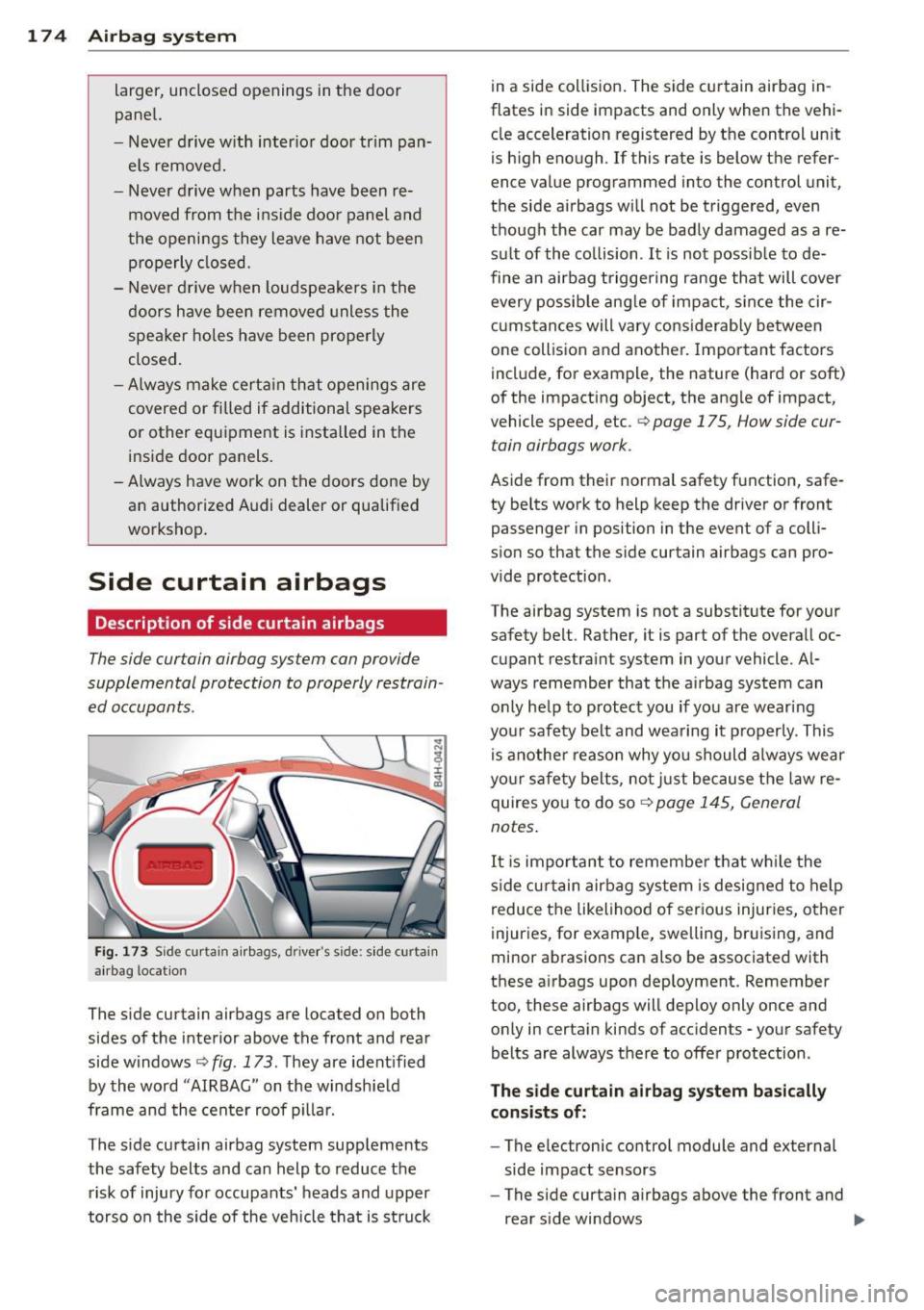
The s ide curtain airbags are located o n both
sides of the interior above the front and rea r
side windows
c:.> fig. 173 . They are ident ified
by the word "AIRBAG" on the windshield
frame and the center roof p illar.
The s ide curtain airbag system supp lements
the safety belts and can help to reduce the risk of injury for occupants' heads and upper
torso o n the side of the vehicle tha t is struc k in a side collision
. The side curtain airbag in
flates in side impacts and only when the vehi cle acceleration registered by the control un it
is h igh enough . If this rate is below the refer
ence value programmed into the control unit,
the side airbags will not be triggered, even
t h ough the car may be bad ly damaged as a re
su lt of the co llision .
It is not possib le to de
fine an airbag triggering range that will cover every possib le ang le of impact, s ince the cir
cumstances will vary cons iderably between
one collision and another. Important factors
include, for example, the nature (hard or soft)
of the impacting object, the angle of impact,
vehicle speed, etc .
c:,, page 175, How side cur
tain airbags work .
Aside from their normal safety function, safe
ty belts work to help keep the driver or front
passenger in position in the event of a colli
sion so that the side curtain airbags can pro
vide protection .
The airbag system is not a substit ute for your
safety belt . Rather, it is part of the overall oc
cupant restraint system in your vehicle. Al
ways remember that the a irbag system can
only help to protect you if you are wear ing
you r saf ety belt and wearing it properly . This
is anothe r reason why yo u should always wear
yo ur safe ty belts, no t just because the law re
quires yo u to do soc:.>
page 145, General
notes .
It is important to remember that w hile the
s ide cur tain airbag system is designed to help
reduce the likelihood of ser ious injur ies, other
injuries, for example, swelling, bruising, and
minor ab rasions can also be associated with
these a irbags upon dep loyment. Remember
too, these airbags will deploy only once and
only in certain kinds of accidents -your safety
belts are always there to offe r protection .
The s ide curtain a irbag system basic ally
cons ists of:
- The e lectronic control module and external
side impact sensors
- The side curtain airbags above the front and
rear s ide windows
Page 177 of 314

-The airbag indicator light in the instrument
pane l
The airbag system is moni to red ele ct ro ni ca lly
t o make certain it is fu nct ion ing properly a t all
times. Each time you switch on the ignition,
the airbag system indicator light wi ll come on
for a few seconds (se lf d iagnost ics) .
The side curtain airbag is not activated:
-if the ignition is switched off,
- i n s ide collisions wh en the acceleration
measu red by the sensor is too low,
- i n rear-end collisions,
- in rollovers.
A WARNING
-
- Safety belts and the a irbag system will
only p rov ide p rotection when occ upants
are in t he p roper seat ing posit io n
c::> page 58, General recommendations.
- If the airbag indicato r light c::> page 18
comes whe n the vehicle is be ing used,
have the system inspected immediately
by you r auth o rized Audi dea le r. I t is pos
sible that the airbag will inflate when it
is not supposed to, or w ill not inflate
when it sho uld.
How side curtain airbags work
Side curtain airbags con work together with
side airbags to help reduce the risk of head
and upper torso injuries for occupants who
are properly res trained.
Fi g. 174 Ill ust rat ion of prin cipl e: In flat ed side cu rtain
airbags on the left side
The side curtain airbags inflate between the
occupant and the windows on the side of the
"' N ;g
±
"" ID
Airba g system 175
vehicle that is struck in a side collision
c::> fig. 174 .
When the system is t riggered, the side curta in
airbag is filled with propellant gas and breaks
through a seam above the front and rear side
w indows identified by the AIRBAG labe l. In or
der to he lp provide this additional protection,
the side curtain airbag must inflate within the
blink of an eye at very high speed and with
great force. The side curtain a irbag could in
jure you if your seating pos it io n is not prope r
or upright or if items are located in the area
whe re the supplemen tal side curta in a irbag
infl ates. This applies espe cially to ch ildren
c::> page 177 .
Although they are not a soft p illow, side cur
ta in ai rbags can "cushion" the impact and in
th is way they can help to reduce the risk of in
jury to the head a nd the upper part of the
body.
A fine dust may deve lop when the ai rbag de
ploys . Th is is qui te no rma l and does not mean
t h ere is a fire in the vehicle .
Important safety instructions on the
side curtain airbag system
Airbags are only supplemental restraints. Al
ways properly wear safety belts and ride in a
proper seating position .
There is a lot that you and your passengers
must know and do to he lp the safety belts and
airbags do their job to provide supplemental
protection .
A WARNING
Improperly wearing safety belts and im
p roper seating positions increase the risk
of ser ious personal injury and death when
eve r a vehicle is being used .
- Never let occupants place any parts of thei r bod ies in the area from which the
side curta in a irbags inflate.
- Always make sure that the s ide curtain
airbags can inflate without interference.
-
Unsuitable accessor ies fitted inside the ..,