steering AUDI A8 2015 User Guide
[x] Cancel search | Manufacturer: AUDI, Model Year: 2015, Model line: A8, Model: AUDI A8 2015Pages: 312, PDF Size: 79.18 MB
Page 48 of 312
46 Clear vis ion
Clear vision
Lights
Switching the headlights on and off
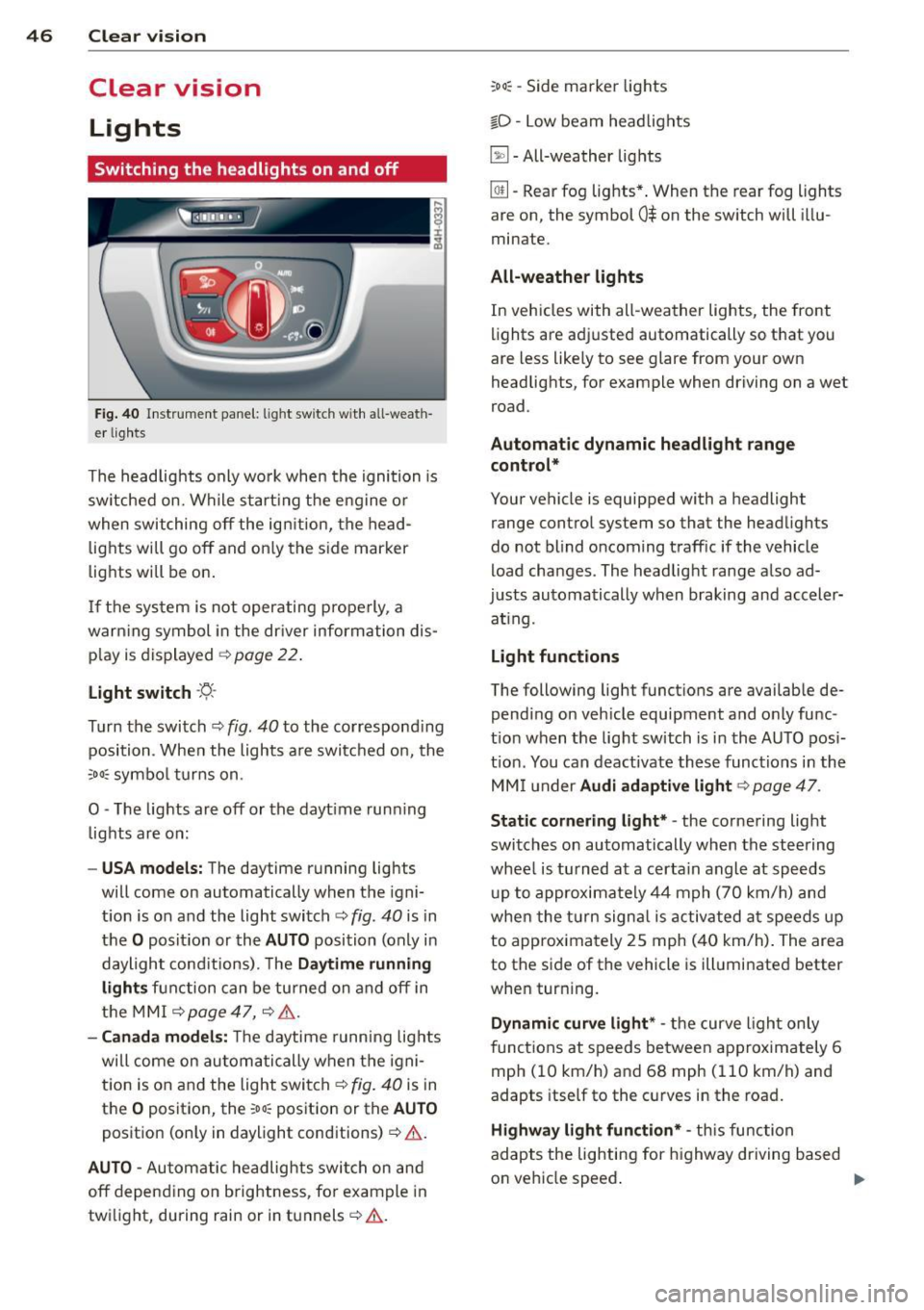
Fig . 40 Instr ument pane l: lig ht sw itc h w it h all -weath
er lig hts
The headlights only wo rk when the ignition is
sw itched on. Wh ile start ing the eng ine or
when switching off the ig nition, the head
lights will go off and on ly the s ide marker
lights w ill be on .
I f the sys tem is not operating properly, a
warn ing symbol in the dr iver information dis
p lay is displayed <=>page
22 .
Light switch -~ -
Turn the switch <=>fig. 40 to the co rrespond ing
position . When the lights a re switched on , the
:o o: symbo l turns on .
0 -The lights are off or the dayt ime run ning
lights are on:
- US A model s: The daytime running ligh ts
will come on automatically when the igni
t ion is on and the light switch<=> fig .
40 is in
the
O posit ion or the A UTO position (only in
daylight cond itions) . T he
Daytime running
lights
function can be turned on and off in
the MMI <=> page
47, <=> .& .
-Canada model s: T he daytime running lig hts
will come on automa tically when the igni
t ion is on and the light switch<=> fig .
40 is in
the
O posit ion, the :oo~ position or the AUTO
posit ion (on ly in daylight conditions)<=>.& .
AUTO -Automatic headlights swi tch on and
off depend ing o n brightness , fo r example in
twi light, during rain or in tunnels<=>.& .
:oo~ -Side marker lights
io -Low beam head lights
~ -All-weather lights
@!l -Rear fog lights *. When th e rear fog lights
a re on , the symbol
0$ on the sw itch will i llu
minate .
All-weather light s
In vehicles with all -weather lights, the front
lights are ad justed automatically so that you
are less like ly to see glare from your own
headlig hts, for example when driving on a wet
road .
Automatic dynamic headlight range
control *
Your vehicle is equipped with a headlight
range control sys tem so that the headligh ts
do not blind oncoming traffic if the vehicle
load cha nges . The headlight range a lso ad
justs automatically when braking and acceler at ing .
Light function s
The following ligh t funct ions are available de·
pending on veh icle equipment and o nly fu nc
t io n when the lig ht switch is i n the AUTO pos i
t ion . You can deactivate these functions in the
MM I under
Audi adaptive light r:!> page 47 .
Static cornering light *· the cornering light
switches on automatically when the steering
wheel is turned at a certa in angle at speeds
u p to approxima tely 44 mph ( 70 km/h) and
when the t urn sign al is activated at speeds up
to approximately 25 mph (40 km/h) . The area
to the s ide of the vehicle is illuminated better
whe n turning.
Dynamic curv e light * -the curve ligh t only
f unct ions at speeds between approximately 6
mph (10 km/h) and 68 mph ( 110 km/h) and
adapts itse lf to the cu rves in the road.
Highway light function* -this function
adapts the lighting for highway driving based
o n ve hicle speed .
Ill>
Page 50 of 312
48 Clear vision
Automatic headlights
You can adjust the following settings in the
Automatic headlights menu:
Headlights a ctivation time -You can adjust if
the head lights switch on
Early , Med. or Late
according to the sensitivity of the light sensor.
Audi adaptive light* -You can switch adaptive
light
On and Off.
Automatic high beams*
You can switch the high beam assist on and
off .
Daytime running lights
USA models :
You can switch the daytime run
ning lights
on and off .
Canada models:
The function cannot be
turned off. It is activated automatica lly each
time the ignition is switched on . This menu
item is shown "greyed out".
Coming home, Leaving home
The coming home function illuminates the
area outside the vehicle when you switch the
ignition off and open the driver's door. To turn
the function on, select
Lights when leaving
car> On.
The leaving home function illuminates the
area outside the vehicle when you un lock the
ve hicle . To turn the funct ion on, select
Lights
when unlocking car > On .
The coming home and leaving home functions
on ly operate when it is dark and the light
switch is in the
AUTO position.
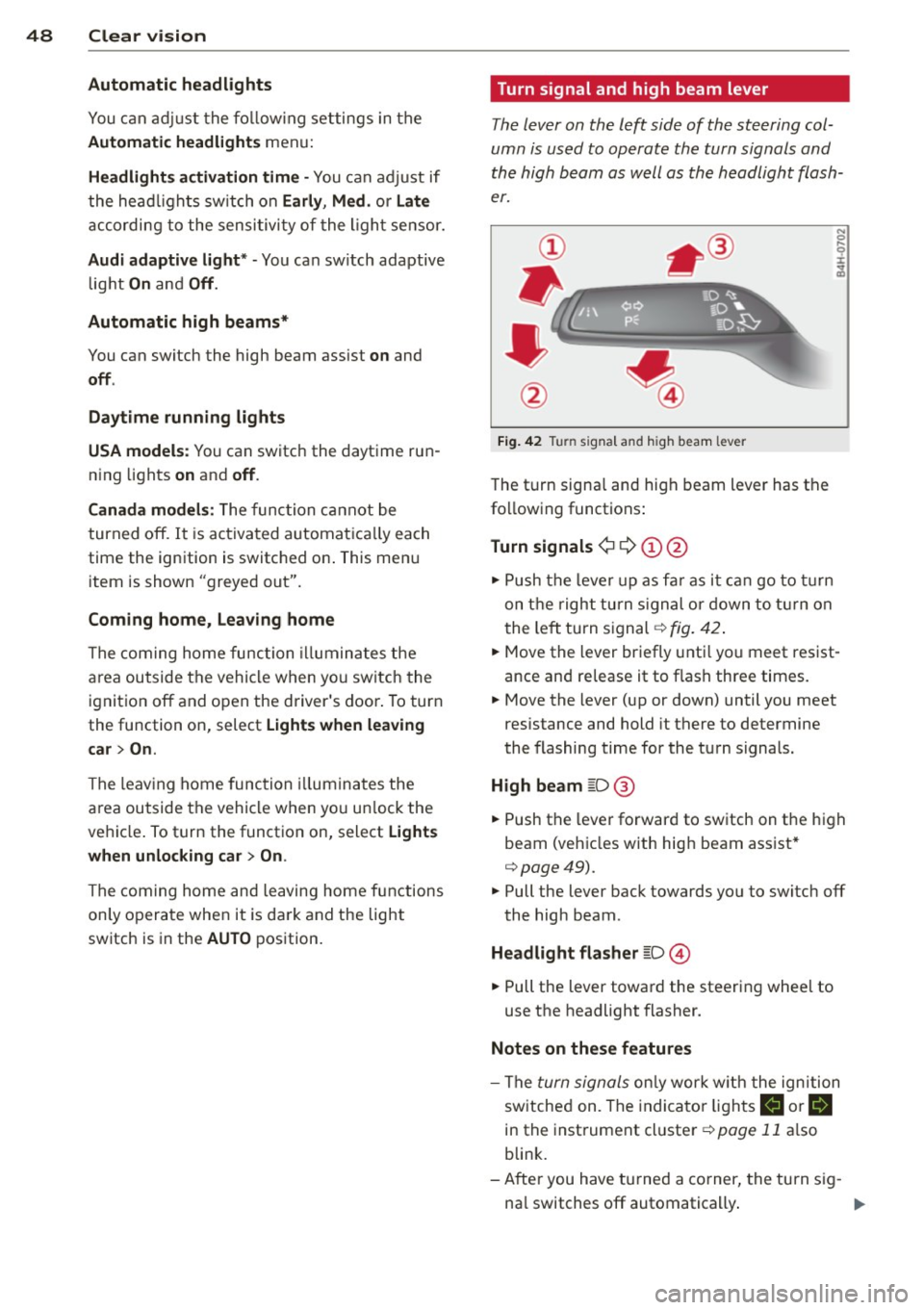
Turn signal and high beam lever
The lever on the left side of the steering col
umn is used to operate the turn signals and
the high beam as well as the headlight flash
er.
Fig. 42 Tu rn signal and high beam lever
The turn signa l and high beam lever has the
following functions:
Turn signals ¢ 9 (D@
.. Push the lever up as far as it can go to turn
on the right turn signal or down to turn on
t he left turn signal
¢ fig. 42 .
N 0 ... 'i' :r
~
.. Move the lever briefly until you meet res ist·
ance and re lease it to flash three times.
.. Move the lever (up or down) until you meet
resistance and hold it there to determine
the flashing time for the turn signals.
High beam [D @
.. Push the lever forward to switch on the high
beam (vehicles with high beam assist*
¢page49).
.. Pull the lever back towards you to switch off
the high beam .
Headlight flasher [D ©
.. Pull the lever toward the steering wheel to
use the headlight flasher.
Notes on these features
-The turn signals only work w ith the ignition
switched on. The indicator lights
ID or iPJ
in the instrument cluster ¢page 11 also
blink.
- After you have t urned a corner, the turn sig -
na l switches off automatically .
Ill>
Page 60 of 312

58 Seat s a nd s tor ag e
Seats and storage
General recommen
dations
Why is your seat adjustment so
important?
The safety belts and the airbag system can
only provide maximum protection if the front
seats are correctly adjusted.
There are various ways of adjust ing the front
seats to provide safe and comfortable support
for the driver and the front passenger . Adjust
you r seat prope rly so that :
- you can easily and quick ly reach all the
switches and controls in the instrument
panel
-your body is prope rly supported thus reduc
ing physical stress and fatigue
- the safety be lts and a irbag system can offer
maximum protection
¢ page 151 .
In the following sec tions, you will see exactly
how you can best adjust you r seats .
There are special regulations and instructions
for insta lling a child seat on the front pas
senger's seat. Always fo llow the information
regarding ch ild safety provided in
q page 17 4, Child Safety.
A WARNING
Incorrect seating position of the driver and
all other passengers can result in serious
personal in jury.
- Always keep your feet on the floor when
the vehicle is in motion -never p ut your
f eet on top of the instrument panel, out
of the w indow or on top of the seat cush
ion . Th is app lies especially to the passen
gers .
If your seating position is incorrect,
yo u increase the r isk of injury in the case
of sudden braking or an acc ident.
If the
a irbag infla tes and the seating positio n
is incorrect, this could result in personal
injury o r even death.
- It is import ant for bo th the driver and
front passenger to keep a distance of at least 10 inches (25 cm) between them
selves and the steering wheel and/or in
strument panel. If you're s itting any
closer than th is, the a irbag system can
not protect you properly . In addition, the
front seats and head restraints must be
adjusted to your body height so that they
can give you max imum protect ion.
- Always try to keep as much distance as
possible between yourself and the steer
ing wheel o r inst rument pane l.
- Do not adjust the driver's o r front pas
senger's seat whi le the vehicle is moving.
Your sea t may move unexpected ly, caus
ing sudden loss of vehicle cont rol and
personal injury . If yo u adjust yo ur seat
while the veh icle is moving, yo u are out
of posit ion.
Driver's seat '
The correct seat position is important for safe
and relaxed driving.
We recommend tha t you adjus t the dr iver's
seat in the fo llowing manner :
.,. Adjust t he seat in fore and aft direction so
t ha t you can eas ily push the peda ls to the
floor w hile keeping your knees sl igh tly bent
q A in Why is your seat adjustment so im
portant? on page 58.
.. Adjust the backrest so that when you sit
w ith your back against t he backrest, you can
still grasp the top of the steering wheel.
.. Adjust the head restraint so the upper edge
is as even as poss ible with the top of your
head . If that is not poss ible , try to adjust
t he head restraint so that it is as close to
t his pos it ion as possib le
q page 65.
A WARNING
Neve r place any objects in the dr iver's foot
well. An object could get into the pedal
a rea and interfere with pedal function . In
case of sudden braking or an acc ident, you
would not be able to brake or accelerate .
Page 68 of 312

66 Seats and storage
Seat memory
Description
Applies to vehicles: wit h memory fu nctio n
The memory function allows you to quickly
and eas ily store and recall personal seating
p rofiles for the dr iver, front passenger and
outer rear seats*. The memory function is op
erated through the master key and the memo ry buttons in the driver's/front passenger's
doors and the rear doors*.
The driver's seating profi le is stored and as
signed to the master key each time the vehicle
is locked . When you open the door, the seat
ing profile is automatically recalled. If two
Remote control
master key
Driver
Seat X
Head restraint X
Steering wheel* X
Safety belt* X
Both exterior rear-X
view mirrors*
There are two additional buttons in the rea r
doors* that can be used to recall two stored
seating profiles
r:=;,page 67.
Remote control key
Appl ies to vehicles: with memory function
To assign the driver's seat settings to the re
mote contro l key when locking the vehicle, the
function must be switched on .
.. Se lect :
I CAR I function button > Car systems
control button > Vehicle settings > Seats >
Driver seat > Remote control key> On.
@ Tips
If you do not want another driver's set
tings to be assigned to the remote control
key, switch off the memory function using
the MMI or the
! OF F! button r:=;, page 67. people
use one vehicle, it is recommended
that each person always uses "their own"
master key.
Two seating profiles can be stored in each of
the driver's/front passenger's doors and one
seat ing profile in each of the rear doors*.
Once stored, these seat ing profiles can be re
ca lled at any time.
T he following sett ings are stored:
Memory button
Driver Front passenger Outer rear seats*
X
X X
X X
X
X
X
X
Page 83 of 312

(D Note
To avoid damage to the heating elements in the seats, do not kneel on the seats or
place heavy loads on a small area of the
seat.
Setup
The climate control system setup is accessed
through the MMI.
• Select: I CARI function button> Car systems
control button > A/C.
Rear cabin settings*
When this function is selected, all sett ings for
the rear can be adjusted through the climate
control system in the cockpit . The climate
control system settings cannot be adjusted in
the rear seat at the same time. This function
switches off after a certain period of time or
when one of the dials in the cockp it is press
ed .
Auto recirculation*
Warm and cold 81
Solar roof*
Parking ventilation is controlled automatically
in the
auto setting .
When the ignition is off, solar-powered park
in g ven tilat ion may switch on, as long as
- there is sufficient sunlight,
- the outside temperature is not too low,
- the sunroof is closed or tilted and
-auto (MMI) is selected .
~ Steering wheel heating
Applies to vehicles : wi th hea ted stee ring wheel
The steering wheel rim can be heated .
Fig. 86 Steering col umn: steering w hee l h eating but-
The sensitivity level of the automatic recircu-ton
lation mode can be set at various levels from
off to sensitive . The recirculation mode l""" I is
controlled on automatically. You must press
the~ button if fog forms on the w indows .
Footwell temperature
You can adjust the footwe ll temperature so
that it is cooler or warmer.
Windshield heat*
When the defroster~ is switched on and the
Auto setting is selected, the windshie ld de
froster is controlled automatically .
Supplementary heater*
The supplementary heater warms the inter ior
of vehicles with diesel engines* more quickly.
The supplementary heater is controlled auto
mat ica lly in the
Auto setting. •
Press the
lj] button to switc h steer ing wheel
he ating on/off. The message
Steering wheel
heating on!/Steering wheel heating off!
appears in the instrument cluster display.
T he temperature is maintained at a constant
level when steering wheel heating is switched
on.
The steering wheel heating settings are stor
ed automatically and assigned to the remote
control key that is in us e.
Page 84 of 312

82 On the road
On the road
Steering
Adjusting steering wheel position
The steering wheel position can be adjusted
for height and reach .
Fig. 87 Switch for steering whee l adjustment
F irst, adjust the driver's seat correctly.
• To adjust the height, press the sw itch up/
down. The stee ring column will continue
moving as long as you a re pressing the
switch.
• To move the steering wheel forward or back,
press the switch forwa rd/back. The steering
column will continue moving as long as you
are pressing the switch.
There must be at least 10 inches (25 cm) be
tween your chest and the center of the steer ing wheel. If you cannot sit more than 10 in
ches (25 cm) from the steering wheel, see if
adaptive equipment is available to help you
reac h the pedals and increase the distance
from the steering wheel.
For detai led informat ion on how to adjust the
driver's seat, see
Qpage 59.
In vehicles with the memory function*, the
steering column settings are stored together
with the seat position.
A WARNING
Improper use of steering wheel adjust
ment and improper seating position can
cause serious personal injury . -
Adjust the steering wheel col umn only
when the vehicle is not mov ing to pre
vent loss of vehicle control.
- Adj ust the driver's seat or steering whee l
so that there is a minimum of 10 inches
(25 cm) between your chest and the
steer ing wheel
Q page 134, fig . 153 . If
you cannot mainta in th is m inimum dis
tance, the airbag system cannot p rotect
you properly.
- If physical limitations prevent you from sitt ing 10 inches (25 cm) or more from
the steering wheel, check wit h your au
thorized A udi dealer to see if adaptive
equipment is available .
- I f the steering wheel is al igned with your
face, the supplementa l driver's airbag
cannot provide as much protection in an
accident. Always make sure that the
steering whee l is aligned with your
chest.
- Always hold the steering wheel w ith your
hands at the 9 o'clock and 3 o'clock posi
tions to reduce the risk of persona l injury
if the dr iver's airbag dep loys.
- Never hold the steering wheel at the 12
o'clock position or with your hands inside
the steeri ng wheel rim or on t he steering
wheel hub. Holding the steer ing wheel
the wrong way can cause serious injuries
to the hands, arms and head if the driv
er's airbag deploys.
Easy entry feature
The easy entry feature makes it easier to en
ter and exit the vehicle by automatically ad
justing the steering wheel.
• Select in the MMI: ICAR lfunction button>
Car sy st e m s control button > Vehi cle set·
tin gs > Se ats > Dri ver 's s eat > Ea sy entr y>
On .
When the easy entry feature is turned on, the
steering wheel moves up to the park position
whe n you switch off the igni tion. Afte r you en-
ter the ve hicl e, the steering wheel moves to .,..
Page 85 of 312
the stored position as soon as you switch on
the ignition.
Starting and stopping
the engine
Starting the engine
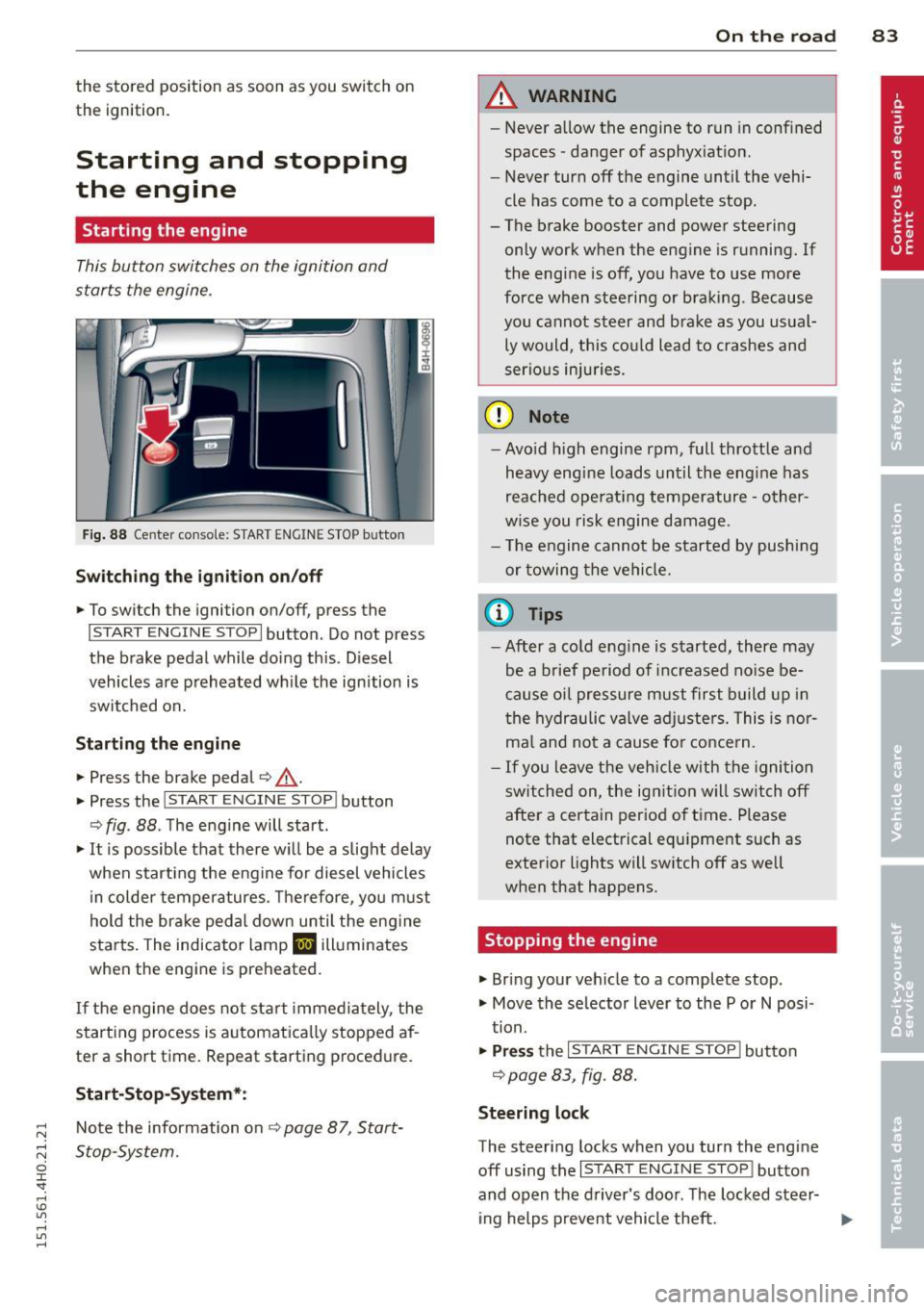
This button switches on the ignition and
starts the engine .
Fig. 88 Cente r console: S TART ENGINE S TOP b utto n
Swi tc hin g the i gni tion on/off
• To switch the ignition on/off, press the
I START ENGINE STOPI button . Do not press
the brake pedal while doing this . D iesel
vehicles are preheated wh ile the ignition is
switched on.
St art in g the engine
• Press the brake pedal~,&. .
• Press the
!START E NGINE STOPI button
~ fig . 88 . The engine will start.
• It is possible that there w ill be a slight delay
when start ing the engine for diesel vehicles
in colder temperatures. Therefore, you must
hold the brake peda l down until the eng ine
starts. The indicator lamp
II illuminates
when the engine is preheated.
If the engine does not start immediately , the
starting process is automatica lly stopped af
ter a short time . Repeat starting procedure.
Start -Stop -System *:
Note the information on ¢ page 87, Start
Stop-System.
On th e road 83
A WARNING
- Never allow the engine to run in confined
spaces -danger of asphyxiat ion.
- Never turn off the engine until the vehi
cle has come to a complete stop.
- The brake booster and power steering
only work when the engine is running. If
the engine is off, you have to use more
force when steering or braking . Because
you cannot steer and brake as you usual ly would, this could lead to crashes and
serious injuries.
(D Note
- Avo id h igh engine rpm, full throttle and
heavy engine loads until the eng ine has
reached operating temperature -other
w ise you risk engine damage .
- T he engine cannot be started by pushing
or towing the vehicle.
(0 Tips
- After a co ld eng ine is started, there may
be a brief period of inc reased no ise be
cause oil pressure must first build up i n
the hydraulic valve adjusters. This is nor
ma l and not a cause for conce rn.
- If you leave the veh icle with the ignition
switched on , the ign ition w ill switch off
after a certain period of time . Please
note that electrical equ ipment such as
exterior lights will sw itch off as well
when that happens.
Stopping the engine
• Bring your vehicle to a complete stop.
• Move the selector lever to the P or
N posi
tion.
• Pr ess the I START ENGINE STO P I button
¢ page 83 , fig. 88.
Steerin g lock
The steering locks when you turn the engine
off using the
I START ENGINE STOP I button
and open the d river's door. The locked steer-
ing helps prevent vehicle theft.
11-
Page 86 of 312

84 On th e road
Emerg ency off
If necessary, the engine can be sw itched off
with the selector lever in the R, Dor S posi
tions . The engine stops if you press the
I START ENGINE STOP ! button at speeds below
6 mph (10 km/h).
A WARNING
- Never turn off the eng ine before the ve
hicle has come to a complete stop . The
full function of the brake booster and the
power steering is not quaranteed. You
must use more force to turn or brake if
necessary. Because you cannot steer and
brake as you usual ly would, this could
lead to crashes and serious injur ies.
- For safety reasons, you should always
park your vehicle with the se lector lever
in P. Otherwise, the vehicle co uld inad
vertent ly roll away .
- After the engine has been switched off, the radiator fan can continue to run for
up to 10 min utes - even with the ign it ion
switched off. It can a lso switch on aga in
after some time if the coolant tempera
ture rises as the result of a heat buildup or if the engine is hot and the engine
compartment is addit ionally heated by
the sun's rays.
(D Note
Do not stop the engine immed iate ly afte r
ha rd or extended dr iving. Keep the engine
r u nning for approx imately two m inutes to
prevent excessive heat build-up.
Driver message in the instrument
cluster display
T urn off ignition before le aving car
This message appears and a war ning tone
sounds if you open the driver's door when the
ignitio n is switched on.
Pr ess brake p edal t o start engin e
This message appears if you press the
I STAR T ENGINE S TOP ! button to start the en- gine and do not depress the brake pedal.
The
engine can only be started if the brake pedal
is depressed.
Ill I s key in th e vehi cle?
If the indicato r light turns on and the mes
sage appears, the remote control key was re
moved from the vehicle whi le the engine was
runn ing .
If the igni tion key is not in the veh i
cle you will not be able to switch on the igni
tion or restart the engine after it has been switched off. You will a lso not be able to lock
the vehicle from the outs ide.
Shift to P, othe rwi se vehicle can roll away.
Door s do not lock if lever i s not in P.
T h is dr iver message appears for safety rea
sons if the transmission has not been shifted
to the P position when you switch the ignition
off. Move the selector lever to the P position.
Otherwise the vehicle is not protected from
ro lling and cannot be locked.
II Key i s not recognized . Hold b ack of key
again st m arked are a. See ow ner' s m anual.
If the indicator l ight turns on and this mes
sage appe ars, there is a ma lfunct ion
¢ page 85.
Tu rn off i gnition before leaving car. Ba ttery
i s di sc harging
Th is message appears if the driver's door is
opened wh ile the ignition is switched on. Al
ways switch off the ign it ion if you a re leav ing
the vehi cle. See also
¢page 89 .
Shift to P and turn off ignition before l eav
ing car, otherwi se vehicle c an roll away
This message appears if the driver's door is
opened wh ile the ignition is switched on and
the selecto r lever is not in the P position. Shift
the selector lever into the P pos ition and
switch off the ignit ion when you exit the vehi
cl e. Otherw ise the vehicle cou ld rol l. See also
¢page 89.
Page 89 of 312

,....,
N ,....,
N
0 J:
'SI: ,...., \!) 1.1'1 ,...., 1.1'1 ,....,
Starting off with a trailer
To prevent rolling back unintentionally on an
incline, do the following:
11-Keep the switch© pulled and depress the
accelerator. The parking brake stays applied
and prevents the vehicle from rolling back
ward .
11-You can release the switch<®> once you are
su re that you a re develop ing enough for
ward momentum at the wheels as you de
press the accelerator.
D epending on the weight of the r ig (vehicle
and tra ile r) and the severi ty of the incl ine, you
may roll backwards as you start. Yo u can pre
vent rolling backwards by holding the parking brake switch<®) p ulled out and acce lerating -
just as you would when starting on a hill with
a conventional hand brake.
Emergency braking
In the event that the conventional brake sys
tem fails or locks.
11-In an emergency, pull the switch(®) and
contin ue to p ull it to slow your vehicle down
with the parking brake.
11-As soon as you release the switch (®) or ac-
ce lerate, the braking process stops.
If you pull the switch<®> and hold it above a
speed of about 5 mph (8 km/h), the emergen
cy braking function is initiated. The vehicle is
braked at all four wheels by activating the hy
draulic brake system. Th e brake performance
i s similar to making an emergency stop
~ &..
In order not to activate the emergency brak
ing by m istake, an audible warning tone (buz
ze r) sou nds when the switch C®> is pulled. As
soon as the switch(®) is released, or the accel
e rator pedal is dep ressed, emergency b ra ki ng
stops.
_& WARNING
Emergency braking should only be used i n
an emergency, when the normal foot brake
has failed or the brake pedal is obstructed .
On the ro ad 87
Using the parking b rake to pe rform emer
gency brak ing will slow your vehicle down
as if you had made a full brake application.
The laws of physics cannot be suspended
even with ESC and i ts associated compo
nents (ABS, ASR, EDL). In corners and
when road o r weathe r cond itions are bad,
a full brake appl ication can ca use the vehi
cle to sk id or the re ar end to break away -
risking an acciden t.
Start-Stop-System
' Description
Applies to vehicles: wit h Start -Stop-System
The Start-Stop-System can help increase fuel
economy and reduce CO2 emissions .
In the Start-Stop-mode, the engine shuts off
automat ica lly w hen the vehicle is stopped,
such as at a traffic light. The ignition remains
switched on du ring this stop phase. The en
gine wi ll be automat ica lly restarted when
needed.
The last Start-Stop-System sett ing (on/off us
ing the button
I O\l ~I) will be restored when the
i gnition is turned on. The L ED in the
1(7() .. 1 but
ton turns on when the Star t-Stop-System is
swi tched off man ually.
Basic requirements for the Start -Stop
mode
- The d rive r's doo r is closed.
- The d river ' seat belt is latched .
- The hood is closed .
- The vehicle must have been driven faster
than
2.5 mph (4 km/h) since the last stop.
- A trailer is not hitched to the vehicle.
_& WARNING
-Never let the vehicle roll with the eng ine
sw itched off. You cou ld lose control over
the vehicle. Th is can lead to a collision
and serio us in ju ries.
- The brake booster and the steering sup port do not work while the engine is
Page 90 of 312

88 On the road
switched off. More force is required to
stop and to steer the vehicle.
- To reduce the risk of injuries, make sure
that the Start-Stop-System is turned off
when working in the engine compart
me nt¢
page 89.
(D Note
Always switch off the Start-Stop -System
when driving through water ¢
page 89.
Starting/stopping the engine
Applies to vehicles: with Start-Stop-System
Fig . 91 In strument duster : eng ine switc hed off (stop
phase)
~ Slow the vehicle to a stop using the brake
and keep pressing the brake pedal. The en
gine w ill switch off. The
11] indicator light
appears in the information line in the instru
ment cluster display.
~ When you take your foot off the brake ped
al, the engine restarts . The ind icator light
turns off.
Additional information
The engine w ill switch off in the P, D, N and S
positions as well as in manua l mode. In the P
position, the e ngine will also remain off if you
take your foot off the brake pedal. The engine
starts again when you select another se lector
lever position and take your foot off the brake
pedal.
If you select the R position during a Stop
phase, the engine will start again .
Shift from D to P quickly to prevent the engine
from starting unintentionally when shifting
through R. You
can determine for yourself if the engine
will stop or not by reducing or increasing the
amount of force you use to press the brake
pedal. For example, if you only lightly press
on the brake pedal in stop-and and-go traffic
or when turning, the engine will not switch off
when the vehicle is stationary. As soon as you
press the brake down harder, the engine wi ll
switch off.
General information
Applies to vehicles: with Start-Stop-System
The standard Start-Stop-mode can be cancel
led for different system-related reasons.
Fig. 92 Instrument cluster: eng ine -Stop temporarily
unavailable
Engine will not switch off
Before each stop phase, the system checks if
certain conditions have been met. For exam
ple, the eng ine will
not be switched off in the
following situations:
- The engine has not reached the minimum
requ ired temperature for Start-Stop-mode.
- The interior temperature selected by the A/C
system has not been reached.
- The outside temperature is extremely high/
low.
- The windshield is being defrosted
¢page 81.
-The parking system* is switched on.
- The battery charge level is too low.
- The steering wheel is sharply turned or
there is a steering movement.
- After engaging the reverse gear.
- On sharp incl ines.