lights AUDI A8 2015 Workshop Manual
[x] Cancel search | Manufacturer: AUDI, Model Year: 2015, Model line: A8, Model: AUDI A8 2015Pages: 312, PDF Size: 79.18 MB
Page 212 of 312

210 Trailer towing
Trailer towing
Driving with a trailer
General information
Your Audi was designed primarily for passen
ger transportation .
If you plan to tow a trai ler, please remember
that the additional load will affect durability,
economy and performance .
Trailer towing not only places more stress on the vehicle, it also calls for more concentra
tion from the driver.
For this reason, always follow the operating
and driving instructions provided and use
common sense.
(D Note
If you are going to tow a trai ler, you must
activate the trailer operation mode
i::> page 210, Operating instructions .
Technical requirements
Trailer hitch
Use a weight-carrying hitch conforming to the
gross trailer weight. The hitch must be suita ble for your vehicle and trailer and must be
mounted securely on the veh icle 's chassis at a
technically sound location . Use only a trailer
hitch with a removable ball mount. A lways
check with the trai le r hitch manufacturer to
make sure that you are using the cor rect
hitch.
Do not use a bumper hitch.
The hitch must be installed in such a way that
it does not interfere with the impact-absorb
ing bumper system. No modifications should
be made to the vehicle exhaust and brake sys
tems. From time to time, check that all hitch
mounting bo lts remain securely fastened.
When you are not towing a trailer, remove the
trailer hitch ball mount. This prevents the
h itch from causing damage should your veh i
cle be struck from behind~ &.
Trailer brakes
If your trailer is equipped with a brak ing sys
tem, check to be sure that it conforms to all
regulations.
T he trailer hydraulic brake system must not be
direc tly connected to the vehicle's hydraulic
brake system .
Safety chains
Always use safety chains between your veh icle
and the tra iler.
Trailer lights
Trailer lights must meet all regulations. Be
sure to check with your Audi dealer for correct
wiring, switches and relays.
Mirrors
If you are unable to see the traffic behind you
using the regular outside mirrors, then you
must install extended mirrors. It is important
that you
always have clear v is ion to the rear .
A WARNING ,~ -
After removing the trailer hitch, do not
store it in your vehicl e. In case of sudden
braking, the hitch could fly forward and in
jure you or your passengers.
Operating instructions
Fig. 189 MMI display : tow ing mode on
Maximum traile r weight
A trai ler for your vehicle is limited to a typical
class 1 or class 2 trailer. .,.
Page 213 of 312
.... N .... N
0 J:
'SI: .... \!) 1.1'1
.... 1.1'1 ,....,
Trailer load distribution Be sure the load in the trailer is held securely
in place to prevent it from shifting forward,
backward or sideways.
Never allow a passenger to ride in a trailer
¢ .&. in Driving instructions on page 212.
Engine cooling system
Towing a trailer makes the engine work hard
er . It is important that the cooling system's
performance is up to the additional load .
Make sure that the cooling system has enough
fluid.
Tire pressure
When towing a trailer, inflate the tires of your
vehicle to the cold tire pressure listed under
"Full load" on the label located on the driver's
side B-pillar (visible when the door is open).
Inflate trailer tires to trailer and tire manufac
turers' specifications.
Lights
Check to make sure both vehicle and trailer
lights are working properly.
Safety chains Be sure trailer safety chains are properly con
nected from the trailer to the hitch on the ve
hicle . Leave enough slack in the chains to per
mit turning corners . When you install safety
chains, make sure they will not drag on the
road when you are driving.
The chains should cross under the trailer
tongue to prevent it from dropping in case of
separation from the hitch .
Adjusting the Audi drive select Make sure the vehicle is on a level surface
be
fore
hitching up the trailer and before adjust
ing the tongue weight. The vehicle must be in
auto or comfort driving mode and not raised
¢page 108, ~CD .
Make sure that the vehicle is lowered. In Info
tainment, select:
ICARI function button> low
er control button .
Trailer towing 211
If you must drive under poor road conditions,
you can raise the vehicle
after coupling the
trailer or
after adjusting the tongue weight
¢ page 110.
@ Note
- Changes in temperature or load can af
fect the height of the vehicle.
- Always select auto or comfort mode.
Otherwise, the tongue load specified for
your vehicle will no longer be applicable.
Driving instructions
Driving with a trailer always requires extra
core and consideration.
To obtain the best possible handling of vehicle
and trailer, please note the following:
.,. Do not tow a loaded trailer when your car it
self is not loaded .
.,. Be especially careful when passing other
vehicles.
.,. Observe speed limits.
.,. Do not drive at the maximum permissible
speed .
.,. Always apply brakes early .
.,. Monitor the temperature gauge.
Weight distribution
Towing a loaded trailer with an empty car re
sults in a highly unstable distribution of
weight. If this cannot be avoided, drive at very
low speeds only to avoid the risk of losing
steering control.
A "balanced" rig is easier to operate and con
trol. This means that the tow vehicle should be loaded to the extent possible and permissi
ble, while keeping the trailer as light as possi
ble under the circumstances . Whenever possi
ble , transfer some cargo to the luggage com
partment of the tow vehicle while observing
tongue load requirements and vehicle loading
considerations .
Speed
The higher the speed, the more difficult it be
comes for the driver to control the rig. Do not .,.
•
•
Page 214 of 312

212 Trailertowing
drive at the maximum permissible speed. Re
duce your speed even more if load, weather or
wind condit ions are unfavorable -part icu larly
when going downhill.
Reduce vehicle speed
immedi atel y if the trail
er shows the slightest sign of swaying .
Do not
tr y to stop th e sway ing by acceler ating .
Observe speed limi ts. In some areas, speeds
for vehicles towing trailers are lower than for
regular vehicles .
A lways apply brakes early. When driv ing
downhill, shift into a lower gear to use the en
gine braking effect to slow the vehicle . Use of
the brakes a lone can cause them to overheat
and fail.
Coolant t emperature
The coolant temperature gauge¢ page 10
must be observed carefully. The coolant tem
perat ure can increase if you drive on long in
clines in a low gear at high engine speeds. Re
duce your speed immediate ly if the L EDs in
the top part of the display turn on.
F or more in formation about indicator lights,
referto .¢page
15 .
A WARNING
Anyone not properly restrained in a mov
ing veh icle is at a much greater risk in an
accident . Never let anyone ride in your car
who is not properly wear ing the restra ints
provided by Aud i.
Trailer towing tips
Important to know
Your vehicle hand les different ly when towing
-
a trailer because of the addit ional weight and
d ifferent weight distribution . Safety, perform
ance and economy w ill greatly depend on how
carefully you load your trailer and operate
your ng.
Before you actually tow your trailer, practice
turning, stopp ing and back ing up in an area
away from traffic . Keep practicing until you have become completely familiar with the way
your vehicle-trailer combination behaves and responds .
Backing up is diffi cult and requ ires practice .
Backing up with a trailer gene rally req uires
steering action opposite to that when backing
up your vehicle without a tra iler.
Maintain a greater d ista nce between you r ve
hicle and the one in front of you . You wi ll need
more room to stop. To compensate for the
trailer, you w ill need a larger than normal
turning rad ius.
When passing, remember that you cannot ac
ce lerate as fast as you norma lly would be
ca use of the added load. Make sure yo u have
enough room to pass. After passing, allow
plenty of room for your trailer be fore chang
ing lanes again .
Avoid jerky starts, sharp turns or rapid lane changes.
(D Tips
- Do not tow a trailer during the break-in
period of your vehicle .
- If you tow a trailer, your Audi may re
quire more frequent maintenance due to
the extra load¢
page 290.
Parking on a slope
Do not park on a slope with a trailer. If it can
not b e avoided, do so only after doing th e fol
lowing:
When par king:
.,. App ly the foot brake.
.,. Have someone p lace chocks under both the
vehicle and the tra iler wheels .
.,. With chocks in place, slowly release the
brakes unt il the wheel chocks absorb the
load .
.,. Turn the whee ls towards the curb .
.,. Apply the parking brake .
.,. Select the P se lector lever posit ion.
When re starting after parking:
.,. App ly the foot brake.
Page 219 of 312

,....,
N ,....,
N
0 J:
'SI: ,...., \!) ..,.,
,...., ..,., ,....,
Vehicle care and cleaning 217
Component Situation Solution
Safety belts
Dirty Mild soap solutional, allow to dry before letting them re-
tract
Textiles, Stains adhering to Vacuum cleaner
Vinyl, the surface
Alcantara Water-based stains Absorbent cloth and mild soap solutiona>
such as coffee, tea,
blood, etc.
Oi l-based stains Apply a mild soap solutional, blot away the dissolved oil
such as oil, make- or dye, treat afterward with water, if necessary
up, etc .
Special stains such Special stain remover, blot with absorbent material,
as ballpoint pen, treat afterward with mild soap solutiona>, if necessary
nail polish, latex
paint, shoe polish,
etc.
Natural leather Fresh stains Cotton cloth with a mild soap solutiona >
Water-based stains Fresh stains: absorbent cloth
such as coffee, tea, Dried stains: stain remover suitable for leather
blood, etc.
Oil-based stains Fresh stains: absorbent cloth and stain remover suitable
such as oil, make- for leather
up, etc. dried stains: Oil cleaning spray
Special stains such Stain remover suitable for leather
as ballpoint pen ,
nail polish, latex
paint, shoe polish,
etc.
Care Regularly apply condit ion ing cream that protects from
light and penetrates into the material. Use specially-col-
ored conditioning cream, if necessary.
Cooler Dust and dirt Clean the ventilation openings in the luggage compart-
ment
Dirty Lukewarm
water, mild soap solutional if necessary, then
dry
Defrosting Empty the refrigerator, switch it off and let it thaw with
the door open, then dry
Carbon parts Dirty Clean the same way as p lastic parts
a) Mild soap so lu tion : maxim um two ta bl es poons neutr al soa p in 1 q uar t (l lit e r) of water
A WARNING
The windshield may not be treated with
water-repelling windshield coating agents.
Unfavorable conditions such as wetness,
darkness, or low sun can result in in- creased
glare. Wiper blade chatter is also
possible.
([) Note
-Headlights/tail lights
•
•
Page 220 of 312

218 Vehicle care and cleaning
- Never clean headlights or tail lights
with a dry cloth or sponge.
- Do not use any cleaning product that
contains alcohol, because they could
cause cracks to form.
-Wheels
- Never use any paint polish or other
abrasive materials.
- Damage to the protective layer on the
rims such as stone chips or scratches
must be repaired immediately.
- Sensors/camera lenses
- Never use warm or hot water to re-
move snow or ice from the camera
lens. This could cause the lens to crack.
- Never use abrasive cleaning materials
or alcohol to clean the camera lens.
This could cause scratches and cracks.
-Windows
- Remove snow and ice on windows and
exterior mirrors with a plastic scraper.
To avoid scratches, move the scraper
only in one direction and not back and
forth.
- Never remove snow or ice from win
dows and mirrors using warm or hot
water because this could cause cracks
to form.
- To avoid damage to the rear window
defogger, do not apply any stickers on
the heating wires on the inside of the
window.
- Decorative parts/trim
- Never use chrome care or cleaning
products.
- Paint
-To reduce the risk of scratches, the ve-
hicle must be free of dirt and dust be
fore polishing or waxing.
- To prevent paint damage, do not polish
or wax the vehicle in direct sunlight.
- To reduce the risk of paint damage, do
not polish away rust film .
- Remove cosmetics and sunblock imme
diately. Otherwise, the paint could be
damaged .
-Trim
- To reduce the risk of damage, do not
treat the trim around the panorama
sunroof with paint polish.
- Decorative decals
-To reduce the risk of damage, do not
use any rough powder or abrasive
cleaning products .
- To reduce the risk of damage, do not
polish decorative parts that have a
matte finish .
-Displays
-To avoid scratches, do not use dry
cleaning methods on displays.
- Controls
- Make sure that no fluids enter the con-
trols, because this could cause dam
age.
- Safety belts
- Do not remove the safety belts to clean
them.
- Never clean safety belts or their com
ponents chemically or with corrosive
fluids or solvents and never allow
sharp objects to come into contact
with the safety belts. This could cause
damage to the belt webbing.
- If there is damage to the webbing, the
connections, the retractors or the buck les, have them replaced by an author
ized Audi dealer or a qualified work
shop.
- Textiles/Vinyl/Alcantara
- Never treat Vinyl/Alcantara with leath-
er care products, solvents, floor polish,
shoe polish, stain remover or similar
products.
- To avoid damage, have stubborn stains
removed by an authorized Audi dealer
or a qualified workshop.
- Never use steam cleaners, brushes,
hard sponges, etc. when cleaning.
- Do not turn on the seat heating* to dry
the seat.
- Objects with sharp edges such as zip
pers, rivets on clothing or belts can
cause damage to the surface.
Page 242 of 312
24 0 Ch eck ing and filling
Always check wi th your a uthorized Audi
dealer to make s ure you are using the
correct brake flu id. The correct type of
brake fluid is also indicated on the
brake fluid reservoir.
- The brake fluid must be new. Heavy use
of the brakes can cause a vapor lock if
the brake fluid is left in the system too
long. This can ser ious ly affect the effi
ciency of the b ra kes as well as yo ur
safety. This could result in an acc ident.
(D Note
Brake flu id will damage the paint of your
veh icle.
@ For the sake of the environment
Because of the problem of proper d isposa l
of brake flu id as wel l as the special tools
requ ired and the necessary expert ise, we
recommend that you have the b rake fluid
changed by your author ized Audi dealer.
Battery
General information
Under
normal operating conditions, the bat
tery in your Audi does not need any mainte
n ance . With
high outside temperatures or
l ong daily dr ives we recommend that you have
the elec trolyte level checked by a service fa
cili ty. The e lec trolyte level sho uld a lso be
checked each time the battery is charged
¢ page 242.
Have the b attery checked when you ta ke yo ur
ve hicl e in for service. Yo u are well adv ise d to
replace a battery that is older than S years .
W ith certa in types of airbag deployment, the
battery is d isconnected from the vehicle ele c
tr ica l system for sa fety reasons¢
& in Re
pair, care and disposal of the airbags on
page 165.
Disconnecting the battery terminals
Some veh icle func tions (power w indow regu
l ato rs, for example) a re los t if the b attery ter- mina
ls are disconnected. These functions have
to be relearned after the battery termina ls are
connected aga in. To prevent th is, the battery
sho uld only be disconnected from the ve hicle
electrical system when abso lutely necessary
for repairs.
Vehicle s not driven for long peri ods
If you do not d rive your vehicle over a period
of several days or weeks, e lectr ica l compo
nents are gradually cut back or sw itched off.
This reduces energy consumption and ma in
ta ins start ing capability over a longer period
¢
page 202. Some of the convenience func
t ions may not ope rate, such as the inter ior
li gh ts or the power seat adjus tment. The con
venience func tions will be ava ilable ag ain
when you switch on the ignition and start the
engine .
Winter operation D uring the winte r months, battery capac ity
tends to de crease as temperatures drop. This
is beca use more power is also consumed wh ile
sta rting, and the headlights, rear window de
fogger, etc ., are used more often .
Avoid unnecessary power consumpt ion, p ar
t icu lar ly in city traffic or whe n traveling only
short distances. Let yo ur au thorized Aud i
dealer check the capacity of the vehicle bat
tery before winter sets in ¢
page 242. A well
charged battery will not on ly prevent starting
problems when the weather is cold, but will
also last longer.
(!) Tips
If your vehicle is left standing for several
weeks at extremely low temperatures, the
vehicle battery sho uld be removed and
stored where it w ill not freeze. This will
prevent it from be ing damaged and having
to be repla ced.
Page 243 of 312
.... N .... N
0 J:
'SI: .... \!) 1.1'1
.... 1.1'1 ,....,
Working on the battery
Be especially careful when working on or near the battery .
The battery is located in the luggage compart
ment under the floor. Before you check any
thing in the luggage compartment,
r ea d and
h ee d all WARNINGS
~ ,&.
Always heed the safet y warn ing s, when work
i ng on the vehicle battery or the veh icle elec
tr ical system to prevent injury .
The following WARNINGS are very
impo rtant when work ing on the battery:
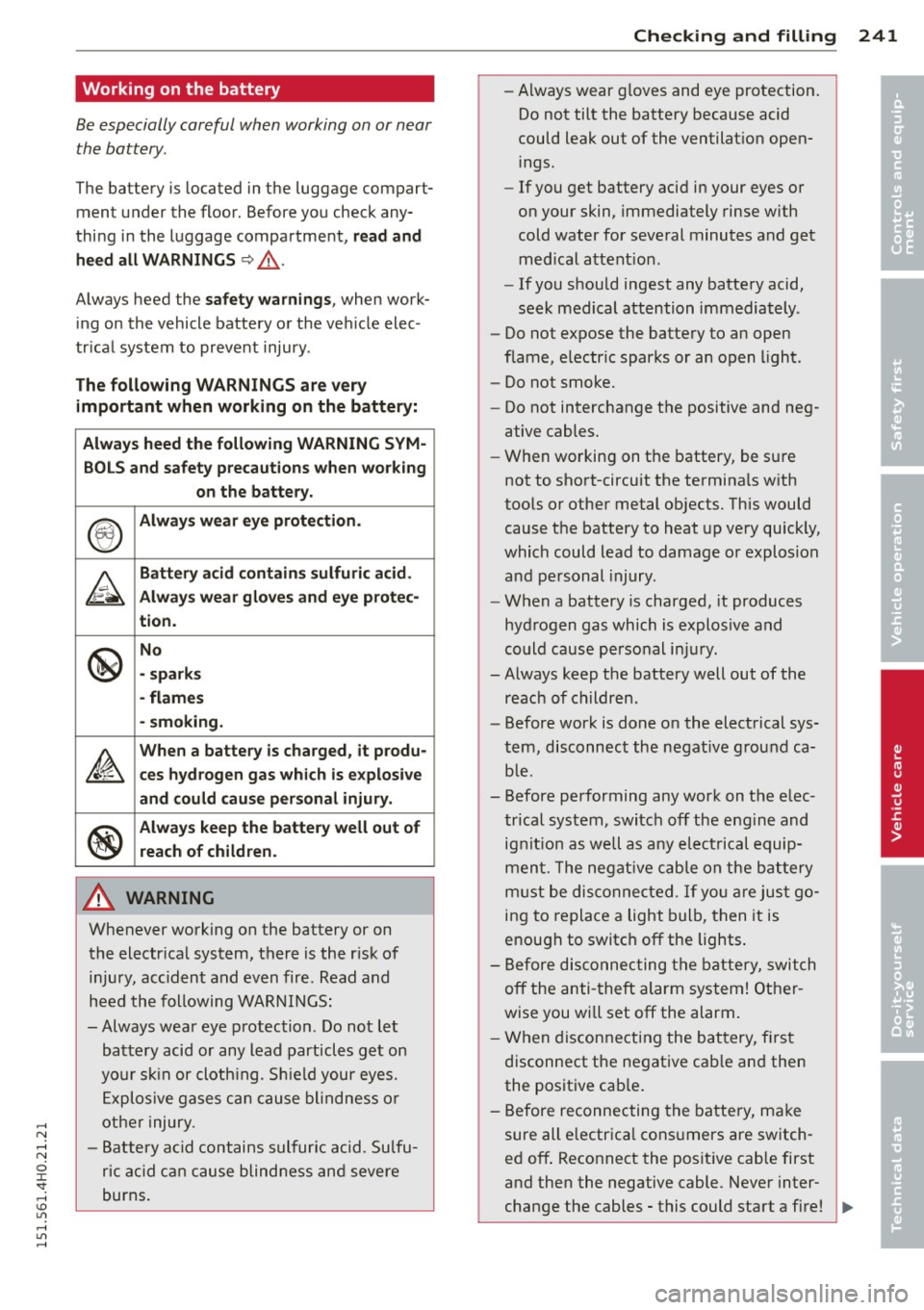
Al ways heed the follow ing WARNING SYM-
BOL S an d saf ety pr eca utions when wo rking
on the b atter y.
®)
Alway s w ea r eye protection .
A
Batter y aci d contain s sulfu ric acid.
Alw ay s w ear g lo ves and ey e prot ec-
tion .
@
No
-spa rk s
- flam es
- sm oking .
~
When a batte ry is charge d, it produ -
c es hyd rogen gas whi ch i s ex plosi ve
an d cou ld cause pers ona l injury .
®
Alway s keep the b atter y well out of
reach of child re n .
A WARNING
Whenever working on the battery or on
the electrical system, there is the r isk of
injury, acc ident and even fire. Read and
heed the following WARNINGS:
- Always wear eye p rotection . Do not let
battery acid or any lead particles get on
your sk in or cloth ing . Sh ield your eyes .
E xplosive gases can cause blindness or
other injury .
- Battery acid contains sulfuric acid . Sulfu
ric acid can cause blindness and severe
burns .
Checkin g and fillin g 241
-Always wear g loves and eye protection.
Do not tilt the battery because acid
could leak out of the ventilation open
i ngs .
- If you get battery acid in your eyes or
on your skin, immediately rinse with
cold water for several minutes and get
med ical attent ion .
- If you should ingest any battery acid,
seek medical attention immediately .
- Do not expose the battery to an open
f lame, e lectr ic sparks or an open light.
- Do not smoke.
- Do not interchange the positive and neg-
ative cables.
- When working on the battery, be su re
not to short-circuit the termina ls with
too ls or other metal objects. This would
cause the battery to heat up very quickly,
which could lead to damage or explosion and personal injury .
- When a battery is charged, it produces
hydrogen gas which is explos ive and
could cause personal in ju ry .
- Always keep the battery well out of the reach of children .
- Before work is done on the electrical sys
tem, disconnect the negat ive ground ca
ble.
- Before performing any work on the e lec
trical system, switch off the eng ine and
ignit ion as well as any electrical equip
ment. The negative cable on the battery
m ust be disconnected. If yo u are just go
ing to replace a light bulb, then it is
enough to switch off the lights .
- Before disconnec ting the battery, switch
off the anti -theft alarm system! Other
wise you wi ll set off the alarm.
- When disconnecting the battery, f irst
disconnect the negative cab le and then
the positive cab le .
- Before reconnecting the battery, ma ke
sure all e lectrica l consumers are switch-
ed off . Reconnect the pos it ive cable first
and then the negative cable . Never inter
change the cables - this could start a fire!
~
•
•
Page 279 of 312

.... N .... N
0 J:
'SI: .... \!) 1.1'1
.... 1.1'1 ,-0
Fuse pa nel @ (brown )
No . Equipment
1 Headlight contro l switch
2
Emergency start coil (key
i dentification)
3
Rear door control module
(driver's side)
4 Head-up Display
5 Horn
6 Inter ior lights (head liner)
Steering column lever, mul-
8
tifunction steering wheel
controls, steering wheel
heat ing
10
Electric steering co lumn
lock
11 D river door contro l modu le
12
D iagnostic connector, light/
rain sensor
14
Power steering col umn ad -
justment
15
Power steering, A/C com-
presse r
16 Brake booster
Fu se pa nel © (b la ck)
No . Equipment
1 Front seat heating
2 Windshield w iper
3 Front exterior lighting
4 Sun roof
5 Driver power window
6 Driver seat (pneumat ic)
7 Panoramic sunroof
8 Dynamic steering
9 Front exterior lighting
10 Windshield/headlight
wash-
er system
11
Rear power w indow (driver's
side)
12 Panoramic sunroof
Amps
5
5
7,5 5
15
7,5
10/5
5
7,5 10
25
20
15
Amps
30 30
30 20
30
7,5
20 35
30
35
30
40
Fu ses and bulb s 2 77
Front passenger side cockpit fuse
assignment
Fig . 233 Fro nt passe nger side cockpit: f use pane l with
plast ic brac ket
Fu se panel @ (bl ac k)
No. Equipment Amps
1 Anti-theft alarm system 5
2
Transmission control mod-
15
ule
3 Front climate control fan 40
4 Engine supply 35
6
Engine cont ro l modu le 5
7
Front passenger door con-
7,5 trol module
8
Front passenger power win-
30 dow
9 ESC contro l module
10
10
ESC contro l modu le 25
1 1
Right rear power window 30
1 2
Front passenger seat (pneu-
7,5 matics)
•
•
Page 282 of 312
280 Fuses and bulb s
No. Equipment Amps
7 TV tuner 5
8 Infotainment un it/drives 7,5
9
I nstrument cluster, analog
5
clock
10 MMI Display 5
11 Radio receiver 7,5
1 2
Rearview camera (park ing
5 aid), Top view
Bulbs
Replacing light bulbs
For your safety, we recommend that you have
your authorized Audi dealer replace burned out bulbs for you .
It is becoming increasingly more and more
difficult to replace vehicle light bulbs s ince in
many cases, other parts of the car must first
be removed before you are able to get to the
bu lb . Thi s applies especially to the light bu lbs
in the front of your car which you can only
reach through the engine compartment .
Sheet metal and bulb holders can have sharp
edges that can cause ser ious cuts, and parts
must be correctly taken apart and then prop
erly put back together to help prevent break
age of parts and long term damage from wa
ter that can enter housings that have not been
properly resealed.
F or your safety, we recommend that you have
your authorized Audi dealer replace any bulbs
for you, since your dealer has the proper tools,
the correct bu lbs and the expertise.
Gas discharge lamps (Xenon lights):
Due to the high electrical vo ltage, have the
bu lbs rep laced by a qualified technician.
Headlights with Xenon light can be ident ified
by the high voltage sticke r.
LE D headlights* require no ma intenance .
Please contact your authorized Aud i dealer if a
bu lb needs to be replaced.
A WARNING
Contact with high-voltage components of
the electrical system and improper re
placement of gas discharge (Xenon) head
light bulbs can cause ser ious personal in
jury and death.
- Xenon bulbs are pressur ized and can ex
p lode when being changed.
- Changing Xenon lamps requ ires the spe
cial tra ining, instructions and equip
ment.
- Only an authorized Audi dealer or other
qualified workshop should change the
bu lbs in gas discharge lamps .
A WARNING
There are parts with sharp edges on the
openings and on the bulb holders that can
cause serious cuts.
- If you are uncertain about what to do,
have the work performed by an author
ized Audi dealer or other qualified work
shop. Serious personal injury may result
from improperly performed work.
(D Tips
-If you must replace the light bulbs your
self, a lways remember that the engine
compartment of any vehicle is a hazard
ous area to work in. Always read and
heed all WARNINGS
c> page 228.
-It is best to ask your authorized Audi
dealer whenever you need to change a
bulb.
-
Page 284 of 312
282 Emergency situations
@ Tips
-The discharged battery must be properly
connected to the vehicle's electrical sys
tem. When jump starting or charging the
battery, never connect the negative
ground cable to the battery negative
post because the battery manager sys
tem must be able to detect the battery's
state of charge . Always connect the neg
ative ground cable to the negative
ground post of the battery manager con
trol unit.
Use of jumper cables
Make sure to connect the jumper coble
clomps in exactly the order described below!
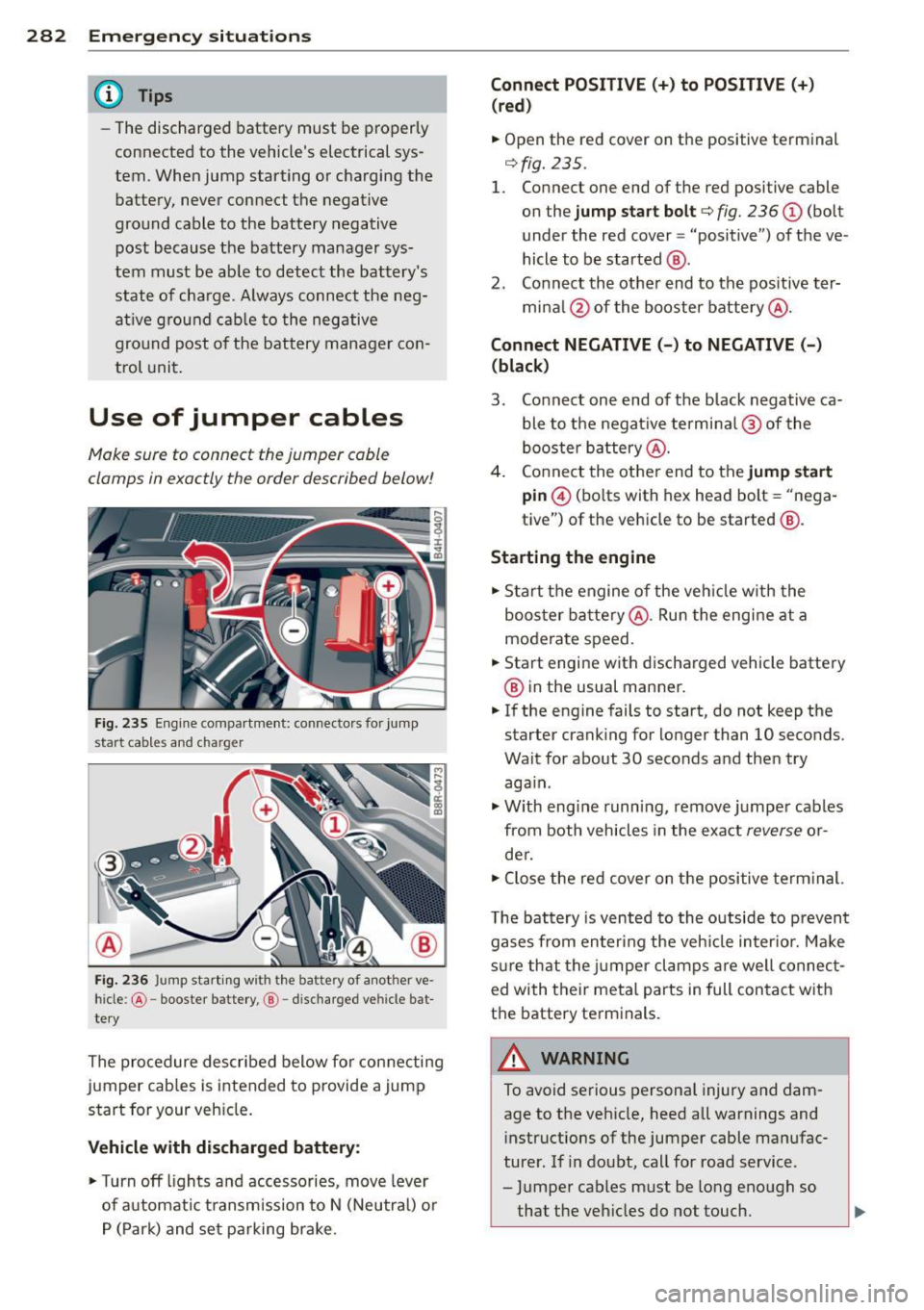
Fig . 235 Engine co mpartment: connecto rs fo r jump
star t cab les and c harg er
Fig. 236 Ju m p sta rt in g w it h the ba ttery of anot her ve
h icle :@ - booster battery, @-discharge d ve hicle bat
tery
The procedure described below for connecting
jumper cables is intended to provide a jump
start for your vehicle.
Vehicle with discharged battery:
•Turnoff lights and accessories, move lever
of automatic transmission to N (Neutral) or
P (Park) and set parking brake.
Connect POSITIVE(+) to POSITIVE(+)
(red)
• Open the red cover on the pos itive terminal
¢ fig. 235 .
1. Connect one end of the red positive cable
on the
jump start bolt¢ fig. 236@ (bolt
under the red cover = "positive ") of the ve
hicle to be started @.
2. Connect the other end to the positive ter-
mina l@ of the booster battery@.
Connect NEGATIVE (-) to NEGATIVE (-)
(black)
3. Connect one end of the black negative ca
ble to the negat ive terminal @ of the
booster battery @.
4. Connect the other end to the
jump start
pin © (bolts with hex head bolt= "nega
tive") of the vehicle to be started @.
Starting the engine
• Start the engine of the veh icle w ith the
booster battery@. Run the engine at a
moderate speed.
• Start engine with discharged vehicle battery
@ in the usual manner.
• If the engine fails to start, do not keep the
starter cranking for longer than 10 seconds.
Wait for about 30 second s and then try
aga in.
• With engine running, remove jumper cables
from both vehicles in the exact
reverse o r
de r.
• Close the red cover on the positive term inal.
T he battery is vented to the outside to prevent
gases from entering the veh icle inter ior. Make
sure that the jumper clamps are well connect
ed with their metal parts in full contact with
the battery terminals.
_& WARNING
To avoid serious personal injury and dam
age to the vehicle, heed all warnings and
instructions of the jumper cable manufac
turer. If in doubt, call for road service.
- Jumper cables must be long enough so
that the veh icles do not touch.
-