brake AUDI A8 2015 Repair Manual
[x] Cancel search | Manufacturer: AUDI, Model Year: 2015, Model line: A8, Model: AUDI A8 2015Pages: 312, PDF Size: 79.18 MB
Page 249 of 312
,....,
N ,....,
N
0 J:
'SI: ,...., \!) 1.1"1 ,...., 1.1"1 ,....,
Tires and wheels 24 7
Gross Vehicle Weight Rating ("GVWR") Ply
means the maximum total loaded weight of
the vehicle .
Groove
means the space between two adjacent tread
ri bs.
Load rating (code)
means the maximum load that a tire is rated
to carry for a given inflat ion pressure . You
may not find this informat ion on all tires be
cause it is not requ ired by law.
Maximum load rating
means the load rating for a t ire at the max i
mum permissible inflation pressure for that
tire .
Maximum loaded vehicle weight
means the sum of:
(a) Curb weight
(b) Accesso ry weight
(c) Vehicle capacity weight, and
(d) Production opt ions we ight
Maximum (permissible) inflation pressure
means the maximum co ld inf lation pressure
to which a tire may be inflated . Also called
"maximum inflation press ure."
Normal occupant weight
means 150 lbs . (68 kilograms) times the
number of occupants seated in the vehicle up
to the tota l seating capacity of your vehicle.
Occupant distribution
means distribution of occupants in a veh icle.
Outer diameter
means the overall diameter of an inflated new
tire .
Overall width
means the linear distance between the exteri
ors of the sidewalls of an inflated tire, includ
ing e levations due to labeling, decorations, or
protective bands or ribs. means a layer of
rubber-coated parallel cords.
Production options weight
means the combined weight of those installed
regular production opt ions we ighing over 5
lbs. (2.3 kg) in excess of those standa rd items
which they replace, not previously considered
in curb weight or accessory weight, including
heavy duty brakes, ride levelers, roof rack,
heavy duty battery, and spec ial trim.
Radial ply tire
means a pneumatic tire in which the ply cords
that extend to the beads are laid at substan
tially 90 degrees to the centerline of the
tread.
Recommended inflation pressure
see ~ page 246, Cold tire inflation pressure .
Reinforced tire
means a tire design to operate at higher loads
and at higher inflation pressures than t he cor
responding standard tire. Reinforced tires
may be identified as "XL", "xl", "EXTRA LOAD",
or "RF" on the sidewal l.
Rim
means a metal support for a tire or a t ire and
tube assembly upo n which the tire beads are
seated .
Rim diamete r
means nominal diameter of the bead seat. If
you change your wheel s ize, you wi ll have to
purchase new tires to match the new r im di
ameter .
Rim size designation
means rim diameter and width.
Rim width
means nominal distance between rim flanges.
Sidewall
means that portion of a t ire between the
tread and bead .
•
•
Page 256 of 312
254 Tires and wheels
A WARNING
Overloading a vehicle can cause loss of ve
hicle control, a crash or other accident, se
rious personal injury, and even death.
- Carrying more weight than your vehicle
was designed to carry will prevent the
vehicle from handling properly and in crease the risk of the loss of vehicle con
trol.
- The brakes on a vehicle that has been
overloaded may not be able to stop the
vehicle within a safe distance.
- Tires on a vehicle that has been overload
ed can fail suddenly, including a blowout
and sudden deflation, causing loss of
control and a crash.
- Always make sure that the total load be
ing transported -including the weight of
a trailer hitch and the tongue weight of a
loaded trailer -does not make the vehi
cle heavier than the vehicle's Gross Vehi
cle Weight Rating.
Determining correct load limit
Use the example below to cal
culate the total weight of the
passengers and luggage or oth
er things that you plan to trans
port so that you can make sure
that your vehicle will not be
overloaded.
Steps for Determining
Correct Load Limit
1. Locate the statement "THE
COMBINED WEIGHT OF OC
CUPANTS AND CARGO
SHOULD NEVER EXCEED XXX
KG OR XXX LBS" on your ve
hicle's placard (tire inflation pressure label)
¢ page 249,
fig. 208.
2.
Determine the combined
weight of the driver and pas
sengers that will be riding in
your vehicle.
3. Subtract the combined weight of the driver and pas
sengers from
"XXX" kilo
grams or
"XXX" pounds
shown on the sticker
c> page 249, fig. 208.
4. The resulting figure equals
the available amount of car
go and luggage load capaci
ty. For example, if the
"XXX"
amount equals 1400 lbs.
and there will be five 150
lbs. passengers in your vehi
cle, the amount of available
cargo and luggage load ca
pacity is 650 lbs. (1400-7 SO
(5
X 150) = 650 lbs.)
5. Determine the combined weight of luggage and cargo
being loaded on the vehicle.
That weight may not safely
exceed the available cargo
and luggage load capacity
calculated in Step 4.
6. If your vehicle will be towing
a trailer, load from your trail
er will be transferred to your .,.
Page 258 of 312

256 Tires and wheels
Incorrect wheel alignment
Incorrect wheel alignment can cause exces
sive tire wear, impairing the safety of the vehi
cle. If tires show excessive wear, have the
wheel alignment checked by an authorized
Audi dealer or qualified workshop.
All Wheel Drive
Vehicles with quattro must always have tires
of the same size, construction and tread type.
For details see Qpage 202 .
.&_ WARNING
Sudden tire failure can lead to loss of con
trol, a crash and serious personal injury!
- Never drive a vehicle when the tread on
any tire is worn down to the wear indica
tors.
- Worn tires are a safety hazard, they do
not grip well on wet roads and increase
your risk of"hydroplaning" and loss of
control.
- Always keep chemicals that can cause
tire damage, such as grease, oil, gasoline
and brake fluid away from tires.
- Tires age even if they are not being used
and can fail suddenly, especially at high
speeds. Tires that are more than 6 years
old can only be used in an emergency
and then with special care and at lower speeds.
- Never mount used tires on your vehicle if
you are not sure of their "previous histo
ry." Old used tires may have been dam
aged even though the damage cannot be
seen that can lead to sudden tire failure
and loss of vehicle control.
New tires and replacing tires and wheels
New tires and wheels have to be broken in .
Fig. 212 Tir e specificat ion codes on the s idewall of a
t ire
No. Description
® Ratio of height to width (aspect ratio)
© Radial
® Rim diameter code
® Load index and speed rating
(J) U.S . DOT tire identification number
® Audi Original tire
® Sever snow conditions
@ Tire ply composition and materials
used
@ Maximum load rating
@ Treadwear, traction and temperature
grades
@ Maximum permissible inflation pres-
sure
The tires and rims are essential parts of the
vehicle's design . The tires and rims approved
by Audi are specially matched to the charac
teristics of the vehicle and can make a major .,..
Page 261 of 312

,....,
N ,....,
N
0 J:
'SI: ,...., \!) 1.1"1 ,...., 1.1"1 ,....,
Driving with different tires reduces vehi
cle handling and can lead to a loss of
control.
- If the spare tire is not the same as the
tires that are mounted on the vehicle -
for example with winter tires -only use
the spare tire for a short period of time and drive with extra care. Refit the nor
mal road wheel as soon as safely possi
ble.
- Never drive faster than the maximum
speed for which the tires on your vehicle
are rated because tires that are driven
faster than their rated speed can fail
suddenly.
- Overloading tires cause heat build-up,
sudden tire failure, including a blowout
and sudden deflation and loss of control.
- Temperature grades apply to tires that
are properly inflated and not over or un
deri nflated.
- For technical reasons it is not always
possible to use wheels from other
vehicles -in some cases not even wheels
from the same vehicle model.
- If you install wheel trim discs on the ve
hicle wheels, make sure that the air flow
to the brakes is not blocked. Reduced air
flow to the brakes can them to overheat, increasing stopping distances and caus
ing a collision.
- Run flat tires may only be used on
vehicles that were equipped with them at the factory . The vehicle must have a
chassis designed for run flat tires. Incor
rect use of run flat tires can lead to vehi
cle damage or accidents. Check with an
authorized Audi dealer or tire specialist
to see if your vehicle can be equipped
with run flat tires. If run flat tires are used, they must be installed on all four
wheels. Mixing tire types is not permit
ted.
(D Note
- For technical reasons, it is not generally
possible to use the wheel rims from oth-
Tires and wheels 259
er vehicles. This can hold true for wheels
of the same vehicle type.
- If the spare tire is different from the
tires that you have mounted on your ve
hicle (for example winter tires or wide
profile tires), then use the spare tire for a
short period of time only and drive with
extra care. Replace the flat tire with the
tire matching the others on your vehicle
as soon as possible.
- Never drive without the valve stem cap .
The valves could get damaged .
(® For the sake of the environment
Dispose of old tires in accordance with the
local requirements.
Uniform tire quality grading
-Tread wear
- Tract ion AA A B C
- Temperature AB C
Quality grades can be found where applicable
on the tire side wall between tread shoulder
and maximum section width
c;, page 256,
fig. 212.
For example: Tread wear 200, Traction AA,
Temperature A.
All passenger car tires must conform to Feder
al Safety Requirements in addition to these
grades.
Tread wear
The tread wear grade is a comparative rating
based on the wear rate of the tire when tested
under controlled conditions on a specified
government test course.
For example, a tire graded ISO would wear
one and one half (11/2) times as well on the
government course as a tire graded 100.
The relative performance of tires depends upon the actual conditions of their use, how
ever, and may depart significantly from the
norm due to variations in driving habits, serv
ice practices and differences in road character-
istics and climate.
ll-
•
•
Page 264 of 312
26 2 T ire s and wheel s
chains because the vehicle will be ex
tremely low. If you do drive with snow
chains on while the vehicle is at this lev
el, the snow chains might severe ly dam
age the wheelhouse and other parts of
the veh icle.
(D} Tips
Where snow chains are mandatory oncer
tain roads, this normally also applies to
veh icles with All Wheel Drive.
Wheel bolts
Wheel bolts must always be tightened to the
correct torque .
The design of whee l bolts is matched to the
factory installed r ims. If different rims
are fit
ted, the correct wheel bolts with the right length and correctly shaped bolt heads must
be used. This ensures that wheels are fitted
secure ly and that the brake system functions
correctly .
In certain circumstances, you may not use
wheel bolts from a different vehicle -even if it
is the same mode l
¢page 292.
_& WARNING
Imprope rly tig htened o r maintained whee l
bolts can be come loose ca using loss of
contro l, a co llision and serious persona l in
jury.
- Always keep the wheel bol ts and the
threads in the wheel hubs clean so the
wheel bolts can tu rn easily and be prop
er ly tightened .
- Never grease or oil the wheel bo lts and
the threads in the wheel h ubs. They can
become loose w hile driving if greased or
oiled, even if tightened to the specif ied
torque.
- Only use wheel bolts that belong to the rim being installed.
- Never use different whee ls bolts on your
vehicle.
- Always maintain the correct tighten ing
torq ue for the wheel bo lts to reduce the risk of a whee
l loss. If the tightening tor
que of the wheel bolts is too low, they
can loosen and come out when the vehi
cle is mov ing. If the tighte ning torque is
too high, the wheel bolts a nd threads
can be damaged and the whee l can be
come loose.
([) Note
The specified torque for the whee l bolts is
90 ft lb (120 Nm) with a tolerance of± 7,4
ft lb(± 10 Nm). Torque whee l bolts diago
nally. Afte r changing a whee l, the torque
must be checked as soon as possible wi th a
torque wrench -pre ferably by an au thor
ized Audi dealer or qualified workshop .
Low aspect ratio tires
Your Audi is factory-equipped with low aspect
ratio tires. These tires have been thoro ughly
tested and been se lected specifically for your
model for their superb performance, road fee l
and hand ling u nder a var iety of d riv ing condi
t ions . As k your author ized Audi dealer for
more details.
The low aspect ratio of these tires is ind icated
by a numeral of
55 or less in the tire's s ize
designation . The numeral rep resents the ratio
of the t ire's s idewa ll height in relation to its
t read width ex pressed in percentage. Conven
tiona l tires have a he igh t/w idth rat io of 60 or
more.
The performanc e of low -a sp ec t-ratio tires i s
pa rticularly sensitive to improper inflation
pre ssure . It is therefore important that low
a spect ratio tires are inflated to the specified
pre ssure and th at the inflation pressure i s
regularly checked and maintained. Tire pre s
s u res should be checked at least once a
month and always befo re a long trip
¢ page 251, Checking tire pressure .
What you can do to avoid tire and rim
damage
Low aspect ratio tires can be damaged more
easily by impact w ith potholes, curbs, gull ies .,..
Page 271 of 312

.... N .... N
0 J:
-
"' ....
Spare wheel
Applies to vehicles: with spare wheel
The spare wheel is stored in the wheel well
underneath the floor panel in the luggage
compartment.
F ig. 220 Luggag e co mpartm ent : spar e wh eel
Taking out the sp are whee l
• Lift the cargo floor by the plast ic handle
c:::>fig . 220.
• Hook the hand le into the luggage compart
ment weather strip .
• Turn the large screw
c:::> fig. 220 counter
clockwise.
• Takeout the spare tire.
• Always store the vehicle tool kit , the jack*
and the replaced tire in the luggage com
partment
c:::> page 139 .
• Unhook the ca rgo floor before closing the
rear lid.
& WARNING
-
Loose items in the passenger compart
ment can cause serious pe rsonal in jury
during hard braking or in an accident.
- Never store the spare wheel or jack and
tools in the passenger compartment.
@ Tips
Check the inflat ion p ressu re of the spare
tire periodically to keep the tire ready for
use.
What do I d o now ? 269
Changing a wheel
Before changing a wheel
Observe the following precautions for your
own and your passenger's safety when chang
ing a wheel.
• After you experience a t ire failure, pull the
car well away from moving traffic and try to
reach
leve l ground before you stop c:::> ,&.
• All passengers should le av e t he ca r and
move to a safe location (for ins tance, behind
t he guardra il)
c:::> ,& .
• Engage the parki ng br ake to prevent your
vehicle from rolling unintentionally
c:::> ,& .
• Move sele ctor lever to po sit ion P c:::> ,&. .
• If you are towing a trailer, unhitch the trailer
from your ve hicle.
• Take the
jac k and the sp are tire out of the
luggage compartment
c:::> page 267,
c:::> page 268 .
& WARNING
You o r you r passengers could be i njured
while changing a wheel if you do not fo l
low these safety precaut ions:
-I f you have a flat tire, move a safe d is
tance off the road. Turn off the engine,
turn the eme rgency flashers on and use
other warning devices to a lert other mo
torists .
- Make sure that passengers wait in a safe
place away from the vehicle and well
away from the road and traffic.
- To help prevent the vehicle from moving
suddenly and possibly slipping off the
jack, always f ully set the parking brake
and b lock the wheel d iagonally opposite
the wheel be ing changed. When one
front wheel is lifted off the ground, plac ing the Automatic Transmission in "P"
(Par k) will
not prevent the vehicle from
mov ing .
- Before you change a wheel, be sure the
ground is level and firm. If necessary,
use a sturdy board under the jac k.
-
Page 274 of 312

272 What do I do now?
hold on to the car to keep your balance
and take care not to slip.
AB: Raising the vehicle
The vehicle must be lifted with the jack first
before the wheel can be removed.
Fig. 224 Sill pa nels : m ark ings
Fig. 225 Sill: position ing t he veh icle jack
.. Activate the vehicle jack mode in the MMI:
I CAR ! function button > Car systems control
button>
Servicing & checks> Air susp.:
jack mode
> On.
.. Engage the parking brake to prevent your
vehicle from rolling unintentionally.
.. Move the
selector lever to position P .
.. Find the marking (imprint) on the sill that is
nearest the wheel that will be changed
o
fig. 224. Behind the marking, there is a
lifting point on the sill for the vehicle jack.
.. Turn the
vehicle jack located under the lift
ing point on the sill to raise the jack until its
arm @o
fig. 225 is located under the des
ignated plastic mount o ,& o0 .
.. Align the jack so that its arm @ o
fig. 225
engages in the designated lifting point in
the door sill and the movable base @ lies
flat on the ground. The base @ must be
ver
tical
under the lifting point @. ..
Wind the jack up further until the flat tire
comes off the ground o
.&,.
Position the vehicle jack only under the desig
nated lifting points on the sill
c:> fig. 224.
There is exactly one location for each wheel.
The jack must not be positioned at any other
location
c:> .&, c:>Q).
An unstable surface under the jack can cause
the vehicle to slip off the jack. Always provide
a firm base for the jack on the ground. If nec
essary place a sturdy board or similar support
under the jack. On
hard, slippery surfaces
(such as tiles) use a rubber mat or similar to
prevent the jack from slipping
c:> .&,.
A WARNING ~
-You or your passengers could be injured
while changing a wheel if you do not fol
low these safety precautions:
- Position the vehicle jack only at the
designated lifting points and align the
jack. Otherwise, the vehicle jack could slip and cause an injury if it does not
have sufficient hold on the vehicle.
- A soft or unstable surface under the
jack may cause the vehicle to slip off
the jack . Always provide a firm base for
the jack on the ground. If necessary,
use a sturdy board under the jack.
- On hard, slippery surface (such as tiles)
use a rubber mat or similar to prevent
the jack from slipping.
- To help prevent injury to yourself and
your passengers:
- Do not raise the vehicle until you are
sure the jack is securely engaged.
- Passengers must not remain in the ve
hicle when it is jacked up.
- Make sure that passengers wait in a
safe place away from the vehicle and
well away from the road and traffic .
- Make sure jack position is correct, ad
just as necessary and then continue to
raise the jack.
- Changes in temperature or load can af
fect the height of the vehicle.
Page 275 of 312

.... N .... N
0 J:
'
"' ....
(D Note
Do not lift the vehicle by the sill. Position
the vehicle jack only at the designated lift
ing points on the sill. Otherwise, your vehi
cle will be damaged.
(D T ips
The vehicle jack mode switches off auto
matically at speeds above 10 km/h.
58: Raising the vehicle
The vehicle must be li~ed with the jack first
before the wheel can be removed.
Fig . 226 S ill pane ls: mark ings
F ig. 227 S ill: posit ion ing the veh icle jack
.. Activate the vehicle jack mode in the MMI:
I CAR I funct ion button > Car syste m s control
button
> Se rvi cing & check s> Air sus p.:
ja ck m ode
> On.
.,. Engage the par kin g brake to prevent your
vehicle from rolling un intentionally.
.. Move the
sel ec tor le ver to po sition P .
.. Find the ma rki ng (imprint) on the sill that is
nearest the wheel that w ill be changed
r=> fig . 226. Behind the marking, there is a
lifti ng po int on the si ll for the vehicle jack.
.. Turn the
ve hicle jack located under the lift
i ng point on the sill to raise the jack until its
What do I d o now ? 273
arm @r=> fig . 22 7 is located under the des
ignated plastic mount
r=> A. in AB: Raising
the vehicle on page 272i::>(f).
.. Align the jack so that its arm @c::> fig. 22 7
engages in the designated lifting point in
the door sill and the movable base @ lies
flat o n the ground. The base @ must be
ver
tical
under the lifting point @.
.. Wi nd the jack up fu rther until the flat t ire
comes off the ground
r=> &,. in AB: Raising
the vehicle on page 272.
Position the vehicle jack only under the desig
na ted lifting points on the s ill
c::>page 272,
fig. 224 .
There is exact ly one l ocation fo r each
whee l. The jack must not be positioned at any
other location c::>
.&. in AB: Raising the vehicle
on page 2 72r=>
(J).
An un sta ble surf ace unde r the jack can cause
the ve hicle to slip
off the jack . Always provide
a firm base for the jack on the gro und. If nec
essary place a sturdy board or simi lar support
under the jack. On
h ard , sl ipp ery surf aces
(such as tiles) use a rubber mat or similar to
prevent the jack from slipping c::>
,&. .
.&_ WARNING
-You or your passengers cou ld be injured
while changing a wheel if you do not fo l
low these safety p re cautions:
- Position the vehicle jack on ly at the
designated lifting points and align the
j ack. Otherw ise, the vehicle jack could
slip and cause an injury if it does not
have sufficient hold on the vehicle.
- A soft or unstable surface under the
j ack may cause the veh icle to slip off
the jack . Always provide a firm base for
the jack on the ground .
If necessary,
u se a st urdy board under the jack .
- On hard, slippery surface (such as t iles)
use a rubber mat or similar to prevent
the jack from slipping .
- To help pr event injury to yourself and
your passengers:
- Do not raise the vehicle until you are
sure the jack is securely engaged .
Page 279 of 312

.... N .... N
0 J:
'SI: .... \!) 1.1'1
.... 1.1'1 ,-0
Fuse pa nel @ (brown )
No . Equipment
1 Headlight contro l switch
2
Emergency start coil (key
i dentification)
3
Rear door control module
(driver's side)
4 Head-up Display
5 Horn
6 Inter ior lights (head liner)
Steering column lever, mul-
8
tifunction steering wheel
controls, steering wheel
heat ing
10
Electric steering co lumn
lock
11 D river door contro l modu le
12
D iagnostic connector, light/
rain sensor
14
Power steering col umn ad -
justment
15
Power steering, A/C com-
presse r
16 Brake booster
Fu se pa nel © (b la ck)
No . Equipment
1 Front seat heating
2 Windshield w iper
3 Front exterior lighting
4 Sun roof
5 Driver power window
6 Driver seat (pneumat ic)
7 Panoramic sunroof
8 Dynamic steering
9 Front exterior lighting
10 Windshield/headlight
wash-
er system
11
Rear power w indow (driver's
side)
12 Panoramic sunroof
Amps
5
5
7,5 5
15
7,5
10/5
5
7,5 10
25
20
15
Amps
30 30
30 20
30
7,5
20 35
30
35
30
40
Fu ses and bulb s 2 77
Front passenger side cockpit fuse
assignment
Fig . 233 Fro nt passe nger side cockpit: f use pane l with
plast ic brac ket
Fu se panel @ (bl ac k)
No. Equipment Amps
1 Anti-theft alarm system 5
2
Transmission control mod-
15
ule
3 Front climate control fan 40
4 Engine supply 35
6
Engine cont ro l modu le 5
7
Front passenger door con-
7,5 trol module
8
Front passenger power win-
30 dow
9 ESC contro l module
10
10
ESC contro l modu le 25
1 1
Right rear power window 30
1 2
Front passenger seat (pneu-
7,5 matics)
•
•
Page 280 of 312
2 78 Fuses and bulbs
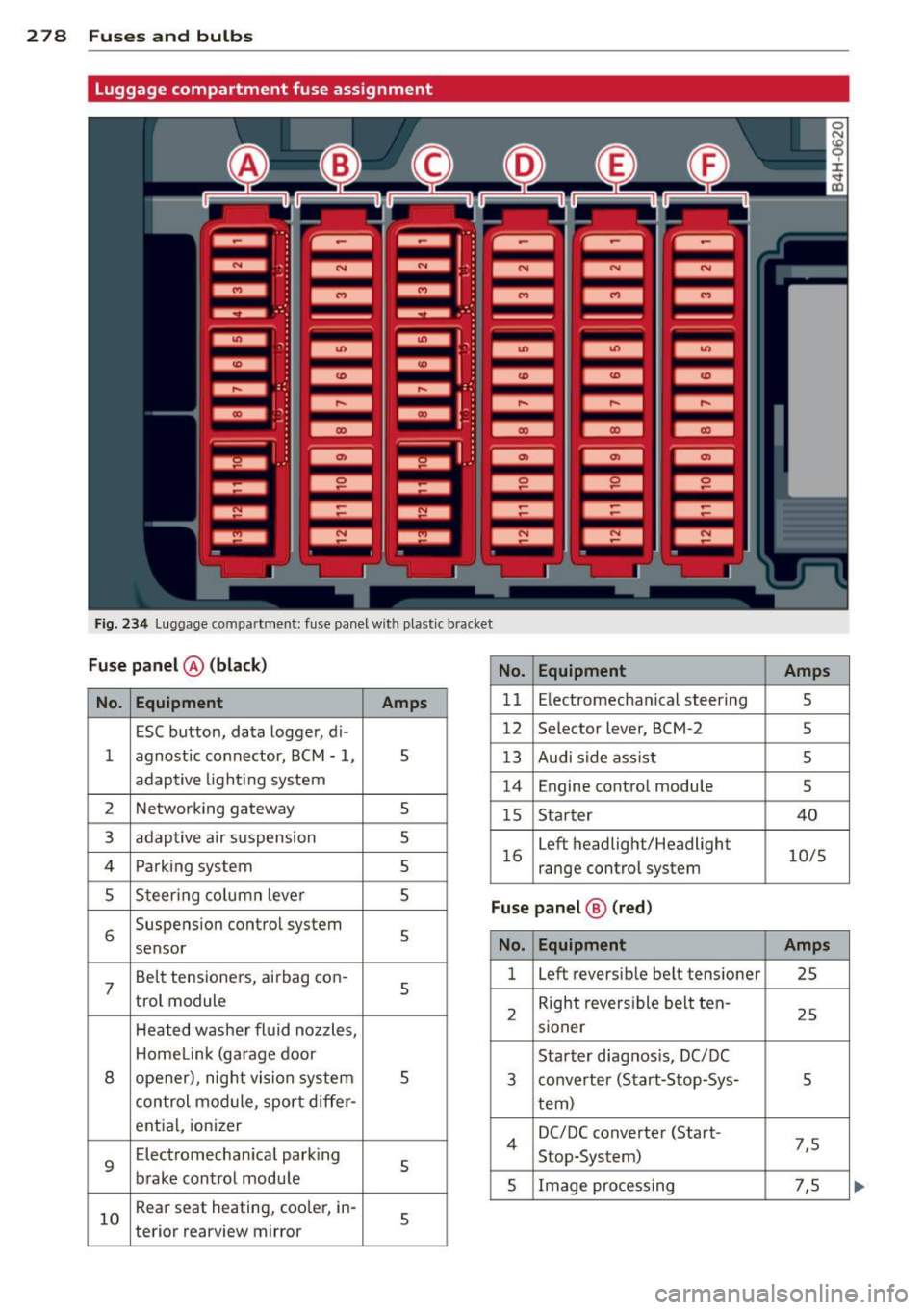
Luggage compartment fuse assignment
Fig. 234 Luggage compartment: fuse pa nel with plastic bracket
Fuse p ane l@ (black) No. Equipment Amps
No . Equ ipm ent Amps
11 E lectromechanical steering 5
ESC button, data logger, di· 12
Selector lever,
BCM-2
5
1 agnostic connector, BCM · 1, 5
13 Audi side ass ist 5
adaptive light ing system
14 Engine control module
5
2 Networking gateway
5
15 Starter 40
3 adaptive air suspension 5
4 Parking system
5 16 Left headlight/Headlight
10/5
range control system
5 Steering column lever
5
6 Suspension control system 5 sensor
Fu
se p an el@ (red )
No. Equipment Amps
7
Belt tensioners, airbag con-
5
trol module
Heated washer fluid nozzles, 1
Left reversible belt
tensioner
2S
2 Right reversible belt
ten-
25
sioner
H ome link (garage door
Starter diagnos is, DC/DC
8 opener), night vision system 5
3 converter (Start-Stop-Sys·
5
control module, sport differ- tern)
ential, ionizer
9
Electromechanical parking 5
brake control module 4
DC/DC converter (Start-
7,5 Stop-System)
5 Image processing
7,5
10 Rear
seat heating, cooler, in· 5 terior rearview mirror