cable AUDI A8 2016 Owner's Manual
[x] Cancel search | Manufacturer: AUDI, Model Year: 2016, Model line: A8, Model: AUDI A8 2016Pages: 302, PDF Size: 75.68 MB
Page 247 of 302
Wheels
check the wheel alignment if have approximately the same
there is unusual wear. length of service life.
-Have the wheels rebalanced if an
For unidirectional tires, make
imbalance is causing noticeable
sure the tires are installed accord-
vibration in the steering wheel. ing to the running direction indi-
If you do not, the tires and other cated on the tire sidewall
vehicle components could wear
¢ page 264.
more quickly.
Hidden damage
Treadwear indicator
Damage to tires and rims can of-
The original tires on your vehicle ten occur in locations that are
have 1/16 inch (1.6 mm) high hidden. Unusual vibrations in the
"wear indicators" ¢
fig. 206 run-
vehicle or pulling to one side may
ning across the tread . Marks on
indicate that there is tire damage.
the tire sidewall (for example Reduce your speed immediately.
"TWI" or other symbols) indicate
Check the tires for damage. If no
the positions of the tread wear in- damage is visible from the out-
dicators. side, drive slowly and carefully to
The tires have reached the mini- the nearest authorized Audi deal-
mum tread depth
l) when they er or authorized
repair facility to
have worn down to the treadwear have the vehicle inspected
.
indicators. Replace the tires with
_& WARNING
new ones ¢&. -
Tread that has worn too low or
Wheel rotation different tread depths on the
Rotating the wheels regularly is tires can reduce driving safety.
recommended to ensure the tires This
can especially have a nega-
wear evenly. To rotate wheels, in- tive effect on handling, on the
stall the wheels from the rear risk aquaplaning when driving
axle on the front axle and vice through water, when driving
versa. This will allow the tires to through curves and when
..
.... N ci :c ": .... l) Obey
any applicable regulations in your '° "? .... country. '° ....
245
Page 255 of 302
been damaged, replace the t ire as soon as
possible .
- T hese tires may wear more q uickly than others.
- Please a lso remembe r th at, while these tires
deliver responsive handling, they may r ide less
comfortab ly and make more noise than other
choices .
Reduc ed performance in wint er/ cold sea son
condit ions
All ti res are designed fo r ce rtain purposes. The
l ow aspect ratio, ultra high performance tires
originally insta lled on your vehicle are intended
for maximum dry and wet road performance and handling . They are not suitable for cold, snowy or
i cy weather cond it ions. If you dr ive under those
circumstances, you should equ ip your vehicle
with a ll-season or winter tires, wh ich offer better
traction under those condit ions. We suggest you
use the recommended snow or all-season tires
specified for yo ur vehicle, or the ir eq uivalent.
Refer to
c::;, page 251 for more detai led informa
tion rega rding winter tires.
Uniform tire quality grading
- T read wear
- T raction AA A B C
- Temperature ABC
Quality grades can be found where applicable on
the tire side wall between tread shoulder and maximum sect ion w idth
c::> page 236, fig . 205.
For e xample: Tread wear 200 , Traction AA , Tem
perature A.
All passenger car tires m ust conform to Federa l
Safety Requirements in addition to these grades .
Tread wea r
The
tread wear grade is a comparat ive rating
based on the wear rate of the t ire when tes ted
under cont ro lled conditions on a specified gov
ernment test course.
F or examp le, a t ire graded
150 would wear one
and one h alf
(1 1/2) times as well on the govern
ment course as a tire g raded
100 .
Wh eel s
The re lat ive pe rformance of tires depends upon
the actual cond itions of their use, however, and
may depart significantly from the norm due to
variations in driv ing habits, service practices and
differences in road character istics and cl imate.
T raction
The
traction grades, from highest to lowest, are
AA, A, Band
C. Those grades rep resent the tire's
ability to stop on wet pavement as measured un
der controlled cond itions on specified govern
ment test surfaces of asphalt and concrete. A tire
marked C may have poor traction performance
c::;, .&_ .
Te mperature
The
temperature grades are A (the highest), B,
and C, representing the tire 's resistance to the
generat ion of heat and its ability to dissipate
heat when tested under controlled conditions on
a specified indoor laboratory test wheel.
Sustained h igh temperature can cause the mate
rial of the tire to degenerate and reduce tire life,
and excessive temperature can lead to sudden
tire failure c::;, .&. .
The grade C corresponds to a level of perform
ance which all passenger car tires must meet un
der the Federal Motor Vehicle Safety Standard
No.
109 . Grades Band A represent higher levels
of pe rformance on the laboratory test wheel than
the minim um req uir ed by law.
A WARNING
-
The t ract io n grade assigned to this t ire is
based on straight -ahead braking traction
tests, and does not include acceleration, co r
nering, hydroplaning or peak traction charac
terist ics.
A WARNING
-The temperature grade for this tire is estab
lished for a tire that is properly inflated and
not overloaded. Excessive speed, underinfla
tion, or excessive loading, either separately or
i n comb inat ion, can cause heat bu ildup and
-
possib le tire fai lure. ~
253
Page 273 of 302
Emergency situations
General
This chapter is intended for trained emergency
crews and working personnel who have the nec
essary tools and equipment to perform these
ope rations.
Starting by pushing or
towing
(D Note
Veh icles with an automatic transmission can
not be started by pushing or towing.
Starting with jumper
cables
If necessary, the engine can be started by con
necting it to the battery of another vehicle .
If the engine shou ld fail to start because of a dis
charged or weak battery, the battery can be con
nected to the battery of
another vehicle, using a
pair of jumpe r cables to start the engine.
Jumper cables
Use only jumper cables of suffic iently large cross
section
to carry the starter current safely. Refer
to the manufacturer's specifications.
Use only jumper cables with
insulated term inal
clamps which are dis tinct ly marked :
plus(+) cable in most cases colored re d
minus( -) cable
in most cases colored blac k.
A WARNING
Batteries contain electricity, acid, and gas.
Any of these can cause very serious or fatal in
jury. Follow the instructions below for safe
handling of your vehicle's battery.
- Always shield your eyes and avo id leaning
over the battery whenever poss ible.
- A discharged battery can freeze at tempera
tures just below 32 °F (0 °C) . Before con
necting a jumper cable, you must thaw the
Emergency situations
frozen battery completely, otherwise it
could explode .
- Do not allow battery acid to contact eyes or
skin. Flush any contacted area with water immediately.
- Improper use of a booster battery to start a
vehicle may cause an exp losion.
- Vehicle batteries generate exp losive gases.
Keep sparks, flame and lighted cigarettes
away from batteries.
- Do not try to jump start any vehicle with a
low acid level in the battery .
- The vo ltage of the booster battery must also
have a 12-Volt rating. The capacity (Ah) of
the booster battery should not be lower
than that of the discharged battery. Use of
batter ies of different voltage or substantial
ly different "Ah" rating may cause an exp lo
sion and personal injury .
- Never charge a frozen battery. Gas trapped
in the ice may cause an explosion.
- Never charge or use a battery that has been
frozen . The battery case may have be weak
ened .
- Use of batter ies of different voltage or sub
stantially different capacity (Ah) rating may
cause an exp losion and injury. The capac ity
(Ah) of the booster battery should not be
lowe r than that of the discharged battery.
- Before you check anything in the eng ine
compartment, always read and heed all
WARNINGS
r::!)page 220.
(D Note
-Applying a higher voltage booster battery
will cause expensive damage to sensitive
electronic components, such as control
units, relays, radio, etc.
- Th ere must be no electrical contact between
the vehicles as otherwise current could al
ready start to flow as soon as the positive
(+) terminals are connected.
(D Tips
- The discharged battery must be properly
connected to the vehicle's e lectrica l system. ..,.
271
Page 274 of 302
Emergency situations
When jump starting or charging the bat
tery, never connect the negative ground ca
ble to the battery negative post because the
battery manager system must be able to de
tect the battery's state of charge. Always
connect the negative ground cable to the
negative ground post of the battery manag
er contro l unit.
Use of jumper cables
Make sure to connect the jumper cable clamps in
exactly the order described below!
F ig . 230 Engine compar tment: connectors for jump start
cables and cha rger
F ig. 231 Jump starti ng wit h the battery of another veh icle:
@ -boos ter battery, @-disc harged vehicle battery
The procedure described be low for connecting
jumper cables is intended to provide a jump start for your vehicle.
Vehicle with discharged battery:
• Turn off lights and accessories, move leve r of
automatic transmission to N (Neutral) or P
(Park) and set parking brake.
Connect POSITIVE (+) to POSITIVE (+) ( red)
• Open the red cover on the positive term inal
¢ fig. 230.
272
1. Connect one end of the red positive cable on
the
jump start bolt 9 fig. 231 (D (bolt under
the red cover= "positive") of the veh icle to be
started @.
2. Connect the other end to the positive termi-
nal @ of the booster battery @.
Connect NEGATIVE (- ) to NEGATIVE(-)
(black)
3. Connect one end of the black negative cable
to the negative term inal @ of the booster
battery @.
4. Connect the other end to the
jump start pin
@ (bolts with hex head bolt= "negative") of
the vehicle to be started ®·
Starting the engine
• Start the eng ine of the vehicle with the booster
battery @. Run the eng ine at a moderate
speed.
• Sta rt engine w ith discharged vehicle ba ttery @
in the usual manner.
• If the engine fails to start, do not keep the
starter cranking for longer than 10 seconds.
Wait for about 30 seconds and then try again.
• With engine running, remove jumper cables
from both vehicles in the exact
reverse order.
• Close the red cover on the positive terminal.
The battery is vented to the outside to prevent
gases from entering the vehicle interior . Make
sure that the jumper clamps are well connected
with their metal parts in full contact with the battery terminals.
&_ WARNING
To avoid ser ious personal injury and damage
to the vehicle, heed all warnings and instruc
tions of the jumper cable manufacturer. If in
doubt, call for road service.
- Jumper cables must be long enough so that
the vehicles do not touch .
- When connecting jumper cables, make sure
that they cannot get caug ht in any moving
parts in the engine compartment.
- Before you check anything in the engine
compartment, always read and heed all
WARNINGS
¢ page 220.
Page 275 of 302
(D Note
Im pro per hook-u p of jum per cables can ru in
the gene ra tor.
- Always connect P OSITI VE( +) to POS ITI VE
( + ), and NEGATIVE( -) to NEGATIVE( -)
ground post of t he battery manager contro l
u nit .
- Check that a ll sc rew p lugs on the battery
ce lls a re sc rewed in firmly . If not, t igh ten
pl ugs p rio r to connecting clamp on negative
batte ry te rminal.
- Please note t hat the procedure fo r con nect
i ng a jumper cab le as desc ribe d above ap
p lies specifica lly to the case of yo ur vehicle
being jump s tarte d. W hen you are giv ing a
ju mp s ta rt to an othe r vehicl e, do
not con
n ect t he nega tive (- ) ca b le t o t he nega tive
(-) t ermin al on the di scharged battery @
c> fig . 23 1. Instead, securely connec t the
negative (-) cable to either a solid metal
com ponent that is f irm ly bolted t o the e n
gine block o r to t he engine bloc k itsel f. If
the batt ery that is be ing c ha rge d d oes not
vent to the outs ide, escap ing batte ry gas
could ignite and e xplode!
Towing with a tow truck
General hints
Your Audi require s speci al handling f or towing.
Th e follow ing informat ion is to be used by com
mercia l tow tr uck o pera tors who know how to op
e rat e the ir equip men t sa fely.
- Never tow your Audi. Towing will cause dam
age to the engine and transmission .
- Never wrap the safety chains or winch cables
around the brake lines.
- To prevent unnecessary damage, your Audi
must be transported with a flat bed truck.
- To load the vehicle on to the flat bed, use the
towing loop found in the vehicle tools and at
tach to the front or rear anchorage
¢page273 and ¢pag e 274 .
Emergency situations
A WARNING
-A ve hicle being towe d is not safe for passen-
ge rs. Neve r allow a nyo ne to ride in a vehicle
b eing towed, for any reason.
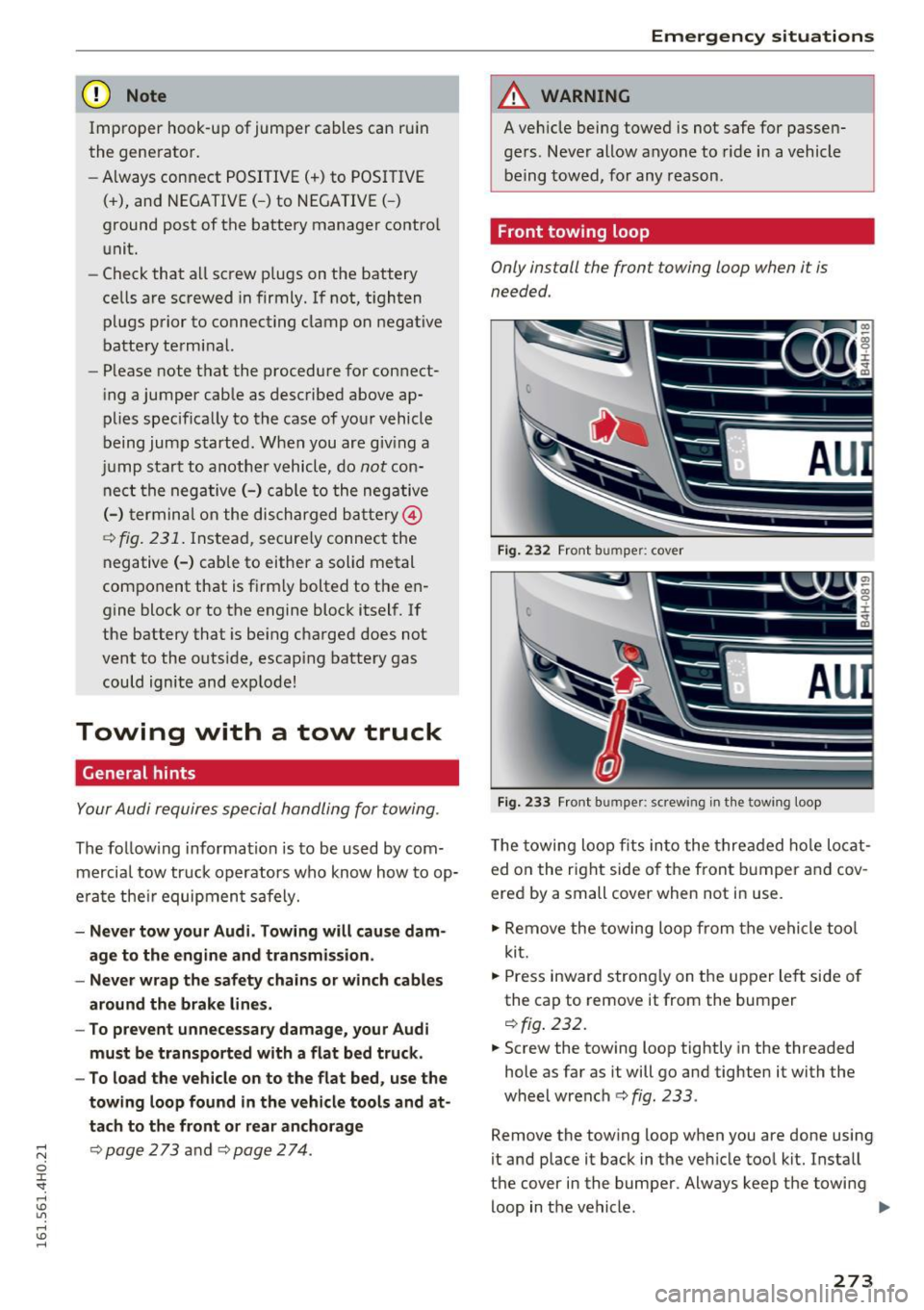
Front towing loop
Only install the front towing loop when it is
needed .
Fig. 232 Front bumper: cover
Fig. 233 Front bumper: screwing in th e towing loo p
The towing loo p fits in to the thre aded hole locat
ed o n the r ig ht side o f the fron t bumper a nd cov
ered by a small cover when not in use.
" Re move the towing loo p from the vehi cle too l
ki t.
" Press inward s tron gly on the up per left si de of
the cap to remove it from the bum per
¢ fig . 232.
" Screw the towing loop tightly in the threaded
hole as far as it will go and tighten it with the
wheel wrench
<=> fig . 233.
Remove the towing loop when you are done using
it and place it back in the ve hicle too l kit. Insta ll
the cover in the bumper . Always keep the towing
loop in the vehicle . ..,.
273
Page 279 of 302

Technical data
Vehicle identification
F ig. 239 Vehi cle Ident if ication N umber (VlN) plate : loca·
tion on dr iver 's side dash pane l
XXXXX XX -X -XX XX X XX XX
CD+ ~t :1 :: xxxxxxxx xx x x x xxx xxx
TVP /fffl XXX XXX
XX XXXXXXX XX X X XX
XXX
KW XXX
®i ~:J ·f lfils~~ XXXX XXX XXX
®-+ ~N:a=i~l xxxx ; xxxx xx x ; xx
11. • AUSS, I OPTIONS
E0 A
7D 5 4UB 6
XM 5SG 5R W
2E H
J0Z lL B l
A S lB A
3FC SM U 7Xl
F 0 A 9G3 0G7 0YH 0JF
TL 6 3KA 8EH UlA X 98 Q Z7
lXW 803 908 824 020
7T6 C V7 7 K0 4 X3 2 K2
3L4
4KC 3Y0 413 502
lSA 7GB 01 A 4G0
XX . X XX X XX X xxxx
Fig. 240 The vehicle identificat ion label- inside the lug
gage compartment
Veh icle Identification Number (VlN )
The Vehicle Identification Number is located in
different p laces:
- under the windshield on the driver's side
¢fig. 239.
-in the MMI: Select: Function button ICAR I > Car
systems > Servicing
& checks > VIN number .
~ -on the vehicle identification label.
0 J:
"". rl I.Cl U"I
rl I.Cl rl
Technical data
Vehicle identification label
The veh icle identification label is located in the
luggage compartment in the spare wheel we ll.
T he label¢
fig. 240 shows the following vehicle
data:
(D Vehicle Identification Number (VIN)
@ Vehicle type, eng ine output, transm ission
@ Engine and transmission code
@ Paint number and interior
® Optional equipment numbers
T he information of the veh icle identification label
can also be found in your Warranty
& Mainte
nance booklet.
Safety compliance sticker
The safety compliance sticker is your assurance
that your new vehicle complies w ith all applicable
Federal Motor Vehicle Safety Standards which
were in effect at the time the vehicle was manu
factured. You can find this sticker on the door
jamb on the driver's side. It shows the month and
year of production and the vehicle identification number of your vehicle (perforation) as well as
the Gross Vehicle Weight Rating (GVWR) and the Gross Axle Weight Rating (GAWR).
H igh voltage warning label
The high voltage warning label is located in the
engine compartment next to the engine hood re
lease. The spark ignition system complies with
the Canadian standard ICES-002.
Weights
Gross Vehicle Weight Rating
The Gross Vehicle Weight Rating (GVWR), and
the Gross Axle Weight Rating (GAWR) for front
and rear are listed on a sticker on the door jamb
on the driver 's side.
The Gross Vehicle Weight Rating includes the
weight of the basic vehicle plus full fuel tank, oil
and coolant, plus maximum load, which includes
passenger weight (150 lbs/68 kg per designated
seating position) and luggage weight
c:> .&, . .,.
277
Page 285 of 302

@ For the sake of the environment
-Changing the engine settings will adversely
affect emission levels. This is detrimental to
the environment and increases fuel con
sumption.
- Always observe environmental regulations
when disposing of old engine oil, used brake
fluid, dirty engine coolant, spent batteries
or worn out tires .
- Undeployed airbag modules and pretension
ers might be classified as Perchlorate Mate
rial -special handling may apply, see
www .dtsc.ca.gov/hazardouswaste/perchlo
rate . When the vehicle or parts of the re
straint system including airbag modules
safety belts with pretensioners are scrap
ped, all applicable laws and regulations
must be observed. Your authorized Audi
dealer is familiar with these requirements
and we recommend that you have your deal er perform this service for you.
Accessories and
technical changes
Additional accessories and parts replacement
Always consult an authori zed Audi dealer before
purchasing accessories.
Your vehicle incorporates the latest safety design
features ensuring a high standard of active and passive safety.
Th is safety could be compromised by non-ap
proved changes to the vehicle. For this reason, if
parts have to be replaced, please observe the fol
lowing points when installing additional accesso
ries :
Approved Audi accessories and genuine Audi parts are available from authorized Audi dealers.
These dealers also have the necessary facilities, tools and trained specialists to install the parts
,..., and accessories properly .
N
0 J:
'SI: ....
A WARNING
Using the wrong spare parts or using non-ap
proved accessories can cause damage to the
vehicle and serious personal injury.
- Use only accessories expressly approved by
Audi and genuine Audi spare parts
- These parts and accessories have been spe
cially designed to be used on your vehicle.
- Never install accessories such as telephone
cradles or beverage holders on airbag covers
or within the airbag deployment zones . Do
ing so will increase the risk of injury if air
bags are triggered in an accident!
- Before you check anything in the engine
compartment, always read and heed all
WARNINGS ~ page 220.
(D Note
-If items other than genuine Audi spare
parts, add-on equipment and accessory
items are used or if repair work is not per
formed according to specified methods, this
can result in severe damage to your vehi
cle's engine and body (such as corrosion)
and adversely affect your vehicle's warranty.
- The innovative aluminium concept of your
Audi AB means that all servicing, repairs or
other work on the vehicle body must be car
ried out exclusively by an Audi workshop.
- If emergency repairs must be performed
elsewhere, have the vehicle examined by an
authorized Audi dealer as soon as possible.
- The manufacturer cannot be held liable for
damage which occurs due to failure to com
ply with these stipulations.
Technical Modifications
Our guidelines must be complied with when tech
nical modifications are made.
Always consult an authorized Audi dealer
before
starting work on any modifications.
This will help ensure that vehicle function, per-
formance and safety are not impaired ~,& . .,.
283
Page 291 of 302

Starting . . . . . . . . . . . . . . . . . . . . . . . . . . . . 81
Starting with jumper cables . . . . . . . . . . . 271
Stopping . . . . . . . . . . . . . . . . . . . . . . . . . . . . 81
E ng ine compartment . . . . . . . . . . . . . . . . . . 222
C losing the hood . . . . . . . . . . . . . . . . . . . . 221
Opening the hood . . . . . . . . . . . . . . . . . . . 220
Safety instructions . . . . . . . . . . . . . . . . . . . 220
Working in the engine compartment . . . . 220
E ng ine coolant . . . . . . . . . . . . . . . . . . . . . . . 227
Adding coolant . . . . . . . . . . . . . . . . . . . . . . 228
Checking the engine coolant level. . . . . . . 227
Expansion tank . . . . . . . . . . . . . . . . . . . . . . 227
Radiator fan . . . . . . . . . . . . . . . . . . . . . . . . 229
Temperature gauge . . . . . . . . . . . . . . . . . . . 10
Engine oil . . . . . . . . . . . . . . . . . . . . . . . . . . . 223
Adding . ... .. ................ ..... . 225
Additives . . . . . . . . . . . . . . . . . . . . . . . . . . . 225
Changing . . . . . . . . . . . . . . . . . . . . . . . . . . 226
Checking oil level . . . . . . . . . . . . . . . . . . . . 225
Checking the engine oil level . . . . . . . . . . . 224
Consumption . . . . . . . . . . . . . . . . . . . . . . . 225
Indications and conditions requiring extra
checking . . . . . . . . . . . . . . . . . . . . . . . . . . . 224
Indicator light . . . . . . . . . . . . . . . . . . . . . . . 17
O il consumption . . . . . . . . . . . . . . . . . . . . . 223
Pressure malfunction . . . . . . . . . . . . . . . . . 16
Recommended oil check intervals . . . . . . . 224
Sensor defective . . . . . . . . . . . . . . . . . . . . . . 21
Specification and viscosity . . . . . . . . . . . . . 223
E ng ine sound . . . . . . . . . . . . . . . . . . . . . . . . 106
Engine speed limitation . . . . . . . . . . . . . . . . . 20
Engine start-stop mode
r e fer to Start-Stop-System . . . . . . . . . . . . . 87
E ntry assistance . . . . . . . . . . . . . . . . . . . . . . . 64
Environment Catalytic converter . . . . . . . . . . . . . . . . . . . 197
Diesel particulate filter . . . . . . . . . . . . . . . 198
Disposing of your vehicle battery ...... . 234
Driving at high speeds . . . . . . . . . . . . . . . . 200
Fuel. .. .. .. .. .. ............. .. .. .. . 214
L eaks under your vehicle . . . . . . . . . . . . . . 220
Letting the vehicle stand and warm up . . . 200
Proper disposal of drained brake fluid . . . 230
Proper disposal of drained engine coolant 228
Proper disposal of drained engine oi l 225, 226
Recycling used engine oil . . . . . . . . . . . . . 225
Unleaded fuel . . . . . . . . . . . . . . . . . . . . . . . 212
What should I do with an old battery? . . . 234
Index
EPC
refer to Electronic power control (EPC) . . . 19
ESC Automatic post-collision braking system . 191
also refer to Electronic Stabilization Control
(ESC) . . . . . . . . . . . . . . . . . . . . . . . . . . . . . . 190
Event Data Recorder (EDR) . . . . . . . . . . . . . 189
Exhaust tail pipes Cleaning . . . . . . . . . . . . . . . . . . . . . . . . . . . 207
Expansion tank . . . . . . . . . . . . . . . . . . . . . . . 227
Exterior lighting . . . . . . . . . . . . . . . . . . . . . . . 46
Exterior mirrors Adjusting . . . . . . . . . . . . . . . . . . . . . . . . . . . 51
Dimming .. .. .. . ... ............... .. . 52
Heating . . . . . . . . . . . . . . . . . . . . . . . . . . . . . 51
Exterior temperature display . . . . . . . . . . . . . 23
F
Fastening
Booster seats . . . . . . . . . . . . . . . . . . . . . . . 176
Convertible child safety seats . . . . . . . . . . 17 4
Infant seats ... .. .. ................. 173
Floor mats . . . . . . . . . . . . . . . . . . . . . . . . . . . 134
Folding table . . . . . . . . . . . . . . . . . . . . . . . . . . 68
Foot pedals . . . . . . . . . . . . . . . . . . . . . . . . . . 134
For the sake of the environment
Environmentally-friendly driving . . . . . . . 199
Gasoline fumes and the env ironment.. .. 214
Reducing engine noise by early upshifting . 10
Refuelling . . . . . . . . . . . . . . . . . . . . . . . . . . 214
Saving fuel by early upshifting . . . . . . . . . . 10
Four zone automat ic climate control . . . . . . 77
Front airbags Description . . . . . . . . . . . . . . . . . . . . . . . . . 1 SO
How they work . . . . . . . . . . . . . . . . . . . . . . 154
Frontal collisions and the laws of physics . . 139
Front passenger seat adjustment . . . . . . . . . 64
Front seats Adjusting . . . . . . . . . . . . . . . . . . . . . . . . . . 131
Child restraints in the front seat . . . . . . . . 147
Fuel Additives.. .. .. .. .. ............... .. 212
Blended gasoline . . . . . . . . . . . . . . . . . . . . 212
Current consumption . . . . . . . . . . . . . . . . . . 24
Economy messages (efficiency program) . . 25
Fuel filler flap emergency release ..... .. 216
289
Page 293 of 302
Jumper cables . . . . . . . . . . . . . . . . . . . . . . . . 272
K
Key
Battery replacement master key . . . . . . . . .
31
Key not recognized . . . . . . . . . . . . . . . . . . . 83
Key replacement . . . . . . . . . . . . . . . . . . . . . 30
Mechanical key . . . . . . . . . . . . . . . . . . . . . . . 31
Kick-down (automatic transmission) . . . . . . 115
Knee airbags . . . . . . . . . . . . . . . . . . . . . . . . . 160
Description . . . . . . . . . . . . . . . . . . . . . . . . . 160
How they work . . . . . . . . . . . . . . . . . . . . . . 161
Important safety instructions . . . . . . . . . . 162
L
Lane Change Assistant
refer to Side ass ist . . . . . . . . . . . . . . . . . . . 102
LATCH . . . . . . . . . . . . . . . . . . . . . . . . . . . . . . 180
Description . . . . . . . . . . . . . . . . . . . . . . . . . 181
Guidance fixtures for lower anchorages . . 182
Install ing a child restraint . . . . . . . . . . . . . 183
Location . . . . . . . . . . . . . . . . . . . . . . . . . . . 181
Mounting and releasing the anchorage
hook . . . . . . . . . . . . . . . . . . . . . . . . . . . . . .
183
Leather cleaning/protection . . . . . . . . . . . . 209
Leaving hom e . . . . . . . . . . . . . . . . . . . . . . . . . 48
Lifting jack . . . . . . . . . . . . . . . . . . . . . . 261, 262
Light
Ambience lighting . . . . . . . . . . . . . . . . . . . .
50
Coming/Leaving home . . . . . . . . . . . . . . . . . 48
Daytime running lights . . . . . . . . . . . . . . . . 46
Emergency flashers . . . . . . . . . . . . . . . . . . . 47
H eadlight range control . . . . . . . . . . . . . . . 46
High beam . . . . . . . . . . . . . . . . . . . . . . . . . . 48
H igh beam assist . . . . . . . . . . . . . . . . . . . . . 49
Interior/r eading lights . . . . . . . . . . . . . . . . 50
Low beam . ................... ..... .. 46
Rear fog lights . . . . . . . . . . . . . . . . . . . . . . . 46
Side marker lights . . . . . . . . . . . . . . . . . . . . 46
Turn signals . . . . . . . . . . . . . . . . . . . . . . . . . 48
Light/rain sensor
Headlig hts . . . . . . . . . . . . . . . . . . . . . . . . . .
46
Intermittent (windshield wipers) . . . . . . . . 54
Sensor defective . . . . . . . . . . . . . . . . . . . . . . 22
Index
Lighting
Exterior . . . . . . . . . . . . . . . . . . . . . . . . . . . . .
46
Interior . . . . . . . . . . . . . . . . . . . . . . . . . . . . . 50
Loading the roof rack . . . . . . . . . . . . . . . . . . . 71
Locking
Luggage compartment lid . . . . . . . . . . . . . .
36
Power locking switch . . . . . . . . . . . . . . . . . . 35
Remote control . . . . . . . . . . . . . . . . . . . . . . 33
Using the key . . . . . . . . . . . . . . . . . . . . . . . . 35
Low beams . . . . . . . . . . . . . . . . . . . . . . . . . . . 46
Luggage compartment
Luggage compartment net . . . . . . . . . . . . .
68
Pass-through with ski sack . . . . . . . . . . . . . 69
Storing cargo cor rectly . . . . . . . . . . . . . . . 135
Stowing luggage . . . . . . . . . . . . . . . . . . . . 135
Tie-downs . . . . . . . . . . . . . . . . . . . . . . . . . . . 68
Luggage compartment lid
Automatic operation . . . . . . . . . . . . . . . . . .
37
Emergency release . . . . . . . . . . . . . . . . . . . . 39
Movement-activated opening . . . . . . . . . . . 39
Opening and closing . . . . . . . . . . . . . . . . . . 36
Lumbar support
Front seats . . . . . . . . . . . . . . . . . . . . . . . . . .
60
Rear seats . . . . . . . . . . . . . . . . . . . . . . . . . . . 61
M
Maintenance . . . . . . . . . . . . . . . . . . . . . . . . . 281
Malfunction Ind icator Lamp (MIL) . . . . . 20, 28
Massage function
Front seats . . . . . . . . . . . . . . . . . . . . . . . . . .
60
Rear seats . . . . . . . . . . . . . . . . . . . . . . . . . . . 61
Reclining rear seat . . . . . . . . . . . . . . . . . . . . 63
Matte finish paint cleaning . . . . . . . . . . . . . 206
Mechan ica l key . . . . . . . . . . . . . . . . . . . . . . . . 31
Memory function . . . . . . . . . . . . . . . . . . . . . . 65
Mirrors
Adjusting the exterior mirrors . . . . . . . . . . .
51
Compass.. .. .. .. .. ............... .. . 56
dimming .. .... .. ................. .. . 52
Vanity mirrors . . . . . . . . . . . . . . . . . . . . 53, 54
Monitoring the Advanced Airbag System . . 156
Multifunction steering wheel . . . . . . . . . . . . . 24
N
Natural leather
Cleaning . . . . . . . . . . . . . . . . . . . . . . . . . . .
209
291