cable AUDI A8 2016 User Guide
[x] Cancel search | Manufacturer: AUDI, Model Year: 2016, Model line: A8, Model: AUDI A8 2016Pages: 302, PDF Size: 75.68 MB
Page 162 of 302
Airbag syste m
@ For the sake of the en vironment
Undep loyed airbag modu les and pretension
ers might be classified as Perchlorate Materi
al -special handling may apply, see
www.dtsc.ca.gov/hazardouswaste/perchlo rate . When the vehicle or parts of the re
straint system including airbag modules and
safety belts w ith pretensioners are scrapped,
all applicable laws and regu lations must be
observed. Your authorized Audi dealer is fa
m iliar with these requirements and we recom
mend that you have your dealer perform this
service for you.
Other things that can affect Advanced
Airbag performance
Changing the vehicle's suspension system can
cha nge the way that the Advanced Airbag System
pe rforms in a crash. For example, using tire-r im
comb inat ions not approved by Audi, lower ing the
veh icle, chang ing the stiffness of the suspens ion,
including the spr ings, suspension struts, shock
absorbers etc . can change the forces that are
measured by the airbag sensors and sent to the
electronic control unit . Some suspens ion changes
can, for example, increase the force levels meas
ured by the sensors and make the airbag system
deploy in crashes in wh ich it would not deploy if
the changes had not been made. Other ki nds of
changes may reduce the force levels measured by
the sensors and preven t the airbag from deploy
ing when it should .
A WARNING
Changing the vehicle's suspension including
use of unapproved tire-rim combinations can
change Advanced A irbag performance and in
crease the risk of serious personal injury in a
crash.
- Never install suspension components that do not have the same performance charac
teristics as the components originally insta l
led on your veh icle .
- Never use tire-rim comb inations that have
not been approved by Audi.
160
A WARNING
Items stored between the safety belt buckle
and the center console can cause the sensors in the buckle to send the wrong information
to the electronic contro l module and prevent
the Advanced A irbag System from wo rking
p roperly.
- Always make sure that noth ing can inte rfe re
w ith the safety belt buckles and that they
are not obst ructed.
Knee airbags
Description of knee airbags
The knee airbag system can provide supplemen
tal protection to properly restrained front seat
occupants.
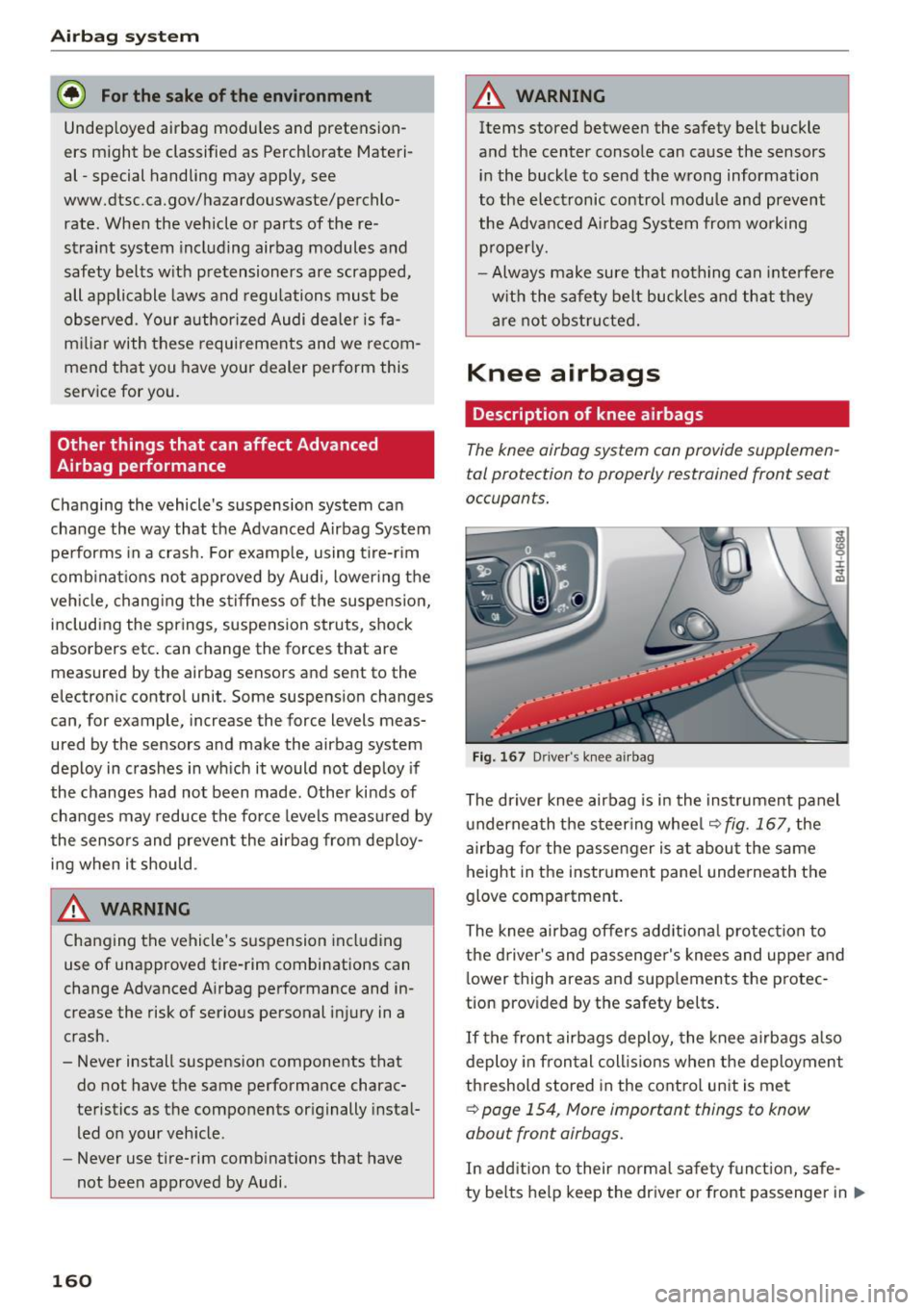
Fig. 167 Driver's kn ee ai rbag
The driver knee airbag is in the inst rument panel
u nderneath the s teer ing whee l
~ fig. 16 7, the
airbag fo r the passenger is at about the same
height in the instrument panel underneath the
glove compartment.
The knee airbag offers add itiona l protection to
the d river's and passenge r's knees and uppe r and
l ower thigh areas and supp lements the protec
tion prov ided by the safety belts .
If the front airbags deploy, the knee airbags a lso
deploy in frontal coll is ions when the deployment
th reshold stored in the control unit is met
~ page 154, More important things to know
about front airbags.
In add ition to their normal safe ty f unct ion, safe-
ty belts help keep the driver or front passenger in ..,
Page 171 of 302
exceptional circumstances and the
PASS ENGER AIR BAG OFF light does not
come on and stay on, immed iately install
the rear-fac ing ch ild safety seat in a rear
seating pos it ion and have the airbag system
inspected immediately by your Audi dealer .
A WARNING
If, in exceptio nal circumstances, you must in
stall a forward-facing chi ld restraint on the
front passenger's seat:
- Always make sure the forward-fac ing seat
has been designed and ce rtified by its man
ufact urer fo r use on a front seat with a pas
senger front and side airbag .
- Always follow the manufact urer's instruc
tions prov ided with the ch ild safety seat or
carrier.
- Always move the passenger seat into its
rearmost position in the seat's fore and aft
adjustment range, as far away from the air
bag as possib le before installing the child
restraint. The backrest must be adjusted to
an upr ight position.
- Always make sure that the
PA SSENGER AIR
BAG OFF
light comes on and stays on all the
t ime whenever the ignition is switched on.
{D) Tips
Always replace chi ld restraints that were in
stalled in a vehicle dur ing a crash . Damage to
a child restraint that is not visible could cause
it to fail in another collision situation.
Advanced front airbag system and children
Your veh icle is equipped with a front "Advanced
Airbag System " in compliance w ith United States
F edera l Moto r Vehicle Safety Standard (FMVSS)
208, as well as Canada Motor Ve hicle Safe ty
Stand ard (CMVSS) 208 as appli cable at the t ime
your vehicle was manufactured .
The Advanced Airbag system in your ve hicle has
been ce rtified to meet the "low-risk " requ ire
ments for 3 -and 6-year old children on the pas
senger side and small adults on the driver side .
The low risk deployment criteria are intended to
Ch ild safety
reduce the risk of injury through interaction with
the airbag that can occur, for example, by being
too close to the steering wheel and instr ument
panel when the airbag inflates. In addition, the
system has been cert ified to comply with the
"suppression" requirements of the Safety Stand
ard, to turn off the front airbag for infants up to
12 months who are restrained on the front pas
senger seat in ch ild rest raints that are lis ted in
the S tanda rd .
Even thoug h your veh icle is equipped with an Ad
vanced Airbag system, all ch ildren, especially
those 12 yea rs and younger, sho uld a lways ride
i n the back seat properly restra ined for their age
and size . The airbag on the passenger side makes
the front seat a potentia lly dangerous p lace for a
child to ride. The front seat is not the safest place
for a ch ild in a forward-fac ing ch ild safety seat. It
can be a very dangerous place for an infant or a
larger ch ild in a rearward-facing seat .
Advanced Airbags and the weight -sensing
mat in the front seat
T he Advanced A irbag System in you r vehicle de
tects the presence of a n in fan t or child in a ch ild
restra int on the front passenger seat using the
weight-sensing mat in the seat cushion and the sensor below the safety belt latch on the front
passenger seat that measures the tension on the
safety belt.
The weight-sensing mat measures total weight
of the child and the chi ld safety seat and a child
blanket on the front passenger seat. The weight
on the front passenger seat is related to the de
s ign of the child restra int and its "footprint" , the
s ize and shape of the bottom of the c hild re
straint as it s its on the seat. The weight of a chi ld
r estra int and its "footprint " va ry for different
k inds of child restra ints and for the different
models of the same kind of ch ild rest raint of
fered by child restraint manufacturers.
T he weight ranges for the individ ual types,
makes and mode ls of chi ld restrain ts that the
N HT SA has spec ified in the Safety Standard to
gether with the weight ranges o f typical infants
and typical 1 year-old chi ld have been stored in .,.
169
Page 176 of 302
Child safety
The airbag on the passenger side makes the front
seat a potentially dangerous p lace for a child to
ride. The front seat is not the safest place for a
child in a forward-facing child seat. It is a very
dangerous place for an infant or a larger child in
a rearward-fac ing seat.
A WARNING
Not using a ch ild safety seat, using the wrong
child safety seat or improperly installing a
child restra int increases the r isk of serious
personal inju ry and death in a crash.
- Never install rear-facing chi ld safety seats
or infant carriers on the front passenger
seat -even with an Advanced Airbag System.
A chi ld will be seriously injured and can be
killed when the inflating airbag hits the
child safety seat or infant carrier with great
force and smashes the child safety seat and
child against the backrest, center armrest,
door or roof
c::, page 147, Child restraints on
the front seat -some important things to
know.
- Always install rear-facing child safety seats
or infant carr iers on the rear seat.
- Never install a rear-facing child restra int in
the forward-facing direct ion. Such restraints
are designed for the spec ial needs of infants
and very sma ll children and cannot protect
them properly if the seat is forward-fa cing.
- If you must install a rearward fac ing ch ild
safe ty seat on the front passenger seat be
ca use of exceptiona l circumsta nces and the
PASSENGER AIR BAG OFF light does not
come on and stay on, immed iate ly install
the rear-facing chi ld safety seat in a rear
seat ing position and have the airbag system
inspected by your Audi dealer.
-Always read and heed all WARNINGS when
ever using a child restrained in a vehicle is
being used
c:> page 138, Safety belts,
c::, page 146, Airbag system and
c:> page 168, Important information.
174
Convertible child safety seats
Properly used convertible child safety seats can
help protect toddlers and children over age one
who weigh between 20 and 40 lbs. (9 and 18 kg)
in a crash.
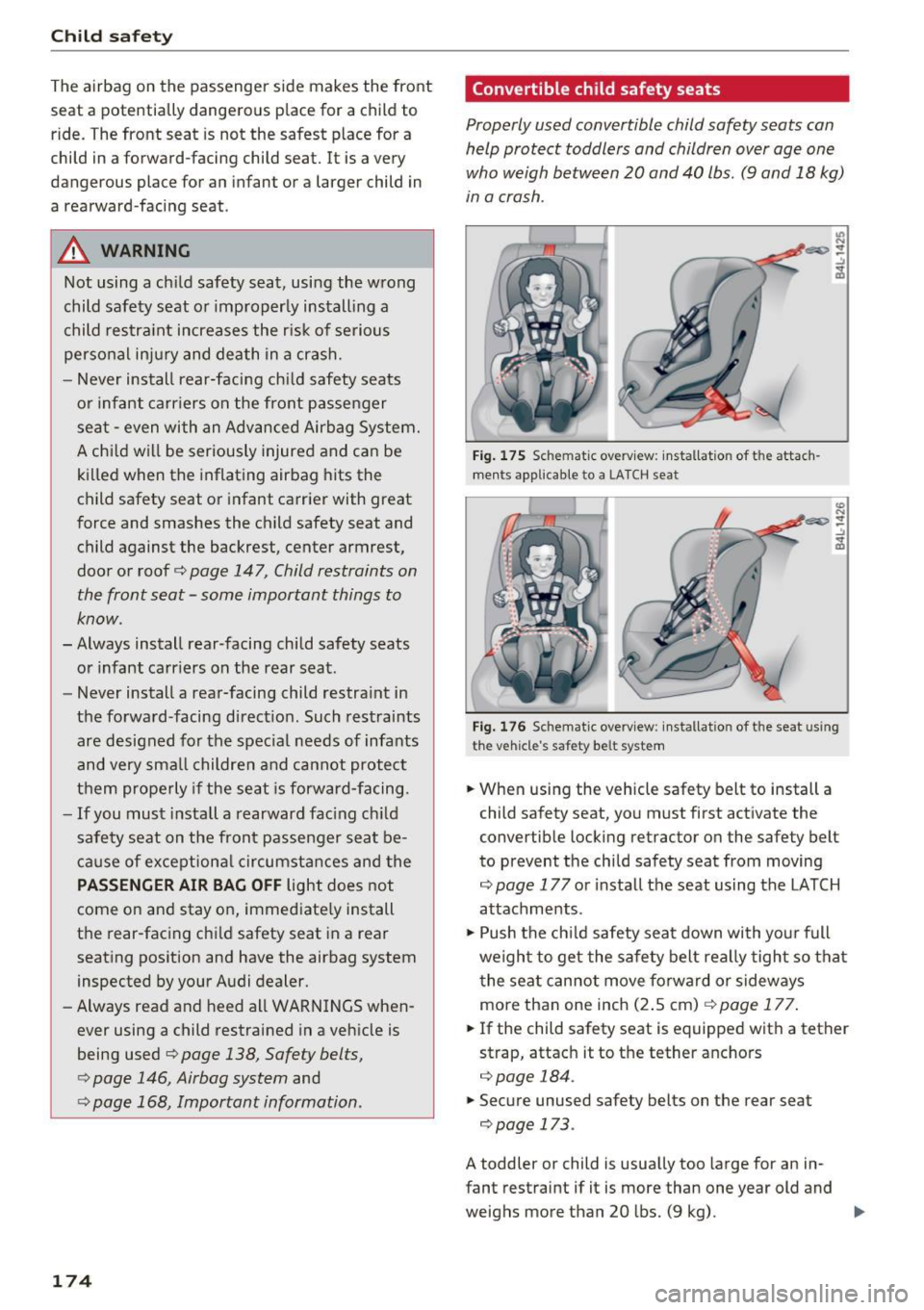
Fig . 1 7 5 Schemat ic overv iew : installat ion of the attach
ments applicable to a LA TCH seat
Fig. 176 Schemat ic overv iew: i nstallat ion of the seat using
the vehicle's safety belt system
.. When using the vehicle safety belt to install a
child safety seat, you must first activate the
convertib le locking retractor on the safety belt
to prevent the child safety seat from moving
c:> page 177 or install the seat using the LATCH
attachments .
.. Push the chi ld safety seat down wi th your full
we igh t to get the safe ty belt really tight so that
the seat cannot move forward or sideways
more than one inch (2 .5 cm)
c:>page 177.
.. If the child safety seat is equipped with a tether
strap, attach it to the tether anchors
c:>page 184.
.. Secure unused safety belts on the rear seat
c:>page 173.
A toddler or child is usually too large for an in
fant restraint if it is more than one year old and
weighs more than 20 lbs. (9 kg). ..,.
Page 182 of 302
Child safety
-Always make sure the seat backrest to which
the child restraint is installed is in an up
right position and securely latched into
place and cannot fold forward. Otherwise,
the seatback with the child safety seat at
tached to it could fly forward in the event of
an accident or other emergency situation.
- Always read and heed all WARNINGS when
ever using a child restrained in a vehicle is
being used
c:::> page 168 . Special precautions
apply when installing a child safety seat on
the front passenger seat¢
page 147, Child
restraints on the front seat -some impor
tant things to know.
Deactivating the convertible locking
retractor
The convertible Locking retractor for child re
straints will be deactivated automatically when
the belt is wound all the way bock into the re
tractor .
~ Press the red button on the safety belt buckle.
Th@ belt tongue will pop out of the buckle.
~ Guide the safety belt all the way back into its
stowed position .
Always let the safety belt retract completely into
its stowed position . The safety belt can now be
used as an ordinary safety belt without the con
vertible locking retractor for child restraints .
If the convertible locking retractor should be ac
tivated inadvertently, the safety belt must be un
fastened and guided completely back into its
stowed position to deactivate this feature. If the
convertible lock ing retractor is not deactivated,
the safety belt will gradually become tighter and
uncomfortable to wear.
A WARNING
-
Improperly installed child safety seats in
crease the risk of serious personal injury and
death in a collision.
- Never unfasten the safety belt to deactivate
the convertible locking retractor for child re straints while the vehicle is moving . You
180
would not be restrained and could be seri
ously injured in an accident.
- Always read and heed all WARNINGS when
ever using a child restrained in a vehicle is
being used
¢page 168. Special precautions
apply when installing a child safety seat on
the front passenger seat
c:::> page 147, Child
restraints on the front seat -some impor
tant things to know.
LATCH system (Lower
anchorages and tethers
for children)
' Child Restraint System anchors and how
are they related to child safety
To provide a simpler and more practicable way to
attach the child restraint on the vehicle seat, Federal regulations require special lower ancho
rages in vehicles and devices on new child re
straints to attach to the vehicle anchorages .
In the United States, the combination of the
tether anchorages and the lower anchorages is
now generally called the LATCH system for
"Lower Anchorages and Tethers for Children" . In
Canada, the terms "top tether" with "lower uni
versal anchorages" (or "lower universal anchor
age bars") are used to describe the system .
In other countries the term "ISOFIX" is used to
describe the lower anchorages .
Forward-facing child restraints manufactured af
ter September 1, 1999, are required by U.S. fed
eral regulations to comply with new child head
movement performance requirements . These
new performance requirements make a tether
necessary on most new child seats.
Installing a child restraint that requires a top
tether without one can seriously impair the per
formance of the child restraint and its ab ility to
protect the child in a collision. Installing a child
restraint that requires a top tether without the
top tether may be a violation of state law.
Child restraint manufacturers offer LATCH lower
anchorages on their child seats with hook-on or ...
Page 205 of 302
Trailer load distribution
Be sure the load in the trailer is held securely in
p la ce to prevent it from sh ifting forward, back
ward or sideways.
Never allow a passenger to ride in a trailer¢.&.
in Driving instructions on page 204.
Engine cooling system
Towing a trailer makes the engine work harder . It
is important that the cool ing system's perform
ance is up to the addit ional load. Make sure that
the cooling system has enough fluid.
Tire pressure
When towing a trailer, inflate the tires of your
veh icle to the cold tire pressure listed under "Full
load " on the label located on the driver's side B
pillar (vis ible when the door is open). Inflate
trailer tires to trailer and tire manufacturers'
specif ications.
Lights
Check to make sure both vehicle and trailer lights
are working proper ly.
Safety chains
Be sure trailer safety chains are properly connect
ed from the trailer to the hitch on the vehicle.
Leave enough slack in the chains to permit turn
in g corners . When you install safety cha ins, make
sure they wi ll not drag on the road when you are
driving.
The chains should cross under the trailer tongue
to prevent it from dropping in case of separat ion
from the hitch.
Adjusting the Audi drive select
Make sure the vehicle is on a level surface before
hitching up the trailer and before adjusting the
tongue we ight. The vehicle must be in
auto or
comfort driving mode and not ra ised
¢ page 106, 9Q) .
Make sure that the vehicle is lowered. In Info
tainment, select:
I CARI function button > lower
control button .
Trailer mode
If you must drive under poor road conditions, you
can raise the vehicle
after coupling the trailer or
after adjusting the tongue weight¢ page 108.
(D Note
-Changes in temperature or load can affect
the height of the vehicle.
- Always select auto or comfort mode. Other
w ise, the tong ue load specified for your ve
hicle will no longer be applicable .
Driving instructions
Driving with a trailer always requires extra care
and consideration.
T o obtain the best possible handling of veh icle
and trailer, p lease note the following:
.,. Do not tow a loaded trailer when your car itself
is not loaded.
.,. Be especially careful when passing other
vehicles.
.,. Observe speed limits.
.,. Do not drive at the maximum permissible
speed .
.,. Always apply brakes early.
.,. Monitor the temperature gauge.
Weight distribution
Towing a loaded tra iler with an empty car results
in a highly unstab le distribution of weight . If this
cannot be avoided, drive at very low speeds only
to avoid the risk of losing steering control.
A "balanced" rig is easier to operate and control.
This means that the tow vehicle shou ld be loaded
to the extent possib le and permissib le, while
keeping the trailer as light as possible under the
cir cumstances . Whenever poss ible, transfer
some cargo to the luggage compartment of the
tow veh icle while observing tongue load require
ments and vehicle load ing conside rations.
Speed
The higher the speed, the more difficult it be
comes for the driver to control the r ig. Do not
drive at the maximum permissible speed. Reduce
your speed even more if load, weather or wind .,._
203
Page 223 of 302
-Do not remove the engine cover under any
circumstances. This increases the risk of
burns.
- If work on the fuel system or the electrical
system is necessary:
- Always d isconnect the battery.
- Never smoke or work near heaters or open
flames. Flu ids in the engine compartment
could start a fire.
- Keep an app roved fire ext inguisher imme
d iate ly availab le.
- To avo id electr ical shock and personal injury
wh ile the eng ine is running or being started,
never touch:
- Ignition cables
- Other components of the high voltage
electronic ignition system.
- If you must perform a check or repa ir with
the engine running:
- First, fully apply the parking brake, move
selector lever to "P" (Park).
- Always use extreme caution to prevent
cloth ing, jewelry, or long hair from get
ting caught in the radiator fan, V-belts or
other mov ing parts, or from contacting
hot parts. Tie back ha ir before starti ng,
and do not wear clothi ng that will hang or
d roop into t he engine.
- Min imize exposu re to emission and chem i
cal hazards¢ .&.-
_& WARNING
California Proposition 65 Warn ing:
- E ngine exhaust, some of its constituents,
and certain vehicle components contain or
em it chem ica ls known to the St ate of C ali
f orn ia to cause cancer and bi rth de fects and
reproductive harm . In addition, certain flu
ids contained in ve hicles and certain prod
ucts of component wear contain or emit
Ch eck ing and Filling
chemicals known to the State of California
to cause cancer and birth defects or other
reproductive harm.
- Battery posts, term inals and related acces
sories contain lead and lead compounds,
chemicals known to the State of Californ ia
to cause cancer and reproductive harms.
Was h hands afte r handling .
([) Note
When adding flu ids, always make sure that
they are poured into the proper co nta iner or
fille r opening, otherwise serious damage to
vehicle systems w ill occur.
® For the sake of the environment
To detect leaks in time, inspect the veh icle
floor pan from unde rneath regularly . If you
see spots from oil or other veh icle fluids, have
your vehicle inspected by an authorized Audi
dealer.
Closing the engine hood
.,.. Pull the hood down un til the press ure from the
struts is reduced.
.,.. Let the hood
drop down and latch in p lace . Do
not try to push it shut;
it may fail to engage
¢ _& .
_& WARNING
--A hood that is not completely latched co uld
fly up and block your view while driv ing.
- When you close the engine hood, check it to
make sure the safety catch has properly en
gaged . The hood s hou ld be flush with the
sur rounding vehicle body parts.
- If you notice while driv ing that the hood is
not secured properly, stop at once and close
it.
-
221
Page 234 of 302
Check ing and F illing
@
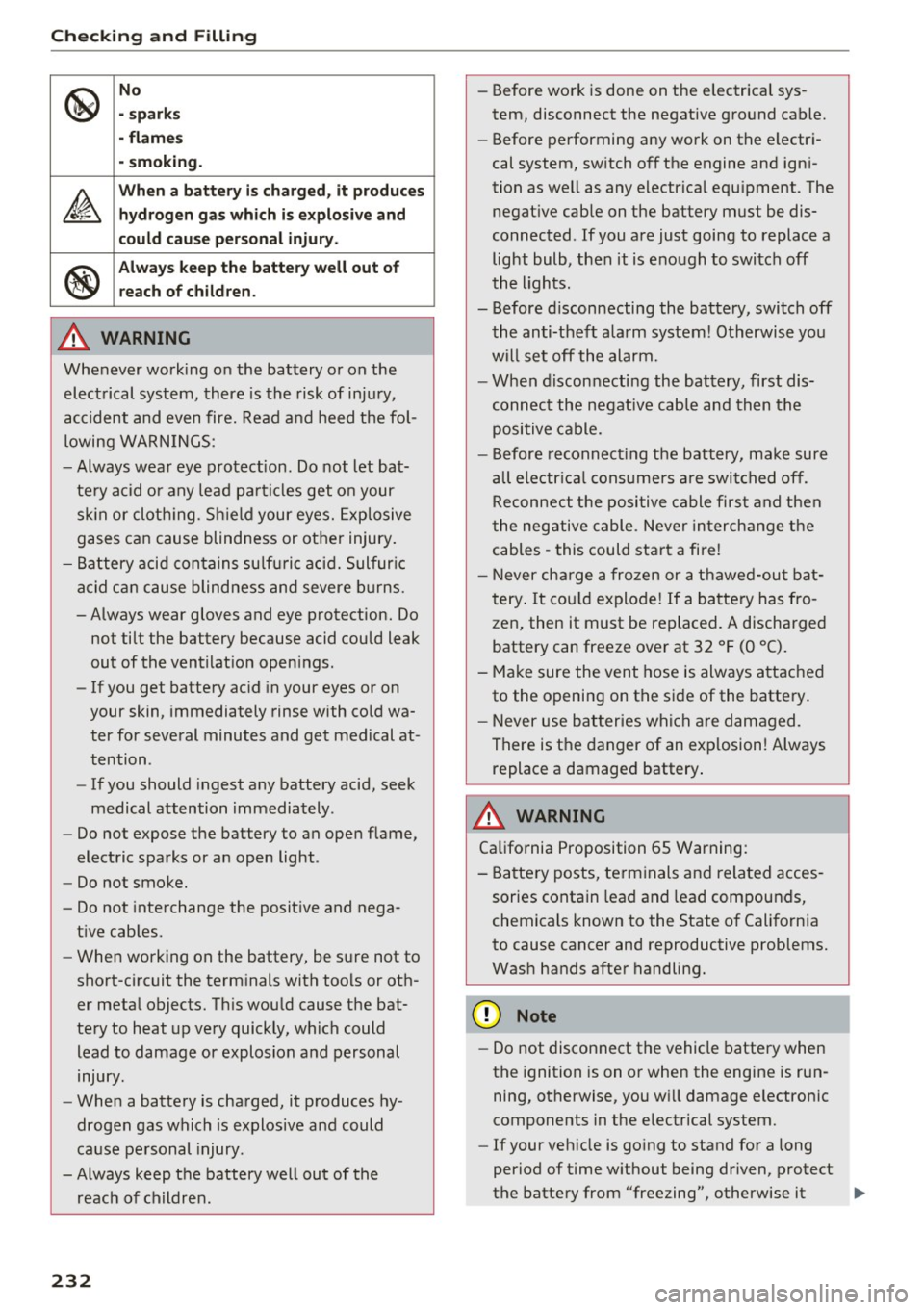
No
- spark s
- fl ame s
- smokin g.
~
Wh en a b att ery is ch arg ed , it produc es
h yd ro ge n ga s which i s explosive and
could cau se per sonal injury.
®
Always keep the b atter y well out of
r each of child ren.
A WARNING
Whenever work ing on the battery or on the
elect rical system, there is the risk of injury,
accident and
even fire. Read and heed the fol
lowing WARN INGS :
- Always wear eye protection. Do not let bat
te ry acid or any lead particles get on your
sk in or cloth ing . Sh ield your eyes. Explosive
gases can cause blindness or other injury .
- Battery acid con tains su lfu ric acid. Sulfur ic
acid can cause blindness and severe b urns.
- Always wear gloves and eye protection. Do
no t tilt the battery because acid could leak
out of the ventilat ion open ings .
- If you get battery ac id in your eyes or on
your skin, immediately rinse with cold wa
ter for several minutes and get medical at tention .
- If you should ingest any battery acid, seek
medical attention immediately .
- Do not expose the battery to an open flame,
electric sparks or an open light .
- Do not smoke.
- Do not interchange the positive and nega-
t ive cables.
- When working on the battery, be sure not to
short-circuit the terminals with tools or oth
er metal objects. Th is wou ld cause the bat
tery to heat up
very quickly, which could
lead to damage or explosion and personal
injury .
- When a battery is charged, it produces hy
drogen gas which is explosive and could
ca use personal injury.
- Always keep the battery well out of the reach of ch ildre n.
232
-
-Before work is done on the electrical sys
tem, disconnect the negative gro und cable.
- Before performing any work on the e lectri
cal system, switch off the engine and ign i
tion as well as any electrical equ ipment . The
negat ive cab le on the battery must be dis
connected . If you are just going to replace a
light bulb, then it is enough to switch off
the lights.
- Before d isconnecting the battery, switch off
the anti-theft alarm system! Otherwise you
will set off the alarm.
- When disconnecting the battery, first dis
connect the negative cab le and then the
positive cable.
- Before reconnect ing the battery, make sure
all electr ica l consume rs a re switched off .
Reconnect the positive cable first and then
the negative cable . Never in terch ange t he
cables -this could sta rt a fire!
- Never cha rge a frozen or a thawed-out bat
tery . It cou ld explode ! If a ba ttery has fro
zen, then it must be replaced. A discharged
battery can freeze over at 32 ° F (0 °C).
- Make sure the
vent hose is always attached
to the opening on the side of the battery .
- Never use batter ies which are damaged.
There is the danger of an exp losion! Always
replace a damaged battery .
A WARNING
Califo rnia Proposition 65 Warning :
- Batte ry posts, te rm inals and related acces
sories contain lead and lead compounds,
chemicals known to the State o f Cali fornia
to cause cancer and reproductive problems.
Wash hands after handling.
(D Note
- Do not disconnect the vehicle battery when
the ignition is on or when the engine is run
ning, otherwise, you w ill damage electronic
components in the electrical system.
- If your veh icle is go ing to stand for a long
period of time w ithout being driven, protect
the battery from "freezing", otherwise it ..,.
Page 235 of 302
will be damaged and will then have to be re
placed.
Battery charging
Starting the engine requires a well charged bat
tery.
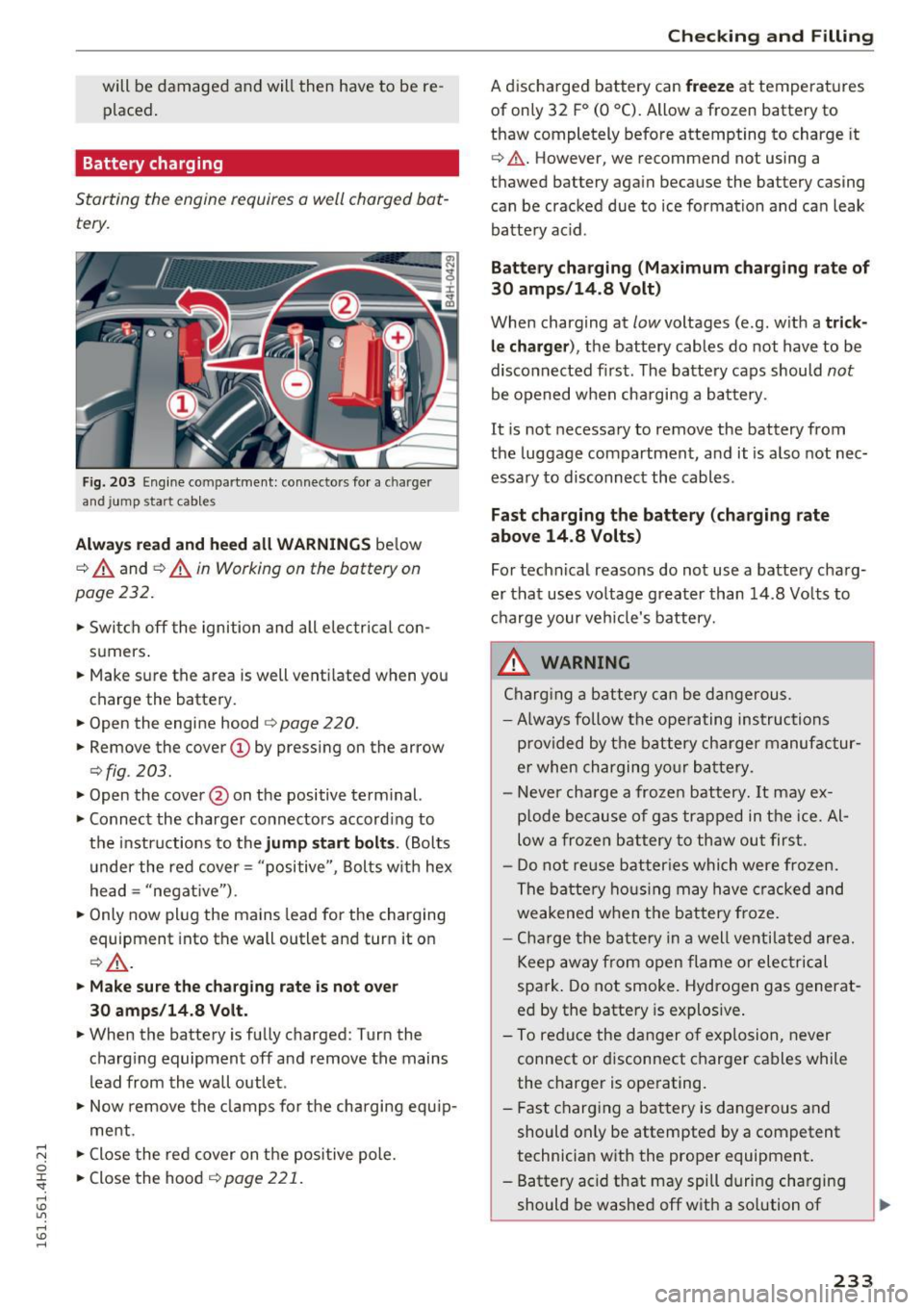
Fig. 203 Engine co mpa rtment: connectors fo r a c harger
and jump start cables
Always read and heed all WARNINGS below
~ &. and
¢ A in Working on the battery on
page 232.
• Switch off the ignition and all electrical con
sumers .
• Make sure the area is well ventilated when you
charge the battery.
• Open the engine hood
~ page 220.
• Remove the cover (D by pressing on the arrow
¢ fig . 203.
• Open the cover @on the positive terminal.
• Connect the charger connectors according to
the instructions to the
jump start bolts. (Bolts
under the red cover= "positive" , Bolts with hex
head
= "negat ive").
• Only now plug the mains lead for the charging
equipment into the wall outlet and turn it on
¢&,, .
• Make sure the charging rate is not over
30 amps/14.8 Volt.
• When the battery is fully charged: Turn the
charging equipment off and remove the mains
lead from the wall outlet .
• Now remove the clamps for the charging equip-
ment.
~ • Close the red cover on the positive pole. 0
~ • Close the hood~ page 221.
rl I.Cl U"I
rl I.Cl rl
Checking and Filling
A discharged battery can freeze at temperatures
of only 32 F
0 (0 °C). Allow a frozen battery to
thaw completely before attempting to charge it
¢ &. However , we recommend not using a
thawed battery again because the battery casing can be cracked due to ice formation and can leak
battery acid.
Battery charging (Maximum charging rate of
30 amps/14.8 Volt)
When charging at low voltages (e.g . w ith a trick
le charger),
the battery cables do not have to be
disconnected first. The battery caps should
not
be opened when charging a battery.
It is not necessary to remove the battery from
the luggage compartment, and it is also not nec
essary to disconnect the cables .
Fast charging the battery (charging rate
above 14.8 Volts)
For technical reasons do not use a battery charg
er that uses voltage greater than 14.8 Volts to
charge your vehicle's battery.
.&_ WARNING
Charging a battery can be dangerous.
- Always follow the operating instructions
provided by the battery charger manufactur
e r when charging your battery.
- Never charge a frozen battery. It may ex
p lode because of gas trapped in the ice. Al
low a frozen battery to thaw out first.
- Do not reuse batteries which were frozen.
The battery housing may have cracked and
weakened when the battery froze.
- Charge the battery in a well ventilated area.
Keep away from open flame or electrical
spark. Do not smoke. Hydrogen gas generat
ed by the battery is explosive.
- To reduce the danger of explosion, never
connect or disconnect charger cables while
the charger is operating.
- Fast charging a battery is dangerous and
should only be attempted by a competent
technician with the proper equipment.
- Battery acid that may spill during charging
should be washed off with a so lution of
233
Page 239 of 302
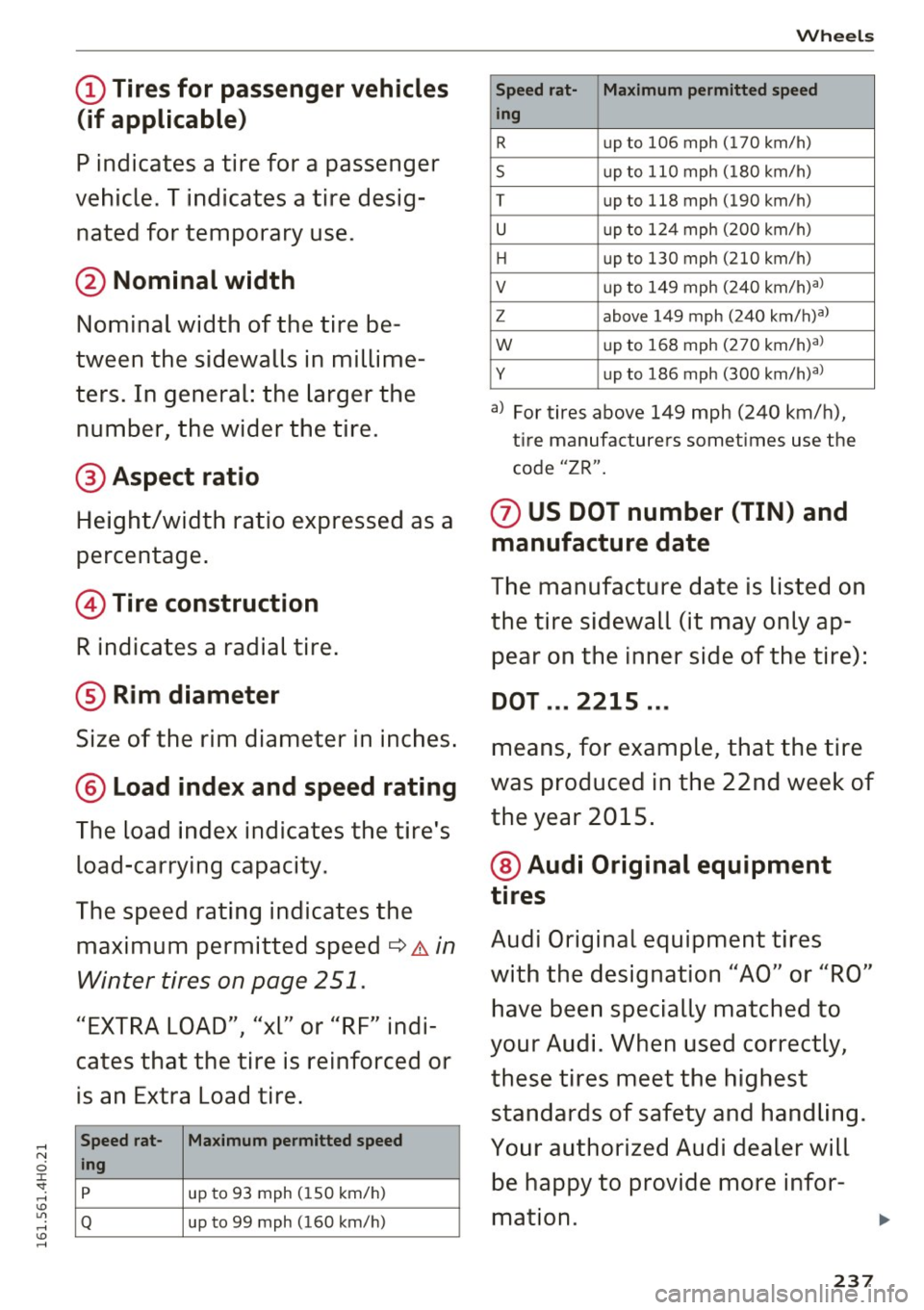
(D Tires for passenger vehicles
(if applicable)
P indicat es a tir e for a p asse ng er
vehi cle. T indi cates a tire de sig
nated for tempor ary us e.
@ Nominal width
Nominal width of the tire be
tween the sidew alls in millime
ters. In general: the larger the number, the wider the tire.
@ Aspect ratio
Height /width ratio expressed as a
percentage.
@ Tire construction
R indicates a radial tire.
® Rim diameter
Siz e of the rim diameter in inches.
@ Load index and speed rating
The load ind ex indi cates the tire' s
lo ad-ca rry in g ca pacity.
The speed rating indicates the maximum permitted speed¢.&
in
W inter tires o n page 251 .
"EXTRA LOAD", "xl" or "RF" indi
cate s that the tire i s reinfor ced or
is an Extra Load tire.
Speed rat- Maximum permitted speed
ing
p
up t o 93 mph ( 150 km/h)
Q up to 99 mph (160 km/ h)
Wheels
Speed rat- Maximum permitted speed
ing
R up to 106 mph (170 km/h)
s u p to 11 0 mph ( 180 km/h)
T up to 118 mph (190 km/h)
u u p to 124 mph ( 200 km/h)
H up to 130 mph (210 km/h)
V up to 14 9 mph (2 40 km/h)al
z above 149 mph (240 km/h)al
w up to 168 mph (270 km/h)al
y up to 186 mph (300 km/h)al
a) For tir es ab ove 149 mph (2 40 km/h),
t ir e man ufact ure rs sometimes use the
co de "Z R".
(j) US DOT number (TIN) and
manufacture date
The m anufac ture date i s listed on
the tire sidewall (it ma y only ap
pear on the inner side of the tire):
DOT ... 2215 ...
means, for example , that the tire
was produced in the 22nd week of
the year 2015.
@ Audi Original equipment
tires
Audi Original equipment tire s
with th e designation "AO " or "RO"
have been sp ec ially matched to
your Audi. When used correct ly,
these t ires meet th e highest
s tandar ds of safety and h andling.
Your authorized Audi dealer will
be happy to provide more infor
mation .
237
Page 243 of 302
-
"XL" "xl" "EXTRA LOAD" or "RF" ' ' '
on the sidewall.
Rim
means a metal support for a tire
or a tire and tube assembly upon
which the tire beads are seated .
Rim diameter
means nominal diameter of the
bead seat. If you change your
wheel size, you will have to pur
chase new tires to match the new
rim d iameter.
Rim size designation
means rim diameter and width.
Rim width
means nominal distance between
r im flanges.
Sidewall
means that portion of a tire be
tween the tread and bead .
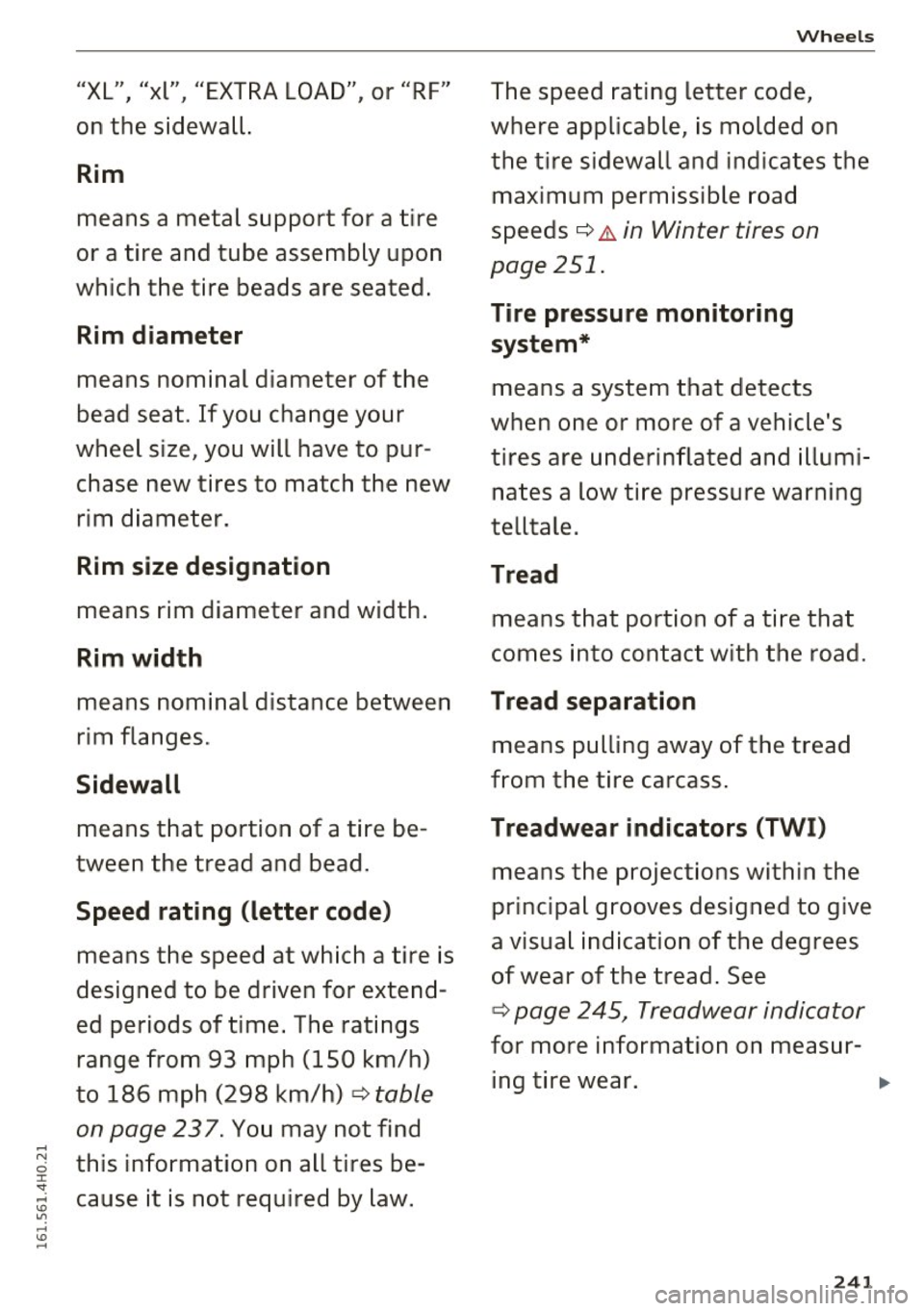
Speed rating (letter code )
means the speed at wh ich a tire is
designed to be driven for exten d
ed periods of t ime . The ratings
range from 93 mph (150 km/h)
to 186 mph (298 km/h)
¢ table
on page 237.
Yo u may not find
ci this information on all tires be-:c
; cause it is not required by law. V,
-"' -
Wheels
T he speed rating letter code,
where applicable, is molded on
the tire sidewall and indicates the
maximum pe rmissible road
speeds
¢ & in Winter tires on
page 251 .
Tire pressure monitoring
system*
means a system that detects
when one or more of a vehicle's
tires are underin flated and illum i
na tes a low tire pressure wa rning
telltale.
Tread
means that port ion of a tire that
comes into contact with the road.
Tread separation
means pulling away of the tread
from the tire carcass .
Treadwear indicators (TWI)
means the projections within the
principal grooves designed to give
a visua l indication of t he degrees
of wear of the tread . See
¢ page 245, Treadwear indicator
for mo re info rma tion on measu r-
ing tire wear. .,.
241