belt AUDI A8 2016 Workshop Manual
[x] Cancel search | Manufacturer: AUDI, Model Year: 2016, Model line: A8, Model: AUDI A8 2016Pages: 302, PDF Size: 75.68 MB
Page 178 of 302
Child safety
Booster seats and safety belts
Properly used booster seats can help protect
children weighing between about 40 lbs . and 80
lbs. (18 kg and 36 kg) who are less than 4
ft. 9
in. (57 inches/1.45 meters) tall .
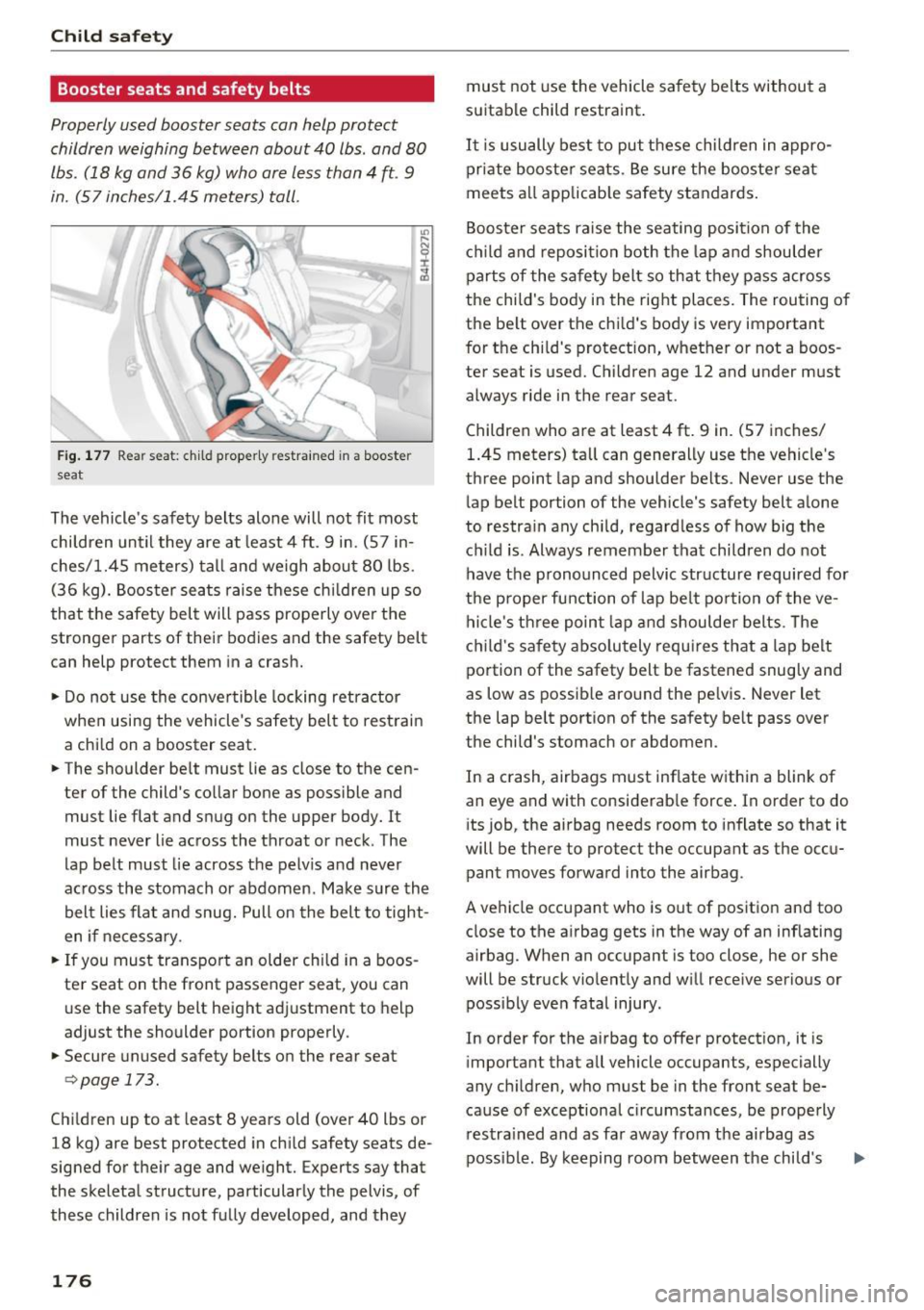
Fig. 177 Rear seat: ch ild proper ly restrained in a booster
seat
The vehicle's safety belts alone will not fit most
children until they are at least 4
ft . 9 in. (57 in
ches/1.45 meters) tall and weigh about 80 lbs.
(36 kg). Booster seats raise these chi ld ren up so
that the safety belt will pass properly
over the
stronger parts of their bodies and the safety belt
can help protect them in a crash.
• Do not use the convertible locking retractor
when using the vehicle's safety belt to restrain
a chi ld on a booster seat.
• The shoulder be lt must lie as close to the cen
ter of the child's collar bone as possible and
must lie flat and snug on the upper body. It
must never lie across the throat or neck. The
lap belt must lie across the pelv is and never
across the stomach or abdomen . Make sure the
belt lies flat and snug. Pull on the belt to tight
en if necessary .
• If you must transport an older child in a boos
te r seat on the front passenger seat, you can
use the safety belt height adjustment to help
adjust the shoulder portion properly .
• Secure unused safety belts on the rear seat
c> page 173.
Children up to at least 8 years old (over 40 lbs or
18 kg) are best protected in child safety seats de
signed for their age and weight. Experts say that
the skeletal structure, particularly the pelvis, of
these children is not fully developed, and they
176
must not use the vehicle safety belts without a
suitable child restraint .
It is usually best to put these children in appro
priate booste r seats. Be sure the booster seat
meets all applicab le safety standards.
Booster seats raise the seating position of the
child and reposition both the lap and shoulder
parts of the safety belt so that they pass across
the child's body in the right places. The routing of
the be lt
over the chi ld's body is very important
for the child's protection, whether or not a boos
ter seat is used. Children age 12 and under m ust
always ride in the rear seat.
Children who are at least 4
ft. 9 in. (57 inches/
1.45 meters) ta ll can generally use the vehicle 's
three point lap and shoulder belts. Never use the
lap belt portion of the vehicle's safety belt alone
to restrain any child, regard less of how big the
c hi ld is. Always remember that children do not
have the p ronounced pelvic structure required for
the proper function of lap belt portion of the
ve
hicle's three point lap and shoulder belts. The
c hi ld's safety absolutely requ ires that a lap belt
portion of the safety belt be fastened snugly and
as low as possible around the pe lvis. Never let
the lap belt portion of the safety belt pass over
the child's stomach or abdomen.
In a crash, airbags must inflate within a blink of
an eye and with considerab le force . In order to do
i ts job, the airbag needs room to inflate so that it
will be there to protect the occupant as the occu
pant
moves forward into the airbag.
A ve hicle occupant who is out of position and too
close to the a irbag gets in the way of an inflating
airbag. When an occupant is too close, he or she
will be struck violently and will receive serious or
possibly even fatal injury .
In order for the a irbag to offer protection, it is
important that all vehicle occupants, especially
any ch ildren, who must be in the front seat be
cause of exceptional c ircumstances, be properly
re stra ined and as far away from the a irbag as
possible. By keeping room between the child's .,..
Page 179 of 302
body and the front of the passenger compart
ment, the airbag can inflate completely and pro
vide supp lemental protect ion in certain frontal
collisions.
_&. WARNING
Not using a booster seat, using the booster
seat improperly, incorrectly installing a boos
ter seat or using the vehicle safety belt im properly increases the risk of serious personal
injury and death in a collision or other emer
gency situat ion. To help red uce the risk of se
rious personal injury and/or death:
- T he shoulder be lt must lie as close to the
center of the child's collar bone as possible
and must lie f lat and snug on the upper
body. It must never lie across the throat or
neck. The lap belt must lie across the pelvis
and never across the stomach or abdomen.
Make sure that the belt lies flat and snug.
Pull on the belt to tighten if necessary.
- Failure to properly route safety belts over a
child's body will cause severe injuries in an
accident or other emergency situation
¢page 138.
-The rear side of the child safety seat should
be pos itioned as close as poss ible to the
backrest on the vehicle seat. Adjust the rear
seat head restraint if it is difficu lt to install
the ch ild seat with the head restraint in
place
¢page 132. Driv ing with head re
straints that are not properly adj usted in
creases the risk of serious or fatal neck in
jury dramatically .
- Children on the front seat of any car, even with Advanced Airbags, can be seriously in
jured or even killed when an airbag inflates.
- Never let a child stand or knee l on any seat,
for example the front seat.
- Never let a child ride in the cargo area of your vehicle.
- Always remember that a child leaning for ward, sitting sideways or out of position in any way during an accident can be struck by
a deploying airbag. This will result in ser ious
personal injury or death.
- If you must install a booster seat on the
front passenger seat because of exceptional
Ch ild safety
circumstances the PASSEN GER AIR BAG
O FF
light must come on and stay on, when
ever the ignition is switched on.
- If the
PASS ENG ER AIR BAG OF F light does
not come on and stay on, perform the
checks described¢
page 156, Monitoring
the Advanced Airbag System.
-Take the child restra int off the front passen
ger seat and install it properly at one of the rear seat positions if the
PA SSENGER A IR
BAG OFF
light does not stay on whenever
the ignition is switched on.
- Always read and heed all WARNINGS when
ever using a child restrained in a vehicle is
be ing used¢
page 138, Safety belts,
¢ page 146, Airbag system and
¢ page 168, Important information .
Securing child seats
Securing a child safety seat using a safety
belt
Safety belts for the rear seats and the front pas
senger can be locked with the convertible locking
retractor to properly secure child safety seats .
The safety belts emergency locking retractors for
the rear seats safety belts and for the front pas senger's seat safety belt have a convertible lock
i ng retractor for child restra ints . The safety be lt
must be lo ck ed so that be lt webb ing cannot un
ree l. The ret racto r can be activated to lock the
sa fety be lt and prevent the safety belt webbing
from loosening up during norma l driving. A chi ld
safety seat can on ly be properly installed when
the safety belt is locked so that the ch ild and
child safety seat will stay in place.
Always remember: Even though your vehicle is equipped with an Advanced Airbag system, all
children, especially those 12 years and younger,
shou ld always ride in the back seat proper ly re
strained for their age and size.
_&. WARNING
-Improperly installed child safety seats in
crease the risk of serious personal injury and
death in a co llision.
-
177
Page 180 of 302
Child safety
-Always make sure that the safety belt re
tractor is locked when installing a child
safety seat. An unlocked safety belt retrac
tor cannot hold the child safety seat in place during normal driving or in a crash.
- Always buckle the child safety seat firmly in
place even if a child is not sitting in it . A
loose child safety seat can fly around during
a sudden stop or in a collision.
- Always make sure that the rear seat back
rest to which the center rear safety belt is
attached is securely latched whenever the
rear center safety belt is being used to se
cure a child restraint .
- If the backrest is not securely latched, the
child and the child restraint will be thrown
forward together with the backrest and will
strike parts of the vehicle interior. The child
can be seriously injured or killed.
- Never install rear-facing child safety seats or infant carriers on the front passenger
seat. A child will be seriously injured and can be killed when the passenger airbag in
flates.
- The inflating airbag will hit the child safety
seat or infant carrier with great force and
will smash the child safety seat and child
against the backrest, center armrest, door
or roof .
- Always install rear-facing child safety seats
or infant carriers on the rear seat .
- Forward-facing child safety seats or infant
carriers installed on the front passenger's
seat may interfere with the deployment of
the airbag and cause serious injury to the
child.
- It is safer to install a forward-facing child
safety seat on the rear seat.
-Always read and heed all WARNINGS when
ever using a child restrained in a vehicle is
being used ¢
page 168. Special precautions
apply when installing a child safety seat on
the front passenger seat¢
page 147, Child
restraints on the front seat- some impor
tant things to know.
178
A WARNING , .
Always take special precautions if you must
install a forward or rearward-facing child re
straint on the front passenger's seat in excep
tional situations:
- Whenever a forward or rearward-facing child restraint is installed on the front pas
senger seat, the
PASSENGER AIR BAG OFF
light must come on and stay on whenever
the ignition is switched on.
- If the PASSENGER AIR BAG OFF light does
not come on and stay on, perform the
checks described¢
page 156, Monitoring
the Advanced Airbag System.
- Take the child restraint off the front passen
ger seat and install it properly at one of the
rear seat positions if the
PASSENGER AIR
BAG OFF
light does not stay on whenever
the ignition is switched on.
- Improper installation of child restraints can
reduce their effectiveness or even prevent
them from providing any protection.
- An improperly installed child restraint can
interfere with the airbag as it deploys and
seriously injure or even kill the child.
- Always carefully follow the manufacturer's
instructions provided with the child safety
seat or carrier .
- Never place additional items on the seat
that can increase the total weight registered
by the weight-sensing mat and can cause in
jury in a crash.
A WARNING
Forward-facing child restraints:
- Always make sure the forward-facing seat
has been designed and certified by its man
ufacturer for use on a front seat with a pas
senger front and side airbag .
- Never put the forward-facing child restraint up, against or very near the instrument pan
el.
- Always move the passenger seat into its
rearmost position in the seat's fore and aft
-
Page 181 of 302
adjustment range, as far away from the air
bag as possible before installing the for
ward-facing child restraint. The backrest must be adjusted to an upright posit ion .
- Make sure that the
PAS SEN GER AIR BAG
OFF
light comes on and stays on all the time
whenever the ignition is switched on .
A WARNING
Rearward-facing child restraints:
- A child in a rearward-facing child safety seat
installed on the front passenger seat will be
seriously injured and can be killed if the
front airbag inflates -even with an Ad
vanced Airbag System.
- The inflating a irbag w ill hit the child safety
seat or infant carrier with great force and
will smash the ch ild safety seat and chi ld
against the backrest, center armrest, door
or roof.
- Always be especially careful if you must in
stall a rearward facing child safety seat on
the front passenger seat in exceptional cir
cumstances.
- A tight tether strap on a rearward-facing
child restraint attached to the front passen
ger seat can put too much pressure on the
weight-mat in the seat and register a heavi
er weight in the Advanced Airbag System .
The heavier weight registered can make the system work as though an adult were on the
seat and deploy the Advanced Airbag when
it must be suppressed causing serious or
even fatal injury to the child.
- Make sure that the
PASSENGER AIR B AG
OFF
light comes on and stays on all the time
whenever the ignition is switched on.
- If the
PASSENGER AIR BAG OFF light does
not come on and stay on, immediately in
sta ll the rear-fac ing ch ild safety sea t in a
rear seating position and have the airbag
system inspected by your Audi dealer.
Ch ild safety
Activating the convertible locking retractor
Use the convertible locking retractor to secure a
child restraint .
Always heed the child sa fety seat manuf actu rer 's
ins truc tions when ins talling a child restraint in
your vehicle . To activate the convertible locking
retractor:
.. Place the child rest raint on a seat, prefe rably
on the rear sea t.
.. Slowly pull the belt
all the w ay out .
.. Route it around or through the child restra int
be lt path ¢,&. .
.. Push the ch ild safety seat down with you r full
weight to get the safety belt really tight.
.. Insert the belt tongue into the buckle for that
seating position.
.. Guide the safety belt back into th e retractor un
til the belt lies flat and snug on the child safety
seat .
.. You should hear a ''cl icking" noise as the belt
w inds back into the inertia reel. Test the con
vert ible lock ing retractor by pulling on the belt .
You shou ld no longer be able to pull the belt
out of the retractor. The convertib le locking re
t ractor is now activated.
.. Make sure that the red release button is facing
away from the child restraint so that it can be
unbuckled quickly .
.. Pull on the belt to make sure the safety belt is
properly tight and fastened so that the seat
cannot move forward or sideways more than
one inch (2 .5 cm) .
A WARNING
Using the wrong ch ild rest raint or an improp
e rly installed child restra int can cause se rious
personal injury or death in a crash .
- Always make sure that the safety be lt re
tr actor is locked when installing a child
safety seat . An un locked safety be lt retrac
tor cannot hold the chi ld safety seat in p lace
during normal driving or in a crash.
- Always buckle the child safety seat firm ly in
p lace even if a child is not sitting in it. A
loose child safety seat can fly around during
a sudden stop or in a crash. .,.
179
Page 182 of 302
Child safety
-Always make sure the seat backrest to which
the child restraint is installed is in an up
right position and securely latched into
place and cannot fold forward. Otherwise,
the seatback with the child safety seat at
tached to it could fly forward in the event of
an accident or other emergency situation.
- Always read and heed all WARNINGS when
ever using a child restrained in a vehicle is
being used
c:::> page 168 . Special precautions
apply when installing a child safety seat on
the front passenger seat¢
page 147, Child
restraints on the front seat -some impor
tant things to know.
Deactivating the convertible locking
retractor
The convertible Locking retractor for child re
straints will be deactivated automatically when
the belt is wound all the way bock into the re
tractor .
~ Press the red button on the safety belt buckle.
Th@ belt tongue will pop out of the buckle.
~ Guide the safety belt all the way back into its
stowed position .
Always let the safety belt retract completely into
its stowed position . The safety belt can now be
used as an ordinary safety belt without the con
vertible locking retractor for child restraints .
If the convertible locking retractor should be ac
tivated inadvertently, the safety belt must be un
fastened and guided completely back into its
stowed position to deactivate this feature. If the
convertible lock ing retractor is not deactivated,
the safety belt will gradually become tighter and
uncomfortable to wear.
A WARNING
-
Improperly installed child safety seats in
crease the risk of serious personal injury and
death in a collision.
- Never unfasten the safety belt to deactivate
the convertible locking retractor for child re straints while the vehicle is moving . You
180
would not be restrained and could be seri
ously injured in an accident.
- Always read and heed all WARNINGS when
ever using a child restrained in a vehicle is
being used
¢page 168. Special precautions
apply when installing a child safety seat on
the front passenger seat
c:::> page 147, Child
restraints on the front seat -some impor
tant things to know.
LATCH system (Lower
anchorages and tethers
for children)
' Child Restraint System anchors and how
are they related to child safety
To provide a simpler and more practicable way to
attach the child restraint on the vehicle seat, Federal regulations require special lower ancho
rages in vehicles and devices on new child re
straints to attach to the vehicle anchorages .
In the United States, the combination of the
tether anchorages and the lower anchorages is
now generally called the LATCH system for
"Lower Anchorages and Tethers for Children" . In
Canada, the terms "top tether" with "lower uni
versal anchorages" (or "lower universal anchor
age bars") are used to describe the system .
In other countries the term "ISOFIX" is used to
describe the lower anchorages .
Forward-facing child restraints manufactured af
ter September 1, 1999, are required by U.S. fed
eral regulations to comply with new child head
movement performance requirements . These
new performance requirements make a tether
necessary on most new child seats.
Installing a child restraint that requires a top
tether without one can seriously impair the per
formance of the child restraint and its ab ility to
protect the child in a collision. Installing a child
restraint that requires a top tether without the
top tether may be a violation of state law.
Child restraint manufacturers offer LATCH lower
anchorages on their child seats with hook-on or ...
Page 183 of 302
push-on connectors attached to adjustable
straps .
I n addition to the LATCH lower anchorages, these
child restraint systems usually require the use of
tether straps to h elp keep the child restraint
firm ly in place.
A WARNING
Improper installation of child restraints will
increase the risk of injury and death in a
crash.
- Always follow the instructions provided by the manufacturer of the child restra int you
intend to install in your veh icle.
- Never install a child restra int w ithout a
properly attached top tether strap if the
child restraint manufacturer's instruct ions
requ ire the top tether strap to be used .
- Improper use of child restra int LATCH lower
anchorage po ints can lead to injury in a colli
sion. The LATCH lower anchorage points are designed to withstand only those loads im
posed by correc tly fit ted child res traints .
- Never mount two chi ld restraint systems on
one LATCH lower anchorage poin t.
- Never secure or attach any luggage or other
item to the LATCH lower anchorages .
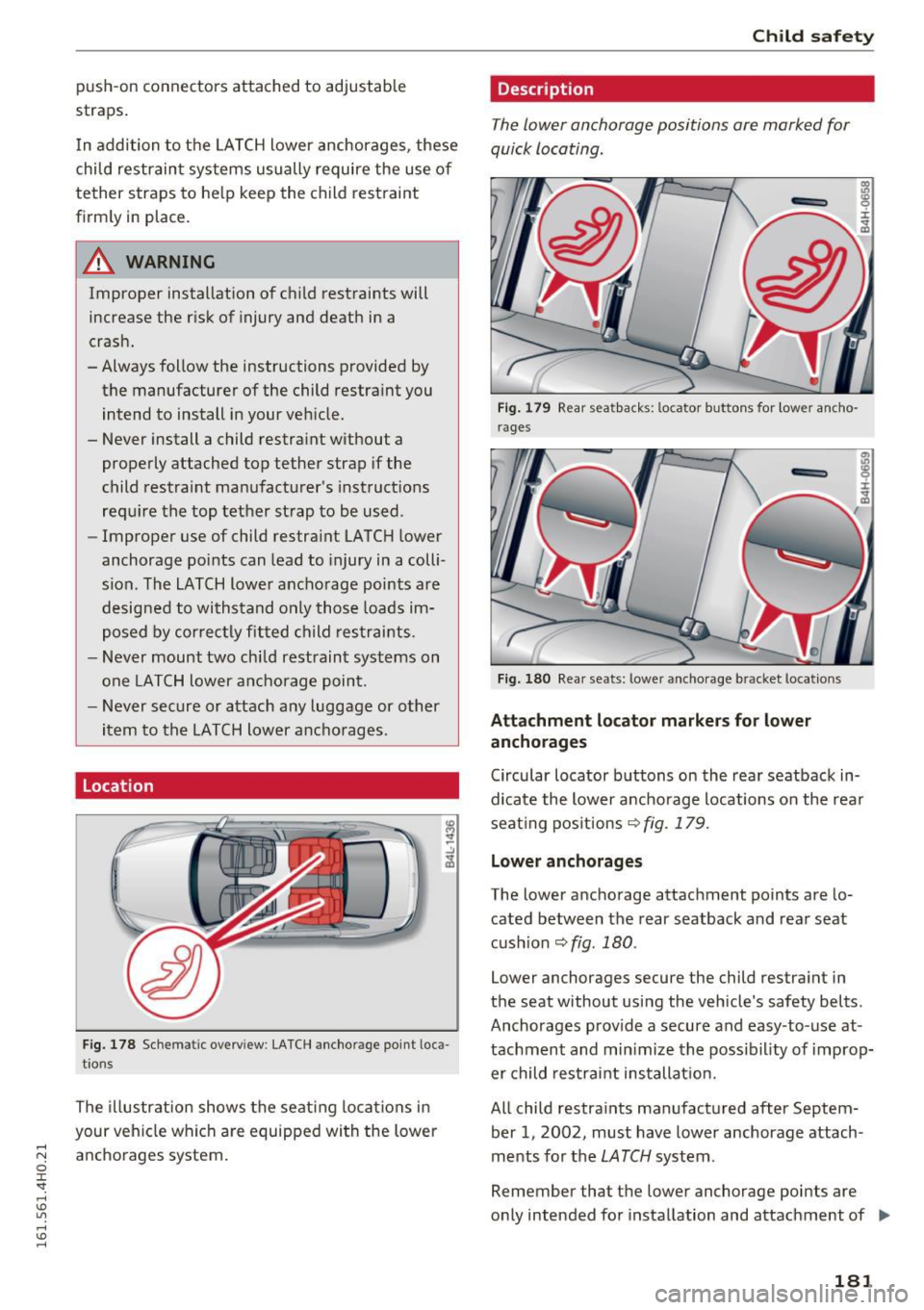
Location
F ig. 178 Sche matic overv ie w : LA TCH an ch orag e point loc a
t io ns
The illustration shows the seating locations in
your veh icle which a re equipped with the lower
ancho rages system.
Ch ild sa fety
Description
The lower anchorage positions are marked for
quick locating .
Fig . 1 79 Rear seatbacks: loca tor bu tto ns for low er an cho
r ages
Fi g. 180 Rea r seat s: lowe r anchorage bracket lo ca tion s
Att achment lo cator markers for lower
anchorages
:r
~ (
Circular locator buttons on the rear seatback in
dicate the lower anchorage locations on the rear
seating pos itions
Q fig . 179.
Lower anchorages
The lower anchorage attachment points are lo
cated between the rear seatback and rear seat
cush ion
c::> fig. 180 .
Lower anchorages secu re the child res traint in
the seat without using the vehicle's safety belts .
Anchorages provide a secure and easy -to -use at
tachment and min imize the possibility of improp
er child restraint installat ion.
All child restra ints manufactured after Septem
ber 1 , 2002, must have lower anchorage attach
ments fo r the
LATCH system .
Remember that the lower anchorage points are
only intended for installation and attachment of .,_
181
Page 184 of 302
Child safety
child restraints specifically certified for use with
LATCH lower anchorages. Child restraints that
are not equipped with the lower anchorage at
tachments can still be installed in compliance
with the child restraint manufacturer's instruc
tions on using vehicle safety belts .
A WARNING
Improper use of LATCH lower anchorages can
cause serious personal injury in an accident.
- Always carefully follow the child restraints
manufacturer's instruct ions for proper in
stallation of the child restra int and proper
use of the lower anchorages or safety belts
in your vehicle.
- Never secure or attach any luggage or other
items to the LATCH lower anchorages.
- Always read and heed the important infor
mation about child restra ints in this chapter
and WARNINGS ~page 168, Child safety.
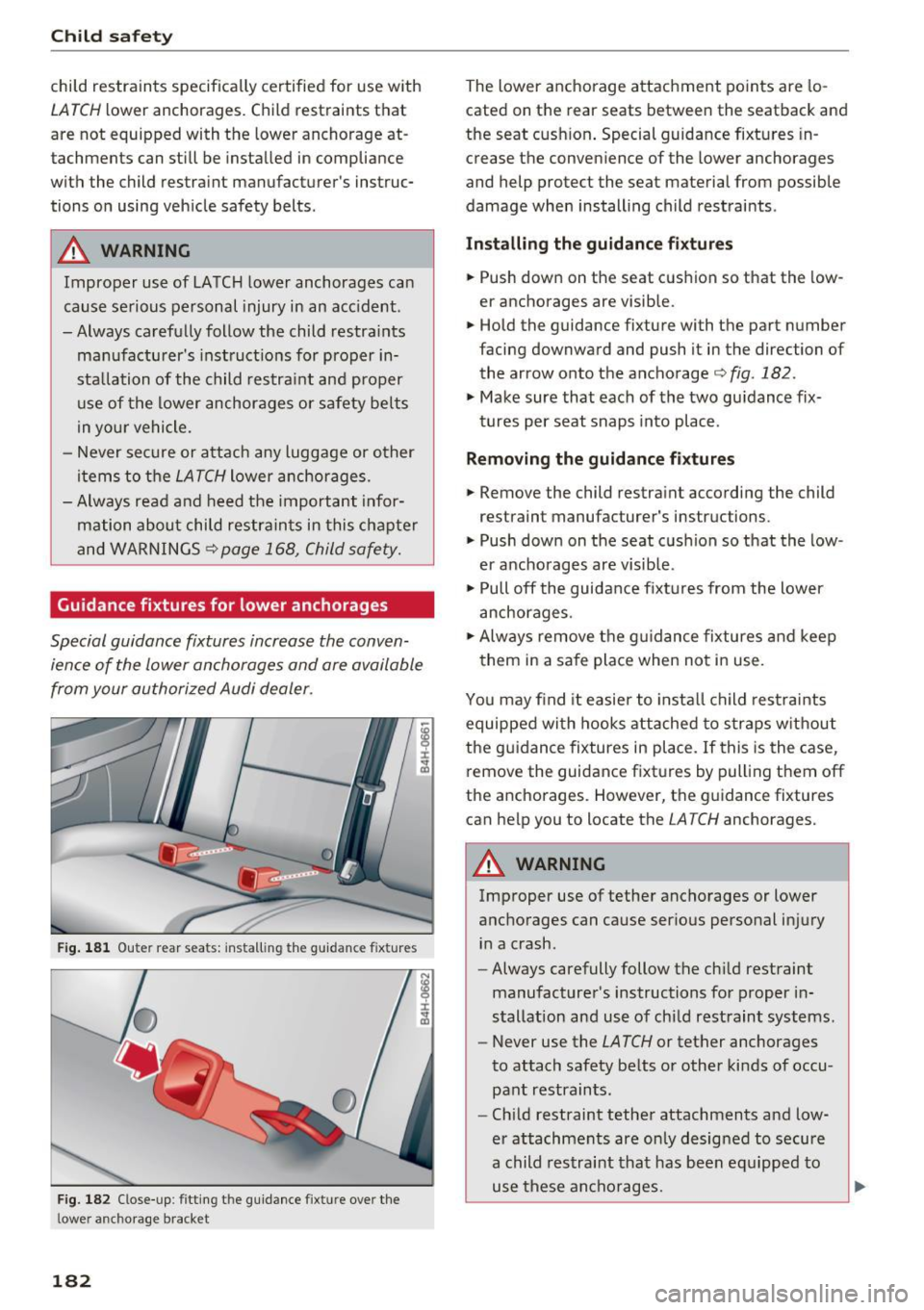
Guidance fixtures for lower anchorages
Special guidance fixtures increase the conven
ience of the lower anchorages and are available
from your authorized Audi dealer .
Fig . 1 81 Outer rear seats: insta llin g the guidance fixt ure s
Fig. 182 Close -up : f itt ing t he gu idance fixtu re over the
l owe r an ch orage bracket
182
The lower anchorage attachment points are lo
cated on the rear seats between the seatback and
the seat cushion . Special guidance fixtures in
crease the conven ience of the lower anchorages
and help protect the seat material from possible
damage when installing child restraints .
Installin g the guidance fi xtur es
.,. Push down on the seat cushion so that the low
er anchorages are visible.
.,. Hold the guidance fixture with the part number
facing downward and push it in the direction of the arrow onto the anchorage ~ fig . 182.
.,. Make sure that each of the two gu idance fix
tures per seat snaps into place.
Removing the guid ance fi xture s
.,. Remove the child restraint according the child
restraint manufacturer's instructions.
.,. Push down on the seat cushion so that the low
er anchorages are visible .
.,. Pull off the guida nee fixtures from the lower
anchorages .
.,. Always remove the g uidance fixtures and keep
them in a safe place when not in use.
You may find it easier to install child restra ints
equipped with hooks attached to str aps w ithout
the gu idance fixtures in place. If this is the case,
r emove the guidance f ixtures by pull ing them off
the anchorages . However, the gu idance fixtures
can help you to locate the LATCH anchorages.
A WARNING
Improper use of tether anchorages or lower
anchorages can cause ser ious personal injury
in a crash .
- Always carefully follow the ch ild restraint
manufacturer's instructions for proper i n
stallation and use of child restraint systems .
- Never use the LATCH or tether anchorages
to attach safety belts or other kinds of occu
pant restraints.
- Ch ild restraint tether attachments and low
er attachments are only desig ned to secure
a child restraint that has been eq uipped to
use these an cho rages.
Page 185 of 302
-Tether anchorages and lower anchorages
are designed to withstand only those loads
imposed by correctly fitted child restraints.
Under no circumstances can they be used
safely for adult or child safety belts or har
nesses .
- Never mount more than one child restraint to a s ingle tether or to a lower anchorage
point. Attaching two ch ild restraints to a
s ingle anchorage point can ca use the an
c horage to fa il and cause serious persona l
injury in a crash.
(D Note
- Remove the g uidance fixtures before fold
i ng the rear seatback to prevent damaging
the seat cush ion.
- To attach the ch ild restraint securely, the
seat must be moved to the farthest rea r po
s ition, the seat height se t to the lowest po
sition and the head restraint must be ad
j u sted to the vertica l posit ion¢
page 61.
- If you leave the guidan ce fixt ures installed
for severa l days, they could leave a mark on
the upho lstery on t he seat c us h ion and
backrest in the area that the gu idance fix
tures were installed. The upholstery would
also be permanently stretched around the
guidance fixtures. This applies especially to
leather seats.
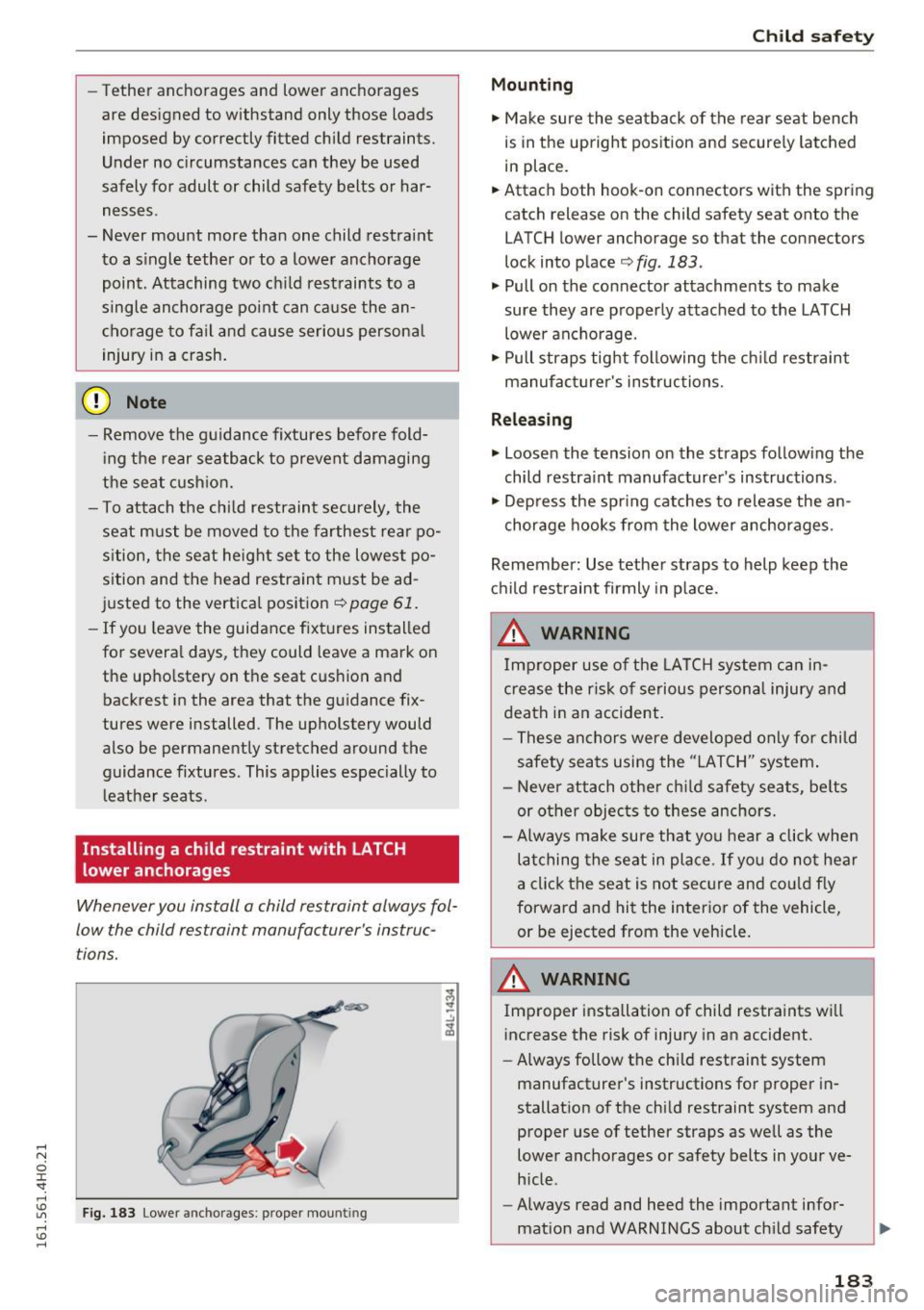
Installing a child restraint with LATCH
lower anchorages
Whenever you install a child restraint always fol
low the child restraint manufacturer's instruc
tions.
F ig. 183 Lower anch orages : proper mo untin g
Ch ild sa fety
Mounting
"' Make sure the seatback of the rear seat bench
is in the up right pos ition and secure ly latched
in place.
"' Attach both hook-on connectors with the spring
catch release on the child safety seat onto the
LATCH lower anchorage so that the connectors
lock into place ¢
fig. 183 .
"' Pull on the connector attachments to make
sure they are properly attached to the LATCH
lowe r ancho rage.
"' Pull straps tig ht following the ch ild restraint
manufac turer 's ins truc tions.
Releasing
"' Loosen the tension on the straps follow ing the
child restra int manufac turer's instructions .
"' Dep ress the spr ing catches to release the an
chorage hooks from the lower anchorages.
Remember: Use tethe r straps to help keep the
child rest raint firmly in p lace.
_&. WARNING
I mp roper use of t he LA TCH system can in
crease the ris k of serious persona l injury a nd
death in an accident.
- These an cho rs were developed only for child
safety sea ts using the " LATCH" system .
- Never attach othe r ch ild safety seats, be lts
or o ther objec ts to these anchors.
- Always make sure that yo u hear a click when
latching the seat in place.
If you do not hear
a cl ick the seat is not se cure and co uld fly
forward and hit the interior of the vehicle,
or be ejected from the vehicle.
_&. WARNING
Improper insta llation of child restraints wi ll
i ncrease the risk of injury in an accident.
- Always follow the ch ild restraint system
manufacturer's instructions for proper in
stallation of the chi ld restraint system and
proper use of tether straps as we ll as the
lower anchorages or safety belts in your ve
h icle .
- Always read and heed the important infor
mat ion and WARNINGS about ch ild safety
183
Page 186 of 302
Child safety
and the installation of child restraint sys
tems
r::> page 168 , Child safety.
(D Note
On vehicles with power adjustable rear seats*
some criteria must be observed when attach
ing the child restraint using the
LA TCH sys
tem:
- To attach the chi ld restraint securely, the
seat must be moved to the farthest rear po
sition, the seat height set to the lowest po
sition and the head restraint must be ad
justed to the vertical position
c'.:> page 61.
- If a ch ild safety seat is attached to one of
the rear seats , this seat must not be adjust
ed using the power controls under any cir
cumstances . The
Entr y ass is ta n ce for th is
seat must also be deactivated in the MMI
r::> page 64. The child safety seat as wel l as
the rear seat can be damaged by the adjust ment process .
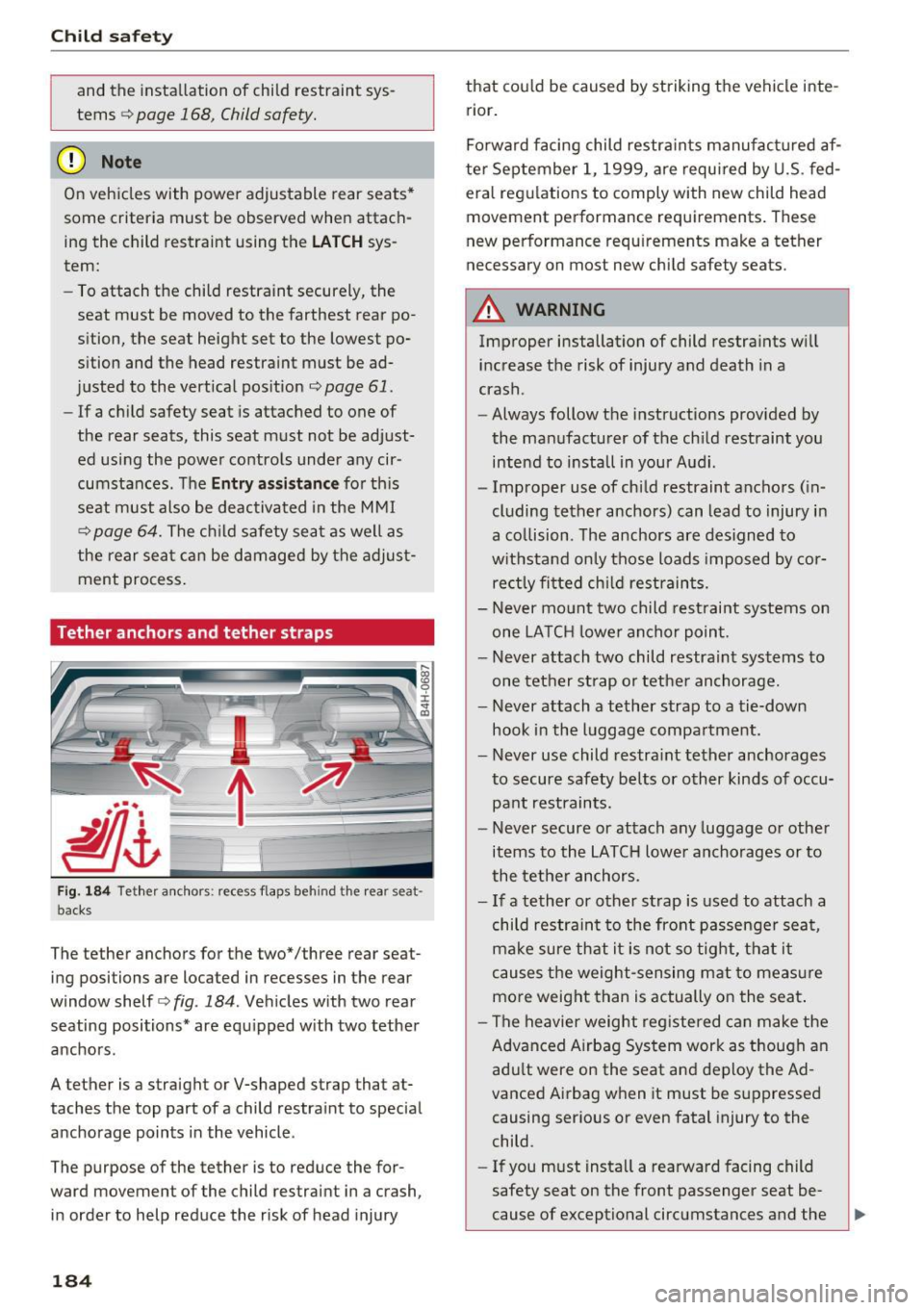
Tether anchors and tether straps
Fig. 18 4 Te ther a nch ors: recess flaps beh ind the rear sea t
ba cks
The tether anchors for the two* /three rear seat
ing positions are located in recesses in the rear
window shelf
r::> fig . 184 . Vehicles with two rear
seating positions* are equ ipped w ith two tether
anchors .
A tether is a straight or V-shaped strap that at taches the top part of a child restraint to special
anchorage points in the vehicle .
The purpose of the tether is to reduce the for
ward movement of the child restraint in a crash, in order to help reduce the risk of head injury
184
that cou ld be caused by striking the vehicle inte
r ior.
Forward facing child restra ints manufact ured af
ter September 1, 1999, a re required by U.S. fed
eral regu lations to comply with new child head
movement performance requirements . These
new performance requ irements make a tether
necessary on most new child safety seats.
A WARNING
Improper installation of child restraints wi ll
i ncrease the risk of injury and death in a
crash .
- Always follow the instructions provided by
the manufacturer of the ch ild restraint you
intend to install in your Audi .
- Improper use of chi ld restraint anchors (in
cluding tether anchors) can lead to injury in
a co llision. The anchors are designed to
w ithsta nd only those loads imposed by cor
rectly fitted ch ild restraints.
- Never mo unt two ch ild rest raint systems on
one LATC H lower anchor poin t.
- Never attach two child restraint systems to
one tether st rap or tethe r anchorage.
- Never attach a tether strap to a tie-down
hook in the luggage compa rtment .
- Never use child restra int tether anchorages
to secure safety belts or other kinds of occu
pant restraints.
- Never secure or attach any luggage o r other
items to the LATCH lowe r anchorages or to
the te ther anchors.
- I f a tether or other strap is used to attach a
child restra int to the front passenge r seat,
make sure that it is not so tight, tha t it
causes the weight-sensing mat to meas ure
more weight than is actually on the seat.
- The heavier weight reg istered can make the
Advanced A irbag Sys tem wor k as though a n
adu lt were on the seat and deploy the Ad
vanced Airbag when it must be suppressed
causing serious or even fatal injury to the
child.
- If you must insta ll a rearward facing child
safety seat on the front passenger seat be
cause of exceptional circumstances and the
Page 189 of 302
Audi pre sense Preventative passenger
protection
A ppl ies to: ve hicles with Audi pre se nse
Audi pre sense can initiate steps to help protect
vehicle occupants in certain situations. The func
tions described depend on equipment installed in
your veh icle:
Audi pre sense basic
The following functions can be triggered in cer
tain driving situations:
- Tightening of the safety belts (for examp le,
during heavy braking): the front safety belts
have reversible belt pretensione rs. If a collision
does not occur, the safety belts loosen slightly
and are ready to be t ightened again.
- Closing the windows and the sunroof*: the win
dows and the sunroof* close leaving a small
open gap .
Audi pre sense basic functions can be triggered at
speeds above 20 mph (30 km/h). The deploy ment time is adapted in the drive select mode dy
namic.
Audi pre sense front (vehicles with adaptive
cruise control*)
Audi pre sense front includes the functions in
Audi pre sense basic . In addition, within the lim
its of the system, the likelihood of a collision
with the vehicle immediately ahead is also calcu lated.
If the system senses an imminent collision
the following functions can be triggered:
- Braking guard
~ page 96
- Tightening the safety belts
- Closing the windows and the sunroof* (leaving
a small open gap)
Audi pre sense rear (vehicles with Audi side
assist*}
Audi pre sense rear includes the functions in Audi
pre sense basic. In addition, the likelihood of a
rear-end collision with the vehicle coming from
behind is also calculated.
If the risk of a collision
is detected , the following functions can be trig
gered:
Audi pre sense
-Tig htening the safety belts
- Closing the windows and the sunroof* ( leaving
a small open gap)
- Adjusting the seats: the settings for the power
head restrains, the upper sections of the backr
ests and the pneumatic side bolsters* are opti mized for the front seats and the outboard rear
seats*. If a co llision does not occur, the previ
ous seat settings are restored.
Audi pre sense plus
Audi pre sense plus includes the functions in Audi
pre sense front and Audi pre sense rear.
Error message
Audi pre sense: not available
Preventative passenger protection is not availa
ble . See your authorized Audi dealer immediately
to have the malfunction corrected .
A WARNING
-
Audi pre sense cannot overcome the laws of
physics. It cannot prevent a collision. Do not
l et the increased safety provided tempt you to
take risks. This will increase the risk of a colli
sion and serious personal injuries.
- The sensors cannot always detect all ob
jects. This increases the risk of a collision.
-Audi pre sense does not detect people or an
imals or objects that are crossing the vehi
cle's path
~ page 90.
-The radar sensor's vision can be reduced by
heavy rain, ice, snow, heavy road sp ray and
reflections from guard rails, tunne l entran
ces, etc. These and similar conditions can prevent vehicles from being accurately de
tected and in some cases they may not be
detected at all.
(D Note
The sensors can be displaced by impacts or
damage to the bumper, wheel housing and
underbody. This can affect the function of the
Audi pre sense system . Have your authorized
Audi dealer check to make sure that the sys
tem is work ing properly.
187