ABS AUDI A8 2017 User Guide
[x] Cancel search | Manufacturer: AUDI, Model Year: 2017, Model line: A8, Model: AUDI A8 2017Pages: 354, PDF Size: 88.68 MB
Page 128 of 354
Intelligent Technology
Intelligent Technology
Electronic Stabilization
Control (ESC)
Description
The ESC increases driving safety . It reduces the
risk of s lipping and improves driving stabi lity.
ESC detects critical situations such as when the
veh icle is oversteer ing and understeering or the
wheels are spinning. The vehicle is stabilized by
apply ing the brakes or reducing eng ine torque .
When ESC engages, the
Ji] ind icator light blinks
in the inst rument cluste r.
The fo llow ing systems are integrated in the ESC:
Anti -lock b raking system (ABS)
ABS prevents the whee ls from locking when brak
i n g . The vehicle can sti ll be steered even d uring
hard brak ing. Apply steady press ure to the brake
pedal. Do not pump the pedal. A puls ing in the
brake pedal indicates that the system is acting to
stabilize the vehicle.
Brake a ssi st sy stem
The brake assist system can dec rease braking dis
tance. It increases brak ing power when the driver
presses the brake pedal quick ly in emergency sit
uations . You must press and hold the brake pedal
until the dangerous situat io n is over . In veh icles
w ith adapt ive c ruise control*, the bra ke assis t
system is more sensitive if the distance detected
to the veh icle dr iv ing ahead is too small. On
ve hicles w ith act ivated and functi oni ng night vi
sion assist*, the brake assist system can respond
more sensit ively if there is a warning .
Anti-slip regulation (ASR)
A SR red uces eng ine power when the d rive wheels
begin s pinning and ad apts the force to the road
conditions. This makes it easier to sta rt, acceler
ate and dr ive up hi lls.
Electronic differential lock (EDL )
EDL applies the brakes to a wheel that sta rts
sp inning and t ransfe rs t he d rive powe r to t he
o ther d riving w heels. This f unct ion is not av aila
b le at higher speeds .
126
In extreme cases, ED L automat ically switches off
to keep the b rake on the braked whee l from over
heating. The veh icle is still working correct ly. ED L
will switc h on again automatically when condi
tions have returned to normal.
Steering recommendat ion
The E SC he lps to stabili ze the vehicle by changing
the steering torque.
I n veh icles with dyna mic steer ing*, ESC a lso
helps to sta bilize the s teer ing in cr it ica l situa
tions.
Selective wheel torque control
Se lective wheel to rque cont rol is used when d riv
i ng on curves.
The fro nt wheel on the ins ide of the curve or bo th
whee ls on the inside of the curve are braked se
l ectively as needed. This allows more pre cise d riv
i ng in cu rves. The applicab le system may no t ac ti
vate when dr iv ing in we t or snowy condi tio ns.
Automatic post -collision braking system
The "automat ic post-coll is io n braking system"
can help to reduce the risk of sl iding and of addi
tiona l co llisions after an acc iden t. If the a irbag
c ontro l modu le detects a collision above a cer tain
vehicle speed, the ve hicle is braked by the ESC.
The veh icle does not b rake automatically if:
- the drive r presses the acce lerator pedal, or
- the bra king force generate d by the pressed
brake pedal is greater than the b raking force
that would be in itiated by the system, or
- the ESC, the bra ke system or the vehicle electri
cal system are not functioning.
A WARNING
- The ESC and its integ rated systems can not
overcome the lim its imposed by natura l
p hys ica l laws. Th is is es pec ially impor tan t
on s lippery or wet roads. If the system s be
g in a cting to stabilize yo ur vehicle, you
should immedi ately alte r your speed to
match the road and tra ffi c conditions. Do
not let t he i ncreased safety provi ded tempt
Page 129 of 354
0 co .... N ,..... N .... 0 0 :c '
your risk of a co llision.
- Please note the risk of a co llision increases
when driving fast, especially through curves
and on slippery or wet roads, and when driv
ing too close to objects ahead. The ESC and
its integrated systems cannot always pre
vent collisions - there is still a r is k of acci
dents!
- Press the accelerator pedal carefully whe n
accele rating on even, s lippery surfaces such
as ice and snow. The d rive wheels can spin
Switching on and off
Intellig ent Technology
even when these control systems a re insta l
led and this can affect driving stability and
increase the risk of a collision.
@ Tips
- The ABS and ASR only function correct ly
when a ll four wheels have a simi la r wear
condition. Different tire sizes can lead to a
reduction in engine power.
- You may hear noises when the systems de
scribed are working.
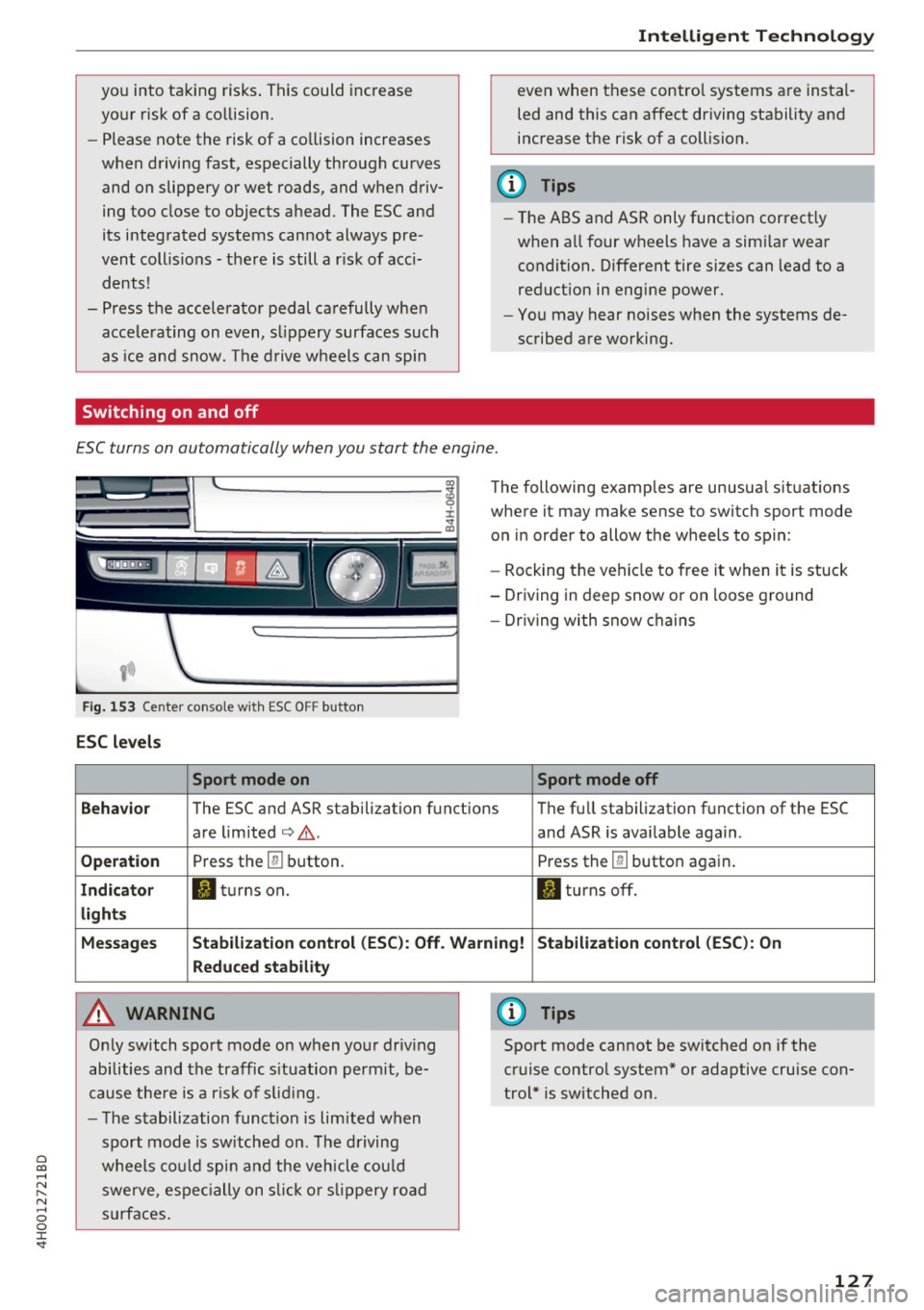
ESC turns on automatically when you start the engine .
Fig. 1 53 Center co nso le w it h ESC O FF button
ESC le vels
Sport mode on
The following examples are unusua l situations
where it may make sense to switch sport mode
on in order to allow the wheels to spin:
- Rock ing the vehicle to free it when it is stuck
- Driving in deep snow o r on loose g round
- Dr iving with snow chains
Sport mode off
Behavior
The ESC and ASR stabilization functions The full stabilization function of the ESC
are lim ited
¢ .&. . and ASR is ava ilable aga in .
Operation Press the [!I button. Press the [!I button again.
Indicator II tu rns on. II turns off .
lights
Messages Stabilization control (ESC ): Off. Warning! Stabilizat ion control (ESC ): On
Reduced stability
A WARNING
On ly switch spo rt mode on when yo ur driv ing
abilities and the traffic s ituation permit, be
cause t he re is a r is k of s lid ing .
- T he stabilization func tion is limited when
spo rt mode is sw itched on. The driving
w heels co uld sp in and the veh icle cou ld
swerve, espec ially on s lick o r slip pery roa d
su rf a ces .
(D Tips
Sport mode cannot be switched on if the
cruise control system* or adaptive cruise con
tro l* is switched on .
127
Page 187 of 354

C) C0 ....
"' " "' .... 0 0 :r
Introduction
Applies to: ve hicles with Audi music interface
You can connect a portable device (such as an
MP3 player) to the Audi music interface using a
special adapter cable* and operate the device through the MMI.
.,-.,.
F ig. 1 96 Adapter cables
® iPod adapter cable* /iPod adapter cab le plus*
® 3.5-mm stereo jack adapter c able*
© Mini USB adapte r cab le*
@ Micro USB adapter cab le*
© USB adapter cable *
® AV adapter cable*
@ Adapter cable for App le dev ices w ith Lightning
connector*
You can p urchase the adapter cable from an au
thor ized Audi or at specialty stores.
(D Note
- Han dle the adapter cab le carefully . Do not
a llow it to be pinched.
- Ext reme ly h igh or l ow temperatures that
can occ ur inside vehicles can damage porta
ble devices or affect their performance .
Never leave a portable audio dev ice in the
vehicle in extremely high or low tempera
tures .
(D Tips
Be sure to pay attent io n to a ny messages on
your cell p ho ne when connect ing it w it h the
USB / Mini USB / Micro USB a dapte r cable. In
Media drives and connections
some c ases, i t may not be possi ble to access
the au dio files on your cell phone.
Setup
Applies to : vehicles wi th Audi music interface
The Au di music interfa ce is located inside the
center armrest.
Fig. 19 7 Connecti ng t he po rtab le dev ice
Requireme nt: T he center a rmrest is fo lded open .
-Connecting the adapter cable: connect the
adapte r cable* @¢
fig. 197 to the port on the
Aud i mus ic interface
(D and then co nnect it to
the portable audio device ® (such as an iPod) .
-Disconnecting the adapter cable from the
Audi music interface :
disconnect the connector
from t he Aud i mus ic interface wh ile press ing
th e re lease tab @.
-Disconnecting the iPod adapter cable (plus)*
from the iPod :
disconnect the iPod connec tor
from the iPod while p ressing the release tabs
@ .
The media are started and operated through the
p ort able device or the MMI, depending on the de
vice being used
¢page 189.
Q) Note
Remove t he c onnector fro m the Aud i music
i nterface carefully so it is not damaged.
@ Tips
- Do not use USB extension cab les or adapt
ers. T hey may impa ir the fu nctionality .
- Functionality is not guaranteed for portable
devices that do not meet the USB 2.0 s peci
fication .
- USB hubs are not suppo rted.
185
Page 215 of 354
0 co .... N ,..._
N .... 0 0 :c '
floor coverings on top of already installed
floor mats. Additional floor mats and other
coverings will reduce the size of the pedal
area and interfere with the pedals .
- Always properly reinstall and secure floor
mats that have been taken out for cleaning.
- Always make sure that objects cannot fall
into the driver footwell while the vehicle is
moving . Objects can become trapped under
the brake pedal and accelerator pedal caus ing a loss of veh icle control.
Storing cargo correctly
Loading the luggage compartment
All luggage and other objects must be properly
stowed and secured in the luggage compart
ment.
L oose items in the luggage compartment can
shift suddenly, changing vehicle handling charac
teristics. Loose items can also increase the risk of
serious personal injury in a sudden vehicle ma
neuver or in a collision.
.. Distribute the load evenly in the luggage com
partment.
.. Always place and properly secure heavy items in
the luggage compartment as far forward as
possible.
.,. Secure luggage items using the tie-downs pro
vided
¢ page 65.
A WARNING
Improperly stored luggage or other items can
fly through the vehicle causing serious per sonal injury in the event of hard braking or an
accident. To help reduce the risk of serious
personal injury:
- Always put objects, for example, luggage or
other heavy items in the luggage compart
ment.
- Always secure objects in the luggage com
partment using the tie-down hooks and
suitable straps .
Driving safety
A WARNING
Heavy loads will influence the way your vehi
cle handles. To help reduce the risk of a loss
of control lead ing to serious personal injury:
- Always keep in m ind when transporting
heavy objects, that a change in the center of
gravity can also cause changes in vehicle handling:
- Always distribute the load as evenly as
possible .
- Place heavy objects as far forward in the
luggage compartment as possible.
- Never exceed the Gross Axle Weight Rating
or the Gross Vehicle Weight Rating specified
on the safety compliance sticker on the left
door jamb. Exceeding permissible weight
standards can cause the vehicle to slide and handle differently.
- Please observe information on safe driving
¢page 207.
A WARNING
To help prevent poisonous exhaust gas from
being drawn into the vehicle, always keep the
rear lid closed while driving .
- Never transport objects larger than those
f itting completely into the luggage area be
cause the rear lid cannot be fully closed.
- If you absolutely must drive with the rear lid open, observe the following notes to reduce
the risk of poisoning:
- Close all windows,
- Close the power roof,
- Open all air outlets in the instrument pan-
el,
- Switch off the air recirculation
,
- Set the fresh air fan to the highest speed .
A WARNING
Always make sure that the doors, all win
dows, the power roof and the rear lid are se
curely closed and locked to reduce the r isk of
in jury when the vehicle is not being used.
- After closing the rear lid, always make sure
that it is properly closed and locked.
-
213
Page 221 of 354
C) C0 ....
"' ,....
"' .... 0 0 :r
that come on, could lead to persona l injury.
Why use safety belts?
Frontal collisions and the law of physics
Frontal crashes create very strong forces for peo
ple riding in vehicles .
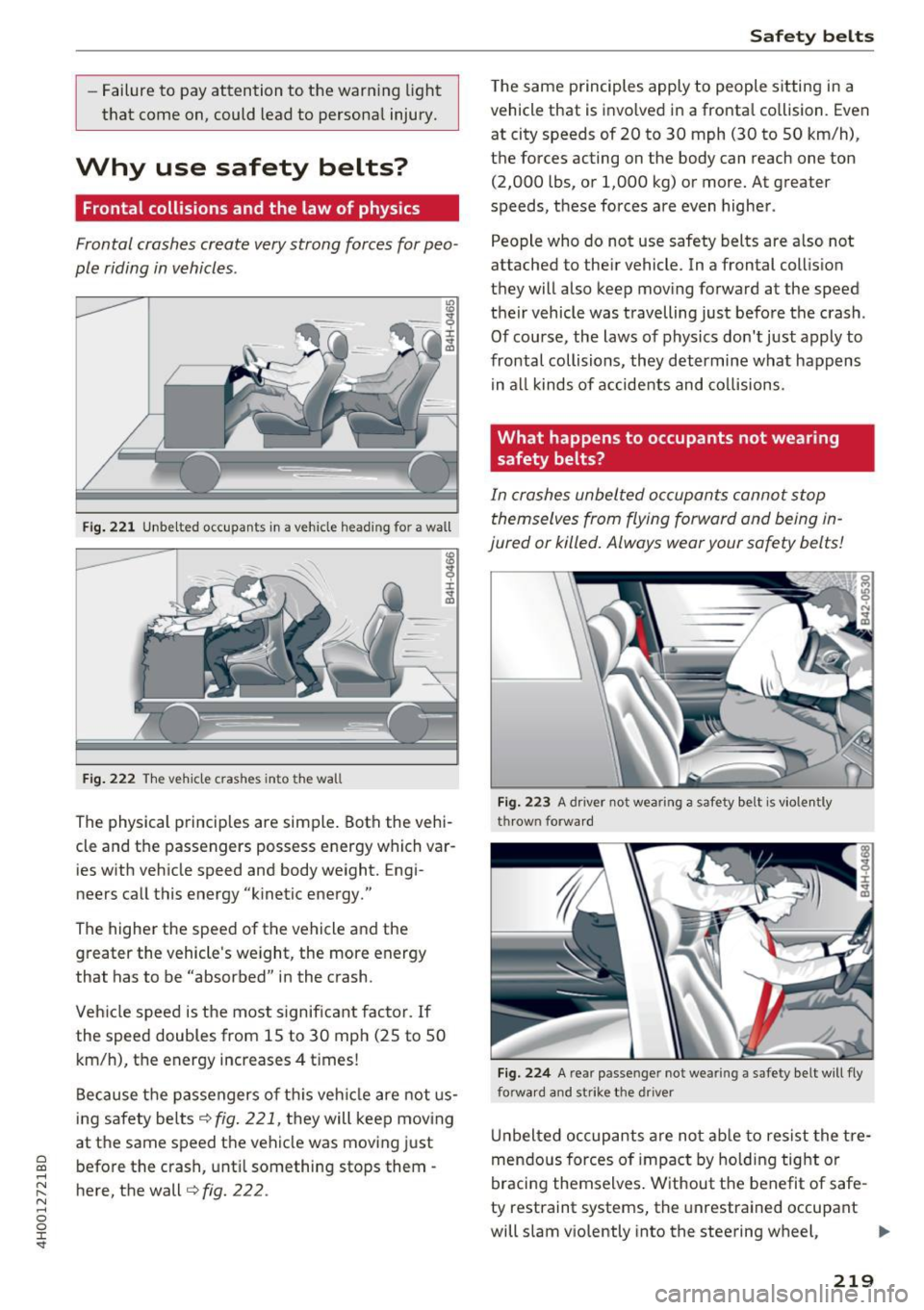
Fig. 221 Unbelted occupants in a vehicle heading for a wall
Fig. 222 The vehicle crashes into the wall
The physical principles are simple. Both the vehi
cle and the passengers possess energy which var ies with vehicle speed and body weight. Engi
neers call this energy "kinetic energy."
The higher the speed of the vehicle and the greater the vehicle's we ight, the more energy
that has to be "absorbed" in the crash.
Veh icle speed is the most significant factor. If
the speed doubles from 15 to 30 mph (25 to 50
km/h), the energy increases 4 t imes!
Because the passengers of this vehicle are not us
ing safety belts
¢fig. 221, they will keep moving
at the same speed the vehicle was moving just
before the crash, until something stops them -
here, the wall¢
fig. 222 .
Safety belts
The same p rinciples apply to people sitting in a
vehicle that is invo lved in a fronta l co llision. Even
at city speeds of 20 to 30 mph (30 to 50 km/h),
the forces acting on the body can reach one ton
(2,000 lbs, or 1,000 kg) or more. At greater
speeds, these forces are even higher.
People who do not use safety belts are a lso not
attached to the ir vehicle. In a frontal collis ion
they will also keep moving forward at the speed
their vehicle was travelling just before the crash .
Of course, the laws of physics don't just apply to
frontal collisions, they determine what happens in all kinds of accidents and collisions .
What happens to occupants not wea ring
safety belts?
In crashes unbelted occupants cannot stop
themselves from flying forward and being in
jured or killed. Always wear your safety belts!
Fig. 223 A dr iver not wearing a safety belt is violently
thrown forward
Fig . 224 A rear passe nger not wearing a safety belt will fly
forwa rd and strike the driver
Unbelted occupants are not able to resist the tre
mendous forces of impact by holding tight or
bracing themselves . Without the benefit of safe
ty restraint systems, the unrestrained occupant
will slam v iolently into the steering wheel,
Ill>-
219
Page 222 of 354
Safe ty belts
instrument panel, windshield, or whatever else is
in the way
r:!> fig. 223. This impact with the vehi
cle interior has all the energy they had just be
fore the crash.
Never rely on airbags alone for protection . Even
when they deploy, airbags provide only additional
protection. A irbags are not supposed to dep loy in
all kinds of accidents. A lthough your Audi is
equipped w ith airbags, all vehicle occupants, in
cluding the driver, must wear safety belts cor
rectly in order to minimize the risk of severe in
jury or death in a crash .
Remember too, that airbags will deploy only
once and that your safety belts are always there
to offer protect ion in those accidents in wh ic h
airbags are not supposed to deploy or when they
have a lready deployed . Unbel ted occupants can
also be thrown o ut of the veh icle where eve n
mo re severe or fatal injuries can occur .
It is also important for the rear pass engers to
wear safety belts correctly. Unbelted passengers
i n t he re ar seats endanger no t on ly themse lves
but also the drive r and other passengers
~ fig . 224. In a frontal collision they will be
thrown forward violently, where they can hit and
in jure the driver and/or front seat passenger.
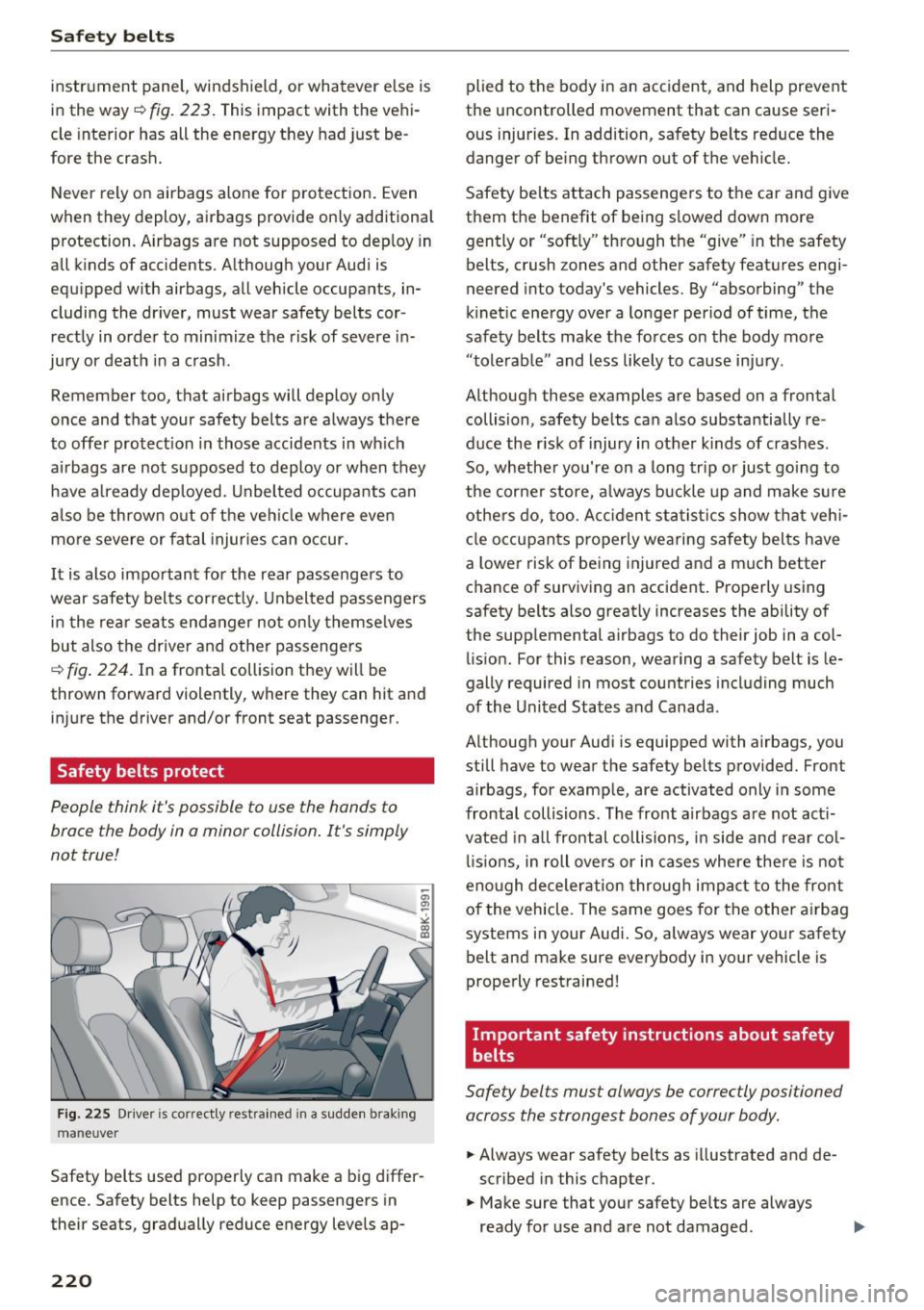
Safety belts protect
People think it's possible to use the hands to
brace the body in a minor collision . It's simply
not true!
F ig . 22 5 Driver is co rrectly restrai ned in a sudde n brak ing
m aneu ver
Safety belts used properly can make a b ig d iffer
ence. Safety belts help to keep passengers in
their seats, gradually reduce energy levels ap-
220
plied to the body in an accident , and help prevent
the uncontrolled movement that can cause seri
ous injuries. In add ition, sa fety belts red uce the
danger of being thrown out of the vehicle.
Safety be lts attach passengers to the car and g ive
them the benefit of being s lowed down more
gently or "soft ly" thro ugh the "give" in the safety
belts, crush zones and other safety feat ures engi
neered into today's vehicles. By "absorbing" the
k inet ic energy over a longer per iod of t ime, the
safety belts make the forces on the body more
"tolerab le" and less likely to cause inju ry .
Although these examples are based on a frontal
collision, safety be lts ca n also substantially re
duce the r isk o f injury in ot her kinds of crashes .
So, whethe r yo u're on a long trip or just goi ng to
the cor ne r store, a lways b uckle up and make s ure
othe rs do, too. Ac ciden t st at ist ics show that veh i
cle o ccupants prope rly wearing safety bel ts have
a lowe r risk of being injured and a m uch better
chance of surviving an acc ident . Properly using
safety be lts also great ly increases the ability of
the supp lemental airbags to do their job in a col
li sion. For this reason, wearing a safety belt is le
gally required in most countries including much
of the United States and Canada .
Although your Aud i is equipped with airbags, you
still have to wear the safety belts provided. Front
airbags, for examp le, are activated only in some
frontal collisions. The front airbags are not act i
vated in all frontal collisions, in side and rear co l
li sions, in roll overs or in cases where the re is not
eno ugh deceler ation throug h impa ct to the front
of the vehicle . The same goes for the other a irbag
systems in your Audi. So, always wear your safety
belt and make sure everybody in your vehicle is
properly rest rained!
Important safety instructions about safety
belts
Safe ty belts must always be correctly positioned
acros s the strongest bones of your body .
.,. Always wear safety belts as illustrated and de
scribed in this chapter.
.,. Make sure that your safety be lts are always
ready fo r use a nd are not damaged .
Page 232 of 354
Airbag system
Front airbags
Description of front airbags
The airbag system can provide supplemental
protection to properly restrained front seat occu
pants.
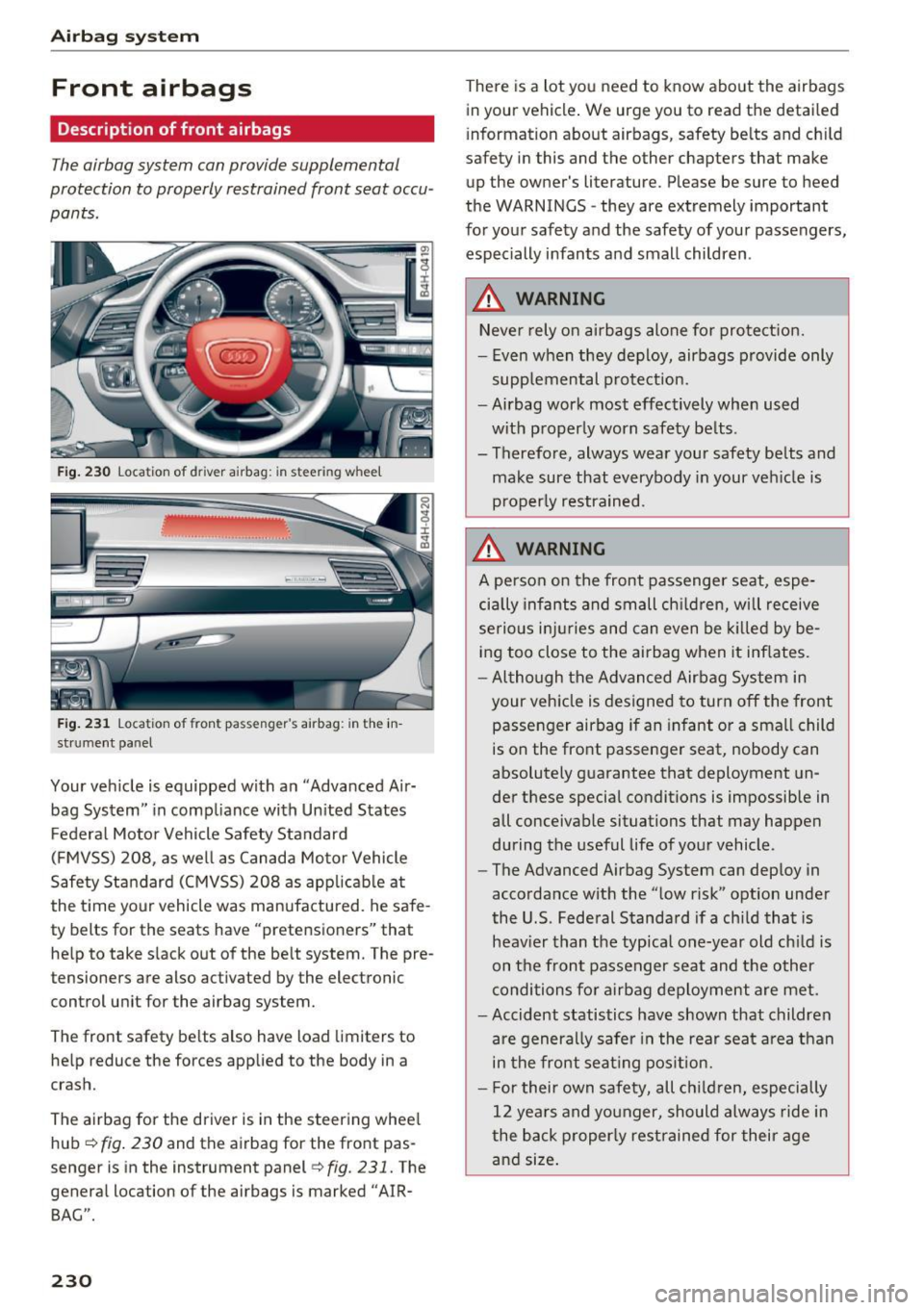
Fig. 230 Location of dr iver airbag: in steering whee l
Fig. 231 Location of front passenger's airbag: in th e in
strument panel
Your veh icle is equipped with an "Advanced Air
bag System " in compliance with Un ited States
Federal Motor Vehicle Safety Standard
(FMVSS) 208, as well as Canada Motor Vehicle
Safety Standard (CMVSS) 208 as applicable at
the time your vehicle was manufactured. he safe
ty belts for the seats have "pretensioners" that help to take s lack out of the belt system. The pre
tensioners are also activated by the electronic
control unit for the airbag system.
The front safety be lts also have load limiters to
help reduce the forces applied to the body in a
crash.
The airbag for the driver is in the steering wheel
hub~
fig . 230 and the airbag for the front pas
senger is in the instrument panel~
fig. 231. The
general location of the airbags is marked "AIR
BAG".
230
There is a lot you need to know about the airbags
in your vehicle . We urge you to read the detai led
i nformation about airbags, safety belts and ch ild
safety in this and the other chapters that make
up the owner's literature. Please be sure to heed
the WARNINGS -they are extremely important
for your safety and the safety of your passengers,
especially infants and small children .
.&_ WARNING -
Never rely on airbags alone for protection.
- Even when they deploy, airbags provide only
supp lemental protection.
- Airbag work most effectively when used
with properly worn safety belts .
- Therefore, always wear your safety belts and make sure that everybody in your vehicle is
properly restrained .
.&_ WARNING
A person on the front passenger seat, espe
cially infants and small ch ildren, wi ll receive
serious injuries and can even be killed by be
ing too close to the airbag when it inf lates.
- Although the Advanced Airbag System in
-
your vehicle is designed to turn off the front
passenger airbag if an infant or a small child
is on the front passenger seat, nobody can
absolutely guarantee that deployment un
der these special conditions is impossible in
all conceivable situations that may happen
during the useful life of your vehicle.
- The Advanced Airbag System can deploy in
accordance with the "low risk" option under
the U.S. Federal Standard if a child that is
heav ier than the typical one-year old ch ild is
on the front passenger seat and the other
conditions fo r airbag deployment are met.
- Accident statistics have shown that children
are generally safer in the rear seat area than
in the front seating pos ition.
- For their own safety, all children, especially
12 years and younger, should always ride in
the back proper ly restrained for their age
and size.
Page 234 of 354
Airbag syste m
-a small adu lt or teenager is on the front pas
senger seat
- a passenger who is not sitting upright with
their back against a non -reclined backrest with
their feet on the vehicle floor in front of the
seat is on the front passenger seat.
I f the front passenger airbag dep loys, the Feder
al Standard requires the airbag to meet the "low
risk" deployment criteria to help reduce the risk
of injury through interaction with the airbag.
"Low risk" deployment occurs in those crashes
that take place at lower decelerations as def ined
in the electronic control unit¢
page 236.
Alway s remember: Even though your vehicle is
equ ipped w ith Advanced Airbags, the safest place
for children is properly restrained on the back
seat . Please be sure to read the important infor
mat ion in the sections that follow and be sure to
heed a ll of the WARN INGS.
A WARNING
To red uce the risk of inj ury when an ai rbag in
fla tes, a lways wear safety bel ts p roperly.
- If you are unrestrained, leaning fo rwa rd, s it
t ing s ideways or o ut of pos ition in any way,
yo ur risk of in jury is much h igher .
- Yo u will also re ceive serious injur ies and
could even be killed if you are up aga inst the
airbag or too close to it when it inflates -
even with an Advanced Airbag ¢
page 226.
A WARNING
A child in a rearward-facing chi ld seat insta l
led on the front passenger seat will be seri
ously injured and can be k illed if the front air
bag inflates -even with an Advanced Airbag
System.
- Although the Advanced A irbag System in
your vehicle is designed to turn off the front
airbag when a rearward-facing child re
straint has been installed on the front pas
senger seat, nobody can absolutely g uaran
tee that deployment is impossible in all con
ceivable s ituations that may happen during
the usef ul life of your vehicle .
- The inflating a irbag w il l hit the child seat or
infant carrier w ith great force and will
232
-
smash the child seat and child against the
backrest, center armrest, door, or roof.
- Always install rearward-facing child re
straints on the rear seat.
- If you must install a rearward facing child
seat on the front passenge r seat because of
except ional circumstances and the
PASSEN
GER AIR BAG OFF
light does not come on
and stay on, immed iate ly install the rear
facing chi ld seat in a rear seating posit ion
and have the airbag system inspected by
your Aud i dea le r.
A WARNING
If, in exceptional ci rcums tances, you must in
stall a forward-facing child restraint on the
fron t passenger's seat:
- Always make sure the forward-fa cing sea t
has been des igned and certified by its man
ufacturer for use on a front seat with a pas
senger front and side airbag.
- Never put the forwa rd-facing child restrain t
up against or very near the instr ument pan
el.
-Always move the front passenge r seat to
the highest position in the up and down ad
justment range and move it back to the
rearmost position in the seat's fore and aft
ad justment range, as far away from the air
bag as poss ible, before installing the for
ward-facing chi ld restraint.
- Always make sure that the safety be lt upper
anchorage is behind the ch ild restraint and
not next to or in fron t of the child restraint
so that the safety be lt will be p roperly posi
tioned.
- Ma ke sure that the
PASSENGER AIR BAG
OFF
li ght comes on and stays on a ll the time
wheneve r the ign it ion is swi tched on.
· Advanced Airbag System components
The fro nt passenge r sea t in your veh icle has a lo t
of ve ry important parts o f the Advanced A irbag
System in it. These parts include t he weight
sensing mat, sensors, wiring, brackets, and
more. The fu nction of the system in the front
passenger seat is checked by the electronic
1111>
Page 242 of 354
Airbag syste m
service action is entered in your Audi War
ranty
& Maintenance book let under AIRBAG
REPLACEMENT RECORD.
- For safety reasons in severe accidents, the
alternator and starter are separated from
the vehicle battery with a pyrotechnic circuit interrupter.
- Work on the pyrotechnic circuit interrupt
er must only be performed by a qualified
dea ler· risk of an accident!
- If the veh icle or the circuit interrupter is
scrapped, all applicab le safety precautions
must be followed .
@ For the sake of the environment
Undeployed airbag modu les and pretension
ers might be classified as Perch lorate Materi
al -special handling may apply, see
www .dtsc.ca.gov/hazardouswaste/perchlo
rate. When the vehicle or parts of the re
straint system including airbag modules and
safety belts w ith pretensioners are scrapped,
all applicable laws and regulations must be
observed. Your authorized Audi dealer is fa
m iliar with these requirements and we recom
mend that you have your dealer perform this
serv ice for you .
Other things that can affect Advanced
Airbag performance
Changing the vehicle's suspension system can
change the way that the Advanced Airbag System
performs in a crash. For example, using t ire-r im
comb inat ions not approved by Audi, lower ing the
veh icle, chang ing the st iffness of the suspens ion,
including the springs, suspension struts, shock
absorbers etc. can change the forces that are
measured by the airbag senso rs and sent to the
electronic contro l unit. Some suspension changes
can, for example, increase the force levels meas
ured by the sensors and make the airbag system
deploy in crashes in which it would not deploy if
the changes had not been made. Other kinds of changes may reduce the force levels meas ured by
the sensors and prevent the airbag from deploy ing when it should .
240
A WARNING
Changing the vehicle's suspension including
use of unapproved tire-rim comb inations can
change Advanced Airbag performance and in
crease the r isk of serious personal injury in a
crash.
- Never insta ll suspension components that
do not have the same performance charac
ter istics as the components origina lly ins tal
led on you r vehicle.
- N ever use tire-r im combinations that have
no t been approved by Aud i.
A WARNING
It ems stored between the safety belt buckle
and the center conso le can cause the sensors
in the buckle to send the wrong information
to the electronic contro l module and prevent
the Advanced A irbag System from working
proper ly.
- Always make sure that nothing can interfere
with the safety belt buckles and that they
are not obstructed.
Knee airbags
Description of knee airbags
The knee airbag system can provide supplemen
tal protection to properly restrained front seat
occupants.
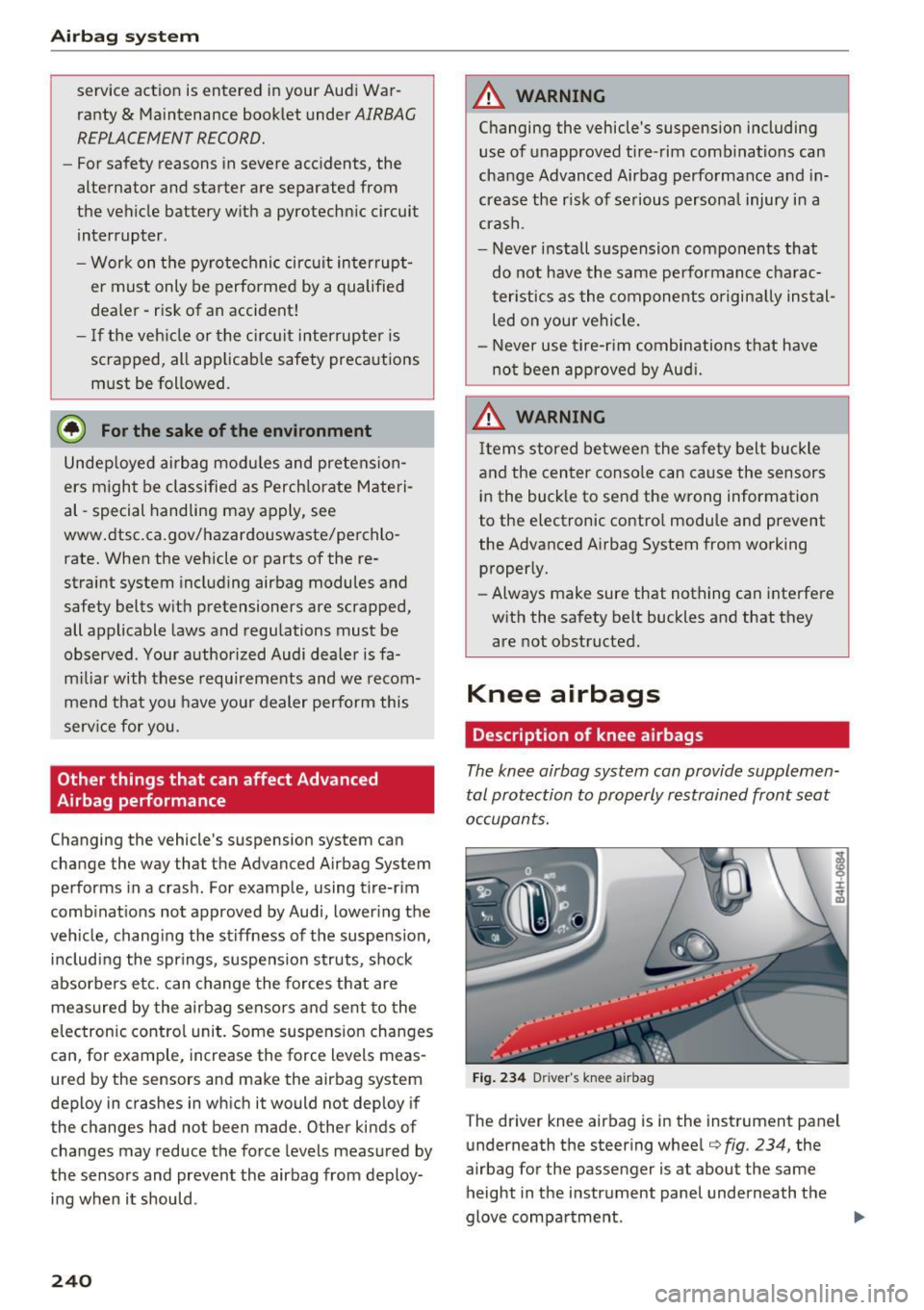
Fig . 234 D river 's knee a irbag
The driver knee airbag is in the instrument panel
underneath the steering wheel~
fig. 234, the
airbag for the passenger is at about the same height in the instrument panel underneath the
glove compartment . ..,_
Page 259 of 354
0 co .... N ,..... N .... 0 0 :c '
18 kg) are best protected in chi ld safety seats de
signed for their age and we ight . Experts say that
the skeletal structure, particularly the pelvis, of
these children is not fully developed, and they
must not use the vehicle safety belts without a
suitable child restraint .
It is usually best to put these children in appro priate booster seats. Be sure the booster seat
meets all applicable safety standards .
Booster seats ra ise the seat ing pos ition of the
child and repos ition both the lap and shoulder
parts of the safety belt so that they pass across
the child 's body in the right places. The routing of
the belt over the child's body is very important
for the child's protection, whether or not a boos
ter seat is used. Chi ldren age 12 and unde r must
a lways ride in the rear seat.
Ch ildren who are at least 4 ft . 9 in . (57 inches/
1.45 meters) tall can genera lly use the veh icle's
three po int lap and shoulder be lts. Never use the
lap belt po rtion of the vehicle 's safety belt alone
to restrain any child, regardless of how big the
child is. A lways remember that children do not
have the pronounced pelvic structure required for
the proper function of lap belt portion of the ve hicle 's three point lap and shoulder belts. The
child's safety absolutely requires that a lap bel t
portion of the safety belt be fastened snugly and
as low as possible around the pelvis. Never let
the lap belt portion of the safety belt pass over
the child's stomach or abdomen.
In a crash, airbags must inflate within a blink of
an eye and with considerable force . In order to do
its job, the airbag needs room to inflate so that it
will be there to p rotect the occupant as the occu
pant moves forward into the a irbag.
A vehicle occupant who is out of position and too
close to the airbag gets in the way of an inflating
a ir bag. When an occupant is too close, he o r she
will be st ruck v iolently and will receive ser ious o r
possib ly even fatal injury.
In order for the airbag to offer p rotection, it is
i mportant that all vehicle occupants, espec ia lly
any chi ldren, who must be in the front seat be
cause of exceptional circumstances, be p roperly
Ch ild safety
restrained and as far away from the airbag as
possible . By keeping room between the chi ld's
body and the front of the passenger compart
ment, the airbag can inflate completely and pro
vide supplementa l protection in certain frontal
collisions .
A WARNING
-Not using a booster seat, using the booster
seat imp roperly, incorrect ly installing a boos
ter seat o r us ing the vehicle safety belt im
p roperly increases the r is k of serious personal
injury and death in a collision or other emer
gency situation. To help reduce the risk of se
rious personal injury and/or death:
- The shou lder belt m ust lie as close to the
center of the chi ld's collar bone as possible
and must lie flat and snug on the upper
body. It must never lie across the throat or
neck . The lap belt must lie across the pelvis
and never across the stomach or abdomen. Make sure that the belt lies flat and snug .
Pull on the belt to tighten if necessary.
- Fa ilure to properly route safety belts over a
child's body w ill cause severe injuries in an
accident o r othe r emergency situation
¢ page 218.
-The rear side of the ch ild safety seat should
be positioned as close as possible to the
b ackrest on the veh icle seat. Adjust the rear
seat head restrain t if it is diffi cult to install
the child seat with the head restraint in p lace ¢
page 210. Driving with head re
straints that are not properly adjusted in
creases the risk of serious or fatal neck in
jury dramat ically .
- Chi ldren on the front seat of any car, even
with Advanced Airbags, can be seriously in
jured or even k illed when an airbag inflates.
- Never let a chi ld put the shoulder belt under
the arm or behind the back, because it could
cause severe injuries in a crash.
- Never let a child stand or kneel on any seat,
for example the front seat.
- Never let a child r ide in the cargo area of
your veh icle .
- Always remember that a chi ld leaning for
ward, sitt ing sideways or out of position in
257