child seat AUDI A8 2017 User Guide
[x] Cancel search | Manufacturer: AUDI, Model Year: 2017, Model line: A8, Model: AUDI A8 2017Pages: 354, PDF Size: 88.68 MB
Page 212 of 354
Driving safety
-Always make sure that there are at least
10 inches (25 cm) between the front pas
senger 's breastbone and the instrument
panel.
- Always make sure that there are at least
4 inches (10 cm) between the front passen
ger's knees and the lower part of the instru
ment panel.
- Each passenger must always sit on a seat of
their own and properly fasten and wear the
safety belt belonging to that seat .
- Before driving, always adjust the front pas
senger seat and head restraint properly .
- Always keep your feet on the floor in front
of the seat. Never rest them on the seat, in
strument panel, out of the window, etc . The
airbag system and safety be lt will not be
able to protect you properly and can even in
crease the risk of injury in a crash.
- Never dr ive with the backrest reclined or
ti lted far back! The farther the backrests are
ti lted back, the greater the risk of injury due
to incorrect positioning of the safety belt
and improper seating position.
- Children must always ride in child seats
¢
page 248. Special precautions apply
when installing a child seat on the front passenger seat ¢
page 226.
Proper seating positions for passengers in
rear seats
Rear seat passengers must si t upright with both
feet on the floor consi sten t with their physical
size and be properly restrained whenever the ve
hicle is in use .
To reduce the risk of injury caused by an incorrect
seating position in the event of a sudden braking
maneuver or an accident, your passengers on the
rear bench seat must always observe the follow
ing:
.,. For adjustable head restraints: Adjust the head
restraint so the upper edge is as even as possi
ble with the top of your head . If that is not pos
s ib le, try to adjust the head restraint so that it
is as close to this position as possible
~page 210.
210
.,. Keep both feet flat in the footwell in front of
the rear seat.
.,. Fasten and wear safety belts properly
q page 221.
.,. Make sure tha t children are always properly re
strained in a child restraint that is appropriate
for their size and age
q page 248 .
A WARNING
Passengers who are imprope rly seated on the
rear seat can be seriously injured in a crash.
- Each passenger must always sit on a seat of
their own and properly fasten and wear the
safety belt belonging to that seat.
- Safety belts only offer maximum protection
when the safety be lts are properly posi
tioned on the body and secure ly latched . By
not sitting upright, a rear seat passenger in
creases the risk of personal injury from im
properly positioned safety belts!
-Always ad just the head restraint properly so
that it can give maximum protection.
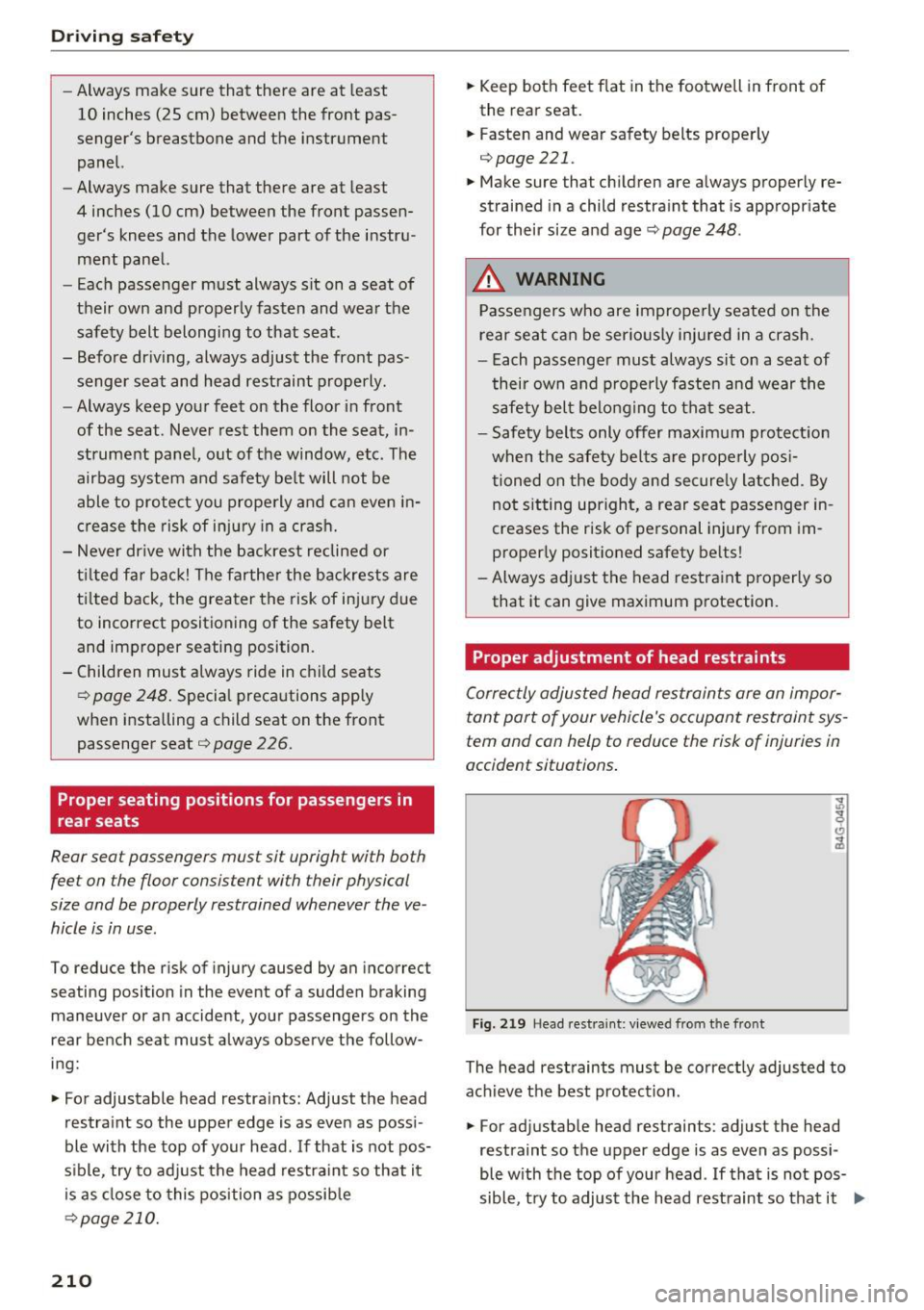
Proper adjustment of head restraints
Correctly adjusted head restraints are an impor
tant part of your vehicle's occupant restraint sys
tem and can help to reduce the risk of injuries in
accident situations .
Fig. 219 Head rest raint : viewed from the front
The head restraints must be correctly adjusted to
achieve the best protection .
.,. For adjustable head restraints: adjust the head
restraint so the upper edge is as even as possi-
ble with the top of your head . If that is not pos
sible, try to adjust the head restraint so that it .,._
Page 213 of 354
0 co .... N ,..._
N .... 0 0 :c '
¢fig. 219 .
Adjusting head restraints ¢page 58.
Crash -active head restraints
In the event of a rear -end collision, it is possible
that the crash-active head restraints on the driv
er's seat and front passenger's seat
1> are trig
gered. On head restraints that have been trig
gered, the padding protrudes forwards by several
centimeters. Drive the vehicle to your authorized
Audi dealer without delay and have the function
of the active head restraints restored.
_& WARNING
Driving without head restraints or with head
restraints that are not properly adjusted in
creases the risk of serious or fatal neck injury
dramatically. To help reduce the r isk of injury:
- Always drive with the head restraints in
place and properly adjusted .
- Every person in the vehicle must have a
properly adjusted head restraint.
- Always make sure each person in the vehicle
properly adjusts their head restraint. Adjust
the head restraint so the upper edge is as
even as possible with the top of your head.
If that is not possib le, try to adjust the head
restra int so that it is as close to this position
as possible.
- Never attempt to adjust head restraint
wh ile driving. If you have dr iven off and
must adjust the driver head rest for any rea
son, first stop the vehicle safely before at
tempting to adjust the head restra int.
- Children must always be properly restrained
in a child restraint that is appropriate for
their age and size¢
page 248.
-
l) Ve hicles w ith recl inin g rear seat: This functio n is not avai l
able fo r th e fro nt passenger's seat .
Driving safety
Examples of improper seating positions
The occupant restraint system can only reduce
the risk of injury if vehicle occupants are properly
seated.
Improper seating positions can cause serious in
jury or death . Safety belts can only work when
they are properly positioned on the body . Im
proper seat ing positions reduce the effectiveness
of safety belts and will even increase the risk of
injury and death by moving the safety belt to cr it
ical areas of the body. Improper seating positions
also increase the risk of serious injury and death
when an airbag deploys and strikes an occupant
who is not in the proper seating position. A driver
is responsible for the safety of all vehicle occu
pants and especially for children . Therefore:
.,. Never allow anyone to assume an incorrect
seating position when the vehicle is being used
¢ .,& .
The following bulletins list only some sample po
sitions that will increase the risk of serious injury
and death . Our hope is that these examples will
make you more aware of seating positions that
are dangerous .
Therefore, whenever the vehicle is moving:
-never stand up in the vehicle
- never stand on the seats
- never kneel on the seats
- never ride with the seatback recl ined
- never lie down on the rear seat
- never lean up against the instrument panel
- never sit on the edge of the seat
- never sit sideways
- never lean out the window
- never put your feet out the window
- never put your feet on the instrument panel
- never rest your feet on the seat cushion or back
of the seat
- never ride in the footwell
- never ride in the cargo area
211
Page 214 of 354
Driving sa fe ty
A WARNING
Improper seating positions increase the r isk
of serious personal injury and death whenever
a vehicle is being used.
- Always make sure that all vehicle occupants
stay in a proper seat ing position and are
properly restrained whenever the vehicle is
being used.
Driver's and front
passenger's footwell
Important safety instructions
A WARNING
Always ma ke sure that the knee airbag can in
flate without inter ference. Objects between
yourself and the airbag can increase the risk
of injury in an acc ident by interfering with the
way the airbag deploys or by being pushed in
to you as the airbag deploys.
- No persons (children) or animals shou ld ride
in the footwell in front of the passenger
seat. If the airbag dep loys, th is can result in
serious or fatal injuries .
- No objects of any k ind shou ld be carried in
the footwell area in front of the driver's or
passenger's seat . Bulky objects (shopping
bags, for example) can hamper or p revent
prope r deployment of the airbag. Small ob
jects can be th rown through the vehicle if
the a irbag deploys and injure you or your
passengers.
Pedal area
Pedals
The pedals must always be free to move and
must never be interfered with by a floor mat or
any o ther object.
Make sure that all peda ls move freely without in
terference and that noth ing prevents them from
returning to the ir origina l positions.
O nly use floor mats that leave the peda l area free
and can be secured w it h floor mat fasteners.
212
If a brake circuit fails, increased brake pedal trav
el is required to bring the vehicle to a fu ll stop.
A WARNING
Pedals that cannot move freely can cause loss
of vehicle contro l and increase the r isk of seri
ous injury.
- Never p lace any objects in the drive r's foot
well. An object could get into the pedal area
and interfere with pedal funct ion. In case of
sudden braking or an acc ident , you would
not be able to b rake o r acce le rate!
- Always make sure that nothing can fall or
move into the driver's footwell.
Floor mats on the driver side
Always use floor mats that can be securely a t
tached to the floor mat fas teners and do not in
terfere with the free movement of the pedals .
.,. Make sure that the floor mats are properly se
cured and cannot move and in terfere w ith the
pedals ¢_& .
Use only floor mats that leave the peda l area un
obstructed and that are firmly secured so that
they can not s lip out of position . You can obtai n
su itable floor mats from your author ized Audi
Dealer .
Floor mat fasteners are installed in your Aud i.
Floor mats used in yo ur vehicle must be attached
to these fasteners. Properly secur ing the floor
mats will prevent them from sliding into posi
tions that could interfere with the pedals or im
pair safe operat ion of your vehicle in other ways .
A WARNING
Pedals that cannot move freely can result in a
loss of vehicle contro l and increase the r is k of
serious pe rsonal injury.
- Always make sure that floo r mats are prop
erly secured.
- Never place or install floor mats or other floor coverings in the vehicle that cannot be
properly secured in place to preven t them
from s lipping and interfer ing wi th the ped
als or the ab ility to cont rol the vehicle .
Page 216 of 354
Driving safety
-Never leave your vehicle unattended espe
cially with the rear lid left open. A child
could crawl into the vehicle through the lug
gage compartment and close the rear lid be
coming trapped and unable to get out . Be
ing trapped in a vehicle can lead to serious
personal injury.
- Never let children play in or around the vehi
cle.
- Never let passengers ride in the luggage compartment. Vehicle occupants must al
ways be properly restrained in one of the ve
hicle's seating positions.
- Air circulation helps to reduce window fog
ging . Stale air escapes to the outside
through vents in the trim panel, on the left
side of the luggage compartment. Be sure
to keep these slots free and open.
- The tire pressure must correspond to the
load. The tire pressure is shown on the tire
pressure label. The tire pressure label is lo
cated on the driver's side B·pillar. The tire pressure label lists the recommended cold
tire inflation pressures for the vehicle at its
maximum capacity weight and the tires that
were on your vehicle at the time it was man
ufactured. For recommended tire pressures
for normal load conditions, please see chap
ter
¢ page 294.
Tie-downs
The luggage compartment is equipped with four
tie-downs to secure luggage and other items .
Use the tie-dow ns to secure your cargo properly
¢ page 213, Loading the luggage compartment .
In a coll ision, the laws of physics mean that even
smaller items that are loose in the vehicle will
become heavy missiles that can cause serious in
jury . Items in the vehicle possess energy which
vary with vehicle speed and the weight of the item. Vehicle speed is the most significant factor.
For example, in a frontal collision at a speed of
30 mph (48 km/h), the forces acting on a 10 -lb
(4 .5 kg) object are about 20 times the normal
214
weight of the item. This means that the weight
of the item would suddenly be about
200 lbs. (90 kg) . You can imagine the injuries
that a 200 lbs. (90 kg) item flying freely through
the passenger compartment could cause in a col
lision like th is.
A WARNING
Weak, damaged or improper straps used to
secure items to tie-downs can fail during hard
braking or in a collision and cause serious per
sonal injury.
- Always use suitable mounting straps and
properly secure items to the tie-downs in
the luggage compartment to help prevent items from shifting or flying forward as dan
gerous missiles.
- Never attach a child safety seat tether strap
to a tie-down.
-
Reporting Safety Defects
Applicable to U.S.A.
If you believe that your vehicle
has a defect which could cause a
crash or could cause injury or
death, you should immediately in
form the National Highway Traffic Safety Administration (NHTSA) in
addition to notifying Audi of
America, Inc.
If NHTSA receives similar complaints, it may open an investiga
tion, and if it finds that a safety
defects exists in a group of
vehicles, it may order a recall and remedy campaign. However,
NHTSA cannot become involved in
individual problems between you,
11>
Page 220 of 354
Safety belt s
Safety belts
General information
Always wear safety belts!
Wearing safety belts correctly saves lives!
This chapter explains why safety be lts are neces
sary, how they work and how to adjust and wear
them correctly.
.. Read all the information that follows and heed
all of the instructions and WARNINGS.
&_ WARNING
Not wearing safety belts or wearing them im
properly increases the risk of serious personal
injury and death.
- Safety belts are the s ingle most effective
means ava ilable to reduce the risk of serious
injury and death in automobile accidents.
For your protect ion and that of your passen
gers, always co rrectly wear safety be lts
when the vehicle is moving .
- Pregnant women, injured, o r physically im
paired persons must a lso use safety belts.
L ik e all vehicle occ upants, they are mo re
likely to be serio usly injured i f they do not
wea r safety be lts. The best way to protect a
fetus is to protect the mother -throughout
the ent ire pregnancy .
Number of seats
Your Audi has a total of five seating positions:
two in the front and three in the rear. In some
veh icles, there are four seating positions: two in
the front and two in the rear . Each seating posi
tion has a safety belt .
&_ WARNING
Not wea ring safety belts or wearing them im
properly incre ases the risk of ser io us personal
injury and dea th.
- Never st rap more tha n one person, includ
ing small ch ild ren, into any be lt .
It is espe
c ia lly da ngerous to place a safety belt over a
child sitting on your lap .
218
-Never let more people ride in the vehicle
than there are safety be lts available .
- Be s ure everyone riding in the vehicle is
properly restrained with a separate safety
be lt or ch ild restraint.
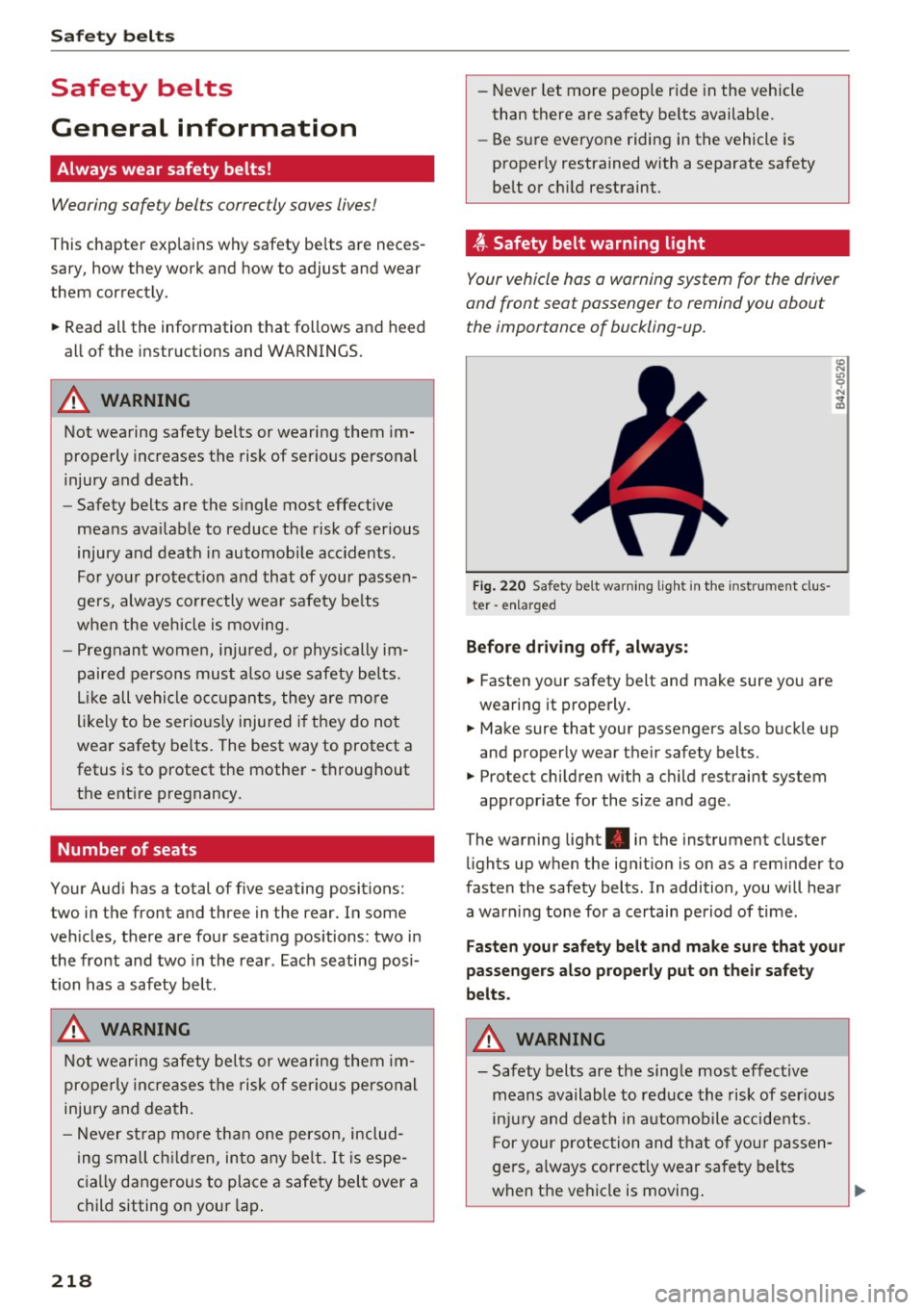
~ Safety belt warning light
Your vehicle has a warning system for the driver
and front seat passenger to remind you about the importance of buckling-up .
F ig. 220 Safety belt wa rning lig ht in the instrument clus·
ter -en larged
Befor e dri ving off , alway s;
.. Fasten your safety belt and make sure you are
wearing it properly.
"' N .,, 0
"' .. m
.. Make sure that your passengers a lso buckle up
and properly wear the ir safety belts.
.. Protect chi ldren with a c hild restraint system
appropr iate for the size and age.
The warning light . in the instrument cluster
lights up when the ign ition is on as a reminder to
fasten the safety belts. In addition, you will hear
a war ning tone for a certain period of time.
Faste n your safety belt and make su re that your
passenge rs al so properl y put on thei r safety
b e lts .
&_ WARNING
-
-Safety belts are the single most effective
means available to red uce the risk of ser io us
inj ury and death in a utomobile accidents.
For your protection and that of yo ur passen
gers, a lways correct ly wear safety belts
when t he vehicle is moving . ..,.
Page 223 of 354
C) C0 ....
"' " "' .... 0 0 :r
Not wearing safety belts or wearing them im
properly increases the risk of serious personal
injury and death . Safety belts can work only
when used correct ly.
-Always fasten your safety belts correctly be fore driving off and make sure all passen
gers are cor rect ly restrained.
- For maximum protection, safety belts must
always be posit ioned properly on the body .
- Never strap more than one person, includ
ing small ch ildren, into any belt .
- Never place a safety belt over a child sitting
on your lap.
- Always keep feet in the footwell in front of
the seat wh ile the vehicle is being driven.
- Never let any person ride w ith their feet on
the instrument panel or sticking out the
window or on the seat .
- Never remove a safety belt while the vehicle
is moving . Do ing so will increase your risk of
being injured or k illed.
- Never wear belts twisted.
- Never wear belts over rigid or breakable ob-
jects in or on your clothing, such as eye
glasses, pens, keys, etc., as these may cause
injury.
- Never allow safety belts to become dam
aged by being caught in door or seat hard
ware.
- Do not wear the shoulder part of the belt
under your arm or otherwise out of position .
- Several layers of heavy clothing may inter
fere with correct positioning of belts and re
duce the overall effectiveness of the system.
- Always keep belt buckles free of anything
that may prevent the buckle from latching
securely .
- Never use comfort clips or devices that cre
ate slack in the shoulder be lt . However, spe
cial clips may be requ ired for the proper use
of some child restraint systems.
- Torn or frayed safety belts can tear, and
damaged belt ha rdware can break in an acc i
dent. Inspect belts regularly.
If webbing,
bind ings, buckles, or re tractors are dam-
Safet y bel ts
aged, have belts rep laced by an authorized
Aud i dea ler or qualified workshop.
- Safety belts that have been worn and loaded
in an accident must be replaced with the
correct replacement safety belt by an au
thor ized Audi dealer. Replacement may be
necessary even if damage cannot be clearly
seen. Anchorages that were loaded must al
so be inspected.
- Never remove, mod ify, d isassemble, or try
to repair the safety belts yourse lf.
-Always keep the belts clean . Dirty belts may
not work properly and can impair the func
tion of the inert ia reel
q table Interior
cleaning on page 308.
Safety belts
Fastening safety belts
Safety first -everbody buckle up!
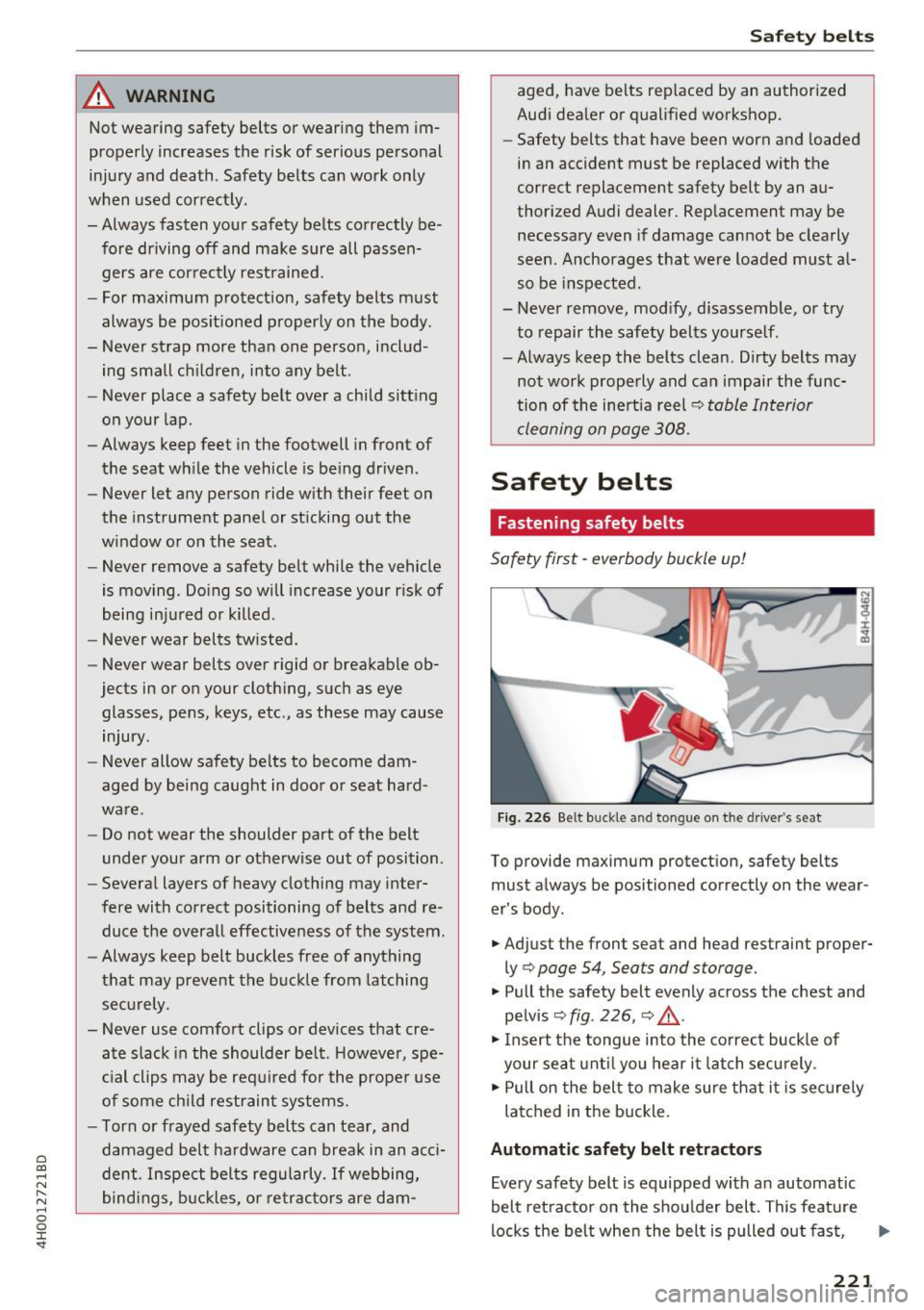
Fig. 226 Belt buckle and tongue on the driver 's seat
To provide maximum protect ion, safety belts
must always be positioned correctly on the wear
er's body .
.. Adjust the front seat and head restraint proper
ly
¢ page 54, Seats and storage.
.. Pull the safety belt evenly across the chest and
pelvis
¢ fig . 226, ¢ ,&..
.. Insert the tongue into the correct buckle of
your seat unt il yo u hear i t latch secu rely .
.. Pull on the belt to make sure that it is securely
latched in the buckle.
Aut omatic safet y belt retractors
Every safety belt is equipped with an automatic
belt retractor on the sho ulder belt. This feat ure
locks the belt when the bel t is pulled out fast, .,..
221
Page 224 of 354
Safe ty belts
during hard braking and in an accident. The be lt
may a lso lock when you drive up or down a steep
h ill or through a sharp curve. Dur ing normal driv
ing the belt lets you move freely .
Safety b elt pr ete nsione rs
The safety be lts are equ ipped with a belt preten
sioner that helps to tighten the safety belt and
remove slack when the pretensioner is activated
¢
page 224. The function of the pretensioner is
monitored by a warning light ¢
page 23.
Convertibl e loc king retra ctor
Every safety be lt except the one on the driver
seat is equipped with a convertible locking retrac
tor that
must be used when the safety belt is
used to attach a child seat. Be sure to read the
important information about this feature
¢page 258.
A WARNING
Improperly pos it ioned safety belts can cause
ser ious injury in an accident¢
page 222,
Safety belt position.
- Safety belts offer optimum protection only
when the seatback is upright and belts are
prope rly positioned on the body.
- Never attach the safety belt to the buckle
for another seat. Attaching the belt to the
wrong b uck le wi ll red uce safety belt effec
t iveness and can cause serious persona l in
jury.
- A passenger who is not p roper ly restrained
can be serio usly injured by the safety be lt it
self when it moves from the stronger parts
of the body into cr it ical areas like the abdo
men.
- Always lock the convertible lock ing retractor
when you are secur ing a child seat in the ve
hicle ¢
page 260.
@ Tips
For information on safety belt pretensioners,
refer to
¢ page 224.
222
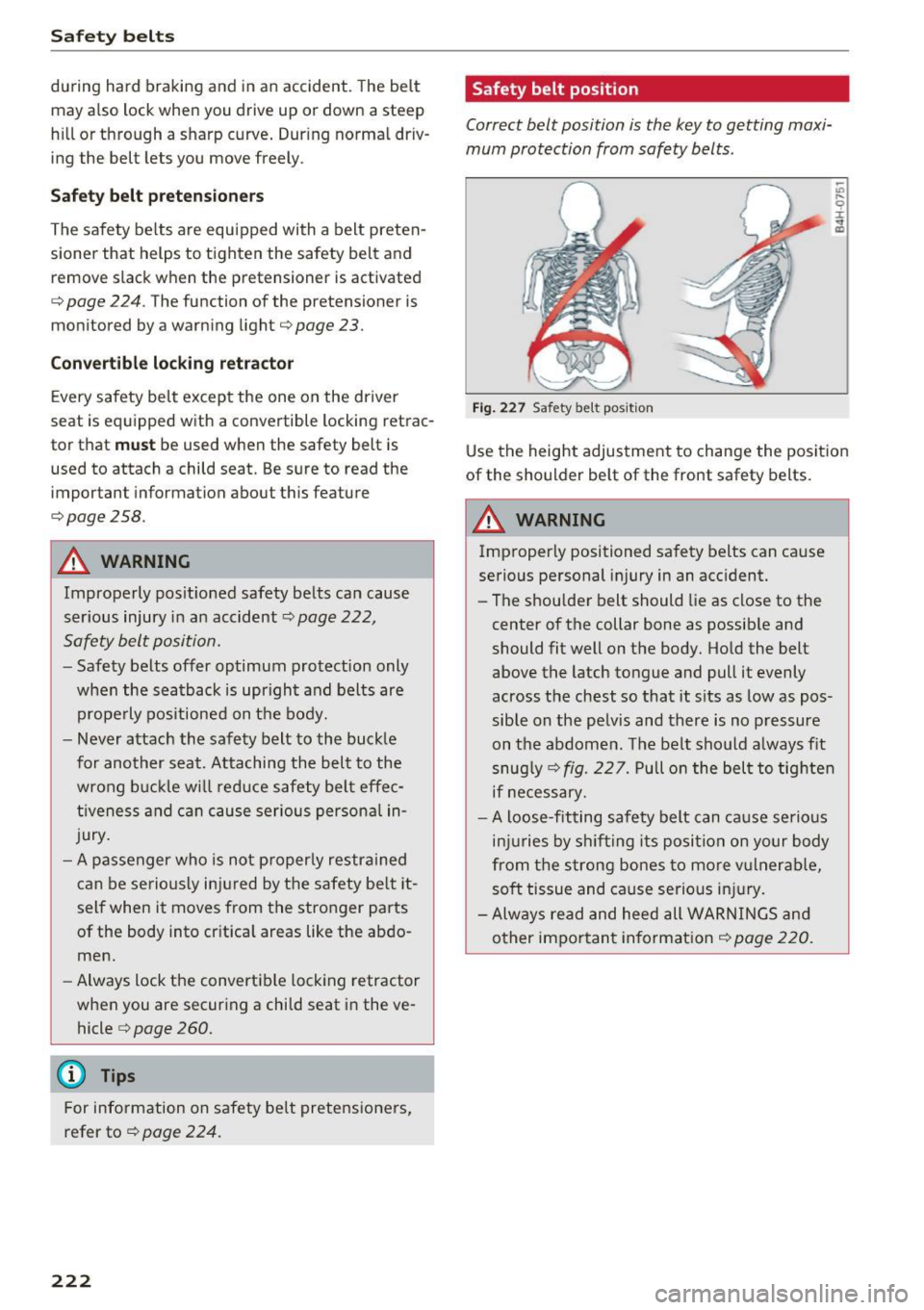
Safety belt position
Correct belt position is the key to getting maxi
mum protection from safety belts.
Fig. 2 27 Safety belt posit ion
Use the height adjus tment to change the posit io n
of the shoulder belt of the front safety belts.
A WARNING
Improperly positioned sa fety belts can cause
serious personal injury in an accident.
- The shou lder belt should lie as close to the
center of the collar bone as possib le and
should fit well on the body. Hold the belt
above the latch tongue and pull it evenly
across the chest so that it s its as low as pos
sible on the pe lvis and there is no p ressure
on the abdome n. T he belt sho uld a lways fit
snug ly¢
fig. 22 7. P u ll on the bel t to tigh ten
if necess ary.
- A loose-fit ting safety belt can ca use serious
in ju ries by s hifting its posi tion on yo ur body
from the strong bones to mo re v ulnera ble,
so ft tissue and cause serious in jury.
- Always read and heed all WARNINGS an d
o ther impor tan t in formation¢
page 220 .
Page 226 of 354
Safety belt s
A WARNING
Always read and heed all WARNINGS and oth
er important informat ion
c:> page 220 .
(D Tips
You can also adjust the height of the front
seats to change the position of the safety
belts.
Improperly worn safety belts
Incorrectly posit ioned safety belts can cause se
vere injuries.
Wearing safety belts imprope rly can cause seri
ous injury or death. Safety belts can on ly work
when they a re correctly positioned on the body.
Improper seating positions reduce the effect ive
ness of safety belts and wi ll even increase the
ris k of injury and deat h by mov ing the safety bel t
to cr it ica l areas of the body . Imp roper seating
posi tions a lso increase the risk of serio us in jury
an d deat h when an air bag deploys and strikes an
oc cupan t who is no t in the co rrect seating pos i
tion. A d river is responsib le for the safety of a ll
ve hicle occupants and especia lly for children.
Therefo re:
... Neve r permit anyone to ass ume an in co rrect
s itting position in the vehicle w hil e trave ling
c:> & .
A WARNING
Improperly worn safety belts increase t he risk
of se rious personal injury and deat h wheneve r
a vehicle is being used.
- Always make sure that all vehicle occupants
are correctly restra ined and stay in a correct
seat ing pos ition whenever the veh icle is be
ing used.
- Always read a nd heed all WARNINGS and
othe r important information
c:> pag e 220.
224
Belt tensioners
' How safety belt pretensioners work
In front, side and rear-end collisions above a
particular sev erity and in a rollover, safety b elts
are tensioned automatically.
Rever sible safety belt tensioners
The safety belts on the front seats a re equipped
with power revers ible tensione rs. The following
funct ions are available whe n the drive r's/front
passenger 's safety belts are faste ned:
- Automatic tens ione rs: at the start of a drive,
the safety belts automat ically adjust to t he
passe nger after a certain time period or ve hicle
speed. To switch t he automatic tensioners off,
select the follow ing in the MMI :
!CARI fu nction
but to n
> Car systems > Vehicle setting s >
Seats > Driver's seat or Passenger's seat > Au
tomatic belt tensioner
> Off .
-In ce rta in dr iving situ ations , the safe ty belts
may tighten w ith a reve rsib le tensioning func
t ion
c:> page 216 .
- Th e safety be lts may also tighten with this re -
vers ible te nsion ing f un ct ion in m ino r collisions.
Pyrotechnic safety belt pretensioners
The safety belts are eq uipped w ith safety bel t
p retens ione rs . The system is activa ted by sensors
i n front, side a nd rear-e nd coll is ions of grea t se
verity and in a ro llover. This tig htens the bel t and
t ak es up belt sla ck
c:> .&. in Service an d disposal of
safety belt pretensioner on page 225.
Taking up
the slack he lps to reduce forward occupant
movement during a collision.
A WARNING
- It is poss ible for the pretensioners to dep loy
incor rect ly.
- The pyrotechnic system can only p rovide
protection for one collision. If t he py rotech
nic pretens io ners deploy, the pretensioning
sys tem must be replaced .
(1) Tips
The pyrotechnic sa fety belt pretensioners can
on ly dep loy once . ..,_
Page 228 of 354
Airbag syste m
Airbag system
Important information
Importance of wearing safety belts and
sitting properly
Airbags are only supplemental restraints . For
airbags to do their job, occupants must always
properly wear their safety belts and be in a prop
er seating position.
For your safety and the safety of your passen
ge rs , before driving off, always :
"' Adjust the driver's seat and steering wheel
properly ¢
page 208,
"'Adjust the front passenge r's seat properly
¢ page 54,
"'Wear safety belts p roperly ¢ page 220,
"' Always properly use the proper child restraint
to protect children ¢
page 248.
In a coll is io n, airbags mus t inflate within the
blink of an eye and wi th considerab le force . The
supp lemental airbags can cause injuries if the
driv er or th e front s eat passeng er is not s eated
properly. Therefore in order to he lp the airbag to
do its job, it is important, both as a dr iver and as
a passenger to sit properly at all t imes.
By keeping room between your body and the
steering whee l and the front of the passenger
compartment, the a irbag can inflate fully and
completely and provide supplemental protect ion
in certain frontal collisions¢
page 208, Correct
passenger seating positions .
For details on the
operation of the seat adjustment con trols
¢ page 54.
It's especially important that children are proper
ly restra ined
¢ page 248 .
There is a lot that the driver and the passengers
can and must do to help the ind iv idual safety fea
tures installed in your Audi work together as a
system .
Proper seating posit ion is important so that the
front airbag on the drive r side can do its job. If
you have a physical impairment or cond ition that
prevents you from s itting properly on the driver
seat with the safety be lt properly fastened and
226
reaching the peda ls, or if yo u have concerns w ith
regard to the function or operation of the Ad
vanced Airbag System, please contact your a u
thori zed Audi dea ler or qua lified workshop, or
ca ll Audi Customer Relations at 1-800-822-2834
for poss ib le modifications to your vehicle .
When the airbag system dep loys, a gas generator
will fill the airbags, break open the padded cov ers, and infla te between the steering wheel and
the driver and between the instrument panel and
t h e front passenger . The airbags w il l deflate im
med iate ly after deployment so that the front oc
cupants can see t hrou gh the windsh ie ld again
without i nterruption.
All of th is takes p lace in the b link of an eye, so
fast that many people don't even rea lize that the
a irbags have deployed. The airbags a lso infla te
with a g re at deal of force and nothing should be
i n the ir way when they deploy. Front airbags in
combination with properly worn safety belts slow
down and limit the occupant 's forward move
ment . Together they he lp to prevent the driver
and front seat passenger from hitting pa rts of
the ins ide of the vehicle while reduc ing the fo rces
acting on the occupant dur ing the cras h. In th is
way they help to reduce the risk of injury to the
head and uppe r body i n the crash . Airbags do not
protect the arms or the lower pa rts of the body.
Both front airbags will not inflate in all frontal
collisions . The t riggering of the a irbag system de
pends on the veh icle decelerat ion rate caused by
t h e coll is io n and regis tered by the ele ctroni c con
tro l unit . If this ra te is be low the refe rence value
programmed in to the contro l unit, the airbags
will not be trigge red, even tho ugh the car may be
badly damaged as a resu lt of the co llision. Vehi
cle damage, rep air costs or even the lack of vehi
cle damage is not necessarily an indication of
whether an a irbag should inflate or not .
Since the circumstances will vary cons iderab ly
between one co llision and another, it is not possi
ble to define a range of veh icle speeds that will
cover every poss ible kind and angle of impact
that w ill always t rigger t he a irbags . Important
factors i nclude, for examp le, the nat ure (hard or
soft) of the object which the ca r hits, the angle of
i mp act , vehicle speed , etc. The front airbags will .,.
Page 229 of 354
0 co .... N ,..._
N .... 0 0 :c '
ro ll-overs.
A lwa ys rememb er: Airbags will deploy only o nce,
and on ly in certain kinds of coll is ions. Your safety
be lts are always there to offer protection in those
situations in which airbags are not supposed to
deploy, or when they have a lready deployed; for
examp le, when your vehicle str ikes or is struck by
another vehicle after the first collis ion.
This is just one of the reasons why an airbag is a
supp lementary restraint and is not a substitute
for a safety belt. The airbag system works most effect ively when used with the safety belts.
Therefore, always properly wear your safety belts
r:::;,page 218.
A WARNING
Sitting too close to the steer ing whee l or in
st rument panel will decrease the effect ive
ness of the airbags and will inc rease the risk
o f persona l injury in a co llision.
- Never sit closer than 10 inches (25 cm) to
the steering wheel or instrument panel.
- If you cannot sit mo re than 10 inches
( 2 5 cm) from the steering wheel, inves ti
gate whethe r adaptive equipment may be
available to help you reach the pedals and
increase your seating distance from the
steering wheel.
- If you are unrest rained, leaning forward, s it
ting s ideways or out of position in any way,
your risk of in jury is much h igher.
- Yo u will also receive serious injur ies and
cou ld even be killed if you are up against the
airbag or too close to it when it inf lates -
even with an Advanced Airbag.
- To reduce the risk of in jury when an airbag
inflates, a lways wear safety belts p roperly
i=> page 221, Safety belts .
-Always make certain that ch ildren age 12 or
younger always ride in the rear seat. If chil dren are not properly restra ined, they may
be severe ly injured o r kill ed when an airbag
inflates .
- Never let children ride unrestrained or im prope rly restrained in the veh icle. Adjust the
fro nt sea ts properly.
-
Airb ag sys tem
-Never ride with the back rest recl ined.
-Always sit as fa r as possible from the steer-
ing wheel o r the instrument panel
r:::;,page208.
- Always sit upright with your back against
the backrest of your seat.
- Never p lace your feet on the instrument
panel or on the seat. Always keep both feet
on the floor in front of the seat to help pre
vent ser ious injuries to the legs and hips if
the airbag inflates.
- Never recline the front passenger's seat to transpo rt objects. Items can also move into
the area of the s ide a irbag or the front air
bag during braking or in a sudden maneu
ver. Objects nea r the airbags can become
p roje ct il es and cause injury when an airbag
inflates.
A WARNING
A irbags tha t h ave deployed in a cr ash m ust be
r e p laced.
- Use o nly orig inal equipment airbags ap
p roved by A udi a nd insta lled by a trained
technici an who has the necessary tools and
diagnostic equipment to properly replace
any airbag in yo ur vehicle and assu re system
effect iveness in a crash.
- Never permit salvaged or recycled airbags to
be installed in you r vehicle .
Child restraints on the front seat - some
important things to know
.,. Be sure to read the important i nformat ion and
heed the WARNINGS for important deta ils
about ch ildren and Advanced A irbags
r:::;, page248 .
Even though your veh icle is equipped wit h an Ad
vanced Airbag System, make certa in that a ll chil
dre n, espec ia lly those 1 2 yea rs and yo unger, al
ways r ide in the back se at prope rly res train ed fo r
their age and size. The ai rbag on t he p asse nger
s ide makes t he fron t seat a potentia lly dange rous
place for a child to ride. The front seat is not the
sa fest p lace for a child in a forward-facing child .,.
227