instrument panel AUDI A8 2017 User Guide
[x] Cancel search | Manufacturer: AUDI, Model Year: 2017, Model line: A8, Model: AUDI A8 2017Pages: 354, PDF Size: 88.68 MB
Page 239 of 354
0 co .... N ,..... N .... 0 0 :c -
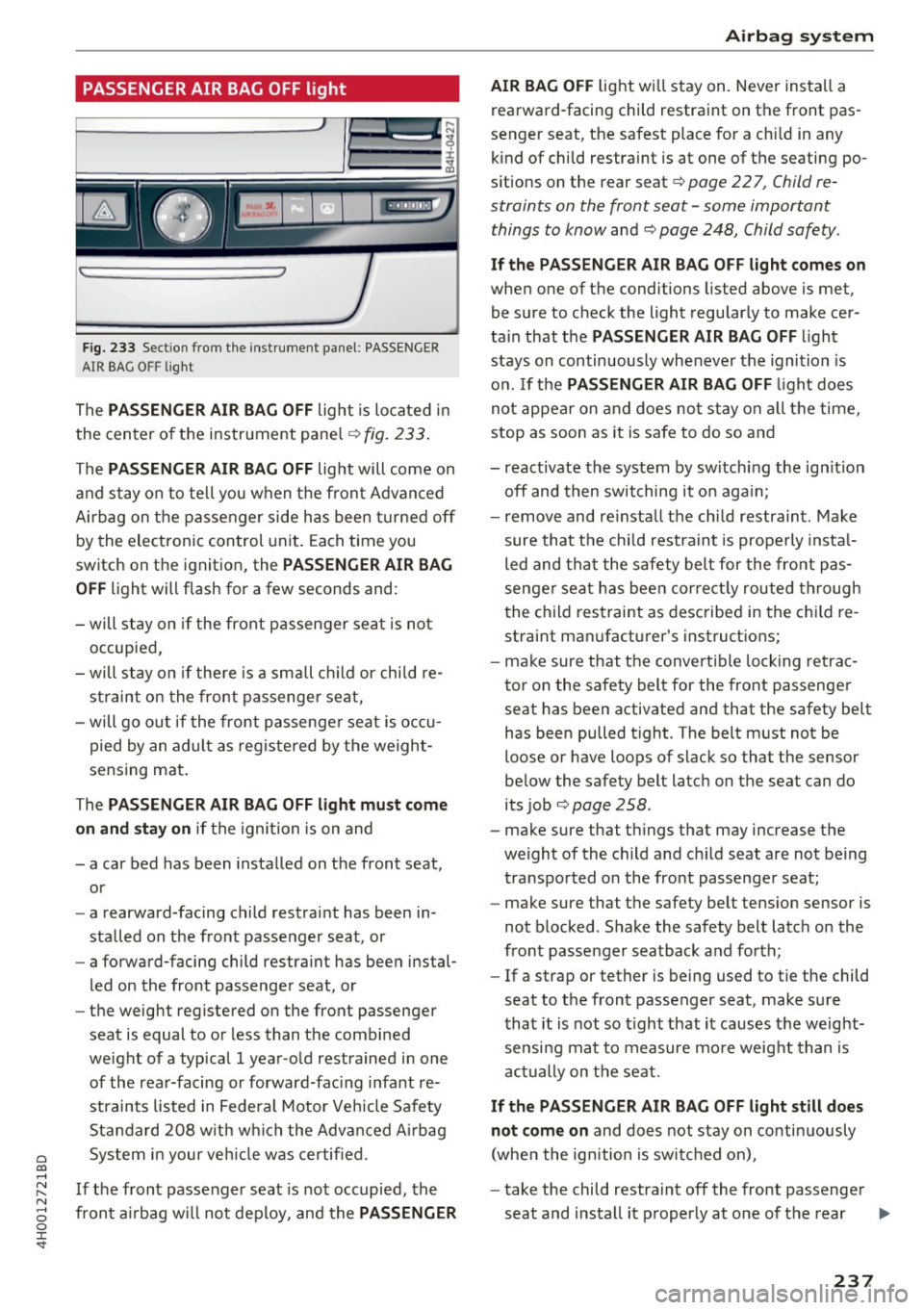
Fig. 233 Section from the instrument panel: PASSENGER
AIR BAG O FF light
The PA SSENGER AIR BAG OFF light is located in
the center o f the instrument panel¢
fig. 233 .
The PASSENGER AIR BAG OFF light will come on
and stay on to tell you when the front Advanced
Ai rbag on the passenger side has been turned off
by the electronic control unit . Each time you
switch on the ignition, the
PAS SENGER AIR BAG
O FF
light will flash for a few seconds and :
- will stay on if the front passenger seat is not
occupied,
- will stay on if there is a small ch ild or chi ld re
straint on the front passenger seat,
- will go out if the fro nt passenge r seat is occu
pied by an adul t as reg istered by the weight
sensing mat .
The
PASSENGER AIR BAG OFF light m ust c ome
on and st a y on
if the ignition is on and
- a car bed has been installed on the front seat, or
- a rearward-facing child restraint has been in
stalled on the front passenger seat, or
- a forward-facing child restra int has been instal
led on the front passenger seat, or
- the weight reg istered on the front passenger
seat is equal to or less than the combined
we ight of a typical 1 year -old restrained in one
of the rear-facing or forward-fac ing infant re
straints listed in Federal Motor Vehicle Safety
Standard 208 w ith w hich the Advanced A irbag
System in your ve hicle was certified .
I f the front passenger seat is not occupied, the
front a irbag w ill not deploy, and the
PASSENGER
Airb ag sys tem
AIR BAG OFF light wi ll stay on . Never insta ll a
rearward -facing child restraint on the front pas
senger seat, the safest place for a chi ld in any
k ind of child restraint is at one of the seating po
s itions on the rear seat¢
page 22 7, Child re
straints on the front seat -some important
things to know
and ¢ page 248, Child safety.
If the PA SSENGER AIR BAG OF F light come s on
when one of the conditions listed above is met,
be sure to check the light regularly to make cer
ta in that the
PA SSENGER AIR BAG OFF light
stays on continuously whenever the ignition is
o n . If the
PA SSENGER AIR BAG OFF light does
not appea r on and does no t stay on all the time ,
stop as soon as it is safe to do so and
- reactivate the system by sw itching the ign ition
off and then switching it on aga in ;
- remove and re install the child restraint . Make
sure that the child restra int is properly insta l
led and tha t the safety belt for the front pas
senger seat h as bee n correct ly routed th rough
the child restraint as desc ribed in the chi ld re
straint manufacturer's instructions;
- make sure that the convert ible lock ing retrac
to r on the safety belt for the fro nt passenge r
seat has been activated and that the safety belt
has been pulled tight. The belt m ust not be
loose or have loops of slack so that the sensor
be low the safety belt latch on the seat can do
its job ¢
page 258 .
-make su re that th ings that may increase the
weight of the child and ch ild seat are not being
transported o n the front passenge r seat;
- make su re that the safety be lt tens ion sensor is
not blocked. Shake the safety belt latch on the
front passenger seatback and forth;
- If a strap or tether is being used to tie the child
seat to the front passenger seat, make su re
that it is not so tight that it causes the weight
sensi ng mat to measure more weight than is
act ually on the seat.
If th e PA SS ENGER AIR BA G OFF light still does
not come on
and does not stay on co ntinuously
(whe n the ign ition is sw itc hed on),
- take the child restra int off the front passenger
seat and install it properly at one of the rear ..,_
237
Page 241 of 354
0 co .... N ,..._
N .... 0 0 :c '
whenever the ignition is switched on.
A WARNING
- If the PASSENGER AIR BAG OFF light does
not go out when an adult is sitting on the
front passenger seat after taking the steps described above, make sure the adult is
properly seated and restrained at one of the
rear seating positions.
- Have the airbag system inspected by your
Audi dealer before transporting anyone on
the front passenger seat.
{D) Tips
If the weight-sensing mat in the front passen
ger seat detects an empty seat, the front air
bag on the passenger side will be turned off,
and the
PASSENGER AIR BAG OFF light will
stay on.
Repair, care and disposal of the airbags
Parts of the airbag system are installed at many
different places on your Audi. Installing, remov
ing, servicing or repairing a part in an area of the
vehicle can damage a part of an airbag system
and prevent that system from working properly in a collision .
There are some important things you have to
know to make sure that the effectiveness of the
system will not be impaired and that discarded
components do not cause injury or pollute the
environment.
A WARNING
Improper care, servicing and repair proce
dures can increase the risk of personal injury
and death by preventing an airbag from de
ploying when needed or deploying an airbag
unexpectedly:
- Never cover, obstruct, or change the steer
ing wheel horn pad or airbag cover or the in
strument panel or modify them in any way.
- Never attach any objects such as cup holders
or telephone mountings to the surfaces cov
ering the airbag units.
Airbag system
-For cleaning the horn pad or instrument
panel, use only a soft, dry cloth or one mois
tened with plain water. Solvents or cleaners
could damage the airbag cover or change
the stiffness or strength of the material so
that the airbag cannot deploy and protect properly.
- Never repair, adjust, or change any parts of
the airbag system.
-All work on the steering wheel, instrument panel, front seats or electrical system (in
cluding the installation of audio equipment,
cellular telephones and CB radios, etc.) must be performed by a qualified technician
who has the training and special equipment
necessary.
- For any work on the airbag system, we
strongly recommend that you see your au
thorized Audi dealer or qualified workshop.
- Never modify the front bumper or parts of
the vehicle body.
- Always make sure that the side airbag can
inflate without interference:
- Never install seat covers or replacement
upholstery over the front seatbacks that
have not been specifically approved by
Audi.
- Never use additional seat cushions that
cover the areas where the side airbags in
flate.
- Damage to the original seat covers or to
the seam in the area of the side airbag
module must always be repaired immedi
ately by an authorized Audi dealer.
- The airbag system can be activated only
once. After an airbag has inflated, it must
be replaced by an authorized Audi dealer or
qualified technician who has the technical
information, training and special equipment
necessary.
- The airbag system can be deployed only
once. After an airbag has been deployed, it
must be replaced with new replacement
parts designed and approved especially for
your Audi model version. Replacement of complete airbag systems or airbag components must be performed by qualified work-
shops only. Make sure that any airbag
Ill-
239
Page 242 of 354
Airbag syste m
service action is entered in your Audi War
ranty
& Maintenance book let under AIRBAG
REPLACEMENT RECORD.
- For safety reasons in severe accidents, the
alternator and starter are separated from
the vehicle battery with a pyrotechnic circuit interrupter.
- Work on the pyrotechnic circuit interrupt
er must only be performed by a qualified
dea ler· risk of an accident!
- If the veh icle or the circuit interrupter is
scrapped, all applicab le safety precautions
must be followed .
@ For the sake of the environment
Undeployed airbag modu les and pretension
ers might be classified as Perch lorate Materi
al -special handling may apply, see
www .dtsc.ca.gov/hazardouswaste/perchlo
rate. When the vehicle or parts of the re
straint system including airbag modules and
safety belts w ith pretensioners are scrapped,
all applicable laws and regulations must be
observed. Your authorized Audi dealer is fa
m iliar with these requirements and we recom
mend that you have your dealer perform this
serv ice for you .
Other things that can affect Advanced
Airbag performance
Changing the vehicle's suspension system can
change the way that the Advanced Airbag System
performs in a crash. For example, using t ire-r im
comb inat ions not approved by Audi, lower ing the
veh icle, chang ing the st iffness of the suspens ion,
including the springs, suspension struts, shock
absorbers etc. can change the forces that are
measured by the airbag senso rs and sent to the
electronic contro l unit. Some suspension changes
can, for example, increase the force levels meas
ured by the sensors and make the airbag system
deploy in crashes in which it would not deploy if
the changes had not been made. Other kinds of changes may reduce the force levels meas ured by
the sensors and prevent the airbag from deploy ing when it should .
240
A WARNING
Changing the vehicle's suspension including
use of unapproved tire-rim comb inations can
change Advanced Airbag performance and in
crease the r isk of serious personal injury in a
crash.
- Never insta ll suspension components that
do not have the same performance charac
ter istics as the components origina lly ins tal
led on you r vehicle.
- N ever use tire-r im combinations that have
no t been approved by Aud i.
A WARNING
It ems stored between the safety belt buckle
and the center conso le can cause the sensors
in the buckle to send the wrong information
to the electronic contro l module and prevent
the Advanced A irbag System from working
proper ly.
- Always make sure that nothing can interfere
with the safety belt buckles and that they
are not obstructed.
Knee airbags
Description of knee airbags
The knee airbag system can provide supplemen
tal protection to properly restrained front seat
occupants.
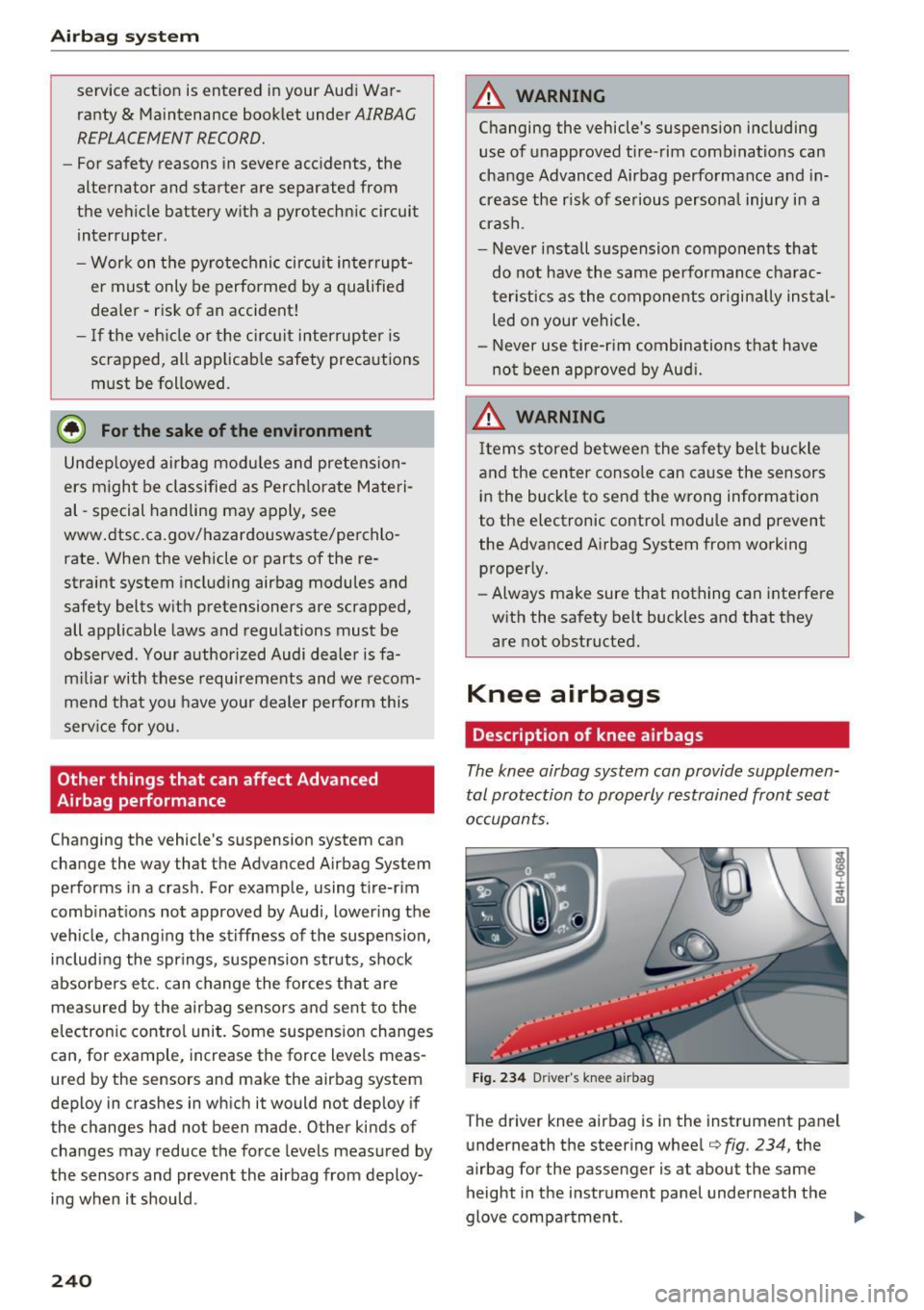
Fig . 234 D river 's knee a irbag
The driver knee airbag is in the instrument panel
underneath the steering wheel~
fig. 234, the
airbag for the passenger is at about the same height in the instrument panel underneath the
glove compartment . ..,_
Page 243 of 354
C) C0 ....
"' " "' .... 0 0 :r
the driver's and passenger's knees and upper and
lower th igh areas and supp lements the protec
tion provided by the safety belts.
I f the front airbags dep loy, the knee airbags also
deploy in fronta l co llisions when the dep loyment
threshold stored in the contro l unit is met
c:::> page 234, More important things to know
about front airbags.
In addition to their normal safety function, safe
ty belts help keep the driver or front passenger in position in a frontal coll is ion so that the a irbags
can prov ide supplemental protect ion.
The airbag system is not a substitute for your safety belt. Rather, it is part of the overall occu
pant restraint system in your vehicle . Always re
member that the airbag system can only help to
protect you if you are wearing your safety belt
and wear ing it properly . T his is why yo u should
always wear your safety belt, not j ust because
the law requires you to do
so <=> page 218, Gener
al information.
Remember too, airbags will deploy only once and
on ly in certain k inds of accidents -your safety
be lts are always there to offer protection in those
accidents in wh ich airbags are no t supposed to
deploy or w hen they have a lready dep loyed, for
examp le when your vehicle strikes or is struck by
another after the first collision .
This is jus t one of the reasons why an airbag is
not a substitute for the safety belt . The a irbag
system works most effectively when used with
the safety belts . Therefore, a lways wear your
safety belts correct ly.
It is important to remember that wh ile the sup
p lemental knee airbag system is designed to re
d uce the likelihood of serious injuries, other inju
ries, for example, swell ing, bruising and minor
abrasions and friction burns can also occur when
an airbag inf lates.
The knee airbag system basically cons ists of:
- The electronic contro l module
- T wo inf latab le airbags (airbag and gas genera-
tor), one for the driver and one fo r the front
passenger
Airb ag sys tem
- The a irbag indicator light in the instrument
panel
The knee airbag system will not deploy:
- when the ignit ion is switched off
- in fronta l co llisions when the decelerat ion
meas ured by the contro l unit is too low
- in side co llisions
- in rear-end collisions
- in rollovers
- in the event of a system malfunction (warning/
ind icator light is on)
c:::> page 23.
A WARNING
--Safety belts and the airbag system can only
provide protect ion when occupants are in
the prope r seat ing pos ition
c:::> page 234.
- If the airbag ind icator light c:::> page 23
comes when the veh icle is being used, have
the system inspected immediately by your
author ized Audi dealer.
It is possib le that
the airbag will inflate when it is not sup
posed to, or w ill not inf late w hen it should.
How knee airbags work
The risk of injury to the leg area can be reduced
by fully inflated knee airbags .
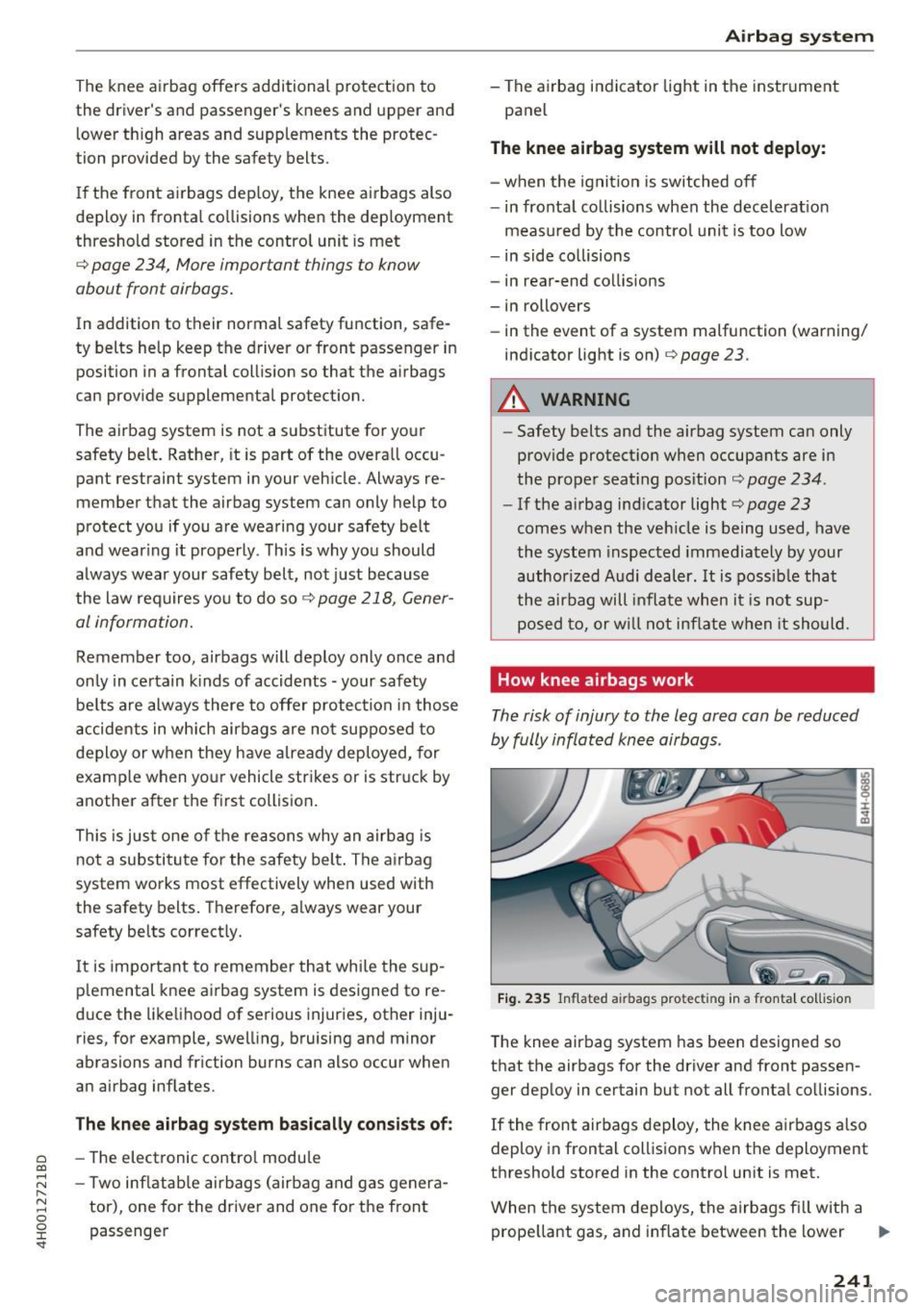
Fig. 2 35 Inflated a irbags protect ing in a fro nta l collision
The knee airbag system has been designed so
that the airbags for the driver and front passen
ger deploy in certain but not all frontal collisions .
If the front airbags deploy, the knee airbags also
deploy in frontal collis ions when the deployment
threshold stored in the control unit is met.
When the system deploys, the a irbags fi ll with a
prope llant gas, and infla te between the lower
Ill-
241
Page 244 of 354
Airbag system
part of the instrument panel and the driver and
the lower part of the instrument panel and the
front passenger
c> poge 234, fig. 232.
Although they are not a soft pillow, they can
"cushion" the impact and in this way they can
help to reduce the risk of injury to the lower ex
tremities.
All of this takes place in the blink of an eye, so
fast that many people don't even realize that the
airbags have deployed. The airbags also inflate
with a great deal of force and it is important for
occupant safety that nothing should be in their
way when they deploy.
Fully inflated airbags in combinat ion with proper
ly worn safety belts slow down and limit the oc
cupant's forward movement and help to reduce
t he risk of injury.
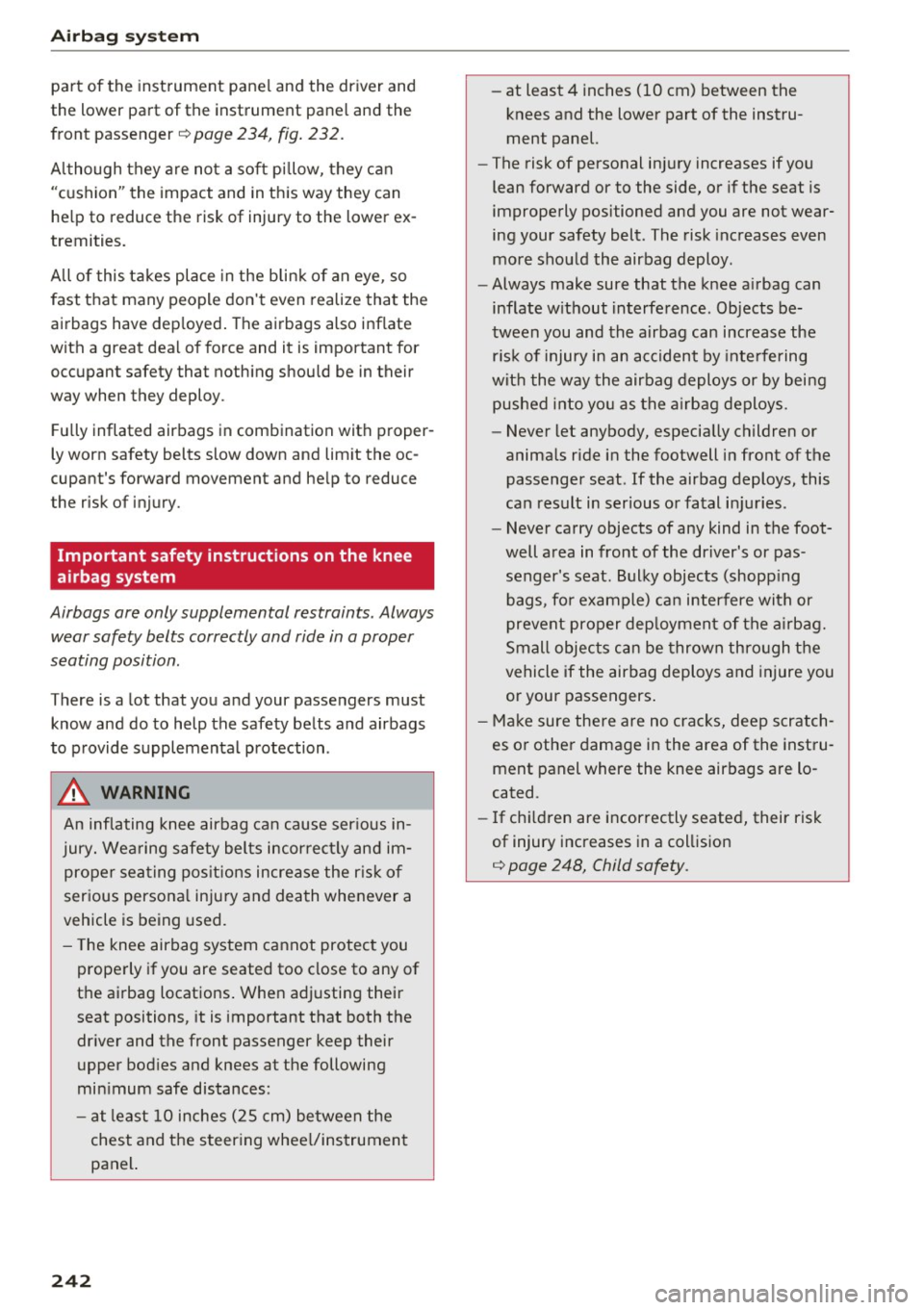
Important safety instructions on the knee
a irbag system
Airbags ore only supplemental restraints. Always
wear safety belts correctly and ride in a proper
seating position.
There is a lot that you and your passengers must
know and do to help the safety belts and airbags
to provide supplemental protection .
A WARNING
An inflating knee airbag can cause serious in
jury. Wearing safety belts incorrectly and im proper seating positions increase the risk of
serious personal injury and death whenever a
vehicle is being used.
- The knee airbag system cannot protect you
properly if you are seated too close to any of
the airbag locations. When adjusting their
seat positions, it is important that both the
driver and the front passenger keep their
upper bodies and knees at the following
minimum safe distances :
- at least 10 inches (25 cm) between the
chest and the steering wheel/instrument panel.
242
- at least 4 inches (10 cm) between the
knees and the lower part of the instru
ment panel.
- The risk of personal injury increases if you
lean forward or to the side, or if the seat is
improperly positioned and you are not wear
ing your safety belt . The risk increases even
more should the airbag deploy.
- Always make sure that the knee airbag can
inflate without interference . Objects be
tween you and the airbag can increase the risk of injury in an accident by interfering
with the way the airbag deploys or by being
pushed into you as the airbag deploys.
- Never let anybody, especially children or
animals ride in the footwell in front of the passenger seat. If the airbag deploys, this
can result in serious or fatal injuries .
- Never carry objects of any kind in the foot
well area in front of the driver's or pas
senger's seat. Bulky objects (shopping bags, for example) can interfere with or
prevent proper deployment of the airbag.
Small objects can be thrown through the
vehicle if the airbag deploys and injure you
or your passengers.
- Make sure there are no cracks, deep scratch
es or other damage in the area of the instru
ment panel where the knee airbags are lo
cated .
- If children are incorrectly seated, their risk
of injury increases in a collision
c> page 248, Child safety.
Page 248 of 354
Airbag syste m
The side curtain airbag system supplements the
safety belts and can he lp to reduce the risk of in
jury for occupants' heads and upper torso on the side of the vehicle that is struck in a side colli
sion . The side curtain airbag inflates in side im
pacts and only when the vehicle acceleration reg
istered by the control unit is h igh enough . If this
rate is below the reference value p rogrammed in
to the control un it, the side ai rbags wi ll not be
tr iggered, even though the car may be bad ly
damaged as a result of the collision. It is not pos
sible to define an airbag triggering range that
will cover every poss ible ang le of impact, since
the circumstances will vary cons iderably between
one collision and another. Important factors in
clude, for example , the nature (hard or soft) of
the impacting object, the angle of impact, vehicle
speed , etc.
c:> page 246, How side curtain air
bags work .
Aside from their normal safety function, safety
belts work to help keep the driver or front pas
senger in pos it io n in the event of a collision so
that the side curtain airbags can provide protec
tion .
The airbag system is not a substitute for your safety belt. Rather, it is part of the overall occu
pant restraint system in your vehicle . Always re
member that the airbag system can only help to
protect yo u if you are wea ring your safety belt
and wear ing it properly . T his is another reason
why you should always wear your safety belts, not just because the law requires you to do so
c:> page 218, General information.
I t is important to remember that whi le the s ide
curtain airbag system is designed to help reduce
the likelihood of serious injuries, other injuries,
for example, swe lling, bruising, and m inor abra
sions can a lso be associated with these airbags
upon deployment. Remember too, these a irbags
w ill deploy only once and only in certa in kinds of
accide nts -your safety belts are a lways the re to
offer protection.
The side curtain airbag system basically
consists of:
- The electronic control module and external s ide
impact senso rs
246
- The side curtain a irbags above the front and
rear side windows
- The a irbag indi cator light in the instrument
panel
The airbag system is mon itored electro nical ly to
make certain it is func tioning properly at all
times. Each t ime you switch on the ignit ion, the
airbag system indicator light will come on for a
few seconds (self diagnostics) .
The side curtain airbag i s not activated:
- if the igni tion is switched off,
- in side collisions whe n the acceleration meas-
ured by the sensor is too low,
- in rear-end collisions .
A WARNING
-Safety belts and the airbag system will only
provide pro tect ion when occupants are in
t he prope r seating pos ition
c:> page 54,
Seats and storage.
- I f the a irbag ind icator light c:> page 23
comes when the veh icle is being used, have
the system inspected immediately by your
authorized Audi dealer . It is possib le that
the airbag will inflate when it is not sup
posed to, or will not inflate when it should.
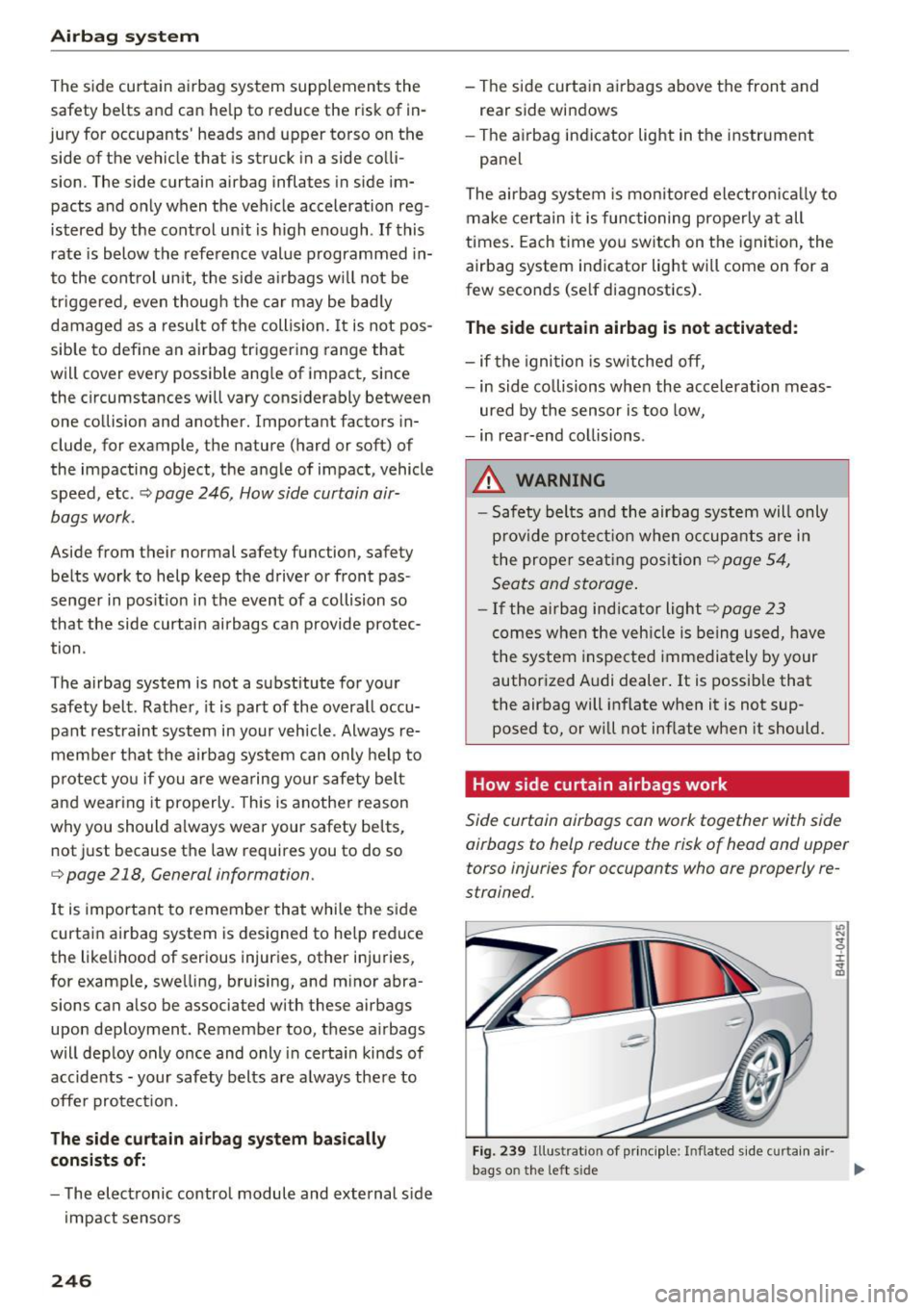
How side curtain airbags work
Side curtain airbags can work together with side
airbags to help reduce the risk of head and upper
torso injuries for occupants who are properly re
strained.
F ig. 239 Illu strat io n of pr inc iple : In flated side curta in a ir-
bag s on the left s ide
II>
Page 251 of 354
0 co .... N ,..... N .... 0 0 :c '
Child ren on the front seat of any car even w ith
Advanced Airbags can be seriously injured or
even killed when an airbag inflates. A child in
a rearward-facing child safety seat installed
on the front passenger seat will be seriously
injured and can be killed if the front airbag in
flates.
- The inflating airbag will hit the child safety
seat or infant carrier with great force and
will smash the ch ild safety seat and child
against the backrest, center armrest, or
door.
- Always install rear-facing child safety seats
on the rear seat.
- If you must install a rearward fac ing ch ild
safety seat on the front passenger seat in
exceptiona l circumstances and the
PA SSEN
GER AIR BAG OFF
light does not come on
and stay on, immediately insta ll the rear
facing child safety seat in a rear seating po
sition and have the airbag system inspected
immediately by your Audi dealer.
A WARNING
If, in except ional circumstances, you must in
stall a forward-facing chi ld restraint on the
front passenger's seat :
- Always make sure the forward-fac ing seat
has been designed and certified by its man
ufacturer for use on a front seat with a pas
senger front and s ide a irbag .
- Always follow the manufacturer's instruc
tions prov ided with the ch ild safety seat or
carrier.
- Always move the front passenger seat to
the highest position in the up and down ad
justment range and move it back to the
rea rmost position in the seat's fore and aft
adjustment range, as fa r away from the air
bag as possib le, before insta lling the for
ward- facing child restra int .
- Always ma ke sure that the s afety bel t upper
anchorage is beh ind the child restraint and
not next to or in front of the chi ld restraint
so that the safety belt will be properly pos i
t ioned.
Ch ild safety
-Always make sure that the PASSENGER AIR
BAG OFF
light comes on and stays on all the
time whenever the ignition is switched on.
@ Tips
A lways replace child restraints that were in
stalled in a vehicle du ring a c rash. Damage to
a child restraint that is not v is ible could cause
i t to fai l in another co llision situat ion.
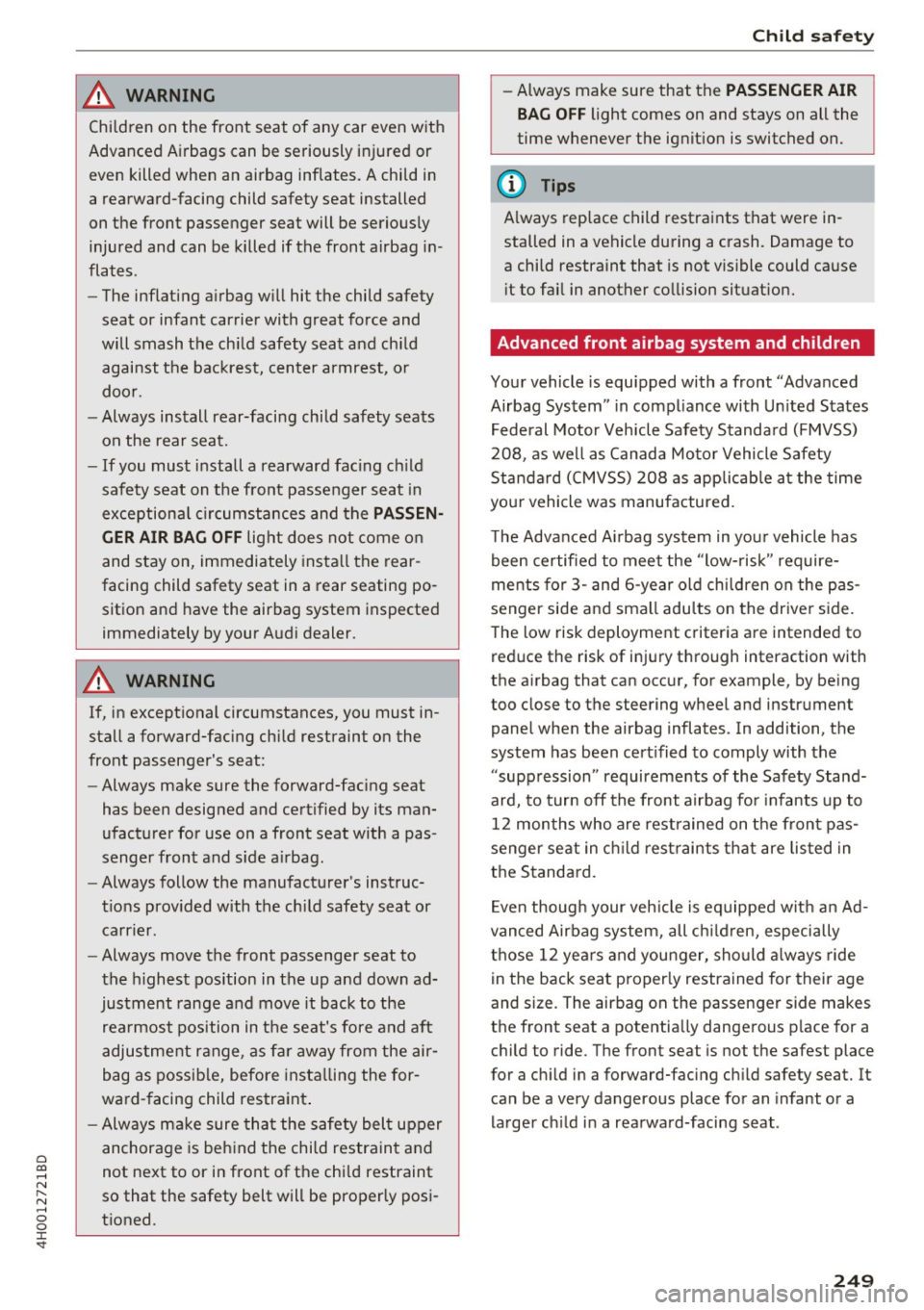
Advanced front airbag system and children
You r vehicle is equipped with a front "Advanced
Airbag System" in compliance with Un ited States
Federal Motor Vehicle Safety Standa rd (FMVSS)
208, as we ll as Canada Moto r Vehicle Safety
Standard (CMVSS) 208 as app licab le a t the time
your vehicle was manufactured.
T he Advanced A irbag system in yo ur vehicle has
been certified to meet the "low-risk" require
ments fo r 3- and 6-year old ch ild ren on the pas
senger side and sma ll adu lts on the driver side.
T he low risk deployment criter ia are intended to
red uce the risk of inju ry t hrough interaction with
the airbag that can occur, for example, by be ing
too close to the steering wheel and instrument
panel when the airbag inflates. In addition, the
system has been cert ified to comply with the
"supp ression" requirements of the Safety Stand
ard, to turn off the front a irbag fo r infants up to
12 months who are restrained on the front pas
senger seat in c hild res traints t hat are lis ted in
t h e Standard.
E ven though your veh icle is eq uipped wit h an Ad
vanced Airbag system, all ch ild ren, especially
those 12 yea rs and you nger, sho uld a lways ride
in the back seat proper ly restrained for their age
and size . The airbag on the passenger side makes
the front seat a potentia lly dange rous p lace for a
child to ride. The front seat is not the safest place
for a child in a forward-fac ing ch ild safety seat. It
can be a very dangerous place fo r an infant o r a
larger ch ild in a rearward-facing seat .
249
Page 327 of 354
0 co .... N ,..... N .... 0 0 :c '
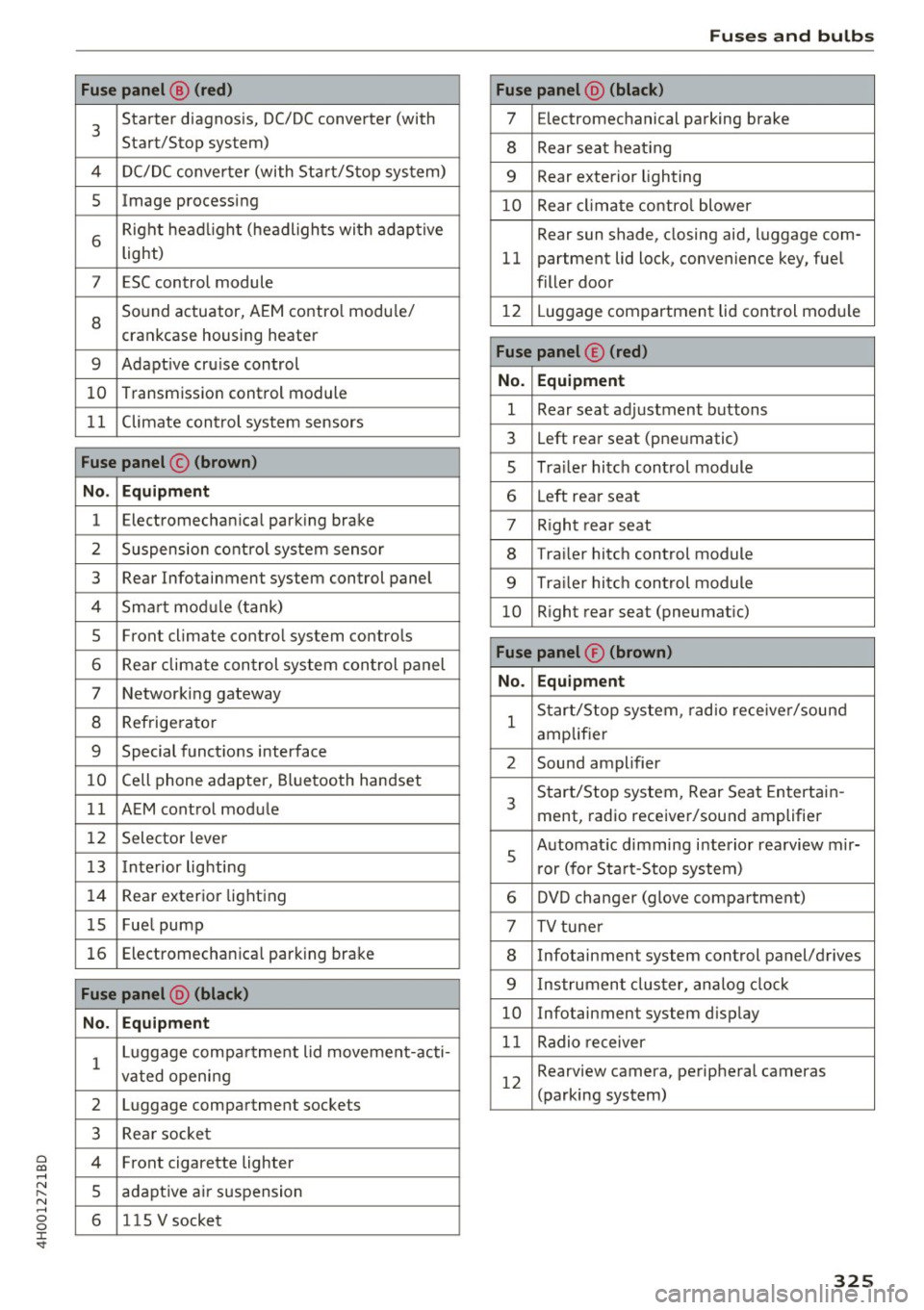
3
Starter diagnosis, DC/DC converter (with
Start/Stop system)
4 DC/DC converter (with Start/Stop system)
5 Image processing
6
Right headl ight (headlights with adaptive
light)
7 ESC control module
8
Sound actuator, AEM contro l modu le/
crankcase housing heater
9 Adapt ive cru ise control
10 Transmission control module
11 Climate control system sensors
Fuse panel © (brown)
No . Equipment
1 Electromechanical parking brake
2 Suspension control system sensor
3 Rear Infotainment system control panel
4 Smart mod ule (tank)
5 Front climate control system controls
6 Rear climate control system control panel
7 Networking gateway
8 Refrigerator
9 Special functions interface
10 Cell phone adapter, Bluetooth handset
11 AEM control module
12 Selector lever
13 Interior lighting
14 Rear exter ior light ing
15 Fue l pump
16 Electromechan ica l parking brake
Fuse panel @ (black)
No . Equipment
1 Luggage compa
rtment lid movement-acti-
vated opening
2 Luggage compartment sockets
3 Rea r socket
4 Front cigarette lighter
5 adaptive air suspension
6 1 lS V socket
Fuses and bulbs
Fuse panel @ (black)
7 Electromechanical parking brake
8 Rear seat heating
9 Rear exterior lighting
10 Rear climate control blower
Rear sun shade, closing aid, luggage com-
11 partment lid lock, convenience key, fuel
filler door
12 L uggage compartment lid control module
Fuse panel © (red)
No. Equipment
1 Rear seat adjustment buttons
3 Left rear seat (pneumatic)
s Trailer hitch control module
6 Left rear seat
7 R ight rear seat
8 Trailer hitch control module
9 Tra ile r hitch control module
10 Right rear seat (pneumatic)
Fuse panel® (brown)
No. Equipment
1
Start/Stop system, radio receiver/sound
amplifier
2 Sound amplifier
3
Start/Stop system, Rear Seat Entertain-
ment, radio receiver/sound amplifier
s
Automat ic dimming interior rearview mir-
r or (for Start-Stop system)
6 DVD changer (glove compartment)
7 TV tuner
8 Infotainment system control panel/drives
9 Instrument cluster, analog clock
10 Infotainment system display
11 Radio receiver
12
Rearview camera, peripheral cameras
(parking system)
325