fuel AUDI A8 2017 Owner's Manual
[x] Cancel search | Manufacturer: AUDI, Model Year: 2017, Model line: A8, Model: AUDI A8 2017Pages: 354, PDF Size: 88.68 MB
Page 271 of 354

C) C0 ....
"' ,....
"' .... 0 0 :r
Never drive your vehicle until the fuel tank is
completely empty. The irregular supply of
fuel can cause misfiring. Gasoline could enter
the exhaust system and damage the catalytic
converter.
Fueling procedure
Fig. 253 R ight rear side of the vehicle: opening the fue l
f iller door
Fig. 254 Fu el fil ler door w ith attached fuel cap
The fuel filler door is unlocked or locked by the
central locking system.
Opening the fuel cap
"" Press on the left side of the fuel filler door to
open
c:!;> fig . 2 53.
""Unscrew the tank cap counterclockw ise.
"" Place the cap from above on the open fuel filler
door
c:!;> fig. 254.
Closing the fuel cap
""Screw the tank cap on to the right on the filler
neck until it cannot turn any farther .
""Then press on the left side of the tank door un
ti l it latches .
Checking and Filling
Once the pump nozzle switches off, the fuel tank
is "full". Do not fill the tank more . Otherwise the
expansion space in the tank will be filled.
The correct fuel type for your vehicle can be
found on a label located on the inside of the fuel
filler door. For additional information on fuel,
see
c:!;> page 267.
The fuel tank capacity of your vehicle is listed in
the
Technical Data section c:!;> page 334.
To avo id fuel spilling or evaporat ing from the fuel
tank always close fuel cap properly and com
pletely. An improperly closed fuel filler cap may
also cause the MIL lamp
c:!;> page 25 to come on.
A WARNING
Not paying attention when fueling or han
dling fuel incorrectly can lead to fires, explo
sions or serious injuries.
- Fuel ignites easily and can cause serious
burns and other injuries.
-
-If you do not switch the engine off when fu
eling and/or do not insert the fuel nozzle
completely into the tank opening, fuel can
leak out or run over. Leaked fuel can ignite
and start a fire.
- Do not use the telephone while fueling. The
electromagnetic rays can cause sparks,
which can ignite fuel vapors and start a fire .
- Do not sit in your vehicle while fueling. If
you must make an exception and enter your
veh icle aga in while fueling, close the door
and touch metal to discharge static electric
ity before touching the fuel nozzle. Static
electricity can create sparks, which can ig
nite vapors when fueling.
- Do not smoke or have an open flame in the
area when fueling your vehicle or filling a
fuel container because this increases the
risk of an explosion.
- For your safety, carrying fuel containers in
your vehicle is not recommended. Whether
full or empty, the container can leak and
cause a fire in the event of an accident.
- If you must make an exception and trans
port a fuel container, note the following:
269
Page 272 of 354

Checking and Filling
-Never fill the fuel container with fuel
while it is in or on the vehicle. Static elec
tricity is discharged when filling which can
cause the fuel vapors to ignite and in
creases the risk of an explosion .
- Always place a fuel container on the
ground before filling .
- Always hold the fuel nozzle completely in
the fuel container when filling .
- If the fuel container is made of metal, the
fuel nozzle must always be in contact with
the container when filling it with fuel. This
prevents static electricity from discharg
ing.
- Never spill fuel in the vehicle or the lug
gage compartment . Evaporated fuel is ex
plosive and increases the risk of serious in
jury or death.
- Follow legal requirements when using,
storing and transporting fuel containers.
- Make sure the fuel container conforms to
industry standards (ANSI/ASTM F852-86).
0 Note
- Remove spilled fuel from vehicle paint im
mediately, because it can damage paint.
- Never drive until the fuel tank is completely
empty . The irregular supply of fuel that re
sults from that can cause engine misfires .
Uncombusted fuel will enter the exhaust
system and increase the risk of damage to
the catalytic converter.
@ For the sake of the environment
Do not overfill the fuel tank, otherwise fuel
can leak out when the vehicle is warming up.
(0 Tips
The fuel filler door on your vehicle does not
lock if you lock the vehicle from the inside .
270
Fuel filler door emergency release
If the cen tral locking system is faulty, the fuel
filler door can be unlocked manually .
Fig. 255 Vehicles with selective ca ta ly tic reduc tion•: righ t
s ide trim panel in the l ugg age compartment
Fig. 256 R ig ht s ide t rim pane l in t he luggage com part·
ment : emerg enc y release mechan ism
.., tn
9 :c
"' a,
The emergency release mechanism is located be
hind the right side trim panel in the luggage
compartment. In vehicles with selective catalytic
reduction*, remove the vent grille first:
.. Press both tabs@¢
fig. 255 and tilt the vent
grille downward. You can then remove the
grille upward .
.. Loosen the loop
q fig . 256 from the retainer
and then pull on the loop carefully
q (I) . The
fuel filler door releases.
.. Press on the left side of the fuel filler door to
open it~
page 269 , fig. 253 .
(D Note
Only pull on the loop until you feel resistance.
You will not hear it release . Otherwise you
could damage the emergency release mecha
nism.
Page 273 of 354
0 co .... N ,..... N .... 0 0 :c '
Applies to: ve hicles with gasoline engine
It is very important that your emission control
system (catalytic converter) is functioning prop
erly to ensure that your vehicle is running in an
environmentally sound manner .
... Always use lead-free gasoline c:> page 267, Fuel
supply.
... Never run the tank down all the way to empty.
... Never put too much motor oil in your engine
c:> page 2 76, Adding engine oil 'l:::r. .
.,. Never t ry to push- or tow-start your vehicle.
The catalytic converter is an efficient "clean-up"
device built into the exhaust system of the vehi
cle . The catalytic conve rter burns many of the
pollutants in the exhaust gas before they are re
l eased into the atmosphe re.
The exclusive use of unleaded fue l is critically im
portant for the life of the catalyt ic converter and
proper functioning of the engine.
.&, WARNING
T he temperature of the exha ust system is
high, both when driving and afte r stopping
the engine .
-
-Never to uch the exha ust tail pipes once they
have become hot . This could result in bu rns.
- Do not park o r operate the vehicle in areas
where the hot exhaust system may come in
contact with dry grass, br ush, fuel spill or
other material which can cause a fire .
- Do not apply additional undercoating or rustproofing on or near the exhaust mani
fold, exhaust pipes, catalytic converter or
heat shields. During dr iving, the substance
used for undercoating could overheat and
cause a fire .
(D Note
-Be aware that just one tank filling with
leaded fuel will already ser iously degrade
the performance of the catalytic converter.
- Do not exceed the correct eng ine o il level
c:> page 2 76.
- Do not drive until the fuel tank becomes
complete ly empty. The engine co uld mis-
Ch eck ing and Filling
fire. Unburned fue l co uld also get into the
exhaust system and this could cause the
catalytic converter to overheat.
- Do not switch off the ignition whi le the vehi
cle is moving .
- Do not continue to ope rate your vehicle un
der these conditions, as otherwise fuel can
reach the catalytic converter . This could re
sult in overheat ing of the converter, requir
ing its replacement .
- To assure efficient operat ion of the Emis
sion Contro l System :
- Have yo ur vehicle maintained p roperly and
in accordance with the serv ice recommen
dat ions in yo ur War ranty
& Ma intenance
booklet .
- L ack of proper ma intenance as well as im
proper use of the veh icle w ill impa ir the
function o f the emission control system
and could lead to damage.
@ For the sake of the environment
Even when the Emiss ion Control System is op
erating properly, the exhaus t gas can have a
su lfur-like exhaust gas sme ll under some op
erating states. This depends on the sulfur
content of the fuel being used. Us ing a differ
ent brand of fuel may help, or fil ling the tank
with lead-free super grade gasoline.
Engine compartment
Working in the engine compartment
Special care is required if you are working in the
engine compartment
For work in the engine compartment such as
chec king and filling fluids , there is a risk of in
jury , scalding, ac cident s, and burn s. For thi s
reason , follow all the warnings and general
safety p recauti ons provi ded in the following in
formation. The engine compartment is a dan
gerous area on the vehicle.
c:> .&. .
.&, WARNING ~
-Turn the engine off .
- Switch the ignition off .
271
Page 274 of 354
Checking and Filling
-Set the parking brake.
- Select the P selector lever position.
- Let the engine cool down.
- Never open the hood when there is steam or
coolant escaping from the engine compart
ment, because there is a risk that you could
be burned. Wait until no steam or coolant is
escaping.
- Keep children away from the engine com
partment.
- Never spill fluids on a hot engine. These flu
ids (such as the anti-freezing agent con
tained in the coolant) can ignite.
- Avoid short circuits in the electrical system.
- When working in the engine compartment,
remember that the radiator fan can switch
on even if the ignition is switched off, which
increases the risk of personal injury.
- Never open the cap on the coolant expan
sion tank when the engine is warm. The
cooling system is under pressure.
- To protect your face, hands, and arms from
hot steam or coolant, cover the cap with a
large cloth when opening.
- Do not remove the engine cover under any
circumstances. This increases the risk of
burns.
- If tests need to be performed with the en
gine running, there is additional danger due
to moving components (such as the ribbed
belt, alternator and radiator fan) and from
the high-voltage ignition system .
- Do not under any circumstances activate the
throttle inadvertently (for example, by hand
from the engine compartment) if the vehi
cle is stationary but the engine is running
and a gear is engaged. Otherwise, the vehi
cle will start to move immediately and this
could result in an accident.
- Pay attention to the following warnings list
ed when work on the fuel system or on the
electrical equipment is required.
- Do not smoke .
- Never work near open flames.
- Always have a working fire extinguisher
nearby
- All work on the battery or electrical system
in your vehicle can result in injuries, chemi-
272
cal burns, accidents or burns. Because of
this, all work must be performed
only by an
authorized Audi dealer or authorized Audi
Service Facility .
- To reduce the risk of electric shock and in
jury, never touch the following components when the engine is running or is being start
ed:
- Ignition cable
- Other components in the electronic high-
voltage ignition system
- If you must check or perform work on the
engine while it is running:
- Set the parking brake and place the selec tor lever in the P (park) position first.
- Always proceed with extreme caution so
that clothing, jewelry or long hair do not
become caught in the radiator fan, fan
belt or other moving components or do
not come into contact with hot compo
nents . Tie back long hair before beginning
work and do not wear clothing that can
hang down into the engine .
- Limit your exposure to exhaust and chemi
cals to as short a time as possible
c:> ,&. .
.&_ WARNING
California Proposition 65 Warning:
- Engine exhaust, some of its constituents,
and certain vehicle components contain or
emit chemicals known to the State of Cali
fornia to cause cancer and birth defects and
reproductive harm. In addition, certain flu
ids contained in vehicles and certain prod
ucts of component wear contain or emit
chemicals known to the State of California
to cause cancer and birth defects or other
reproductive harm .
- Battery posts, terminals and related acces
sories contain lead and lead compounds,
chemicals known to the State of California
to cause cancer and reproductive harms .
Wash hands after handling.
Page 277 of 354

0 co .... N ,..._
N .... 0 0 :c '
functionality and service life of the engine. Your
engine was factory-filled with a high -quality oil
which can usually be used throughout the entire
year.
Note
Your Limited New Vehicle Warranty does not cover damage or malfunctions due to failure
to follow recommended maintenance and use
requirements as set forth in the Audi Owner's Manual and Warranty & Maintenance booklet.
- Use only a high quality engine oil that ex-
pressly complies with the Aud i oil quality
standard specified for your vehicle's engine.
Using any o ther oil can cause serious engine
damage.
- Do not mix any lubricants o r other additives
into the engine oil. Doing so can cause en
gine damage.
@ Tips
If you need to add oil and there is none availa
ble that meets the Audi o il quality standard
your eng ine requ ires, you may add a total of
no more than 0 .5 quart/li ter of a h igh-quality
"synthet ic"oil that meets the following speci
fications.
- Vehicles with gasoline eng ine: ACEA A3 o r
API SM with a viscosity grade of SAE OW-30,
SAE SW-30 or SAE SW-40.
- For more information about engine oil that has been approved for your vehicle, please
contact e ither your authorized Audi dea ler
or A udi Customer Relat ions at
1 (800) 822-2834 or visit our web site at
www.audiusa.com or www.aud icanada .ca.
Engine oil consumption
The engine in your vehicle depends on an ade
quate amount of oil to lubricate and cool all of
its moving parts .
In order to provide effective lubr ication and coo l
ing of internal engine components, all internal
combustion engines consume a certain amount
of oil. Oil consumption varies from engine to en
g ine and may change significant ly over the life of
Ch eck ing and Filling
the engine. Typ ica lly, engines with a specified
break-in period (see ¢
page 73) consume more
o il during the break -in per iod than they consume
after oil consumption has stabili zed.
Under normal cond itions, the rate of oil con
sumption depends on the quality and viscosity of
the oil, the RPM (revo lutions per minute) at
which the engine is operated, the amb ient tem
perature and road condit ions. Further factors are
the amount of o il dilution from water condensa
t ion or fuel residue a nd the oxidat ion level of the
o il. As any engine is subject to wear as mileage
builds up, the oil consumption may increase ove r
t ime unt il repla cement of worn components may
become necessary .
With a ll these variab les coming into play, no
sta ndard rate of o il cons umption can be estab
l is h ed or spec ified. The re is no alternative to reg
u lar and frequent checking of the oi l level, see
Note .
If the yellow engine o il leve l warning symbo l in
t h e instr ume nt cl uster
II lights up, yo u should
check the o il level as soon as possible
¢ page 2 76 . Top off the o il at your earliest con
venience
¢ page 276.
A WARNING
-Before you check anyth ing in the engine com-
partment, always read and heed all WARN
INGS
¢ .& in Working in the engine compart
ment on page 271 .
@ Note
Driving with an insufficient oil level is likely to
cause severe damage to the eng ine.
(D Tips
- The oil pressu re warning display. is not
an indicator of the o il le vel. Do not rely on
i t. Instead, check the oil level in you r en
g ine at regular inter vals, preferabl y each
time you refuel, and alw ays before go ing
on a long trip .
-If you have the impression your engine con
sumes excessive amou nts of oil, we recom-
mend that you consult your Aud i dea le r to .,,.
275
Page 278 of 354

Checking and Filling
have the cause of your concern properly di
agnosed. Keep in mind that the accurate
measurement of oil consumption requires
great care and may take some time. Your
Audi dealer has instructions about how to
measure oil consumption accurately.
Checking the engine oil level
A pp lies to: ve hicles w ith oil leve l indicator
The engine oil level can be checked in the Info
tainment system
Observe the safety precautions c:::> &. in Working
in the engine compartment on page 2 71.
.. Park your vehicle on a level surface.
.. Shut the engine off when it is warm .
.. Switch only the ignition back on.
.. Wait approximately two minutes.
.. Select: the
ICARI function button > Car systems
control button > Servicing & checks> Oil level.
.. Read the oil level in the display . Add engine oil
if the bar in the oil level indicator is just before
"min"
<=:> page 276.
The engine oil consumption may be up to
0.5 quart/600 miles (0.5 liter/1,000 km), de
pending on driving style and operating condi
tions. Consumption may be higher during the
first 3,000 miles (5,000 km). Because of this, the
engine oil level must be checked regularly. It
would be best to check each time you refuel your
vehicle and before long drives.
@ Tips
The oil level indicator in the display is only an
informational display. If the oil level is too
low, a minimum oil warning appears in the in
strument cluster. Add oil and close the hood.
The current oil level is displayed in the Info
tainment system the next time the ignition is
switched on .
276
· Adding engine oil~
Fig. 260 En gine compartment : engine oil f iller opening
cover
Read and follow the WARNINGS before check
ing anything in the engine compartment
c:::> page 2 71 .
.. Turn the engine off .
.. Unscrew the engine oil filling opening cap
"I::?:
c:::> fig. 260, c:::> page 2 74.
.. Carefully add 0.5 quart (0.5 liter) of the correct
oil
c:::> page 2 74.
.. Check the oil level again after two minutes
c:::> page 2 76, Checking the engine oil level .
.. Add more oil if necessary.
.. Close the engine oil filler opening cap.
A WARNING
- When adding oil, do not let oil drip onto hot
engine components. This increases the risk
of afire.
- Always clean skin thoroughly if it comes into
contact with engine oil.
(D Note
- Check the oil level. If the message Please
reduce oil level
appears, contact an author
ized Audi dealer or authorized Audi Service
Facility to have excess oil extracted if neces
sary.
- Do not mix any additional lubricants into
the engine oil. Damage caused by such addi
tives is not covered by the warranty.
(® For the sake of the environment
-Oil should never enter the sewer system or
come into contact with the ground.
Page 285 of 354
0
a:,
.... N ...... N .... 0
0
I
Wheels and Tires
General information
.,.Check your tires regularly for
damage (punctures, cuts, cracks
and bulges). Remove foreign ob
jects from the tire tread.
.,. If driving over c urbs or similar
obstacles, drive slowly and ap
proach the curb at an angle.
.,.Have faulty tires or rims re
placed immediately.
.,.Protect your tires from oil,
grease and fuel.
.,.Mark tires before removing
them so that the same running direction can be maintained if
they are reinstalled .
.,.Lay tires flat when storing and
store them in a cool, dry location
with as little exposure to light as possible.
(D Note
-Please note that summer and winter tires are designed for
the conditions that are typical in those seasons. Audi recom
mends using winter tires dur
ing the winter months. Low
temperatures significantly de
crease the elasticity of summ
er tires, which affects traction
Wheels
and braking ab ility. If summer
tires are used in very cold
temperatures, cracks can form on the tread bars, result ing in
permanent tire damage that
can cause loud driving noise
and unbalanced tires.
-Burnished, polished or chromed rims must not be
used in winter driving condi
tions. The surface of the rims does not have sufficient corro
sion protection for this and
could be permanently dam
aged by road salt or sim ilar
substances.
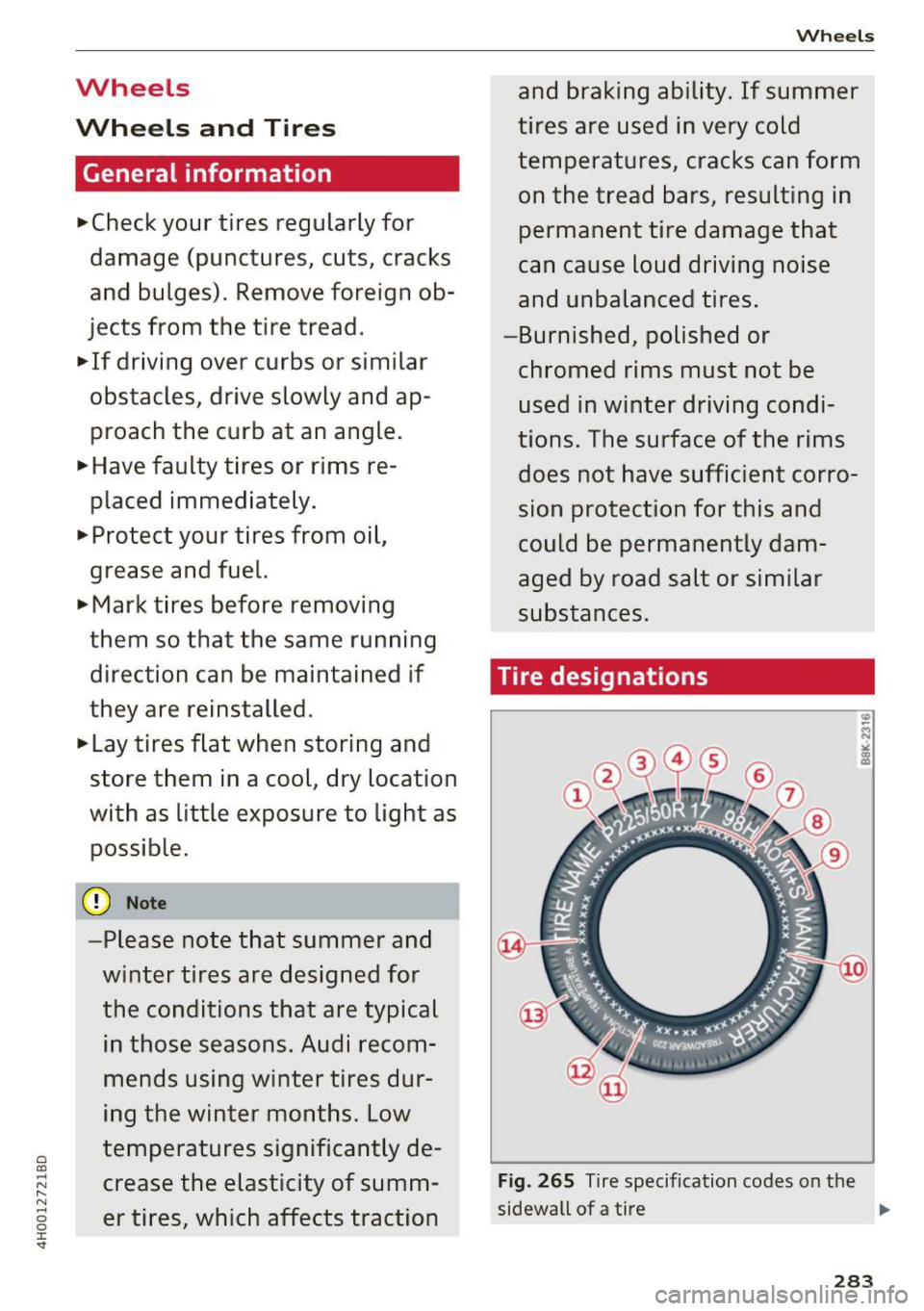
Ti re designations
Fig. 265 Tire specification codes on the
sidewall of a tire .,.
283
Page 288 of 354
Wheels
Bead
means the part of the tire that is
made of steel wires, wrapped or
reinforced by ply cords and that is
shaped to fit the rim .
Bead separation
means a breakdown of the bond
between components in the bead.
Cord
means the strands forming the
plies in the tire.
Cold tire inflation pressure
means the tire pressure recom
mended by the vehic le manufac
turer for a tire of a des ignated
size that has not been driven for more than a couple of miles (kilo
meters) at low speeds in the
three hour period before the tire pressure is measured or adj usted.
Curb weight
means the weight of a motor ve
hicle w ith standard equipment in
cluding the maximum capacity of
fuel, oil, and coolant, air condi
tioning and additiona l weight of
op tional equipment.
E x tra load tire
means a tire des igned to operate
at higher loads and at h igher in -
286
flation pressures than t he corre
spond ing standa rd tire. Extra load
tires may be identified as "XL",
"xl" , "EXTRA LOAD" , or "RF" on
the sidewall.
Gross A xle Weight Rating
("GAWR ")
means the load-carrying capacity
of a single axle system , measured
at the ti re-gro und interfaces.
Gross Vehicle Weight Rating
("GVWR")
means the max imum total loaded
weight of the vehicle .
Groove
means the space between two ad
jacent tread ribs .
Load rating (code)
means the maximum load tha t a
tire is rated to carry for a given in
flation pressure. You may not find
this informat ion on all ti res be
cause it is not required by law .
Maximum load rating
means the load rating for a tire at
the maximum permissible infla
tion p ressure for that ti re .
Maximum loaded vehicle
weight
means the sum of:
Page 296 of 354
Wheels
A WARNING
Always adapt the tire pressure
to your driving style and vehicle load.
-Overloading can lead to loss of vehicle control and increase
the risk of an accident. Read and follow the important safe
ty precautions inc:::> page 295,
Tires and vehicle load limits.
-The tire must flex more if the
tire pressure is too low or if
the vehicle speed or load are
too high. This heats the tire up
too much. This increases the
risk of an accident because it
can cause the tire to burst and
result in loss of vehicle con
trol.
-Incorrect tire pressure in creases tire wear and has a
Tire pressure table
Please note that the information
contained in the following table
was correct at the time of print ing, and the information is sub
ject to change . If there are differ
ences between this information
and the tire pressures specified
on the label on the driver's side 8- pillar, always follow the specifica-
294
negative effect on driving and
braking behavior, which in
creases the risk of an accident.
(D Note
Replace lost valve caps to re
duce the risk of damage to the
tire valves.
@ For the sake of the environment
Tire pressure that is too low in
creases fuel consumption.
(D Tips
Audi recommends using the
tire pressure specified for a normal load c:::>
table on
page 295
or for a full load
when the vehicle is partially
loaded.
tion on the 8-pillar label c:::>
page 293, fig. 267.
Make sure that the tire designa
tion on your tire matches the des ignation on the tire pressure label
and the tire pressure table.
The following table lists recom- mended tire pressures in cold ..
Page 298 of 354
Wheels
sure that load limits are not ex
ceeded. Vehicle load includes ev
erybody and everything in and on
the vehicle. These load limits are
technically referred to as the vehi
cle's
Gross Vehicle Weight Rat
ing
("GVWR").
The "GVWR" includes the weight
of the basic vehicle, all factory in
stalled accessories, a full tank of
fuel, oil, coolant and other fluids plus maximum load. The maxi
mum load includes the number of
passengers that the vehicle is in
tended to carry ("seating capaci
ty") with an assumed weight of
150 lbs. (68 kg) for each passen
ger at a designated seating posi
tion and the total weight of any luggage in the vehicle. If you tow
a trailer, the weight of the trailer
hitch and the tongue weight of
the loaded trailer must be includ
ed as part of the vehicle load.
The
Gross Axle Weight Rating
("GAWR") is the maximum load
that can be applied at each of the
vehicle's two axles.
The fact that there is an upper
limit to your vehicle's Gross Vehi
cle Weight Rating means that the
total weight of whatever is being
296
carried in the vehicle (including
the weight of a trailer hitch and the tongue weight of the loaded
trailer) is limited. The more pas
sengers in the vehicle or passen
gers who are heavier than the
standard weights assumed mean
that less weight can be carried as l uggage .
The Gross Vehicle Weight Rating
and the Gross Axle Weight Rating
are listed on the safety compli
ance sticker label located on the
driver's side B-pillar
¢ page 293,
fig. 267.
.&_ WARNING
-
Overloading a vehicle can cause
loss of vehicle control, a crash
or other accident, serious per
sonal injury, and even death.
-Carrying more weight than
your vehicle was designed to
carry will prevent the vehicle
from handling properly and increase the risk of the loss of
vehicle control.
-The brakes on a vehicle that
has been overloaded may not
be able to stop the vehicle
within a safe distance.