tow AUDI A8 2017 Service Manual
[x] Cancel search | Manufacturer: AUDI, Model Year: 2017, Model line: A8, Model: AUDI A8 2017Pages: 354, PDF Size: 88.68 MB
Page 236 of 354
Airbag syste m
damaged, preventing them and the airbag
system from working properly.
- Never place seat covers or rep lacement up
holstery that have not been specifically ap
proved by Audi on the front seats .
- Seat covers can prevent the Advanced Air
bag System from recognizing child re
straints or occupants on the front passenger
seat and prevent the side a irbag in the seat
backrest from deploying properly.
- Never use cush ions, pillows, blankets or
similar items on the front passenger seat.
The add it ional padding will prevent the
weight-sens ing mat in the seat from acc u
rately reg istering the ch ild restraint or per
son on the seat and prevent the Advanced
Airbag System from funct ioning properly.
- If you must use a child rest raint on the front
passenge r seat and the child restraint man
ufacturer 's instructions require the use of a
towel, foam cushion or something else to properly position the ch ild restraint, make
certain that the
PA SSENGER AIR BAG OFF
light comes on and stays on whenever the
child restraint is installed on the front pas
senger seat.
- If the
PASSEN GER AIR B AG OFF light does
not come on and stay on, immed iately in
stall child restraint in a rear seating position and have the airbag system inspected by
yo ur Audi dealer.
How the Advanced Airbag System
components work together
The front Advanced Airbag System and the side
airbags supplement the protection offered by the
front three-po int safety belts with pretensioners
and load limiters and the adjustable head re
stra ints to help reduce the r isk of injury in a wide
range of accident and crash situations. Be sure to read the important informa tion about safety and
heed the WARN INGS in t his chapter.
Deployment of the Advanced Airbag System and
the act ivat ion of the safety belt pretensioners de
pend on the deceleration measu red by the crash
sensors and regis tered by the electronic control
unit. Crash severity depends on speed and decel-
2 34
eration as well as the mass and stiffness of the
vehicle or object involved in the crash .
On the passenger side, regard less of safety be lt
u se, the airbag will be turned off if the weight on
the passenger seat is less than the amount pro
grammed in the electronic control unit . The front
airbag on the passenger side will also be turned
off if one of the child seats that has been certi
fied under Federal Motor Vehicle Safety Standard 208 has been recognized on the seat. The
PA S
S ENGER AIR BAG OFF
light comes on and stays
on to tell you when the front Advanced A irbag on
the passenger side has been turned off
q page 22 7, Child restraints on the front seat
some important things to know.
A WARNING
To reduce the ris k of injury when an airbag in
f lates, always wea r safety belts properly.
- If you are un restrained, leaning forward, sit
ting sideways or out of position i n any way,
your risk of injury is much higher.
- You will a lso receive serious injuries and
could even be killed if you are up against the
airbag or too close to it when it inflates -
even with an Advanced Airbag
q page 226.
More important things to know about front
airbags
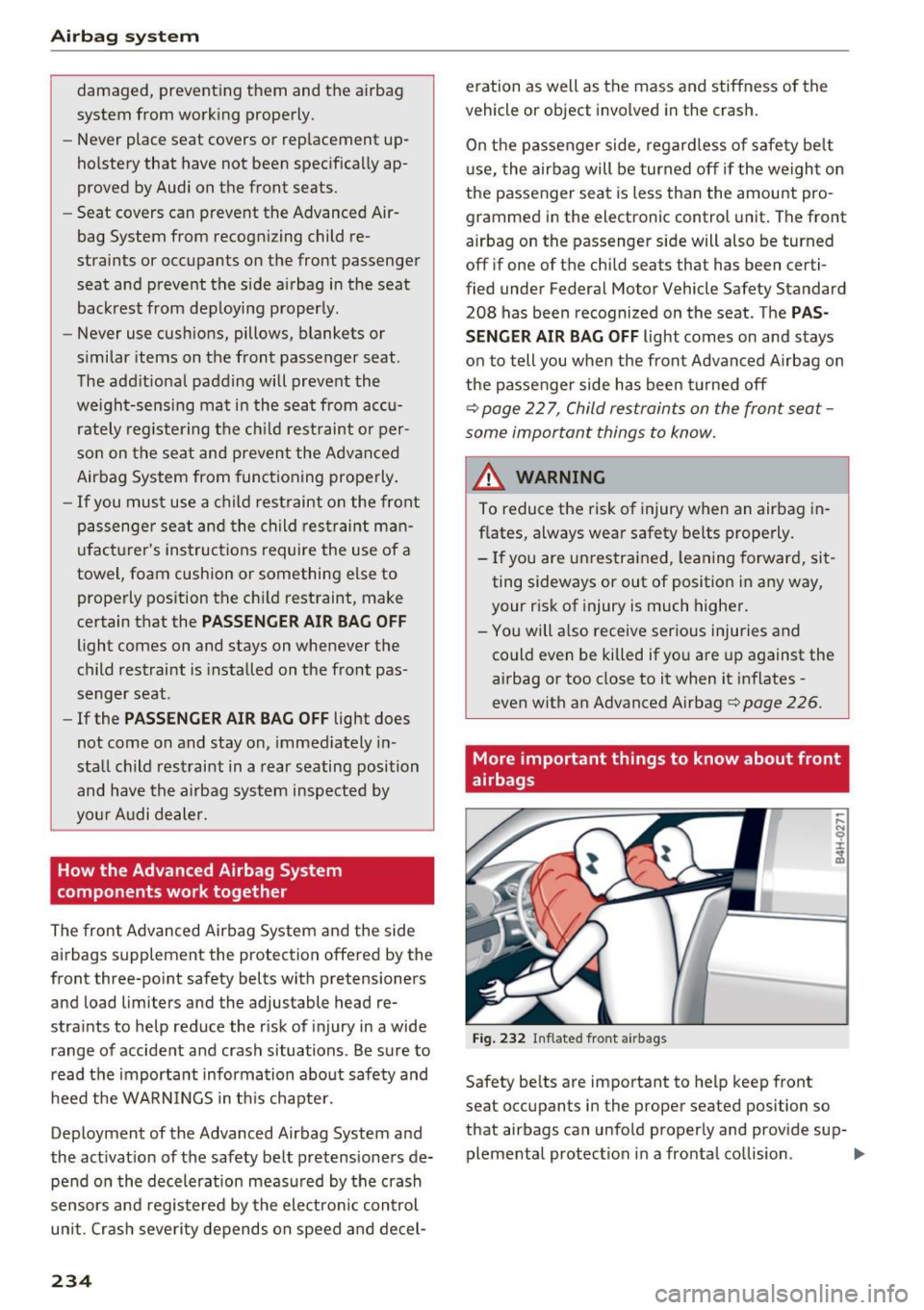
Fig . 232 Inflated front a irbags
Safety be lts are important to help keep front
seat occupants in the proper seated position so
that airbags can unfold properly and prov ide sup-
plemental protection in a fronta l collision . ..,.
Page 262 of 354
Child safet y
Activating the convertible locking retractor
Use the convertible locking retractor to secure a
child restraint.
Always heed the child safety seat manufacturer 's
instructions when installing a child restraint in
your veh icle . To activate the convertible locking
retractor:
.,. Place the child restraint on a seat, preferab ly
on the rear seat.
.,. Slowly pull the belt
all the wa y out .
.,. Route it around o r through the ch ild restraint
belt path
~ ,&. .
""Pu sh the child safety seat down wit h your fu ll
weight to get the s afety be lt rea lly tight.
.,. Inse rt the belt tongue into the buckle for that
seating position .
.,. Guide the safety belt back into the retractor un
ti l the belt lies flat and snug on the child safety
seat.
.,. You should hear a "clicking" no ise as the belt
winds back into the inertia reel. Test the con
vertib le locking ret ractor by pu lling on the belt .
Yo u should no longer be ab le to pu ll the belt
out of the retracto r. The conve rtible locking re
tra cto r is now act ivated .
.,. Make s ure that the red release b utton is fac ing
away from the child restraint so that it can be
u nbuck led q uickly.
.,. Pull on the be lt to make sure the safety belt is
properly tight and fastened so that the seat
cannot move forward or sideways more than
one inch (2 .5 cm) .
A WARNING
Using the wrong child restra int or an im prop
erly installed ch ild rest raint can cause ser ious
perso nal in jury o r de ath in a crash.
- Always make sure tha t the safety belt re
t ra ctor is loc ked when ins tall ing a child
safe ty seat. An unlocke d safety bel t re trac
tor cannot hold the child safety seat in place during no rma l driving or in a crash .
- Always buckle the child safety seat firmly in
place even if a child is not s itting in it. A
loose child safety seat can f ly arou nd du ring
a sudden stop or in a crash.
260
- Always make sure the seat back rest to which
the child restraint is installed is in an up
r ight position and securely latched into
place and cannot fold forward. Otherw ise,
the seatback with the child safety seat at
tached to it could fly forward in the event of
an accident o r othe r emergency s ituation.
- Always read and heed all WARNINGS when
eve r us ing a child restrained in a vehicle is
be ing used~
page 248. Spe cial p recau tions
ap ply when installing a child safety seat on
the front passenge r seat ~
page 22 7, Child
restraints on the front seat -some impor
tant things to know .
' Deactivating the convertible locking
retractor
The convertible locking retractor for child re
straints will be deactivated automatically when
the belt is wound all the way back into the re
tractor .
.,. Press the red button on the safety belt buck le.
The belt tongue will pop out of the buckle.
.,. Guide the safety be lt all the way back into its
stowed posit io n.
Always let the safety be lt retract completely into
i ts stowed pos it ion. The safety be lt can now be
u sed as an ord inary safety belt w it h out the con
vertib le locking retractor for ch ild restraints .
If the conve rtible locking retractor should be ac
tivated inadvertently, the safety belt must be un
fastened and guided comp letely back i nto its
stowed pos ition to deactiva te th is feature . If the
conve rtible locking retractor is not deactivated,
the safety be lt will g radually become t ighter and
u n comfortab le to wear.
A WARNING
Improperly installed c hild safety seat s in
crease the r is k of serious personal injury and
death in a co llision.
-
- Never unfasten the safety belt to deactiv ate
the convertible locking ret ractor fo r ch ild re-
straints wh ile the vehicle is mov ing. You
~
Page 273 of 354
0 co .... N ,..... N .... 0 0 :c '
Applies to: ve hicles with gasoline engine
It is very important that your emission control
system (catalytic converter) is functioning prop
erly to ensure that your vehicle is running in an
environmentally sound manner .
... Always use lead-free gasoline c:> page 267, Fuel
supply.
... Never run the tank down all the way to empty.
... Never put too much motor oil in your engine
c:> page 2 76, Adding engine oil 'l:::r. .
.,. Never t ry to push- or tow-start your vehicle.
The catalytic converter is an efficient "clean-up"
device built into the exhaust system of the vehi
cle . The catalytic conve rter burns many of the
pollutants in the exhaust gas before they are re
l eased into the atmosphe re.
The exclusive use of unleaded fue l is critically im
portant for the life of the catalyt ic converter and
proper functioning of the engine.
.&, WARNING
T he temperature of the exha ust system is
high, both when driving and afte r stopping
the engine .
-
-Never to uch the exha ust tail pipes once they
have become hot . This could result in bu rns.
- Do not park o r operate the vehicle in areas
where the hot exhaust system may come in
contact with dry grass, br ush, fuel spill or
other material which can cause a fire .
- Do not apply additional undercoating or rustproofing on or near the exhaust mani
fold, exhaust pipes, catalytic converter or
heat shields. During dr iving, the substance
used for undercoating could overheat and
cause a fire .
(D Note
-Be aware that just one tank filling with
leaded fuel will already ser iously degrade
the performance of the catalytic converter.
- Do not exceed the correct eng ine o il level
c:> page 2 76.
- Do not drive until the fuel tank becomes
complete ly empty. The engine co uld mis-
Ch eck ing and Filling
fire. Unburned fue l co uld also get into the
exhaust system and this could cause the
catalytic converter to overheat.
- Do not switch off the ignition whi le the vehi
cle is moving .
- Do not continue to ope rate your vehicle un
der these conditions, as otherwise fuel can
reach the catalytic converter . This could re
sult in overheat ing of the converter, requir
ing its replacement .
- To assure efficient operat ion of the Emis
sion Contro l System :
- Have yo ur vehicle maintained p roperly and
in accordance with the serv ice recommen
dat ions in yo ur War ranty
& Ma intenance
booklet .
- L ack of proper ma intenance as well as im
proper use of the veh icle w ill impa ir the
function o f the emission control system
and could lead to damage.
@ For the sake of the environment
Even when the Emiss ion Control System is op
erating properly, the exhaus t gas can have a
su lfur-like exhaust gas sme ll under some op
erating states. This depends on the sulfur
content of the fuel being used. Us ing a differ
ent brand of fuel may help, or fil ling the tank
with lead-free super grade gasoline.
Engine compartment
Working in the engine compartment
Special care is required if you are working in the
engine compartment
For work in the engine compartment such as
chec king and filling fluids , there is a risk of in
jury , scalding, ac cident s, and burn s. For thi s
reason , follow all the warnings and general
safety p recauti ons provi ded in the following in
formation. The engine compartment is a dan
gerous area on the vehicle.
c:> .&. .
.&, WARNING ~
-Turn the engine off .
- Switch the ignition off .
271
Page 298 of 354
Wheels
sure that load limits are not ex
ceeded. Vehicle load includes ev
erybody and everything in and on
the vehicle. These load limits are
technically referred to as the vehi
cle's
Gross Vehicle Weight Rat
ing
("GVWR").
The "GVWR" includes the weight
of the basic vehicle, all factory in
stalled accessories, a full tank of
fuel, oil, coolant and other fluids plus maximum load. The maxi
mum load includes the number of
passengers that the vehicle is in
tended to carry ("seating capaci
ty") with an assumed weight of
150 lbs. (68 kg) for each passen
ger at a designated seating posi
tion and the total weight of any luggage in the vehicle. If you tow
a trailer, the weight of the trailer
hitch and the tongue weight of
the loaded trailer must be includ
ed as part of the vehicle load.
The
Gross Axle Weight Rating
("GAWR") is the maximum load
that can be applied at each of the
vehicle's two axles.
The fact that there is an upper
limit to your vehicle's Gross Vehi
cle Weight Rating means that the
total weight of whatever is being
296
carried in the vehicle (including
the weight of a trailer hitch and the tongue weight of the loaded
trailer) is limited. The more pas
sengers in the vehicle or passen
gers who are heavier than the
standard weights assumed mean
that less weight can be carried as l uggage .
The Gross Vehicle Weight Rating
and the Gross Axle Weight Rating
are listed on the safety compli
ance sticker label located on the
driver's side B-pillar
¢ page 293,
fig. 267.
.&_ WARNING
-
Overloading a vehicle can cause
loss of vehicle control, a crash
or other accident, serious per
sonal injury, and even death.
-Carrying more weight than
your vehicle was designed to
carry will prevent the vehicle
from handling properly and increase the risk of the loss of
vehicle control.
-The brakes on a vehicle that
has been overloaded may not
be able to stop the vehicle
within a safe distance.
Page 299 of 354
0
"' -N .... N
-0
0
:c ...
-Tires on a vehicle that has
been overloaded can fail sud
denly, including a blowout and
sudden deflation, causing loss
of control and a crash.
-Always make sure that the to tal load being transported -
including the weight of a trail
er hitch and the tongue
weight of a loaded trailer - does not make the vehicle
heavier than the vehicle's
Gross Vehicle Weight Rating.
Determining correct load
limit
Use the example below to calcu
late the total weight of the pas
sengers and luggage or other
things that you plan to transport so that you can make sure that
your vehicle will not be overload
ed.
Steps for Determining Correct Load Limit
1. Locate the statement "THE
COMBINED WEIGHT OF OCCU
PANTS AND CARGO SHOULD
NEVER EXCEED XXX KG OR XXX
LBS "on your vehicle's placard
(tire inflation pressure label)
c::> page 293, fig. 267 .
Wheels
2. Determine the combined
weight of the driver and pas sengers that will be riding in
your vehicle.
3. Subtract the combined weight of the driver and passengers
from "XXX" kilograms or "XXX"
pounds shown on the sticker
c::> page 293, fig . 267 .
4. The resulting figure equals the
available amount of cargo and
luggage load capacity. For ex
ample, if the "XXX " amount
equals
1400 lbs. and there will
be five
150 lbs . passengers in
your vehicle, the amount of
available cargo and luggage
load capacity is 650 lbs.
(1400-750 (5 X 150) = 650
lbs .)
5. Determine the combined
weight of luggage and cargo
being loaded on the vehicle.
That weight may not safely ex ceed the available cargo and
luggage load capacity calculat
ed in Step 4.
6. If your vehicle will be towing a trailer, load from your trailer
will be transferred to your ve
hicle. Consult this manual to
determine how this reduces .,..
297
Page 315 of 354

0 co .... N ,..._
N .... 0 0 :c '
cident.
- The factory-supplied jack is intended only
for your vehicle model. Under no circum
stances should it be used to lift heavy
vehicles or other loads; you r isk injuring
yourself .
- Never start the engine when the vehicle is
ra ised, which could cause an accident.
- Support the veh icle secure ly with appropri
ate stands if work is to be performed under
neath the vehicle; otherwise, there is a po
tent ial risk for injury .
- Never use the jack supplied with your Audi
on anothe r vehicle, particularly on a heav ier
one . The jack is only suitable for use on the
vehicle it came w ith.
(D Tips
The vehicle jack* in your vehicle is mainte
na nee-free.
Replacing wheels
Before changing a wheel
Observe the following precautions for your own
and your passenger's safety when changing a
wheel .
.,. After you experience a tire fail ure, pull the car
well away from moving t raff ic and try to reach
le vel ground before you stop¢,&. .
.,. All passengers should
lea ve the ca r and move
to a safe location (for instance, behind the
guardrail) ¢,&. .
.,. Engage the
parking brake to prevent your vehi
cle from rolling unintentionally¢,&. .
.,. Move
sel ecto r le ve r to pos it ion P ¢ ,&. .
.,. If you a re towing a trailer, unh itch the trailer
from your veh icle.
.,. Take the
jack and the s pare tir e out of the lug
gage compartment
¢ page 312.
WARNING
You or your passengers co uld be injured while
chang ing a wheel if you do not follow these
safety precautions:
Em ergenc y ass is tanc e
-If you have a flat tire, move a safe distance
off the road. Turn off the eng ine, turn the
emergency flashers on and use other warn ing dev ices to alert other motorists .
- Make sure that passengers wait in a safe
p lace away from the vehicle and well away
from the road and traff ic .
- To help prevent the veh icle from moving
suddenly and possib ly slipping off the jack,
always fully set the park ing brake and block
the wheel d iagonally opposi te the wheel be
ing changed. When one front whee l is lifted
off the groun d, p lacing the Automatic
Transmission in "P" (Park) w ill
not prevent
the vehicle from mov ing.
- Before you change a wheel, be sure the
g round is leve l and firm. If necessary, use a
sturdy board under the jack .
- Always s tore the vehicle tool kit, the jack
and the replaced tire in the luggage com
partment
r::> page 213 .
(D Tips
Befo re c hanging the w heel, you must activate
t he jacking mode, so that the a utomat ic co n
tro ls for the Adaptive Air Suspension do not
make it more difficult to lift the vehicle with
the jack
¢ page 315.
Changing a wheel
When you change a wheel, follow the sequence
described below step-by-step and in exactly that
order .
1. Activate the vehicle jack mode ¢ page 315 .
2. Remove the decorative wheel cover *. For
more detai ls see also
r:::> page 314, Decora
tive wheel covers
or ¢ page 314, Wheels
with wheel bolt caps.
3. Loosen the wheel bolts r:=> page 315 .
4. Locate the proper mounting point for the
jack a nd align the jack below that point
r:::> page 315 or ¢page 316.
5. Raise the ca r wi th the jack ¢ page 315 or
r:::> page 316 .
6. Remove the whee l with the flat tire and then
insta ll
the spare r:::>page 318 . IJII>
313
Page 329 of 354

0 co .... N ,..... N .... 0 0 :c '
General
This chapter is intended for trained emergency
crews and working personnel who have the nec
essary tools and equipment to perform these
ope rations.
Starting by pushing or
towing
CD Note
Veh icles with an automatic transmission can
not be started by pushing or towing.
Starting with jumper
cables
If necessary, the engine can be started by con
necting it to the battery of another vehicle.
If the engine shou ld fail to start because of a dis
charged or weak battery, the battery can be con
nected to the battery of
another vehicle, using a
pair of jumpe r cables to start the engine.
Jumper cables
Use only jumper cables of suffic iently large cross
section
to carry the starter current safely. Refer
to the manufacturer's specifications.
Use only jumper cables with
insulated term inal
clamps which are dis tinct ly marked:
plus (+) cable in most cases colored re d
minus( -) cable
in most cases colored black.
A WARNING
Batteries contain electricity, acid, and gas.
Any of these can cause very serious or fatal in
jury. Follow the instructions below for safe
handling of your vehicle's battery.
- Always shield your eyes and avo id leaning
over the battery whenever poss ible.
- A dead battery can freeze at temperatures
around 32 °F (0 °C). If the vehicle battery is
frozen, you must thaw it before connecting
the jump start cab les. If you do not, this in-
Emergency situations
creases the risk of an explosion and chemi
cal burns. After jump starting the vehicle,
drive to an authorized Aud i dealer or author
ized Audi Service Facility immediately to
have the vehicle battery checked.
- Do not allow battery ac id to contact eyes or
skin . Flush any contacted area with water
immed iately.
- Improper use of a booster battery to start a
veh icle may cause an explosion .
- Veh icle batteries generate explosive gases.
Keep sparks, flame and lighted cigarettes
away from batter ies.
- Do not try to jump start any vehicle with a
low acid level in the battery .
- The voltage of the booster battery must also
have a 12-Volt rat ing. The capacity (Ah) of
the booster battery should not be lower
than that of the discharged battery. Use of
batter ies of different voltage or substantial
ly different "Ah" rating may cause an exp lo
sion and personal injury.
- Never charge a frozen battery. Gas trapped
in the ice may cause an explosion.
- Never charge or use a battery that has been
frozen . T he battery case may have be weak
ened.
- Use of batteries of different voltage or sub
stantially different capacity (Ah) rating may
cause an exp losion and injury . The capacity
(Ah) of the booster battery should not be
lower than that of the discharged battery.
- Before you check anything in the engine
compartment, always read and heed all
WARNINGS
qpage 271.
CD Note
-App lying a higher voltage booster battery
wi ll ca use expensive damage to sensitive
electronic components, such as control
units, relays, radio, etc.
- There must be no electrical contact between
the vehicles as otherwise current could al
ready start to flow as soon as the positive
(+) terminals are connected.
327
Page 331 of 354

-When connect ing jumper cables, make sure
that they cannot get caught in any mov ing
parts in the engine compartment.
- Before you check anything in the engine
compartment, a lways read and heed a ll
WARNINGS
¢ page 271.
(D Note
Impro per hook-u p of jum per cables can ru in
the generato r.
- Always connect POSITIVE( +) to POSITI VE
( + ), and NEGATIVE( -) to NEGATIVE( -)
g round post of the battery manager contro l
unit.
- Check that a ll screw p lugs on the batt ery
cells are sc rewed in firmly. If not, t ighten
pl ugs p rior to connect ing clamp on negative
b atte ry te rmi nal.
- Please note t hat the procedure fo r con nect
i ng a jumper cab le as desc ribed above ap
p lie s specifica lly to the case of yo ur vehicle
b eing ju mp started. When you are g iv ing a
ju mp s tart t o another vehicle, do
not con
n ect th e neg ative( -) ca b le to the neg ative
( -) t ermin al on t he disch arge d batte ry @
¢ fig . 291 . Instead, secure ly connect the
n egative(- ) cab le to either a solid metal
com ponent that is f irm ly bolted to the en
gine block o r to the engine bloc k itself. If
the battery that is be ing c ha rged does not
vent to the outs ide, escap ing batte ry gas
could ignite and ex plod e!
Towing with a tow truck
General hints
Yo ur Audi requires special h andling for towing .
The follow ing information is to be us ed by com
mercia l tow tr uck o pera tors w ho kn ow how to op
e rat e the ir equip men t sa fely.
- Never tow your Audi. Towing will cause dam
age to the engine and transmission .
- Never wrap the safety chains or winch cables
~ around the brake lines. ,..,
~ - To prevent unnecessary damage, your Audi N
8 must be transported with a flat bed truck . 0 :r
-To load the vehicle on to the flat bed , use the
towing loop found in the vehicle tools and at
tach to the front or rear anchorage
¢ page 329 and c> page 330.
A WARNING
A veh icle being towed is not safe for passen
gers. Neve r allow anyo ne to ride in a vehicle
b eing towed, for any reason.
Front towing loop
Fi g. 29 2 Fron t bumper: removing th e cap
Fig. 293 Fron t bumper: insta lling the towing loop
The thread for the towing loop is on the right
s ide of the front bumper beh ind a cap.
.,. Remove the towing loop f rom the vehicle too l
kit.
.,. Press the cap inward with brief, forceful pres
sure
c> fig. 292 . The cap will loosen from the
bumper .
.,. Tighten the tow ing loop in the threaded open
ing until it stops
c> fig. 293 and then tighten it
w ith a wheel w re nch .
.,. Afte r usi ng, p la ce th e tow ing loop b ack i n the
-
veh icle tool kit. ..,.
329
Page 332 of 354
Emergency situations
_& WARNING
If the towing loop is not tightened until it
stops when installing, the threads may be
pulled out when towing the vehicle and that
could cause an accident.
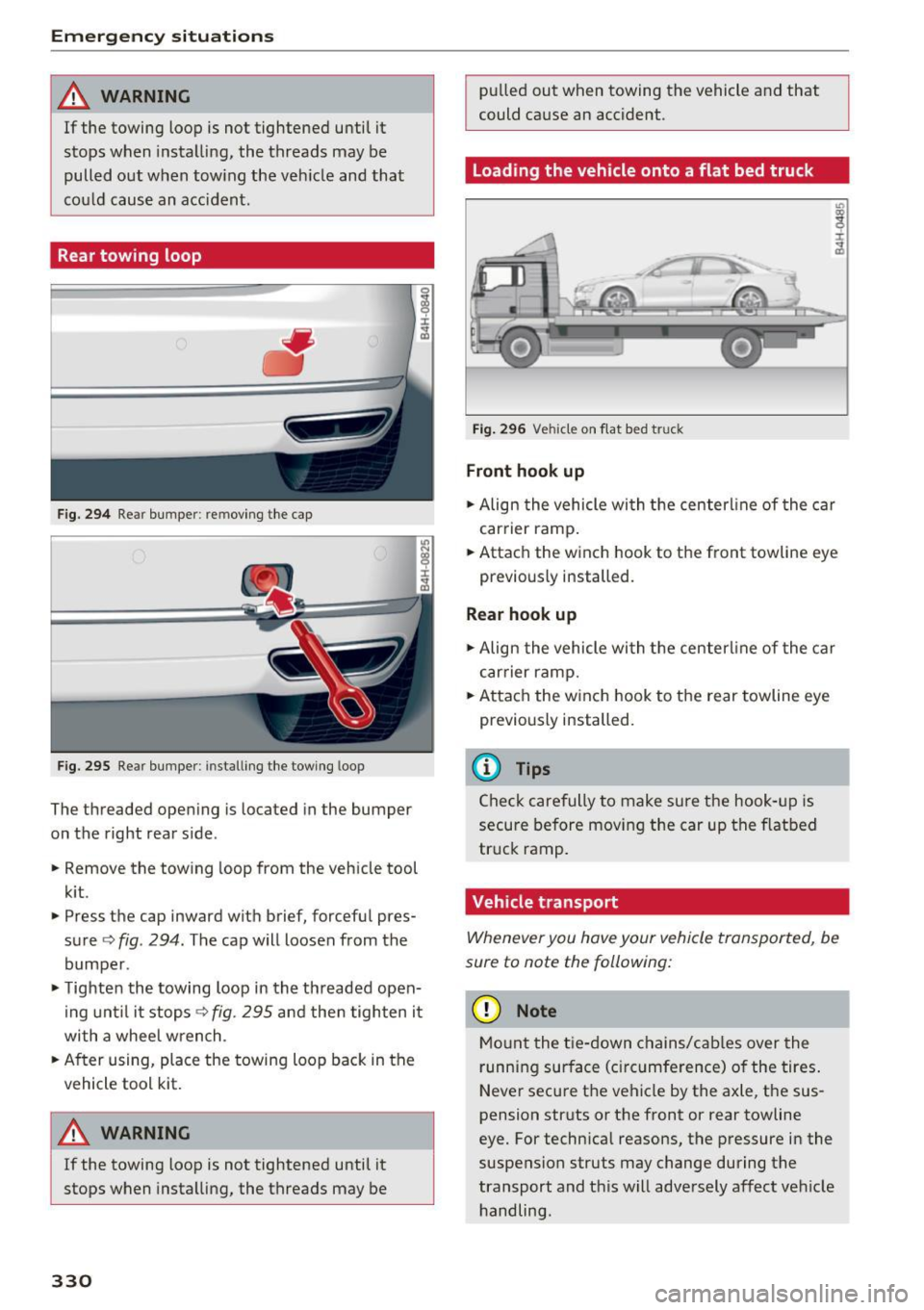
Rear towing loop
F ig. 294 Re ar bumper: re moving the cap
Fig. 295 Re ar bumpe r: in stalli ng the towing loop
The threaded open ing is loca ted in the bumper
on the right rear side .
.. Remove the towing loop from the vehicle tool
kit .
.. Press the cap inward with brief, forceful pres
sure <:>
fig. 294. The cap will loosen from the
bumper .
.. Tighten the towing loop in the threaded open
ing until it stops ¢
fig. 295 and then tighten it
with a wheel wrench .
.. After using, place the towing loop back in the
vehicle tool kit.
8_ WARNING
If the towing loop is not tightened until it
stops when installing, the threads may be
330
-
pulled out when towing the vehicle and that
could cause an accident .
Loading the vehicle onto a flat bed truck
Fig. 296 Vehicle on f lat bed tru ck
Front hook up
I
.. Align the vehicle with the centerl ine of the car
car rier ramp .
.. Attach the winch hook to the front towline eye
previously installed.
Rear hook up
.. Align the vehicle wi th the centerl ine of the car
car rier ramp .
.. Attach the w inch hook to the rear towline eye
previously installed.
@ Tips
Check carefully to make sure the hook-up is
secure before moving the car up the flatbed
truck ramp .
Vehicle transport
Whenever you hove your vehicle transported, be
sure to note the following:
(D Note
Mount the tie-down chains/cables over the
running surface (circumference) o f the tires.
Never secure the vehicle by the axle, the sus
pension struts or the front or rear towline
eye. For technical reasons, the pressure in the
suspension struts may change during the
transport and this will adversely affect veh icle
handling.
Page 338 of 354
Consumer information
Consumer information
Warranty coverages
Your Audi is covered by the following warran
ties:
- New Vehicle Limited Warranty
- Limited Warranty Against Corrosion Perfora-
tion
- Emissions Control System Warranty
- Emissions Performance Warranty
- California Emissions Control Warranty (USA
vehicles only)
- California Emissions Performance Warranty
(USA vehicles only)
Detailed information regarding your warranties
can be found in your
Warranty & Maintenance
booklet .
Operating your vehicle
outside the U.S.A. or
Canada
Government regulati ons in the United States and
Canada require that automobi les meet specific
emission regulations and safety standards.
Therefore, vehicles built for the U.S.A. and Cana
da differ from vehicles sold in other countries.
If you plan to take your vehicle outside the conti
nenta l limits of the United States or Canada,
there is the poss ibility that:
- un leaded fue ls for vehicles with catalytic con
verter may not be available;
- fuel may have a considerably lower octane rat
ing . Improper fuel may cause engine damage;
- service may be inadequate due to lack of proper
service facilities, tools or testing equipment;
- r eplacement parts may not be readily available.
- Nav igation systems for veh icles built for the
U.S .A . and Canada will not necessarily work in
Europe, and may not work in other countries
outside North America.
336
(D Note
Audi cannot be responsib le for mechanical
damage that could result from inadequate
fuel, service or parts ava ilability.
Audi Service Repair
Manuals and Literature
Audi Official Factory Service Manuals and Litera
ture are published as soon as poss ible after mod
el introduction . Service manuals and literature
are available to order from the Audi Technical Lit
erature Ordering Center at :
www.audi.techliterature .com
Maintenance
General '
Your vehicle has been designed to help keep
maintenance requirements to a minimum. How
ever, a certain amount of regular maintenance is
still necessary to assure your vehicle's safety,
economy and reliability . For detailed vehicle
maintenance consult your Warranty & Mainte
nance booklet .
Under difficult operating conditions, for exam
ple at extremely low outside temperatures, in
very dusty regions, when towing a trailer very fre
quently, etc., some service work should be per
formed between the intervals specified. This ap
plies particularly to:
- oil changes, and
- cleaning or replac ing the a ir filter .
'
@) For the sake of the environment
By regularly maintain ing your vehicle, you
help make sure that em iss ion standards are
maintained, thus minimizing adverse effects
on the environment .
Important considerations for you and your
vehicle
The increasing use of electronics, sophisticated
fuel injection and emission control systems, and
the generally increas ing technica l complexity of ..,_