warning AUDI A8 2018 Owners Manual
[x] Cancel search | Manufacturer: AUDI, Model Year: 2018, Model line: A8, Model: AUDI A8 2018Pages: 356, PDF Size: 54.71 MB
Page 301 of 356
u. co .... N
" N .... 0 0 :c '
chains after driving a few feet, if necessary. Fol
low the instructions from the manufacturer.
~ Note the maximum speed of 30 mph (SO km/
h). Note the loc al regulations.
Use of snow chains is only permitted with certain
rim/tire combinations due to technical reasons.
Check with an authori zed Audi dealer or author
ized Audi Service Facility to see if you may use
snow chains .
You must remove the snow chains on roads with
out snow. Otherwise, you could impair driving
ability and damage the tires.
A WARNING
Using incorrect snow chains or installing snow
chains incorrectly can result in loss of vehicle
control, which increases the risk of an acci
dent.
0 Note
-Snow chains can damage the rims/wheel
covers* if the chains come into direct con·
tact with them . Remove the wheel covers*
first. Use coated snow chains.
-Using snow chains that add more than 0.4
inch (10.5 mm) of height can severely dam
age the wheel housings and other vehicle
components.
-Do not install and use snow chains if there is
a malfunction in the adaptive air suspen
sion, because the vehicle height will be very
low. If you drive with snow chains anyway,
the wheel housings and other vehicle com ponents can be severely damaged.
@ Tips
When using snow chains, it may be useful to
switch on sport mode
¢ page 128.
Low-profile tires
Appl ies to: ve hicles w ith low-profile tires
Your vehicle is equipped with low-profile tires* at
the factory . Compared to other tire/rim combina
tions, low-profile tires offer a wider tread surface
and a larger rim diameter with shorter tire side-
Wheels
walls. This results in an agile driving style. How
ever, it may reduce the level of comfort and in
crease road noise when driving on roads in poor
condition.
Low-profile tires can become damaged more
quickly than standard tires when driving over
large bumps, potholes, manhole covers, speed
bumps and curbs. Therefore, it is particularly im
portan t to maintain the correct tire pressure
¢ page 293.
To reduce the risk of damage to the tires and
rims, drive very carefully on poor roads.
Check your wheels regularly every 2,000 mi
(3,000 km) for damage. For example, check for
bulges/cracks on the tires or deformations/
cracks on the rims.
After a heavy impact or damage, have the tires
and rims inspected or replaced immediately by
an authorized Audi dealer or authori zed Audi
Service Facility.
Low-profile tires can wear out faster than stand
ard tires.
Summer tires are not suitable for cold weather,
snow or black ice. If you are driving in these con
ditions, use winter or all season tires
¢ page 298.
Uniform tire quality grading
-Tread wear
-Traction AA AB C
-Temperature ABC
Quality grades can be found where applicable on
the tire side wall between tread shoulder and
maximum section width
¢ page 283, fig. 264.
For example: Tread wear 200, Traction AA, Tem
perature
A .
All passenger car tires must conform to Federal
Safety Requirements in addition to these grades .
Tread wear
The tread wear grade is a comparative rating
based on the wear rate of the tire when tested
299
Page 302 of 356
Wheels
under controlled conditions on a specified
government test course.
For example, a tire graded 150 would wear one
and one ha lf (11/2) times as well on the govern
ment course as a tire graded 100 .
The relative performance of tires depends upon
the actual conditions of their use, howeve r, and
may depart significant ly from the norm due to
variations in driving habits, service practices and
differences in road characteristics and climate .
Traction
The traction grades, from highest to lowest, are
AA, A, Band
C. Those grades represent the tire's
ability to stop on wet pavement as measured un
der contro lled conditions on specified govern
ment test surfaces of aspha lt and concrete. A tire
marked C may have poor traction performance
¢ & .
Temperature
The temperatu re grades are A (t he highest), B ,
and C, representing the tire's resistance to the
generation of heat and its ability to dissipate
heat when tested under controlled conditions on
a specified indoor laboratory test wheel.
Sustained high temperature can cause the mate
rial of the tire to degenerate and reduce tire life,
and excessive temperature can lead to sudden
tire
fa ilure¢ fr:. .
The grade C corresponds to a leve l of perform
ance which a ll passenger car tires must meet un
der the Federa l Motor Vehicle Safety Standard
No. 109. Grades B and A represent higher leve ls
of performance on the laboratory test wheel than
the mi nimum required by law.
A WARNING
-
The traction grade assigned to this tire is
based on straight-ahead braking traction
t ests, and does not include acceleration, cor
nering, hydroplaning or peak traction charac
teristics.
300
A WARNING
The temperature grade for t his tire is estab
lished for a tire that is properly inflated and
not overloaded. Excessive speed, underinfla
tion, or excessive loading, either separately or
in comb ination , can cause heat buildup and
possible tire failure.
A WARNING
-
-
Temperature grades apply to tires that are
properly inflated and not over or under inflat
ed .
Tire Pressure Monitoring
System
(AS, S8)
ill General notes
Applies to: AS, 58
Each tire, including the spare (if prov ided),
shou ld be checked monthly when cold and inflat
ed to the inflation pressure recommended by the
vehicle manufacturer on the vehicle placard or
tire inflation pressure labe l.
(If your veh icle has
tires of a different size than the size ind icated on
the ve hicle placard or tire inflat ion pressure la
bel , you should determ ine the proper tire infla
tion pressure for those tires).
As an added safety feature, your vehicle has been
equipped with a tire pressure mon itor ing system
(TPMS) that illum inates a low tire pressure tell
tale when o ne or more of your tires is significant
l y unde r-inflated. According ly, when the low tire
pressure telltale illum inates, you sho uld stop and
check your tires as soon as possible, and inflate
them to the proper pressure . Driving on a signifi
cant ly under -inflated tire causes the tire to over
heat and can lead to tire fai lure. Under-inflation
also reduces fue l eff iciency and tire tread life,
and may affect the vehicle's handling and stop ping ability.
Please note that the TPMS is not a substitute for
proper tire maintenance, and it is the dr iver's re
spons ibility to maintain correct t ire pressure,
even if under-inflation has not reached the level
to trigger illumination of the TPMS low tire pres-
sure te lltale .
.,.
Page 303 of 356
lL t:0 ....
"" ......
"" .... 0 0 :c '
malfunction indicator to indicate when the sys
tem is not operating properly. The TPMS mal
function indicator is combined with the low tire
pressure telltale. When the system detects a
malfunction, the telltale will flash for approxi
mately one minute and then remain cont inuously
illuminated . This sequence will continue upon
subsequent vehicle start-ups as long as the mal
function ex ists.
When the malfunction indicator is illuminated,
the system may not be ab le to detect or signal
low tire pressure as intended . TPM S malfunctions
may occur for a var iety of reasons, including the
installation of replacement or alternate tires or
wheels on the vehicle that prevent the TPMS
from functioning properly. Always check the
TPMS malfunction telltale after replacing one or
more tires or wheels on your vehicle to ensure
that the replacement or alternate tires and
wheels allow the TPMS to continue to function
properly.
If the Tire Pressure Monitoring System
indicator appears
Applies to: AS, 58
The tire pressure indicator in the instrument
cluster informs you if the tire pressure is too low
or if there is a system malfunction .
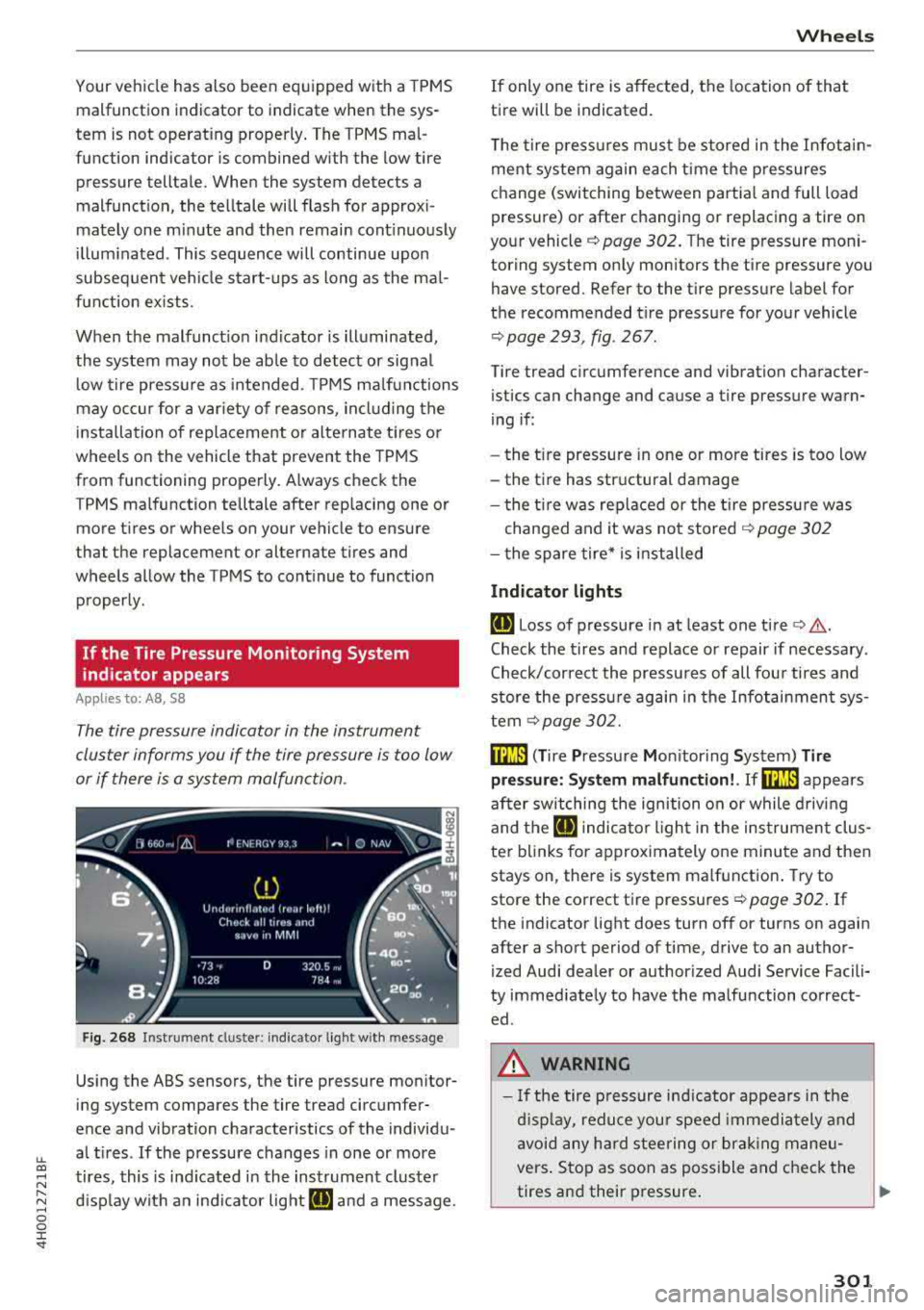
Fig. 268 Instrument clus ter: indicator light with message
Using the ABS sensors, the tire pressure monitor
ing system compares the tire tread circumfer
ence and vibration characteristics of the individu
al tires . If the pressure changes in one or more
tires, this is ind icated in the instrument cluster
display with an indicator light
ti] and a message .
Wheels
If only one tire is affected, the location of that
tire will be indicated.
The tire pressures must be stored in the Infotain
ment system again each time the pressures
change (switching between partial and full load
pressure) or after changing or replacing a tire on
your vehicle
c:> page 302. The tire pressure mon i
toring system only monitors the tire pressure you
have stored. Refer to the tire pressure label for
the recommended tire pressure for your vehicle
c:> page 293, fig . 267 .
Tire tread circumference and vibration character
istics can change and cause a tire pressure warn
ing if :
- the t ire pressure in one or more tires is too low
- the tire has structural damage
- the tire was replaced or the tire pressure was
changed and it was not stored
c:> page 302
- the spare tire* is installed
Indicator lights
ti] Loss of pressure in at least one tire c:> ,&..
Check the tires and replace or repair if necessary.
Check/correct the pressures of all four tires and
store the pressure again in the Infotainment sys
tem
c:>page 302.
mm ( T ire Pressure Monitor ing System) Tire
pressure: System malfunction!. Ifm:m appears
after switching the ignition on or while driving
and the
ti] indicator light in the instrument clus
ter blinks for approximately one minute and then
stays on, there is system malfunction. Try to
store the correct tire pressures
c:> page 302. If
the indicator light does turn off or turns on again
after a short period of time, drive to an author
ized Audi dealer or authorized Audi Service Facili
ty immediately to have the malfunction correct ed .
.&, WARNING
- If the tire pressure ind icator appears in the
display, reduce your speed immediately and
avoid any hard steering or braking maneu
vers. Stop as soon as possible and check the
tires and their pressure.
..,.
301
Page 305 of 356
u. co .... N
" N .... 0 0 :c '
installation of replacement or alternate tires or
wheels on the vehicle that prevent the TPMS
from functioning properly . Always check the
TPMS malfunction telltale after replacing one or
more tires or wheels on your vehicle to ensure
that the replacement or alternate tires and
wheels allow the TPMS to continue to function
properly.
Description
Applies to: 58 plus
The tire pressure monitoring system monitors
the pressure in the four tires when driving.
The system uses sensors that measure the tem
perature and pressure in the tires . The data is
sent from these sensors to the control module by
radio frequency.
The Tire Pressure Monitoring System shows the
current pressures and temperatures of the tires
in the Infota inment system
c:> page 303 . It also
compa res the current tire pressures with the
stored tire press ures and gives a warning in the
driver information system if the tire pressure is
different from what is stored
c:> page 304.
The system does not detect if the stored tire
pressures match the recommended tire pres
sures.
- Every time the tire pressures change, for exam-
ple when the load in the vehicle changes,
- after replac ing a tire, or
- if wheels with new wheel sensors are used,
you must store the tire pressures again
c:> page 304.
A WARNING
-The tire pressure mon itor ing system assists
the driver in monitoring tire pressures. The
dr iver is responsible for having the tires in
flated to the correct pressure.
- Do not change the tire pressure when the
temperature of the tire is extremely high.
T his cou ld result in serious damage to the
t ir e and even cause the tire to burst, in
creasing the risk of an accide nt.
Wheels
-A tire with low pressure flexes more . This
heats the tire up too much. This could cause
the tread to separate and even cause the
tire to burst, increasing the risk of an acci
dent.
- The Tire Pressure Monitoring System does
not warn you of damage or defects in the
tire construct ion that could cause the tire to
burst, for example. Inspect your tires regu
larly.
@ For the sake of the environment
Low tire pressure increases fuel consumption
and tire wear.
(D Tips
-The pressure of the spare t ire* is not mon i
tored.
- If tires are replaced, the sensors/va lves do
not need to be removed or replaced. Just re
placed the valve stem and, if necessary, the
valve and the whee l electronics . If you have
questions, see an authorized Audi dealer or
authorized Audi Service Facility.
Displaying tire pressures/temperatures
Applies to: 58 plus
Requirement: the ignition must be switched on.
.. Select: the I CAR! funct ion button > Car systems
> Service & control > Tire pressure monitor >
Display tire pressure .
The current tire pressures are shown in green and
yellow numbers in the Infotainment system:
-Green: the current tire pressure and the spec i
fied tire pressure are approx imately the same .
-Yellow: the current tire pressure is too low
compared to the specified tire pressure .
The specified tire pressure is the last tire pres
sure that was stored
c:> page 304 .
Note that the tire pressure also depends on the
temperature of the tire . The tire pressure in
creases as the engine becomes warmer while
driv ing.
.,.
303
Page 306 of 356
Wheels
~ WARNING
Read and follow the important information
and notes ¢
page 303.
© Tips
The tire pressure or tem perature a re not di s
played in ada pta tion mode. Da shes --.-- a re
shown in place of the press ure and tempera
ture .
Tire pressure loss
Applies to: 58 plus
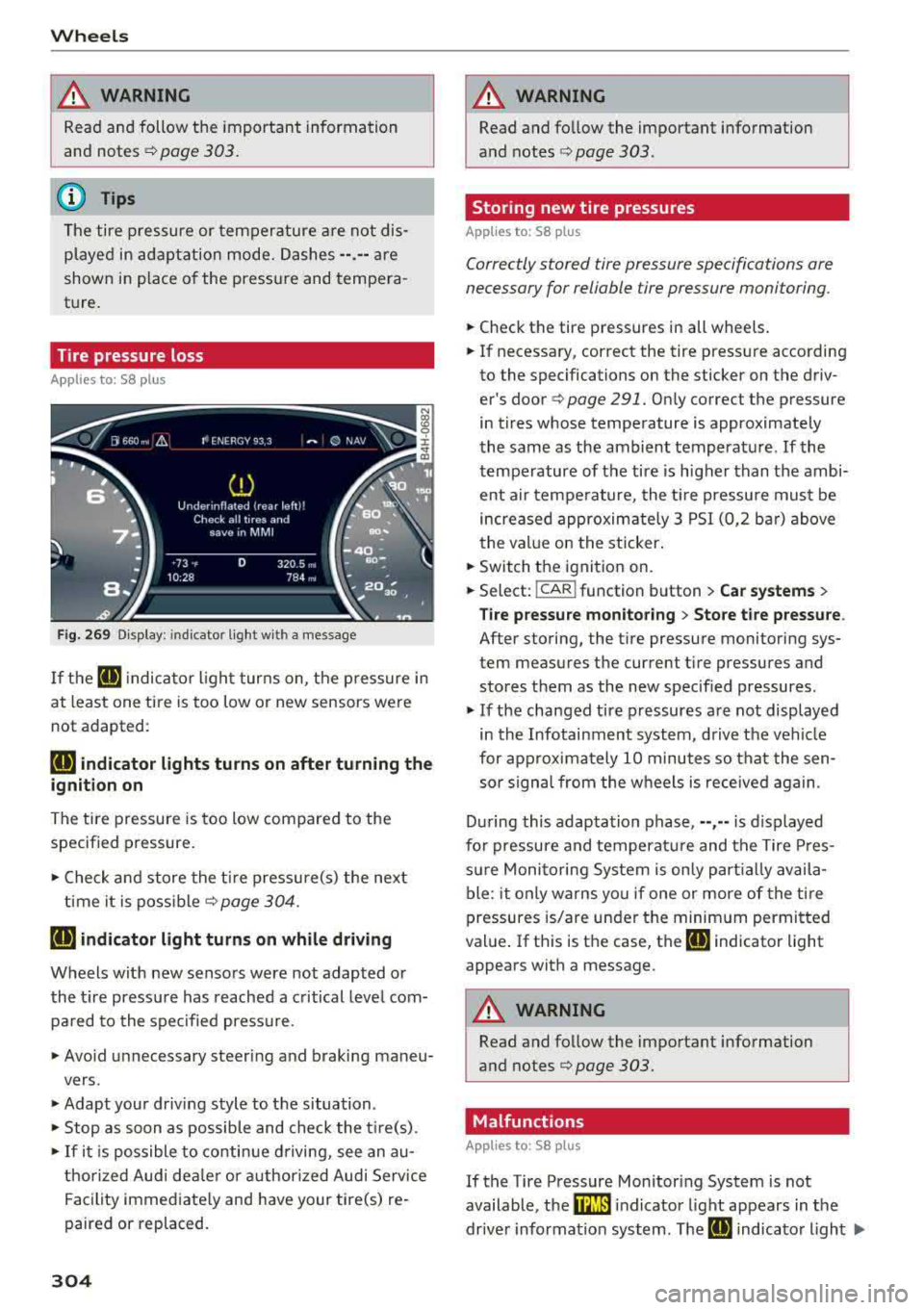
F ig. 269 D isp lay: ind icator light wi th a message
-
If the IE indica to r li ght turns on, the p ressure in
at least one ti re is too low or new sensors were
not adapted :
RE indicator lights turns on after turning the
ignition on
The tire pressure is too low compared to the
specif ied pressure .
.,. Check and store the t ire pressure(s) the next
ti me it is poss ible¢
page 304 .
RE indicator light turns on while driving
Wheels with new senso rs were not adapted or
the t ire pressu re has reached a c ritical leve l com
p ar ed to the specified press ure.
.,. Avo id unnecessary steering and braking maneu-
vers .
.,. Adapt you r d riving style to the situation .
.,. Stop as soon as possible and check the t ire(s) .
.,. If it i s po ssible to co nti nu e d riving, see an au-
t horized Audi dea le r or a uthorized Audi Service
Fa cility immed iate ly and have your tire(s) re
paired or replaced.
304
A WARNING
, -
Read and fo llow the important information
and notes
¢ page 303.
Storing new tire pressures
App lies to: 58 pl us
Correctly stored tire pressure specifications are
necessary for reliable tire pressure monitoring.
.,. Check the tire pressures in all wheels .
-
.,. If necessary , correct the tire press ure according
to the specifications on the sticker on the driv
er's doo r
q page 291. On ly co rrect t he pressure
in t ires whose tempe rature is appro ximate ly
the same as the ambient tempera ture. If the
tempe rature of the tire is higher than the ambi
ent air tempe rature, the t ire pressure must be
i n creased approxim ate ly 3 PSI (0 ,2 ba r) above
the val ue on the sticker .
.,. Switch the ignitio n on .
.,. Select: !CAR ! function button > Car systems >
Tire pressure mon itoring > Sto re tire pressure .
After storing, the t ire pressu re monitoring sys
tem measures t he current t ire pressures and
s to res them as the new specif ied pressures .
.,. If the changed tire p ressures are not displayed
in the Infotainment system, d riv e the veh icle
for approximately 10 minutes so that the sen so r signa l from the w heels is received again.
D ur ing this adapta tion phase, --,--is displayed
fo r pressure and temperat ure and t he Tire Pres
su re Moni toring Sys tem is on ly p arti all y av ail a
ble: it only warns yo u if one or more of the tire
pressures is/are under t he minim um permitted
val ue. If th is is the case, the
IE indicator light
appears with a message .
A WARNING
Read and follow the important information
and notes
q page 303.
Malfunctions
App lies to: 58 plus
-
If the Tire Pressure Mon itoring System is not
available, t he
mm indicato r light appears in the
dr ive r informa tion system . T he
IE indica to r light .,..
Page 308 of 356
Care and cleaning
Care and cleaning
General information
Regular, proper care helps to maintain your vehi
cle's value. It can also be a requirement when
submitting warranty claims for corrosion damage
and paint defects on the body.
The necessary care products can be obtained
from an authorized Audi dea ler or authorized
Audi Service Facility. Read and follow the instruc
tions for use on the packaging.
A WARNING
-Using cleaning and care products incorrectly
can be dangerous to your health.
- Always store clean ing and care products out
of reach of children to reduce the r isk of poi
sonin g.
@ For the sake of the environment
- Preferab ly purchase environmenta lly-friend
l y cleaning products.
- Do not dispose of leftover cleaning and care
products with household trash.
Car washes
The longer that deposits such as insects, bird
droppings, tree sap or road salt remain on the ve
h icle, the more the surface can be damaged. High
temperatures such as those caused by sunlight
increase the damaging effect.
Before washing, r inse
off heavy deposits with
p lenty of water.
Stubborn deposits such as bird droppings or tree
sap are best removed with plenty of water and a microfiber cloth.
A lso, wash the underside of yo ur vehicle once
road sa lt stops being used for the season .
Pressure washers
When washing your veh icle w ith a pressure wash
er , al ways fo llow the operating instructions pro
vided with the press ure washer. This is especially
important in regard to the pressure and spraying
distance. Do not aim the spray directly at the
306
seals on the side windows, doors, lids or the sun
roof* or at tires, rubber hoses, insulating materi
a l, sensors* or camera lenses* . Keep a distance of
at least 16 in (40 cm).
Do not remove snow and ice with a pressure
washer.
Never use cone nozz les or high pressure nozzles.
The water temperature must not be above 140 °F
(60 °C) .
Automatic car washes
Spray off the vehicle before washing.
Make sure that the windows and roof* are closed
and the windshie ld wipers are
off . Follow instruc
tions from the car wash operator, especially if
there are accessories attached to your vehicle.
If possible, use car washes that do not have
brushes.
Only use car washes where the vehicle remains
stationary and the washing equipmen t moves
around the vehicle when washing and drying. Car
washes that move the vehicle t hrough the car
wash using a chain are not recommended .
Washing by hand
Clean the vehicl e starting from the top and work
ing down using a soft sponge or cleaning brush.
Use solvent -free cleaning products.
Washing vehicles with matte finish paint by
hand
To avoid damaging the paint when washing, first
remove dust and large particles from your vehi
cle. Insects, grease spots and fingerprints are
best removed with a special cleaner for matte
finish paint .
Apply t he product using a microfiber cloth. To
avoid damaging the paint surface, do not use too
much pressure.
Rinse t he ve hicle thoroughly with wate r. Then
clean using a neutral shampoo and a soft micro
fiber clot h.
R inse the vehicl e thoroughly again and let it air
dry. Remove any water residue using a chamois.
..,..
Page 309 of 356
u. co .... N
" N .... 0 0 :c '
-Only wash the vehicle when the ignition is
off and follow the instructions from the car
wash operator to reduce the risk of acci
dents.
-To reduce the risk of cuts, protect yourself
from sharp metal components when wash
ing the underbody or the inside of the wheel
housings.
-After washing the vehicle, the braking effect may be delayed due to moisture on the
brake rotors or ice in the winter . This in
creases the risk of an accident. The brakes
must be dried first with a few careful brake
applications.
@ Note
-If you wash the vehicle in an automatic car
wash, you must fold the exterior mirrors in
to reduce the risk of damage to the mirrors.
Power folding exterior mirrors* must only
be folded in and out using the power folding
function.
-To reduce the risk of paint damage, do not
wash the vehicle in direct sunlight.
-
Care and cleaning
-To reduce the risk of damage, do not wash
the power top with a pressure washer.
-To reduce the risk of damage to the surface,
do not use insect removing sponges, kitchen
sponges or similar items.
-Matte finish painted vehicle components:
-To reduce the risk of damage to the sur-
face, do not use polishing agents or hard
wax.
-Never use protective wax. It can destroy
the matte finish effect .
-Do not place any stickers or magnetic
signs on vehicle parts painted with matte
finish paint. The paint could be damaged
when the stickers or magnets are re
moved .
@ For the sake of the environment
Only wash the vehicle in facilities specially de
signed for that purpose . This will reduce the
risk of dirty water contaminated with oil from
entering the sewer system.
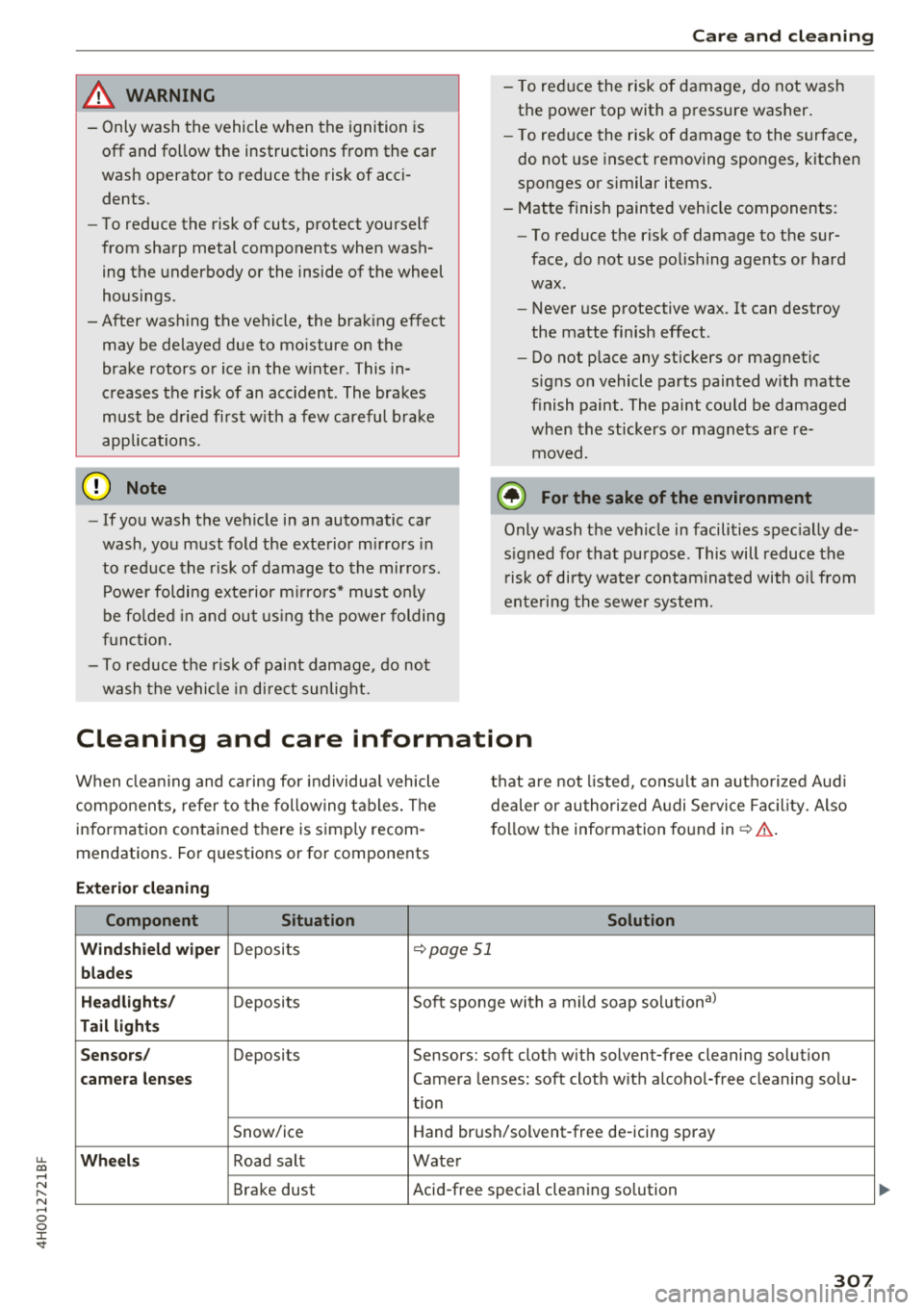
Cleaning and care information
When cleaning and caring for individual vehicle
components, refer to the following tables. The
information contained there is simply recom
mendations. For questions or for components that are
not listed, consult an authorized Audi
dealer or authorized Audi Service Facility. Also
follow the information found
in~.&. -
Exterior cleaning
Component Situation Solution
Windshield wiper
Deposits ~ page 51
blades
Headlights/
Deposits Soft sponge with a
mild soap solutiona)
Tail lights
Sensors/
Deposits Sensors: soft cloth with solvent-free cleaning solution
camera lenses Camera lenses: soft cloth with alcohol-free cleaning solu-
tion
Snow/ice Hand brush/solvent-free de-icing spray
Wheels Road salt Water
Brake dust Acid-free special cleaning solution
307
...
Page 311 of 356
u. co .... N
" N .... 0 0 :c '
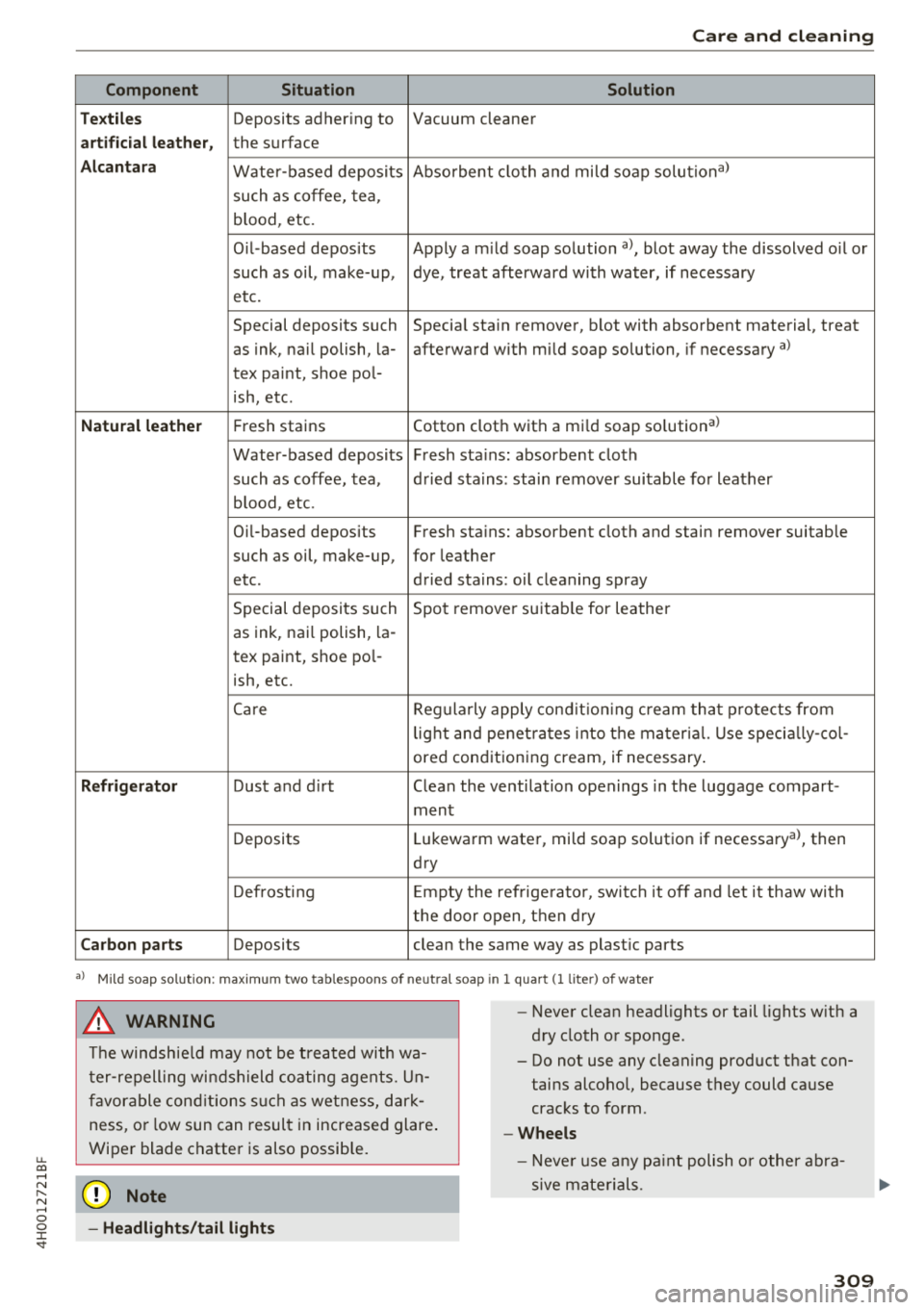
Component Situation Solution
Te xtiles
Deposits adhering to Vacuum cleaner
artificial leather, the surface
Alcantara Water-based deposits Absorbent
cloth and mild soap solutiona>
such as coffee, tea,
b lood, etc.
O il-based deposits Apply a m ild soap solution
al, blot away the dissolved o il or
such as oil, make-up, dye, treat afterward with water, if necessary
etc.
Special deposits such
Specia l stain remover, blot with absorbent material, treat
as ink, nail polish, la- afterward with mi ld soap solution, if necessary
a)
tex paint, shoe pol-
ish, etc .
Natural leather Fresh stains Cotton cloth with a mi
ld soap solution a>
Water-based deposits Fresh stains : absorbent cloth
such as coffee, tea, dried stains: stain remover suitable for leather
b lood , etc.
Oi l-based deposits Fresh sta ins: absorbent cloth and stain remover suitable
such as oil, make-up, for leather
etc . dried stains: oil cleaning spray
Special deposits such Spot
remover suitable for leather
as ink, nail polish, la-
tex paint, shoe pol-
ish, etc.
Care Regularly apply conditioning cream that protects from
light and penetrates into the material. Use specially-c ol-
ored conditioning cream, if necessary .
Refrigerator Dust and dirt Clean the ventilation openings in the luggage compart-
ment
Deposits Lukewarm
water, mild soap solution if
necessarya>, then
dry
Defrosting Empty the refrige rato r, switch it off and let it thaw with
the door open, t hen dry
Carbon parts Deposits clean the same way as plast ic parts
• > Mi ld s oap so lution: maxim um two tablesp oon s of neu tra l soap in 1 quar t (1 lite r) of wat er
A WARNING
Th e windsh ie ld may not be treated with wa
ter-repelling windshi eld coating agents. Un
favorable conditions such as wetness, dark
ness, or lo w sun can result in increased glare.
Wiper blade chatter is also possible.
@ Note
-Headlights/tail lights
-
- Never clean headlights or tail lights with a
dry cloth or sponge.
- Do not use any cleaning product that con
tains alcoho l, because they could cause
cracks to form .
-Wheels
- Never use any paint polish or other abra-
sive materials.
309
Page 314 of 356
Emergency assistance
Emergency assistance
General information
.,. Park the vehicle as far as possible from moving
traffic in the event of a breakdown. In the event
of a flat tire, park the vehicle on a level surface .
It you are on a steep hill, be especially careful.
.,. Set the parking brake .
.,. Switch the emergency flashers on .
.,. Set up the warning triangle r=;,page 312 .
.,. Have the passengers exit the vehicle . They
should move to a safe place, for example be
hind a guard rail.
A WARNING
Follow the steps given above. This is for your
protection and the for the safety of other driv
ers.
Equipment
Warning triangle
Applies to: vehicles with warning triangle
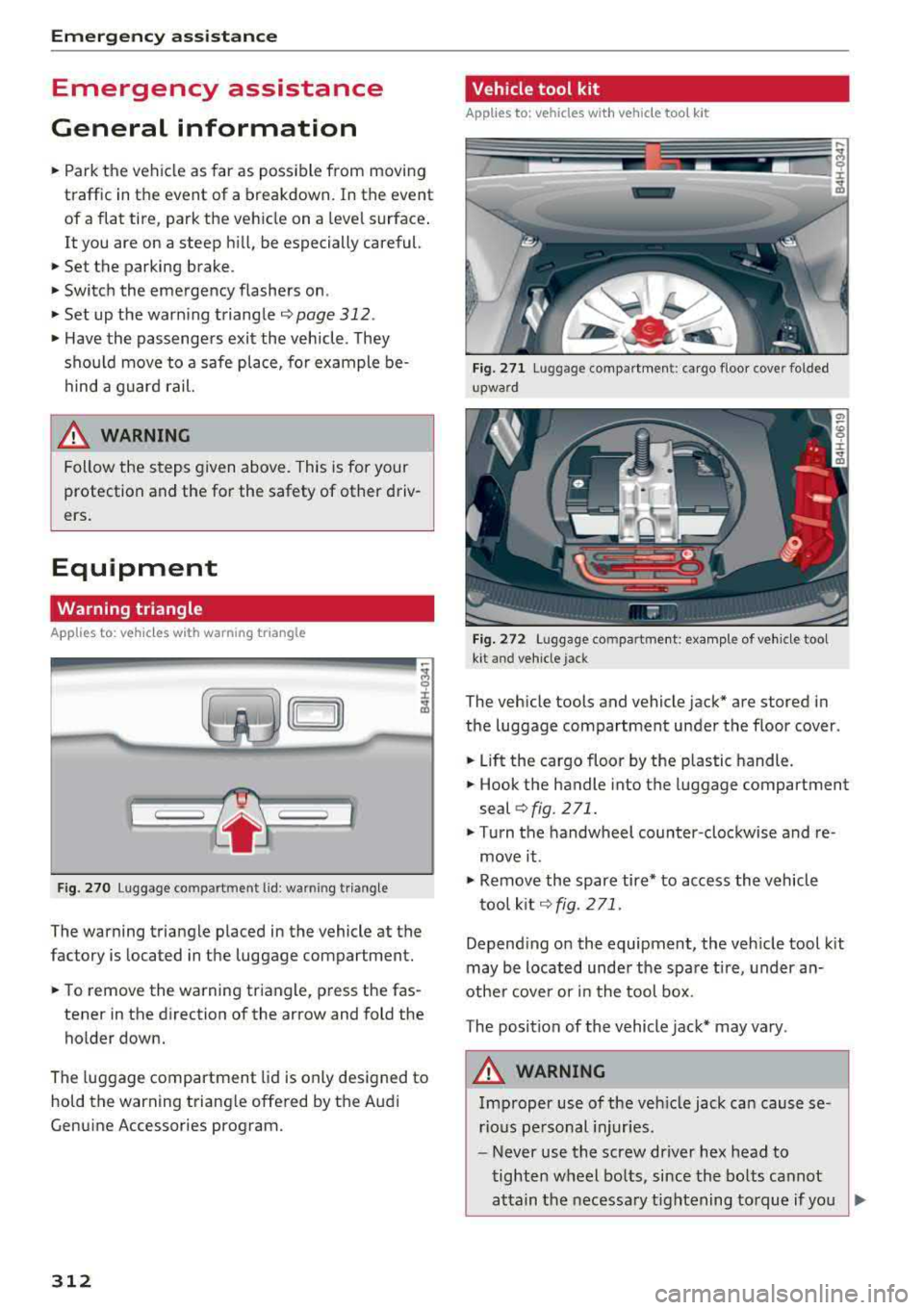
Fig. 270 L uggage co mpartm ent lid : w arnin g triangle
The warning triangle placed in the vehicle at the
factory is located in the luggage compartment.
.,. To remove the warning triangle, press the fas-
tener in the direction of the arrow and fold the
holder down.
The luggage compartment lid is only designed to
hold the warning triangle offered by the Audi
Genuine Accessories program.
312
Vehicle tool kit
Applies to: vehicles with vehicle toot kit
Fig. 271 Lu gg age compartment : cargo floor cove r folded
upward
Fig. 272 Luggage compartment: examp le of vehicle toot
kit and vehicle j ack
The vehicle tools and vehicle jack* are stored in
the luggage compartment under the floor cover .
.,. Lift the cargo floor by the plastic handle .
.,. Hook the handle into the luggage compartment
seal
r:;, fig. 2 71 .
.,. Turn the handwheel counter-clockwise and re
move it .
.,. Remove the spare tire* to access the vehicle
tool kit
~ fig. 271 .
Depending on the equipment , the veh icle tool kit
may be located under the spare tire, under an
other cover or in the tool box.
The position of the vehicle jack* may vary .
A WARNING
Improper use of the veh icle jack can cause se
rious personal injuries.
-Never use the screw driver hex head to
tighten wheel bolts, since the bolts cannot
attain the necessary tightening torque if you
..,.
Page 315 of 356
u. co .... N
" N .... 0 0 :c '
c ident.
- The factory-supplied jack is intended on ly
for your vehicle m odel. Under no circum
stances should it be used to lift heavy
vehicles or other loads; you r isk injuring
yourself .
- Never start the en gine when the vehicle is
ra ised, which could cause an accident .
- Support the veh icle secure ly w ith appropr i
ate stands if work is to be performed under
neath the vehicle; otherwise, there is a po
tent ial risk for in ju ry .
- Never use the jack supplied with your Audi
on another vehicle, particularly on a heav ier
one . The jack is only suitable for use on the
vehicle it came w it h .
(D Tips
The vehicle jack* in your vehicle is mainte
na nee -free .
Replacing wheels
Before changing a wheel
Observe the following precautions for your own
and your passenger's safety when changing a
wheel.
.,. After yo u experience a tire fail ure, pull the car
we ll away from moving t raffic and t ry to rea ch
level g round before you s top ¢&, .
.,. All passengers sho uld lea ve the ca r and move
to a saf e location (for instance, be hind t he
guardrai l) ¢ &, .
.,. Engage the parking brake to prevent you r vehi
cle from rol ling
unintentionally ¢ A_.
.,. Move selector lever to position P ¢ A_.
.,. If you a re towing a trailer, unh itch the trailer
from your ve hicle.
.,. Take the jack and the spare tire ou t of the lug
gage compa rtment
¢ page 312.
A WARNING
You or your passengers cou ld be inju red wh ile
chang ing a wheel if you do not follow these
safety precautions :
Emergenc y ass is tanc e
-If you have a flat tire, move a safe distance
off the road. Turn off the eng ine, turn the
emergency flashers on and use other warn ing dev ices to alert other motorists .
- Make sure that passengers wait in a safe
p lace away from the vehicle and well away
from the road and traff ic .
- To help prevent the veh icle from moving
suddenly and possib ly slipping off the jack ,
always fu lly set the par king brake and block
the front and back of the wheel diagonally
opposite the wheel being changed. W hen
one front w heel is li fted off the gro und,
p lacing the Au tom atic Transmi ssion in P
(Park) will
not p revent the vehicle from
mov ing.
- Before you change a wheel, be sure the
g ro u nd is leve l and firm. If necessary, use a
sturdy board under the jack .
- Always s tore the vehicle tool ki t, the jack
an d the replaced tire in the luggage com
pa rtment ¢
page 213 .
(D Tips
Befo re c hangin g the wheel, you mus t activ ate
the jacking mode, so that the a utomat ic con
tro ls for the Adaptive Air Suspension do not
make it more di fficult to lift the vehicle with
the jack
¢ page 315 .
Changing a wheel
When you change a wheel , follow the sequence
described below step -by-step and in exactly that
order .
1. Activate the vehicle jack mode ¢ page 315 .
2. Remove the de corative wheel cover *. For
more detai ls see
a lso ¢ page 314, Decora
tive wheel covers
or ¢ page 314, Wheels
with wheel bolt caps .
3. Loosen the wheel bolts ¢ page 315 .
4. Loca te t he p roper mount ing point for the
jac k and alig n the jack be low that po int
¢page 315 or ¢ page 316.
S. Rai se the ca r wi th the jack ¢ page 315 or
¢page 316 .
313