warning AUDI A8 2018 Owners Manual
[x] Cancel search | Manufacturer: AUDI, Model Year: 2018, Model line: A8, Model: AUDI A8 2018Pages: 356, PDF Size: 54.71 MB
Page 316 of 356
Emergency assistance
6. Remove the wheel with the flat tire and then
install
the spare r::!> page 318.
7. Tighten all wheel bo lts light ly .
8. Lower the veh icle w ith the jack.
9. Use the wheel bolt wrench and firmly t ighten
a ll whee l bolts
r::!> page 315 .
10 .
Replace the decorative wheel cover* .
11. D eactivate the vehi cle jack mode in the MMI:
ICAR I fu nction bu tton > Car systems con trol
b utt on
> Servicing & c heck s > Air susp .: ja ck
mode > Off.
The vehicle jack mode switches off a utomat ically
at speeds above
10 k m/ h.
_& WARNING
Alw ays read and fo llow all WARNI NGS and in
formation
c::> .&. in AB: Raising the vehicle on
poge316an d
¢page 319.
After changing a wheel
A wheel change is not complete without the do
ing the following.
• A lway s store the vehicle tool kit, the jack* a nd
t he repl aced t ire in the luggage compartment
r::!:> poge 213.
• Check the tire pre ssure on the spare whee l im
med iate ly after mount ing it.
• As soon as possible, have th e tightening tor
ques
on all wheel bolts checked with a torque
wrench. The correct tightening torque is
90 ft
lb
(120 Nm) .
• Have the fla t tire replaced as soon as possible .
(D Tips
- If you notice that the whee l bolts are cor
r oded and diffic ult to t urn wh ile cha nging a
tire, they should be rep laced before you
c hec k th e tighte ning torque .
- Drive a t reduced speed until you have the
tightening torques c hec ke d .
- After changi ng a wheel, the ti re pressure in
a ll four tires must be chec ked/corrected and
the tire pr ess ure mon itoring indicato r mus t
be store d in t he MM I
r::!:> page 302 .
314 Decorative wheel covers
App
lies to : vehicles with decorative w heel covers
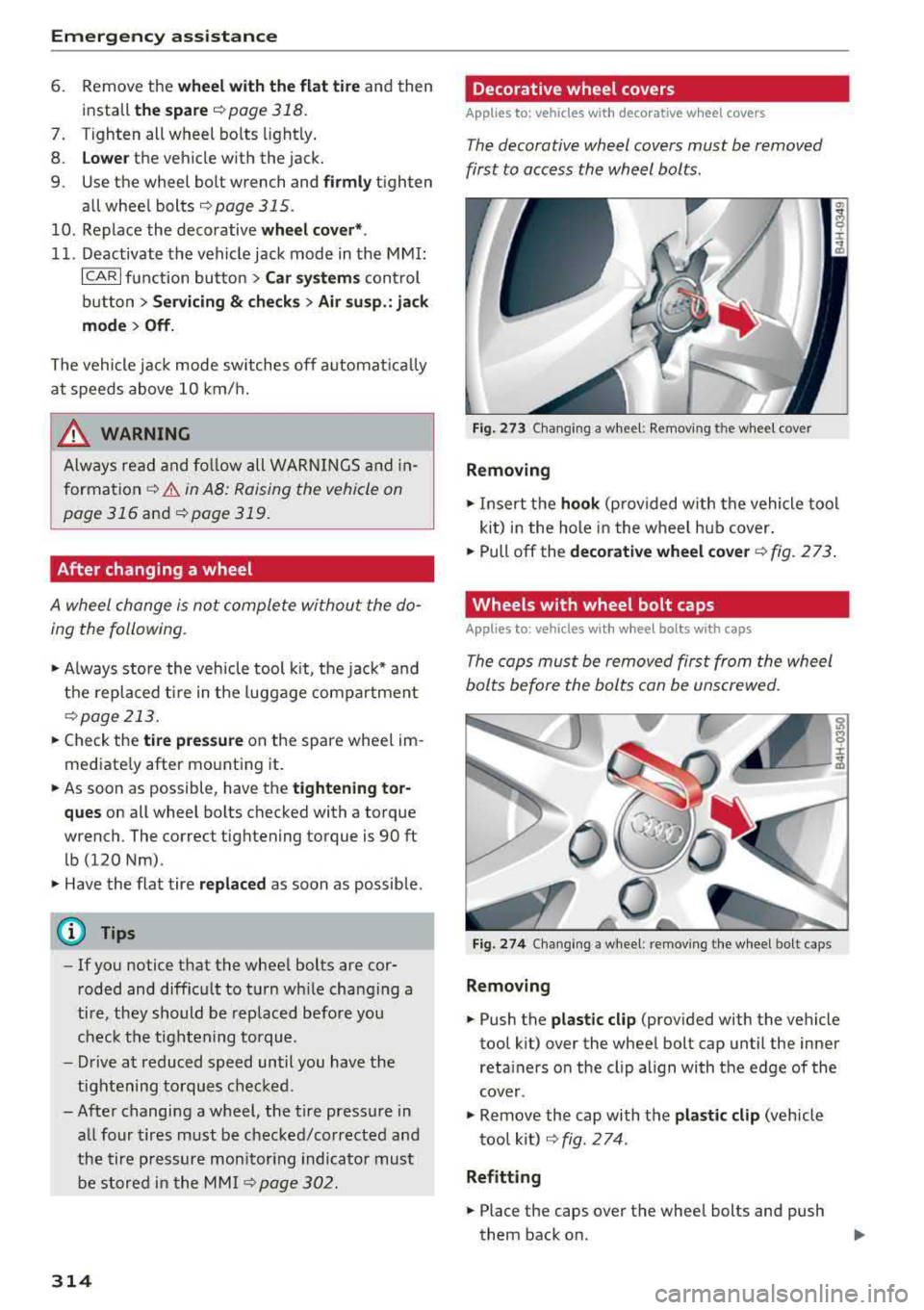
The decorative wheel covers must be removed
first to access the wheel bolts.
F ig. 273 Changing a whee l: Remov ing t he whe el cover
Removing
• Insert the hook (p rovided w ith the vehicle tool
kit) i n the hole in the wheel hu b cover .
• Pull off the decorative wheel cover r::!:> fig. 273 .
Wheels with wheel bolt caps
Applies to: vehicles with w heel bolts with caps
The cops must be removed first from the wheel
bolts before the bolts con be unscrewed.
Fi g. 274 Chang ing a wheel: remov ing the w heel bo lt caps
Removing
• Push the plastic clip (prov ided with the vehicle
tool k it) over the whee l bolt cap until the inner
reta iners on the clip a lign with t he edge of the
cover.
• Remove the cap with t he plastic clip (veh icle
t oo l kit )
r::!> fig. 274.
Refitt ing
• Place the caps over the whee l bolts and push
them back on .
Page 317 of 356
lL t:0 ....
"' ......
"' .... 0 0 :c '
clean.
Loosening and tightening the wheel bolts
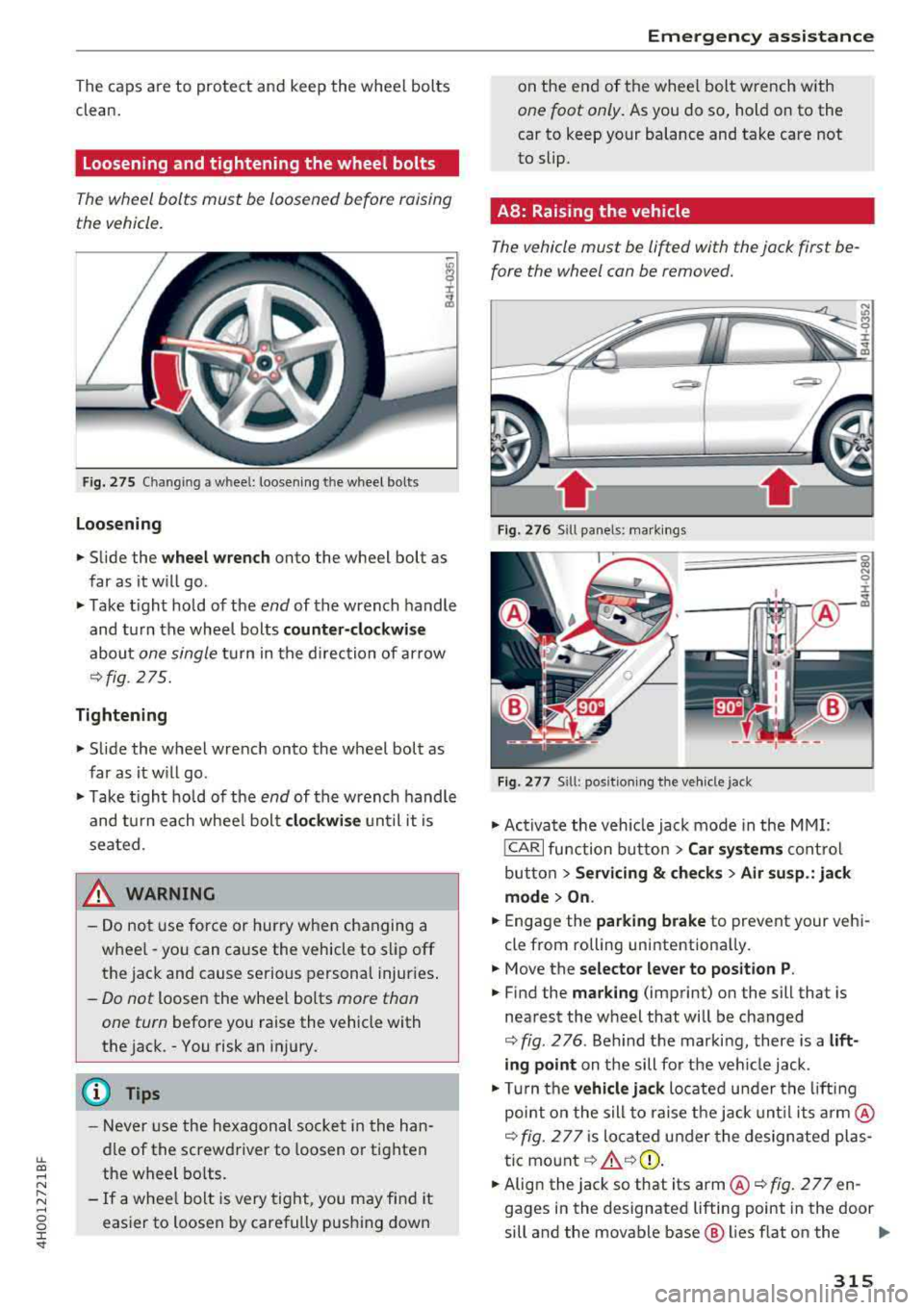
Th e whe el bolts must be loos en e d b efor e raising
the vehicle .
Fig. 275 C han gin g a w hee l: l oose ning t he wheel bo lt s
Loo sening
.. Slide the w heel wr enc h onto the wheel bolt as
far as it will go .
.. Take tight hold of the end of the wrench handle
and turn the wheel bolts
c o unter -clock wise
about one single tu rn in the d irection of ar row
¢ fig. 275.
Tightening
.. Slide the wheel wrench onto the wheel bolt as
far as it w ill go.
.. T ake t ight hold of the end of the wrench handle
and tu rn each whee l bolt
cl ockwi se until it is
seated.
& WARNING
- Do not use force or hurry when changing a
wheel
-you can cause the vehicle to slip off
the jack and cause serious personal injuries .
-Do not loosen the wheel bolts more than
one turn
before you raise the vehicle with
the jack. - You risk an injury.
(D Tips
- Never use the hexagonal socket in the han
dle of the screwdriver to loosen or tighten
the wheel bo lts .
- If a whee l bolt is very tight, you may find it
easier to loosen by carefully push ing down
Em ergen cy as sis tanc e
on the end of the whee l bolt wrench with
one foot only . As you do so, hold on to the
car to keep your balance and take care not
to slip .
AB: Raising the vehicle
The vehicle must b e lifted with the jack first be
fore the wheel can be removed.
Fi g. 276 Sill panels: ma rk in gs
F ig. 277 S ill: posit ion ing t he veh icle jac k
.. Act iva te the veh icle jack mode in the MMI :
!CARI function button> Car system s control
button >
Servi cing & ch ecks > Air su sp. : jack
mode > On .
.. Engage the parking brake to prevent your vehi
cl e from rolling unintentiona lly.
.. Move the s elector le ver to p osition P .
.. Find the mark ing (imprint) on the sill that is
nearest the wheel that will be changed
¢ fig . 2 76 . Beh ind the marki ng, there is a lift
ing point on the sill for the veh icle jack .
.. Turn the ve hicl e ja ck located u nder the lift ing
point on the sill to raise the jack unt il its
a rm @
¢ fig. 277 is located under the design ated plas
tic mo unt ¢
_A ¢(D .
.. Align the jack so that its arm @¢ fig. 2 77 en
gages in the designated lifting point in the door
sill and the movable base @ lies flat on the
""
315
Page 318 of 356
Emergency assistance
ground. The base @ must be vertical under the
lifting point@.
"'"Wind the jack up further until the flat tire
comes off the ground
c::> &, .
Position the vehicle jack only under the designat
ed lifting points on the sill
c::> fig. 2 76. There is ex
actly
one location for each wheel. The jack must
not be positioned at any other location
c::> .,&.c::>(!) .
An unstable surface under the jack can cause the
vehicle to slip off the jack. Always provide a firm
base for the jack on the ground. If necessary
place a sturdy board or similar support under the
jack . On
hard, slippery surfaces (such as tiles)
use a rubber mat or similar to prevent the jack
from slipping
c::> &. .
,& WARNING
-
-Yo u or your passengers could be injured
wh ile chang ing a wheel if you do not follow
these safety precautions:
- Position the vehicle jack only at the desig nated lifting points and align the jack .
Otherwise, the vehicle jack could slip and
cause an injury if it does not have suffi
cient hold on the vehicle.
- A soft or unstable surface under the jack may cause the vehicle to slip off the jack.
Always provide a firm base for the jack on
the ground.
If necessary, use a sturdy
board under the jack.
-On hard, s lippery surface (such as tiles)
use a rubber mat or similar to prevent the
jack from slipping.
- To help prevent injury to yourself and yo ur
passengers:
- Do not raise the vehicle until you are sure
the jack is securely engaged.
- Passengers must not remain in the vehicle
when it is jacked up.
- Make sure that passengers wait in a safe
place away from the vehicle and well away
from the road and traff ic.
- Make sure jack position is correct, adjust
as necessary and then continue to raise
the jack.
316
- Changes in temperature or load can affect
the height of the vehicle.
(D Note
Do not lift the veh icle by the si ll. Pos ition the
vehicle jack only at the designated lifting
points on the sill. Otherwise, your vehicle will
be damaged.
(D Tips
The vehicle jack mode switches off automati
cally at speeds above 10 km/h .
58: Raising the vehicle
The vehicle must be lifted with the jack first be
fore the wheel can be removed.
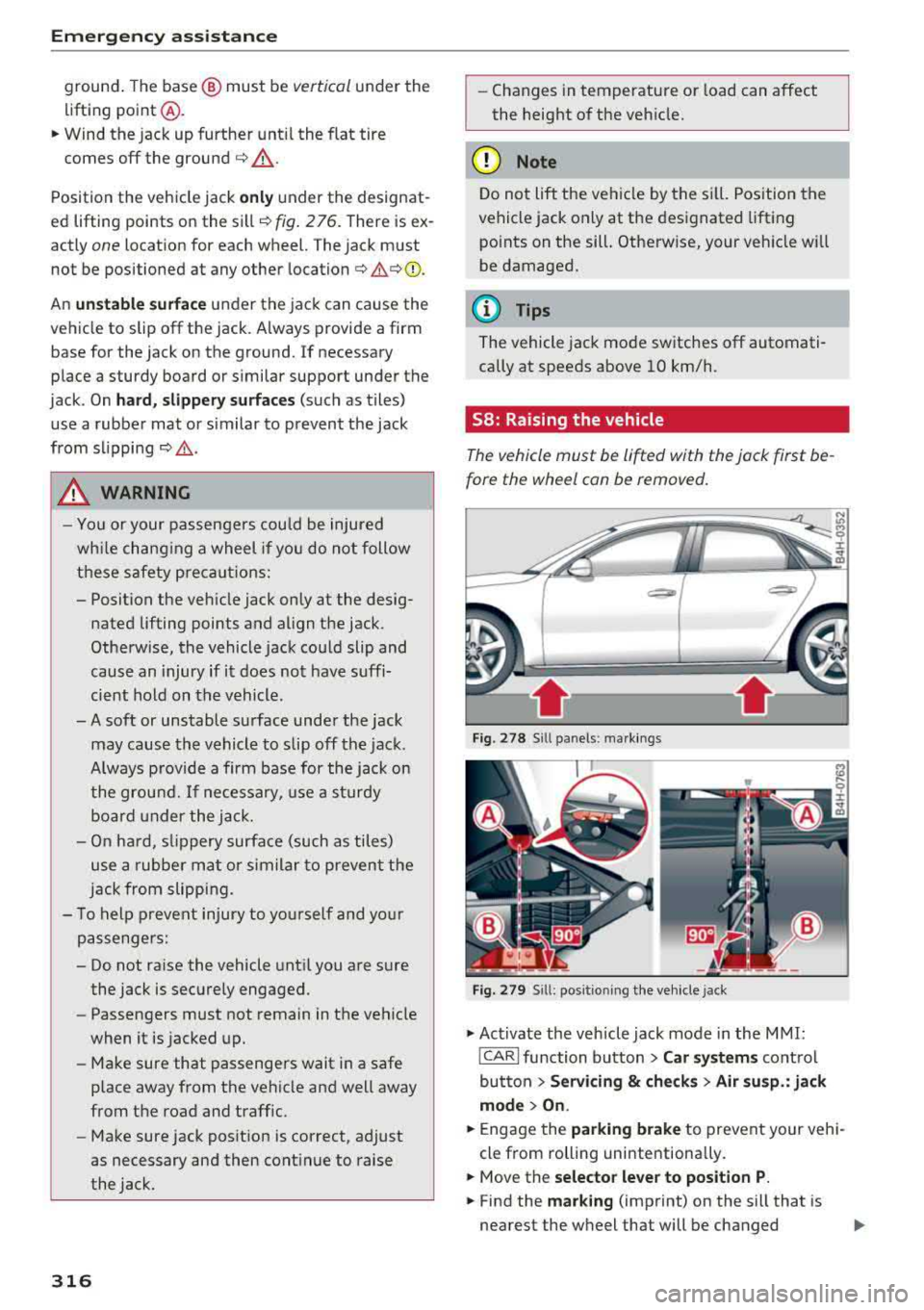
Fig . 278 Sill panels : ma rkings
Fig. 279 Sill : posi tioning the vehicle jack
.,. Activate the vehicle jack mode in the MMI:
!CARI function button> Car systems control
button >
Servicing & checks > Air susp.: jack
mode > On .
.,. Engage the parking brake to prevent your vehi
cle from rolling unintentiona lly.
.,. Move the selector lever to position P.
"'" Find the marking (imprint) on the sill that is
nearest the wheel that will be changed
..,.
Page 319 of 356
u. co .... N
" N .... 0 0 :c '
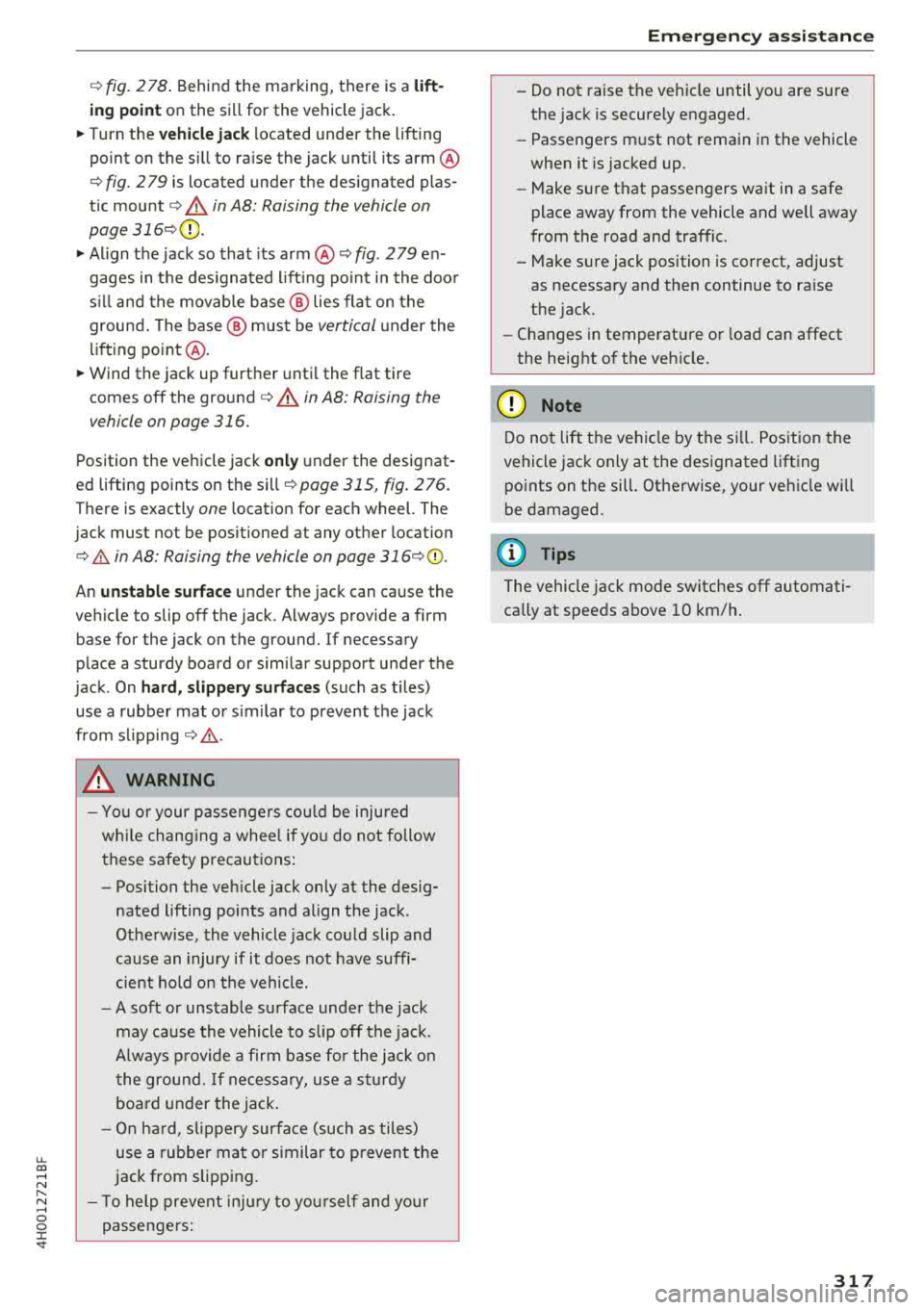
in g point on the sill for the vehicle jack .
~ Turn the vehicle jac k located under the lifting
point on the s ill to ra ise the jack until its arm @
¢
fig . 2 79 is located under the des ignated plas
t ic
mount ¢.&. in AB: Raising the vehicle on
page
316 ¢
gages in t he des ignated l ift ing po int in the doo r
s ill and the movable base @ lies flat on the
ground . The base @ must be
vertical under the
lifting point @.
~ Wind the jack up further unti l the flat tire
comes off the
ground ¢.&. in AB: Raising the
vehicle on page 316.
Position the vehicle jack onl y under the designat
ed lifting points on the sill
¢ page 315, fig . 276.
There is exactly one locat ion for each wheel. The
jack must not be pos itioned at any other location
¢ & in AB: Raising the vehicle on page 316¢ (!).
An unsta ble surf ace under the jack can cause the
vehicle to slip
off the jack . Always provide a firm
base for the jack on the ground. If necessary
place a sturdy board or similar support under the
jack . On
hard, slippery surfaces (such as tiles)
use a rubber mat or s imilar to prevent the jack
from
sl ipping ¢& .
.8, WARNING -
-Yo u or your passe ngers cou ld be inju red
w hil e chang ing a whee l if yo u do not follow
these safety precautions :
- Position the veh icle jack on ly at the desig
nated lifting points and align the jack .
Otherw ise, the vehicle jack could slip and
cause an injury if it does not have suffi
cient hold on the vehicle.
- A soft or unstable su rface unde r th e jack
may cause the vehicle to s lip off the jac k.
A lways p rovide a firm base fo r the jack on
t he grou nd. If ne cessary, use a stu rdy
board under the jack .
- On ha rd, s lippery surface (such as ti les)
use a rubber mat o r similar to prevent t he
jack from slipping .
- T o help prevent inju ry to yo urself and yo ur
passengers:
Em ergenc y ass is tanc e
-Do not raise the ve hicle until you are sure
the jack is secure ly engaged.
- Passengers must not remain in the vehicle
when it is jacked up.
- Make sure that passengers wait in a safe
place away from the vehicle and well away
from the road and traffic.
- Make s ure jack position is correct, adjust
as necessary and then continue to raise
the jack.
- Changes in temperature or load can affect
the height of the veh icle.
@ Note
Do not lift the vehicle by the s ill. Pos ition the
vehicle jack on ly at the designated lifting
points on the sill. Otherwise, your vehicle wi ll
be damaged.
(D Tips
The vehicle jack mode switches off automati
cally at speeds above 10 km/h.
317
Page 321 of 356
lL t:0 ....
'"" ......
'"" .... 0 0 :c '
Tires with unidirectional tread design must be
mounted with their tread pattern pointed in the
right direction .
Using a spare tire with a tread pattern
intended for use in a specific direction
When using a spare t ire with a tread pattern in
tended fo r use in a specific direction, please note
the following:
- The direction of rotat ion is marked by an arrow
on the side of the tire .
- If the spare tire has to be installed in the incor
rect direction, use the spare tire only tempora
rily s ince the tire will not be able to achieve its
opt imum performance character istics with re
gard to aquaplaning, noise and wear .
- We recommend that you pay particular atten
t ion to this fact during wet weather and that
you adjust your speed to match road condi
tions.
- Replace the flat tire with a new one and have it
installed on your vehicle as soon as possible to
restore the handling advantages of a unidirec
tiona l tire .
Notes on wheel changing
Please read the information ~ page 290 if you
are going to use a spare tire which is different
from the tires on your vehicle.
After you change a tire:
- Check the tire pressure on the spare immedi
ately after installation.
- Have the wheel bolt tightening torque
checked with a torque wrench as soon as pos
sible by your authorized Audi dealer or a
qualified service station.
- With steel and alloy wheel rims, the wheel
bolts are correctly tightened at a torque of 90
ft lb
(120 Nm).
- If you notice that the wheel bolts are corroded
and difficult to turn while changing a tire ,
they should be replaced before you check the
tightening torque .
Emergency assistance
-Replace the flat tire with a new one and have
it installed on your vehicle as soon as possi
ble. Remount the wheel cover.
Until then , drive with extra care and at reduced
speeds.
A WARNING
- If you are going to equip your vehicle with
tires or rims which differ from those which
were factory installed, then be sure to read the information
Q page 290.
- Always make sure the damaged wheel or
even a flat tire and the jack and tool kit are
properly secured in the luggage compart
ment and are not loose in the passenger
compartment.
- In an accident or sudde n maneuver they
could fly forward, injuri ng anyone in the ve
h icle .
- Always store damaged wheel, jack and tools
securely in the luggage compartment. Oth
erwise, in an accident or sudden maneuver
they could fly forward, causing injury to pas
sengers in the vehicle.
Spare tires
General information
Applies to : vehicles wit h spare tire/space-saving spare tire
(com pact spa re tire)
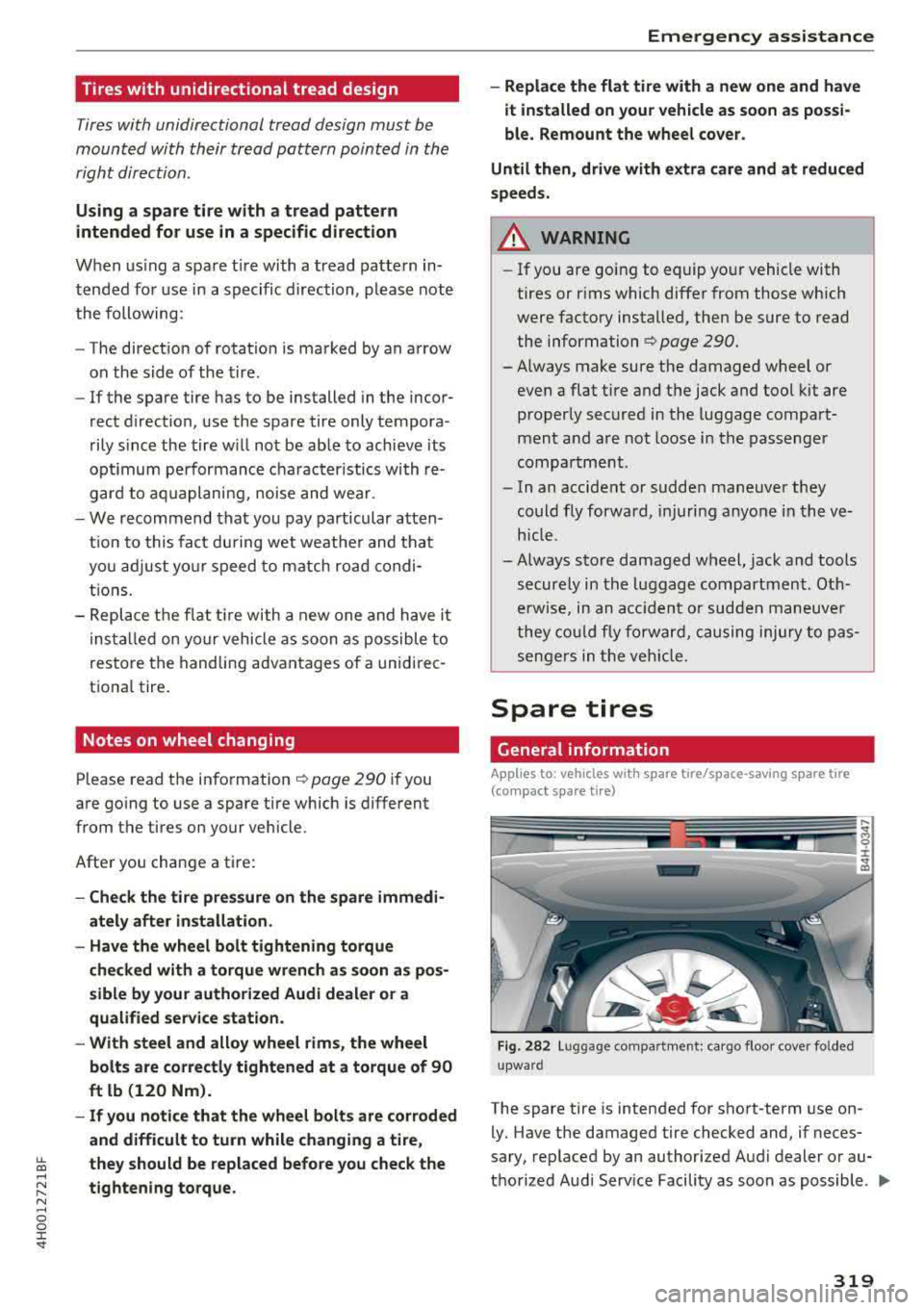
Fig. 282 Lu ggage compar tmen t: ca rgo floor cover fo lded
upwa rd
The spare tire is intended for short-term use on-
-
ly. Have the damaged tire checked and, if neces
sary, replaced by an authorized Audi dealer or au
thorized Audi Serv ice Facility as soon as possible.
II>-
319
Page 322 of 356
Emergency assistance
There are some restrictions on the use of the
spare tire. The spare tire has been designed spe
cifically for your type of vehicle. Do not replace it
with the spare tire from another type of vehicle.
There are different types of spare tires available
depending on the equipment
c::> page 320.
Removing the spare tire
• Lift the cargo floor by the plast ic ha ndle
c::> fig. 282.
• Hook the hand le into the luggage compartment
weathe r strip.
• Turn the handwheel counter-clockwise and re-
move it.
• Remove the spare tire.
Snow chains
For technical reasons, the use of snow chains on
the compact spare tire is not permitted.
If you have to drive w ith snow chains and a front
tire fails , mount the spare t ire in place of a rear
tire . Install the snow chains on the rear tire that
you removed, and install that in place of the
front tire that failed.
A WARNING
-After installing a spare tire, the tire pres sure must be checked as quickly as possible.
- Do not drive faster than 50 mph (80 km/h)
with a compact spare tire. Driving faster
than that increases the risk of an accident.
- To reduce the risk of an accident, avoid full
throttle acceleration, heavy braking, and
fast cornering with the compact spare t ire.
- To reduce the risk of an accident, never drive
with more than one compact spare tire.
- Norma l summer or winter tires must not be
mounted on the compact spare wheel rim.
A WARNING
- Never use the spare tire if it is damaged or if
it is worn down to the tread wear indicators.
- If the spare tire is more than 6 years old, use it only in an emergency and with ex
treme caution and careful dr iving .
- The spare tire is intended only for tempora
ry and short-term use.
It should be replaced
320
as soon as possible with the normal whee l
and tire.
- For technical reasons, the use of tire chains
on the spare tire is not permitted. If it is
necessary to drive with tire chains, the spare
wheel must be mounted on the front axle in
the event of a flat in a rear tire . The newly
ava ilable front wheel must then be installed
in place of the rear wheel w ith the flat tire.
Installing the tire chain before mounting
the wheel and tire is recommended.
- Loose items in the passenger compartment
can cause serious personal injury during
hard braking or in an accident. Never store
the inflatable spare tire or jack and tools in
the passenger compartment .
Spare tire types
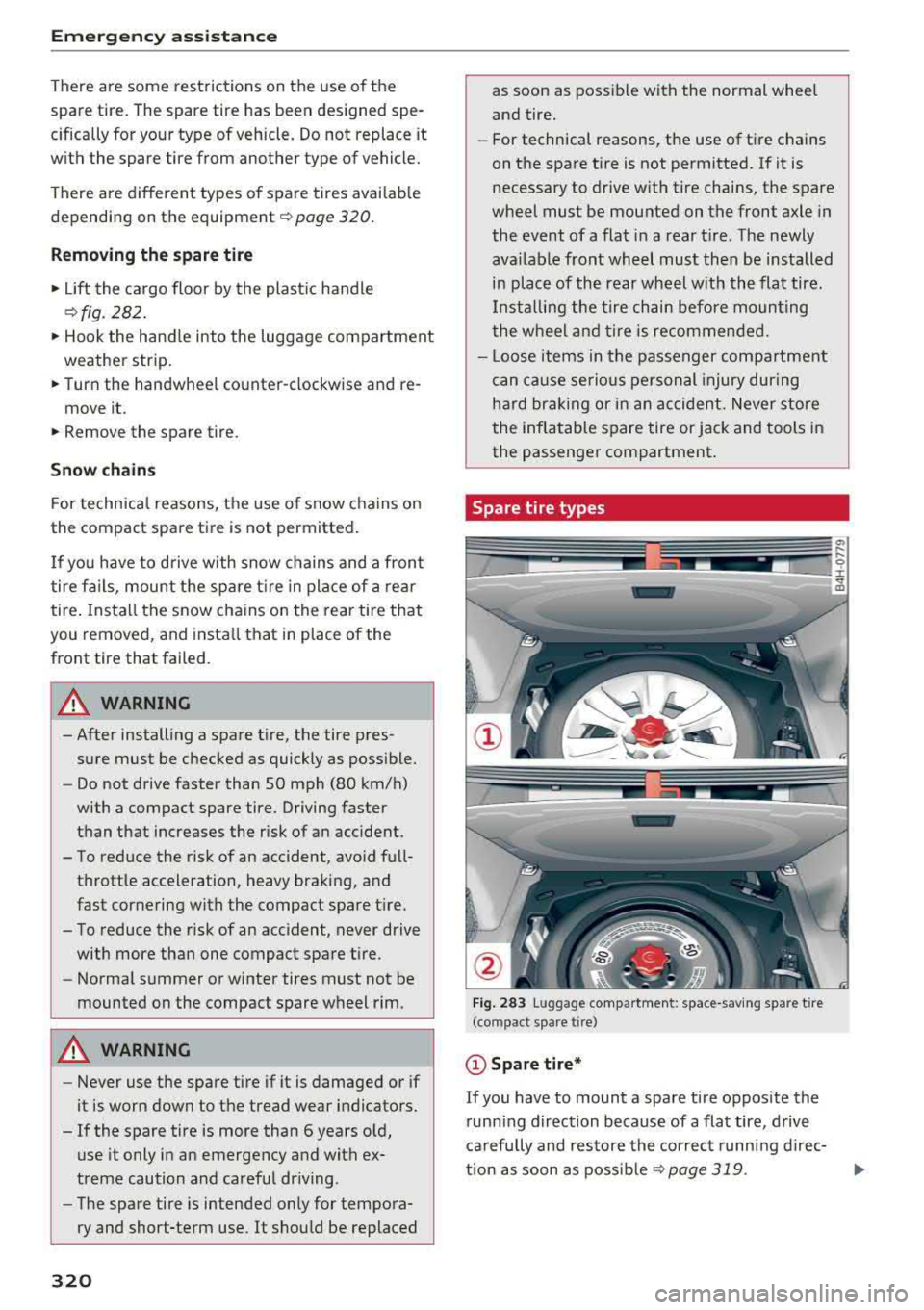
Fig. 283 Luggage compartment: space -saving spa re t ire
(compact spare tire)
(D Spare tire*
If you have to mount a spare tire oppos ite the
running direction because of a flat tire , drive
ca refully and restore the correc t running direc
tion as soon as possible
<=:>page 319.
Page 324 of 356
Fuses and bulbs
Fuses and bulbs
Electrical fuses
Changing fuses
A fuse that has blown will have metal strips that have burned through .
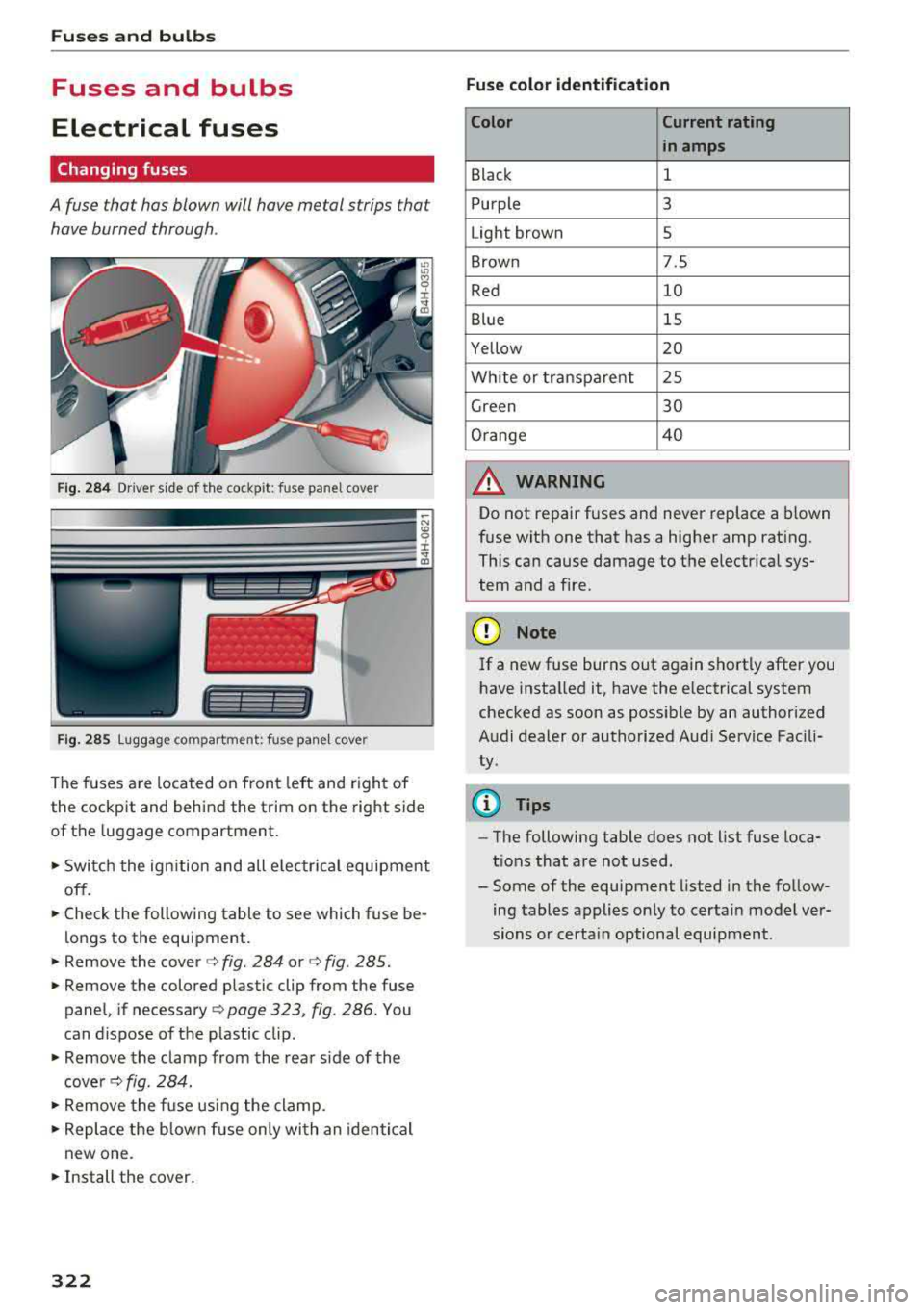
Fig. 284 Driver side of the cockp it: fuse panel cover
1
•
Fig. 285 Luggage compartment: fuse panel cover
The fuses are located on front left and right of
the cockpit and behind the trim on the right side
of the luggage compartment.
.. Switch the ignition and all electrical equipment
off.
.. Check the following table to see which fuse be
longs to the equipment .
.. Remove the cover c::> fig. 284 or c::> fig. 285 .
.. Remove the colored plastic clip from the fuse
panel, if necessary
<=:>page 323 , fig. 286. You
can dispose of the plastic clip .
.. Remove the clamp from the rear side of the
cover
c::> fig. 284 .
.. Remove the fuse using the clamp .
.. Replace the blown fuse only with an identical
new one .
.. Install the cover.
322
Fuse color identification
Color Current rating
in amps
Black 1
Purple 3
Light brown 5
Brown 7.5
Red 10
Blue 15
Yellow 20
White or transparent 25
Green 30
Orange 40
A WARNING
-
Do not repair fuses and never replace a blown
fuse with one that has a higher amp rating.
This can cause damage to the electrical sys
tem and a fire.
(D Note
If a new fuse burns out again shortly after you
have installed it, have the electrical system
checked as soon as possible by an authorized
Audi dealer or authorized Audi Service Fac ili
ty .
(!) Tips
-The following table does not list fuse loca
tions that are not used .
- Some of the equipment listed in the follow
ing tables applies only to certain model ver
sions or certain optional equipment.
Page 328 of 356
Fuses and bulb s
Bulbs
Replacing light bulbs
For your safety, we recommend that you have
your authorized Audi dealer replace burned out
bulbs for you .
It is becoming increasingly more and more diffi
cult to replace vehicle light bulbs since in many
cases, other parts of the car must first be re moved before you are able to get to the bulb .
This applies espec ially to the light bulbs in the
front of your car wh ich you can only reach
through the engine compartment .
Sheet metal and bulb ho lders can have sharp
edges that can cause ser ious cuts, and parts
must be co rrectly taken apart and then p roperly
put back together to help prevent breakage of
parts and long term damage from water that can
enter housings that have not been properly re
sea led.
F or your safety, we recommend that you have
your authorized Audi dealer replace any bu lbs for
you, since your dealer has the proper tools, the correct bulbs and the expertise.
Ga s di sc ha rge la mp s (Xe non ligh ts):
Due to the high electrical voltage, have the bulbs
replaced by a qua lified techn ic ian . Head lights
with Xenon light can be identified by the high
voltage sticker.
LED headlights* requ ire no maintenance. P lease
contact your authorized Aud i dealer if a bulb
needs to be replaced.
A WARNING
Contact w it h high -vo ltage components of the
electrical system and improper rep lacement
of gas disc harge (Xenon) head light bu lbs can
cause serious personal injury and death.
- Xenon bulbs are pressurized and can ex
plode when being changed.
- Changing Xenon lamps requires the special
training, instructions and equipment.
- Only an a uthorized Audi dea ler or other
qualified workshop s hou ld change the bulbs
in gas disc harge lamps .
326
A WARNING
There are parts with sharp edges on the open
ings and on the bulb holders that can cause
serious cuts .
- If you are uncertain about what to do, have
the work performed by an author ized Audi
dealer or other qual ified workshop . Ser ious
pe rsonal inju ry may resu lt from improperly
pe rformed wor k.
(D Tips
- If you must replace the light bulbs yourself,
always remember that the eng ine compart
ment of any vehicle is a hazardo us a rea to
work in. Always read and heed all WARN INGS
~ page 272.
-It is best to ask you r author ized Audi dea le r
w henever you need to change a bulb.
Page 329 of 356
u. co .... N
" N .... 0 0 :c '
General
This chapter is intended for trained emergency
crews and working personnel who have the nec
essary tools and equipment to perform these
operations.
Starting by pushing or
towing
~ Note
Vehicles with an automatic transmission can
not be started by pushing or towing.
Starting with jumper
cables
If necessary, the engine can be started by con
necting it to the battery of another vehicle .
If the engine should fail to start because of a dis
charged or weak battery, the battery can be con
nected to the battery of
another vehicle, using a
pair of jumper cables to start the engine.
Jumper cables
Use only jumper cables of sufficiently large cross
section
to carry the starter current safely. Refer
to the manufacturer's specifications.
Use only jumper cables with
insulated terminal
clamps which are distinctly marked :
plus(+) cable in most cases colored red
minus(-) cable
in most cases colored black.
A WARNING -
Batteries contain electricity, acid, and gas.
Any of these can cause very serious or fatal in
jury. Follow the instructions below for safe
handling of your vehicle's battery .
-Always shield your eyes and avoid leaning
over the battery whenever possible.
-A dead battery can freeze at temperatures
around 32 °F (0 °C) . If the vehicle battery is
frozen, you must thaw it before connecting
the jump start cables. If you do not, this in-
Emergency situations
creases the risk of an explosion and chemi
cal burns. After jump starting the vehicle,
drive to an authorized Audi dealer or author ized Audi Service Facility immediately to
have the vehicle battery checked.
- Do not allow battery acid to contact eyes or
skin . Flush any contacted area with water
immediately.
- Improper use of a booster battery to start a
vehicle may cause an explosion .
- Vehicle batteries generate explosive gases .
Keep sparks, flame and lighted cigarettes
away from batteries.
- Do not try to jump start any vehicle with a
low acid level in the battery .
- The voltage of the booster battery must also
have a 12-Volt rating . The capacity (Ah) of
the booster battery should not be lower
than that of the discharged battery. Use of
batteries of different voltage or substantial
ly different "Ah " rating may cause an explo
sion and personal injury.
- Never charge a frozen battery. Gas trapped
in the ice may cause an explosion.
- Never charge or use a battery that has been
frozen. The battery case may have be weak
ened.
- Use of batteries of different voltage or sub
stantially different capacity (Ah) rating may
cause an explosion and injury. The capacity
(Ah) of the booster battery should not be
lower than that of the discharged battery.
- Before you check anything in the engine
compartment, always read and heed all
WARNINGS
c>page 272.
@ Note
- Applying a higher voltage booster battery
will cause expensive damage to sensitive
electronic components, such as control
units, relays, radio, etc.
- There must be no electrical contact between
the vehicles as otherwise current could al
ready start to flow as soon as the positive
( + ) terminals are connected.
327
Page 330 of 356
Emergency situations
@ Tips
The discharged battery must be properly con
nected to the vehicle's electrical system .
When jump starting or charging the battery,
never connect the negative ground cable to
the battery negative post because the battery
manager system must be able to detect the
battery's state of charge. Always connect the
negat ive g round cable to the negative ground
post of the battery manager control unit.
Using the jump start
cable
Both jump start cables must be connected in the
correct order!
Fig. 289 E ngin e compartme nt: co nn ectors for jump start
cables and a charger
Fig. 290 Jump starting using a battery in anot her vehicle:
A
-p rov id in g current, B -drai ned
The procedure for connecting jump start cables
that is descr ibed next is designed to help jump
start your vehicle.
Vehicle with discharged battery:
~ Turn off lights and accessories, move automatic
transmission lever to N (Neutral) or P (Park)
and set parking bra ke.
328
Connecting the positive cable (red) to the
positive terminal
~ Open the cover on the positive terminal
qfig . 289.
1. Secure one end of the pos itive cable (red) to
the jump start pin
(D q fig. 290 (pin under
the cover =
"plus") on the vehicle that needs
to be started @.
2. Secure the other end of the positive cable
(red) to the posit ive terminal @on the bat
tery provid ing the cur rent @.
Connecting the negative cable (black) to the
negative terminal
3. Secure one end of the negative cable (black)
to the negative terminal @ on the battery
that is providing the current @.
4. Secure the other end of the negative cable
(black) to the jump start
pin @ (hex head pin
= "negative") on the vehicle that needs to be
started @.
Starting the engine
~ Sta rt the eng ine on the vehicle providing the
jump start @and let it run at idle.
~ Now start the engine on the vehicle with the
drained battery @.
~ If the engine does not start, stop the starting
procedure after 10 seconds and then repeat it
after approx imately 30 seconds.
~ Remove the cables when the engi nes are run
ning. Remove them in reverse order from the
way they were installed.
~ Close the cover on the posi tive terminal.
The battery is vented to the outside to prevent
gases from enter ing the vehicle interior. Make
sure that the jumper clamps are well connected
with their
metal ports in full contact with the
battery terminals .
A WARNING
-To avoid serious personal injury and damage
to the vehicle, heed all warnings and instruc
tions of the jumper cable manufacturer. If in
doubt, call for road service.
-Jumper cables must be long enough so that
the vehicles do not touch.
..,.