airbag AUDI A8 2018 User Guide
[x] Cancel search | Manufacturer: AUDI, Model Year: 2018, Model line: A8, Model: AUDI A8 2018Pages: 356, PDF Size: 54.71 MB
Page 163 of 356
u. co .... N
" N .... 0 0 :c '
my Audi Account <=> page 168 or on line map
view
<=> page 17 2.
- Traffic information (Sirius): receive informa
tion about accidents, road construction and other incidents
c;,page 176
Audi connect services on the phone
Applies to: vehicles with Audi connect
The follow ing Audi connect serv ices are currently
ava ilable:
- Storing contacts on yo ur computer using your
myAudi Account and loading the contacts into
the MMI directory
c:;, page 154
Wi-Fi hotspot
Applies to: vehicles with Audi connect
You can use the MMI as a Wi-Fi hotspot to con
nect up to eight wireless devices to the Internet. While driving , restricted use of non-secured,
light, small wireless devices is only possible from the rear of the vehicle.
.,. Select : the IT EL! button > Settings control but-
ton
> Wi-Fi settings .
The following settings can be modified in the Wi
Fi settings
menu:
Wi-Fi active
The MMI Wi-Fi hotspot is deactivated at the fac
tory. Your Wi-Fi hotspot must be activated and
visible to establish a connection between your ve hicle and your w ireless device .
-Off : the MMI Wi-Fi hotspot is deactivated. An
Internet connection is not poss ible.
- Visible : th e MMI Wi-Fi hotspot is active and can
be used to connect to the Internet.
-Invisible : the MMI Wi-Fi hotspot is active but
not visib le to other devices. A connection can
not be established with a new w ireless device.
The Wi-Fi connection between your vehicle and
your wire less device (laptop, cell phone) is en
crypted. To establish a connection, yo u must en
ter the following settings when setting up your
wire less device. You can change them if necessa
ry.
Audi connect
- Network ID (SSID) :
name of the Wi-Fi net
work .
-Encryption type : WEP , WPA or WPA2
-Password : depending on the encrypt ion type, a
passwo rd may be generated in the MMI that is
used to encrypt the wireless connection. The
password can be changed. Be sure to se lect a
secure password. For t he WEP encryption type,
the password must be exactly 13 characters.
For the WPA or the WPA2 encrypt ion types, the
password must be at least
8 (maximum of 63)
characters.
- Apply settings : the modified settings are ap
plied to the MMI. You must then update the
changes in your mobile wirel ess device .
A WARNING
-
-As the driver, do not allow usage of the Wi
Fi hotspot to distract you from driv in g, as
this could increase the risk of an accident.
-It is only safe to use laptops and similar mo
b ile devices when the vehicl e is stationary
beca use, like all loose objects, they could be
thrown around the inside of the vehicle in a
cras h and cause serious injuries . Store these
types of devices securely while driving.
- Do not use any wireless devices on the front
seats within range of the airbags whi le driv
ing. Also read the warnings in the chapter
c:;, page 208.
@ Note
-Under some conditions, certain mobile devi
ces and operating systems may automati
cally sw itch from your vehicle's Wi-Fi hot
spot to the device's mobile data connection.
In that event, standard text and data usage
rates would apply wh ile the device's mobile
data connect ion is in use. Please refer to
documentation provided by your mobile de
vice's manufacture and your data carrier for
details, rela ted terms and privacy state
ment .
- You are respons ible for all precautions tak
en for data protection, anti-virus protection
and protection against loss of data on mo
bile devices th at are used to access the In
ternet through the Wi-Fi hotspot.
161
Page 211 of 356
lL t:0 ....
"' ......
"' .... 0 0 :c '
weather conditions.
~ Take frequent breaks on long trips. Do not drive
for more than two hours at a stretch.
~ Do NOT drive when you are tired, under pres
s ure or when you are stressed .
A WARNING
Impaired driv ing safety increases the risk of
ser ious personal inj ury and death whenever a
vehicle is being used .
Correct passenger
seating positions
Proper seating position for the driver
The proper driver sea ting po sit ion is impor tan t
for safe, relaxed driving .
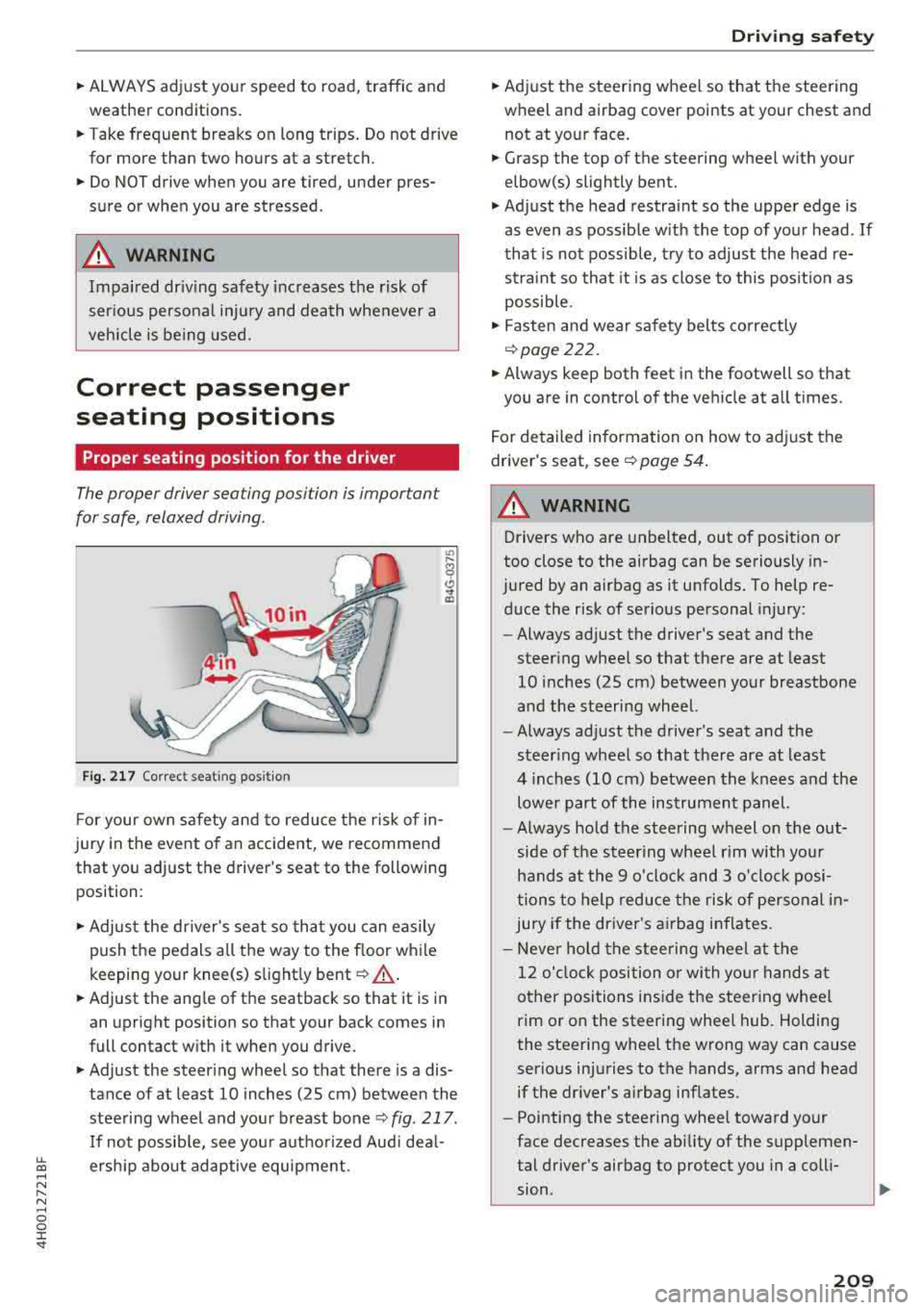
Fig. 217 Correc t seat ing posit ion
F or your own s afety and to reduce the risk of in
jury in the event of an accident, we recommend
that you adjust the driver 's seat to the following
position :
~ Adjust the dr iver's seat so tha t you can easily
push the pedals all the way to the f loor wh ile
keeping your knee(s) s light ly bent
c:!;> _& .
~ Adjust the ang le of the seatback so that it is in
an upright position so that your back comes in
full contact w ith it when you drive.
~ Adjust the steering wheel so that there is a dis
tance of at least 10 inches (25 cm) between the
stee ring wheel and you r breast bone
<:!;> fig . 217 .
If no t possib le, see you r autho riz ed Aud i dea l
ersh ip about adaptive equipment .
Driving safety
~ Adjust the steering wheel so that the steering
wheel and airbag
cover points at your chest and
not at yo ur face.
~ Grasp the top of the steering wheel with you r
elbow(s) slightly bent.
~ Adjust the head restraint so the upper edge is
as
even as possible w ith the top of your head . If
that is not possible, t ry to adjust the head re
s traint so that it is as close to this posit ion as
possible .
~ Fasten and wear safety belts correctly
c:!;> page 2 2 2.
~ Always keep both feet in the footwell so that
you are in contro l of the ve hicle at a ll times .
F or detailed information on how to adj ust the
driver's seat,
see r:!;> page 54 .
A WARNING
-
Drivers who are unbelted, out of position or
too close to the airbag can be se riously in
jured by an airbag as it unfolds. To help re duce the risk of serious personal injury:
- Always ad just the driver's seat and the
steer ing whee l so that there are at least
10 inc hes (25 cm) between you r breastbone
and the steer ing wheel.
- Always ad just the d river's seat and the
steer ing wheel so that there are at least
4 inches (10 cm) between the knees and the
lowe r part of the instrument panel.
- Always hold the steering w heel on the out
side of the steering wheel r im with yo ur
hands at the 9 o'clock and 3 o'clock posi
tions to help reduce the risk of personal in
jury if the driver's airbag inflates.
- N ever hold the stee ring wheel at the
12 o' clock position o r wi th yo ur hands at
other posi tions i nside the steer ing whee l
rim or on the steering wheel hub . Holding
the steering wheel the wrong way can cause
serio us injuries to the hands, arms and head
if the dr iver's airbag inf lates .
- Pointing the steering wheel toward your
face decreases the abi lity of the supplemen
tal driver's airbag to protect you in a coll i-
sion .
..,
209
Page 212 of 356
Drivin g saf ety
- Always sit in an upright position and never
lean against or p lace any part of your body
too close to the area where the airbags are located.
- Before dr iving, always adjust the front seats
and head restraints properly and make sure
that all passengers are properly restrained .
- Never adjust the seats while the vehicle is
moving . Your seat may move unexpectedly
and you could lose control of the vehicle.
- Never dr ive with the backrest reclined or
t ilted far back! The farther the backrests are
t ilted back, the greater the risk of injury due
to incorrect positioning of the safety belt and imp roper seating position.
- Children must always ride in child seats
¢ page 249. Special precautions apply
when installing a child seat on the front
passenge r
seat¢ page 22 7.
Proper seating position for the front
passenger
The proper front passenger seating position is
important for safe, relaxed driving.
F or your own safety and to reduce t he risk of in
ju ry in the event of an accide nt, we recomme nd
that you adjust the seat for the front passenger
to the following position:
.,. Adjust the ang le of t he seatback so that it is i n
an upright posit ion and you r back comes in f ull
contact wi th it w henever the vehicle is mov ing.
.,. Adjust the head restraint so the upper edge is
as even as possible with the top of your head . If
that is not possible, try to ad just the head re
straint so that it is as close to this position as
poss ible
¢ page 211.
.,. Keep both feet flat on the floor in front of the
front passenger seat .
.,. Fasten and wear safety be lts cor rect ly
¢ page 222.
For deta iled i nformation on how to adjust the
front passenger's seat, see
¢ page 54.
210
A WARNING
Front seat passengers who are unbelted, out
of position or too close to the airbag can be
seriously injured or k illed by the airbag as it
unfo lds. To help red uce the risk of serio us
personal injury:
- Passengers must a lways sit in an upright po
sition and never lean aga inst or place any
p art of their body too close to the are a
where the air bags a re loc ated.
- Passengers who are unbelted, out of posi
tion or too close to the airb ag can be se ri
ously in jured by an airbag as it unfolds wi th
great fo rce in the blink of an eye .
- Always make sure th at there are at least
10 inches (2 5 cm) between the fron t pas
senger's breastbone an d the instrument
panel.
- Always make sure that there are at least 4 inches (10 cm) between the front passen
ge r's knees and the lower pa rt of the inst ru
ment panel.
- Each passenger must always sit on a seat of
their own and properly fasten and wear the
safety belt belonging to that seat .
- Before d riving, always ad just the front pas
senger seat and head restraint properly.
- Always keep your feet on the floor in front
of the seat. Never rest them on the seat, in
strument panel, out of the window, etc . The
airbag system and safety belt w ill not be
ab le to protect you properly and can even in
crease the r isk of injury in a crash .
- Never drive with the backrest recl ined or
tilted far back! The farther the backrests are
tilted bac k, the greater the r is k of injury due
to incor rec t positioning of the safety be lt
a nd imprope r seat ing pos ition .
- Ch ild ren must always ride in child seats
¢ page 249 . Special pre caut ions apply
when install ing a child sea t on the front
passenger
sea t¢ page 22 7 .
Page 214 of 356
Drivin g saf ety
- Every person in the vehicle must have a
properly adjusted head restra int.
- Always make sure each person in the vehicle
properly adjusts their head restraint. Adjust
the head restra int so the upper edge is as
even as possib le w ith the top of your head.
If that is not possible, try to adjust the head
restra int so that it is as close to th is position
as possib le.
- Never attempt to adjust head restraint wh ile driving.
If you have dr iven off and
must adjust the driver headrest for any rea
son, fi rst s top the vehicle safely before at
tempting to ad just the head restra int.
- Children must always be p roperly restrained
in a chi ld restrain t that is appropria te fo r
their age and size
q page 249.
Examples of improper seating positions
The occupant restraint system con only reduce
the risk of injury if vehicle occupants ore properly
sea ted.
I mp roper seating posit ions can cause se rious in
ju ry or deat h. Safety belts can only wo rk when
t hey are p roper ly posit ioned o n the body . Im
p roper seating posi tions reduce t he effect iveness
of safety belts and wi ll even increase the risk of
inj ury and death by moving the safety be lt to crit
ical areas of the body. Improper seating posit ions
also increase the risk of ser ious injury and death
when an airbag deploys and str ikes an occupant
who is not in the proper seat ing position . A driver
is responsible for the safety of a ll vehicle occu
pants and especially fo r ch ildre n. Therefo re :
"' Never allow anyone to assume an incorrect
seat ing pos ition w hen the ve hicle is being used
q& .
The fo llow ing bulletins list only some sample po
sitions that wi ll increase the risk of ser ious injury
a nd death . Our hope is that these examples will
make you more aware of seat ing pos it ions that
are dangero us.
Therefore, whenever the vehicle is moving:
- never stand up in the ve hicle
- never stand on the seats
212 -
neve r kneel on the seats
- neve r ride w it h the sea tback re clined
- neve r lie down on the seats
- never lean up aga inst the instrument panel
- never s it on the edge of the seat
- never s it sideways
- never lean out the window
- never put your feet out the window
- neve r put your feet on the instr ument panel
- neve r rest you r feet on the seat c ushion or bac k
of t he se at
- neve r ride in the footwell
- never ride in the cargo area
A WARNING
Imp roper seating posi tions inc rease the risk
of ser ious personal inju ry and death whenever
a veh icle is being used.
- Always make sure that all veh icle occupants
s tay in a proper sea ting posit ion and a re
properly restrained whenever the vehicle is
be ing used .
Driver's and front
passenger's footwell
Important safety instructions
A WARNING
A lways make su re that the knee airbag can in
flate w ithout interference. Objects between
yourself and the airbag can inc rease the risk
of injury in an accident by interfering with the
way the airbag dep loys o r by being pushed in
to you as the airbag dep loys .
- No persons (ch ild ren) or animals should ride
in the footwell in front of the passenger
seat . If the airbag deploys, this can res ult in
serious or fatal injuries.
- No objects of any kind should be carried in
the footwell area in front of the dr iver's or
passenger's se at. Bu lky objects (shopping
bags, for examp le) can ham per or prevent
proper dep loymen t of the airbag . Sma ll ob
jects can be thrown thro ugh the vehicle if
the air bag deploys and in jure you or your
passengers.
Page 220 of 356
Audi pre sense
(D Tips
-Certain pre sense front functions switch off
when sport mode is swi tc h ed off or when
driving in reverse .
- The pre sense functions may not be availa
b le if there is a malfuncti on in the ESC sys
tem or the airbag contro l module.
- The pre sense front/plus funct ions are not
available if the re is a ma lf u nction in t he
adaptive c ruise contro l" system
c::;, page 102.
-The pre sense rear/plus f unctions are no t
available if the re is a ma lf u nction in the s ide
assist " system
c::;, pag e 102.
218
Page 223 of 356
lL t:0 ....
"" ......
"" .... 0 0 :c '
in the way ¢
fig. 222. This impact w ith the vehi
cle interior has all the energy they had just be
fore the crash.
Never rely on airbags alone fo r protection . Even
when they deploy, airbags provide on ly additiona l
protection. Airbags are not supposed to dep loy in
all kinds of accidents. A lthough your Audi is
equ ipped w ith airbags, all vehicle occupants, in
cluding the dr iver , must wear safety belts cor
rectly in order to minimize the risk of severe in
jury or death in a crash .
Remember too, tha t airbags will deploy only
once and that your safety belts are always there
to offer protec tion in those acc idents in w hich
airbags are not supposed to deploy or when they
have a lready deployed. Unbel ted occupants can
also be thrown o ut of the vehi cle where even
more severe or fatal injur ies can occur .
It is also important for the rear passenge rs to
wear s afety bel ts corre ctly . U nbel ted passengers
in the re ar seats endanger no t onl y themse lves
but also the driver and ot her passengers
¢ fig . 223. In a fronta l collision they will be
thrown forward violently, where they can hit and
in jure the driver and/or front seat passenger .
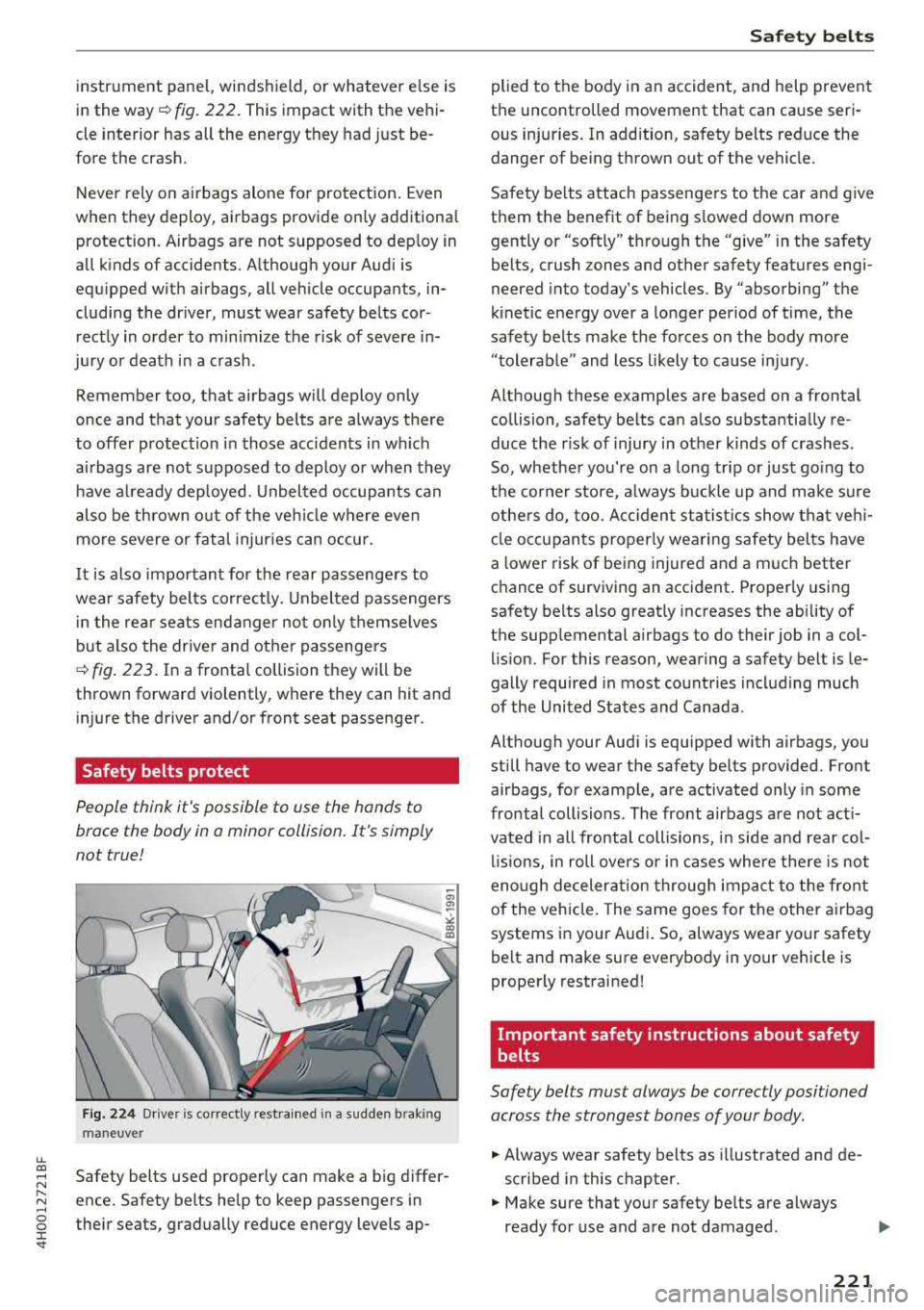
Safety belts protect
People think it's possible to use the hands to
brac e the body in a minor collision . It 's simply
not true!
F ig . 2 24 Drive r is correctly rest ra ined in a sudde n brak ing
m aneuver
Safety belts used properly can make a big d iffer
ence. Safety belts he lp to keep passengers in
their seats, gradually reduce energy leve ls ap-
Safet y bel ts
plied to the bo dy i n an accident, and help prevent
t h e uncontrolled movement that can cause seri
ous injuries. In addition, safety belts reduce the
danger of be ing th rown out of the vehicle.
Safety be lts attach passengers to the car and g ive
them the benefit of be ing s lowed down more
gently or "soft ly" th rough the "give" in the safety
belts, crush zones and other safety features engi
neered into today's vehicles. By "absorbing" the
k inetic ene rgy over a longer period of t ime, the
sa fe ty belts make the fo rces on the body more
"tolerab le " and less likely to ca use in jury.
Although these examples are based on a frontal collision, safety be lts can also substa ntia lly re
duce the r is k of injury in ot her k inds of crashes .
So, whethe r you're on a long tr ip or just go ing to
t h e cor ner store , a lways b uck le up and make sure
othe rs do, too. A cciden t st atis tic s show tha t ve hi
cl e occupan ts properly wea ring safety bel ts have
a lower risk of be ing injured and a muc h better
chance of surviving an acci dent . Properly using
sa fety belts also great ly increases the ability of
the supp lemental airbags to do their job in a col
lis ion. For this reason, wearing a safety belt is le
gally required in most count ries includ ing much
of the United States and Canada .
Although your Aud i is equipped with airb ags, you
still have to wear the safety belts provided. Front airbags, for example, are activated only in some
frontal collisions. The front airbags a re not ac ti
vated in a ll frontal collisions , in side and rear co l
li sio ns, in roll overs or i n cases where the re is not
eno ugh deceleration throug h impact to the front
of the veh icle. The same goes for the other a irbag
systems in your Audi . So, always wear your safety
belt and make sure everybody in your vehicle is
properly rest rained !
Important safety instructions about safety
belts
Safe ty belts must always be correctly posi tioned
across the strongest bones of your body.
.. Always wear safety belts as illustrated and de
scribed in this chapter .
.. Make sure that your safety be lts are always
ready for use and are not damaged.
221
Page 227 of 356
u. co .... N
" N .... 0 0 :c '
Always read and heed all WARNINGS and other important
i nformation¢ page 221.
(D Tips
You can a lso adjust the height of the front
seats to change the position of the safety
be lts.
Improperly worn safety belts
Incorrectly positioned safety belts can cause se
vere injuries.
Wearing safety be lts improperly can cause seri
ous injury or death. Safety belts can on ly work
when they are correctly pos itioned on the body.
Improper seating positions reduce the effect ive
ness of safety belts and will even increase the
risk of injury and death by mov ing the safety belt
to cr it ica l areas of the body. Improper seating
positions also increase the r isk of serious i njur y
a n d death when an airbag deploys a nd str ikes an
occupant who is not in the correct seating pos i
tion . A driver is responsible for the safety of a ll
ve hicle occupants and especia lly for children.
Therefore:
.. Never permit anyone to ass ume an incorrect
sitting position in the vehicle w hil e trave ling
¢A .
A WARNING
Improperly worn safety be lts increase the risk
of serious personal injury and death whenever
a vehicle is be ing used.
- Always ma ke sure that a ll vehicle occupants
are correctly restra ined and stay i n a correct
sea ting pos it ion whenever the ve hicle is be
ing used .
- Always read and heed all WARNINGS and
ot her important information
¢ page 221.
Safet y be lts
Belt tensioners
How safety belt pretensioners work
Rev ersible safety belt tension ers
T he following fu nctions a re available when safety
belts w it h reversib le safety belt tensione rs a re
faste ned:
- Automatic tens ioners: at the start of a drive,
the safety belts automatically ad just to the
passenger after a certain time period or veh icle
speed. To switch the a utomat ic tens ioners off,
select the following in t he M MI:
!CARI fu nction
button
> Car systems > Vehicle settings >
Seat s > Driver 's seat or Passenger 's seat > Au
tomatic belt tensioner
> Off .
- In ce rtain driving situations, the safety belts
may tighten wit h a reve rsib le tensioning func
tion
r=;, page 217.
- The safety be lts may also tighten with this re -
versible tensioning function in minor collisions.
Pyrotechnic safety belt pretensioners
Seat be lts wi th py ro technic s afety be lt preten
s io ners are tensioned au toma tically i n seve re col
li sions, depending on t he circumstances . This
helps to reduce the forward motion of the occu
pants .
A WARNING
= -
- It is poss ib le for the pretensioners to dep loy
incor rectly.
- Any work on the tens ioner system or remov
al and installation of system components
for other repairs m ust be performed by a
qualified workshop.
- The pyrotechnic system can only p rovide
protection fo r one collision. If the py rotech
n ic pretens ioners deploy, the pretensioning
system must be rep laced.
(D Tips
- A fine dust is re leased when the pyrotechnic
safety belt pretensioners dep loy. Th is is no r
ma l and is not caused by a f ire in t he ve hi
cle.
- The relevant safety requirements must be
observed when the vehicle or componen ts
225
Page 228 of 356
Safety belts
of the system are scrapped. A qualified
dealership is familiar with these regulations
and will be pleased to pass on the informa
tion to you.
Service and disposal of safety belt preten
sioner
The safety belt pretensioners are parts of the
safety belts on your Audi. Installing, removing,
servicing or repairing of belt pretensioners can
damage the safety belt system and prevent it
from working correctly in a collision.
There are some important things you have to
know to make sure that the effectiveness of the
system will not be impaired and that discarded
components do not cause injury or pollute the
environment.
A WARNING -
Improper care, servicing and repair proce
dures can increase the risk of personal injury
and death by preventing a safety belt preten
sioner from activating when needed or acti
vating it unexpectedly:
- The belt pretensioner system can be activat
ed only once . If belt pretensioners have
been activated, the system must be re
placed.
- Never repair, adjust, or change any parts of
the safety belt system.
- Safety belt systems including safety belt
pretensioners cannot be repaired. Special
procedures are required for removal, instal
lation and disposal of this system.
- For any work on the safety belt system, we
strongly recommend that you see your au
thorized Audi dealer or qualified technician
who has an Audi approved repair manual,
training and special equipment necessary.
@ For the sake of the environment
Undeployed airbag modules and pretension
ers might be classified as Perchlorate Materi
al -special handling may apply, see
www.dtsc.ca.gov/hazardouswaste/ perchlorate. When the vehicle or parts of the restraint system including airbag modules
226
safety belts with pretensioners are scrapped,
all applicable laws and regulations must be
observed. Your authorized Audi dealer is fa
miliar with these requirements and we recom
mend that you have your dealer perform this
service for you.
Page 229 of 356
u. co .... N
" N .... 0 0 :c '
Importance of wearing safety belts and
sitting properly
Airbags are only suppl em ental restraints . For
airbags to do their job, occupants must always
properly wear their safety belts and be in a prop
er seating position .
For your safety and the safety of your passen
ge rs, before dr iving off, always:
.,. Adjust the dr iver's seat and steer ing wheel
prope rly~ page 209,
.,. Adjust the fro nt passenge r's seat prope rly
~page 54,
.,. We ar safety bel ts p roperly~ page 221,
.. Always properly use the proper c hild restraint
to protect chi ld ren
r=>page 249.
In a coll is io n, a irbags mus t infla te wi thin t he
b link of an eye and with consi derab le force . The
supp lemental airbags can cause injuries if the
d river or the front seat passenger is not seated
properly. Therefore in order to he lp the airbag to
do its job, it is important, both as a dr iver and as
a passenger to sit properly at a ll times.
By keeping room between yo ur body and t he
steer ing whee l and the front of the passenger
compa rtment, the airbag can inflate fully and
comp lete ly and prov ide supplemental protect io n
in certa in frontal coll is ions
r=> page 209, Correct
passenger seating positions.
Fo r de tails on the
operat ion of the seat ad justment cont rols
r=>page5 4.
It's especially important that children a re proper
ly restra ined
r=>page 249.
There is a lot that the driver and the passengers
can and must do to help the ind ividual safety fea
tures installed in your Audi work togethe r as a
sys tem.
Proper seating posit ion is important so that the
front airbag on the driver side can do its job. If
you have a physical impairment o r cond it ion that
p revents yo u from s itting properly on the driver
seat with the safety be lt prope rly fastened and
Airbag syste m
reaching the peda ls, o r if yo u have concerns w it h
r egard to the functio n or operatio n of the Ad
vanced Airbag System, please co ntact you r au
thorized Audi dea le r or q ua lified workshop, or
ca ll Audi Customer Re lations at 1-800-822-2834
for poss ible modifications to your vehicle .
When the a irbag system dep loys, a gas generator
will fill the airbags, break open the padded cov ers, and inflate betwee n the stee ring wheel and
the driver and between the inst rument panel and
the fron t passenger . The a irbags w il l deflate im
med iate ly after deployment so that the front oc
c u pants can see t hrough the winds hield aga in
wi thou t interru ption.
All of t his takes place in the bl ink of an eye, so
fast that many peop le don't even real ize that the
airbags have deployed. The airbags a lso infla te
wi th a g re at deal of for ce and n othing should be
i n the ir way when t hey dep loy . Front airbags in
combination with properly worn safety belts slow
down and limit the occupant's forward move
ment. Together they he lp to prevent t he driver
and front seat passenger from hitting pa rts of
the ins ide of the vehicle whi le red ucing the forces
acting on the occupa nt dur ing the crash. In th is
way they help to red uce the risk of in jury to the
head and uppe r body in the crash. Airbags do no t
pro te ct the arms or the lower pa rts of t he bo dy.
Both front airbags will not inflate in all frontal
collisions. The t rigge ring of t he a irbag system de
pends on the veh icle decelerat ion rate caused by
t h e coll is io n an d regis tered by the ele ct ronic con
t ro l unit. If this rate is be low the refe re nc e v alue
programmed in to the co ntro l unit, t he a irbags
will not be t riggered, even tho ugh t he car may be
badly damaged as a res ult of the co llision. Vehi
cle damage, repa ir costs or even the lack of vehi
cle damage is not necessari ly an indication of
whethe r an a irbag should inflate o r not.
S ince the circumstances will vary cons iderably
between one co llision and another, it is not possi
ble to define a range of ve hicle speeds that will
cove r every poss ible kind and angle of impact
t h at w ill always trigge r th e a irbags. Importa nt
factors include, for examp le, the nat ure (hard or
soft) of the object which t he ca r hits, t he angle of
im pact, vehicle speed, etc. The front airbags will
.,.
227
Page 230 of 356
Airbag syste m
also not inflate in side or rear co llisions, or in
ro ll- overs.
Alwa ys rem ember : Airbags will deploy only once,
and on ly in ce rtain k inds of coll is ions. Yo ur safety
be lts are always there to offer protection in those
situations in which airbags are not supposed to
deploy, or when they have already deployed; for
examp le, when your vehicle str ikes or is struck by
another vehicle after the first collision.
This is just one of the reasons why an airbag is a
supplementary restraint and is not a substitute
for a safety belt. The a irbag system works most
effect ively when used with the safety belts.
Therefore, always properly wear your safety belts
r;:;, page 219 .
A WARNING
Sitting too close to the steering wheel o r in
st rument panel will decrease the effective
ness of the airbags and will inc rease the risk
of personal injury in a co llision.
- Never sit closer than 1 0 inches ( 25 cm) to
the steering wheel or instrument panel.
- If you cannot sit mo re than 10 inches
( 2 5 cm) from the steering wheel, invest i
gate whether adap tive equipment may be
available to help yo u reach the pedals and
increase your seating distance from the
steering wheel.
- If you are unrestrained, leaning forward, sit
ting sideways or out of position in any way,
your risk of in jury is much h igher.
- Yo u will also receive serious injuries and
could even be killed if you are up aga inst the
airbag or too close to it when it inflates
-
even with an Advanced Airbag.
- To reduce the risk of injury when an airbag inflates, a lways wear safety belts properly
c> page 222, Safety belts .
- Always make certain that chi ldren age 12 or
younger always ride in the rear seat. If chil dren are not properly restra ined, they may
be severe ly injured or k illed when an airbag
inflates.
- Never let children ride unrestrained or im prope rly restrained in the vehicle . Adjust the
front seats properly.
228
-
- Never ride with the back rest recl ined .
-Always sit as far as possible from the steer -
ing wheel or the instrument panel
c>page209.
- Always sit upright with your back against
the backrest of your seat.
- Never p lace your feet on the instrument
panel or on the seat. Always keep both feet
on the floor in front of the seat to help pre
vent serious injur ies to the legs and hips if
the airbag inflates.
- Never recl ine the front passenger's seat to
transport objects. Items can also move into
the area of the s ide a irbag or the front air
bag during brak ing or in a sudden maneu
ver. Objects nea r the airbags can become
pro jecti les and cause injury when an airbag
inflates.
A WARNING
A irbags tha t have deployed in a cr ash m ust be
replaced.
- Use on ly orig inal equipment airbags ap
proved by Audi and insta lled by
a trained
technician who has the necessary tools and
diagnostic equipment to prope rly replace
any airbag in yo ur vehicle and assure system
effectiveness in a crash.
- Never permit salvaged or recycled airbags to
be installed in your vehicle .
Child restraints on the front seat - some
important things to know
"' Be sure to read the important informat ion and
heed the WARNINGS fo r important deta ils
about ch ild ren and Advanced A irbags
r;:;, page 249 .
Even thoug h your veh icle is equ ipped w it h an Ad
vanced Airbag Sys tem, make certa in that a ll chil
dre n, espec ia lly those 12 yea rs and younger, al
ways ride i n the b ack seat prope rly res train ed fo r
t h eir age and size. The ai rbag on the passenger
s ide makes t he front seat a potentia lly dange rous
place for a child to ride . The front seat is not the
safest p lace for a c hild in a forward-fac ing c hild
.,.