airbag off AUDI A8 2018 User Guide
[x] Cancel search | Manufacturer: AUDI, Model Year: 2018, Model line: A8, Model: AUDI A8 2018Pages: 356, PDF Size: 54.71 MB
Page 214 of 356
Drivin g saf ety
- Every person in the vehicle must have a
properly adjusted head restra int.
- Always make sure each person in the vehicle
properly adjusts their head restraint. Adjust
the head restra int so the upper edge is as
even as possib le w ith the top of your head.
If that is not possible, try to adjust the head
restra int so that it is as close to th is position
as possib le.
- Never attempt to adjust head restraint wh ile driving.
If you have dr iven off and
must adjust the driver headrest for any rea
son, fi rst s top the vehicle safely before at
tempting to ad just the head restra int.
- Children must always be p roperly restrained
in a chi ld restrain t that is appropria te fo r
their age and size
q page 249.
Examples of improper seating positions
The occupant restraint system con only reduce
the risk of injury if vehicle occupants ore properly
sea ted.
I mp roper seating posit ions can cause se rious in
ju ry or deat h. Safety belts can only wo rk when
t hey are p roper ly posit ioned o n the body . Im
p roper seating posi tions reduce t he effect iveness
of safety belts and wi ll even increase the risk of
inj ury and death by moving the safety be lt to crit
ical areas of the body. Improper seating posit ions
also increase the risk of ser ious injury and death
when an airbag deploys and str ikes an occupant
who is not in the proper seat ing position . A driver
is responsible for the safety of a ll vehicle occu
pants and especially fo r ch ildre n. Therefo re :
"' Never allow anyone to assume an incorrect
seat ing pos ition w hen the ve hicle is being used
q& .
The fo llow ing bulletins list only some sample po
sitions that wi ll increase the risk of ser ious injury
a nd death . Our hope is that these examples will
make you more aware of seat ing pos it ions that
are dangero us.
Therefore, whenever the vehicle is moving:
- never stand up in the ve hicle
- never stand on the seats
212 -
neve r kneel on the seats
- neve r ride w it h the sea tback re clined
- neve r lie down on the seats
- never lean up aga inst the instrument panel
- never s it on the edge of the seat
- never s it sideways
- never lean out the window
- never put your feet out the window
- neve r put your feet on the instr ument panel
- neve r rest you r feet on the seat c ushion or bac k
of t he se at
- neve r ride in the footwell
- never ride in the cargo area
A WARNING
Imp roper seating posi tions inc rease the risk
of ser ious personal inju ry and death whenever
a veh icle is being used.
- Always make sure that all veh icle occupants
s tay in a proper sea ting posit ion and a re
properly restrained whenever the vehicle is
be ing used .
Driver's and front
passenger's footwell
Important safety instructions
A WARNING
A lways make su re that the knee airbag can in
flate w ithout interference. Objects between
yourself and the airbag can inc rease the risk
of injury in an accident by interfering with the
way the airbag dep loys o r by being pushed in
to you as the airbag dep loys .
- No persons (ch ild ren) or animals should ride
in the footwell in front of the passenger
seat . If the airbag deploys, this can res ult in
serious or fatal injuries.
- No objects of any kind should be carried in
the footwell area in front of the dr iver's or
passenger's se at. Bu lky objects (shopping
bags, for examp le) can ham per or prevent
proper dep loymen t of the airbag . Sma ll ob
jects can be thrown thro ugh the vehicle if
the air bag deploys and in jure you or your
passengers.
Page 220 of 356
Audi pre sense
(D Tips
-Certain pre sense front functions switch off
when sport mode is swi tc h ed off or when
driving in reverse .
- The pre sense functions may not be availa
b le if there is a malfuncti on in the ESC sys
tem or the airbag contro l module.
- The pre sense front/plus funct ions are not
available if the re is a ma lf u nction in t he
adaptive c ruise contro l" system
c::;, page 102.
-The pre sense rear/plus f unctions are no t
available if the re is a ma lf u nction in the s ide
assist " system
c::;, pag e 102.
218
Page 223 of 356
lL t:0 ....
"" ......
"" .... 0 0 :c '
in the way ¢
fig. 222. This impact w ith the vehi
cle interior has all the energy they had just be
fore the crash.
Never rely on airbags alone fo r protection . Even
when they deploy, airbags provide on ly additiona l
protection. Airbags are not supposed to dep loy in
all kinds of accidents. A lthough your Audi is
equ ipped w ith airbags, all vehicle occupants, in
cluding the dr iver , must wear safety belts cor
rectly in order to minimize the risk of severe in
jury or death in a crash .
Remember too, tha t airbags will deploy only
once and that your safety belts are always there
to offer protec tion in those acc idents in w hich
airbags are not supposed to deploy or when they
have a lready deployed. Unbel ted occupants can
also be thrown o ut of the vehi cle where even
more severe or fatal injur ies can occur .
It is also important for the rear passenge rs to
wear s afety bel ts corre ctly . U nbel ted passengers
in the re ar seats endanger no t onl y themse lves
but also the driver and ot her passengers
¢ fig . 223. In a fronta l collision they will be
thrown forward violently, where they can hit and
in jure the driver and/or front seat passenger .
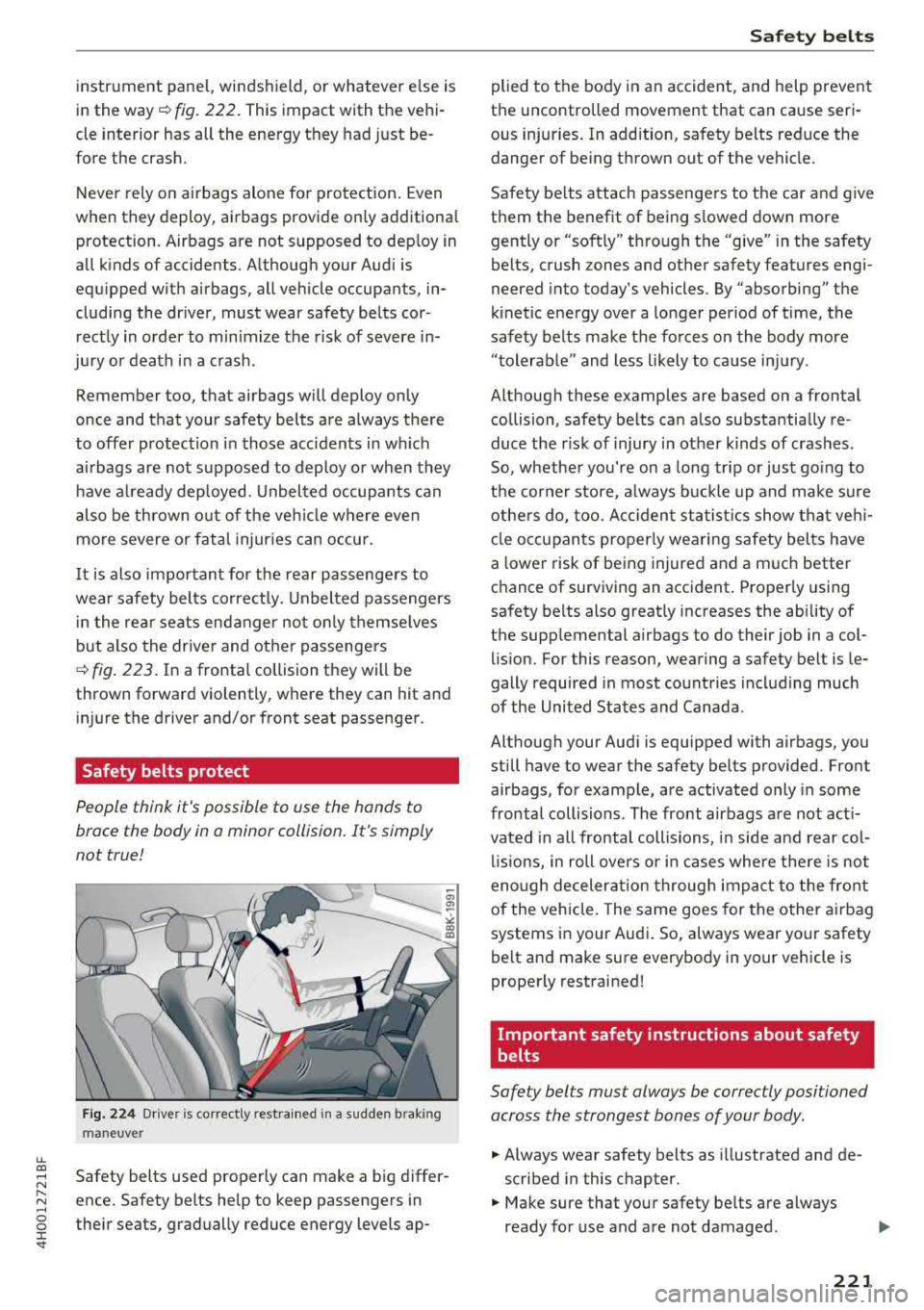
Safety belts protect
People think it's possible to use the hands to
brac e the body in a minor collision . It 's simply
not true!
F ig . 2 24 Drive r is correctly rest ra ined in a sudde n brak ing
m aneuver
Safety belts used properly can make a big d iffer
ence. Safety belts he lp to keep passengers in
their seats, gradually reduce energy leve ls ap-
Safet y bel ts
plied to the bo dy i n an accident, and help prevent
t h e uncontrolled movement that can cause seri
ous injuries. In addition, safety belts reduce the
danger of be ing th rown out of the vehicle.
Safety be lts attach passengers to the car and g ive
them the benefit of be ing s lowed down more
gently or "soft ly" th rough the "give" in the safety
belts, crush zones and other safety features engi
neered into today's vehicles. By "absorbing" the
k inetic ene rgy over a longer period of t ime, the
sa fe ty belts make the fo rces on the body more
"tolerab le " and less likely to ca use in jury.
Although these examples are based on a frontal collision, safety be lts can also substa ntia lly re
duce the r is k of injury in ot her k inds of crashes .
So, whethe r you're on a long tr ip or just go ing to
t h e cor ner store , a lways b uck le up and make sure
othe rs do, too. A cciden t st atis tic s show tha t ve hi
cl e occupan ts properly wea ring safety bel ts have
a lower risk of be ing injured and a muc h better
chance of surviving an acci dent . Properly using
sa fety belts also great ly increases the ability of
the supp lemental airbags to do their job in a col
lis ion. For this reason, wearing a safety belt is le
gally required in most count ries includ ing much
of the United States and Canada .
Although your Aud i is equipped with airb ags, you
still have to wear the safety belts provided. Front airbags, for example, are activated only in some
frontal collisions. The front airbags a re not ac ti
vated in a ll frontal collisions , in side and rear co l
li sio ns, in roll overs or i n cases where the re is not
eno ugh deceleration throug h impact to the front
of the veh icle. The same goes for the other a irbag
systems in your Audi . So, always wear your safety
belt and make sure everybody in your vehicle is
properly rest rained !
Important safety instructions about safety
belts
Safe ty belts must always be correctly posi tioned
across the strongest bones of your body.
.. Always wear safety belts as illustrated and de
scribed in this chapter .
.. Make sure that your safety be lts are always
ready for use and are not damaged.
221
Page 227 of 356
u. co .... N
" N .... 0 0 :c '
Always read and heed all WARNINGS and other important
i nformation¢ page 221.
(D Tips
You can a lso adjust the height of the front
seats to change the position of the safety
be lts.
Improperly worn safety belts
Incorrectly positioned safety belts can cause se
vere injuries.
Wearing safety be lts improperly can cause seri
ous injury or death. Safety belts can on ly work
when they are correctly pos itioned on the body.
Improper seating positions reduce the effect ive
ness of safety belts and will even increase the
risk of injury and death by mov ing the safety belt
to cr it ica l areas of the body. Improper seating
positions also increase the r isk of serious i njur y
a n d death when an airbag deploys a nd str ikes an
occupant who is not in the correct seating pos i
tion . A driver is responsible for the safety of a ll
ve hicle occupants and especia lly for children.
Therefore:
.. Never permit anyone to ass ume an incorrect
sitting position in the vehicle w hil e trave ling
¢A .
A WARNING
Improperly worn safety be lts increase the risk
of serious personal injury and death whenever
a vehicle is be ing used.
- Always ma ke sure that a ll vehicle occupants
are correctly restra ined and stay i n a correct
sea ting pos it ion whenever the ve hicle is be
ing used .
- Always read and heed all WARNINGS and
ot her important information
¢ page 221.
Safet y be lts
Belt tensioners
How safety belt pretensioners work
Rev ersible safety belt tension ers
T he following fu nctions a re available when safety
belts w it h reversib le safety belt tensione rs a re
faste ned:
- Automatic tens ioners: at the start of a drive,
the safety belts automatically ad just to the
passenger after a certain time period or veh icle
speed. To switch the a utomat ic tens ioners off,
select the following in t he M MI:
!CARI fu nction
button
> Car systems > Vehicle settings >
Seat s > Driver 's seat or Passenger 's seat > Au
tomatic belt tensioner
> Off .
- In ce rtain driving situations, the safety belts
may tighten wit h a reve rsib le tensioning func
tion
r=;, page 217.
- The safety be lts may also tighten with this re -
versible tensioning function in minor collisions.
Pyrotechnic safety belt pretensioners
Seat be lts wi th py ro technic s afety be lt preten
s io ners are tensioned au toma tically i n seve re col
li sions, depending on t he circumstances . This
helps to reduce the forward motion of the occu
pants .
A WARNING
= -
- It is poss ib le for the pretensioners to dep loy
incor rectly.
- Any work on the tens ioner system or remov
al and installation of system components
for other repairs m ust be performed by a
qualified workshop.
- The pyrotechnic system can only p rovide
protection fo r one collision. If the py rotech
n ic pretens ioners deploy, the pretensioning
system must be rep laced.
(D Tips
- A fine dust is re leased when the pyrotechnic
safety belt pretensioners dep loy. Th is is no r
ma l and is not caused by a f ire in t he ve hi
cle.
- The relevant safety requirements must be
observed when the vehicle or componen ts
225
Page 229 of 356
u. co .... N
" N .... 0 0 :c '
Importance of wearing safety belts and
sitting properly
Airbags are only suppl em ental restraints . For
airbags to do their job, occupants must always
properly wear their safety belts and be in a prop
er seating position .
For your safety and the safety of your passen
ge rs, before dr iving off, always:
.,. Adjust the dr iver's seat and steer ing wheel
prope rly~ page 209,
.,. Adjust the fro nt passenge r's seat prope rly
~page 54,
.,. We ar safety bel ts p roperly~ page 221,
.. Always properly use the proper c hild restraint
to protect chi ld ren
r=>page 249.
In a coll is io n, a irbags mus t infla te wi thin t he
b link of an eye and with consi derab le force . The
supp lemental airbags can cause injuries if the
d river or the front seat passenger is not seated
properly. Therefore in order to he lp the airbag to
do its job, it is important, both as a dr iver and as
a passenger to sit properly at a ll times.
By keeping room between yo ur body and t he
steer ing whee l and the front of the passenger
compa rtment, the airbag can inflate fully and
comp lete ly and prov ide supplemental protect io n
in certa in frontal coll is ions
r=> page 209, Correct
passenger seating positions.
Fo r de tails on the
operat ion of the seat ad justment cont rols
r=>page5 4.
It's especially important that children a re proper
ly restra ined
r=>page 249.
There is a lot that the driver and the passengers
can and must do to help the ind ividual safety fea
tures installed in your Audi work togethe r as a
sys tem.
Proper seating posit ion is important so that the
front airbag on the driver side can do its job. If
you have a physical impairment o r cond it ion that
p revents yo u from s itting properly on the driver
seat with the safety be lt prope rly fastened and
Airbag syste m
reaching the peda ls, o r if yo u have concerns w it h
r egard to the functio n or operatio n of the Ad
vanced Airbag System, please co ntact you r au
thorized Audi dea le r or q ua lified workshop, or
ca ll Audi Customer Re lations at 1-800-822-2834
for poss ible modifications to your vehicle .
When the a irbag system dep loys, a gas generator
will fill the airbags, break open the padded cov ers, and inflate betwee n the stee ring wheel and
the driver and between the inst rument panel and
the fron t passenger . The a irbags w il l deflate im
med iate ly after deployment so that the front oc
c u pants can see t hrough the winds hield aga in
wi thou t interru ption.
All of t his takes place in the bl ink of an eye, so
fast that many peop le don't even real ize that the
airbags have deployed. The airbags a lso infla te
wi th a g re at deal of for ce and n othing should be
i n the ir way when t hey dep loy . Front airbags in
combination with properly worn safety belts slow
down and limit the occupant's forward move
ment. Together they he lp to prevent t he driver
and front seat passenger from hitting pa rts of
the ins ide of the vehicle whi le red ucing the forces
acting on the occupa nt dur ing the crash. In th is
way they help to red uce the risk of in jury to the
head and uppe r body in the crash. Airbags do no t
pro te ct the arms or the lower pa rts of t he bo dy.
Both front airbags will not inflate in all frontal
collisions. The t rigge ring of t he a irbag system de
pends on the veh icle decelerat ion rate caused by
t h e coll is io n an d regis tered by the ele ct ronic con
t ro l unit. If this rate is be low the refe re nc e v alue
programmed in to the co ntro l unit, t he a irbags
will not be t riggered, even tho ugh t he car may be
badly damaged as a res ult of the co llision. Vehi
cle damage, repa ir costs or even the lack of vehi
cle damage is not necessari ly an indication of
whethe r an a irbag should inflate o r not.
S ince the circumstances will vary cons iderably
between one co llision and another, it is not possi
ble to define a range of ve hicle speeds that will
cove r every poss ible kind and angle of impact
t h at w ill always trigge r th e a irbags. Importa nt
factors include, for examp le, the nat ure (hard or
soft) of the object which t he ca r hits, t he angle of
im pact, vehicle speed, etc. The front airbags will
.,.
227
Page 230 of 356
Airbag syste m
also not inflate in side or rear co llisions, or in
ro ll- overs.
Alwa ys rem ember : Airbags will deploy only once,
and on ly in ce rtain k inds of coll is ions. Yo ur safety
be lts are always there to offer protection in those
situations in which airbags are not supposed to
deploy, or when they have already deployed; for
examp le, when your vehicle str ikes or is struck by
another vehicle after the first collision.
This is just one of the reasons why an airbag is a
supplementary restraint and is not a substitute
for a safety belt. The a irbag system works most
effect ively when used with the safety belts.
Therefore, always properly wear your safety belts
r;:;, page 219 .
A WARNING
Sitting too close to the steering wheel o r in
st rument panel will decrease the effective
ness of the airbags and will inc rease the risk
of personal injury in a co llision.
- Never sit closer than 1 0 inches ( 25 cm) to
the steering wheel or instrument panel.
- If you cannot sit mo re than 10 inches
( 2 5 cm) from the steering wheel, invest i
gate whether adap tive equipment may be
available to help yo u reach the pedals and
increase your seating distance from the
steering wheel.
- If you are unrestrained, leaning forward, sit
ting sideways or out of position in any way,
your risk of in jury is much h igher.
- Yo u will also receive serious injuries and
could even be killed if you are up aga inst the
airbag or too close to it when it inflates
-
even with an Advanced Airbag.
- To reduce the risk of injury when an airbag inflates, a lways wear safety belts properly
c> page 222, Safety belts .
- Always make certain that chi ldren age 12 or
younger always ride in the rear seat. If chil dren are not properly restra ined, they may
be severe ly injured or k illed when an airbag
inflates.
- Never let children ride unrestrained or im prope rly restrained in the vehicle . Adjust the
front seats properly.
228
-
- Never ride with the back rest recl ined .
-Always sit as far as possible from the steer -
ing wheel or the instrument panel
c>page209.
- Always sit upright with your back against
the backrest of your seat.
- Never p lace your feet on the instrument
panel or on the seat. Always keep both feet
on the floor in front of the seat to help pre
vent serious injur ies to the legs and hips if
the airbag inflates.
- Never recl ine the front passenger's seat to
transport objects. Items can also move into
the area of the s ide a irbag or the front air
bag during brak ing or in a sudden maneu
ver. Objects nea r the airbags can become
pro jecti les and cause injury when an airbag
inflates.
A WARNING
A irbags tha t have deployed in a cr ash m ust be
replaced.
- Use on ly orig inal equipment airbags ap
proved by Audi and insta lled by
a trained
technician who has the necessary tools and
diagnostic equipment to prope rly replace
any airbag in yo ur vehicle and assure system
effectiveness in a crash.
- Never permit salvaged or recycled airbags to
be installed in your vehicle .
Child restraints on the front seat - some
important things to know
"' Be sure to read the important informat ion and
heed the WARNINGS fo r important deta ils
about ch ild ren and Advanced A irbags
r;:;, page 249 .
Even thoug h your veh icle is equ ipped w it h an Ad
vanced Airbag Sys tem, make certa in that a ll chil
dre n, espec ia lly those 12 yea rs and younger, al
ways ride i n the b ack seat prope rly res train ed fo r
t h eir age and size. The ai rbag on the passenger
s ide makes t he front seat a potentia lly dange rous
place for a child to ride . The front seat is not the
safest p lace for a c hild in a forward-fac ing c hild
.,.
Page 231 of 356
seat. It ca n be a very dangerous place fo r an
infant or a child in a rearward-facing seat .
The Advanced Airbag System in your ve hicle has
been ce rt ified to comp ly with the requ irements
of United States Federa l Motor Vehicle Safety
Standard (FMVSS) 208, as well as Canada Motor
Ve hicle Safety Standard (CMVSS) 208 as applica
b le at the time your veh icle was man ufactu red.
Accord ing to requ irements, the front Advanced
Airbag System o n the passenger s ide has been
cert ified for "suppression" for infants of about
12 month old and yo unger and fo r
"low risk de
p loyment " for children aged 3 to 6 years o ld (as
defined in the standa rd).
The
PASSENGER AIR BAG OFF light in the instru
ment panel tells you w hen the front Advanced
A irbag on t he passenger side has been tu rned off
by the elect ronic con trol unit.
E ach t ime you sw itch on t he ignit ion, the
PAS
SENGER AIR BAG OFF
l ight will come on fo r a
few seconds a nd:
- wi ll stay on if the front passenger seat is not
occup ied,
- will stay on if there is a small c hild or chi ld re
straint on the front passenge r seat,
- will go off if the front passenger seat is occu
pied by an adult as reg istered by the weight
sensing mat
c> page 23 7, Monitoring the Ad
vanced Airbag System .
The PASSENGER AIR BAG OFF light comes on
when the control unit detects a total we ight on
the fro nt passenge r seat that requ ires the front
a ir bag to be t urn ed off .
If the total weigh t on the front passenger seat is
mo re t han that of a typical 1 year -old child but
less t han the weight of a small adult , the front
a ir bag on the passenger side can deploy (the
PASSENGER AIR BAG OFF light does no t come
on). If the
PASSENGER AIR BAG OFF light does
no t come on, the front a irb ag on the passenger
side has not been turned o ff by the e lectronic
control unit and can dep loy if the control unit
~ senses an impact that meets the condit ions sto r-
.... ~ ed in its memory.
N ....
g For e xample, the airbag may deploy if:
:c '
- a sma ll ch ild that is heav ier than a typ ica l 1
year -o ld child is on the front passenger seat
(regard less o f whethe r the child is in one o f the
child seats listed
c> page 251), or
- a child who has outgrown c hild rest raints is on
the front passenge r seat.
If the front passenge r airb ag is t urned off, the
PASSENGER AIR BAG OFF light comes on in the
inst rument cluste r and stays on.
T he front airbag on the p assenger side may
not
deploy (the PASSENGER AIR BAG OFF light does
not ill uminate and stay lit) even if a small adu lt
o r teenager, or a passenge r who is not sitting up
right w ith their bac k against a non-recl ined back
res t with the ir feet on the vehicle floor i n front of
the seat is on the fron t passenger seat
c> page 209, Proper seating position for the driv
er .
If the front passenger a irbag deploys, the Feder
al Standard requires t he airbag to meet the
"low
risk" deployment cr iteria to reduce the r isk of in
j ury throug h interact ion w it h the airbag . "Low
risk" deployment occurs in t hose cr'1s hes th'1t
tak e place at lowe r decele rations as defined in
t h e e lec tron ic co ntrol un it
c>page 237, PASSEN
GER A IR BAG O FF light.
Always remembe r, a ch ild seat o r infant ca rr ie r
i n sta lled on the front seat m ay be s truck and
k nocked out of pos it io n by the rap idly inf lat ing
passenge r's airbag in a fron tal coll is ion . The a ir
bag cou ld great ly reduce the effectiveness of the
c h ild rest raint and even seriously injure the child
during inflat ion.
F o r thi s reason, an d beca use the back seat is the
safest p lace for children
-w hen proper ly restrain
ed according to their age and size
-we strongly
recommend that chi ldren always sit in the back
seat
c> page 249, Child safety .
A WARNING "---
A child in a rearward-fac ing child seat instal
l ed on the fron t passenger seat will be se ri
ously injured a nd ca n be killed if the fron t air
b ag inflates
-even with an Advanced Airbag
S ys tem.
229
Page 232 of 356
Airbag syste m
-The inflating airbag will hit the child seat or
infant carrier w ith great force and will
smash the ch ild seat and c hild against the
backrest, center armrest , door or roof .
- Always install rear-facing child seats on the
rear seat.
- If you must install a rearward fac ing ch ild
seat on the front passenger seat because of exceptional c ircumstances and the
PA SSEN
GER AIR BAG OFF
light does not come on
and stay on, immediately insta ll the rear
facing child seat in a rea r seating position
and have the airbag system inspected by
yo ur Audi dealer.
- Forward-facing ch ild seats insta lled on the
front passenge r's sea t may in terfe re with
the deployment of the airbag and cause se
rious persona l injury to the child.
A WARNING
If, in exceptional circumstances, you must in
stall a forward-facing chi ld restraint on the
front passenger's seat :
- Always make sure the forward -facing seat
has been designed and cert ified by its man
ufact urer for use on a front seat with a pas
senger front and side a irbag.
- Never put the forward-facing child restraint up against or very near the instrument pan
el.
- Always move the front passenger seat to the h ighest position in the up and down ad
justment range and move it back to the
rearmost position in the seat's fore and aft
adjustment range, as fa r away from the air
bag as possib le, before insta lling the for
ward-facing child res trai nt.
- Always make sure that the safety belt upper
anchorage is beh ind the child restraint and
not next to or in front o f the child restrain t
so tha t the safety belt will be properly pos i
tioned.
- Make s ure tha t the
PASSENGER AIR BAG
OFF
light comes on and stays on all the time
whenever the ignition is switched on.
230
A WARNING
To reduce the risk of serious injury, make sure
that the
PASSENGER AIR BAG OFF light will
be d isplayed whenever a ch ild restraint is in
stalled on the front passenge r seat and the
ignit ion is switched on.
- If the
PASSENGER AIR BAG OFF light does
not stay on, perform the checks desc ribed
~ page 23 7, Monitoring the Advan ced Air
bag System.
- Take the child restra int off the front passen
ge r seat an d install it prope rly at one of the
rear sea t positions if the
PASSENGER AIR
BAG OFF
light does not stay on .
- Have the ai rb ag system inspec ted by your
Aud i dea ler immediately.
- Always carefully follow ins truc tions from
child restrain t manufacture rs when instal
ling child restra ints .
A WARNING
If, in exceptional ci rcumstances, you must in
stall a forward or rearward-fac ing child re
stra int on the front passenger's seat:
- Improper installat ion of child restraints can
reduce the ir effectiveness or even prevent
them from provid ing any protect ion.
- An improperly installed child restra int can
inter fere with the airbag as it deploys and
serious ly injure or even kill the child - even
w ith an Advanced A irbag System.
- Always carefully follow the manufacturer's instructions provided with the child seat or
car rier.
- Never p lace add itiona l items on the seat
that can increase the tota l weight registered
by the weight -sensing mat and can cause in
jury in a crash.
Page 233 of 356
Front airbags
Description of front airbags
The airbag system can provide supplemental
protection to properly restrained front seat occu
pants .
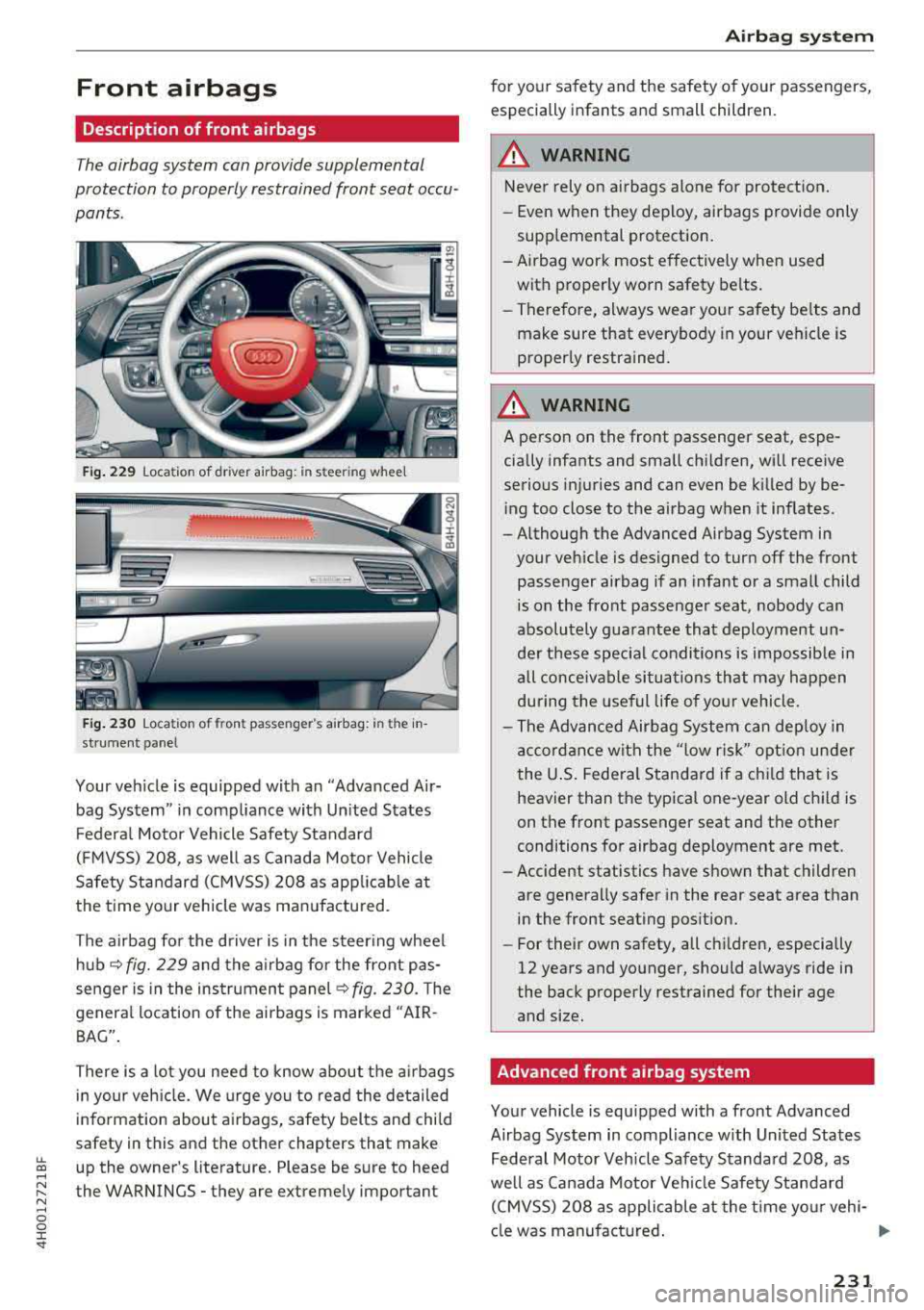
Fig. 229 Location of driver airbag: in steering wheel
Fig. 230 Location of front passenger's airbag : in the in
strument panel
Your vehicle is equipped with an "Advanced Air
bag System" in compliance with United States
Federal Motor Vehicle Safety Standard
(FMVSS) 208, as well as Canada Motor Vehicle
Safety Standard (CMVSS) 208 as applicable at
the time your vehicle was manufactured .
The airbag for the driver is in the steer ing wheel
hub ~ fig. 229 and the airbag for the front pas
senger is in the instrument panel
~ fig. 230. The
general location of the airbags is marked
"AIR
BAG" .
There is a lot you need to know about the airbags
in your vehicle. We urge you to read the detailed
information about airbags, safety belts and child
safety in this and the other chapters that make
lL ~ up the owner's literature. Please be sure to heed
~ the WARNINGS -they are extreme ly important N ...... 0 0 :c '
for your safety and the safety of your passengers,
especially infants and small children.
A WARNING
-
Never rely on airbags alone for protection.
- Even when they deploy, airbags provide only
supplemental protection.
-Airbag work most effectively when used with properly worn safety belts.
- Therefore, always wear your safety belts and
make sure that everybody in your vehicle is
properly restrained.
_&. WARNING
A person on the front passenger seat, espe
cially infants and small children, will receive
serious injuries and can even be killed by be ing too close to the airbag when it inflates.
- Although the Advanced Airbag System in
your vehicle is designed to turn off the front
passenger airbag if an infant or a small child
is on the front passenger seat, nobody can
absolutely guarantee that deployment un
der these specia l conditions is impossib le in
all conceivable situations that may happen
during the useful life of your vehicle.
- The Advanced Airbag System can dep loy in
accordance with the "low risk" opt ion under
the U.S. Federal Standard if a child that is
heavier than the typical one-year old child is
on the front passenger seat and the other
conditions for airbag deployment are met.
- Accident statistics have shown that children
are generally safer in the rear seat area than
in the front seating position.
- For their own safety, all children, especially
12 years and younger, should always ride in
the back properly restrained for their age
and size.
Advanced front airbag system
Your vehicle is equipped with a front Advanced
Airbag System in compliance with United States Federal Motor Vehicle Safety Standard 208, as
well as Canada Motor Vehicle Safety Standard (CMVSS) 208 as applicable at the time your vehi-
cle was manufactured .
IJJ,,
231
Page 234 of 356
Airbag syste m
The front Advanced Airbag System supp lements
the safety belts to provide additional protection
for the dr iver's and front passenger's heads and
upper bodies in frontal crashes. The airbags in
flate only in frontal impacts when the veh icle de
celerat ion is high enough.
The front Advanced Airbag System for the front
seat occupants is not a substitute for your safety belts. Rather, it is part of the overall occupant re
stra int system in your vehicle. Always remember
that the a irbag system can only help to protect
you, if you are sitt ing upr ight, wear ing your safe
ty belt and wear ing it prope rly. This is why you
and your passengers must always be prope rly re
stra ined, not just because the law req uires yo u to
be .
The Advanced Airbag System i n your veh icle has
been ce rt ified to meet the " low r isk" requ ire
men ts for 3 and 6 yea r-old children on the pas
senger side and very sma ll adults on the driver
side . The low risk dep loyment criteria are intend
ed to he lp reduce the risk of injury through inter
action with the front airbag that can occur, for
examp le, by being too close to the steering wheel
and instrument panel when the airbag inflates .
In addition, the system has been certified to
comp ly w ith the "suppression" requirements of
the Safety Standard, to turn
off the front a irbag
for infants 12 months old and younger who are
restrained on the front passenger seat in c hild re
stra ints that are listed in the Standa rd
¢ page 251, Child restraints and Advanced Air
bags.
"Suppress ion" requ ires t he front a irbag on the
passenger side to be turned
off if:
- a chi ld up to about one year of age is restra ined
on the front passenger seat in one of the rear
facing o r fo rward-fac ing infant restra ints listed
i n Federal Motor Vehicle Safety Standard
208
with wh ic h the Advanced Airbag System in your
vehicle was ce rt ified. For a l isting of the c hild
restra ints that were used to certify your veh i
cle's compliance with the US Safety Standard
¢ page 251,
232
-weight less than a threshold leve l stored in t he
control unit is detected on the front passenger
seat.
When a person is detected on the fron t passen
ger seat, weig hing more than the total weight of
a chi ld that is about 1 year old restrained in one
of the rea r-facing or forward-fac ing infant re
straints (listed in Federal Motor Vehicle Safety
Standard
208 with w hich the Advanced Airbag
System in your vehicle was certified), the front
a irbag on the passenger s ide may or may not de
ploy.
The
PASSENGER AIR BA G OFF light comes on
whe n the electronic control unit detects a tota l
weight on t he front passenger seat that requ ires
t h e front a irbag to be tur ned
off . If t he PASSEN
GER AIR BAG OFF
light does not come on, the
front a irbag on the passenge r side has no t been
tu rne d
off by t he control unit and can dep loy if
the control unit senses an impact t hat meets the
conditions stored in its memory.
If the total weig ht on the front passe nger sea t is
more than that of a typ ica l 1 year-o ld, but less
than the weight of a small adult, the front airbag
on the passenger side may dep loy (the
PASSEN
GER AIR BAG O FF
light does not come on).
For example , the airbag ma y deplo y if:
- a small ch ild that is heav ier than a typ ica l 1
year-old child is on the front passenger seat (regard less of whethe r the child is in one of t he
child seats listed
¢ page 251),
-a child who has outgrown c hild res traints is on
the front passenge r seat.
If the front passenger a irbag is tu rned
off, the
PA SSENGER AIR BAG OFF light in the center of
t h e i nstr ument pane l w ill come on and s tay on.
The front airbag on the passenger side may
not
deploy (the PASSENGER AIR BAG OFF light does
not ill uminate and stay lit) if:
- a small adult or teenager is on the front pas
senger seat
- a passenger who is not s itting upright with
their back against a no n-reclined backrest with
their feet on the veh icle floor in front of the
seat is on the front passenger seat .