check engine light AUDI A8 2018 User Guide
[x] Cancel search | Manufacturer: AUDI, Model Year: 2018, Model line: A8, Model: AUDI A8 2018Pages: 356, PDF Size: 54.71 MB
Page 132 of 356
Intellig ent T echn olo gy
- New brake pads do not achieve their full
braking effect during the first 250 mi
(400 km). They must be "broken in" first.
However, you can compensate for the
sl ightly reduced brak ing force by pressing
firmly on the brake pedal. Avoid heavy brak
i ng dur ing t he break- in per iod.
- Certa in weather and operat ing cond it ions
such as dr iv ing through water, driving in
heavy ra in or driving after washing your ve
hicle can impair the effectiveness of the
brakes . In the winter, ice may build up on
the brake pads, rotors and drums . Check
these components by braking carefu lly. Ap
plying the brakes carefully severa l times
dr ies the brakes and removes ice bu ild-up.
- The effic iency of the brakes can also be im
paired by driving for long stretches on roads
covered w ith salt w ithout using the brakes.
You can remove salt deposits from the brake rotors and pads by carefully applying
the b rakes severa l t imes .
- If the front spo iler is damaged or you install
another spoiler, make sure the front wheel
bra kes are vent ilated properly. Otherwise,
the brake system could ove rheat, w hich re
duces the ir effectiveness.
- Failure of a b rake circuit impa irs b raking
perfo rmance, which inc reases brak ing dis
tance . Avoid driving the vehicle and have it
towed it to the nearest authorized Audi
dealer or authorized Audi Service Facility .
- If the brake booster is not working, you will
have to press m uch harder on the brake
peda l to compensate for the lack of the
booster.
@ Note
- Never let the brakes " rub" by pressing the
pedal light ly when braking is not actually
necessary. This causes the brakes to over
heat and increases braking distance and
causes wear.
- Before driving downhill a long distance on a
steep hill, decrease your speed and select a l ower gear. This makes use of the engine
braking effect and relieves the brakes. If
130
you need to brake add itiona lly, brake in in
terva ls and not continuous ly .
(D Tips
- If the bra ke boos ter is not wor king, you
must press the brake peda l with much more
force than normal.
- If you retrof it your vehicle with a front spoi l
er, wheel covers or simi lar items, make sure
that the air flow to the front wheels is not interrupted. Otherwise the brake system
can become too hot.
Electromechanical
steering, dynamic
steering
The electromechonicol steering supports the
driver's steering movements.
Power steering adapts electronically based on
the vehicle speed .
Indicator lights and messages
• Do not drive vehi cle: S tee rin g defect ive
If this indicator light turns on and stays on and
th is message appears, the power steering may
have failed .
Stop the vehicle in a safe location as soon as pos
s ible. Do
not conti nue driving. See an authorized
Audi dealer or authorized Audi Service Fac il ity for
ass istance.
l;rfl St ee ring: System faul t You ca n cont inue
dr ivi ng
If the indicator light turns on and the message
appears, the steering wheel may be more diffi
cu lt to move or more sensitive than usual. The
steering wheel may also be at an angle when driv ing stra ight .
Drive slowly to an authorized Audi dea ler or au
thori zed Audi Serv ice Facility to have the mal
funct io n corrected.
'-r-ij Dynamic stee ring: Init ializing
If the indicato r light is blinking and this message
appears, dynamic steering* is being initialized.
IJ>-
Page 270 of 356
Checking and Filling
Checking and Filling
Gasoline
Fuel supply
Applies to: vehicles with gasoline engine
Using the right fuel helps keep the environment
clean and prevents engine damage .
Fuel recommendation
The fuel recommended for your vehicle is unlead
ed premium
grade gasoline . Audi recommends
using TOP TIER Detergent Gasoline with a mini
mum octane rating of91 AKI (95 RON). For more
information on TOP TIER Detergent Gasoline,
please go to the offic ial website
(www.toptiergas .com).
The recommended gasoline octane rat ing for
your engine can also be found on a label located
on the ins ide of the fuel filler flap. This rating
may be specified as AK I or RON .
Your veh icle may also be operated using unlead
ed regular gasoline with a minimum octane rat
ing of 87 AKl/91 RON . However, using 87 AKI/91
RON octane fuel w ill slightly reduce engine per
formance.
Use unleaded gasoline only. Unleaded gasoline
is available throughout the USA, Canada, and in
most European countries. We recommend that
you do not take your vehicle to areas or count ries
where un leaded gasoline may not be available.
For more information on refueling your vehicle,
see
~ page 269 .
Octane rating
Octane rating indicates a gasoline's ability to re
sist engine damaging "knock" caused by prema
ture ignit ion and detonation . T herefore, buy ing
the correct grade of gasoline is very important to
he lp prevent possible engine damage and a loss
of eng ine pe rformance.
Gasoline most commonly used in the United
States and Canada has the following octane rat
ings that can usually be found on the filler pump:
- Premium Grade: 91 - 96 AKI
268
-Regular Grade: 87 -90 AK I
Explanation of the abbreviations :
AKI =
Anti Knock Index = (R +M)/2 = (RON +MON)/
2
RON = Research Octane Number
MON= Motor Octane Number.
@ Note
- Do not us e any fuel with octane ratings low
er than 87 AKI or 91 RON otherwise expen
sive engine damage will occur .
- Do
not us e leaded gasoline. The use of lead
ed gasoline will severely damage your vehi
cle's catalytic converter and its ability to
contro l exhaust emissions .
Blended gasoline
Applies to: vehicles with gasoline engine
Use of gasoline containing alcohol or MTBE
(methyl tertiary butyl ether)
You may use unleaded gasoline blended with al
cohol or MTBE (commonly referred to as oxygen
ates) if the blended mixture meets the follow ing
criteria :
Blend of gasoline methanol (wood alcohol or
methyl alcohol)
-Anti -knock index must be 87 AKI or higher.
- Blend must contain no more than 3% metha-
nol.
- Blend must contain more than 2% co-solvents.
Blend of gasoline and ethanol (grain alcohol or
ethyl alcohol)
- Anti-knock index must be 87 AKI or h igher .
- Blend must not conta in more than 15% etha-
nol.
Blend of gasoline and MTBE
-Anti -knock index must be 87 AK I or h igher.
- Blend must not contain more th an 15% MTBE.
Seasonally adjusted gasoline
Many gasoline grades are blended to perform es
pecially well for winter or summer dr iv ing . Dur-
i ng seasonal change-over, we suggest that you
IJIJ,
Page 275 of 356
lL t:0 ....
"' ......
"' .... 0 0 :c '
Service Facility.
- To reduce the risk of electric shock and in
jury, never touch the following components
when the eng ine is running or is being start
ed :
- I gnition cable
- Othe r components in the electronic h igh-
voltage ignition system
- If you must check o r perform work on the
engi ne while it is run ning:
- Set the parking bra ke and p lace the se lec
tor lever in the P (pa rk) position first .
-Always p roceed with extreme ca utio n so
that clothing, jewelry or long ha ir do not
become caught in the radiator fan, fan
belt or other moving components or do
not come into contact with hot compo
nents . Tie back long ha ir before beginning
work and do not wear cloth ing that can
hang down into the engine .
- L imit your exposure to exhaust a nd chemi
cals to as short a time as poss ible ¢
A.
A WARNING
California Proposi tion 6S Warn ing:
- Engine exhaust, some of its constituents,
and certain vehicle components contai n or
em it chem icals known to the State of C ali
forn ia to ca use cancer and bi rth defects an d
re produc tive harm. In ad dition , ce rtain fl u
ids contained in vehicl es and certa in prod
ucts of com ponent wear contain o r emit
chemica ls known to the State of California
to cause cancer and birth defects or other
reproduct ive harm.
- Battery posts, termina ls and re lated acces
sories contain lead and lead compounds,
chemica ls known to the State of California
to cause ca ncer and reproduct ive harms .
Wash hands after handling .
(D Note
When fil ling fl uids, be sure not to mix the flu
ids up . Otherwise severe ma lfunctions and en
gine damage w ill occur.
Chec king and Filling
@) For the sake of the environment
You should regularly check t he gro und under
your vehicle in order to detect leaks quick ly .
If
the re are visible spots from o il or other fluids,
b ring your veh icle to an authorized A udi deal
er o r aut ho rized Aud i Serv ice Facility to be
checked .
Opening/closing the hood
The hood is released from inside the vehicle .
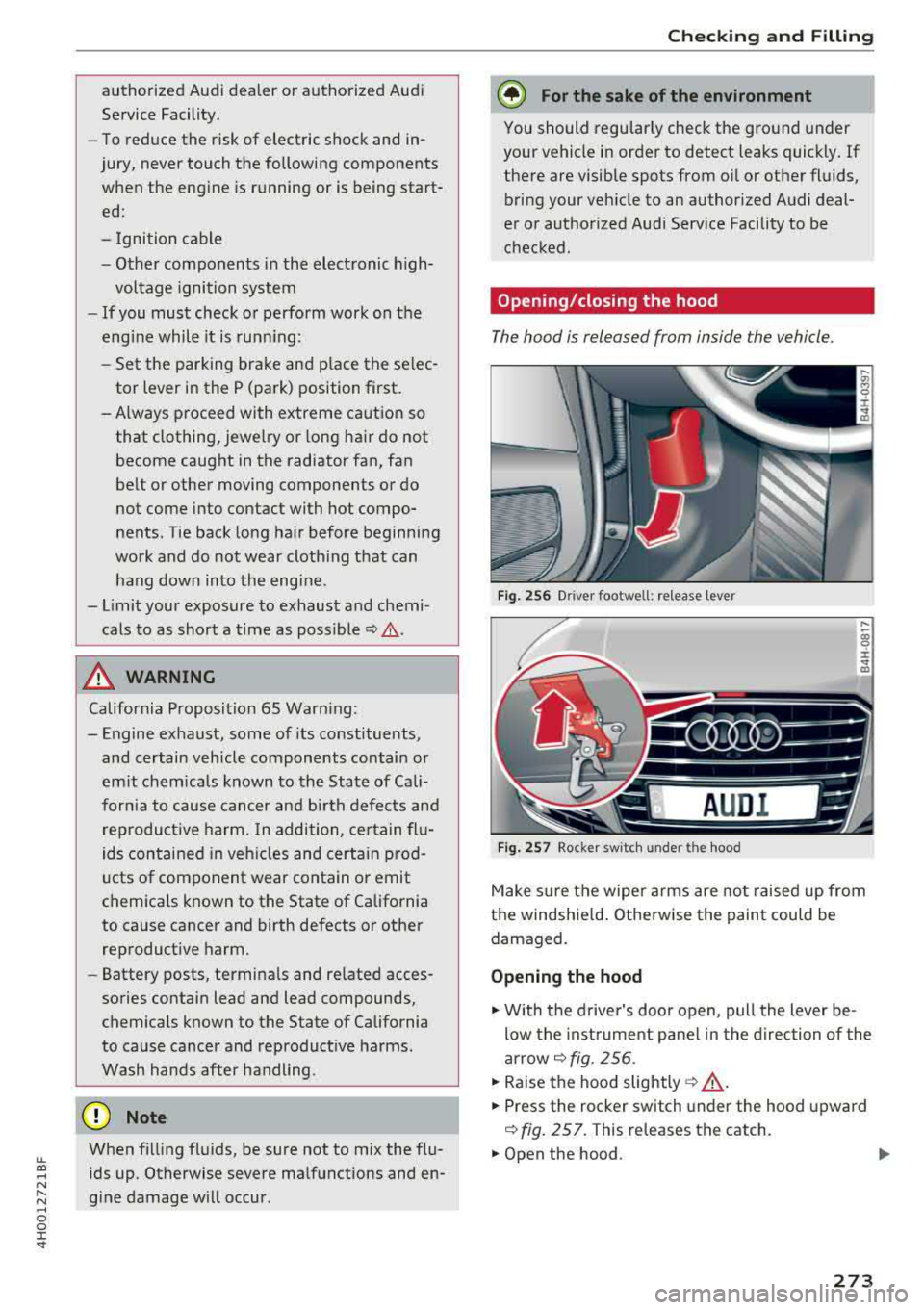
Fig. 256 Drive r footwell : re lea se leve r
Fig. 25 7 Rocker sw itc h unde r the hood
M ake s ure th e wipe r arms are no t rais e d up from
t h e windshie ld . Otherwise the pain t could be
damaged.
Opening the hood
.,. With the d rive r's doo r open, pull the lever be
low t he instrume nt pane l in the direction of the
ar row ¢
fig. 256.
.,. Ra ise the hoo d slightly¢&_ .
.. Press the rocker switch under the hood upward
¢ fig . 257. T his re leases the catch.
.,. Open the hood . ..,.
273
Page 276 of 356
Checking and Filling
Cl osing the ho od
~ Push the hood down until you override the
force of the strut .
~ Let the hood fall light ly into the latch. Do not
press it in.
c::> .&_ .
A WARNING
-Never open the hood when there is steam or
coolant escaping from the engine compart
ment, because there is a risk that you could
be burned. Wait until no steam or coolant is
escaping.
Engine compartment overview
The most important check points .
-For safety reasons, the hood must always be
closed securely while driv ing. Because of
this, always check the hood after closing it
to make sure it is latched correctly . The
hood is latched if the front corners cannot
be lifted.
-If you notice that the hood is not latched
while you are driving, stop immed iate ly and
close
it, because d riving when the hood is
not latched increases the r is k of an accident.
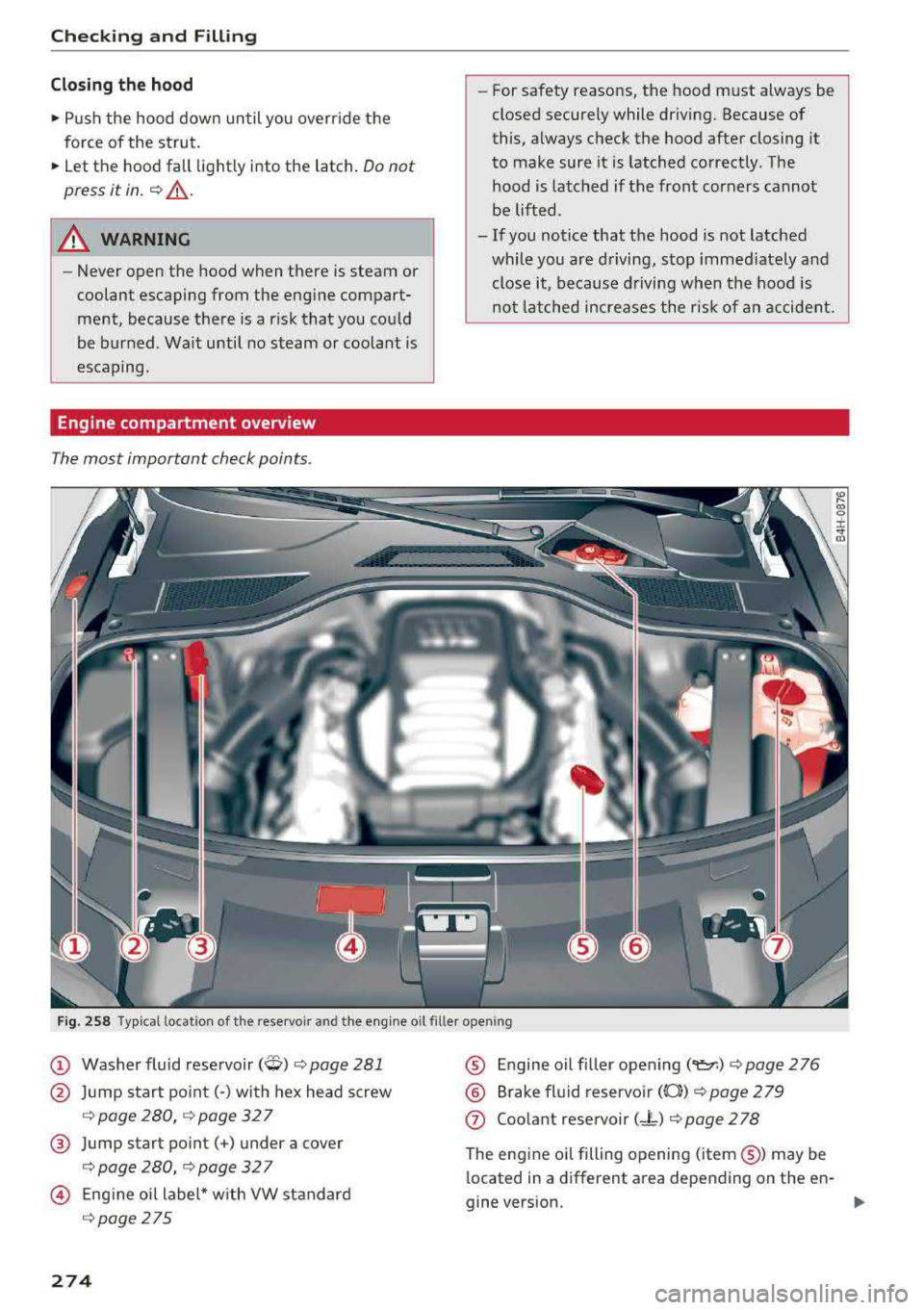
Fig. 258 Typical locatio n of the rese rvoir and the engi ne o il fille r open ing
(D Washer fluid reservoir (Q) c::> page 281
@ J ump start point(-) with hex head screw
c::> page 280, c::> page 32 7
® Jump start point(+) under a cover
c::> page 280, c::> page 32 7
@ Engine oil label * w ith VW standard
c::> page 2 75
274
® Engine oil filler opening (
@ Brake fl uid reservo ir ((0)) c::> page 2 79
(J) Coolant reservoir (-L) c::> page 2 78
The engine oil filling opening (item @) may be
l ocated in a different area depending on the en-
gine version.
.,.
Page 279 of 356
u. co .... N
" N .... 0 0 :c '
-Oil should never enter the sewer system or
come into contact with the ground.
- Pay attention to legal requirements when
disposing of empty oi l containers .
Changing the engine oil
We recommend that hove your oil changed by on
authorized Audi dealer or a qualified service sta
tion .
Before you check anyt hing in the engine compart
ment,
alw ays re ad and h eed all W ARNINGS ¢ &
in Working in the engine comportment on
page 272.
The engine oil must be changed according to the
intervals specified in your Warranty
& Mainte
nance booklet . This is very important because the
lubricating properties of oil diminish gradually
during normal vehicle use.
Under some circumstances the engine oi l should
be changed more frequently. Change oil more of
ten if you drive mostly short distances, operate
the vehicle in dusty areas or under predominantly
stop-and-go traffic condit ions, or have your vehi
cle where temperatures remain below freezing
for extended periods .
Detergent additives in the oil will make fresh oil
look dark after the engine has been running for a
short t ime . Th is is normal and is not a reason to
change the oil more often than recommended .
Because of the problem of proper disposal, along
with the special tools and necessary expertise re
qu ired, we strongly recommend that you have
your oil changed by an authorized
A ud i d ea ler or
a qualified se rvice station .
If you choo se to chang e your o il y ou rse lf, please
note the following important information:
A WARNING
T o reduce the r isk of personal injury if you
must change the engine oil in your ve hicle
yourse lf:
- Wear eye protection .
-
Check ing and F illing
- To reduce the risk of burns from hot engine
oil, let the engine cool down to the touch.
- When removing the oil drain p lug with your
fingers, stay as far away as possible. Always keep your forearm parallel to the ground to
help prevent hot oil from running down your
arm.
- Drain the oil into a container designed for
this purpose, one large enough to hold at least the total amount of oil in your engine.
- Engine oil is poisonous. Keep it well out of
the reach of children .
- Continuous contact with used engine o il is
harmful to your skin. Always protect your
skin by wash ing oil off thoroughly with soap
and wate r.
@ Note
Never mix oil additives with your engine oil.
These add itives can damage your engine and
adversely affect your Audi L imited New Vehi
cle War ranty .
@ For the sake of the environment
-Before chang ing your o il, first make sure
you know where you can properly d ispose of
the used oil.
- Always dispose of used engine o il properly .
Do not dump it on garden so il, wooded
areas, i nto open streams o r down sewage
dra ins.
- Recycle used eng ine o il by tak ing it to a used
eng ine oi l collection fac ility in yo ur area, or
c ontact a se rvice station.
Cooling system
Coolant
The eng ine cooling system is filled w ith a mixture
of purified water and coolant additive at the fac
tory. This coolant must not be not changed .
The coo lant level is mon itored through
the . in
dicator
light¢ page 20. However, we do recom
mend occasionally checking the coolant level
manually .
.,.
277
Page 280 of 356
Checking and Filling
If you must add coolant, use a mixture of water
and coolant additive . Mixing the coolant additive
with distilled water is recommended.
Coolant additive
The coolant additive is made of anti-freezing and
corros ion protection agents. Only use the follow
ing coo lant additives .
Coolant additive Specification
Gl2evo
TL 774 L
Gl2++ TL 774 G
Gl3
TL 774 J
These additives may be mixed wi th each othe r.
The amount of coo lant additive that needs to be
mixed with water depends on the climate where
the vehicle will be operated. If the coolant addi
tive percentage is too low, the coo lant can free ze
and damage the engine.
Coolant addi- Freeze protec-
tive tion
Warm regions min.
40%, min. -13 °F
max . 45% (-25 °()
C old regions min.
50%, max. -40 °F
max.
55% (-40 °C)
@ Note
-Before the start of winter, have an author
ized Audi dealer or authorized Audi Service
Faci lity check if the coolant additive in your
vehicle matches the percentage appropriate
for the climate. This is especially important
when driving in colder climates .
-If the appropriate coolant additive is not
available in an emergency, do not add any
other addit ive for risk of damaging the en
g ine . If this happens, only use water and re
store the correct mixture ratio with the
specified coolant additive as soon as possi ble.
-Only refill with new coolant.
-Radiator sealant must not be mixed w ith
the coolant.
278
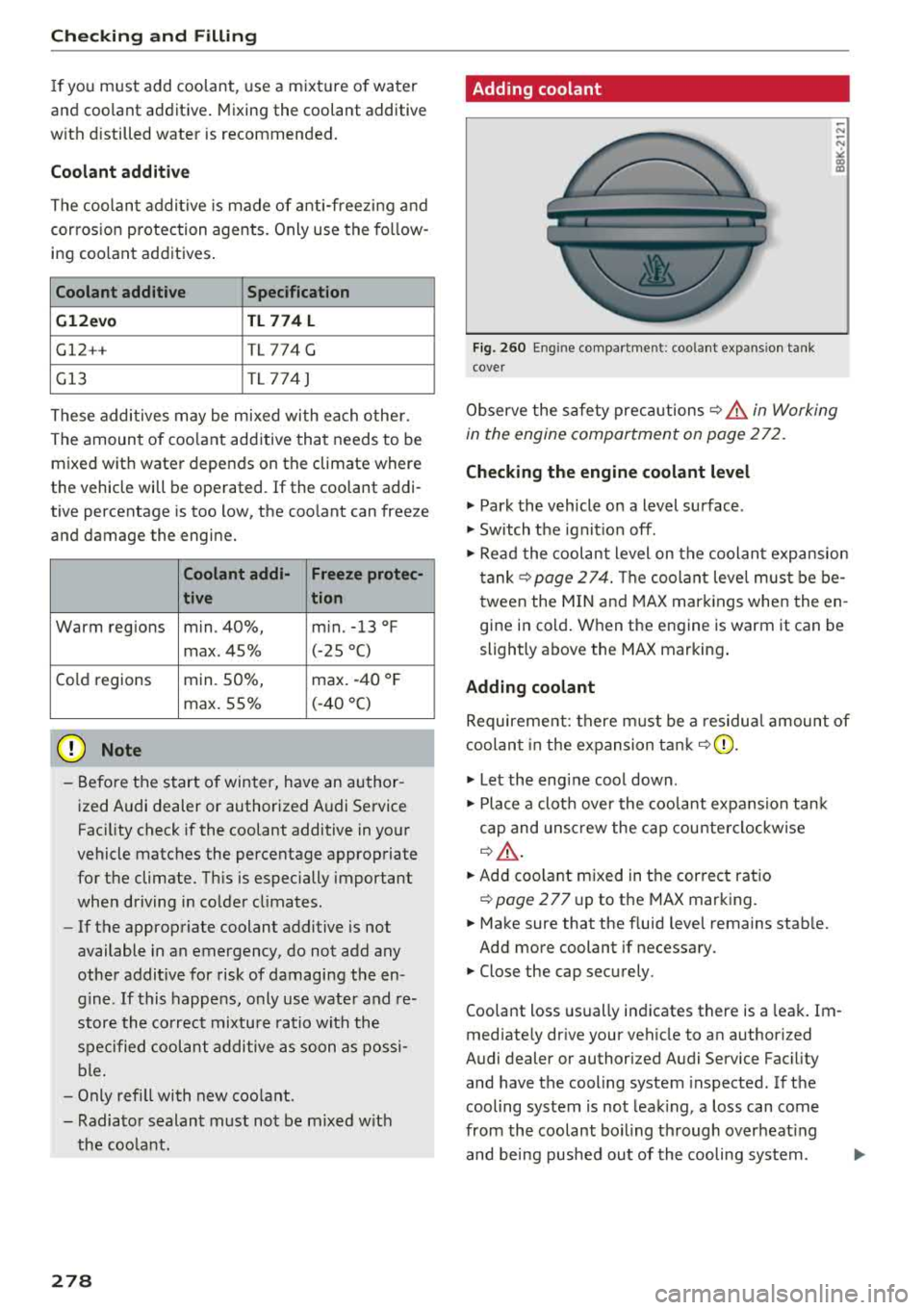
Adding coolant
Fig. 260 Eng in e compar tment : coolant exp ansion tank
cover
Observe the safety precautions ~.&, in Working
in the engine compartment on page 2
72.
Checking the engine coolant level
~ Park the vehicle on a level surface .
~ Switch the ignit io n off.
~ Read the coolant level on the coolant expansion
tank ~ page 2 74. The coolant leve l must be be
tween the MIN and MAX markings when the en
gine in co ld. When the engine is warm it can be
slightly above the MAX marking,
Adding coolant
Requirement: there must be a residual amount of
coolant in the expansion
tank ~(©) .
~ Let the engine cool down .
~ Place a cloth over the coolant expansion tank
cap and unscrew the cap counterclockwise
~.&. -
~ Add coo lant mixed in the correct ratio
~ page 277 up to the MAX marking.
~ Make sure that the f luid level remains stable.
Add more coolant if necessary .
~ Close the cap securely .
Coo lant loss usually indicates there is a leak . Im
mediate ly drive your vehicle to an authorized
Audi dealer or authorized Audi Service Fac ility
and have the cooling system inspected. If the
cooling system is not leaking, a loss can come
from the coolant bo iling t hrough overheat ing
and being pushed out of the cooling system .
Page 282 of 356
Checking and Filling
@
Fire, sparks, open flame and smok ing are
forb idden.
~
A highly explosive mixture of gases can
form when charging batteries.
®
Keep c hildren away from battery acid and
batteries.
A WARNING
All work on the battery or electrical system in
your vehicle can result in injuries, chemical
burns, accidents or burns. Because of this, a ll
work must be performed
only by an author
ized Aud i dea le r o r authorized Aud i Serv ice
Facility.
A WARNING
California Proposit ion 65 Warning:
- Battery posts, terminals and re lated acces
sories contain lead and lead compounds,
chemicals known to the Sta te of California
to ca use ca nce r and rep roduct ive p roblems.
Wash hands after handling.
{Q) Note
If the v ehicle wi ll be par ked for long periods
of t ime, pro tect i t against the co ld so that it
w ill not be destroyed by "freezing"
¢page 280.
Vehicle battery
The term "vehicle battery" refers to the 12 Volt
bat tery in your vehicle.
Not running the vehicle for long periods of
time
I f you do not dr ive your vehicle for seve ral days or
weeks, elec trical equipmen t is gradually scaled
back or switched off. This reduces energy use and
ensu res the vehicle wi ll be able to start after long
periods of
time ¢ page 131. Some convenience
functions, such as interior lighting or power seat
ad justment, may not be available under certa in
circumstances. These convenience funct ions w ill
be ava ilable aga in once you switch the ignition on
and start the engine.
280
Even when electrical equipment is swi tched o ff,
the equipment can still drain the vehicle battery i f the ve hicle is not dr iven fo r long periods of
time. Deep draining results in a chemica l reaction
that destroys the ins ide of the vehicle battery.
The vehicle battery must be charged every month
to reduce the risk of this
happen ing ¢ page 280.
Contact an autho rized Aud i dea le r or a uthorized
A udi Se rvice Fa cility for mo re information.
Winter operation
Co ld weather places higher demands on the vehi
cle battery. T his res ults in reduced starting abili
ty . Have the vehicle ba tte ry checked by an au
thorized Aud i dea ler or author ized Audi Service
Fa cil ity befo re the cold time of ye ar.
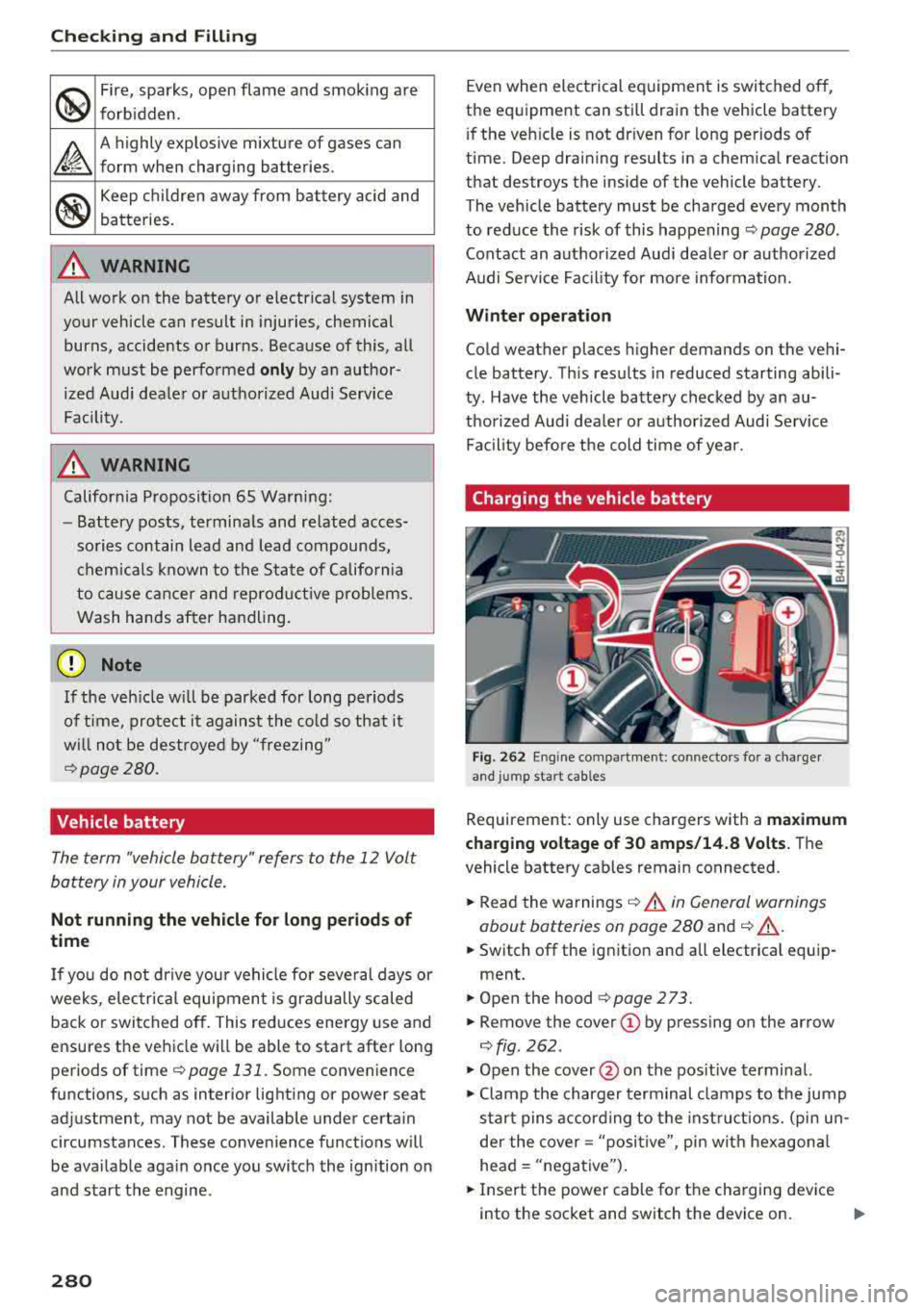
Charging the vehicle battery
Fi g. 262 Eng ine compa rtment: connectors fo r a cha rger
and jump start cab les
Requirement: only use chargers with a ma ximum
charging voltage of 30 amp s/14.8 Volts.
The
vehicle battery cab les remain connected .
.. Read the warnings ¢.&. in General warnings
about batteries on page 280
and ¢ _&. .
.. Switch off the ignitio n and all electrica l equip
ment.
.. Open the hood ¢ page 2 73 .
.. Remove the cover (I) by pressing on the arrow
¢fig. 262.
.. Open the cover @on the pos it ive terminal.
.. Clamp the charger terminal clamps to the jump
star t pins accord ing to the inst ru ct ions. (pin un
de r the cover= "positive", p in wit h hex agon al
head = "nega tive") .
.. Insert the power cable for t he cha rging dev ice
into the socket and switch the device on.
Ill>
Page 329 of 356
u. co .... N
" N .... 0 0 :c '
General
This chapter is intended for trained emergency
crews and working personnel who have the nec
essary tools and equipment to perform these
operations.
Starting by pushing or
towing
~ Note
Vehicles with an automatic transmission can
not be started by pushing or towing.
Starting with jumper
cables
If necessary, the engine can be started by con
necting it to the battery of another vehicle .
If the engine should fail to start because of a dis
charged or weak battery, the battery can be con
nected to the battery of
another vehicle, using a
pair of jumper cables to start the engine.
Jumper cables
Use only jumper cables of sufficiently large cross
section
to carry the starter current safely. Refer
to the manufacturer's specifications.
Use only jumper cables with
insulated terminal
clamps which are distinctly marked :
plus(+) cable in most cases colored red
minus(-) cable
in most cases colored black.
A WARNING -
Batteries contain electricity, acid, and gas.
Any of these can cause very serious or fatal in
jury. Follow the instructions below for safe
handling of your vehicle's battery .
-Always shield your eyes and avoid leaning
over the battery whenever possible.
-A dead battery can freeze at temperatures
around 32 °F (0 °C) . If the vehicle battery is
frozen, you must thaw it before connecting
the jump start cables. If you do not, this in-
Emergency situations
creases the risk of an explosion and chemi
cal burns. After jump starting the vehicle,
drive to an authorized Audi dealer or author ized Audi Service Facility immediately to
have the vehicle battery checked.
- Do not allow battery acid to contact eyes or
skin . Flush any contacted area with water
immediately.
- Improper use of a booster battery to start a
vehicle may cause an explosion .
- Vehicle batteries generate explosive gases .
Keep sparks, flame and lighted cigarettes
away from batteries.
- Do not try to jump start any vehicle with a
low acid level in the battery .
- The voltage of the booster battery must also
have a 12-Volt rating . The capacity (Ah) of
the booster battery should not be lower
than that of the discharged battery. Use of
batteries of different voltage or substantial
ly different "Ah " rating may cause an explo
sion and personal injury.
- Never charge a frozen battery. Gas trapped
in the ice may cause an explosion.
- Never charge or use a battery that has been
frozen. The battery case may have be weak
ened.
- Use of batteries of different voltage or sub
stantially different capacity (Ah) rating may
cause an explosion and injury. The capacity
(Ah) of the booster battery should not be
lower than that of the discharged battery.
- Before you check anything in the engine
compartment, always read and heed all
WARNINGS
c>page 272.
@ Note
- Applying a higher voltage booster battery
will cause expensive damage to sensitive
electronic components, such as control
units, relays, radio, etc.
- There must be no electrical contact between
the vehicles as otherwise current could al
ready start to flow as soon as the positive
( + ) terminals are connected.
327
Page 346 of 356
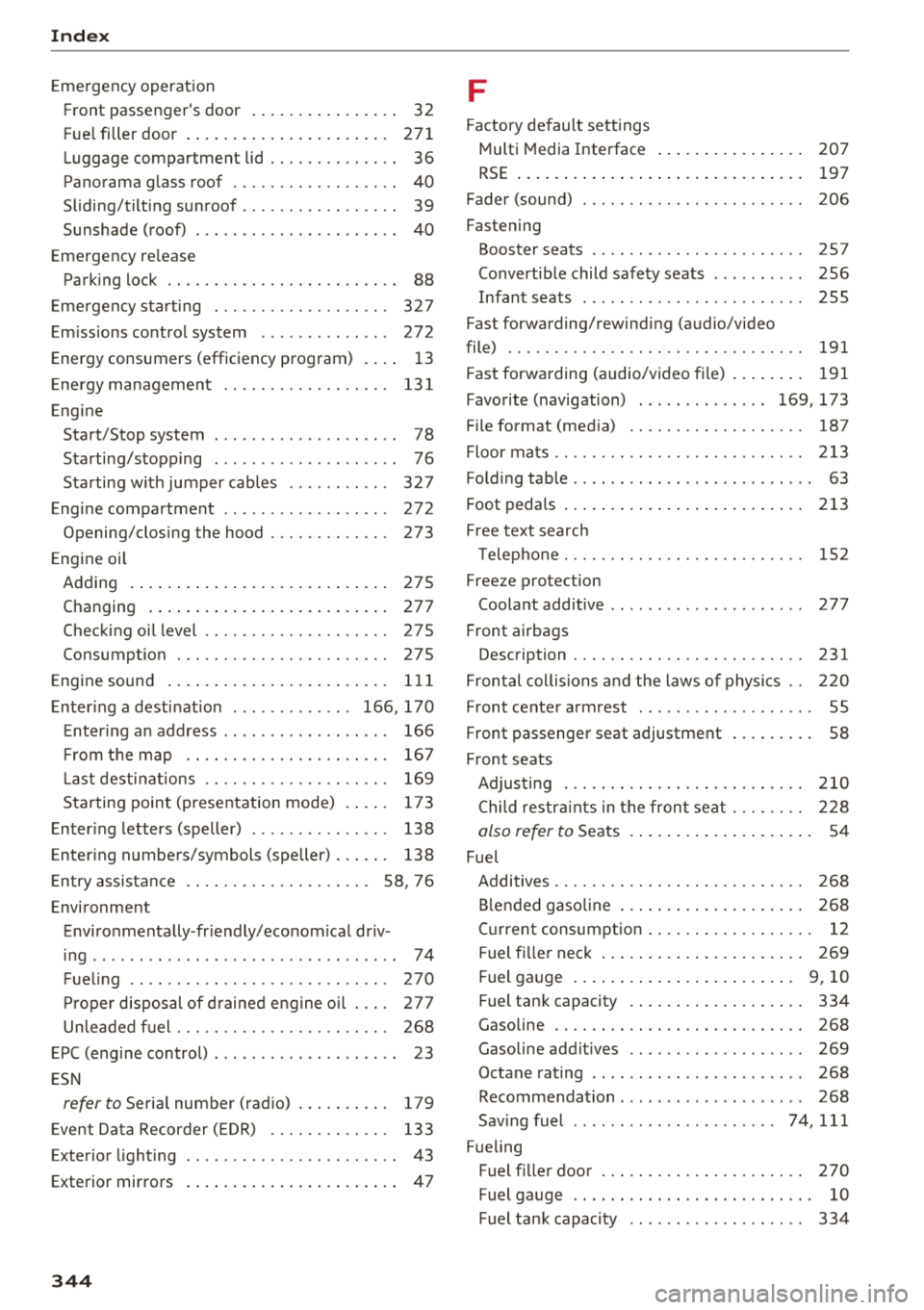
Index
Emergency operation
Fr ont passenger 's door . . . . . . . . . . . . . . . . 32
Fuel filler door . . . . . . . . . . . . . . . . . . . . . . 271
Luggage compartment lid . . . . . . . . . . . . . . 36
Panoram a glass roof . . . . . . . . . . . . . . . . . . 40
Sliding/tilting sunroof . . . . . . . . . . . . . . . . . 39
Sunshade (roof) . . . . . . . . . . . . . . . . . . . . . . 40
E mergency re lease
Parking lock . . . . . . . . . . . . . . . . . . . . . . . . . 88
Emergency starting . . . . . . . . . . . . . . . . . . . 327
Emissions control system . . . . . . . . . . . . . . 272
Energy consumers (efficiency program) . . . . 13
Energy management . . . . . . . . . . . . . . . . . . 131
E ngine
Start/Stop system . . . . . . . . . . . . . . . . . . . . 78
Starting/stopping . . . . . . . . . . . . . . . . . . . . 76
Starting with jumper cables . . . . . . . . . . . 327
E ngine compartment . . . . . . . . . . . . . . . . . . 272
Opening/closing the hood . . . . . . . . . . . . . 273
Engine oil
Adding . . . . . . . . . . . . . . . . . . . . . . . . . . . . 275
Changing . . . . . . . . . . . . . . . . . . . . . . . . . . 277
Checking oil level . . . . . . . . . . . . . . . . . . . . 275
Con sumption . . . . . . . . . . . . . . . . . . . . . . . 275
Engine sound . . . . . . . . . . . . . . . . . . . . . . . . 111
Entering a destination . . . . . . . . . . . . . 166, 170
Entering an address . . . . . . . . . . . . . . . . . . 166
From the map . . . . . . . . . . . . . . . . . . . . . . 167
La st destinations . . . . . . . . . . . . . . . . . . . . 169
Starting point (presentation mode) . . . . . 173
Entering letters (speller) . . . . . . . . . . . . . . . 138
E ntering numbers/symbols (speller) . . . . . . 138
Entry assistance . . . . . . . . . . . . . . . . . . . . 58, 76
Environment Environmentally-friendly/ economical driv -
ing ..... ... .. .. ................ ... .. 74
Fueling . . . . . . . . . . . . . . . . . . . . . . . . . . . . 270
Proper disposal of drained engine o il . . . . 277
Unleaded fu el . . . . . . . . . . . . . . . . . . . . . . . 268
EPC (engine control) . . . . . . . . . . . . . . . . . . . . 23
ESN
refer to Serial number (radio) ... .... .. .
Event Data Recorder (EDR) ........ .. .. .
E xterior lighting 179
133 43
Exterior mirrors . . . . . . . . . . . . . . . . . . . . . . . 47
344
F
Factory default settings
Multi Media Interface . . . . . . . . . . . . . . . . 207
R5E . . . . . . . . . . . . . . . . . . . . . . . . . . . . . . . 197
Fader(sound) ... .. .. .. ............. .. 206
Fastening Booster seats . . . . . . . . . . . . . . . . . . . . . . . 257
Convertible child safety seats . . . . . . . . . . 256
Infant seats . . . . . . . . . . . . . . . . . . . . . . . . 255
Fast forwarding/rewinding (audio/video
file) . . . . . . . . . . . . . . . . . . . . . . . . . . . . . . . . 191
Fast forwarding (audio/video file) . . . . . . . . 191
Favorite (navigation) . . . . . . . . . . . . . . 169, 173
File format (media) . . . . . . . . . . . . . . . . . . . 187
Floor mats.. .. .. .. .. .. ............. .. 213
Folding table . . . . . . . . . . . . . . . . . . . . . . . . . . 63
Foot pedals . . . . . . . . . . . . . . . . . . . . . . . . . . 213
Free text search
T elephone. . . . . . . . . . . . . . . . . . . . . . . . . . 152
Freeze protection Coolant additive . . . . . . . . . . . . . . . . . . . . . 277
Front airbags
Description . . . . . . . . . . . . . . . . . . . . . . . . . 231
Frontal collisions and the laws of physics . . 220
Front center armrest . . . . . . . . . . . . . . . . . . . 55
Front passenger seat adjustment . . . . . . . . . 58
Front seats
Adjusting . . . . . . . . . . . . . . . . . . . . . . . . . . 210
Child restraints in the front seat . . . . . . . . 228
also refer to Seats . . . . . . . . . . . . . . . . . . . . 54
Fuel Additives. . . . . . . . . . . . . . . . . . . . . . . . . . . 268
Blended gasoline . . . . . . . . . . . . . . . . . . . . 268
Current consumpt ion . . . . . . . . . . . . . . . . . . 12
Fuel filler neck . . . . . . . . . . . . . . . . . . . . . . 269
Fuel gauge . . . . . . . . . . . . . . . . . . . . . . . . 9, 10
Fuel tank capacity . . . . . . . . . . . . . . . . . . . 334
Gasoline . . . . . . . . . . . . . . . . . . . . . . . . . . . 268
Gasoline additives . . . . . . . . . . . . . . . . . . . 269
Octane rating . . . . . . . . . . . . . . . . . . . . . . . 268
Recommendation . . . . . . . . . . . . . . . . . . . . 268
Saving fuel ...... .. .. ............ 74, 111
Fueling Fuel filler door . . . . . . . . . . . . . . . . . . . . . . 270
Fuel gauge . . . . . . . . . . . . . . . . . . . . . . . . . . 10
Fuel tank capacity . . . . . . . . . . . . . . . . . . . 334