power steering AUDI A8 2018 User Guide
[x] Cancel search | Manufacturer: AUDI, Model Year: 2018, Model line: A8, Model: AUDI A8 2018Pages: 356, PDF Size: 54.71 MB
Page 129 of 356
u. co .... N
" N .... 0 0 :c '
Control (ESC)
Description
The ESC increases driving safety. It reduces the
risk of slipping and improves driving stability.
ESC detects critical situations such as when the
vehicle is oversteering and understeering or the
wheels are spinning. The vehicle is stabilized by
applying the brakes or reducing engine torque .
When the ESC engages,
the G1 indicator light
b links in the instrument cluster.
The following systems are integrated in the ESC:
Anti-lock braking system (ABS)
ABS prevents the whee ls from locking when brak
ing. The vehicle can still be steered even during
hard braking. Apply steady pressure to the brake
pedal. Do not pump the pedal. A pulsing in the
brake pedal indicates that the system is acting to
stabilize the vehicle .
Brake assist system
The brake assist system can decrease braking dis
tance. It increases braking power when the driver
presses the brake pedal quickly in emergency sit
uations . You must press and hold the brake pedal
until the dangerous situat ion is over . In veh icles
w ith adaptive cruise contro l*, the brake assist
system is more sensitive if the distance detected
to the vehicle dr iv in g ahead is too small. On
ve hicl es w ith activated and functioning night vi
sion assist*, the brake assist system can respond
more sensitively if there is a warning .
Anti-Slip Regulation (ASR)
ASR reduces engine power when the drive wheels
begin spinning and adapts the force to the road
conditions. This makes it easier to start, acceler
ate and drive up hills.
Electronic differential lock (EDL)
EDL applies the brakes to a wheel that starts
sp inn ing and transfers the drive power to the
other driving wheels. This functio n is not availa
ble at higher speeds.
Intelligent Technology
In extreme cases, EDL automatica lly switches off
to keep the brake on the braked whee l from over
heating. The vehicle is still working correct ly. ED L
will switch on again automatically when condi
tions have returned to normal.
Steering recommendation
T he ESC he lp s to stabilize the vehicle by changing
the steering torque .
In veh icles with dynamic steer ing*, ESC also
helps to stab ilize the steer ing in crit ica l situa
tions.
Selective wheel torque control
Selective wheel torque control is used when driv
in g on curves.
The front wheel on the inside of the curve or both
wheels on the inside of the curve are braked se
lectively as needed. This allows more precise driv
in g in curves . The applicable system may not acti
vate when dr iv in g in wet or snowy conditions .
Automatic post -collision braking system
Th e "automat ic post-collis ion braking system"
can help to reduce the risk of sliding and of addi
t iona l co llisions after an acc ident. If the airbag
control module detects a co llision above a certa in
vehicle speed, the veh icle is braked by the ESC.
The vehicle does not brake automatically if :
- the dr iver presses the acce lerator pedal, or
- the braking force generated by the pressed
brake pedal is greater than the braking force
that would be initiated by the system, or
- the ESC, the brake system or the vehicle electri
cal system are not functioning.
A WARNING
,--
- The ESC and its integrated systems cannot
overcome the lim its imposed by natural
p hys ical laws. This is especially important
on slippery or wet roads. If the systems be
g in acting to stabilize your vehicle, you
should immediately alter your speed to
match the road and traffic conditions. Do
not let the increased safety provided tempt
127
Page 132 of 356
Intellig ent T echn olo gy
- New brake pads do not achieve their full
braking effect during the first 250 mi
(400 km). They must be "broken in" first.
However, you can compensate for the
sl ightly reduced brak ing force by pressing
firmly on the brake pedal. Avoid heavy brak
i ng dur ing t he break- in per iod.
- Certa in weather and operat ing cond it ions
such as dr iv ing through water, driving in
heavy ra in or driving after washing your ve
hicle can impair the effectiveness of the
brakes . In the winter, ice may build up on
the brake pads, rotors and drums . Check
these components by braking carefu lly. Ap
plying the brakes carefully severa l times
dr ies the brakes and removes ice bu ild-up.
- The effic iency of the brakes can also be im
paired by driving for long stretches on roads
covered w ith salt w ithout using the brakes.
You can remove salt deposits from the brake rotors and pads by carefully applying
the b rakes severa l t imes .
- If the front spo iler is damaged or you install
another spoiler, make sure the front wheel
bra kes are vent ilated properly. Otherwise,
the brake system could ove rheat, w hich re
duces the ir effectiveness.
- Failure of a b rake circuit impa irs b raking
perfo rmance, which inc reases brak ing dis
tance . Avoid driving the vehicle and have it
towed it to the nearest authorized Audi
dealer or authorized Audi Service Facility .
- If the brake booster is not working, you will
have to press m uch harder on the brake
peda l to compensate for the lack of the
booster.
@ Note
- Never let the brakes " rub" by pressing the
pedal light ly when braking is not actually
necessary. This causes the brakes to over
heat and increases braking distance and
causes wear.
- Before driving downhill a long distance on a
steep hill, decrease your speed and select a l ower gear. This makes use of the engine
braking effect and relieves the brakes. If
130
you need to brake add itiona lly, brake in in
terva ls and not continuous ly .
(D Tips
- If the bra ke boos ter is not wor king, you
must press the brake peda l with much more
force than normal.
- If you retrof it your vehicle with a front spoi l
er, wheel covers or simi lar items, make sure
that the air flow to the front wheels is not interrupted. Otherwise the brake system
can become too hot.
Electromechanical
steering, dynamic
steering
The electromechonicol steering supports the
driver's steering movements.
Power steering adapts electronically based on
the vehicle speed .
Indicator lights and messages
• Do not drive vehi cle: S tee rin g defect ive
If this indicator light turns on and stays on and
th is message appears, the power steering may
have failed .
Stop the vehicle in a safe location as soon as pos
s ible. Do
not conti nue driving. See an authorized
Audi dealer or authorized Audi Service Fac il ity for
ass istance.
l;rfl St ee ring: System faul t You ca n cont inue
dr ivi ng
If the indicator light turns on and the message
appears, the steering wheel may be more diffi
cu lt to move or more sensitive than usual. The
steering wheel may also be at an angle when driv ing stra ight .
Drive slowly to an authorized Audi dea ler or au
thori zed Audi Serv ice Facility to have the mal
funct io n corrected.
'-r-ij Dynamic stee ring: Init ializing
If the indicato r light is blinking and this message
appears, dynamic steering* is being initialized.
IJ>-
Page 133 of 356
u. co .... N
" N .... 0 0 :c '
starting the engine. Re-initialization might be
necessary if the steering whee l was moved hard
to the left and right while the vehicle was not
moving . The display turns off if the initia liz ation
was successful.
(D Tips
- If the . or l;:r-ij indicator light only stays on
for a short time, you may continue driving.
-The dynamic steering stability systems
<=>page 127 are not available in the event of
a system malfunction.
-For additional informat ion on dynamic
steering, see
<=> page 111.
ALL wheel drive (quattro)
In all wheel drive, all four wheels are powered .
General information
In all wheel drive, the driving power is divided be
tween a ll four wheels . This happens automatical
ly depending on your driving behavior as well as
the current road conditions. Also see
<=> page 12 7, E lectronic Stabilization Control
(ESC) .
With the sport differential*, power distri
bution to the rear wheels is variable and can be
adjusted using the drive select
<=>page 111.
The all wheel drive concept is designed for high
engine power . Your vehicle is exceptionally pow
erful and has excellent driving characterist ics
both under normal driving conditions and on
snow and ice. Always read and follo w safety pre
cautions<=>.&. .
Winter tires
By using all wheel drive, your vehicle has good
forward mot ion with standard tires in winter con
ditions. However, in winter we recommend using
winter or all season tires on all four wheels, be
cause this will improve the braking effect.
Snow chains
If there are snow cha in laws, snow chains must
a lso be used on vehicles with all wheel drive
<=> page 298, Snow chains .
Intelligent Technology
Replacing tires
For vehicles with all wheel drive, only wheels with
the same rolling circumference should be used.
Avoid using tires with different tread depths
<=> page 2 90, New tires or wheels.
Offroad vehicle?
Your Audi is not an offroad vehicle -there is not
enough ground clearance. For this reason, avoid
difficu lt terrain .
A WARNING ~ -
-Also, in vehicles with all whee l drive, adapt
your driving style to the current road and
traffic cond itions. Do not let the increased
safety prov ided tempt you into taking r isks,
because this increases the risk of an acci
dent.
- The braking ability of your vehicle is limited
to the traction of the wheels. In this way, it
is not different from a two wheel drive vehi
cle. Do not be tempted to accelerate to a
high speed when the road is slipp ery, be
cause this incr eases the risk of an accident.
- Note that on wet streets, the front wheels
can "hydrop lane" if dr iv in g at speeds that
are too high . Unlike front wheel drive
vehicles, the engine does not rev higher sud
den ly when the vehicle begins hydroplaning.
For this reason, adapt your speed to the
road conditions to reduce the risk of an acci
dent.
Energy management
The starting ability is optimized
The energy management system manages the
electrical energy distribution and optimizes the
availability of electrical energy for starting the
engine.
When a vehicle with a conventiona l energy sys
tem is not driven for a long t ime, the vehicle bat
te ry is drained by equipment (for example, the
immobilizer). In certain circumstances, there
cou ld may not be enough energy to start the en-
gine.
.,.
131
Page 325 of 356
lL t:0 ....
'"" ......
'"" .... 0 0 :c '
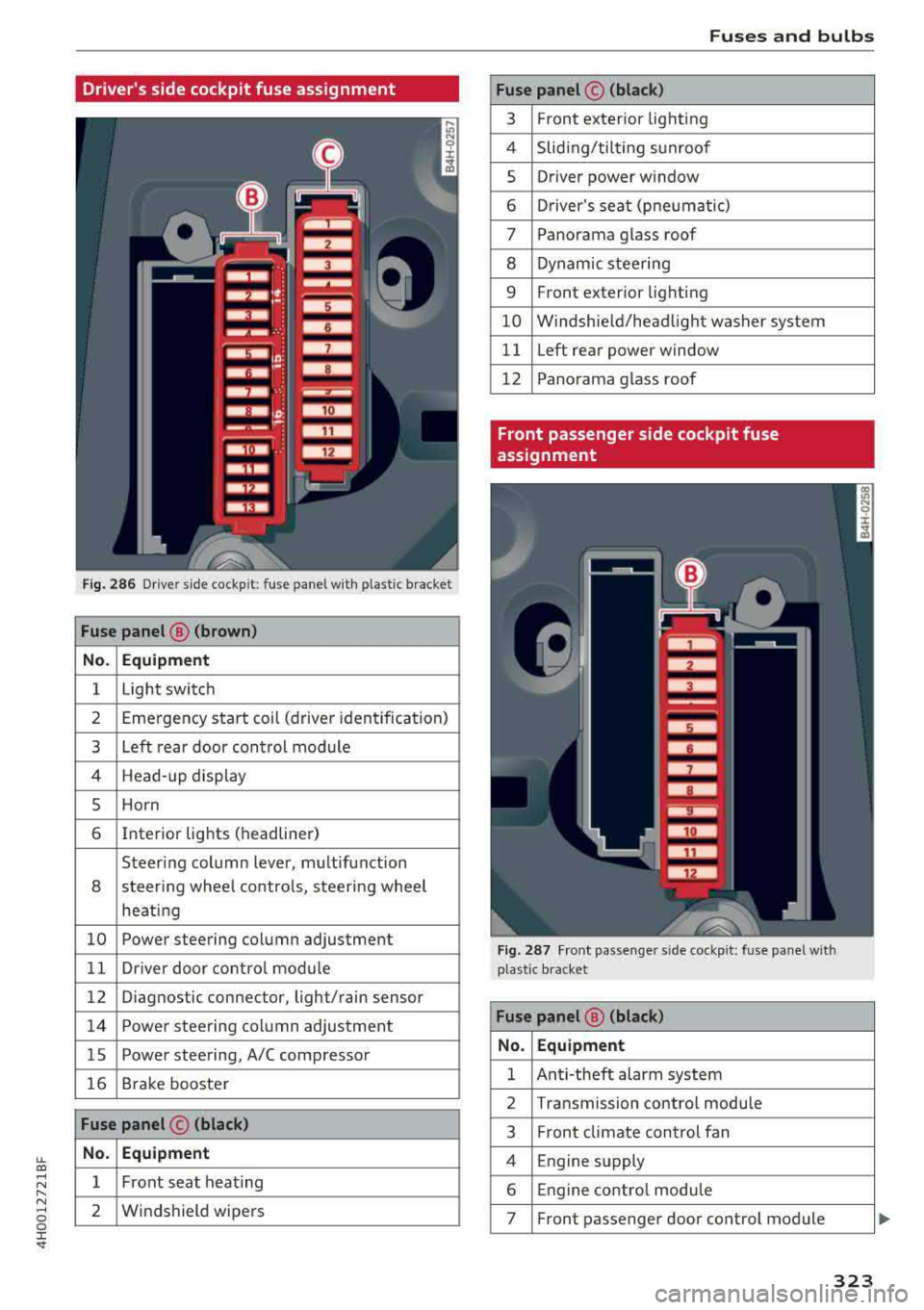
Fig. 286 Drive r side cockpit: fuse panel with plastic bracket
Fuse panel @ (brown)
No. Equipment
1 Light switch
2 Eme rgency start coil (driver iden tification)
3 Left rear door control module
4 Head-up display
5 Horn
6 Interior lights (headliner)
Steering column lever, multifunction
8 steer ing whee l controls, steering wheel
heating
10 Powe r steering column adjustment
11 Driver door control module
12 Diagnostic con nector, light/rain sensor
14 Power steering column adjustment
lS Power steering, A/C compressor
16 Brake booster
Fuse panel © (black)
No. Equipment
1 Front seat heating
2 Windshield wipers
Fuses and bulbs
Fuse panel © (black)
3 Front exterior lighting
4 Sliding/tilting sunroof
5 Driver power window
6 Dr iver 's seat (pne umat ic)
7 Panorama glass roof
8 Dynamic steering
9 Front exterior lighting
10 Windshield/headlight washer system
11 Left rear power window
12 Panorama glass roof
Front passenger side cockpit fuse
assignment
Fig. 287 Fro nt passe nge r side cockp it: fuse panel with
plastic bracket
Fuse panel @ (black)
No. Equipment
1 Anti-theft alarm system
2 Transmission contro l module
3 Front climate control fan
4 Engine s upply
6 Engine control module
7 Front passenger door control module
323
Page 326 of 356
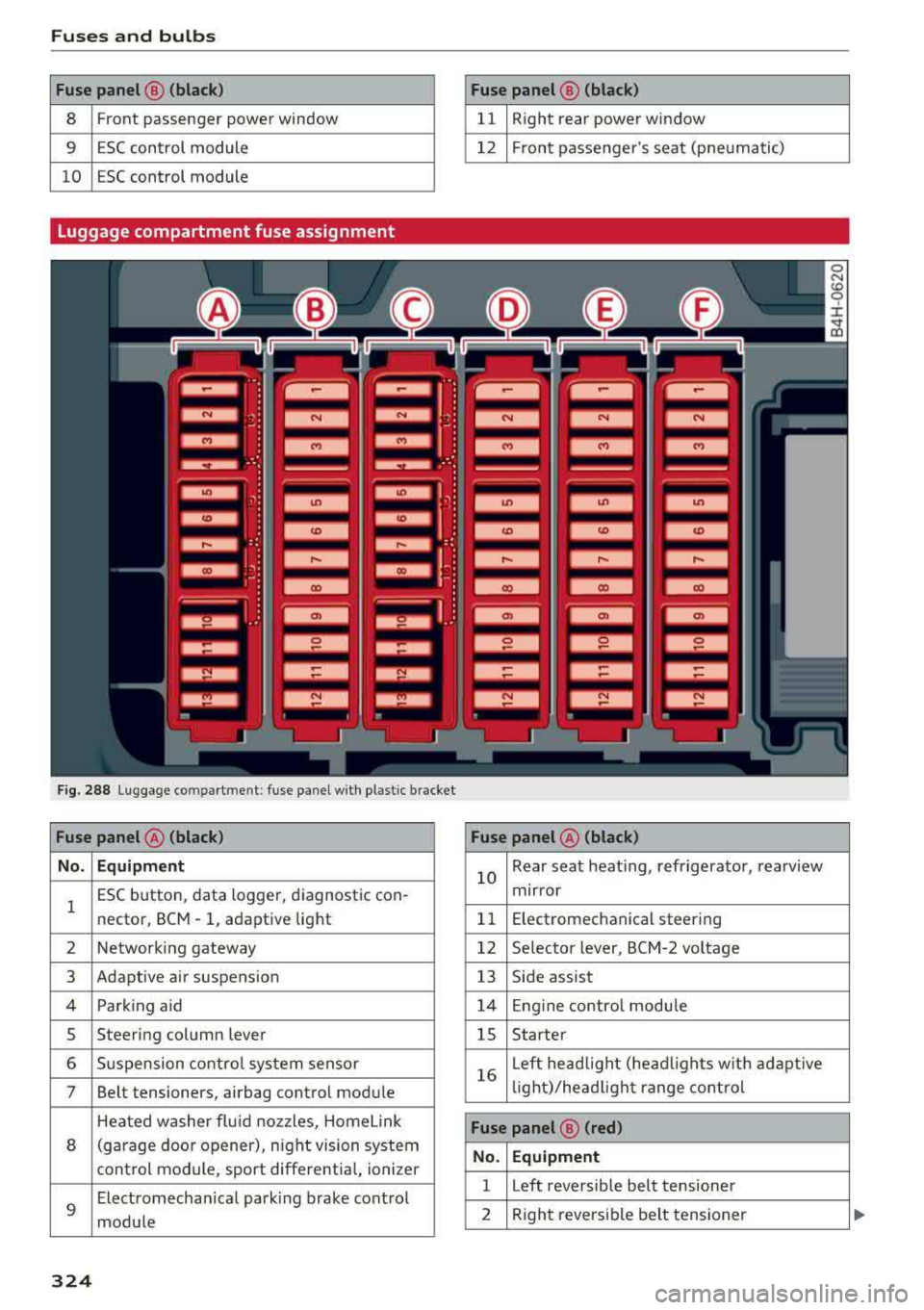
Fuses and bulbs
Fuse panel@ (black ) Fuse panel@ (black)
8 Front passenger power window 11 Right rear power window
9 ESC con trol module 12 Front passenger's seat (pne umatic)
10 E
SC control module
Luggage compartment fuse assignment
F ig . 28 8 Luggage co mpar tment : fuse panel w it h plastic bracket
Fuse panel @ (black) Fuse panel@ (black)
No. Equipment
10 Rear seat heat
ing, refrigerator, rearv iew
1 ESC b
utton , data logger, d iagnost ic con -
nector, BCM - 1, adaptive lig ht mir
ror
1 1 Electromechanical steering
2 Network ing gateway 12 Selec tor lever, BCM-2 vol tage
3 Adaptive air suspension
13 Side assist
4 Park ing a id 14 E ngine contro l module
5 Steer
ing column lever
15 Starter
6 S usp ension contro l system senso r
7 Belt tensioners, airbag control mod ule 16
L
eft head light (he adlights w it h adap tive
li ght)/head light range co ntr ol
Heated w asher flu id no zz les, Home link
8 (garage doo r opener), night vision system
cont rol mod ule, sport differe ntia l, ionizer
9
Electromecha nica l par king brake cont rol
modu le
Fuse panel ® (red)
No . Equipment
1 Left reversible belt tensioner
2 R
ight revers ible belt tensioner
324