fuel AUDI A8 2018 Owner's Manual
[x] Cancel search | Manufacturer: AUDI, Model Year: 2018, Model line: A8, Model: AUDI A8 2018Pages: 356, PDF Size: 54.71 MB
Page 273 of 356
lL t:0 ....
"' ......
"' .... 0 0 :c '
while it is in or on the vehicle. Stat ic elec
tr icity is discharged when filling which can
cause the fuel vapors to ignite and in
creases the r isk of an explos ion.
- Always p lace a fuel container on the
ground before fi lling.
- Always hold the fuel nozzle comp letely in
the fuel container when f il li ng .
- If the fuel container is made of metal, the
fuel nozzle must always be in contact with the conta iner when filling it w ith fuel. Th is
prevents static electr ic ity from discharg
ing.
- Never sp ill fuel in the veh icle or the lug
gage compartment. Evaporated fue l is ex
p losive and increases the risk of serio us in
jury or dea th.
- Follow legal requir ements when using,
sto ring and transpor ting fue l contai ners .
- M ake sure the fuel conta iner confo rms to
i nd ust ry st anda rds (ANSI/AS TM F852 -86).
(D Note
- Remove spilled fuel from vehicle paint im
mediate ly, because it can damage paint.
- Never dr ive unti l th e fuel tank is comp letely
empty . The ir regular supply of fuel that re
su lts from that ca n caus e engine misfires.
U ncomb usted fuel w ill enter the exha ust
system a nd i ncre ase the risk of damage to
the c atalyt ic converter.
@) For the sake of the environment
Do not overfi ll the fuel tank , othe rw ise fue l
can leak out whe n the vehicle is warm ing up.
(D Tips
The f uel f iller door on your vehicle does not
loc k if you lock the vehicle from the inside.
Chec king and Filling
Fuel filler door emergency release
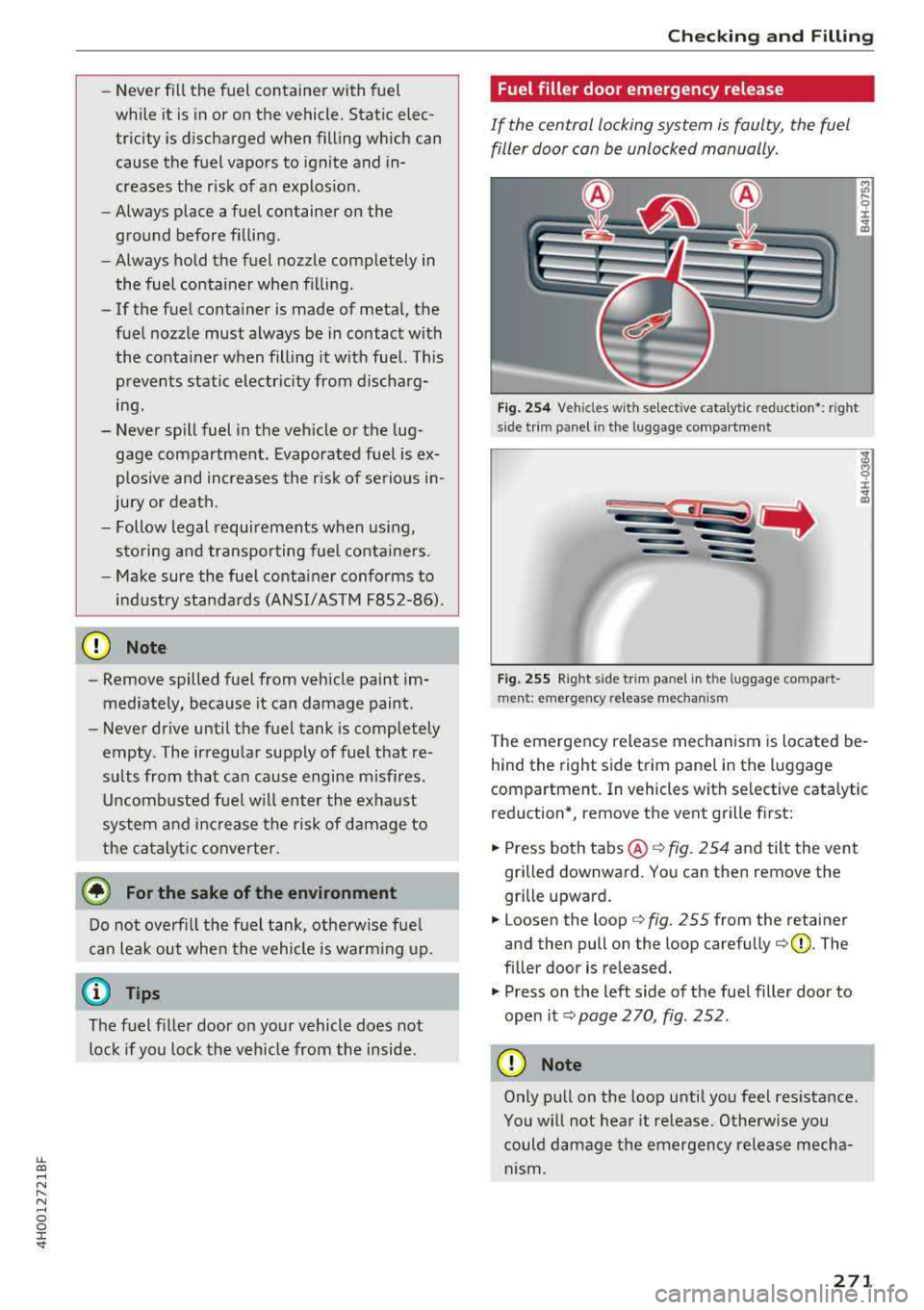
If the central locking system is faulty, the fuel
filler door can be unlocked manually.
F ig . 25 4 Veh icles w it h se lect ive catalyt ic reduct io n•: right
side trim pa nel in t he luggage compa rtme nt
Fi g. 25 5 Righ t sid e tr im pa nel in t he luggage compart·
ment : emergency release mechanism
T he emergency release mechanism is located be
hind the rig ht side trim pane l in the luggage
compartment . In vehicles with se lective cata lytic
reduction*, remove the vent grille f irst:
.,. Press bo th tabs @¢fig. 254 an d tilt the vent
grilled downward. Yo u can then remove the
grille upwar d .
.,. Loosen the loop¢ fig. 255 from the retainer
and then pull on the loop caref ully
¢ (D . The
fi ller door is released.
.,. Press on t he left side of the fue l filler door to
open
it ¢ page 2 70, fig . 252.
~ Note
Only p ull on the loop until yo u feel resista nce.
You w ill not hear it re lease. Othe rw ise you
could damag e the emergency rel ease mecha
n ism.
271
Page 274 of 356
Checking and Filling
Emissions control
systems
Catalytic converter
A pp lies to: ve hicles w ith gasoline engines
The vehicle may on ly be driven with unleaded
gasoline, otherwise the catalyt ic converter will be
destroyed.
Never d rive until the tank is comp letely empty .
The irregular supp ly of f uel that results from that
can cause engine m isfires. Uncombusted fuel will
enter the exhaust system , w hich can cause over
heating and damage to the catalyt ic converter .
A WARNING
The temperature o f the exha ust system is
hig h, bo th whe n driving and after stopping
t he engine.
-
- Never touch the exha ust ta il pi pes once they
h ave become ho t. This could resul t in burns.
- Do no t park you r vehicle ove r flammable
m aterials such as g rass or leaves because
t h e hi gh te mperat ure of the emiss io ns con
t rol sys te m c ould star t a fire.
- D o no t apply u nder bod y p rote ctant in the
exha ust syste m are a, bec au se t his in cre ases
t h e ris k of fire .
Engine compartment
Working in the engine compartment
Special core is required if you ore working in the
engine comportment
For work in the engine compartment such as
checking and filling fluids, there is a risk of in
jury , scalding , accidents, and burns . For this
reason, follow all the warnings and general
safety precautions provided in the following in
formation . The engine compartment is a dan
gerous area on the vehicle .
~ ,&..
A WARNING
- T urn the engine off.
- Switch the ign ition off .
- Set the parking b rake .
- Select the P selector leve r pos ition.
272
- Let the eng ine cool down .
- Never open the hood when there is steam o r
coo lant escapin g from the engine compart
ment, because there is a risk that yo u could
be burned. Wait unt il no steam or coolant is
escaping.
- Keep children away from the eng ine com
pa rtment.
- Never sp ill fluids on a hot engine. These flu
ids (such as the anti-freezing agent con
tained in the coolant) can ignite .
- Avoid short c ircuits in the electrical system.
- When working in the engine compa rtment,
remember that the radiator fan can switch
on even if the ignition is switched off, wh ich
increases the r isk of persona l injury.
- Never open the cap on the coolant expan
sion tank when the engine is warm. The
cooli ng system is under p ressure .
- To protect your face, hands, and a rms from
hot steam or coolant, cover the cap with a
large cloth when opening.
- Do not remove the engine cove r under any
circumstances . T his increases the risk of
burns.
- If tests need to be perfo rmed with the en
gine running, there is add itiona l danger due
to mov ing components (such as the r ibbed
be lt, alterna tor and rad iator fan) and from
the high-voltage ignition system.
- Do not unde r any circ ums tances activate the
throttle inadvertently (for example, by hand
from t he e ngine compartment) if the veh i
cle is stat ionary but the en gine is r un ning
an d a gea r is en gaged. Otherwise, the veh i
cle will start to move immediately and this
could result in an acc ident .
- Pay a ttent ion to the following wa rnings lis t
e d w hen wor k on the fue l system o r on the
electrical equipment is require d.
- Do no t smoke.
- Never work near open flames .
- Always have a working fire extinguisher
nearby.
- All work on the battery or elect rical system
in your vehicle can result in injuries, chemi
cal b urns, acc idents or bu rns. Because o f
this, all work m ust be perfo rmed
only b y an ~
Page 277 of 356
u. co ..... N
" N ..... 0 0 :c '
Read and follow all WARNINGS before check
ing anything in the engine
compartment~ .&.
in Working in the engine compartment on
page 272.
Engine oil
If the engine oil level is too low
If you need to add engine oil, use an oil that is listed on the sticker.
The sticker is located at the
front of the engine
compartment ~ page 274,
fig.
258.
If the recommended engine oil is not available,
in an emergency you may add a maximum of 1
quart
(I liter) of ACEA C3 or API SN engine oil
one time until the next oil change.
For more information on the correct engine oil
for your vehicle, contact an authorized Audi deal
er or authorized Audi Service Facility. Have the oil
changed by an authorized Audi dealer or author ized Service Facility.
Audi recommends
«;;castrol I /g@@g PrtfTr.:!\.7.Tri,'lAl.
Audi recommends using the Longlife high-per·
formance engine oil from Audi Genuine Parts.
Checking the engine oil level
The engine oil level can be checked in the Info
tainment system
Observe the safety precautions ~ A in Working
in the engine compartment on page 2 72.
~ Park your vehicle on a level surface.
~ Shut the engine off when it is warm.
~ Switch only the ignition back on.
~ Wait approximately two minutes.
~ Select: the ICARI function button> (Car)* Sys
tems
control button > Service & control > Oil
level.
~ Read the oil level in the Infotainment system .
Add engine oil if the bar in the oil level indica
tor is just before
"min"~ page 2 76.
Checking and Filling
@ Note
The engine oil level must not be under the
"min" marking, as this will increase the risk of
engine damage.
(D Tips
The oil level indicator in the display is only an
informational display.
If the oil level is too
low, a minimum oil warning appears in the in
strument cluster. Add oil and close the hood.
The current oil level is displayed in the Info
tainment system the next time the ignition is
switched on.
(D Tips
The engine oil consumption may be up to
0.5 quart/600 miles (0 .5 liter/1,000 km), de
pending on driving style and operating condi
tions. Consumption may be higher during the
first 3,000 miles (5,000 km). Because of this,
the engine oil level must be checked regular
ly. It is best to check each time you refuel
your vehicle and before long drives.
- In order to provide effective lubrication and
cooling of internal engine components, all
internal combustion engines consume acer
tain amount of oil. Oil consumption varies
from engine to engine and may change sig
nificantly over the life of the engine. Typi
cally, engines with a specified break-in peri
od consume more oil during the break-in pe
riod than they consume after oil consump
tion has stabilized.
- Under normal conditions, the rate of oil
consumption depends on the quality and
viscosity of the oil, the RPM (revolutions per
minute) at which the engine is operated, the
ambient temperature and road conditions.
Further factors are the amount of oil dilu
tion from water condensation or fuel resi
due and the oxidation level of the oil. As any
engine is subject to wear as mileage builds
up, the oil consumption may increase over
time until replacement of worn components
may become necessary.
.,.
275
Page 285 of 356
u. a:, .... N
" N .... 0
0
I
Wheels and Tires
General information
~check your tires regularly for
damage (punctures, cuts, cracks
and bulges). Remove foreign ob
jects from the tire tread.
~ If driving over curbs or similar
obstacles, drive slowly and ap
proach the curb at an angle.
~Have faulty tires or rims re
placed immediately.
~Protect your tires from oil,
grease and fuel.
~Mark tires before removing
them so that the same running
direction can be maintained if
they are reinstalled.
~Lay tires flat when storing and
store them in a cool, dry location
with as little exposure to light as possible.
(D Note
-Please note that summer and winter tires are designed for
the conditions that are typical in those seasons. Audi recom
mends using winter tires dur
ing the winter months. Low
temperatures significantly de
crease the elasticity of summ
er tires, which affects traction
Wheels
and braking ability. If summer
tires are used in very cold
temperatures, cracks can form on the tread bars, resulting in
permanent tire damage that
can cause loud driving noise
and unbalanced tires.
-Burnished, polished or chromed rims must not be
used in winter driving condi
tions. The surface of the rims does not have sufficient corro
sion protection for this and
could be permanently dam
aged by road salt or similar
substances.
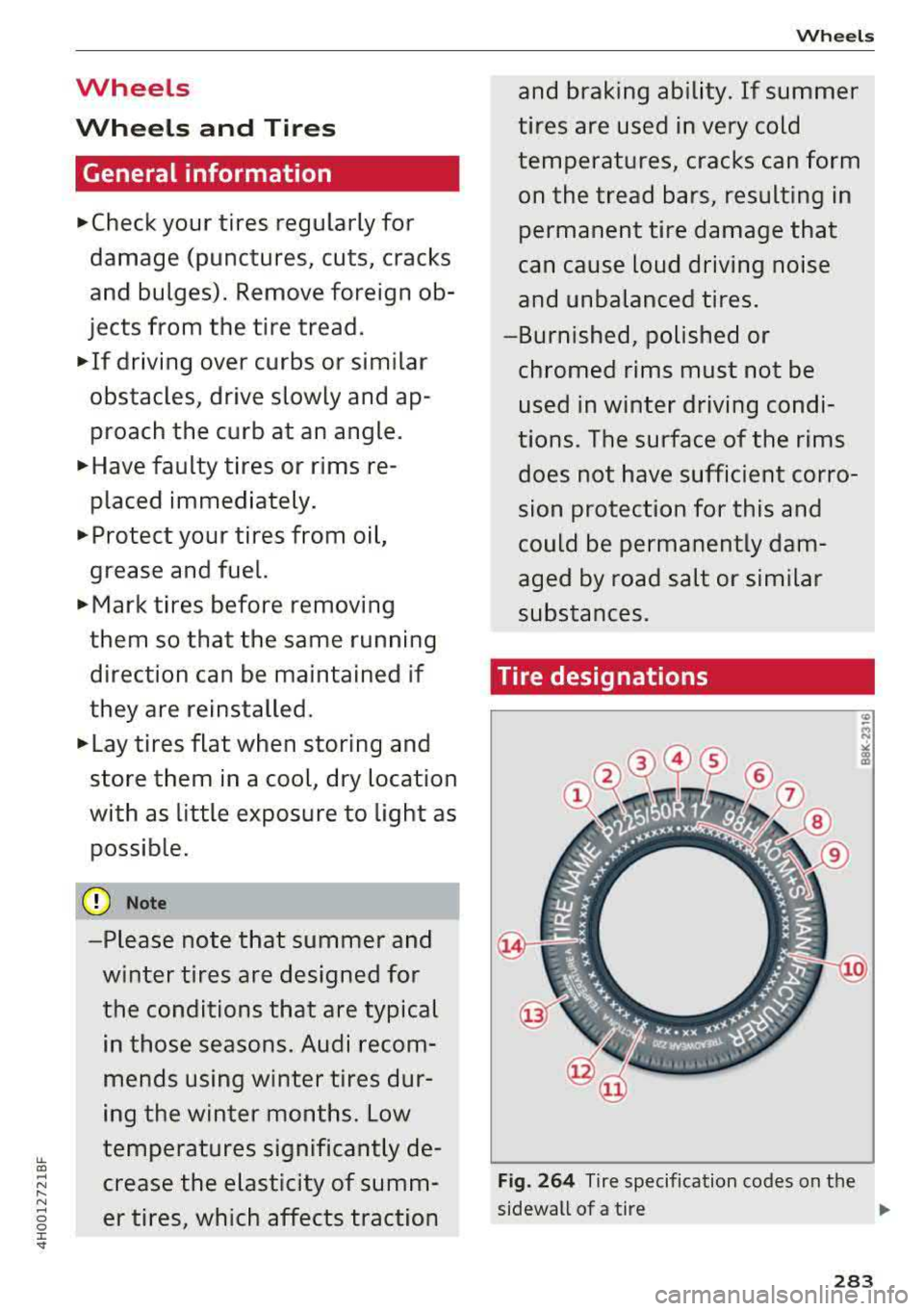
Tire designations
Fig. 264 Tire specification codes on the
sidewall of a tire
.,.
283
Page 288 of 356
Wheels
Bead
means the part of the tire that is
made of steel wires, wrapped or
reinforced by ply cords and that is
shaped to fit the rim .
Bead separation
means a breakdown of the bond
between components in the bead .
Cord
means the strands forming the
plies in the tire .
Cold tire inflation pressure
means the tire pressure recom
mended by the vehicle manufac
turer for
a tire of a designated
size that has not been driven for more than a couple of miles (kilo
meters) at low speeds in the
three hour period before the tire pressure is measured or adjusted .
Curb weight
means the weight of a motor ve
hicle with standa rd equipment in
cluding the maximum ca pacity of
fuel, oil, and coolant, air condi
tioning and addit ional weigh t of
optional equipment.
E x tra load tire
means a tire designed to operate
at higher loads and at higher
in -
28 6
flation pressures than t he corre
spond ing standard tire. Extra load
tires may be identified as "X L",
"xl" , "EXTRA LOAD" , or "RF" on
the sidewall.
Gross Axle Weight Rating ("GAWR")
means the load-car rying capacity
of a single axle system , measu red
at the ti re-ground interfaces .
Gross Vehicle Weight Rating
("GVWR")
means the maximum total loaded
weight of the vehicle .
Groove
means the space between two ad
jacent tread ribs .
Load rating (code)
means the maximum load tha t a
tire is rated to carry for a given i n
flation pressure. You may no t find
this informat ion on all ti res be
cause it is not required by law .
Maximum load rating
means the load rating for a tire at
the maximum permissible infla
tion pressure for that tire .
Maximum loaded vehicle
weight
means t he sum of:
Page 296 of 356
Wheels
&,. WARNING
Always adapt the tire pressure
to your driving style and vehicle
load .
-Overloading can lead to loss of
vehicle control and increase
the risk of an accident. Read and follow the important safe
ty precautions
inc:::> page 295,
Tires and vehicle load limits.
-The tire must flex more if the
tire pressure is too low or if
the vehicle speed or load are
too high . This heats the tire up
too much. This increases the
risk of an accident because it
can cause the tire to burst and
result in loss of vehicle con
trol.
-Incorrect tire pressure in creases tire wear and has a
Tire pressure table
Please note that the information
contained in the following table
was correct at the time of print
ing, and the information is sub
ject to change. If there are differ ences between this information
and the tire pressures specified
on the label on the driver's side B pillar, always follow the specifica-
294
negative effect on driving and
braking behavior, which in
creases the risk of an accident.
@ Note
Replace lost valve caps to re
duce the risk of damage to the
tire valves.
@ For the sake of the environment
Tire pressure that is too low in
creases fuel consumption.
(D Tips
Audi recommends using the
tire pressure specified for a normal load
c:::> table on
page 295
or for a full load
when the vehicle is partially loaded.
tion on the B-pillar label
c:::> page 293, fig. 266.
Make sure that the tire designa
tion on your tire matches the des ignation on the tire pressure label
and the tire pressure table.
The following table lists recom- mended tire pressures in cold
.,..
Page 298 of 356
Wheels
sure that load limits are not ex
ceeded. Vehicle load includes ev
erybody and everything in and on
the vehicle. These load limits are
technically referred to as the vehi
cle's
Gross Vehicle Weight Rat
ing
("GVWR").
The "GVWR" includes the weight
of the basic vehicle, all factory in
stalled accessories, a full tank of
fuel, oil, coolant and other fluids plus maximum load. The maxi
mum load includes the number of
passengers that the vehicle is in
tended to carry ("seating capaci
ty") with an assumed weight of
150 lbs. (68 kg) for each passen
ger at a designated seating posi
tion and the total weight of any
l uggage in the vehicle. If you tow
a trailer, the weight of the trailer
hitch and the tongue weight of
the loaded trailer must be includ
ed as part of the vehicle load.
The
Gross Axle Weight Rating
("GAWR") is the maximum load
that can be applied at each of the
vehicle's two axles.
The fact that there is an upper
limit to your vehicle's Gross Vehi
cle Weight Rating means that the
total weight of whatever is being
296
carried in the vehicle (including
the weight of a trailer hitch and the tongue weight of the loaded
trailer) is limited. The more pas
sengers in the vehicle or passen
gers who are heavier than the
standard weights assumed mean
that less weight can be carried as l uggage .
The Gross Vehicle Weight Rating
and the Gross Axle Weight Rating
are listed on the safety compli
ance sticker label located on the
driver's side B-pillar
¢ page 293,
fig. 266.
_& WARNING ~
Overloading a vehicle can cause
loss of vehicle control, a crash
or other accident, serious per
sonal injury, and even death.
-Carrying more weight than
your vehicle was designed to
carry will prevent the vehicle
from handling properly and increase the risk of the loss of
vehicle control.
-The brakes on a vehicle that
has been overloaded may not
be able to stop the vehicle
within a safe distance.
Page 300 of 356
Wheels
the available cargo and luggage load capacity of your vehi
cle.
.,.Check the tire sidewall
(¢ page 283, fig. 264) to deter
mine the designated load rating
for a specific tire.
Wheel bolts and rims
Wheel bolts
Wheel bolts must be clean and loosen/tighten
easily .
Rims
Rims with a bolted rim ring* or with bolted wheel
covers* consist of multiple pieces . These compo
nents were bolted together using special bolts
and a special procedure. You must not repair or
disassemble
them £:=?.&. .
A WARNING
Wheel bolts that are tightened or repaired in
correctly can become loose and result in loss
of vehicle control, which increases the risk of
an accident. For the correct tightening specifi
cation, see
¢page 314.
- Always keep the wheel bolts and the
threads in the wheel hub clean and free of grease.
- Only use wheel bolts that fit the rim.
- Always have damaged rims repaired by an
authorized Audi dealer or authorized Audi
Service Facility. Never repair or disassemble
rims yourself, because this increases the risk
of an accident .
Winter tires
Winter tires significantly improve the vehicle's
handling when driving in winter conditions. Be
cause of their construction (width, compound,
tread pattern) , summer tires provide less trac
tion on ice and snow.
298
.. Use winter tires on all four wheels .
.. Only use winter tires that are approved for your
vehicle.
.. Please note that the maximum permitted
speed may be lower with winter
tires¢ _&.. An
authorized Audi dealer or authorized Audi Serv
ice Facility can inform you about the maximum
permitted speed for your tires .
.,. Check the tire pressure after installing wheels
¢page 293 .
The effectiveness of winter tires is reduced great
ly when the tread is worn down to a depth of
0.157 in (4 mm). The characteristics of winter
tires also decrease greatly as the tire ages , re
gardless of the remaining tread.
A WARNING
- Never drive faster than the maximum per
mitted speed for your tires. This could cause
the tires to heat up too much. This increases
the risk of an accident because it can cause
the tire to burst .
- Always adapt your driving to the road and
traffic conditions. Drive carefully and reduce
your speed on icy or slippery roads. Even
winter tires can lose traction on black ice .
® For the sake of the environment
Reinstall summer tires at the appropriate
time, because they provide better handling
when roads are free of snow and ice. Summer
tires cause less road noise, tire wear and fuel
consumption.
(D Tips
You can also use all season tires instead of
winter tires. Please note that in some coun
tries where winter tires are required, only
winter tires with the
& symbol may be per
mitted.
Snow chains
-
Snow chains not only improve the driving in win
ter road conditions, but also the braking.
.,. Only install snow chains on the front wheels. .,.
Page 304 of 356
Wheels
-The driver is responsible for maintaining the
correct tire pressure. You must check the
tire pressure regularly.
- Under certain conditions (such as a sporty
driving style, winter conditions or unpaved
roads), the tire pressure monitoring system
indicator may be delayed .
- Do not use run-flat tires on your vehicle. Us
ing them when not permitted can lead to
vehicle damage or accidents .
(D Tips
- The tire pressure monitoring system can al
so stop working when there is an ESC mal
function .
- Using snow chains may result in a system
malfunction.
- The tires with the identification
"AO" or
"RO" ¢ page 290 have been matched with
your Audi tire pressure monitoring system.
Using these tires is recommended.
Storing tire pressures
Applies to: AB, S8
If the tire pressure changes or a tire is replaced,
it must be confirmed in the Infotainment sys
tem .
.,. Make sure before storing that the tire pressures
of all four tir es meet the specified values and
are adapted to the
load ¢ page 291 .
.,. Switch the ignition on .
.,. Select : the ICARI function button > Car Systems
control button > Service & control > Tire pres
sure monitor> Store tire pressure > Yes, store
now.
(D Tips
Do not store the tire pressures if snow chains
are installed. Otherwise the system could
malfunction.
302
Tire Pressure Monitoring System (SB plus)
ill General notes
Applies to: S8 plus
Each tire, including the spare (if provided),
shou ld be checked monthly when cold and inflat
ed to the inflation pressure recommended by the
vehicle manufacturer on the vehicle placard or
tire inflation pressure label. (If your vehicle has
tires of a different size than the size ind icated on
the veh icle placard or tire inflat ion pressure la
bel, you should determine the proper tire infla
tion pressure for those tires).
As an added safety feature, your vehicle has been
equipped with a tire pressure mon itor ing system
(TPMS) t hat illuminates a low tire pressure tell
ta le when o ne or more of your tires is significant
l y under-inflated. According ly, when the low tire
pressure telltale illuminates, you should stop and
check your tires as soon as possible, and inflate
them to the proper pressure . Driving on a signifi
cant ly under-inflated tire causes the tire to over
heat and can lead to tire failure . Under-inflation
also reduces fuel efficiency and tire tread life,
and may affect the vehicle's handling and stop
ping ability .
Please note that the TPMS is not a substitute for
proper tire maintenance, and it is the driver's re
spons ibility to maintain correct t ire pressure,
even if under-inflation has not reached the level
to trigge r illumination of the TPM S low t ire pres
su re te lltale.
Your vehicle has also been equipped with a TPMS
malfunction indicator to ind icate when the sys
tem is not operating prope rly . The TPM S mal
function indicator is combined with the low t ire
pressure telltale. When the system detects a
malfunction, the telltale will flash for approxi
mately one minute and then remain continuously
illuminated. This sequence wi ll continue upon
subsequent vehicle start-ups as long as the mal
function exists.
When the malfunction indicator is illuminated,
the system may not be able to detect or signal
low tire pressure as intended. TPMS
malfunctions ..,_
Page 305 of 356
u. co .... N
" N .... 0 0 :c '
installation of replacement or alternate tires or
wheels on the vehicle that prevent the TPMS
from functioning properly . Always check the
TPMS malfunction telltale after replacing one or
more tires or wheels on your vehicle to ensure
that the replacement or alternate tires and
wheels allow the TPMS to continue to function
properly.
Description
Applies to: 58 plus
The tire pressure monitoring system monitors
the pressure in the four tires when driving.
The system uses sensors that measure the tem
perature and pressure in the tires . The data is
sent from these sensors to the control module by
radio frequency.
The Tire Pressure Monitoring System shows the
current pressures and temperatures of the tires
in the Infota inment system
c:> page 303 . It also
compa res the current tire pressures with the
stored tire press ures and gives a warning in the
driver information system if the tire pressure is
different from what is stored
c:> page 304.
The system does not detect if the stored tire
pressures match the recommended tire pres
sures.
- Every time the tire pressures change, for exam-
ple when the load in the vehicle changes,
- after replac ing a tire, or
- if wheels with new wheel sensors are used,
you must store the tire pressures again
c:> page 304.
A WARNING
-The tire pressure mon itor ing system assists
the driver in monitoring tire pressures. The
dr iver is responsible for having the tires in
flated to the correct pressure.
- Do not change the tire pressure when the
temperature of the tire is extremely high.
T his cou ld result in serious damage to the
t ir e and even cause the tire to burst, in
creasing the risk of an accide nt.
Wheels
-A tire with low pressure flexes more . This
heats the tire up too much. This could cause
the tread to separate and even cause the
tire to burst, increasing the risk of an acci
dent.
- The Tire Pressure Monitoring System does
not warn you of damage or defects in the
tire construct ion that could cause the tire to
burst, for example. Inspect your tires regu
larly.
@ For the sake of the environment
Low tire pressure increases fuel consumption
and tire wear.
(D Tips
-The pressure of the spare t ire* is not mon i
tored.
- If tires are replaced, the sensors/va lves do
not need to be removed or replaced. Just re
placed the valve stem and, if necessary, the
valve and the whee l electronics . If you have
questions, see an authorized Audi dealer or
authorized Audi Service Facility.
Displaying tire pressures/temperatures
Applies to: 58 plus
Requirement: the ignition must be switched on.
.. Select: the I CAR! funct ion button > Car systems
> Service & control > Tire pressure monitor >
Display tire pressure .
The current tire pressures are shown in green and
yellow numbers in the Infotainment system:
-Green: the current tire pressure and the spec i
fied tire pressure are approx imately the same .
-Yellow: the current tire pressure is too low
compared to the specified tire pressure .
The specified tire pressure is the last tire pres
sure that was stored
c:> page 304 .
Note that the tire pressure also depends on the
temperature of the tire . The tire pressure in
creases as the engine becomes warmer while
driv ing.
.,.
303