belt AUDI A8 2018 Owner's Guide
[x] Cancel search | Manufacturer: AUDI, Model Year: 2018, Model line: A8, Model: AUDI A8 2018Pages: 356, PDF Size: 54.71 MB
Page 233 of 356
Front airbags
Description of front airbags
The airbag system can provide supplemental
protection to properly restrained front seat occu
pants .
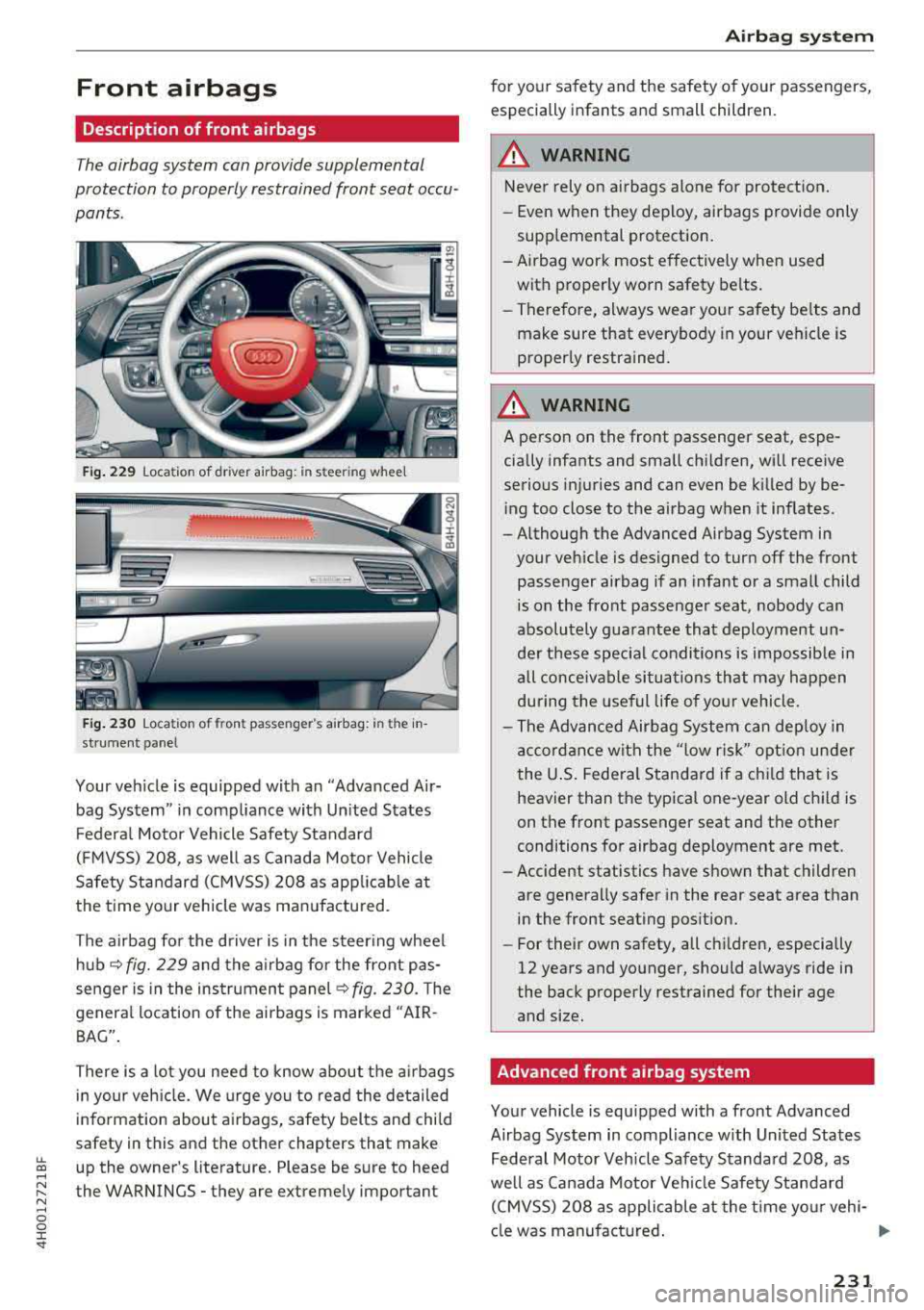
Fig. 229 Location of driver airbag: in steering wheel
Fig. 230 Location of front passenger's airbag : in the in
strument panel
Your vehicle is equipped with an "Advanced Air
bag System" in compliance with United States
Federal Motor Vehicle Safety Standard
(FMVSS) 208, as well as Canada Motor Vehicle
Safety Standard (CMVSS) 208 as applicable at
the time your vehicle was manufactured .
The airbag for the driver is in the steer ing wheel
hub ~ fig. 229 and the airbag for the front pas
senger is in the instrument panel
~ fig. 230. The
general location of the airbags is marked
"AIR
BAG" .
There is a lot you need to know about the airbags
in your vehicle. We urge you to read the detailed
information about airbags, safety belts and child
safety in this and the other chapters that make
lL ~ up the owner's literature. Please be sure to heed
~ the WARNINGS -they are extreme ly important N ...... 0 0 :c '
for your safety and the safety of your passengers,
especially infants and small children.
A WARNING
-
Never rely on airbags alone for protection.
- Even when they deploy, airbags provide only
supplemental protection.
-Airbag work most effectively when used with properly worn safety belts.
- Therefore, always wear your safety belts and
make sure that everybody in your vehicle is
properly restrained.
_&. WARNING
A person on the front passenger seat, espe
cially infants and small children, will receive
serious injuries and can even be killed by be ing too close to the airbag when it inflates.
- Although the Advanced Airbag System in
your vehicle is designed to turn off the front
passenger airbag if an infant or a small child
is on the front passenger seat, nobody can
absolutely guarantee that deployment un
der these specia l conditions is impossib le in
all conceivable situations that may happen
during the useful life of your vehicle.
- The Advanced Airbag System can dep loy in
accordance with the "low risk" opt ion under
the U.S. Federal Standard if a child that is
heavier than the typical one-year old child is
on the front passenger seat and the other
conditions for airbag deployment are met.
- Accident statistics have shown that children
are generally safer in the rear seat area than
in the front seating position.
- For their own safety, all children, especially
12 years and younger, should always ride in
the back properly restrained for their age
and size.
Advanced front airbag system
Your vehicle is equipped with a front Advanced
Airbag System in compliance with United States Federal Motor Vehicle Safety Standard 208, as
well as Canada Motor Vehicle Safety Standard (CMVSS) 208 as applicable at the time your vehi-
cle was manufactured .
IJJ,,
231
Page 234 of 356
Airbag syste m
The front Advanced Airbag System supp lements
the safety belts to provide additional protection
for the dr iver's and front passenger's heads and
upper bodies in frontal crashes. The airbags in
flate only in frontal impacts when the veh icle de
celerat ion is high enough.
The front Advanced Airbag System for the front
seat occupants is not a substitute for your safety belts. Rather, it is part of the overall occupant re
stra int system in your vehicle. Always remember
that the a irbag system can only help to protect
you, if you are sitt ing upr ight, wear ing your safe
ty belt and wear ing it prope rly. This is why you
and your passengers must always be prope rly re
stra ined, not just because the law req uires yo u to
be .
The Advanced Airbag System i n your veh icle has
been ce rt ified to meet the " low r isk" requ ire
men ts for 3 and 6 yea r-old children on the pas
senger side and very sma ll adults on the driver
side . The low risk dep loyment criteria are intend
ed to he lp reduce the risk of injury through inter
action with the front airbag that can occur, for
examp le, by being too close to the steering wheel
and instrument panel when the airbag inflates .
In addition, the system has been certified to
comp ly w ith the "suppression" requirements of
the Safety Standard, to turn
off the front a irbag
for infants 12 months old and younger who are
restrained on the front passenger seat in c hild re
stra ints that are listed in the Standa rd
¢ page 251, Child restraints and Advanced Air
bags.
"Suppress ion" requ ires t he front a irbag on the
passenger side to be turned
off if:
- a chi ld up to about one year of age is restra ined
on the front passenger seat in one of the rear
facing o r fo rward-fac ing infant restra ints listed
i n Federal Motor Vehicle Safety Standard
208
with wh ic h the Advanced Airbag System in your
vehicle was ce rt ified. For a l isting of the c hild
restra ints that were used to certify your veh i
cle's compliance with the US Safety Standard
¢ page 251,
232
-weight less than a threshold leve l stored in t he
control unit is detected on the front passenger
seat.
When a person is detected on the fron t passen
ger seat, weig hing more than the total weight of
a chi ld that is about 1 year old restrained in one
of the rea r-facing or forward-fac ing infant re
straints (listed in Federal Motor Vehicle Safety
Standard
208 with w hich the Advanced Airbag
System in your vehicle was certified), the front
a irbag on the passenger s ide may or may not de
ploy.
The
PASSENGER AIR BA G OFF light comes on
whe n the electronic control unit detects a tota l
weight on t he front passenger seat that requ ires
t h e front a irbag to be tur ned
off . If t he PASSEN
GER AIR BAG OFF
light does not come on, the
front a irbag on the passenge r side has no t been
tu rne d
off by t he control unit and can dep loy if
the control unit senses an impact t hat meets the
conditions stored in its memory.
If the total weig ht on the front passe nger sea t is
more than that of a typ ica l 1 year-o ld, but less
than the weight of a small adult, the front airbag
on the passenger side may dep loy (the
PASSEN
GER AIR BAG O FF
light does not come on).
For example , the airbag ma y deplo y if:
- a small ch ild that is heav ier than a typ ica l 1
year-old child is on the front passenger seat (regard less of whethe r the child is in one of t he
child seats listed
¢ page 251),
-a child who has outgrown c hild res traints is on
the front passenge r seat.
If the front passenger a irbag is tu rned
off, the
PA SSENGER AIR BAG OFF light in the center of
t h e i nstr ument pane l w ill come on and s tay on.
The front airbag on the passenger side may
not
deploy (the PASSENGER AIR BAG OFF light does
not ill uminate and stay lit) if:
- a small adult or teenager is on the front pas
senger seat
- a passenger who is not s itting upright with
their back against a no n-reclined backrest with
their feet on the veh icle floor in front of the
seat is on the front passenger seat .
Page 236 of 356
Airbag syste m
passenger seat contains important parts of the
Advanced Airbag System, you must take care to
prevent it from being damaged . Damage to the
seat may prevent the Advanced A irbag for the
front passenger seat from doing its job in a
crash .
The front Ad vanced Airb ag S ystem con sist s
o f the follo wing :
-Crash sensors in the front of the vehicle that
measure vehicle acceleration/decelerat ion to
provide information to the Advanced Airbag
System about the severity of the crash .
- An electron ic control un it, with integrated
crash sensors for front and side impacts . The
contro l unit "decides " whether to fire the front
airbags based on the information received from
the crash sensors. The contro l unit also "de
cides" whether the safety be lt pretensioners
sho uld be activated.
-An Advanced Airbag with gas generator and
contro l valve for the driver inside the steering
whee l hub .
-An Advanced Airbag with gas generator and
contro l valve inside the instrument pane l for
the front passenger.
- A weight -sensing mat unde r th e upho lstery
padding of the front passenger seat cushion
that meas ures the tota l weight on the seat . T he
information registered is sent continuously to
the e lec tronic control unit to regu la te dep loy
ment of the front Adva need A irbag on the pas
senger side .
- An airbag monitoring system and indicator
light in the instrument cluster
c> page 23 7 .
- A sensor in each front sea t registers the dis
tance between the respective seat and the
steering wheel or instrument panel. The infor
mation reg istered is sent continuously to the
electronic cont rol u nit to regulate deployment
of the fro nt Advanced A irbags.
- T he
PASSENGER AIR BAG OFF light comes on
and stays on in the center of the instr ument
pane l
c> page 23 7, fig. 232 and tells you w hen
the front Advanced Airbag on the passenger side has been turned off.
-A sensor be low the safety belt latch fo r the
front seat passenger to meas ure the tension on
234
the sa fety be lt. The tension on the safety belt
and the weight registered by the weight -sens
ing mat he lp the contro l unit "decide" whether
the front airbag for the front passenger seat
should be turned
off or not c> page 228, Child
restraints on the front seat -some important
things to know .
-A sensor in the safety belt latch for the driver
and for the front seat passenger that senses
whether that safety belt is latched or not and
transmits this informat ion to the e lectronic
cont rol u nit.
_&, WARNING
Da mage to the front passenge r seat can pre
vent the front airbag from work ing prope rly .
- I mp roper repair or disassembly of the front
passenger and driver seat will p revent the
Advanced Airbag System from functioning
proper ly.
-Repairs to the front passenger seat mus t be
performed by qualified and proper ly trained
workshop personne l.
- Never remove the front passenger or driver seat from the vehicle.
-Never remove the upholstery from the front
passenger seat.
-N ever d is a ssemble o r remove pa rts from the
seat or disconnect wi res from it.
- N ever carry sharp objects in your pocke ts or
p lace them on the seat. If the weight-sens
ing mat in the passenger seat is p unctured
it ca nnot work proper ly.
- Never carry things on your lap or carry ob
jects on the passenger seat. S uch items can
increase t he weight reg istered by the
weight-sensing mat and send the wrong in formation to the a irbag control u nit.
- Never store items under the front passenger
seat . Parts of the Advanced Airbag System
under the passenger seat cou ld be dam
aged, preventing them and the airbag sys
tem from worki ng p roperly.
- Never place seat covers or replacement up
holstery that have not been specifically ap
proved by A ud i on the front seats.
- Seat covers can prevent the Advanced A ir
bag System from recognizi ng ch ild
Page 237 of 356
restraints or occupants on the front passen
ger seat and prevent the side airbag in the
seat backrest from deploying properly.
- Never use cushions, pillows, blankets or
similar items on the front passenger seat.
The additional padding will prevent the
weight-sensing mat in the seat from accu
rately registering the child restraint or per
son on the seat and prevent the Advanced
Airbag System from functioning properly .
- If you must use a child restraint on the front
passenger seat and the child restraint man
ufacturer's instructions require the use of a
towel, foam cushion or something else to properly position the child restraint, make
certain that the
PASSENGER AIR BAG OFF
light comes on and stays on whenever the
child restraint is installed on the front pas
senger seat.
- If the
PASSENGER AIR BAG OFF light does
not come on and stay on, immediately in
stall child restraint in a rear seating position and have the airbag system inspected by
your Audi dealer .
How the Advanced Airbag System
components work together
The front Advanced Airbag System and the side
airbags supplement the protection offered by the
front three-point safety belts and the adjustable head restraints to help reduce the risk of injury in
a wide range of accident and crash situations . Be
sure to read the important information about
safety and heed the WARNINGS in this chapter.
Deployment of the Advanced Airbag System and
the activation of the safety belt pretensioners de pend on the deceleration measured by the crash
sensors and registered by the electronic control
unit. Crash severity depends on speed and decel
eration as well as the mass and stiffness of the
vehicle or object involved in the crash.
On the passenger side , regardless of safety belt
use, the airbag will be turned off if the weight on
~ the passenger seat is less than the amount pro-...,
~ gram med in the electronic control unit. The front N
8 airbag on the passenger side will also be turned 0 :c '
off if one of the child seats that has been certi
fied under Federal Motor Vehicle Safety Standard
208 has been recognized on the seat. The
PAS
SENGER AIR BAG OFF
light comes on and stays
on to tell you when the front Advanced Airbag on
the passenger side has been turned off
~ page 228, Child restraints on the front seat
some important things to know .
_&. WARNING
To reduce the risk of injury when an airbag in
flates, always wear safety belts properly.
- If you are unrestrained, leaning forward, sit
ting sideways or out of position in any way,
your risk of injury is much higher .
- You will also receive serious injuries and
could even be killed if you are up against the
airbag or too close to it when it inflates
-
even with an Advanced Airbag~ page 227.
More important things to know about front
airbags
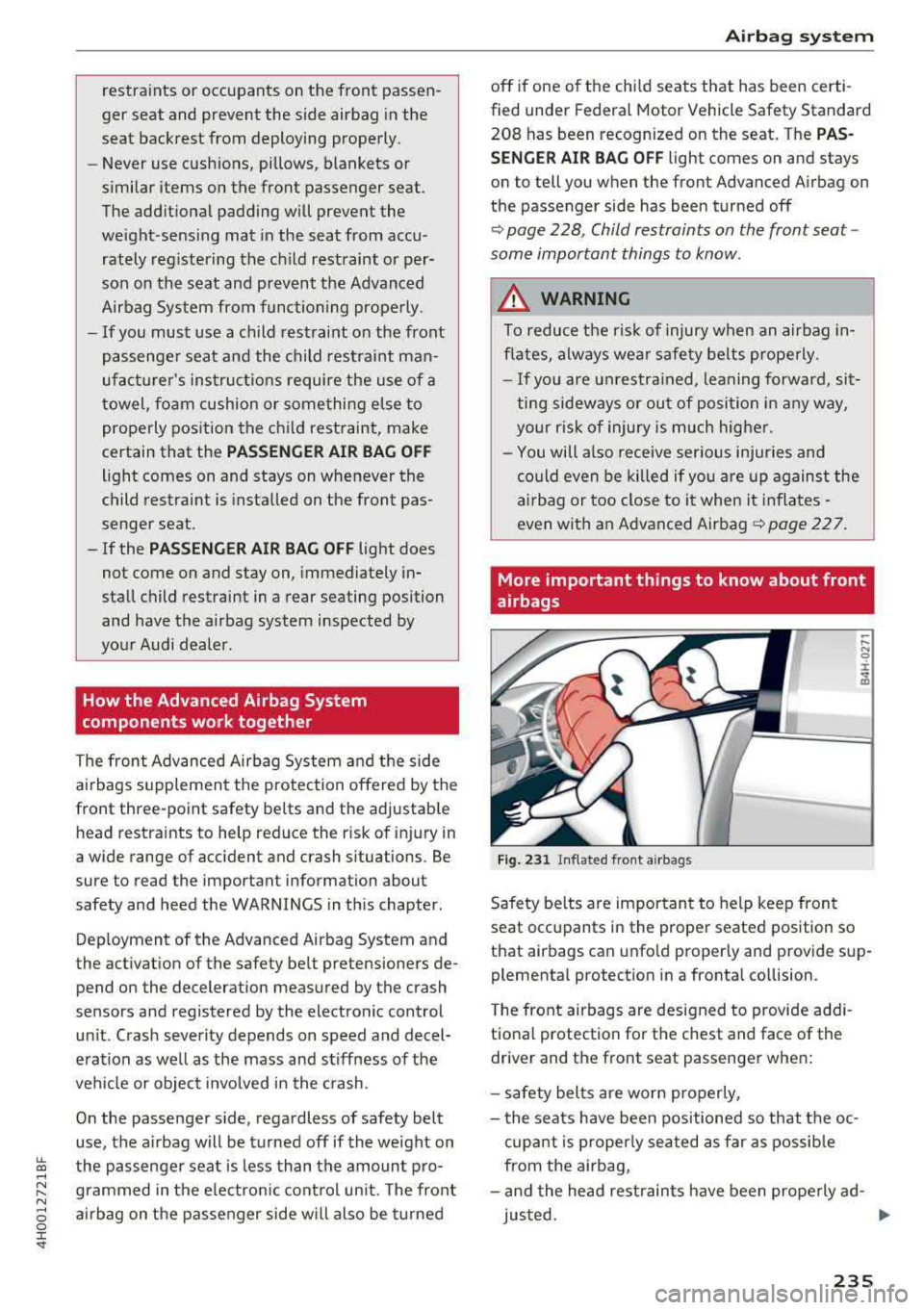
Fig. 231 Inflated front airbags
Safety belts are important to help keep front
seat occupants in the proper seated position so
that airbags can unfold properly and provide sup plemental protection in a frontal collision .
The front airbags are designed to provide addi
tional protection for the chest and face of the driver and the front seat passenger when:
- safety belts are worn properly,
- the seats have been positioned so that the oc-
cupant is properly seated as far as possible
from the airbag,
- and the head restraints have been properly ad-
justed .
.,.
235
Page 238 of 356
Airbag syste m
Because airbags inflate in the blink of an eye with
great force, things you have on your lap or have
p laced on the seat cou ld become dangerous pro
jectiles, and be pushed into you if the airbag in
flates .
When an airbag deploys, fine dust is re leased.
This is normal and is not caused by a fire in the
veh icle. Th is dust is made up mostly of a powder
used to lubricate the airbags as they deploy. It
could irr itate sk in .
It is important to remember that while the sup
p lemental a irbag system is designed to reduce
the likelihood of serious injuries, other injuries,
for example swelling, bruising and m inor abra
sions, can also happen when airbags inflate . A ir
bags do not protect the arms or the lower parts
of the body. Front a irbags supplement the th ree
point safety belts only in some fronta l co llisions
in which the veh icle decelerat ion is high enough
to deploy the airbags.
Front airbags will not deploy:
- i f the ign it ion is switched off when a crash oc-
c ur s,
- i n s ide collisions,
- in rear -end collisions,
- in rollovers,
- when the crash deceleration measured by the
airbag system is less than the minimum thresh
o ld needed for airbag deployment as registered
by the electronic control unit .
The front passenger airbag als o will not
deplo y:
- when the front passenger seat is not occupied,
- when the weight on the front passenger seat as
sensed by the Advanced A irbag System indi
cates that the front airbag on the passenger
s ide has to be turned off by the electronic con
trol unit (the
P A SSENGER AIR BAG OFF light
comes on and stays on).
_& WARNING
Sitting in the wrong pos ition can increase the
r is k of serious in jury in c rashes.
- To reduce the risk of inju ry when the airbags
inflate, the d river an d passengers must
al-
236
ways sit in an upright posit ion, must not
lean aga inst or place any part of their body
too close to the area where the airbags are
located.
- Occupants who are unbe lted, out of posit ion
or too close to the airbag can be serious ly
in jured by an airbag as it unfolds with g reat
force in the blink of an eye
~ page 228.
_& WARNING
A child in a rearward-facing child seat instal led on the front passenger seat will be seri
ously injured and can be killed if the front air
bag inflates
-even with an Advanced Airbag
System.
- The infla ting air bag will h it the ch ild seat o r
infan t ca rrier wi th great force and wi ll
smash the child seat and child against the
backrest, center armrest, door or roof .
- Always install rear -fac ing ch ild seats on the
rear seat.
- If you must install a rea rw ar d facing child
seat on the front passenger seat because o f
except ional circumstances and the
PASSEN·
GER AIR BAG OFF
light does not come on
and stay on, immed iate ly install the rear
facing chi ld seat in a rear seating posit ion
and have the airbag system inspected by
your Aud i dea le r.
_& WARNING
Objects between you and the airbag will in
crease the r is k of injury in a c rash by interfe r
ing wi th the way the airbag unfolds or by be
ing p ushed into you as the air bag infla tes.
- Never hold things in you r hands o r on your
lap when the veh icle is in use.
- Never transport items on or in the a rea of
the front passenge r seat. Objects could
move into the area of the front airbags dur
ing b raking or other s udden maneuvers and
become dangerous projectiles that can
cause serious persona l injury if the airbags
inflate.
- Never p lace or attach accessories or othe r
objects (such as cup holders, telephone brackets, large, heavy or bulky ob jects) on -
Page 240 of 356
Airbag syste m
The PASSENGER AIR BAG OFF light will come on
and stay on to tell you when the front Advanced
Airbag on the passenger side has been turned
off
by the electronic control unit. Each time you
sw itch on the ignit ion, the
P ASS ENGER AIR BAG
OFF
light will flash for a few seconds and:
- will stay on if the front passenger seat is not
occupied,
- will stay on if there is a small c hild or child re
straint on the front passenger seat,
- will go out if the front passenger seat is occu
pied by an adult as registered by the weight
sensing mat .
The
PA SSENGER AIR BAG OFF light mu st come
on and sta y on
if the ignition is on and
- a car bed has been insta lled on the front seat,
o r
- a rearward-fac ing child rest ra in t has been in
stalled on the front passe nger seat, or
- a fo rwa rd-facing child restra int has bee n in stal
led on the front passenger seat, o r
- the weight reg istered on the fro nt passenger
seat is equal to o r less than the comb ined
we ight of a typ ica l 1 yea r-old restrained in one
of the rear -facing or forward -fac ing infant re
straints listed in Federal Motor Vehicle Safety
Standard 208 with w hich the Advanced Airbag
System in your vehicle was certified.
I f t he front passenger seat is not occupied, the
front airbag wi ll not dep loy, and the
PASSENGER
AIR BAG OFF
light will stay on . Never insta ll a
rearward-facing child restraint on the front pas
senger seat, the safest p lace for a child in any
kind of child restraint is at one of the seating po
sitions on the rear seat
¢ page 228, Child re
straints on the front seat -some important
things to know
and ¢ page 249, Child safety.
If the PA SSENGER AIR BAG OFF light comes on
when one of the condit ions listed above is met,
be sure to check the light regularly to make cer
tain that the
P A SSENGER AIR B AG OFF light
s tays o n cont inuous ly wheneve r the ig nition is
on.
If the PA SSENGER AIR BAG OFF light does
not appear on and does not stay on all the time,
stop as soon as it is safe to do so and
238
- reactivate the system by switching the ignition
off and then switching it on again;
- remove and reinsta ll the chi ld restraint . Make
sure that the child restraint is properly insta l
led and that the safety belt for the front pas
senger seat has been correct ly routed through
the child restraint as described in the ch ild re
straint ma nufacturer's instruct ions;
- make sure that the convert ib le lock ing retrac
tor on the safety belt for the front passenger
seat has been activated and that the safety belt
has been pulled t ight. The belt must not be
loose or have loops of slack so that the sensor
be low the safety belt latc h on the seat can do
i t s
job¢ page 259 .
-make sure that th ings that may increase the
weight of the ch ild and c hild seat a re not be ing
transpo rted on the front passenge r seat;
- ma ke sure that t he safety be lt te nsion sensor is
not b locked. S hake the safety belt latch on the
front passenger seatback and forth;
- If a strap or tether is being used to t ie the child
seat to t he fron t passenger sea t, make s ure
that it is not so tight that it causes the weight
sensing mat to measure more weight than is
actually on the seat.
If th e PAS SENGER AIR BAG OFF light still do es
n o t come on
and does not stay on continuously
(when the ignition is switc hed on),
- take the child restra int
off the front passenge r
seat and insta ll it p roperly a t one of the rear
seat pos itions. Have the airbag system inspect
ed by yo ur Audi dealer immediate ly .
- move the ch ild to a rear seat pos ition and m ake
sure that the child is proper ly restrained in a
child restraint that is appropriate for its size
and age .
The
PASSENGER AIR BAG OFF lig ht sho uld NOT
come on when t he ignit ion is on and an ad ult is
sitting in a proper seating position on the front
passenger seat. If the
PASSENGER AIR BAG OFF
li ght comes on and stays on or flashes for about
5 seconds while dr iv ing, under these c ircumstan
ces, make sure that:
- the adult on the front passenger seat is proper-
ly seated on the center of the seat cushion with
..,.
Page 241 of 356
u. co ..... N
" N ..... 0 0 :c '
backrest is not reclined ¢
page 209, Correct
passenger seating positions,
- the adult is not taking weig ht off the seat by
holding on to the passenger assist handle
above the front passenger door or supporting
their we ight on the armrest,
- the safety be lt is being properly worn and that
there is not a lot of slack in the safety belt web
bing,
- accessory seat covers or cushions or other
th ings that may cause an incorrect read ing or
impression on the weight-sens ing mat under
the upholstery of the seat have been removed
from the front passenge r seat,
- a safety belt extender has not been left in the
safety belt latch for the front passenger seat.
In addition to the
PASSENGER AIR BAG OFF
light in the center of the instrument panel, the
message
PAS SENG ER AIR BAG OFF or PAS SEN
GER AIR BAG ON
w ill br iefly appear in the instru
ment cluster display . T his is to inform the dr iver
of the curre nt front passenge r airbag status.
Important safety instructions on
monitoring the Advanced Airbag System
A WARNING
An airbag system that is not funct ioning prop
erly cannot provide supplemental p rotection
in a frontal crash .
- If the airbag indicator l ight¢
page 23
comes when the vehicle is be ing used, have
the system inspected immed iate ly by yo ur
au thori zed Au di dealer. It is possible that
the a irbag will in flate when it is not s up
posed to, or will not inflate when it shou ld .
A WARNING
If the front airbag inflates, a child without a
child restraint, or in a rearward-facing child
safety seat, or in a forward-facing child re
straint that has not been properly installed
w ill be seriously injured and can be killed.
- Even though your veh icle is equipped with
an Advanced Airbag System, make certain
that all ch ild ren, especially 12 years and
Airbag syste m
younger, always ride on the bac k seat prop
erly rest rained for the ir age and s ize.
- Always install forward or rea r-facing child
seats on the rea r seat
-even w ith an Ad
vanced Airbag System.
- If you must install a rea rward-facing child
seat on the front passenger seat because o f
except ional circumstances and the
PASSEN
GER AIR BAG OFF
light does not appear and
s tay on, immed iate ly ins tall the rea r-facing
child sea t in a rear seat ing pos ition and have
the airbag system inspected by your Audi
deale r.
- A tight tether or other strap on a rearward
facing ch ild restraint attached to the front
p a ssenger se at c an put too much pressure
on the weight-sensing mat in the seat and
register more weight than is actually on the
seat . The heav ier weight registered can
make the system work as though an adu lt
were on the seat and deploy the Advanced
Airbag when it must be suppressed causing
serio us or even fatal injury to the child .
- If, in exceptional circumstances, you must
install a forward-facing child restraint on
the front passenge r seat, always move the
seat into its rearmost position in the seat 's
fore and aft ad justment range, as far away
from the airbag as poss ible. The back res t
m ust be adjusted to an upr igh t position.
Make sure that the
PASSENGER AIR BAG
OFF
li ght comes on and stays on all the time
wheneve r the ignit ion is switched on.
A WARNING
--
- If the PASSENGER AIR BAG OFF light does
not go out when an adult is sitting on the
front passenger seat after tak ing the steps
described above, make sure the adult is p roperly sea ted and restra ined a t one of the
rear sea ting posit ions.
- Have the ai rbag system inspected by your
Aud i deale r before transpo rting anyone on
the front passenge r seat.
239
Page 243 of 356
lL t:0 ....
"' ......
"' .... 0 0 :c '
Undeployed airbag modu les and pretension
ers might be classified as Perch lorate Materi
al· special handling may apply, see
www.dtsc .ca.gov/hazardouswaste/
perchlorate. When the vehicle or parts of the
restraint system including a irbag modules
and safety belts with p retensioners are scrap·
ped, a ll applicable laws and regu lations must
be observed. Your a uthorized Audi dealer is
familiar w ith these requirements and we rec
ommend that you have yo ur dealer perform
this service for you .
Other things that can affect Advanced
Airbag performance
Changing the vehicle's suspension system can
change the way that the Advanced Airbag System pe rforms in a crash. For examp le, using tire-r im
comb ina tions not approved by Audi, lowering the
veh icle, chang ing the s tiffness of the suspens ion,
including the springs, suspension struts, shock
absorbers etc . can change the forces that are
measured by the airbag sensors and sent to the
e lectronic contro l unit . Some suspension changes
can, for example, increase the force levels meas
ured by the sensors and make the airbag system
deploy in crashes in wh ich it would not deploy if
the changes had not been made . Other ki nds of
changes may reduce the fo rce levels measured by
the sensors and preven t the airbag from deploy
ing when i t should.
A WARNING
Changing the vehicle's suspension including
use of unapproved tire-rim combinations can
change Advanced Airbag performance and in
crease the risk of serious personal injury in a
crash.
-Never install suspens ion components that
do not have the same performance charac
teristics as the components originally instal
led on your veh icle.
-Never use tire-rim combinations that have
not been approved by Audi.
Airbag system
A WARNING
Items stored between the safety belt buckle
and the center console can cause the sensors i n the buckle to send the w rong information
to the electronic control modu le and prevent
the Advanced A irbag System from wo rking
p roperly.
- Always make sure that nothing can interfe re
with the safety belt buckles and that they
are not obstructed.
Knee airbags
Description of knee airbags
The knee airbag system can provide supplemen
tal protection to properly restrained front seat
occupants.
F ig . 233 Dr ive r's knee airbag
T he driver knee airbag is in the ins trument panel
u nderneath the steer ing
whee l~ fig. 233, the
airbag fo r the passe nger is at abou t the same
height in the instr ument pane l underneath the
glove compartment.
The knee airbag offers add itional protection to
t h e driver 's and passenger's knees and uppe r and
lower thigh areas and supplements the protec
t ion prov ided by the safety be lts .
If the front airbags deploy, the knee airbags also
deploy in frontal collis ions when the deployment
threshold stored in the control unit is met
~ page 235, More important things to know
about front airbags.
In add ition to their normal sa fety f unct ion, safe-
ty be lts he lp keep the driver or front passenge r in
..,.
241
Page 244 of 356
Airbag system
position in a frontal collision so that the airbags
can provide supplemental protection .
The airbag system is not a substitute for your
safety belt. Rather, it is part of the overall occu
pant restraint system in your vehicle. Always re
member that the airbag system can only help to
protect you if you are wearing your safety belt
and wearing it properly . This is why you should
always wear your safety belt, not just because
the law requires you to do
so c:> page 219, Gener
al information .
Remember too, airbags will deploy only once and
only in certain kinds of accidents
-your safety
belts are always there to offer protection in those
accidents in which airbags are not supposed to
deploy or when they have already deployed, for
example when your vehicle str ikes or is struck by
another after the first collis ion.
This is just one of the reasons why an airbag is
not a substitute for the safety belt. The airbag
system works most effectively when used with
the safety belts . Th erefore , always wear your
safety belts correctly.
It is important to remember that while the sup
p lemental knee air bag system is des igned to re
duce the likelihood of serious injuries, other inju
ries, for example, swelling, bruising and minor
abrasions and friction burns can also occur when
an airbag inflates .
The knee airbag system basically consists of:
- The electronic control module
- Two inflatable airbags (airbag and gas genera-
tor), one for the driver and one for the front
passenger
- The airbag indicator light in the instrument
pane l
The knee airbag system will not deploy:
-when the ignition is switched off
- in frontal collisions when the deceleration
measured by the control unit is too low
- in side collisions
- in rear-end collisions
- in rollove rs
242
-in the event of a system malfunction (warning/
indicator light is
on) ¢ page 23 .
A WARNING
-Safety belts and the airbag system can only
provide protect ion when occupants are in
the proper seating position
r::;> page 235 .
- If the airbag indicator light c:> page 23
comes when the vehicle is being used, have
the system inspected immediately by your
author ized Audi dealer. It is possible that
the airbag will inflate when it is not sup
posed to, or will not inflate when it should.
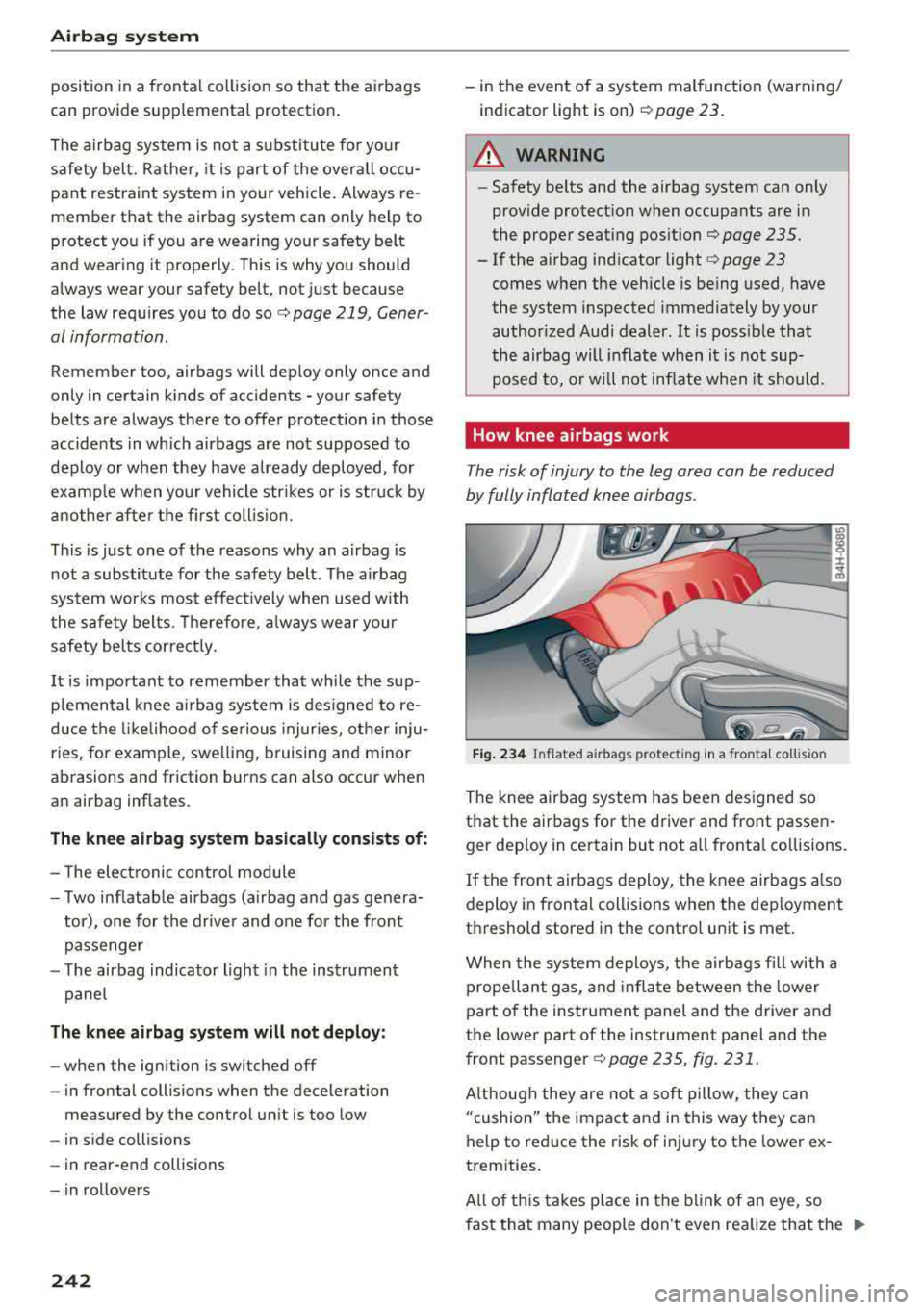
How knee airbags work
The risk of injury to the leg area can be reduced
by fully inflated knee airbags .
Fig. 234 Inflated a irbags protec ting in a fronta l co llis io n
The knee airbag system has been designed so
that the airbags for the driver and front passen
ger dep loy in certain but not all fronta l collisions.
If the front airbags deploy, the knee airbags also
deploy in frontal collisions when the deployment
threshold stored in the control unit is met .
When the system deploys, the airbags fill with a
prope llant gas, and inflate between the lower
part of the instrument panel and the driver and
the lower part of the instrument panel and the
front passenger
c:> page 235 , fig. 231.
Although they are not a soft pillow, they can
"cushion" the impact and in this way they can
help to reduce the risk of inj ury to the lower ex
tremities.
All of this takes pla ce in the blink of an eye, so
fast that many people don't even realize that the
.,,.
Page 245 of 356
lL t:0 ....
'"" ......
'"" .... 0 0 :c '
with a great deal of force and it is important for
occupant safety that nothing should be in their
way when they deploy .
Full y inflated airbags in comb ination with proper
ly worn safety belts slow down and limit the oc
cupant's forward movement and help to reduce
the risk of injury.
Important safety instructions on the knee
airbag system
Airbags are only supplemental restraints. Always
wear safety belts correctly and ride in a proper
seating position .
There is a lot that you and your passengers must
know and do to help the safety belts and airbags
to provide supplemental protection .
A WARNING
An inflating knee airbag can cause serious in
jury. Wearing safety belts incorrectly and im
proper seating positions increase the risk of
serious personal injury and death whenever a
vehicle is being used.
- The knee airbag system cannot protect you
properly if you are seated too close to any of
the airbag locations. When adjusting their
seat positions, it is important that both the
driver and the front passenger keep their
upper bodies and knees at the following
minimum safe distances :
- at least 10 inches (25 cm) between the
chest and the steering wheel/instrument
panel.
- at least 4 inches (10 cm) between the
knees and the lower part of the instru
ment panel.
- The risk of personal injury increases if you
lean forward or to the side, or if the seat is
improperly positioned and you are not wear
ing your safety belt. The risk increases even
more should the airbag deploy.
-Always make sure that the knee airbag can inflate without interference. Objects be
tween you and the airbag can increase the risk of injury in an accident by interfering
Airbag system
with the way the airbag deploys or by being
pushed into you as the airbag deploys.
- Never let anybody, especia lly children or
animals r ide in the footwell in front of the
passenger seat. If the airbag deploys, this
can result in serious or fatal injuries.
- Never carry objects of any kind in the foot
well area in front of the driver's or pas
senger's seat . Bulky objects (shopping
bags, for example) can interfere with or
prevent proper deployment of the airbag.
Small objects can be thrown through the
vehicle if the airbag deploys and injure you
or your passengers.
- Make sure there are no cracks, deep scratch
es or other damage in the area of the instru
ment panel where the knee airbags are lo
cated.
- If children are incorrectly seated, their risk
of injury increases in a collision
<=> page 249, Child safety .
Side airbags
Description of side airbags
The airbag system can provide supplemental
protection to properly restrained occupants.
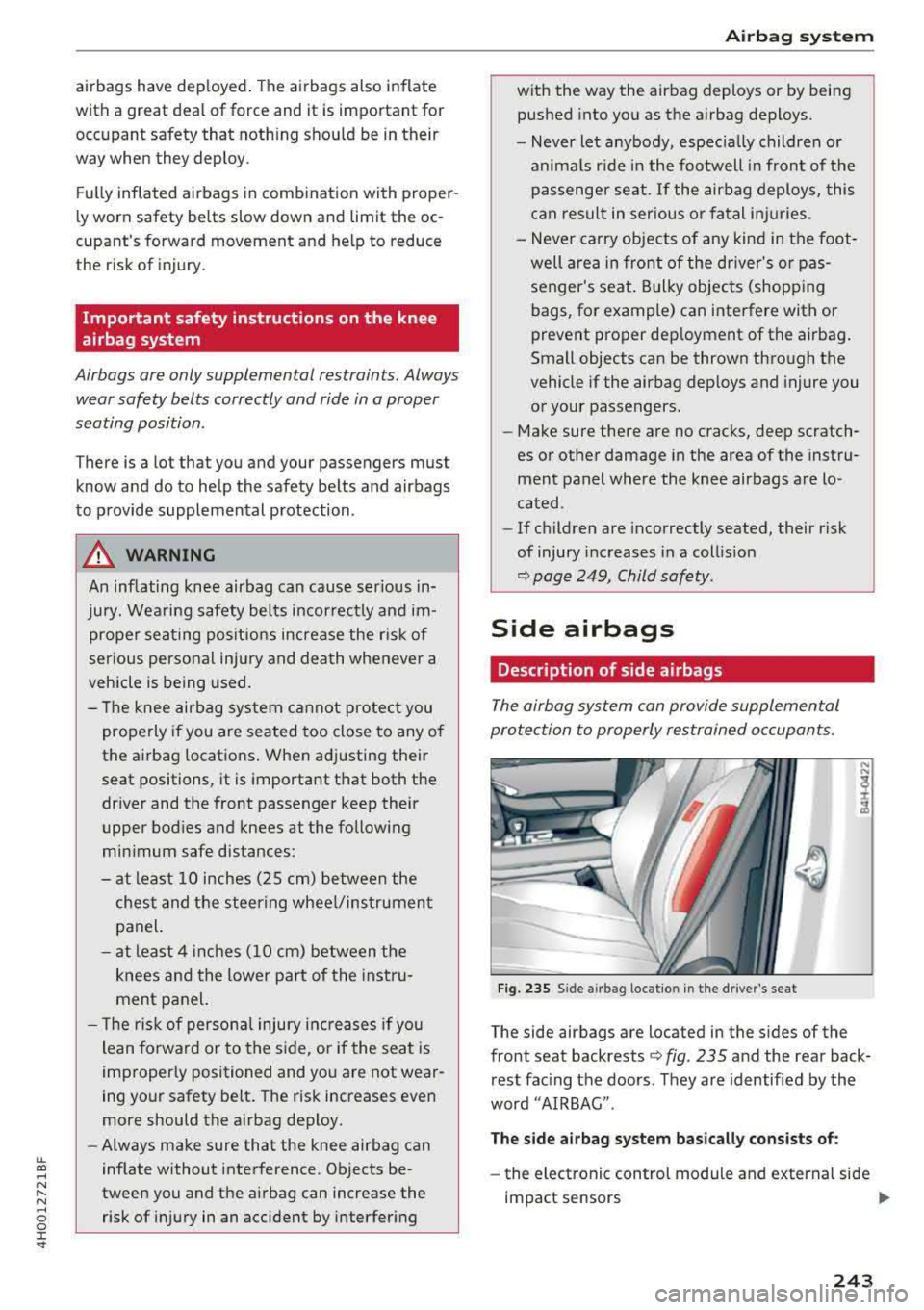
Fig. 235 Side a irbag locatio n in the driver's seat
The side airbags are located in the sides of the
front seat backrests
<=> fig . 235 and the rear back
r est facing the doors . They are identified by the
word "AIRBAG" .
The side airbag system basically consists of:
-the electronic control module and external side
impact sensors
.,..
243