warning lights AUDI A8 2018 Owner's Guide
[x] Cancel search | Manufacturer: AUDI, Model Year: 2018, Model line: A8, Model: AUDI A8 2018Pages: 356, PDF Size: 54.71 MB
Page 144 of 356
Voice recognition s ystem
Voice recognition system
Operating
A pplies to: ve hicles w ith vo ice recognition system
You con operate many Infotainment functions
conveniently by speaking.
R equirement: the ignition and the MM I must be
switched
on <=> page 135, there must be no phone
call in progress and the parking system m ust not
be active .
~ Switching on : briefly press th e ~ button @
<=> page 11, fig. 7 on the multifunction steering
whee l* and say the desired command after the
Beep .
~ Sw itching off : press and hold the~ button.
Or: press any button on the MMI control panel.
~ Canceling : press the~ button a nd say a new
command.
Or: say the command Cancel.
Input assis tance
The system gu ides you through the input with
visual and audio feedback .
-Vi sual inpu t as sistan ce : after t urning on voice
recognition, a d isp lay with a select ion of possi
ble commands appears in the Infotainment dis
play . The command d isplay can be turned on or
off in the ma in menu using the
MMI setup con
trol button .
-Audio input a ssistance : to have the poss ible
comma nds read, turn the voice recogn ition sys
tem on and say
Help.
For the s ystem to understand you:
Speak clearly and dist inct ly at a normal volume.
Speak louder when driving faster.
Emphasize the words in the commands even ly
and do not leave long pauses.
Do not speak a command when t he voice recogni
tion system is making an anno uncement.
C lose t he doors, the windows a nd the sunroof* to
reduce bac kg round noise . Make s ure t hat passen
gers a re not speaking when yo u are giving a voice
command.
142
Do not d irect the air vents toward the hands -free
microp hone, which is on the roof headliner nea r
t h e front interior lights .
Only use the system from the dr ive r's seat be
ca use the hands -free microphone is directed to
ward that seat .
Additional settings
Additional settings, s uch as individual speech
training
based on yo ur voice, Display sp eech
command s
or the prompt volume , can be adjust
ed in the main menu using the
MMI setup con
tro l button
<=> page 206.
A WARNING
- Direct your full attention to dr iv ing. As the
driver, you have complete responsibility for
safety in traff ic. On ly use the functions in
such a way that you a lways maintain com
p lete co ntro l over your veh icle in all traff ic
situat ions.
- Do not use the voice recognition system in
emergencies beca use your voice may change
in st ressfu l situ at ions.
It may t ake longe r to
d ial t he number or th e sys tem m ay no t be
a bl e to d ial it a t all. Dia l th e emer gen cy
number manually.
© Tips
- Th e dia log pauses w hen the re is a n in com
ing pho ne call and will con tinue if you ig
nore the call. T he dialog en ds if yo u answer
t h e ca ll.
- Yo u ca n sele ct an i tem in the list using ei
ther the vo ice recognit ion sys tem o r the
cont ro l knob .
Command overview
information
App lies to: vehicles wit h voice recog nitio n syste m
The following overv iews describe the commands
that can be used to operate the MMI using the
vo ice recog nition system .
A lternative commands are separated by a
" I" , for
example, say:
Telephone I (or) Na vigation I (or)
R adio .
Page 168 of 356
Navigation
Navigation
Opening navigation
Applies to: vehicles with navigation system
The navigation system directs you to your desti
nation , around traffic incidents and on alterna
tive routes, if desired .
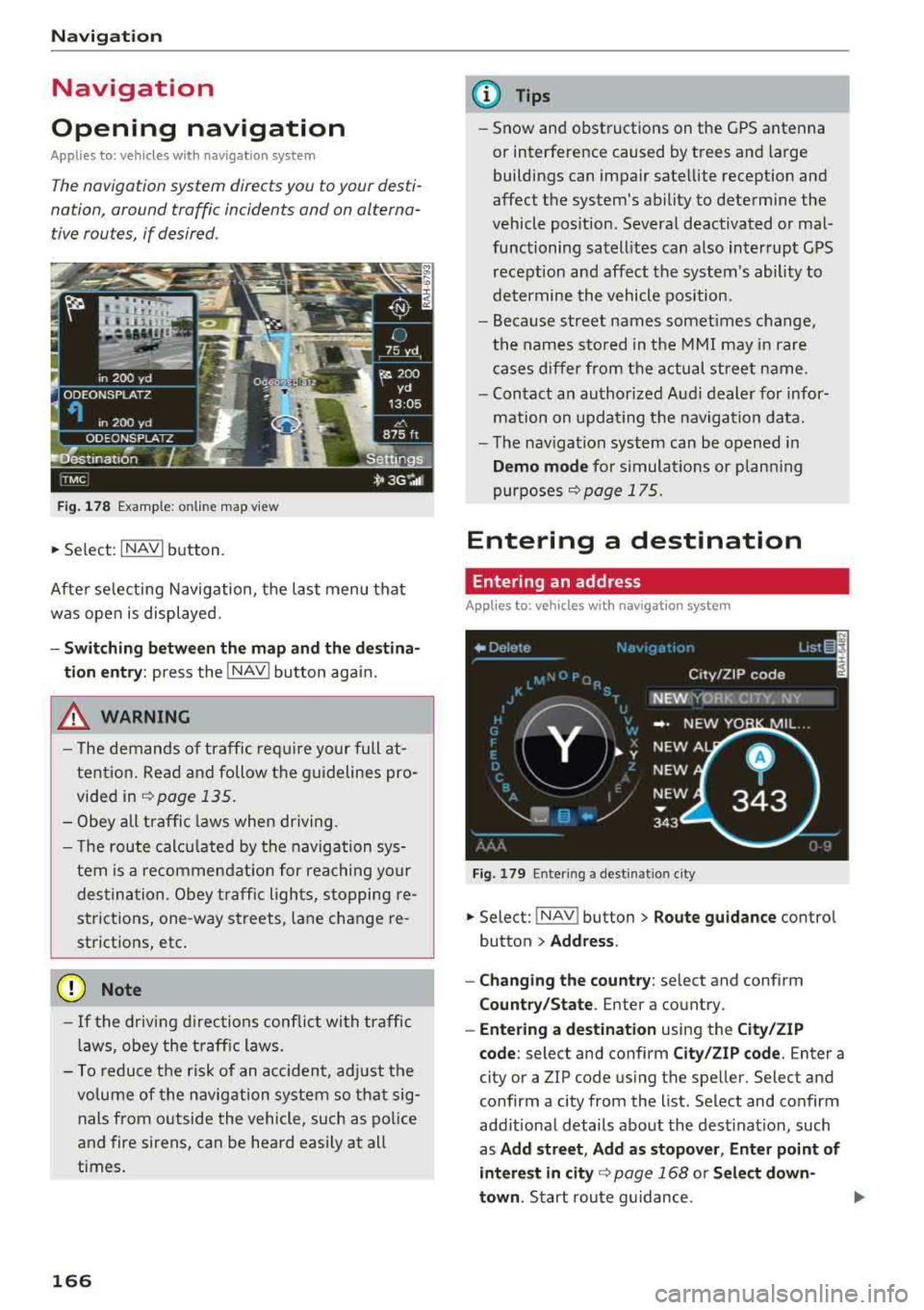
Fig. 178 Example: on lin e map v iew
.. Select : INAVI button.
After selecting Navigation, the last menu that
was ope n is displayed.
- Switching between the map and the destina
t ion entry:
press the !NAV ! button again.
,&. WARNING
-The demands of traffic require your full at
tention. Read and follow the guidelines pro
vided in
i=;,poge 135.
-Obey all traffic laws when driving.
- The route calcu lated by the navigation sys-
tem is a recommendat ion for reaching your
destination. Obey traffic lights, stopping re
strictions, one-way streets , lan e change re
strictions, etc.
@ Note
- If the driving directions conflict with traffic
laws, obey the traffic laws.
- To reduce the risk of an accident, adjust the
volume of the navigation system so that sig
nals from outside the vehicle, such as police
and fire sirens, can be heard easily at all
times.
166
.
@ Tips
- Snow and obstructions on the GPS antenna
or interference caused by trees and large
buildings can impair satellite reception and
affect the system's ability to determine the
vehicle position. Several deactivated or mal
functioning satellites can also interrupt GPS reception and affect the system's ability to
determine the vehicle position .
- Because street names somet imes change,
the names stored in the MMI may in rare
cases differ from the actual street name.
- Contact an authorized Audi dealer for infor
mation on updating the navigation data.
- The navigation system can be opened in
Demo mode for s imulations or plann ing
purposes
re;, page 175.
Entering a destination
Entering an address
Applies to : vehicles with navigat ion system
Fig . 179 En ter ing a destina tion city
.. Select: !NAV ! button > Route guidance contro l
button
> Address .
- Changing the country:
select and conf irm
Country/State . Enter a country .
- Entering a destination using the City/ZIP
code:
select and confirm City/ZIP code. Enter a
city or a ZIP code using the spe ller. Select and
confirm a city from the list. Select and confirm
add itional details about the dest ination, such
as
Add street , Add as stopover, Enter point of
interest in
city re;, page 168 or Select down
town .
Start route guidance.
Page 210 of 356
Drivin g saf ety
Driving safety
Basics
Safe driving habits
Please remember -safety first!
The individua l safety features of your vehicle can
work together as a system to help protect you
and your passengers in a wide range of accidents.
These features cannot work as a system if they
are not always correctly adjusted and correctly
used .
This chapter contains important informat ion,
tips, instruct ions and warn ings that you need to
read and observe for your own safety, the safety
of you r passengers and others . We have summar
ized here w hat you need to know about safety
be lts, a irbags, child restra ints as well as child
safety. Yo ur safety is for us
priority number 1. Al
ways observe the information and warnings in
this section -for your own safety as we ll as that
of your passengers.
The information in this section applies to all
model versions of your vehicle . Some of the fea
tures described in this sections may be standard
equipment on some models, or may be optional
equ ipment on others. If you are not sure, ask
your author ized Audi dealer.
A WARNING
- Always make sure that you follow the in
structions and heed the WARNINGS in th is
Manua l.
It is in your interest and in the in
te rest of your passengers .
-
-Always keep the complete Owner's Litera
tu re in you r A udi when you lend or se ll you r
vehicle so that this import ant information
will always be available to the d river and
passengers.
- Always keep the Owner 's lite rature h andy so
that you can find it easily if you have ques
tions .
208
Important things to do before driving
Safety is everybody's job! Vehicle and occupant
safety always depends on the informed and care
ful driver .
For your safety and the safety of your passen
gers,
bef ore dri ving alw ays:
.. Make sure that a ll lights and signals are operat
ing correctly .
.. Make sure that the tire pressure is correct.
.. Make sure that all windows are clean and afford
good vis ibility to the outs ide .
.. Sec ure all luggage and othe r items ca refully
¢ page 65, ¢page 63 .
.. Make sure tha t noth ing ca n interfere wi th the
peda ls .
.. Adjust front seat, head restraint and mirrors
correctly for your height.
.. Instruct passengers to adjust the head re
straints according to their he ight.
.. Make sure to use the right child restraint cor
rectly to protect
children ¢ page 249, Child
safety .
• Sit proper ly in yo ur seat a nd make sure t hat
your passenge rs do the same
¢ page 54, Seats
and storage.
.. Fasten your sa fety belt and wear it p roperly . Al
so instruct your passengers to fasten their safe
ty be lts properly
¢ page 219 .
What impairs driving safety?
Safe driving is directly related to the condition of
the vehicle, the driver as well as the driver's abili
ty to concentrate on the road without being dis
tracted.
The driver is responsib le for the safety of the ve
hicle and a ll of its occupants. If your ability to
drive is impa ired, safety risks for everybody in the
vehicle increase and you a lso become a hazard to
everyone else on the road
¢ _&. . Therefore:
.. Do not let yourse lf be distracted by passenge rs
or by using a cellular telephone .
.. NEVER drive when your driving ability is im
paired (by med ications, alcohol, drugs, etc .) .
.. Observe all traffic laws, rules of the road and
speed lim its and plain common sense .
.,.
Page 221 of 356
u. co .... N
" N .... 0 0 :c '
General information
Always wear safety belts!
Wearing safety belts correctly saves lives!
This chapter explains why safety be lts are neces
sary, how they work and how to adjust and wear
them correctly.
~ Read all the information that follows and heed
all of the instructions and WARNINGS.
A WARNING
Not wearing safety belts or wearing them im
properly increases the risk of serious personal
injury and death.
- Safety belts are the s ingle most effective
means ava ilable to reduce the risk of serious
injury and death in automobi le accidents.
For your protection and that of your passen
gers, always co rrect ly wea r safety be lts
w hen the veh icle is mov ing.
- Pregnant wome n, in ju red, o r physically im
paired persons mus t also use safety be lts.
Lik e al l vehicle oc cupan ts, they are mo re
li kely to be serio usly injured i f th ey do no t
wear safety be lts . The best way to protect a
fetus is to protect the mothe r -throug hout
the ent ire pregnancy.
Number of seats
Your Aud i has a total of five seating positions:
two in the front and three in t he rear. In some
veh icles, there are four seat ing positions: two in
the fro nt and two in the rear . Each seati ng posi
tion has a safety belt.
A WARNING
N ot we aring safety bel ts or wear ing them im
pro perly in cre ases the risk of ser io us pe rsonal
inju ry and dea th.
- Never st rap more th an one pe rso n, includ
ing sm all c hildr en, in to any be lt.
It is espe
c ially dangerous to place a safety belt over a
child sitting on your lap .
Safet y be lts
- Never let more peop le r ide in the vehicle
than there are safety be lts available.
- Be s ure everyone riding in the vehicle is
proper ly restrained w ith a separate safety
be lt or ch ild restraint.
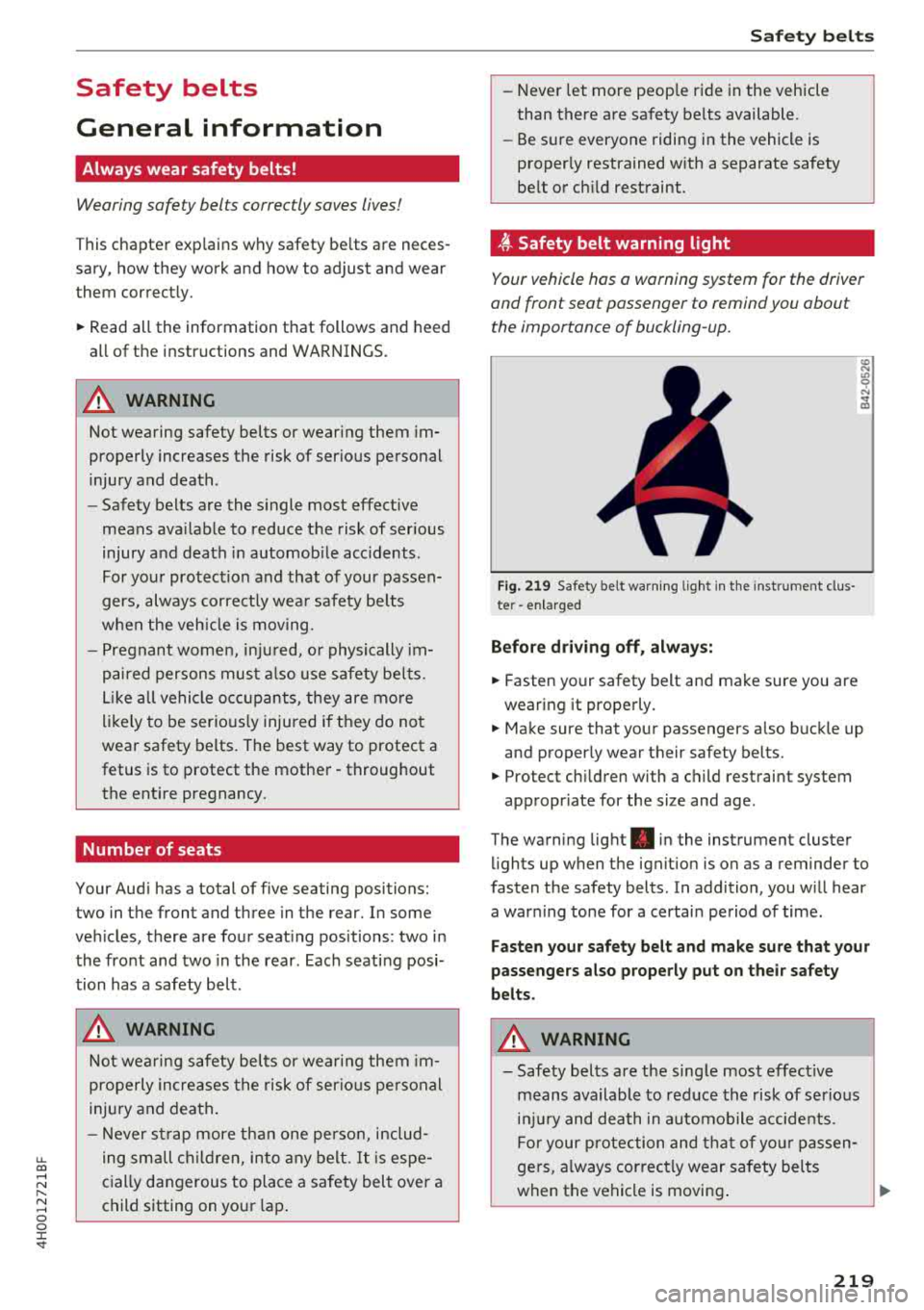
,ff. Safety belt warning light
Your vehicle has a warning system for the driver
and front seat passenger to remind you about
the importance of buckling-up.
F ig. 21 9 Safety belt warnin g lig ht in t he inst rument clus·
te r -en larged
Befor e dr ivi ng off , always :
~ Fasten your safety belt and make sure you are
wearing it properly.
~
~ Make sure that your passengers a lso buckle up
and properly wear their safety belts.
~ Protect ch ildren with a c hild restraint system
appropr iate for the size and age .
The warning lig ht . in the instrument cluster
lights up when the ignit ion is on as a reminder to
fasten the safety belts . In addition, you will hear
a war ning tone for a certai n period of time .
Fasten your safet y belt and make su re that your
passengers also properly put on their safety
b e lts .
A WARNING
-
-Safety bel ts are the sing le m ost effec tive
means available to red uce the risk of ser io u s
i njur y and death in a utomob ile accidents.
F or your p rotection and that of yo ur passen
ge rs, always correc tly wear safety bel ts
when the vehicle is moving .
~
219
Page 303 of 356
lL t:0 ....
"" ......
"" .... 0 0 :c '
malfunction indicator to indicate when the sys
tem is not operating properly. The TPMS mal
function indicator is combined with the low tire
pressure telltale. When the system detects a
malfunction, the telltale will flash for approxi
mately one minute and then remain cont inuously
illuminated . This sequence will continue upon
subsequent vehicle start-ups as long as the mal
function ex ists.
When the malfunction indicator is illuminated,
the system may not be ab le to detect or signal
low tire pressure as intended . TPM S malfunctions
may occur for a var iety of reasons, including the
installation of replacement or alternate tires or
wheels on the vehicle that prevent the TPMS
from functioning properly. Always check the
TPMS malfunction telltale after replacing one or
more tires or wheels on your vehicle to ensure
that the replacement or alternate tires and
wheels allow the TPMS to continue to function
properly.
If the Tire Pressure Monitoring System
indicator appears
Applies to: AS, 58
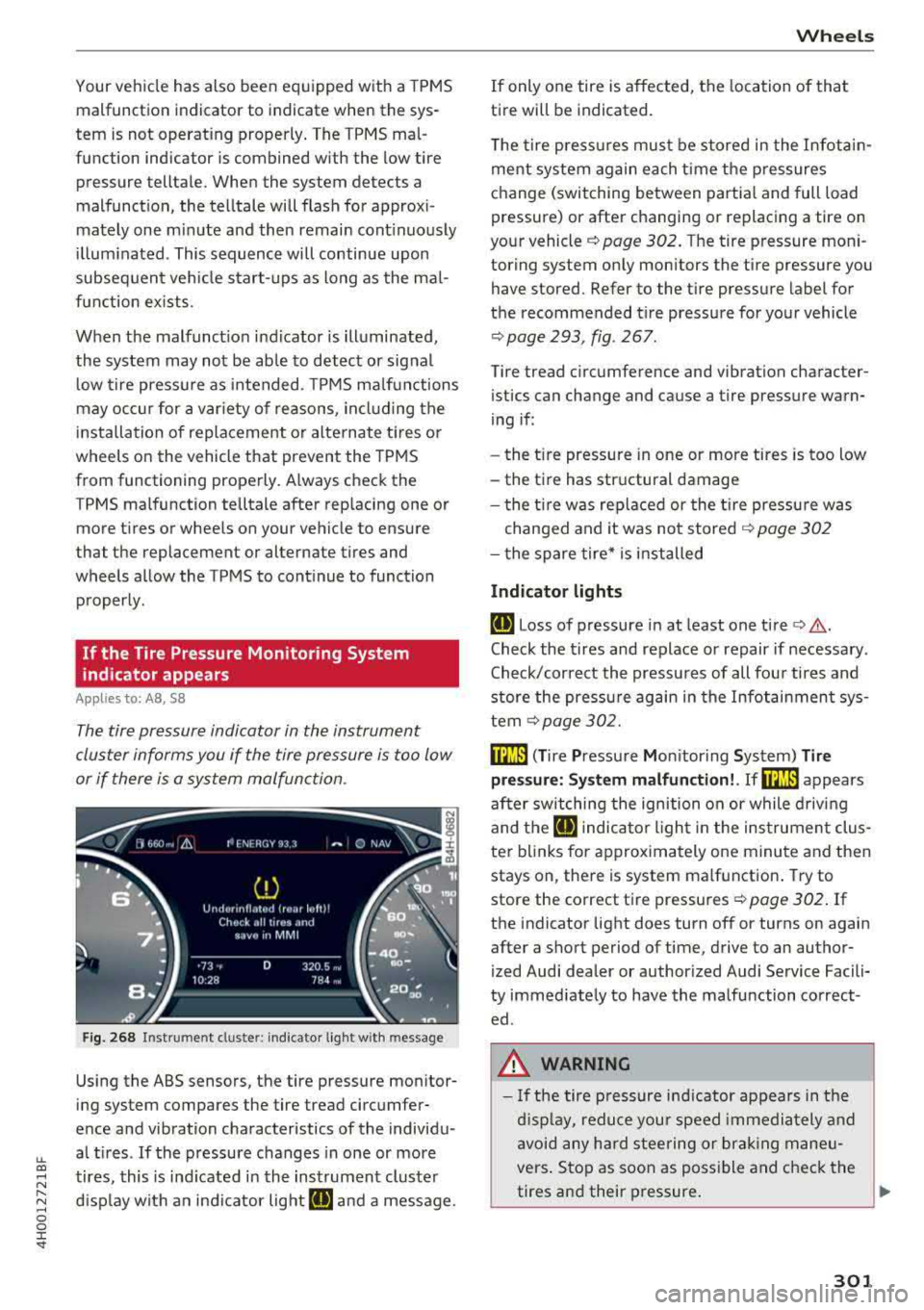
The tire pressure indicator in the instrument
cluster informs you if the tire pressure is too low
or if there is a system malfunction .
Fig. 268 Instrument clus ter: indicator light with message
Using the ABS sensors, the tire pressure monitor
ing system compares the tire tread circumfer
ence and vibration characteristics of the individu
al tires . If the pressure changes in one or more
tires, this is ind icated in the instrument cluster
display with an indicator light
ti] and a message .
Wheels
If only one tire is affected, the location of that
tire will be indicated.
The tire pressures must be stored in the Infotain
ment system again each time the pressures
change (switching between partial and full load
pressure) or after changing or replacing a tire on
your vehicle
c:> page 302. The tire pressure mon i
toring system only monitors the tire pressure you
have stored. Refer to the tire pressure label for
the recommended tire pressure for your vehicle
c:> page 293, fig . 267 .
Tire tread circumference and vibration character
istics can change and cause a tire pressure warn
ing if :
- the t ire pressure in one or more tires is too low
- the tire has structural damage
- the tire was replaced or the tire pressure was
changed and it was not stored
c:> page 302
- the spare tire* is installed
Indicator lights
ti] Loss of pressure in at least one tire c:> ,&..
Check the tires and replace or repair if necessary.
Check/correct the pressures of all four tires and
store the pressure again in the Infotainment sys
tem
c:>page 302.
mm ( T ire Pressure Monitor ing System) Tire
pressure: System malfunction!. Ifm:m appears
after switching the ignition on or while driving
and the
ti] indicator light in the instrument clus
ter blinks for approximately one minute and then
stays on, there is system malfunction. Try to
store the correct tire pressures
c:> page 302. If
the indicator light does turn off or turns on again
after a short period of time, drive to an author
ized Audi dealer or authorized Audi Service Facili
ty immediately to have the malfunction correct ed .
.&, WARNING
- If the tire pressure ind icator appears in the
display, reduce your speed immediately and
avoid any hard steering or braking maneu
vers. Stop as soon as possible and check the
tires and their pressure.
..,.
301
Page 306 of 356
Wheels
~ WARNING
Read and follow the important information
and notes ¢
page 303.
© Tips
The tire pressure or tem perature a re not di s
played in ada pta tion mode. Da shes --.-- a re
shown in place of the press ure and tempera
ture .
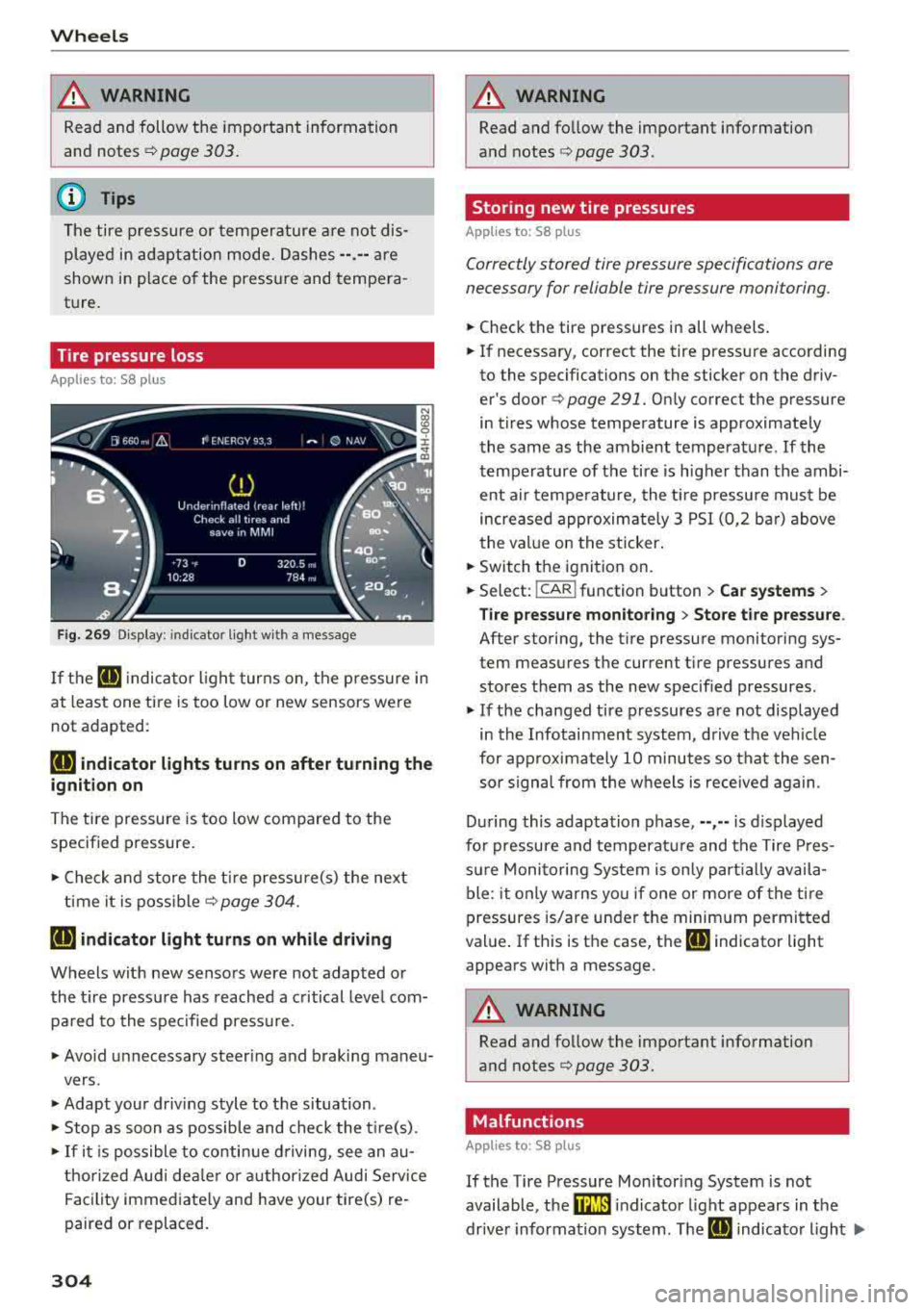
Tire pressure loss
Applies to: 58 plus
F ig. 269 D isp lay: ind icator light wi th a message
-
If the IE indica to r li ght turns on, the p ressure in
at least one ti re is too low or new sensors were
not adapted :
RE indicator lights turns on after turning the
ignition on
The tire pressure is too low compared to the
specif ied pressure .
.,. Check and store the t ire pressure(s) the next
ti me it is poss ible¢
page 304 .
RE indicator light turns on while driving
Wheels with new senso rs were not adapted or
the t ire pressu re has reached a c ritical leve l com
p ar ed to the specified press ure.
.,. Avo id unnecessary steering and braking maneu-
vers .
.,. Adapt you r d riving style to the situation .
.,. Stop as soon as possible and check the t ire(s) .
.,. If it i s po ssible to co nti nu e d riving, see an au-
t horized Audi dea le r or a uthorized Audi Service
Fa cility immed iate ly and have your tire(s) re
paired or replaced.
304
A WARNING
, -
Read and fo llow the important information
and notes
¢ page 303.
Storing new tire pressures
App lies to: 58 pl us
Correctly stored tire pressure specifications are
necessary for reliable tire pressure monitoring.
.,. Check the tire pressures in all wheels .
-
.,. If necessary , correct the tire press ure according
to the specifications on the sticker on the driv
er's doo r
q page 291. On ly co rrect t he pressure
in t ires whose tempe rature is appro ximate ly
the same as the ambient tempera ture. If the
tempe rature of the tire is higher than the ambi
ent air tempe rature, the t ire pressure must be
i n creased approxim ate ly 3 PSI (0 ,2 ba r) above
the val ue on the sticker .
.,. Switch the ignitio n on .
.,. Select: !CAR ! function button > Car systems >
Tire pressure mon itoring > Sto re tire pressure .
After storing, the t ire pressu re monitoring sys
tem measures t he current t ire pressures and
s to res them as the new specif ied pressures .
.,. If the changed tire p ressures are not displayed
in the Infotainment system, d riv e the veh icle
for approximately 10 minutes so that the sen so r signa l from the w heels is received again.
D ur ing this adapta tion phase, --,--is displayed
fo r pressure and temperat ure and t he Tire Pres
su re Moni toring Sys tem is on ly p arti all y av ail a
ble: it only warns yo u if one or more of the tire
pressures is/are under t he minim um permitted
val ue. If th is is the case, the
IE indicator light
appears with a message .
A WARNING
Read and follow the important information
and notes
q page 303.
Malfunctions
App lies to: 58 plus
-
If the Tire Pressure Mon itoring System is not
available, t he
mm indicato r light appears in the
dr ive r informa tion system . T he
IE indica to r light .,..
Page 309 of 356
u. co .... N
" N .... 0 0 :c '
-Only wash the vehicle when the ignition is
off and follow the instructions from the car
wash operator to reduce the risk of acci
dents.
-To reduce the risk of cuts, protect yourself
from sharp metal components when wash
ing the underbody or the inside of the wheel
housings.
-After washing the vehicle, the braking effect may be delayed due to moisture on the
brake rotors or ice in the winter . This in
creases the risk of an accident. The brakes
must be dried first with a few careful brake
applications.
@ Note
-If you wash the vehicle in an automatic car
wash, you must fold the exterior mirrors in
to reduce the risk of damage to the mirrors.
Power folding exterior mirrors* must only
be folded in and out using the power folding
function.
-To reduce the risk of paint damage, do not
wash the vehicle in direct sunlight.
-
Care and cleaning
-To reduce the risk of damage, do not wash
the power top with a pressure washer.
-To reduce the risk of damage to the surface,
do not use insect removing sponges, kitchen
sponges or similar items.
-Matte finish painted vehicle components:
-To reduce the risk of damage to the sur-
face, do not use polishing agents or hard
wax.
-Never use protective wax. It can destroy
the matte finish effect .
-Do not place any stickers or magnetic
signs on vehicle parts painted with matte
finish paint. The paint could be damaged
when the stickers or magnets are re
moved .
@ For the sake of the environment
Only wash the vehicle in facilities specially de
signed for that purpose . This will reduce the
risk of dirty water contaminated with oil from
entering the sewer system.
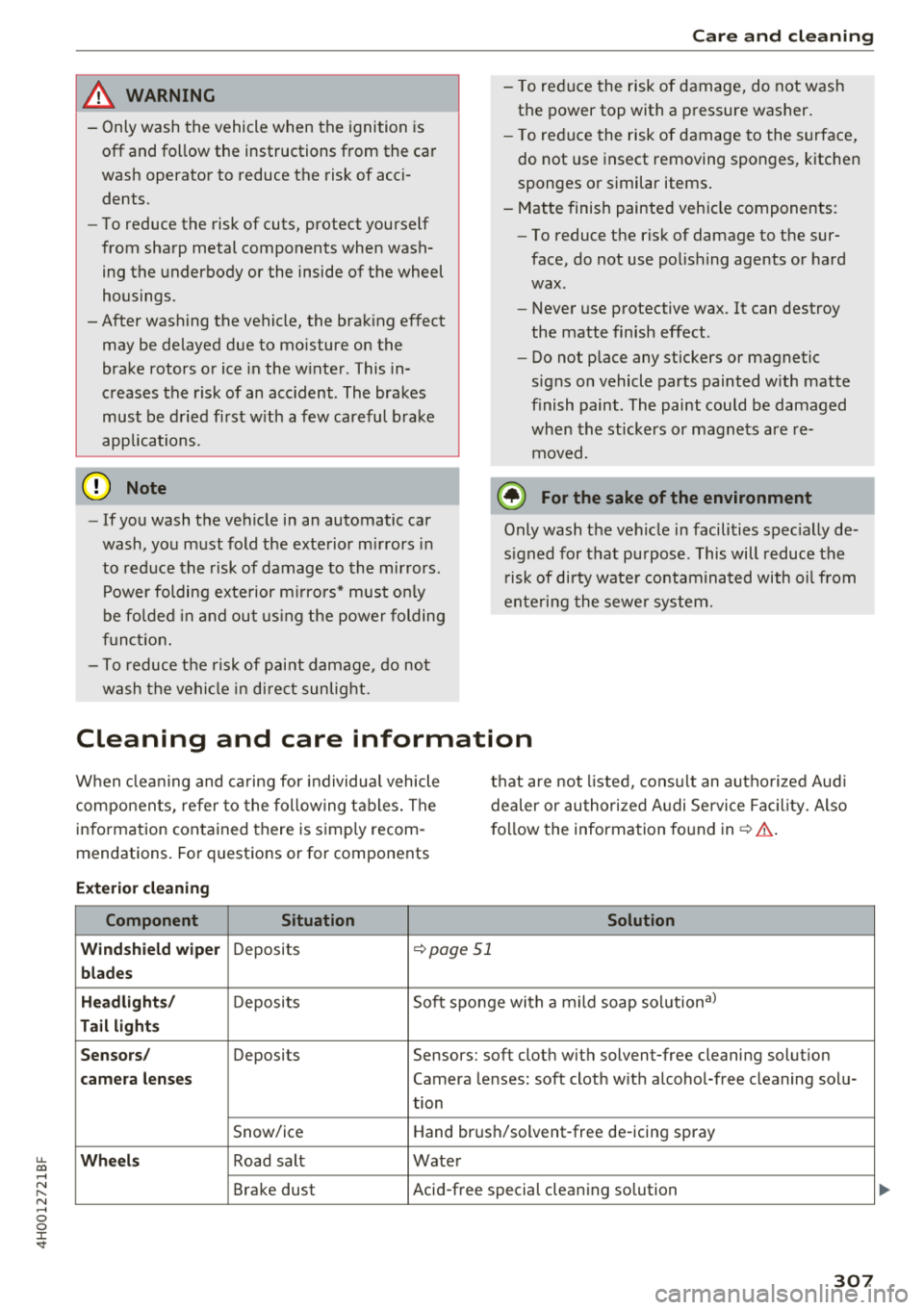
Cleaning and care information
When cleaning and caring for individual vehicle
components, refer to the following tables. The
information contained there is simply recom
mendations. For questions or for components that are
not listed, consult an authorized Audi
dealer or authorized Audi Service Facility. Also
follow the information found
in~.&. -
Exterior cleaning
Component Situation Solution
Windshield wiper
Deposits ~ page 51
blades
Headlights/
Deposits Soft sponge with a
mild soap solutiona)
Tail lights
Sensors/
Deposits Sensors: soft cloth with solvent-free cleaning solution
camera lenses Camera lenses: soft cloth with alcohol-free cleaning solu-
tion
Snow/ice Hand brush/solvent-free de-icing spray
Wheels Road salt Water
Brake dust Acid-free special cleaning solution
307
...
Page 311 of 356
u. co .... N
" N .... 0 0 :c '
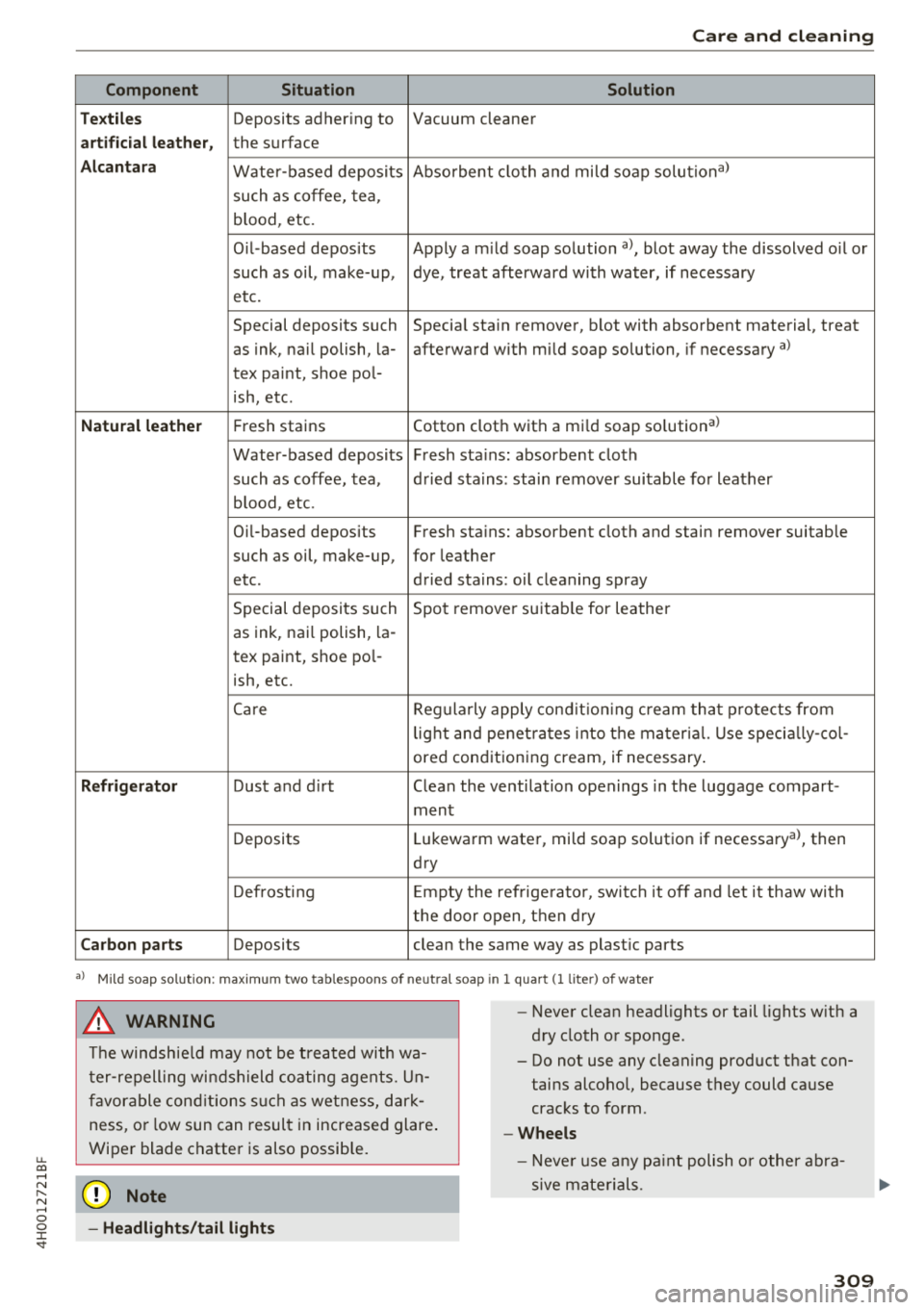
Component Situation Solution
Te xtiles
Deposits adhering to Vacuum cleaner
artificial leather, the surface
Alcantara Water-based deposits Absorbent
cloth and mild soap solutiona>
such as coffee, tea,
b lood, etc.
O il-based deposits Apply a m ild soap solution
al, blot away the dissolved o il or
such as oil, make-up, dye, treat afterward with water, if necessary
etc.
Special deposits such
Specia l stain remover, blot with absorbent material, treat
as ink, nail polish, la- afterward with mi ld soap solution, if necessary
a)
tex paint, shoe pol-
ish, etc .
Natural leather Fresh stains Cotton cloth with a mi
ld soap solution a>
Water-based deposits Fresh stains : absorbent cloth
such as coffee, tea, dried stains: stain remover suitable for leather
b lood , etc.
Oi l-based deposits Fresh sta ins: absorbent cloth and stain remover suitable
such as oil, make-up, for leather
etc . dried stains: oil cleaning spray
Special deposits such Spot
remover suitable for leather
as ink, nail polish, la-
tex paint, shoe pol-
ish, etc.
Care Regularly apply conditioning cream that protects from
light and penetrates into the material. Use specially-c ol-
ored conditioning cream, if necessary .
Refrigerator Dust and dirt Clean the ventilation openings in the luggage compart-
ment
Deposits Lukewarm
water, mild soap solution if
necessarya>, then
dry
Defrosting Empty the refrige rato r, switch it off and let it thaw with
the door open, t hen dry
Carbon parts Deposits clean the same way as plast ic parts
• > Mi ld s oap so lution: maxim um two tablesp oon s of neu tra l soap in 1 quar t (1 lite r) of wat er
A WARNING
Th e windsh ie ld may not be treated with wa
ter-repelling windshi eld coating agents. Un
favorable conditions such as wetness, dark
ness, or lo w sun can result in increased glare.
Wiper blade chatter is also possible.
@ Note
-Headlights/tail lights
-
- Never clean headlights or tail lights with a
dry cloth or sponge.
- Do not use any cleaning product that con
tains alcoho l, because they could cause
cracks to form .
-Wheels
- Never use any paint polish or other abra-
sive materials.
309
Page 328 of 356
Fuses and bulb s
Bulbs
Replacing light bulbs
For your safety, we recommend that you have
your authorized Audi dealer replace burned out
bulbs for you .
It is becoming increasingly more and more diffi
cult to replace vehicle light bulbs since in many
cases, other parts of the car must first be re moved before you are able to get to the bulb .
This applies espec ially to the light bulbs in the
front of your car wh ich you can only reach
through the engine compartment .
Sheet metal and bulb ho lders can have sharp
edges that can cause ser ious cuts, and parts
must be co rrectly taken apart and then p roperly
put back together to help prevent breakage of
parts and long term damage from water that can
enter housings that have not been properly re
sea led.
F or your safety, we recommend that you have
your authorized Audi dealer replace any bu lbs for
you, since your dealer has the proper tools, the correct bulbs and the expertise.
Ga s di sc ha rge la mp s (Xe non ligh ts):
Due to the high electrical voltage, have the bulbs
replaced by a qua lified techn ic ian . Head lights
with Xenon light can be identified by the high
voltage sticker.
LED headlights* requ ire no maintenance. P lease
contact your authorized Aud i dealer if a bulb
needs to be replaced.
A WARNING
Contact w it h high -vo ltage components of the
electrical system and improper rep lacement
of gas disc harge (Xenon) head light bu lbs can
cause serious personal injury and death.
- Xenon bulbs are pressurized and can ex
plode when being changed.
- Changing Xenon lamps requires the special
training, instructions and equipment.
- Only an a uthorized Audi dea ler or other
qualified workshop s hou ld change the bulbs
in gas disc harge lamps .
326
A WARNING
There are parts with sharp edges on the open
ings and on the bulb holders that can cause
serious cuts .
- If you are uncertain about what to do, have
the work performed by an author ized Audi
dealer or other qual ified workshop . Ser ious
pe rsonal inju ry may resu lt from improperly
pe rformed wor k.
(D Tips
- If you must replace the light bulbs yourself,
always remember that the eng ine compart
ment of any vehicle is a hazardo us a rea to
work in. Always read and heed all WARN INGS
~ page 272.
-It is best to ask you r author ized Audi dea le r
w henever you need to change a bulb.
Page 330 of 356
Emergency situations
@ Tips
The discharged battery must be properly con
nected to the vehicle's electrical system .
When jump starting or charging the battery,
never connect the negative ground cable to
the battery negative post because the battery
manager system must be able to detect the
battery's state of charge. Always connect the
negat ive g round cable to the negative ground
post of the battery manager control unit.
Using the jump start
cable
Both jump start cables must be connected in the
correct order!
Fig. 289 E ngin e compartme nt: co nn ectors for jump start
cables and a charger
Fig. 290 Jump starting using a battery in anot her vehicle:
A
-p rov id in g current, B -drai ned
The procedure for connecting jump start cables
that is descr ibed next is designed to help jump
start your vehicle.
Vehicle with discharged battery:
~ Turn off lights and accessories, move automatic
transmission lever to N (Neutral) or P (Park)
and set parking bra ke.
328
Connecting the positive cable (red) to the
positive terminal
~ Open the cover on the positive terminal
qfig . 289.
1. Secure one end of the pos itive cable (red) to
the jump start pin
(D q fig. 290 (pin under
the cover =
"plus") on the vehicle that needs
to be started @.
2. Secure the other end of the positive cable
(red) to the posit ive terminal @on the bat
tery provid ing the cur rent @.
Connecting the negative cable (black) to the
negative terminal
3. Secure one end of the negative cable (black)
to the negative terminal @ on the battery
that is providing the current @.
4. Secure the other end of the negative cable
(black) to the jump start
pin @ (hex head pin
= "negative") on the vehicle that needs to be
started @.
Starting the engine
~ Sta rt the eng ine on the vehicle providing the
jump start @and let it run at idle.
~ Now start the engine on the vehicle with the
drained battery @.
~ If the engine does not start, stop the starting
procedure after 10 seconds and then repeat it
after approx imately 30 seconds.
~ Remove the cables when the engi nes are run
ning. Remove them in reverse order from the
way they were installed.
~ Close the cover on the posi tive terminal.
The battery is vented to the outside to prevent
gases from enter ing the vehicle interior. Make
sure that the jumper clamps are well connected
with their
metal ports in full contact with the
battery terminals .
A WARNING
-To avoid serious personal injury and damage
to the vehicle, heed all warnings and instruc
tions of the jumper cable manufacturer. If in
doubt, call for road service.
-Jumper cables must be long enough so that
the vehicles do not touch.
..,.