page 57 AUDI ALLROAD 2000 Owners Manual
[x] Cancel search | Manufacturer: AUDI, Model Year: 2000, Model line: ALLROAD, Model: AUDI ALLROAD 2000Pages: 306, PDF Size: 9.95 MB
Page 274 of 306
•
Be sure to check the tire pressure
as quickly as possible after you
install a wheal that is fitted with
new tires.
If you notice while changing a tire
that the wheal bolts are corroded
and difficult to turn, then they
should be replaced before you
check the tightening torque.
Until then, drive with extra care and
at reduced speeds. m
WARNING
• If you are going to equip your ve
hicle with tires or rims which dif
fer from those which were factory
installed, then be sure to read the
information on page 257.
• Always store damaged wheel,
jack and tools securely in luggage
compartment. DO-IT-YO
URSELF SERVICE
Note
Remember that the deflated full size
spare tire is for temporary use only!
273
Page 275 of 306
DO-IT-YOURSELF
SERVICE----------------------
Fuses
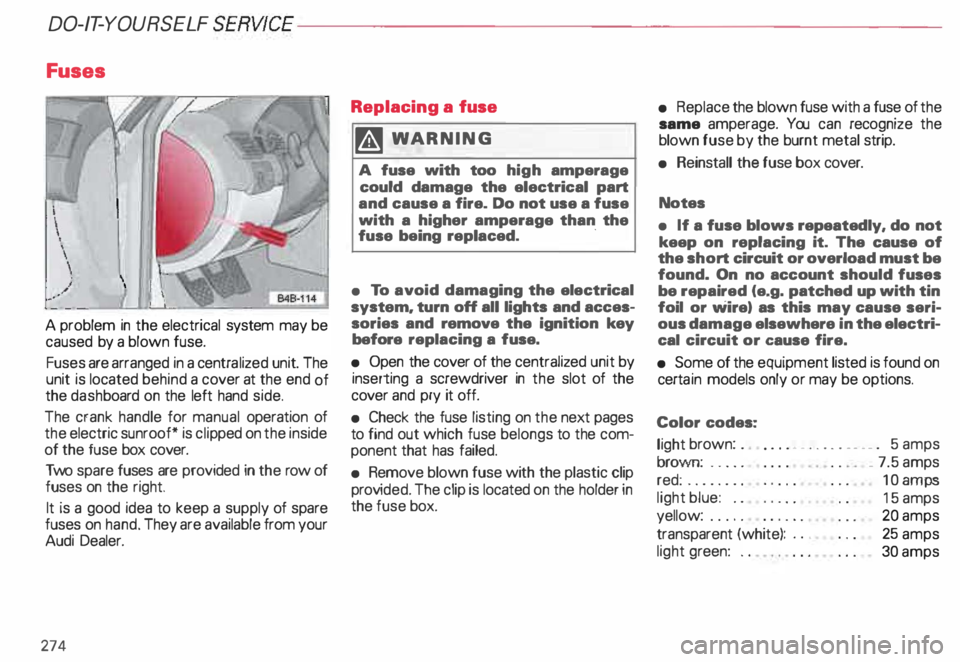
A problem in the electrical system may be
caused by a blown fuse.
Fuses are arranged in a centra lized unit. The
unit is located behind a cover at the end of
the dash board on the left hand side.
The crank handle for manual operation of
the electric sunroof* is cli pped on the inside
of the fuse box cover.
Two spare fuses are provided in the row of
fuses on the right.
It is a good idea to keep a supply of spare
fuses on hand. They are available from your
Audi Dealer.
274 Replacing
a fuse
� WARNING
A fuse with too high amperage
could damage the electrical part
and cause a fire. Do not use a fuse
with a higher amperage than the
fuse being replaced. ·
• To avoid damaging the electrical
system. turn off all lights and acces
sories and remove the ignition key
before replacing a fuse.
• Open the cover of the centralized unit by
inserting a screwdriver in the slot of the
cover and pry it off.
• Check the fuse listing on the next pages
to find out which fuse belongs to the com
ponent that has failed.
• Remove blown fuse with the plastic clip
prov ided. The clip is located on the holder in
the fuse box. •
Replace the blown fuse with a fuse of the
same amperage. You can recognize the
blown fuse by the burnt metal strip.
• Reinstall the fuse box cover.
Notes
• If a fuse blows repeatedly. do not
keep on replacing it. The cause of
the short circuit or overload must be
found. On no account should fuses
be repaired (e.g. patched up with tin
foil or wire) as this may cause seri
ous damage elsewhere in the electri
cal circuit or cause fire.
• Some of the equipment listed is found on
certa in models only or may be options.
Color codes:
light brown: . .
... • _ .. .. . __ . _ . 5 amps
brown: .... .
red: ....... .
light blue: ..
yellow: .....
transparent (white): ..•
light green: .. _
7.5 amps
10 amps
15 amps
20 amps
25 amps
30 amps
Page 278 of 306
----------------------DO-IT-YOURSELF SERVICE
Replacing bulbs
It is becoming increasingly more and more
difficult to replace vehicle light bulbs since
in many cases, other parts of the car must
first be removed before you are able to get
to the bulb. This applies especially to the
light bulbs in the front of your car which you
can only reach through the engine compart
ment.
For your safety, we recommend that you
have your authorized Audi Dealer replace
any bulbs for you, since your dealer has nec
essary tools, the correct bulbs and the ex
pertise.
g Always heed all WARNINGS
� on page 232. Gas
discharge lamps
(Xenon lights)•
Yo ur vehicle may be equipped with gas dis
charge lamps. Due to the high elec trical
voltage, have the bulbs exchanged by a
qualified technician.
Headlights with xenon light are identified by
the high voltage sticker(see symbol above).
� WARNING
Only your authorized Audi Dealer
or a qualified workshop should
change the bulbs in gas discharge
lamps (xenon light). Due to the
high voltage, improper handling
can cause serious personal injury. Insta
lling I
replacing a radio
f you wish to install a radio or replace the
factory installed radio, please note the fol
lowing:
• The factory installed radio connectors are
designed for Genuine Audi Radios.
When installing a different radio, difficulties
could arise such as:
- the radio may not fit into the space pro
vided
- the electrical connections may not be
compat ible
- different connector terminals may be
needed.
• Therefore, we recommend that you have
your authorized Audi Dealer install or re
place the radiO.
They are the most familiar with the techni
cal features of your vehicle. They also offer
Genuine Audi Radios with the necessary
installation components and instructions.
� WARNING
Improperly installing a radio could
cause a short circuit.
This could result in an electrical
fire.
277
Page 280 of 306
----------------------DO-IT-YOURSELF SERVICE
Note
• Applying a higher voltage booster
battery will cause expensive dam
age to sensitive electronic compo
nents, such as control units, relays,
radio, etc.
• Ve hicle with discharged battery:
Turn off lights and accessories, move lever
of automatic transmission to N (Neutral)
or P (Park) and set parking brake. Use
of jumper cables
�W ARNING
• To avoid serious personal Injury
and damage to the vehicle, heed
all warnings and instructions of
the jumper cable manufacturer.
If in doubt, call for road service.
• The jumper cables must be long
enough so that the vehicles do not
touch.
• When
connecting jumper
cables, make sure that they cannot
get caught in any moving parts in
the engine compartment. Removing
the battery cover -see
page 245.
Improper hook-up of jumper cables
can ruin the generator.
Always connect POSITIVE (+ ) to
POSITIVE (+ ). and NEGATIVE (-)to
NEGATIVE (-).
279
Page 281 of 306
DO-IT-YOURSELF SERVICE----------------------
A-
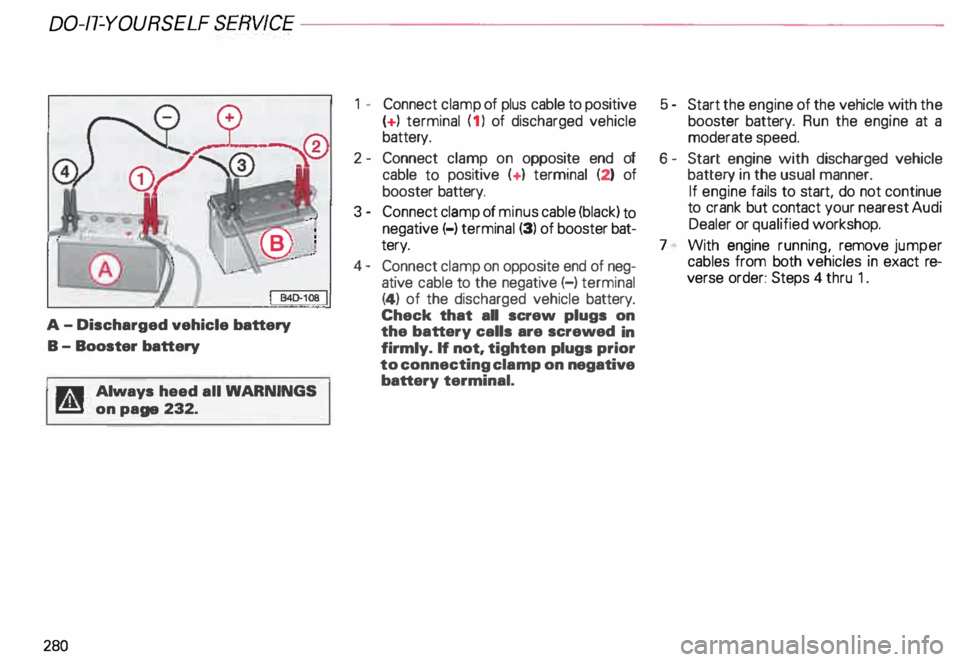
Discharged vehicle battery
B - Booster battery
11r,:!1 Always heed all WAR NINGS
r!!l on page 232.
280 1
- Connect clamp of plus cable to positive
( + ) terminal (1 ) of discharged vehicle
battery.
2 - Connect clamp on opposite end of
cable to positive (+ ) terminal (2) of
booster battery.
3 - Connect clamp of minus cable (black) to
negative (-) terminal (3) of booster bat
tery.
4- Connect clamp on opposite end of neg
ative cable to the negative (-) terminal
(4) of the discharged vehicle battery.
Check that all screw plugs on
the battery calls are screwed in
firmly. If not, tighten plugs prior
to connecting clamp on negative
battery terminal. 5
- Start the engine of the vehicle with the
booster battery. Run the engine at a
moderate speed.
6- Start engine with discharged vehicle
battery in the usual manner.
If engine fails to start, do not continue
to crank but contact your nearest Audi
Dealer or qualified workshop.
7 With engine running, remove jumper
cables from both vehicles in exact re
verse order: Steps 4 thru 1.
Page 284 of 306
Lifting
vehicle
Lifting with workshop hoist
and with floor jack
Notes
• The vehicle should never be lifted
or jacked up from underneath the
engine oil pan, the transmission
housing, the front or rear axle or the
body side members. This could lead
to serious damage.
The same lifting points as illus trated on the
next page for the hoist also apply when a
floor jack is used.
e To avoid damage to the under
body or chassis frame, it is neces
sary to insert a rubber pad between
the floor jack and the lift points.
• To prevent damaging the shock
absorbers when lifting the vehicle
with a jack or on a hoist, the level
selection must be in the jack mode.
See next page. �W
ARNING
• To reduce the risk of serious in
jury and vehicle damage, lift the
vehicle only at the special work
shop hoist and floor jack lift points
illus trated. Failure to lift the ve
hicle at these points could cause
the vehicle to tilt or fall from a lift
if there is a change in vehicle
weight distribution and balance.
This might happen, for example,
when heavy components such as
the engine block or transmission
are removed.
• When removing such heavy
components, anchor vehicle to
hoist or add correspo nding
weights to maintain the center of
gravity. Otherwise, the vehicle
might tilt or slip oH the hoist,
causing serious damage or person
al injur y. DO-IT-YOU
RSELF SERVICE
�� WARNING continued
• If you must lift your vehicle with
a floor jack to work underneath,
be sure the vehicle is safely sup
ported on stands intended for this
purpose.
• Before driving over a workshop
hoist, check that the vehicle weight
does not exceed the permissible lift
ing capacity of the hoist.
• Before driving over a workshop
hoist, ensure that there is suHicient
clearance between the hoist and
low parts of the vehicle.
283
Page 286 of 306
----------------------DO-IT-YOURSELF SERVICE
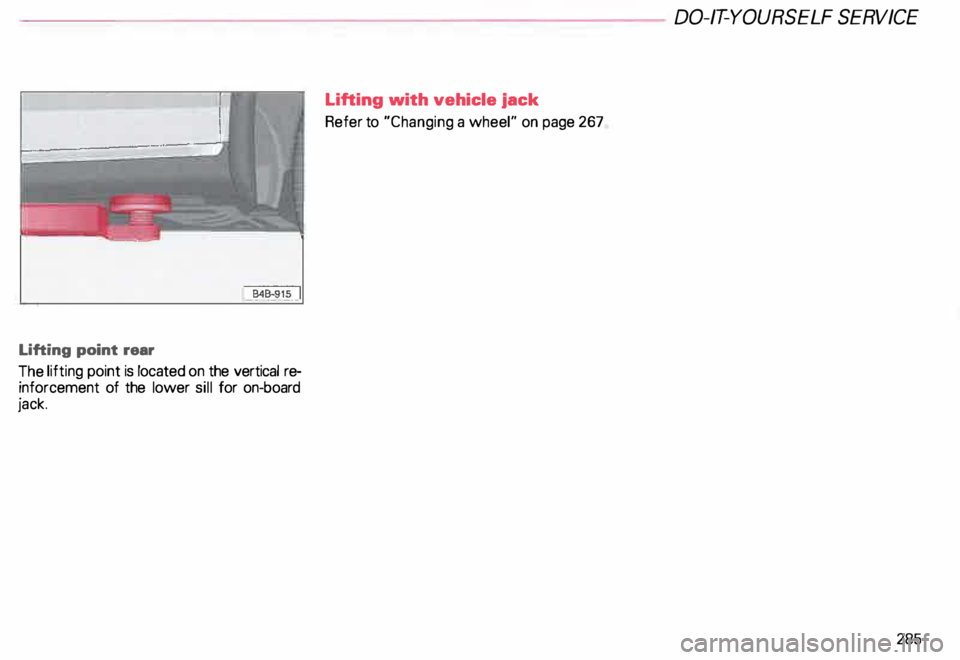
Lifting point rear
The lifting point is located on the vertical re
inforcement of the lower sill for on-board
jack. Lifting
with vehicle jack
Refer to "Changing a wheel" on page 267
285
Page 287 of 306
TE
CHNICAL DAT
A-------------------------
Engine data
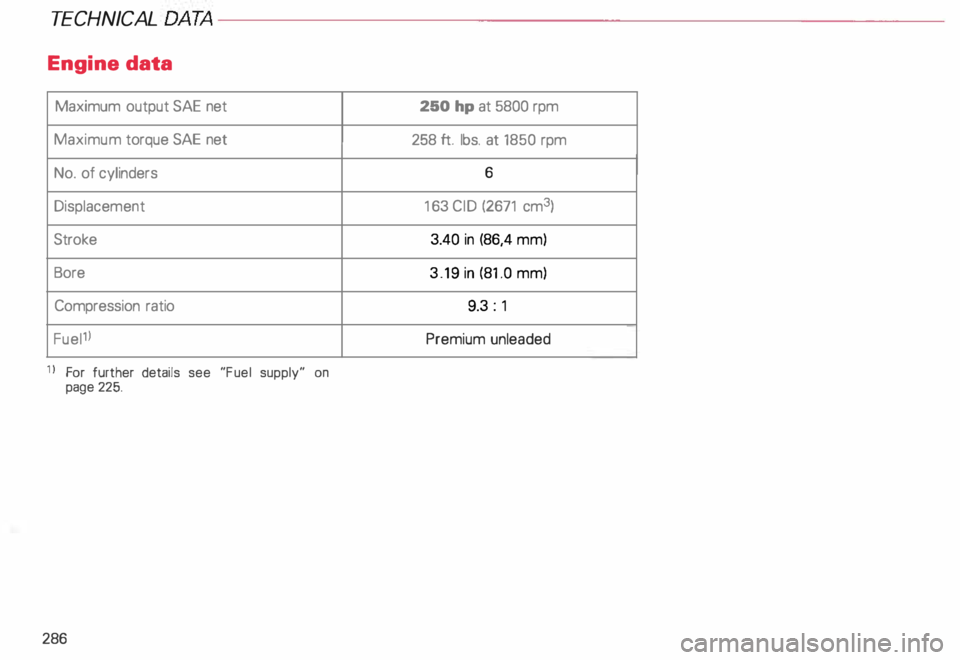
Maximum output SAE net
Maximum torque SAE net
No. of cylinders
Displacement
Stroke
Bore Compression ratio
Fuel1l
11 For further details see "Fuel supply" on
page 225.
286 250
hp at 5800 rpm
258 ft. lbs. at 1850 rpm
6
16 3 CID (2671 cm3)
3.40 in (86,4 mm)
3.19 in (81 .0 mm)
9.3 : 1
Premium unleaded
Page 288 of 306
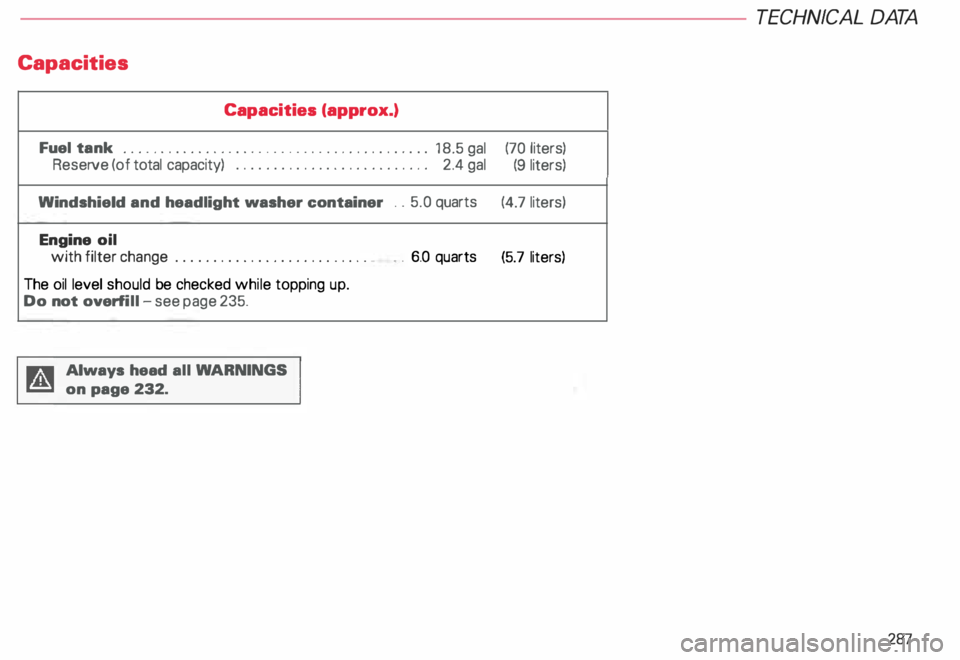
Capacities
Capacities (approx.)
Fuel tank
••••••• •••••••••• ••••••••••••••••• 0 ••• 0 ••
18.5 gal
Reserve (of total capacity) ............
..............
2.4 gal
Windshield and headlight washer container ..
5.0 quarts
Engine oil
with filter change .......................... •
The oil level should be checked while topping up.
Do not overf ill -see page 235.
Always head all WA RNINGS
on page 232. .
. 6.0 quarts TECHNICA
L DAT A
(70 liters)
(9 liters)
(4.7 liters)
(5.7 liters)
287
Page 291 of 306
TECHNICA L
DAT A-------------------------
Roof weight
The maximum permissible roof weight is
200 lbs (1 00 kg).
Only use the roof rack system specifically
designed, tested and approved by Audi.
Distribute the load evenly and do not ex
ceed the Permissible Roof Weight (in
cluding the weight of the roof rack system)
or the Gross Vehicle Weight.
For more details see page 191.
290 Ve
hicle identification
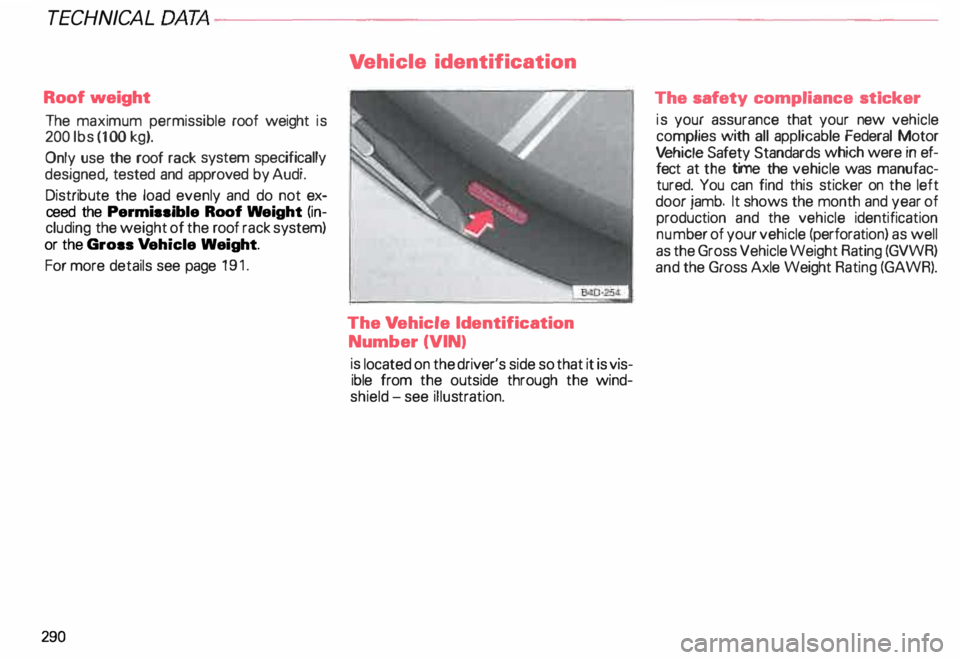
The Vehicle Identification
Number (YIN)
is located on the driver's side so that it is vis
ible from the outside through the wind
shield -see illustration. The
safety compliance sticker
is your assurance that your new vehicle
complies with all applicable Federal Motor
Ve hicle Safety Standards which were in ef
fect at the time the vehicle was manufac
tured. You can find this sticker on the left
door jamb. It shows the month and year of
production and the vehicle identification
numb er of your vehicle (perforat ion) as well
as the Gross Vehicle Weight Rating (GVWR)
and the Gross Axle Weight Rating (GAWR).