roof AUDI ALLROAD 2000 User Guide
[x] Cancel search | Manufacturer: AUDI, Model Year: 2000, Model line: ALLROAD, Model: AUDI ALLROAD 2000Pages: 306, PDF Size: 9.95 MB
Page 178 of 306
Sun
visors
I e4s-2e1
1
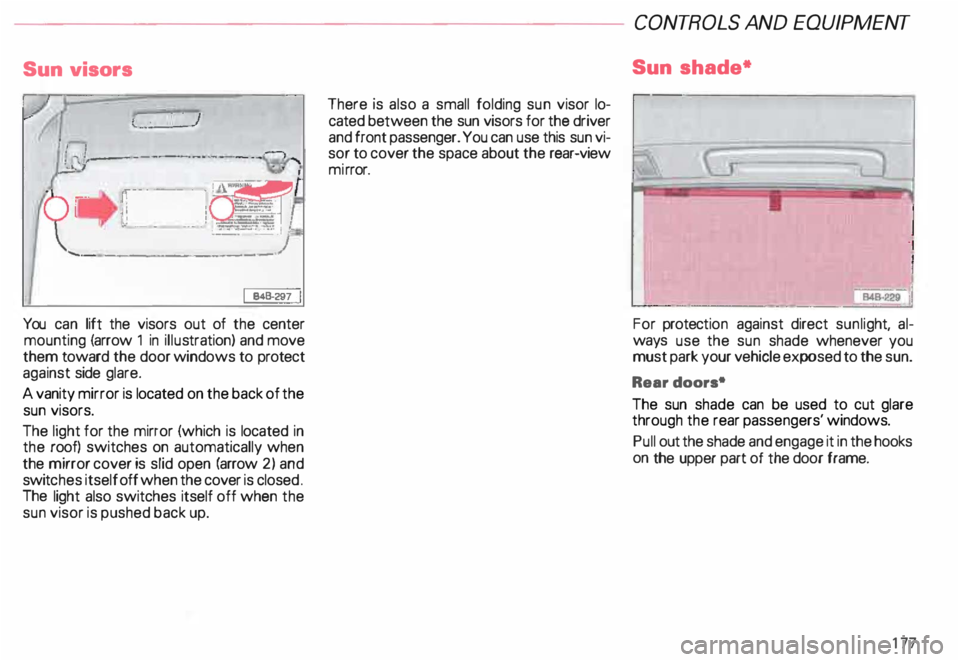
You can lift the visors out of the center
mounting {arrow 1 in illus tration) and move
them toward the door windows to protect
against side glare.
A vanity mirror is located on the back of the
sun visors.
The light for the mirror {which is located in
the roof) switches on automatically when
the mirror cover is slid open (arrow 2) and
switc hes itself off when the cover is closed .
The light also switches itself off when the
sun visor is pushed back up. There is
also a small folding sun visor lo
cated between the sun visors for the driver
and front passenger. You can use this sun vi
sor to cover the space about the rear-view
mi rror. CONT
ROLS AND EQUIPMENT
Sun shade*
·---� --�
For protect ion against direct sunlight, al
ways use the sun shade whenever you
must park your vehicle exposed to the sun.
Rear doors•
The sun shade can be used to cut glare
through the rear passengers' windows.
Pull out the shade and engage it in the hooks
on the upper part of the door frame.
177
Page 192 of 306
---------------------CONTROLS AND EQUIPMENT
Roof rack
If a roof rack or similar luggage carrying
equipment is to be installed, please note the
following;
• The vehicle is equipped with integrated
roof railings, which can be covered into a
roof rack by installing cross bars. Only install
cross bars specifically designed for this ve
hicle.
• These bars are the basis for a complete
roof rack syste m. Additional attachments
are necessary to safely transport luggage,
bicycles, surf boards, s.kis or boats.
• All necessary hardware for these sys
tems is available from your authorized Audi
Dealer. Note
• Any damage to the vehicle caused
by using roof racks or other types of
cross bars that have not been ap
proved by Audi for your vehicle or
incorrect roof rack installation is
not covered by the Warranty.
�W ARNING
• Use of an unapproved roof rack
or incorrect mounting of an ap
proved roof rack can cause the
roof rack or the items carried on it
to fall off the roof onto the road.
• Objects falling from the roof of
a vehicle can cause an accident
and personal injury.
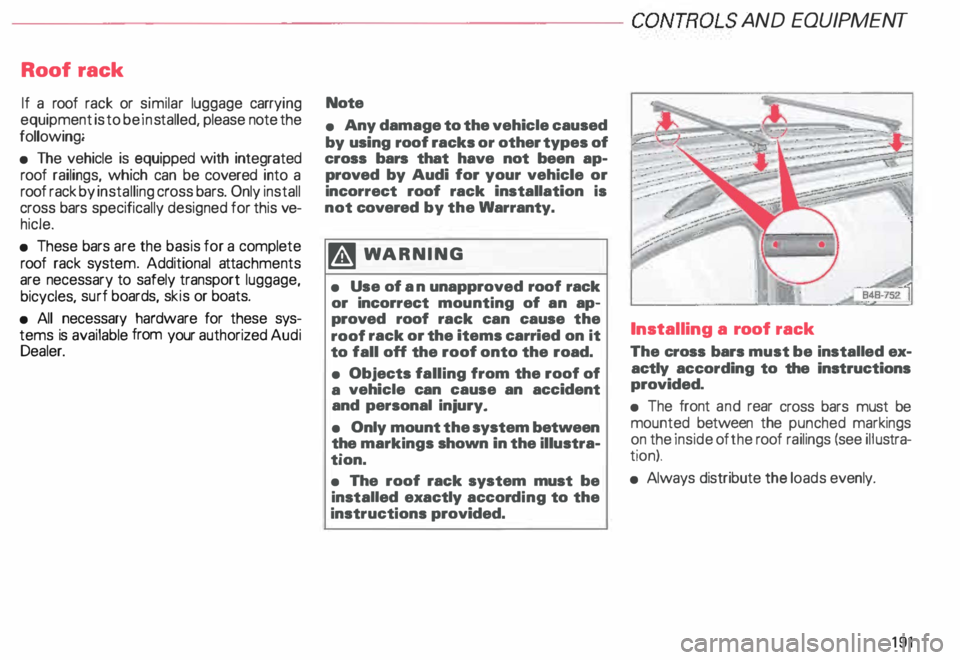
• Only mount the system between
the markings shown in the illustra
tion.
• The roof rack system must be
installed exactly according to the
instructions provided. Installing
a roof rack
The cross bars must be installed ex
actly according to the instructions
provided.
• The front and rear cross bars must be
mounted between the punched markings
on the inside of the roof railings (see illustra
tion).
• Always distribute the loads evenly.
191
Page 193 of 306
CONT
ROLS AND
EQUIPMENT---------------------
Loading a roof rack
Always distribute the loads evenly.
The total maximum permissible load
carrying capacity of 200 lbs ( 1 00 kg)
for the roof rack installation (includ
ing weight the roof rack system)
must not be exceeded -see
page 290 for details.
19 2 �
WARNING
• Improper use of a roof rack can
cause accidents and personal inju
ries.
• The use of a roof rack can nega
tively affect the way a vehicle han
dles.
• Cargo that is large. heavy,
bulk y, long or flat will have a
greater negative influence on the
vehicle's aerodynamics. center of
gravity and over all handling.
• Never exceed the maximum per
missible load carrying capacity of
the roof of your vehicle.
• Always drive slowly, avoid sud
den braking and maneuvers when
transp orting cargo on the roof of
your vehicle. When to
remove the roof rack
If you have installed a roof rack on your ve
hicle, it is best to ask the car wash operator
if it should be removed before going
through an automatic car wash.
When not in use, remove the roof rack to re
duce wind noise, improve handling, fuel
consump tion and guard against theft.
Page 195 of 306
VEHICLE OPERA
TION-----------------------
Operate your vehicle safely
The condition of the vehicle is es
sential for driving safety.
Therefore, always be sure to observe the
following points before you drive off:
• Check lights and turn signals.
• Check fuel level.
• Adjust the mirrors.
• Make sure that all lights and all
windows are clean.
• Make sure the air Intake slot be
tween the engine hood and the
windshield is free of leaves, snow
and ice.
• Check warning and indicator
lights when starting the engine.
For driving safety, always follow the speci
fied maintenance intervals in your Mainte
nance booklet -especially for changing
the brake fluid, see page 242.
Yo ur personal driving style and your
attitude affect driving safety to a
very great extent.
19 4 Therefore,
for your own safety:
• Wear your safety belts and wear
them properly, even if you're just
driving in the city or to the corner
store -see page 14.
• Make sure that all passengers are
wearing their safety belts properly,
even those sitting in the rear -
see page 14.
Passengers not wearing safety belts endan
ger not only themselves in case of an acci
dent, but also the driver and other passen
gers.
• Make sure that children always sit
on the rear seat properly restrained
by a res traint system appropriate
for their size and age.
• Never transport a child in a rear
facing child or infant seat on the
front passenger seat.
• Adjust your seat so that you can
easily reach all controls as far away
from the airbag as possible but no
closer than 10 in. (25 em) -
see page 76. •
The seating position is very im
portant for the airbag performance
- see page 29.
• Always adjust the head restra ints
to the correct height.
For maximum protection, the upper edge of
the head restraints should be at least at
eye level, or higher .
• Always make sure that the move
ment of the pedals is not restricted
In any way-see page 102.
• Store luggage and light items
properly
in the luggage compartment
see page 88.
of the roof - see page 191.
• If you drink, do not drive.
The use of alcohol, drugs and certain medi
cations will seriously impair perception,
reactions and driving ability, and substan
tially increase the risk of an accident and
personal injury.
Page 198 of 306
----------------------VEHICLE
OPERATION
,:lib Remove
supplementary roof
� rack components when not In
use.
At high road speeds, the increased air �e
sistance caused by the cross bars also In
creases fuel consumption.
,:lib Switch oH any electrical equip
� ment when no longer needed.
The more electricity you consume, the
higher the fuel consumption.
,:lib Check your vehicle 's fuel co?'l!�Sr sumption regularly. Keep a writ
ten record or use the trip odometer .
Check your fuel consumption ea?h time you
refu el. By doing this, you can d1scov �r a �y
inc onsistencies which could result 1n In
creased fuel consumption and have these
checked before other problems appear. •
Check your oil each time you fill
your tank
The amount of oil used is related to engine
load and speed.
It is normal for the oil consumption of a new
engine to reach its lowest value after a cer
tain mileage has been driven.
You must drive your vehicle about 3,000
miles (5 000 kilome tres) before you can
properly assess oil consumption.
This also applies to fuel consumption and
engine output.
• The published ENVIRONME NTAL
PROTECTION AGENCY (EPA) and
Tr ansport Canada consumption esti
mates may not correspond to your
actual consumption on the road.
which will vary depending upon ve
hicle load and speed. road and
weather conditions. trip length. etc. The
catalytic converter is an efficient
"clean-up" device built into the exhaust
system of the vehicle. The catalyttc convert
er burns many of the pollutants in the ex
haust gas before they are released into the
atmosphere.
The exclusive use of unleaded fuel is
critically important fo.r the life of
the catalytic converter and proper
functioning of the engine - see
page 225.
The catalytic converter will be per
manently damaged by:
• Exc eeding the correct engine oil
level - see page 236;
• Driving until the fuel tank be
comes completely empty. The en
gine could misfire. Unburned fuel
could also get into the exhaust sys
tem and this could cause the catalyt
ic converter to overheat;
197
Page 199 of 306
VE
HICL E OPER ATION ------------------------
• Tu rning off the ignition while the
vehicle is movin g-sea page 115 -or
• Other unusual operating condi
tions.
Do not continue to operate your ve
hicle under these conditions, as
otherwise fuel can reach the catalyt
ic converter. This could result in
overheating of the converter, requir
ing its replacement.
To assure eHiciant operation of the
Emission Control System:
• Have your vehicle maintained
properly and in accordance with the
service recommendations in your
Maintenance booklet.
Lack of proper maintenance as well
as improper usa of the vehicle will
impair the function of the emission
control system and could lead to
damage.
19 8 Cl
Do not alter or remove any com
ponent of the Emission Control Sys
ta.m unless approved by the
manufacturer.
• Do not alter or remove any device,
such as heat shields, switches, igni
tion wires, valves, which are de
signed to protect your vehicle 's
Emission Control System and other
important vehicle components.
Nota
Do not leave engine idling unat
tended after starting. If warning
lights should come on to indicate
improper operation, they would go
unheeded. Extended idling also pro
duces heat, which could result in
overheat ing or other damage to the
vehicle or other property. �W
ARNING
• Parking
Do not park or operate the vehicle
in areas where the hot exhaust sys
tem may coma in contact with dry
grass, brush, fuel spill or other ma
terial which can causa a fire.
• Undercoating
Do not apply additional undercoat
ing or rustproofing on or near the
exhaust manifold, exhaust pipes,
cata lytic converter or heat shields.
During driving, the substance
used for undercoating could over
heat and causa a fire.
Page 213 of 306
VEHICLE CA
RE---------------------------------------------------
Cleaning and protec tion
Any automobile is subjected to abuse from
indus trial fumes, corrosive road salt, aban
doned lollipops, muddy dog feet, etc. A well
cared- for Audi can look like new many years
after purchase. Regular and correct care will
contribute to maintaining the beauty and
value of your Audi.
Furthermore. good care may be a
condition for upholding a warranty
claim should corrosion damage or
paint defects occur.
Yo ur Audi Dealer has a variety of vehicle
care products and can advise you which
ones to use for cleaning the exterior and in
terior of your vehicle.
Whether you use products recommended
by Audi or other commercially available
cleaning agents, please make very sure you
apply them correctly.
212
r.Gb Select only environmentally � friendly cleaning products. Any
remaining cleaning products do not
belong in the household waste.
�W ARNING
• Cleaning agents may be poison
ous. Keep them out of the reach of
children.
• Observe all caution labels.
• Always read directions on the
cont ainer before using any prod
uct. Follow these directions care
fully.
• Most chemical cleaners are con
centrates which require dilution.
• Only use spot removing fluids in
well ventilated areas.
• Do not use gasoline. kerosene.
Diesel fuel. nail polish remover or
other volatile fluids. They may be
toxic, flammable or hazardous in
other ways. Care
of exterior
Important Never use polishes or hard waxes on
matte- painted parts or plastic parts,
since this can permanently damage
the visual appearance of the sur
faces of these parts.
In parti cular , make certain that the roof,
bumper, trim moldings, rocker panel mol
ding and wheel house liners do not come
in contact with cleaners I polishes or hard
waxes.
Page 214 of 306
Washing
The best protection against environmental
influences is frequent washing and waxing.
How often this is required depends on how
much the vehicle is used, where it is parked
(garage, in the open under trees, etc.), the
seasonal and weather conditions as well as
env ironmental influences. The longer bird
droppings, insects, tree resin, road and in
dustrial grime, tar, soot, road salt and other
materials remain on the vehicle paint, the
more lasting their destructive effect will be.
High temperatures, as from strong sunlight,
intensify the corrosive effect.
Under certain circumstances, weekly
washing may be necessary. Under other
conditions. a monthly washing and waxing
may be adequate.
After the winter, the underside of the ve
hicle should be thoroughly washed. Automatic
car wash
The vehicle paint is so durable that the ve
hicle can normally be washed without prob
lems in an automatic car wash. However,
the effect on the paint depends to a large
extent on the design of the facil ity, the filter
ing of the wash water, the type of wash and
care material, etc. If the paint has a dull ap
pearance after going through the car wash
or is scratched, bring this to the atte ntion of
the operator immediately. If necessary use
a different car wash.
Notes
• Before going through a car wash, be sure
to take the usual precautions such as clos
ing the windows and sunroof*.
• You don't have to remove the factory
installed radio antenna. However, if your ve
hicle is equipped with the Navigation Sys
tem*, then you must remove the antenna.
• If you have installed additional accesso
ries on the vehicle -such as spoilers, roof
rack, etc. -it is best to ask the car wash op
erator if these should be remov ed. VE
HICLE CARE
Washing the vehicle by hand
� In the intsi'Sst of the environ
� msnt, the vehicle should only be
washed in special wash bays.
First soften the dirt with plenty of water and
rinse off as well as possible.
Then clean the vehicle with a soft sponge,
glove or brush starting on the roof and work
ing down using only slight pressure. Special
car wash soap should only be used for very
persistent dirt.
Rinse the sponge or glove thoroughly and
oft en.
Clean wheels .and sill panels last, using a dif
ferent sponge if pos sible.
After washing the vehicle, rinse thoroughly
with water and wipe it off.
213
Page 221 of 306
VEHICL E
CA RE-------------------------
If the engine compartment is cleaned at any
time with grease removing solutions 1 ), or if
you have the engine washed, the antK:orr
as well. It is therefore essential to ask: for a
long-lasting corrosion protection of all sur
faces, seams, joints and components in the
engine compartment.
c£> If you must rinse off gasoline, oil
residue or grease while you are
washing your engine, then tha dirty
water should be run through an oil
separator filter. We recommend that
you have your engine washed at a
qualified workshop or service sta
ti on.
11 Use only
the correct cleaning solutions.
Never use gasoline or Diesel.
220 Chassis
The lower body shell of your Audi is also
thoroughly protected against corrosion.
Any damage to the undercoat ing caused by
road hazards should be repaired promptly.
g WARNING
Do not apply additional undercoat
ing or rustproofing on or near the
exhaust manifold, exhaust pipes.
catalytic converter or heat shields.
During driving, the substance
used for undercoating could over
heat and cause a fire. Body
cavity sealing
All body cavities which could be affected by
corro sion have been given thorough protec
tion at the factory.
This sealing does not require any inspection
or additional treatments. If any wax should
seep out of the cavity when the ambient
temperature is high, it can be removed with
a plastic scraper and a suitable solvent.
c£> If you use benzine for removing
the wax, keep sparks, flame and
ligh ted cigara ttas away. Nsver
dump benzine on the ground, into
open streams or down sewage
dr ains.
Be sure to observe all safety and en
vi ronmental regulations.
Page 229 of 306
VEHICLE
CARE---------------------------------------------------
Maintenance
Yo ur vehicle has been designed to help
keep maintenance requirements to a mini
mum.
However. a certa in amount of regular main
tenance is still necessary to assure your ve
hic le's safety, economy and reliabili ty.
c£> By regularly maintaining your
vehicle, you help make sure that
emission standards are maintai ned,
thus minimizing adverse effects on
the envir onment.
For detailed vehicle maintenance consult
your Maintenance booklet.
Under difficult operating condi
tions, for example at extremely low out
side temperatures, in very dusty regions,
when towing a trailer very frequently, etc.,
some service work should be performed
between the intervals specified.
This applies particularly to:
• oil changes, and
• cleaning or replacing the air filter.
228 Important
considerations for
you and your vehicle:
The increasing use of electr onics, sophisti
cated fuel injection and emission control
systems, and the generally increasing tech
nical complexity of today's automobiles,
have steadily reduced the scope of mainte
nance and repairs which can be carried out
by vehicle owners. Also, safety and en
vironmental concerns place very strict
limi ts on the nature of repairs and adjust
ments to engine and transmission parts
which an owner can perform . Main
tenance, adjustments and repairs usu
ally require special tools, testing devices
and other equipment available to specially
trained workshop personnel in order to as
sure proper performance, reliability and
safety of the vehicle and its many systems.
Impr oper maintenan ce, adjustments and
repairs can impair the operation and reliabil
ity of your vehicle and even void your ve
hicle warranty. Therefore, proof of servicing
in accordance with the maintenance
schedule may be a condition for upholding
a possible warranty claim made within the
warranty period.
Above all, operational safety can be ad
versely affected, creating unnecessary
risks for you and your passengers.