seats AUDI ALLROAD 2000 User Guide
[x] Cancel search | Manufacturer: AUDI, Model Year: 2000, Model line: ALLROAD, Model: AUDI ALLROAD 2000Pages: 306, PDF Size: 9.95 MB
Page 31 of 306
SAFETY FIRST--------------------------
�
WARNING continued
- Always sit upright with your
back against the backrest of
your seat.
. 30 Never
place your feet on the in
strument panel or on the seat.
Always keep both feet on the
floor in front of the seat to help
prevent serious injuries to the
legs and hips if the airbag in
flates. BBN-163
There is a lot that you and your passengers
can do to help the individual safety features
installed in your Audi work together as a
system. Adjusting
the driver's seat
For detailed steps for adjusting the driver's
seat please see "Front Seats" on page 76.
We recommend that you adjust the driver's
seat as follows:
- adjust the seat in fore and aft direction so
that you can easily push the pedals all the
way while keeping your knee slightly
bent.
- adjust the seatback so that when you sit
with your back against the seatback, you
can still grasp the top of the steering
wheel.
adjust the steering wheel -see chapter
"Adjustable steering column" page 98.
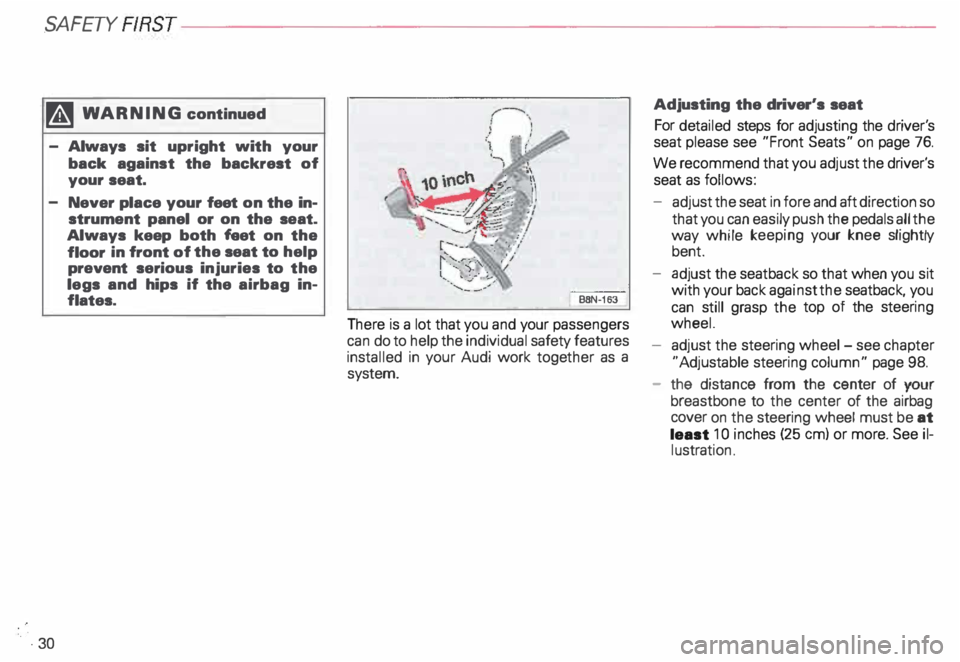
- the distance from the center of your
breastbone to the center of the airbag
cover on the steering wheel must be at
least 1 0 inches (25 em) or more. See il
lustration .
Page 32 of 306
-----------------------------------------------------SAFETY RRST
�W ARNING
• Never sit closer than 10 inches
(25 em) to the stee ring wheel.
• If you cannot sit more than
10 inches (25 em) from the steer
ing wheel, we recommend that
you investigate whether adaptive
equipment may be available to
help you reach the pedals and in
crease your seating distance from
the steering wheel.
Adjusting the steering wheel
For detailed steps for adjusting the steering
wheel please see "Adjustable steering col
umn" page 98.
Adjust the steering wheel so that the steer
ing wheel and airbag cover points at your
chest and not at your face. The steer ing
wheel should be adjusted so that you can
hold the outer rim of the steering wheel
comfortably with your hands at the 3 o'clock
and 9 o'clock positions. �W
ARNING
• Pointing the steering wheel to
ward your face decreases the abil
ity of the supplementa l driver's air
bag to protect you in an accident.
• Holding the steering wheel the
wrong way can cause serious inju
ries to the hands, arms and head if
the driver's airbag inflates.
• Never hold the steering wheel at
the 12 o'clock position or with
your hands at other positions in
side the steering wheel rim or on
the steering wheel hub.
Adjusting the passenger's seat
For detailed steps for adjusting the pas
senger's seat please see "Front Seats" on
page 76.
We recommend that you adjust the passen
ger's seat as follows:
- backrest upright (never reclined)
place your feet on the floor in front of the
passenger's seat adjust
the passenger's seat as far as pos
sible to the rear of the fore and aft adjust-
1)1ent range.
�W ARNING
• Always keep both feet on the
floor in front of the seat.
• Never place your feet on the in
strument panel or on the seat. If
the airbag inflates and your feet
are on the instrument panel or on
the seat, your could receive seri
ous personal injuries.
Some other important points to
know
Because airbags inflate in the blink of an eye
with great force, things you have on your lap
or have placed on the seat could become
dangerous projectiles and be pushed into
you if the airbag inflates.
Always head all WARNINGS
on next page.
31
Page 33 of 306
SAF
ETY RRST---------------------------------------------------
. � WARNING
• Objects between you and the
airbag can increase the risk of in
jury in an accident by interfering
with the way the airbag unfolds or
by being pushed into you as the
airbag inflates.
• Never hold things in your hands
or on your lap when the vehicle is
in use.
• Never place or attach accesso
ries or other objects (such as cup
holders, telephone brackets or
even large and bulky objects) on
the doors, over or near the area
marked ,. Airbag" on the steering
wheel, instrument panel, seat
backrests or between those areas
and yourself. These objects could
cause injury in a crash especially
when the airbags inflate.
32 �,
WARNING continued
• Never transport items on or in
the area of the front passenger
seat. Objects could move into the
area of the front alrbags during
braking or other sudden maneuver
and become dangerous projectiles
that can cause serious personal in
jury if the airbags inflate.
• Never recline the front passen
ger's seat to transport objects.
Items can also move into the area
of the side airbags or the front air
bag during braking or sudden ma
neuver. Objects near the airbags
can become projectiles and cause
injury particularly when the seat is
reclined. Child
restraints on the front seat -
important things to know
All children, especially 12 years old and
younger should always ride in the back seat
properly restrained for their age and size.
The ai rbag on the passenger side makes the
front seat a potentially dangerous place for
a child to ride. The front seat is not the saf
est place for a child in a forward-facing child
seat. It is a very dangerous place for an in
fant or a larger child in a rearward-facing
seat.
• Never install rear-facing child
seats or infant carriers on the front
passenger seat. A child will be se
riously injured and can be killed
when the passenger airbag in
flates.
Page 34 of 306
M
WARNING continued
• The inflating airbag will hit the
child seat or infant carrier with
great force and will smash the
child seat and child against the
backrest, center arm rest, or door.
• Always install rear-fac ing child
seats or infant carriers on the rear
seat.
A child seat or infant carrier installed on the
front seat may be struck and knocked out of
position by the rapidly inflating passenger's
airbag in a frontal collision. The airbag could
greatly reduce the effectiveness of the child
restraint and even seriously injure the child
during inflation. For
this reason, and because children are
generally better protected -when properly
restrained according to their age and size
in a rear seating position, we strongly rec
ommend that children always sit in the back
seat. See "Child Safety" on page 44.
�W ARNING
Forward-fa cing
child seats
installed on the front passenger's
seat may interfere with the deploy
ment of the airbag and cause seri
ous injury to the child. Install for
ward-fa cing child seats on the rear
seat. SA
FETY FIRST
If exceptional circumstances require the
use of a forward-facing child seat on the
front seat, the child's safety and well-being
require that the following special precau
tions be taken:
�W ARNING
If, in exceptional circumstances,
you must install a forward-f acing
child restraint on the front passen
ger's seat:
make sure the forward-fa cing
seat has been designed and cer
tified by its man ufacturer for
usa on a front seat with a pas
senger front and side airbag.
Always follow the manuf actur
er's instructions provided with
the child seat or carrier.
Always heed all WA RNINGS
on next page.
33
Page 35 of 306
SAFETYRRST-----------------------------------------------------
'4 WARNING continued
- Always move the passenger
seat into its rearmost position,
as far away from the airbag as
possible before installing the
child restraint. The backrest
must be adjusted to an upright
position.
- For more important information
on the use of child restraints in
your Audl, see ""child seats"",
page 44.
34 Supplemental
side airbags
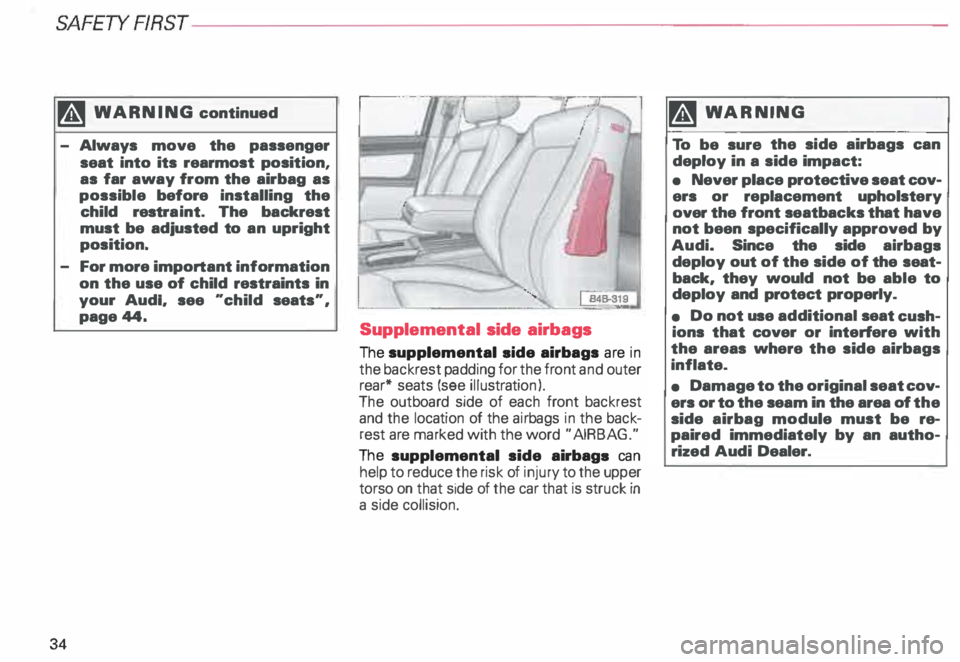
The supplemental aide airbags are in
the backrest padding for the front and outer
rear* seats (see illustration).
The outboard side of each front backrest
and the location of the airbags in the back
rest are marked with the word "AIRBAG."
The supplemental side airbaga can
help to reduce the risk of injury to the upper
torso on that side of the car that is struck in
a side collision. �W
ARNING
To be sure the side airbags can
deploy in a side impact:
• Never place protective seat cov
ers or replacement upholstery
over the front seatbacks that have
not been specifically approved by
Audi. Since the side airbaga
deploy out of the side of the seat
back, they would not be able to
deploy and protect properly.
• Do not use additional seat cush
ions that cover or interfere with
the areas where the side airbags
inflate.
• Damage to the original seat cov
ers or to the seam in the area of the
side airbag module must be re
paired immediately by an autho
rized Audi Dealer.
Page 44 of 306
-------------------------------------------------SAFETY RRST
'4 WARNING continued
• Any work on the airbag system.
such as removing/insta lling, re
pairing . or any work on the steer
ing wheel. instrument panel. front
seats or electrical system (Includ
ing the installation of audio equip
ment. mobile telephones and CB
radios. etc.) must be performed by
a qualified technician who has the
. training and special equipment
necessary. Improper handling may
result in injury.
• For any work on the airbag sys
tem. we strongly recommend that
you see your Audi Dealer.
• The alrbag system can be acti
vated only once. After an alrbag
has inflated. it must be replaced. Please
be sure that this manual al
ways remains with your Audi when
ever you lend your vehicle to
another person or if you sell it so
that this and other important infor
mation will always be available to
the driver and passengers.
43
Page 46 of 306
Infant
seats
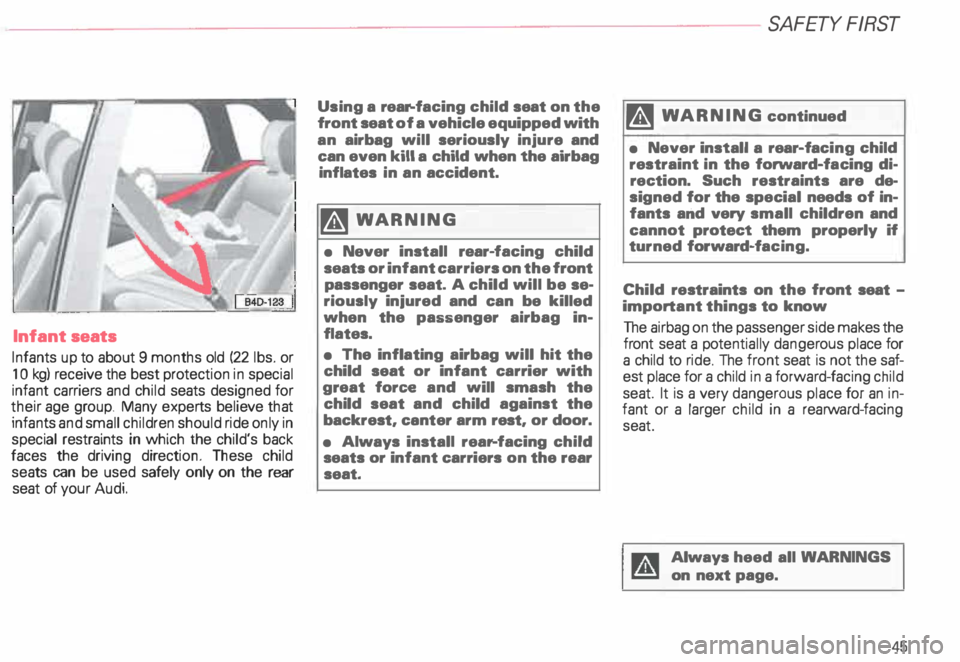
Infants up to about 9 months old (22 lbs. or
1 0 kg) receive the best protection in special
infant carriers and child seats designed for
their age group. Many experts believe that
infants and small children should ride only in
special restraints in which the child's back
faces the driving direction. These child
seats can be used safely only on the rear
seat of your Audi. Using
a rear-fa cing child seat on the
front seat of a vehicle equipped with
an airbag will seriously injure and
can even kill a child when the airbag
inflates in an accident.
� WARNING
• Never install rear-facing child
seats or infant carriers on the front
passenger seat. A child will be se
riously iniured and can be killed
when the passenger airbag in
flates.
• The inflating airbag will hit the
child seat or infant carrier with
great force and will smash the
child seat and child against the
backrest, canter arm rest, or door.
• Always install rear--facing child
seats or infant carriers on the rear
seat. SA
FETY FIRST
ftl WARNING continued
• Never install a rear-fac ing child
restraint in the forward-fa cing di
rection. Such restraints are de
signed for the special needs of in
fants and very small children and
cannot protect them properly if
turned forward-fa cing.
Child restraints on the front seat -
important things to know
The airbag on the passenger side makes the
front seat a potentially dangerous place for
a child to ride. The front seat is not the saf
est place for a child in a forward-facing child
seat. It is a very dangerous place for an in
fant or a larger child in a rearward-facing
seat.
Always heed all WARNINGS
on next page.
45
Page 48 of 306
--------------------------SAFETY FIRST
Converti
ble seats
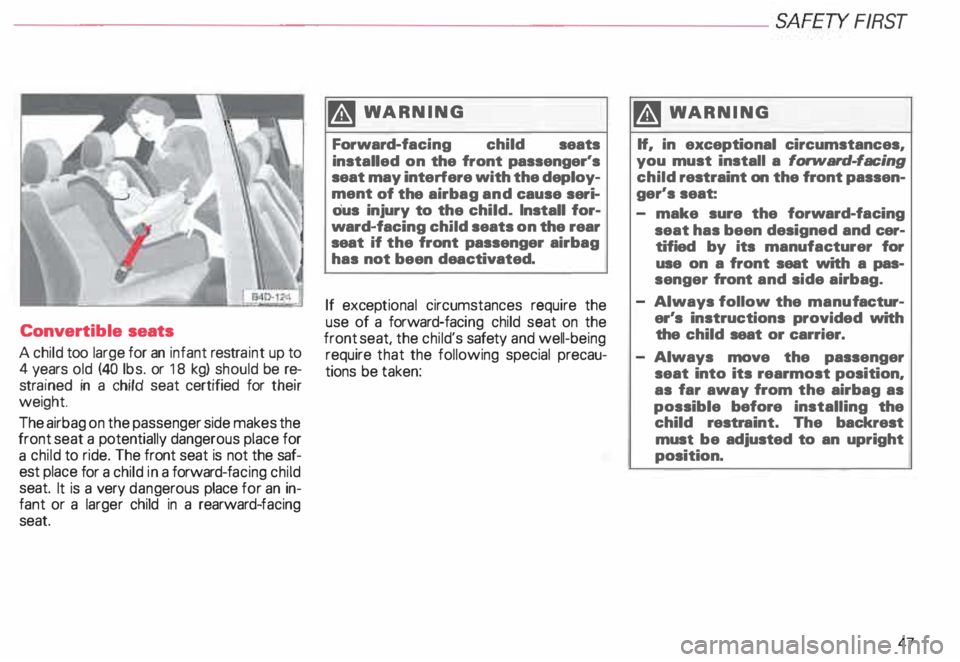
A child too large for an infant restraint up to
4 years old (40 lbs. or 18 kg) should be re
stra ined in a child seat certified for their
weight.
The airbag on the passenger side makes the
front seat a potentially dangerous place for
a child to ride. The front seat is not the saf
est place for a child in a forward-f acing child
seat. It is a very dangerous place for an in
fant or a larger child in a rearward-facing
seat. m
WARNING
Forward-fa cing
child seats
installed on the front passenger's
seat may interfere with the deploy
ment of the airbag and cause seri
ous injury to the child. Install for
ward·fac ing child seats on the rear
seat if the front passenger airbag
has not been deactivated.
If excep tional circumstances require the
use of a forward-fac ing child seat on the
front seat. the child's safety and well-b eing
require that the following special precau
tions be taken: �W
ARNING
If, in exceptional circumstances,
you must install a forward-facing
child restraint on the front passen
ger's seat:
make sure the forward-facing
seat has been designed and cer
tified by its manufacturer for
use on a front seat with a pas
senger front and side airbag.
Always follow the manuf actur
er's instructions provided with
the child seat or carrier.
Always move the passenger
seat into its rearmost position,
as far away from the airbag as
possible before installing the
child restraint. The backrest
must be adjusted to an upright
position.
47
Page 49 of 306
SA
FETY FIRST--
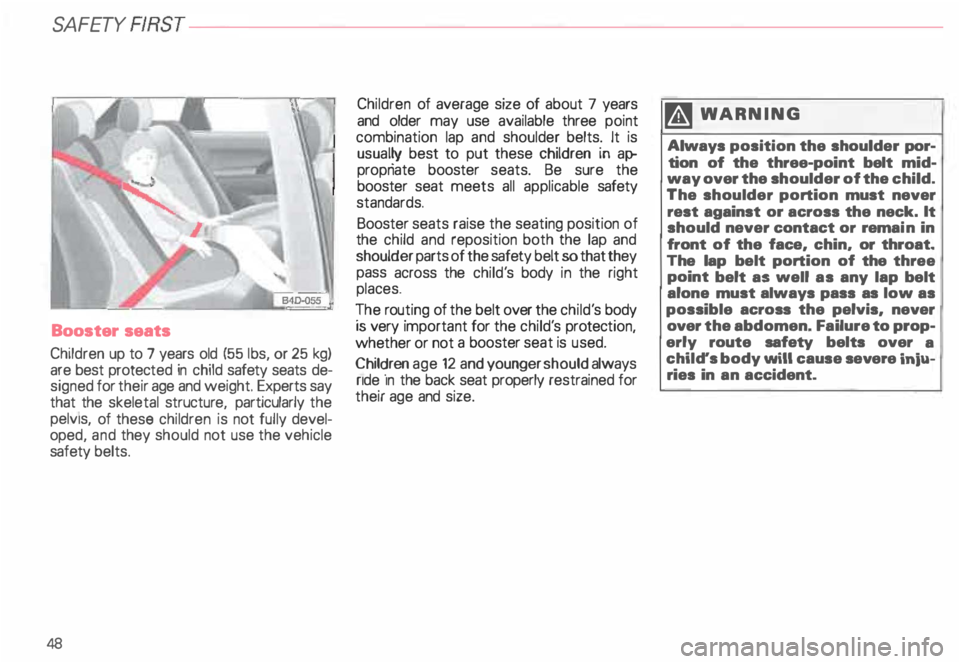
Booster seats
Children up to 7 years old (55 1bs, or 25 kg)
are best protect ed in child safety seats de
signed for their age and weight. Experts say
that the skeletal structure, particularly the
pelvis, of these children is not fully devel
oped, and they should not use the vehicle
safety belts.
48 Children
of average size of about 7 years
and older may use available three point
combination lap and shoulder belts. It is
usual �y best to put these children in ap
propnate booster seats. Be sure the
booster seat meets all applicable safety
standards.
Booster seats raise the seating position of
the child and reposition both the lap and
shoulder parts of the safety belt so that they
pass across the child' s body in the right
places.
} he rou.ting of the belt over the child' s body
IS very Important for the child' s protec tion,
whether or not a booster seat is used.
Chil �ren age 12 and younger should always
nde 1n the back seat properly restrained for
their age and size. �W
ARNING
� lways position the shoulder por
tion of the three-point belt mid
way over the shoulder of the child.
The shoulder portion must never
rest against or across the neck. It
should never contact or rema in in
front of the face, chin, or throat.
The lap belt portion of the three
point belt as well as any lap belt
alone must always pass as low as
possible across the pelvis, never
over the abdomen. Failure to prop
erly route safety belts over a
chil d's body will cause severe iniu
ries in an accident.
Page 51 of 306
SAFETYRRST-----------------------------------------------------
�W ARNING
Failure to properly route safety
balta over a childs body will cause
severe injuries in an accident.
The lap belt portion of the three
point belt as wall as any lap belt
alone must always pass as low as
possible across the pelvis, never
over the stomach or abdomen.
Yo unger children should use a lap belt only
in very exceptio nal situations and only if no
child restraint system for the child' s size and
weight or safer alternative means of trans
portation of the child is available. In these
excep tional situations, the use of a lap belt
is better than permitting the child to remain
totally unrestrained. But remember: a lap
belt cannot provide the same level of
protect ion as a proper child restra int.
50 �W
ARNING
• An improperly worn safety belt
will not provide the best protec
tion in an accident and may causa
serious personal injury. Always
make sure that children and other
vehicle occupants properly wear
available restraint systems. Care
fully follow the Instructions pro
vided by the manufacturers of
child restra ints.
• Commercially available child
seats are required to comply with
U. S. Federal Motor Vehicle Safety
Standard (FMVSS) 213 (in Canada
CMVSS 213).
• These standards include instal
lation requirements for using the
lap portion of a combination lap
shoulder belt such as those
installed in your vehicle. fA,
WARNING continued
• When buying a child restraint,
select one that fits your child and
vehicle.
• Only use child restraint systems
that fully contact the flat portion
of the seat cushion. The child seat
must not tip or lean to either side.
Audi does not recommend using
child seats that rest on legs or
tube-like frames. They do not pro
vida adequate contact with the
seat.
• Improperly or inadequately
installed child restraint systems
can increase the risk of injury to
children in accidents. Therefore,
always carefully read and follow
all instructions on installation and
use that come with the system.