weight AUDI ALLROAD 2000 User Guide
[x] Cancel search | Manufacturer: AUDI, Model Year: 2000, Model line: ALLROAD, Model: AUDI ALLROAD 2000Pages: 306, PDF Size: 9.95 MB
Page 56 of 306
�W
ARNING
• To prevent serious injuries, chil
dren must always be secured in a
vehicle by a child restraint system
appropriate for their age and size.
• A child must never rest his I her
head against the side trim panel in
the area where the side airbag in
flates.
An inflati ng alrbag can cause seri
ous or fatal injury!
• Never place items in the area
where the side airbag inflates. This
could cause serious injury!
Note If special situations in your family require,
your authorized Audi Dealer can disconnect
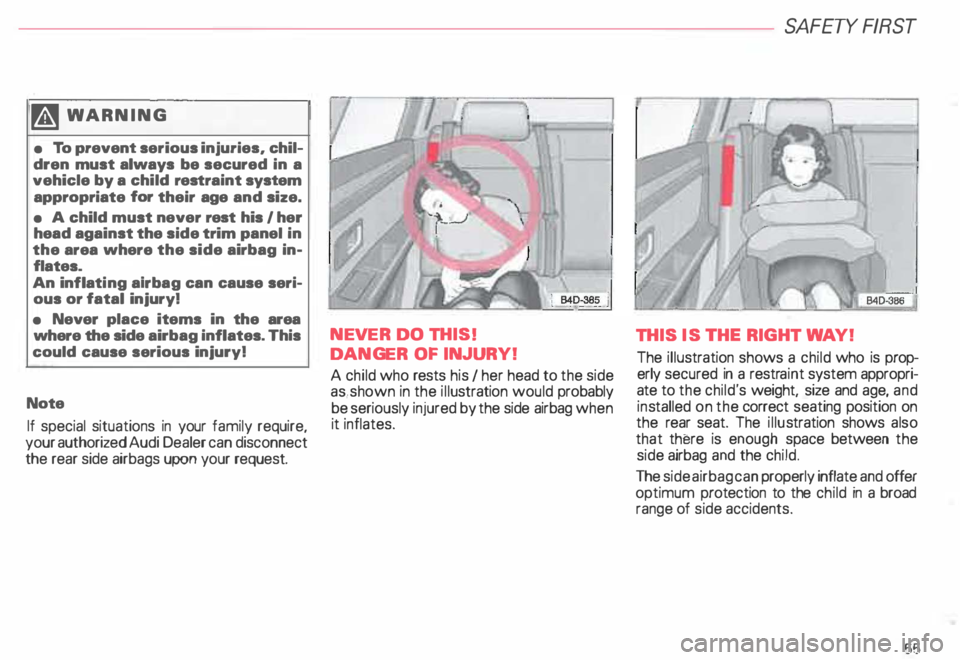
the rear side airbags upon your request. NEVER
DO THIS I
DANGER OF INJ URY !
A child who rests his I her head to the side
as, shown in the illustration would probably
be seriously injured by the side airbag when
it inflates. SA
FETY FIRST
THIS IS THE RIGHT WAY !
The illustration shows a child who is prop
erly secured in a restr aint system appropri
ate to the child' s weight, size and age, and
ins talled on the correct seating position on
the rear seat. The illustration shows also
that there is enough space between the
side airbag and the child.
The side airbag can properly inflate and offer
optimum protection to the child in a broad
range of side accidents.
55
Page 89 of 306

CONTROLS
AND EQUIPMENT---------------------
Luggage
compartment
Increasing size of the luggage
compartment
Yo u can fold the backrest forward to in
crease the size of the luggage compart
ment.
Tr ansporting heavy objects
Tra nsporting heavy objects can change the
way your vehicle behaves. For best han
dling under these conditions, distribute
loads evenly.
Always place heavy cargo as far forward as
possible in the luggage compartment.
When transporting heavy objects, drive
slowly and avoid sudden maneuvers.
�W ARNING
• Never exceed the Gross Axle
Weight Rating or the Gross Vehicle
Weight Rat�ng specified on the
safety compliance sticker on the
left door jamb. Exceed ing permis
sible weight ratings can change
the way the vehicle handles and
could result in accidents, personal
injur y, and vehicle damage.
88 M
WARNING continued
• Do not allow passengers to
occupy the rear load surface while
the vehicle Is in motion. Vehicle
occupants must always be prop
erly restrained.
• Loose items inside the passen
ger compartment, can fly forward
in an accident or sudden maneuver
and injure occupants. Always
store articles in the luggage
compartment and use the fasten
ing eyes, especially when the rear
seat backs have been folded down.
In particular, when traveling on
rough roads or rugged terrain, ma
ke cert ain that all luggage and
other items are stowed in the lug
gage compartment and that they
are secured in such a way that they
cannot shift. M
WARNING continued
• To help prevent poisonous ex
haust gas from being drawn into
the vehicle, always keep the rear
lid closed while driving. Never
transport objects larger than
those fitting completely into the
luggage area, because the rear lid
cannot be fully closed.
• If you must drive with the rear
lid open under exceptional circum
stances always take the following
precautions to help reduce the risk
of deadly carbon monoxide (CO)
from the exhaust system from be
ing drawn into the passengers
compartment:
open all of the windows
turn off the air recirculation
switch
- select maximum fan speed.
Page 108 of 306
In selector
lever positions "P" (Park) a no
"N" (Neutral), the instruction "WHEN
STA TIONARY APPLY FOOTBRAKE WHILE
SELECTING GEAR" appears in the instru
ment cluster as a reminder for the driver.
Also, the symbol in the shift console will
light up.
A time delay element prevents the selector
lever from locking when it is moved through
the "N"' (Neutral) position (for example,
going from "R" to "D"). The locking ele
ment only locks the selector lever if it is left
in the "N" (Neutral) position for more than
about one second without the brake pedal
being depressed.
In the N (Neutral) position, the selector le
ver will not lock when the vehicle is driving
faster than 3 mph (5 km/h). Display
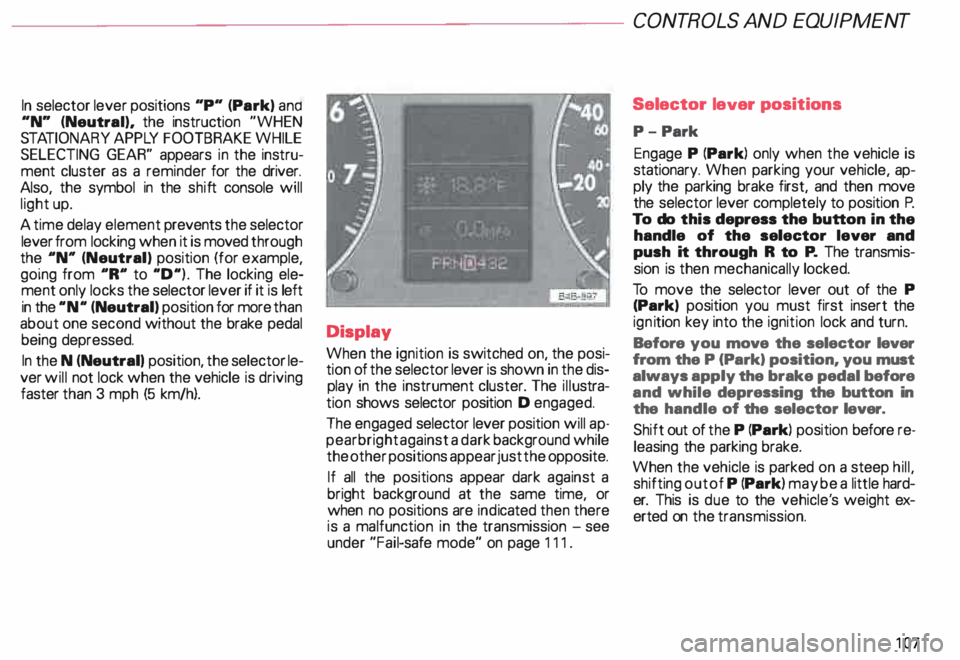
When the ignition is switched on, the posi
tion of the selector lever is shown in the dis
play in the instrument cluster. The illustra
tion shows selector position D engaged.
The engaged selector lever position will ap
pear bright against a dark background while
the other positions appear just the opposite.
If all the positions appear dark against a
bright background at the same time, or
when no positions are indicated then there
is a malfunction in the transmission -see
under "Fail-safe mode" on page 111. CONT
ROLS AND EQUIPMENT
Selector lever positions
P- Park
Engage P (Park) only when the vehicle is
stationary. When parking your vehicle, ap
ply the parking brake first, and then move
the selector lever completely to position P.
To do this depress the button in the
handle of the selector lever and
push it through R to P. The transmis
sion is then mechanically locked.
To move the selector lever out of the P
(Park) position you must first insert the
ign ition key into the ignition lock and turn.
Before you move the selector lever
from the P (Park) position, you must
always apply the brake pedal before
and while depressing the button in
the handle of the selector lever.
Shift out of the P (Park) position before re
leasing the parking brake.
When the vehicle is parked on a steep hill,
shifting out of P (Park) may be a little hard
er. This is due to the vehicle' s weight ex
erted on the transmission.
107
Page 151 of 306

CONTROLS AND
EQUIPMENT--------------------
1 and 4-Electrically heated ... 8
seats• utJ
The heating elements in both seats can be
turned on and regulated separately with the
two thumb wheel switches.
With the ignition on, the seat cushion and
backrest of the front seats can be heated
electrically.
15 0 1
- Use this thumb wheel switch to activate
and regulate the heating elements in the
driver's seat.
4- Use this thumbwheel switch to activate
and regulate the heating elements in the
front passenger's seat.
From position 0, roll thumbwheel upward to
activate the heating elements.
Select the desired temperature setting be
tween positions 1-6. When the heating ele
ments are activated, the numbers on the
thumb wheel will light up.
The steering wheel heating* is
swit ched on automatically when the seat
heating is switched on. The temperature.
however, remains at a constant preset level
and cannot be regulated with the thumb
wheel (1).
Note
To prevent possible damage to the heating
elements, do not kneel on the seats or in
any other way apply a heavy load to relative
ly small areas of the seat. The
heating elements* for the left and right
seating positions of the rear seat bench are
switched on and off and regulated by the
thumbwheel in the center console:
a - left
b- right
The rear seat heating* only operates when
a sensor registers the weight of the occu
pant on the seat.
Select the desired temperature setting be
tween positions 1-6. When the heating ele
ments are activated, the numb ers on the
thumbwheel will light up.
Page 180 of 306
Coat hooks
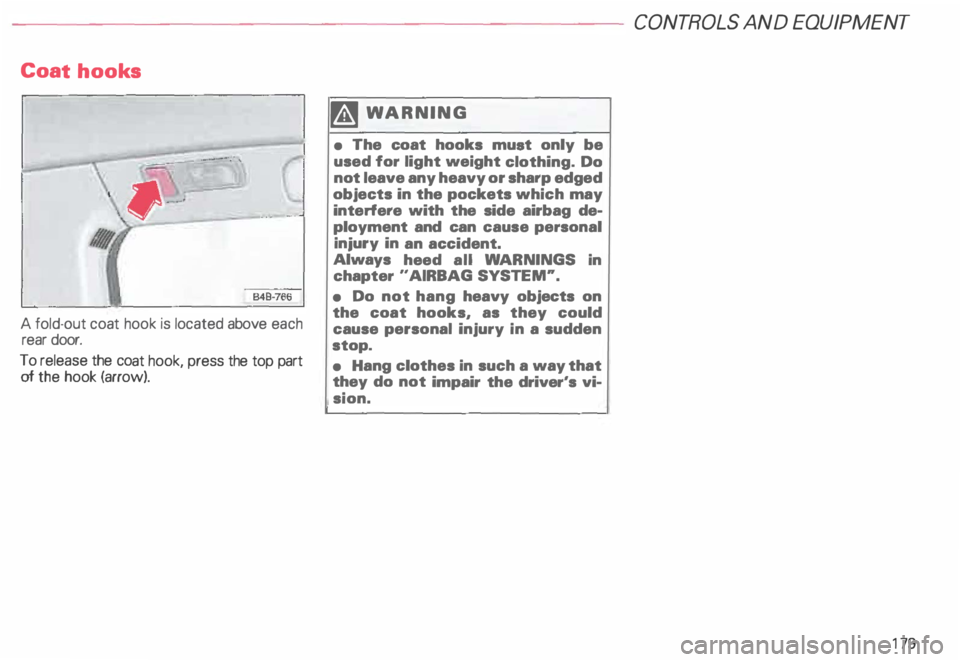
A fold-out coat hook is located above each
rear door.
To release the coat hook, press the top part
of the hook (arrow). �W
ARNING
• The coat hooks muet only be
used for light weight clothing. Do
not leave any heavy or sharp edged
objects in the pockets which may
interfere with the side airbag de
ployment and can cause personal
injury in an accident.
Always heed all WARNINGS in
chapter ., AIRBAG SYSTEM".
• Do not hang heavy objects on
the coat hooks, as they could cause personal injury in a sudden
stop.
• Hang clothes in such a way that
they do not impair the driver's vi
sion. CONTROLS
AND EQUIPMENT
179
Page 193 of 306
CONT
ROLS AND
EQUIPMENT---------------------
Loading a roof rack
Always distribute the loads evenly.
The total maximum permissible load
carrying capacity of 200 lbs ( 1 00 kg)
for the roof rack installation (includ
ing weight the roof rack system)
must not be exceeded -see
page 290 for details.
19 2 �
WARNING
• Improper use of a roof rack can
cause accidents and personal inju
ries.
• The use of a roof rack can nega
tively affect the way a vehicle han
dles.
• Cargo that is large. heavy,
bulk y, long or flat will have a
greater negative influence on the
vehicle's aerodynamics. center of
gravity and over all handling.
• Never exceed the maximum per
missible load carrying capacity of
the roof of your vehicle.
• Always drive slowly, avoid sud
den braking and maneuvers when
transp orting cargo on the roof of
your vehicle. When to
remove the roof rack
If you have installed a roof rack on your ve
hicle, it is best to ask the car wash operator
if it should be removed before going
through an automatic car wash.
When not in use, remove the roof rack to re
duce wind noise, improve handling, fuel
consump tion and guard against theft.
Page 197 of 306
VE
HICLE OPERATION------------------------
The external conditions
in which you drive also affect your fuel con
sumption.
The following conditions increase fuel con
sumption:
• Heavy traffic, especially in large cities
with many traffic lights.
• Stop-and-go driving, especially short dis
tances so that the engine never warms up
as it should.
• Driving in heavy, slow moving traffic in
low gear so that the engine speed is rela
tively high when compared to the distance
driven.
� Plan your trips ahaad of time. Or
� ganizs your trips to include sev
sral errands and to avoid heavy traf
fi c.
Of course, there are some conditions that
will affect fuel consumption that you can't
control.
For example, fuel consumption increases in
the winter or under difficult conditions (bad
roads, towing a trailer, etc.).
19 6 The
technical requirements
for optimum fuel consumption and eco
nomy were ''built" intoyourvehicle. Special
attention was paid to the environment. To
reta in and make use of these characteris
tics, please note the following points:
riJ Use only unleaded gasoline.
Leaded gasoline causes damage to the cat
alytic converter and other components of
the emission system.
t:Gh Have your vehicle serviced by an
� Audi Dealar at the specified in
tervals -see page 228 and your
Main tenance booklet.
Having your vehicle regularly serviced by an
Audi Dealer helps ensure that it runs prop
erly and economical ly, that it does not dis
turb the environment, and that it has a long
service life. t:Gh
Check
your tire pressure once a
W month.
Low tire pressure increases fuel consump
tion and tire wear, and impair s vehicle han
dling.
�W ARNING
Underinflation and overloading of
tires can lead to tire failure. Sud
den failur e on the road could cause
a serious or fata l accident. See
page 253 for inflation informa
tion.
� Do not carry unnecessary items
in the luggage compartment.
Particularly in city traffic where you must
often accelerate, weight influences fuel
consumption.
Page 209 of 306
VEHICLE OPERA
TION-----------------------
Trailer towing
Yo ur Audi was designed primarily for pas
senger transportat ion. The additional load
will affect durability, economy and perfor
mance.
Tra iler towing not only places more stress
on the vehicle, it also calls for more con
centration from the driver.
For this reasons, always follow the opera
ting and driving instructions given and use
common sense.
208 Te
chnical requirements
Tr ailer hitch
Use a weight-carrying hitch conforming to
the gross trailer weight. The hitch must be
suitable for your vehicle and trailer and
securely bolted to appropriate place on the
vehicle's chassis. Use only a trailer hitch
with removable ball mount. Always check
with the trailer hitch manufacturer to make
sure that you are using the correct hitch.
Do not use a bumper hitch.
The hitch must be installed in such a way
that it does not interfere with the impact-ab
sorbing bumper system. No modifications
should be made to the vehicle exhaust and
brake systems. From time to time, check
that all hitch mounting bolts remain secure
ly fastened. When
you are not towing a trailer, remove
the trailer hitch ball mount. This prevents
the hitch from causing damage should your
vehicle be struck from behind.
�W ARNING
When you are no longer towing a
trailer, remove the entire trailer
hitch. When doing so, seal all bolt
holes to prevent water and deadly
exhaust fumes from entering the
vehicle.
Engine cooling system
To wing a tr ailer make the engine work hard
er. It is important that the engine cooling
system be up to the job. Make sure that the
cooling system has enough fluid.
Page 210 of 306
Tr
ailer brakes
If your trailer is equipped with a bra king sys
tem, check to be sure that it conforms to all
regulations.
The trailer brake system must not be direct
ly connected to the vehicle' s brake system.
Safety chains
Always use safety chains between your ve
hicle and trailer.
Tr ailer lights
Tra iler lights must meet all regulations. Do
not connect the trailer light system directly
to the light system of your vehicle. Be sure
to check with your Audi Dealer for correct
wiring, switches and relays. Mirrors
If you are unable to see the traffic behind
you using the regular outside mirrors, then
you must install extended mirrors. It's im
porta nt that you always have clear vision to
the rear.
Operating instructions
Maximum trailer weight
A trailer for your vehicle is limi ted to a typical
class 1 or class 2 trailer.
Never allow a passenger to ride in a
trailer.
�W ARNING
Anyone not properly restrained in
a moving vehicle is at much great
er risk in an accident.
Never let anyone ride without the
restra ints provided by Audi. VEHICL
E OPER ATION
Lights
The headlight settings should be checked
with the trailer attached before driving off.
Adjust as necessary so that you can see the
road ahead but not blind on-coming traffic.
Check proper working of vehicle and trailer
lights.
Safety chains
Be sure trailer safety chains are properly
conn ected from the trailer to the hitch on
the vehicle. Leave enough slack in the
chains to permit turning corners. When you
install safety chains, make sure they will not
drag on the road when you are driving.
The chains should cross under the trailer
tongue to prevent it from dropping in case
of separation from the hitch.
209
Page 212 of 306
-----------------------VEHICL E OPER ATION
Tr ailer towing tips
Yo ur vehicle handles differently when tow
ing a trailer because of the additional weight
and weight distribution. Safety, perfor
mance and economy will greatly depend on
how carefully you load your trailer and oper
ate your rig.
Before you actually tow your trailer, practice
turning, stopping and backing up in an area
away from traffic until you learn the feel of
your vehicle and trailer unit.
Backing up is difficult and requir es practice.
Steering while backing up is generally oppo
site of that when backing your vehicle with
out a trailer.
Maintain a greater distance between your
vehicle and the one in front of you. You will
need more room to stop.
To compensate for the trailer, you will need
a larger than normal turning radius. When
passing, remember that you cannot
accelerate as fast as you normally would be
cause of the added load. Make sure you
have enough room to pass. After passing,
allow plenty of room for your trailer before
changing lanes again.
Avoid jerky starts, sharp turns or rapid lane
changes.
After parking, always block the wheels of
both vehicle and trailer. Do not park with a
trailer on a slope. If it cannot be avoided, do
so only after doing the following:
• Apply foot brake.
• Have someone place chocks under both
vehicle and trailer wheels.
• With chocks in place, slowly release
brakes until wheel blocks absorb the load.
• Turn wheels to curb.
o Apply parking brake.
• Place automatic transmission in "P". If
you move the selector lever of the auto
matic transmission to "P" before applying
the parking brake and before blocking the
wheels, you may require more force later to
move the lever out of the "P" position.
When restarting after parking on a slope, re
verse the procedure:
• Start the engine.
• Shift transmission into gear.
o Release the parking brake and slowly
move away from the wheel blocks.
• Stop and have someone retrieve the
wheel blocks.
Notes
• Do not tow a trailer during the
break-in period of your vehicle.
• If you tow a trailer, your Audi may require
more frequent maintenance due to the ex
tra load -see also page 228.
211