ECO mode AUDI ALLROAD 2000 Owner's Manual
[x] Cancel search | Manufacturer: AUDI, Model Year: 2000, Model line: ALLROAD, Model: AUDI ALLROAD 2000Pages: 306, PDF Size: 9.95 MB
Page 188 of 306
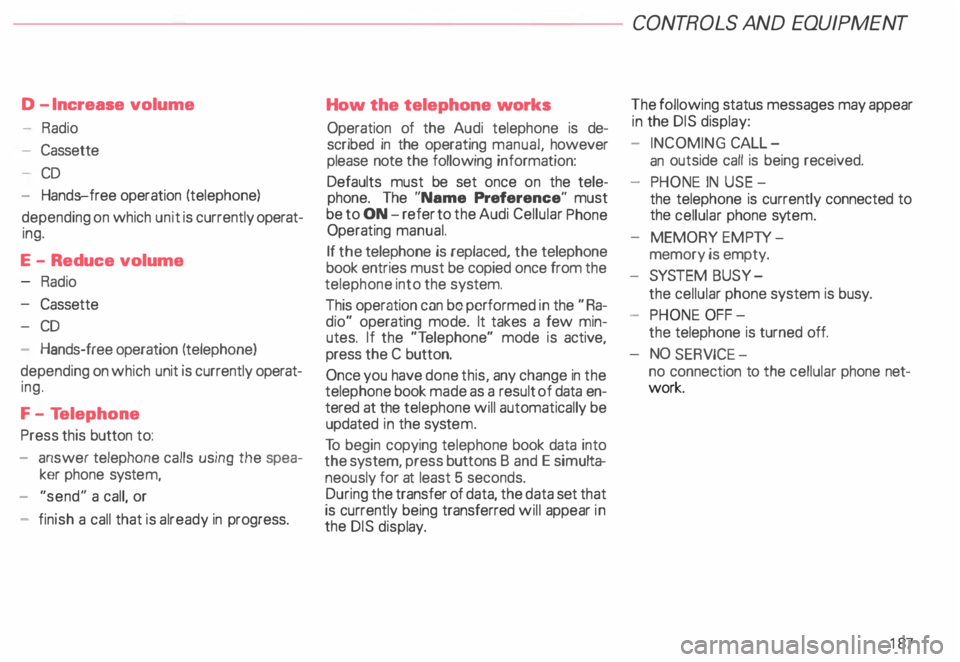
D
-Increase volume
- Radio
- Cassette
- CD
- Hands-free operation (telephone)
depending on which unit is currently operat
ing.
E -Reduce volume
Radio
- Cassette
- CD
- Hands-free operation (telephone)
depending on which unit is currently operat
ing.
F - Te lephone
Press this button to:
- answer telephone calls using the spea
ker phone system,
- "send" a call, or
- finish a call that is already in progress. How
the telephone works
Operation of the Audi telephone is de
scribed in the operating manual, however
please note the following information:
Defaults must be set once on the tele
phone. The "Name Preference" must
be to ON -refer to the Audi Cellular Phone
Operating manual.
If the telephone is replaced, the telephone
book entries must be copied once from the
telephone into the system.
This operation can be performed in the "Ra
dio" operating mode. It takes a few min
utes. If the "T elephone" mode is active,
press the C button.
Once you have done this, any change in the
telephone book made as a result of data en
tered at the telephone will automatically be
updated in the syste m.
To begin copying telephone book data into
the system, press buttons B and E simul ta
neously for at least 5 seconds.
During the transfer of data, the data set that
is currently being transferred will appear in
the DIS disp lay. CONT
ROLS AND EQUIPMENT
The following status messages may appear
in the DIS display:
- INCOMING CALL-
an outside call is being received.
- PHONE IN USE -
the telephone is currently connected to
the cellular phone sytem.
- MEMORY EMPTY-
memory is empty.
- SYSTEM BUSY-
the cellular phone system is busy.
- PHONE OFF-
the telephone is turned off.
NO SERV ICE-
no connection to the cellular phone net
work.
187
Page 189 of 306
CONT
ROLS AND
EQUIPMENT-------------------------------------------
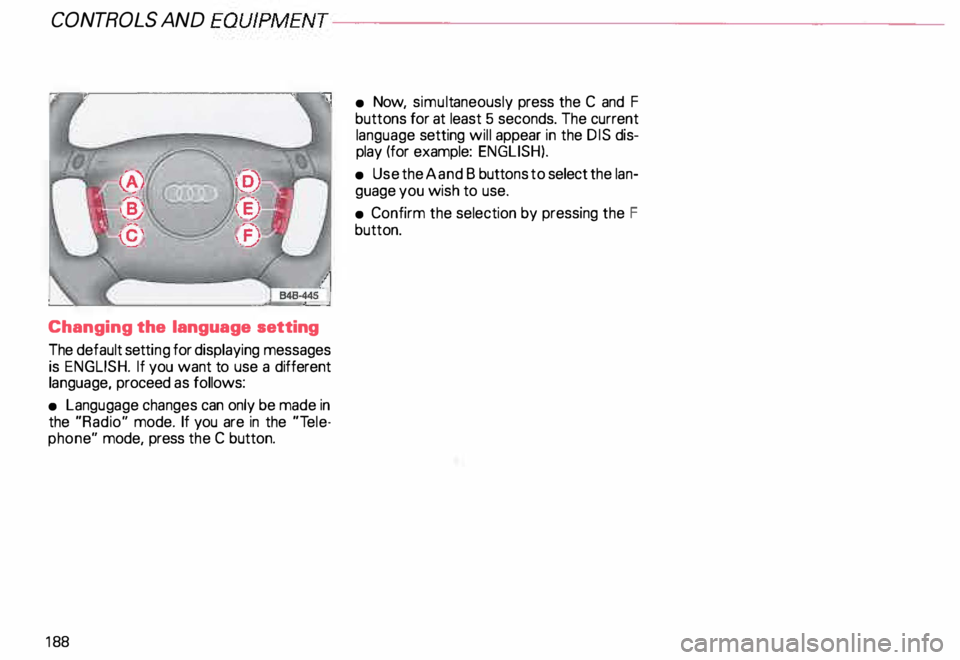
Changing the language setting
The default setting for displaying messages
is ENGLISH. If you want to use a different
language, proceed as follows:
• Langugage changes can only be made in
the "Radio" mode. If you are in the "Tele
phone" mode, press the C button.
18 8 •
Now, simult aneously press the C and F
buttons for at least 5 seconds. The current
language setting will appear in the DIS dis
play (for example: ENGLISH).
• Use the A and B butt ons to select the lan
guage you wish to use.
• Confirm the selection by pressing the F
button.
Page 206 of 306
Electronic
Stability Program (ESP)
The Electronic Stability Program helps to
control the vehicle in critical maneuvers like
curves.
When the vehicle starts up and accelerates,
the wheels are prevented from spinning by
adjusting the engine power to conform to all
road conditions. This improves vehicle sta
bil ity.
The system operates across the entire
speed range in combination with the ABS
syst em. If the Anti-Lock Brake System
(ABS) malfunctions, the ESP will also shut
down.
When you turn on the engine, the ESP will
automatically be activated and will perform
a self-test. The
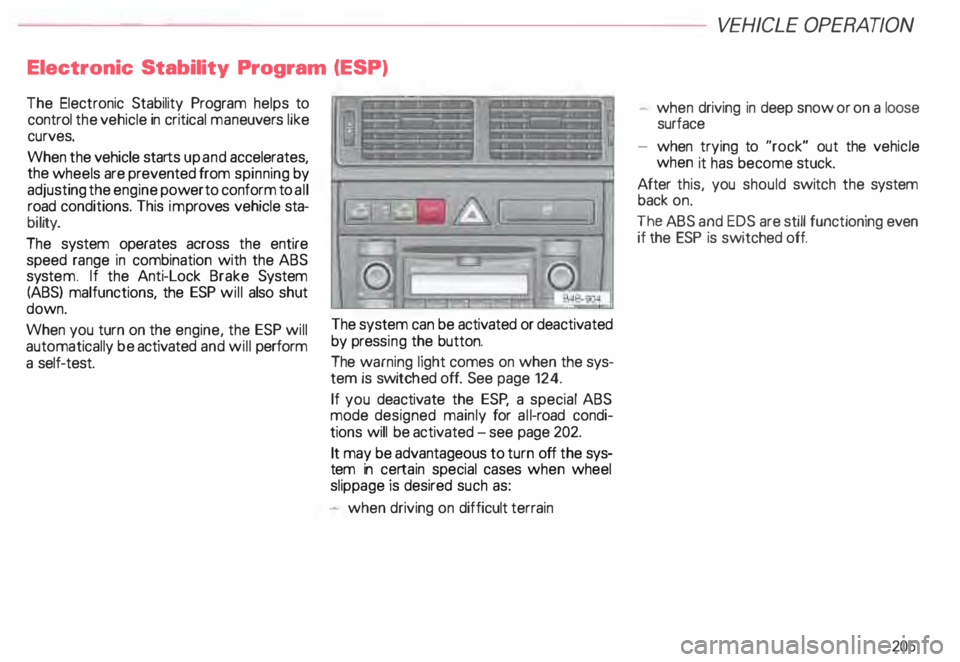
system can be activated or deactivated
by press ing the button.
The warning light comes on when the sys
tem is switch ed off. See page 124.
If you deactivate the ESP, a special ABS
mode designed mainly for all-road condi
tions will be activated - see page 202.
It may be advantageous to turn off the sys
tem in certain special cases when wheel
slippage is desired such as:
- when driving on difficult terrain VE
HICL E OPER ATION
- when driving in deep snow or on a loose
surface
- when trying to "rock" out the vehicle
when it has become stuck.
After this, you should switch the system
back on.
The ABS and EDS are still functioning even
if the ESP is switched off.
205
Page 239 of 306
VEHICLE CA
RE----------------------------------------------------
Engine cooling system
The cooling system is sealed and generally
requires little attention.
The cooling system has been filled at the
factory with a permanent coolant which
does not need to be changed. The coolant
consists of a mixture of water and the
man ufacturer's coolant additive G 12 ABD
-ant ifreeze on a glycol base with anti-corro
sion additives (50% for USA models; 60o/o
for Canadian models). This mixture assures
the necessary frost protection and protects
alloy components in the engine's cooling
system from corrosion and scaling. It also
raises the boiling point of the coolant.
Do not reduce the concentration of the cool
ant in the summer by adding plain water.
The proportion of coolant additive
must be at least 500fa but not more
than 600fa to maintain antifreeze protec
tion and cooling efficiency.
238 For
year-r ound driving, antifreeze is added at
the factory for temperatures down to:
-31 °F (-35 °C) USA
-40 °F (-40 °C) Canada.
g Always heed all WA RNINGS
E!!1 on page 232.
Never use eny coolant additive
other than our G12 ABD additive
(check label) for your vehicle. This
coolant additive is available at au
thorized Audi Dealers.
Other types of antifreeze can. above
all. significantly reduce corrosion
protection. The resulting corrosion
can cause a loss of coolant and
therefore serious engine damage. When
adding coolant additive to
your cooling system. please remem
ber:
Under no circumstances may G12
ABD be mixed with other coolant ad
ditives (for example G 11 ).
You can recognize G12 ABD in the
expansion tank by its red color. If
the liquid in the expansion tank is
brown, G 12 ABD has been mixed
with another coolant additive. In
this case. your vehicle's coolant
must be changed as soon as pos
sible.
Note
Mixing coolant additives can result
in serious malfunction or engine
damage!
Page 250 of 306
-------------------------VEHICLE
CARE
Spark plugs
Spark plugs are replaced during the Audi
scheduled Maintenance Service.
If you have to replace the spark plugs be
tween the Audi Maintenance services, be
sure to note the following:
• Engine, spark plugs and the ignition sys
tem are matched to each other. To avoid
faulty operation or engine damage, use only
Original Audi spark plugs. It is especially im
portant to note the number of electrodes on
the spark plug and the heat value.
• Since spark plug specifications may
change for technical reasons during a model
year, we recommend that you obtain your
spark plugs from an authorized Audi Dealer,
who has the latest information.
Always heed all WARNINGS
on page 232. Belts
Ribbed V-Belt
The radiator fan, hydraulic pump (power
steering), alternator and air conditioner
compressor are driven by one V-belt.
The installed V-belt conforms to the highest
quality requirements. The V-belt adjusts its
own tension.
Replacing of the V-belt should be
performed by your authorized Audi
Dealer or a qualified workshop.
When replacing a belt, it is not sufficient to
use just any belt of the same size. For safe
and reliable operation, use only Genuine
Audi V-belts specially designed for your ve
hicle. The correct belts can be obta ined at
your authorized Audi Dealer. �W
ARNING
To prevent serious personal inju
ries stay well clear of the V-belt,
The radiator fan and the V-belt
driven accessories when the en
gine is running. The V-belt will be
inspected and replaced by your au
thorized Audi Dealer during a
scheduled Maintenance Service.
Timing belt
• Yo ur engine is equipped with a long last
ing toothed belt. The belt will be in
spected and replaced during a scheduled
Maintenance Service.
Always heed all WA RNINGS
on page 232.
249
Page 254 of 306
lira
service life
The service life of your tires depends for the
most part on the following factors:
lire pressure
Requir ed cold tire inflation pressures are
listed on a sticker inside the fuel filler flap or
on the rear passenger's door pillar (right
side) -depending on the model.
�W ARNING
• Incorrect tire pressures can lead
to a serious or fatal accident:
• Incorrect tire pressures cause
increased tire wear and can affect
handling of the vehicle.
• Incorrect pressures can also
lead to sudden tire failure and
deflati on, causing loss of vehicle
contr ol.
c£' Low tire pressures increase fuel
consumption, which is detri
mental to the environment. Tire
pressures should be checked at least
once a month and always before a long trip.
Tire pressures are very important,
particularly when the vehicle is driv
en at higher speeds.
If you are going to be driving at higher
speeds (a lot of expressway driving), then it
is rec ommended to increase the tire pres
sure by 5 psi (0.3 bar).
Always check tire pressures when the tires
are cold. When the tires are warm, the pres
sure will be highe r. Do not reduce the
pressure of warm tires.
Don't forget to check the spare wheel. The
inflation pressure is marked on the tire side
wall.
Use an accurate tire pressure gauge when
checking inflation pressures. Never exceed
the maximum tire inflation pressure listed
on the tire sidewall. Cold tire inflation pres
sure means: the vehicle has been standing
for at least 3 hours or driven for less than
1 mile (1 km).
Do not forget to replace the valve stem caps
after checking tire pressure. VE
HICL E CA RE
Driving habits
Fast cornering, heavy acceleration and hard
braking all increase tire wear.
Wheel balancing
The wheels on new vehicles are balanced.
When driving, however, various conditions
can cause a wheel to become unbalanced.
This may be noticed as vibrations in the
steering.
Since tire imbalance can cause wear on the
steeri ng, suspension and tires, you should
have your wheels re-balanced. A wheel
should always be balanced if a new tire has
been mounted or a tire was repaired.
Incorrect wheel alignment
Incorrect wheel alignment causes exces
sive and uneven tire wear, impairing the
safety ofth e veh ide. If you notice excessive
tire wear, contact your authorized Audi
Dealer.
253
Page 269 of 306
DO-IT-Y
OURSELF SERVICE----------------------
Step 1 ·"7
r.-&
.--· t I . ... ,.. . . . --------� .... ... . . ...
-
' . .. . ...
.. - - . .
J
To avoid damaging parts of the air
suspension system. you must have
the ride level adjustment system in
the jack mode whenever a jack or lift
is used to raise the vehicle:
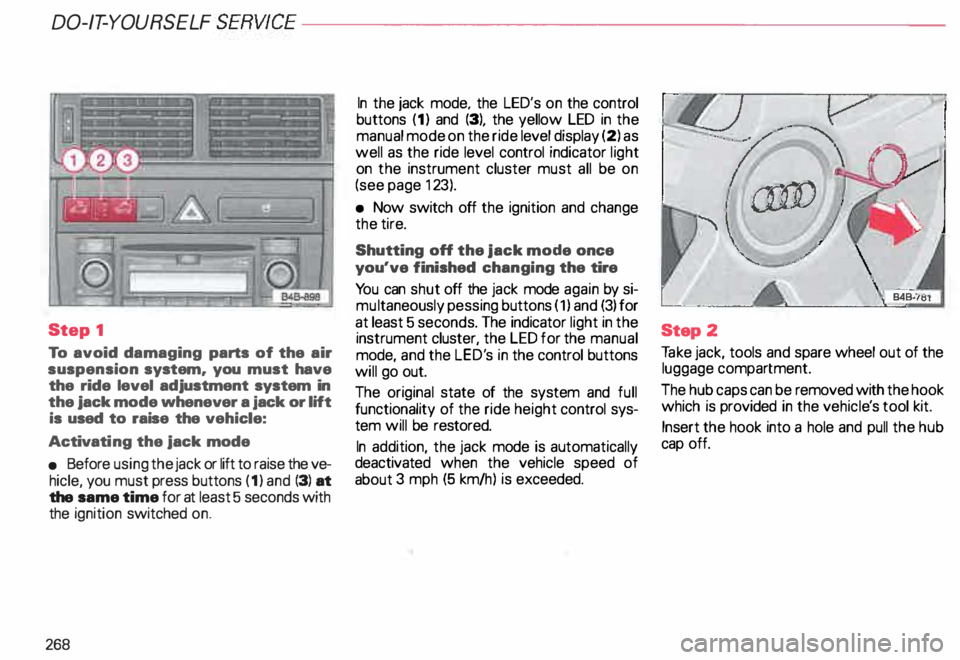
Activati ng the jack mode
• Before using the jack or lift to raise the ve
hicle, you must press buttons (1) and (3) at
the same time for at least 5 seconds with
the ignition switched on.
268 In
the jack mode. the LED's on the control
buttons (1) and (3), the yellow LED in the
manual mode on the ride level display (2) as
well as the ride level control indicator light
on the instrument cluster must all be on
(see page 123).
• Now switch off the ignition and change
the tire.
Shutting off the jack mode once
you've finished changing the tire
Yo u can shut off the jack mode again by si
mu ltaneously pessing buttons (1) and (3) for
at least 5 seconds. The indicator light in the
instrument cluster, the LED for the manual
mode, and the LED's in the control buttons
will go out.
The original state of the system and full
functionality of the ride height control sys
tem will be restored.
In addition, the jack mode is automatically
deactivated when the vehicle speed of
about 3 mph (5 km/h) is exceeded. Step
2
Ta ke jack, tools and spare wheel out of the
luggage compartment.
The hub caps can be removed with the hook
which is provided in the vehicl e's tool kit.
Insert the hook into a hole and pull the hub
cap off.
Page 275 of 306
DO-IT-YOURSELF
SERVICE----------------------
Fuses
A problem in the electrical system may be
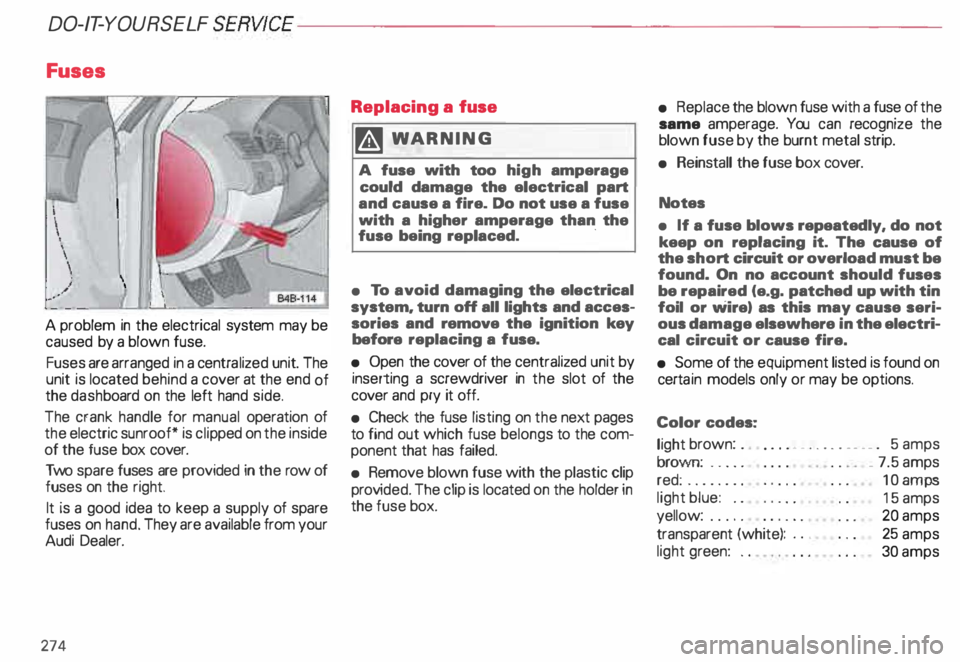
caused by a blown fuse.
Fuses are arranged in a centra lized unit. The
unit is located behind a cover at the end of
the dash board on the left hand side.
The crank handle for manual operation of
the electric sunroof* is cli pped on the inside
of the fuse box cover.
Two spare fuses are provided in the row of
fuses on the right.
It is a good idea to keep a supply of spare
fuses on hand. They are available from your
Audi Dealer.
274 Replacing
a fuse
� WARNING
A fuse with too high amperage
could damage the electrical part
and cause a fire. Do not use a fuse
with a higher amperage than the
fuse being replaced. ·
• To avoid damaging the electrical
system. turn off all lights and acces
sories and remove the ignition key
before replacing a fuse.
• Open the cover of the centralized unit by
inserting a screwdriver in the slot of the
cover and pry it off.
• Check the fuse listing on the next pages
to find out which fuse belongs to the com
ponent that has failed.
• Remove blown fuse with the plastic clip
prov ided. The clip is located on the holder in
the fuse box. •
Replace the blown fuse with a fuse of the
same amperage. You can recognize the
blown fuse by the burnt metal strip.
• Reinstall the fuse box cover.
Notes
• If a fuse blows repeatedly. do not
keep on replacing it. The cause of
the short circuit or overload must be
found. On no account should fuses
be repaired (e.g. patched up with tin
foil or wire) as this may cause seri
ous damage elsewhere in the electri
cal circuit or cause fire.
• Some of the equipment listed is found on
certa in models only or may be options.
Color codes:
light brown: . .
... • _ .. .. . __ . _ . 5 amps
brown: .... .
red: ....... .
light blue: ..
yellow: .....
transparent (white): ..•
light green: .. _
7.5 amps
10 amps
15 amps
20 amps
25 amps
30 amps
Page 285 of 306
DO-IT-YOURSELF
SERVICE----------------------
Jack
mode
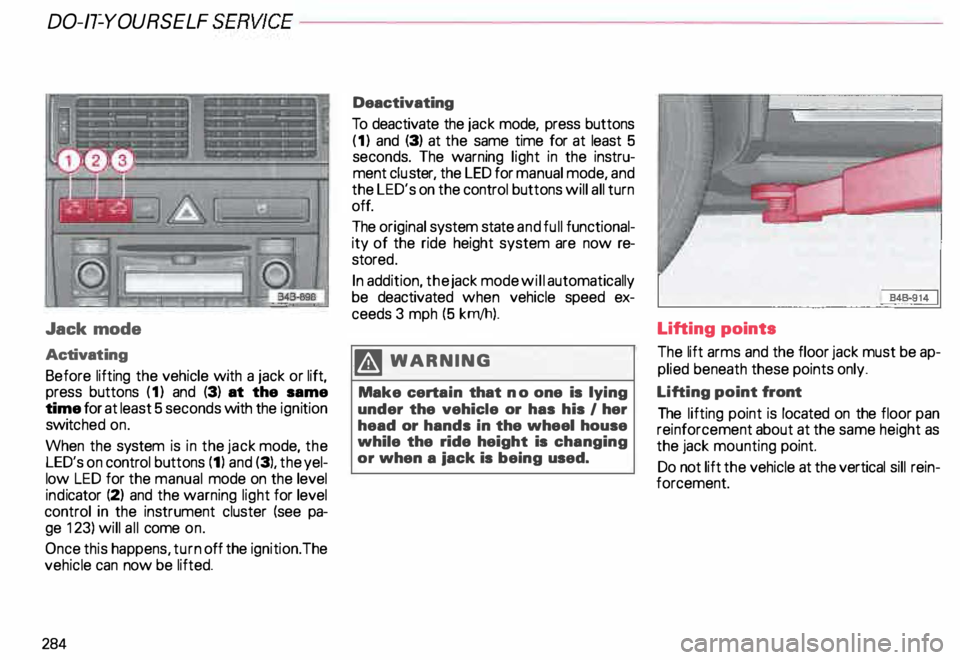
Activat ing
Before lifting the vehicle with a jack or lift,
press buttons (1) and (3) at the same
time for at least 5 seconds with the ignition
switc hed on.
When the system is in the jack mode, the
LED's on control buttons (1) and (3), the yel
low LED for the manual mode on the level
ind icator (2) and the warning light for level
control in the instrument cluster (see pa
ge 123) will all come on.
Once this happens, turn off the ignition. The
vehicle can now be lifted.
284 Deactivating
To deactivate the jack mode, press buttons
(1) and (3) at the same time for at least 5
seconds. The warning light in the instru
ment cluster, the LED for manual mode, and
the LED's on the control buttons will all turn
off.
The original system state and full functional
ity of the ride height system are now re
store d.
In addition, the jack mode will automatically
be deactivated when vehicle speed ex
ceeds 3 mph (5 krn/h).
.� WARNING
Make certain that no one is lying
under the vehicle or has his I her
head or hands in the wheel house
while the ride height is changing
or when a iack is being used. Lifting points
The
lift arms and the floor jack must be ap
plied beneath these points only.
Lifting point front
The lifting point is located on the floor pan
reinforcement about at the same height as
the jack mounting point.
Do not lift the vehicle at the vertical sill rein
forcement.