brake light AUDI ALLROAD 2000 Owner's Manual
[x] Cancel search | Manufacturer: AUDI, Model Year: 2000, Model line: ALLROAD, Model: AUDI ALLROAD 2000Pages: 306, PDF Size: 9.95 MB
Page 206 of 306
Electronic
Stability Program (ESP)
The Electronic Stability Program helps to
control the vehicle in critical maneuvers like
curves.
When the vehicle starts up and accelerates,
the wheels are prevented from spinning by
adjusting the engine power to conform to all
road conditions. This improves vehicle sta
bil ity.
The system operates across the entire
speed range in combination with the ABS
syst em. If the Anti-Lock Brake System
(ABS) malfunctions, the ESP will also shut
down.
When you turn on the engine, the ESP will
automatically be activated and will perform
a self-test. The
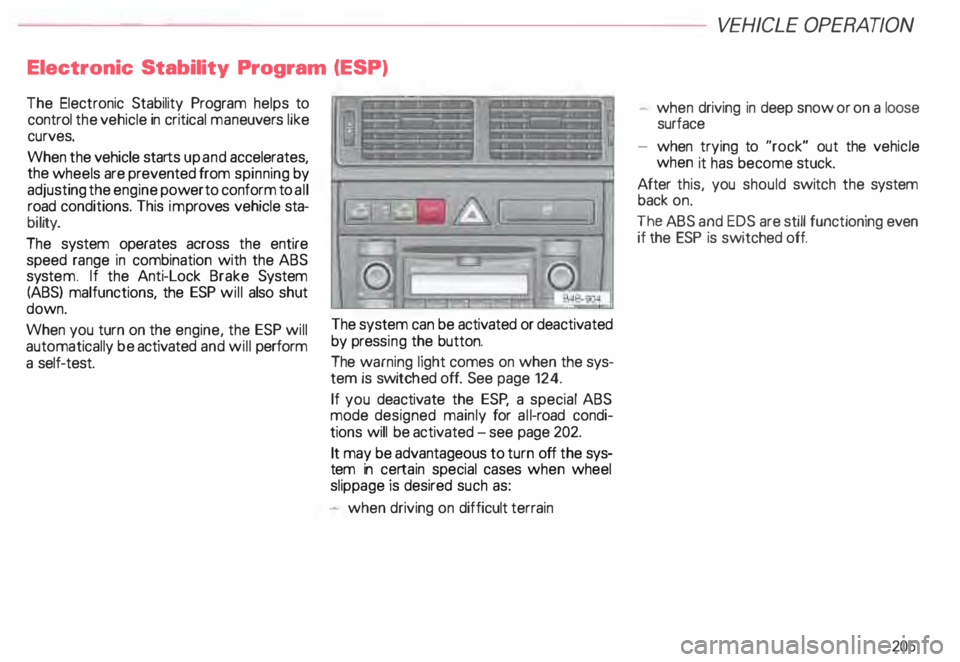
system can be activated or deactivated
by press ing the button.
The warning light comes on when the sys
tem is switch ed off. See page 124.
If you deactivate the ESP, a special ABS
mode designed mainly for all-road condi
tions will be activated - see page 202.
It may be advantageous to turn off the sys
tem in certain special cases when wheel
slippage is desired such as:
- when driving on difficult terrain VE
HICL E OPER ATION
- when driving in deep snow or on a loose
surface
- when trying to "rock" out the vehicle
when it has become stuck.
After this, you should switch the system
back on.
The ABS and EDS are still functioning even
if the ESP is switched off.
205
Page 207 of 306
VEHICLE
OPER ATION----------------------
Operation
The Anti-Lock Brake System (ABS) and the
Electronic Differential Lock (EDU are inte
grat _ed in the Electronic Stability Progr am. In
a _ddrtron to the data provided by these func
tions, the ESP control unit requires addition
al measurement data provided by hig h-per
forman ?e sensors. The rotat ional speed of
the veh1cle about its vertical axis, vehicle lat
eral acceleration, brake pressure and the
steering angle are measured.
The direction in which the driverwishes to
travel is determined with the aid of the
stee �ing angle and the vehicle speed and is
contmually compared with the actual be
havior of the vehicle.
If the data do not match - for example when
a vehrcle is beginning to spin out of control
- the ESP applies the brakes to the appropri
ate wheels for the given situation and, if
necessar y, changes the vehicle traction
forces so as to reduce the slipping of individ
ual wheels (ASR anti-slip regulation).
206 The
vehicle is then stabilized by the forces
a ?tin � on the wheel during braking. If the ve
hicle IS overstee ring (rear tends to skid out
of the turn), the brakes are mainly applied on
the wheel that is on the outside ofthe curve.
In the case of a vehicle that is und ersteering
(tendency to slide out of the curve). the
brakes are applied at the rear wheel that is
on the inside of the curve. An audible signal
�rll accompany the brake application func
tion.
All �SP senso rs a�e monitored continuously
wh1le the vehicle IS being driven. However,
when the vehicle is driven at low speed on
ex tremely rugged terrain, it is not always
possrble to monrtor the ESP sensors contin
uously. Thus, in rare and exceptional cases
the ESP itself can deactivate (ESP and ABS
ind icator lights will be lit continuously).
In this case. the ride level adjustment sys
tem lowers the vehicle to the normal level
If this happens, you may need to select th�
ride level again (see page 153).
Operation of the ESP and ABS is restored
whenever you restart the engine. m
WAR NING
! he Electronic Stability Program
•• nevertheless subject to the laws
of physics. It is particularly impor
tant to pay attention to this fact on
wet and slippery roads.
It is therefore important that you
always adapt your driving to the
condition of the road and traffic
conditions. Do not allow the in
creased safety provided by the
Electro nic Stability Program sys
tem to lull you into accepting addi
tional safety risks.
Page 210 of 306
Tr
ailer brakes
If your trailer is equipped with a bra king sys
tem, check to be sure that it conforms to all
regulations.
The trailer brake system must not be direct
ly connected to the vehicle' s brake system.
Safety chains
Always use safety chains between your ve
hicle and trailer.
Tr ailer lights
Tra iler lights must meet all regulations. Do
not connect the trailer light system directly
to the light system of your vehicle. Be sure
to check with your Audi Dealer for correct
wiring, switches and relays. Mirrors
If you are unable to see the traffic behind
you using the regular outside mirrors, then
you must install extended mirrors. It's im
porta nt that you always have clear vision to
the rear.
Operating instructions
Maximum trailer weight
A trailer for your vehicle is limi ted to a typical
class 1 or class 2 trailer.
Never allow a passenger to ride in a
trailer.
�W ARNING
Anyone not properly restrained in
a moving vehicle is at much great
er risk in an accident.
Never let anyone ride without the
restra ints provided by Audi. VEHICL
E OPER ATION
Lights
The headlight settings should be checked
with the trailer attached before driving off.
Adjust as necessary so that you can see the
road ahead but not blind on-coming traffic.
Check proper working of vehicle and trailer
lights.
Safety chains
Be sure trailer safety chains are properly
conn ected from the trailer to the hitch on
the vehicle. Leave enough slack in the
chains to permit turning corners. When you
install safety chains, make sure they will not
drag on the road when you are driving.
The chains should cross under the trailer
tongue to prevent it from dropping in case
of separation from the hitch.
209
Page 211 of 306
VEHICLE OPER
ATION-----------------------
Driving Instructions
To obtain the best possible handling of ve
hicle and trailer , please note the following:
• A "balanced" rig is easier to operate and
control. This means that the tow vehicle
should be loaded to the extent possible and
permissible while keeping the trailer as light
as possible under the circumstances.
Whenever possible, transfer some cargo to
the luggage compartment of the tow ve
hicle while observing tongue load require
ments and vehicle loading considerations.
• The higher the speed, the more difficult
it becomes for the driver to control the rig.
Do not drive at the maximum per
missible speed. Reduce your speed even
more under unfavorable load, weather or
wind conditions - particularly when going
dow nhill.
210 Be
especially careful when passing other
vehicles.
Reduce vehicle speed immediately if the
trailer shows the slightest sign of swaying.
Do not try to stop the sway ing by accel erat
ing.
Observe speed limits. In some areas
speeds for vehicles towing trailers are low
er than for regular vehicles.
• Always apply brakes early.
When driving downhill, shift into lower gear
to use the engine braking effect to slow
down the vehicle. Use of the brakes alone
can cause them to overheat and fail. •
The coolant temperatura gauge
must be observed carefully. H the
needle nears the upper end of the
scale, reduce speed immediately
and/or switch off the air condi
tioner.
If the coolant temperature warning
light in the instrument cluster starts
flashing in red, pull off the road,
stop and let the engine idle for about
2 minutes to prevent a heat build-up.
Page 215 of 306
VEHICL E CA
RE----------------------------------------------------
Notes
• Do not wash the vehicle in direct sun
light.
• If the vehicle is rinsed with a hose, do not
direct the water into the lock cylinders -
otherwise they may freeze up in the winter.
�W ARNING
• Do not wash, wax or dry the ve
hicle with the engine running.
• Do not clean the underside of
chassis, fenders, wheel covers,
etc. without protecting your
hands and arms. You may cut your
self on sharp-edged metal parts.
• Moisture and ice on brakes may
affect braking efficiency. Test the
brakes carefully after each vehicle
wash.
214 Washing
your vehicle with a power
washer
If you use a power washer, please note the
following:
• Always follow the operating instructions
for the power washer -especially for pres
sure and spraying distance.
• Make sure that the jet on the spray hose
produces a "fan shape" spray. Do not use
a jet which sprays the water out in a direct
stream or one that has a rota ting jet.
• Water temperature should not exceed
140 °F (60 °C).
�W ARNING
Never wash tires with a jet that
sprays the water out in a direct
stream. This could invisibly dam
age and weaken the tires, even if
they are sprayed from a relatively
long distance for a vary short
amount of time. Damaged and
weakened tires can fail and cause
accidents and personal injury. Headli
ghts
Do not clean your headlights with a dry
towel or sponge. They must be cleaned
with a moistened towel.
Never use a sponge designed for removing
dried-on insects, a kitchen scrubber or any
other similar product since the lens surface
can be damaged by scrat ching and scour
ing.
When using high-pressure washing equip
ment or steam-cl eaning units, never spray
the vehicle with the nozzle close the vehicle
surface and never aim the spray at the same
point for a relatively long period of time.
Polishing Please refer to the imp ortant information on
page 212.
Polish your vehicle only if the paint has lost
its shine and the gloss cannot be brought
back with wax. If the polish used doesn't
contain preservative compounds, the paint
must be waxed afterwards.
Do not treat matte- pain�ed and plas
tic parts with polish or wax.
Page 217 of 306
VEHICL E
CA RE-------------------------
Weatherstrips
Keep silicone sprays off the wind
shield to avoid wiper smear in rain.
To seal properly, weatherstrips around
hood, rear lid, doors, etc., must be pliable.
Spray with silicone or coat with talcum pow
der or glycerine to reta in flexibility of the
rubber and to protect against freezing in the
w1nter.
Dull finishes and plastics
Plas .tic pa �s. such as light bulb lenses, dec
orative stnpes, panels, bumpers, etc., will
come clean with regular washing. Should
additional cleaning or spot remova l be nec
essar y, use a soft brush or cloth soaked with
a mild detergent solution. Then rinse thor
oughly and imme diately with clear water.
Do not use anyth ing which could
mar the plastic or dull finished sur
faces, such as wax, polish, abrasive
detergents or chemical cleaning sol
vents.
216 Bright
metal trim
Bright or black anodized metal trim will
come clean with regular washing. Remove
spots or dirt from chrome and stainless
steel with a chrome cleaner. Apply a
chrome polish for continued luster and
protec tion.
Steel wheels
Always include the hub caps and wheel
rims when washing your vehicle to remove
road dirt, salt sprays and brake dust. If nec
essary, use a commercial wheel cleaner to
remove accumulated brake dust. Paint
scratches should be touched up as soon as
possible to prevent corrosion.
Light alloy wheels
To preserve the decorative appearance of
the light alloy wheels, some special care is
necessary. In addition to road dirt and salt
sprays, brake dust is also corrosive. If left on
too long, brake dust can cause pitting. Wash
the wheels with a sponge or hose brush ev
ery other week. Road salt
should be removed weekly with
an acid free cleaning solution. Every three
months (after regular cleaning) coat the
wheels with petroleum jelly or car wax. Rub
it in firmly with a soft cloth. Never use abra
sive or metal polishing cleaning agents.
� WARNING
Moisture, ice, and road salt on
brakes may affect braking effi
ciency. Test the brakes carefully
after each washing. Always heed
WA RNING on page 203.
Page 234 of 306
When
adding fluids, always make
sure that they are poured into the
proper container or filler opening,
otherwise serious damage to ve
hicle systems will occur. r:Gb To detect leaks in time, inspect
� the vehicle floor pen from under
neath regular ly. If you see spots
from oil or other vehicle fluids, have
your vehicle inspected by an autho
ri zed Audi Dealer .
D Always heed all WA RNINGS
� on page 232.
Always exercise extreme caution
when working under the engine
hood. -
VE HICLE CARE
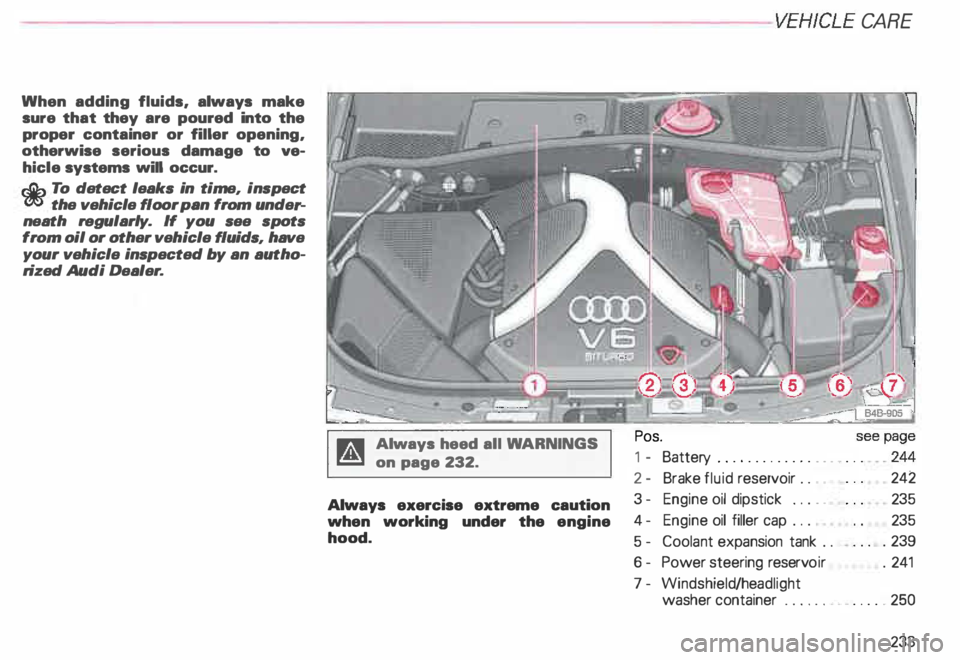
Pos.
1 - Battery ............. . _ .. .. .
2- Brake fluid reservoir . . . 242
3 - Engine oil dipstick ... . _ 235
4- Engine oil filler cap . . . 235
5- Coolant expansion tank . . . 239
6 - Power steering reservoir .
241
7 - Windshield /headlight
washer container ......•• _ .... . 250
233
Page 243 of 306
VE
HICLE CA
RE----------------------------------------------------
Brake fluid
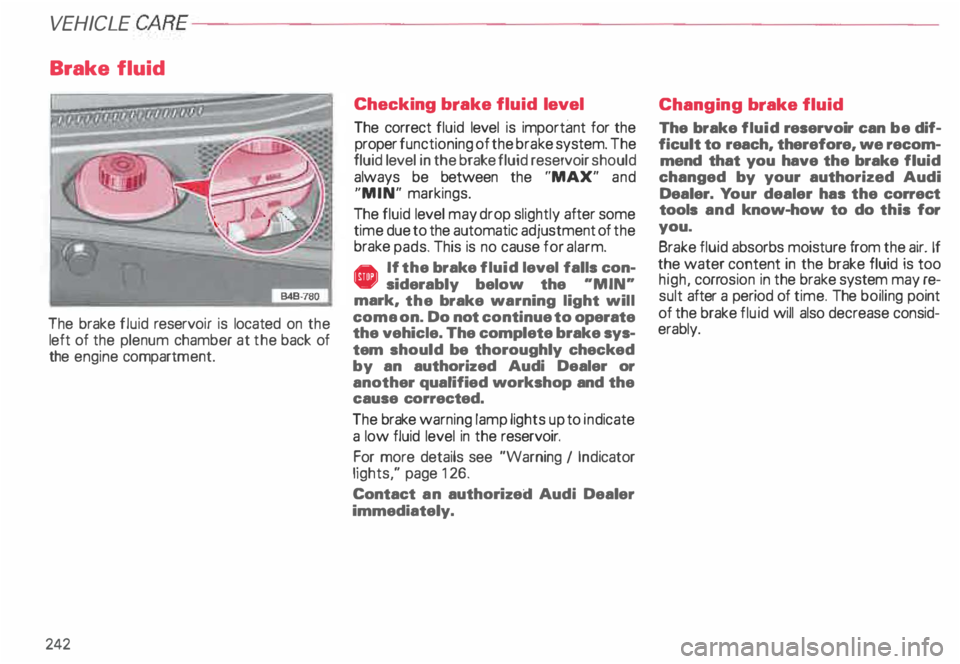
The brake fluid reservo ir is located on the
left of the plenum chamber at the back of
the engine compartm ent.
242 Checking
brake fluid level
The correct fluid level is important for the
proper functioning of the brake system. The
fluid level in the brake fluid reservoir should
always be between the "MAX" and
"MIN" markings.
The fluid level may drop slightly after some
time due to the automatic adjustment of the
brake pads. This is no cause for alarm.
• If the brake fluid level falls con
siderably below the "MIN"
mark, the brake warning light will
coma on. Do not continue to operate
the vehicle. The complete brake sys
tem should be thoroughly checked
by an authorized Audi Dealer or
another qualified workshop and the
cause corrected.
The brake warning lamp lights up to indicate
a low fluid level in the reservoir.
For more details see "Warning I Ind icator
lights," page 126.
Contact an authorized Audi Dealer
immediately. Changing
brake fluid
The brake fluid reservoir can be dif
ficult to reach, therefore, we recom
mend that you have the brake fluid
changed by your authorized Audi
Dealer. Your dealer has the correct
tools and know-how to do this for
you.
Brake fluid absorbs moisture from the air. If
the water content in the brake fluid is too
high, corrosion in the brake system may re
sult after a period of time. The boiling point
of the brake fluid will also decrease consid
erably.
Page 260 of 306
-------------------------VEHICLE
CARE
Te mperature
The temperature grades are A (the highest),
8, and C, repres enting the tire's resistance to
the generation of heat and its ability to dissi
pate heat when tested under contro lled con
ditions on a specified indoor laboratory test
wheel. Sustained high temJ)erature can
cause the material of the tire to degenerate
and reduce tire life, and excessive tempera
ture can lead to sudden tire failure. The
grade C corres ponds to a level of perfor
mance which all passenger car tires must
meet under the Federal Motor Vehicle Safety
Sta ndard No. 1 09. Grades Band A represent
higher levels of performance on the laborato
ry test wheel than the minimum required by
law.
�W ARNIN G
The temperature grade for this tire
is est ablished for a tire that is
properly inflated and not over
loaded. Excessive speed, under
inflation, or excessive loading, ei
ther separately or in combination,
can causa heat buildup and pos
sible tire failure. Wheel
replacement
If you wish to equip your vehicle with tires
or wheels other than those installed at the
factory, please note the following:
• For technical reasons it is not al
ways possible to use wheels from
other vehicles -under certain condi
tions not even wheels from the same
vehicle model.
• Wheel rims and wheel bolts are
matched to fit your Audi. When
installing different wheels (for ax
ample, wheels with winter tires), the
correct wheel bolts with the proper
length and conical shape of the bolt
head must be used. The secure fit of
the wheels and the proper function
ing of the brake system and safety
are dependent upon this.
• Wheel rims and wheal bolts are
matched to fit your Audi. •
Before you plan on exchanging
steel wheels, light alloy wheals, or
winter tires already mounted on
wheel rims, consult your authorized
Audi Dealer. They have the technical
information necessary to advise you
which wheal rims and wheel bolts
are compatible with the original fac
tory installations.
1ft WARNING
• Incorrect tire/wheel parts may
cause an accident and personal in
jury. Such parts will adversely af
fect the safe operation of your ve
hicle. Always use tires, wheel rims
and wheel bolts that meat specifi
cations of the original factory
installed equipment.
• If wheel trim discs or a front
spoiler are Installed, make sura the
airflow for cooling the brakes is
not obstructed.
259
Page 276 of 306

Fuse
arrangement
No. 1 - Heated washer jets !
B45-087C I
A 11
- .. 5
2 - Turn signals . . . . . . . . .
. 10
3 - Headlight washer (relay)
illum ination for glove compartment,
climate control, Automatic
Tr ansmission, instrument cluster ... 5
4 - License plate light . . . 5
l) Amps No.
A1l
5 - Ins trument cluster, seat heating,
test connection for cruise control,
bulb monitor, Automatic
Tr ansmis sion display, switch lighting,
mirror switches and actuators,
airbag warning light, outside
temperature indicator, climate
control, solar roof, acoustic parking
assistance system, navigation
system, car telephone, 4 Level Air
Suspension ............ .. ...... 1 0
6 - Power locking system . . . . . . . . . 5
7 - Anti-lock brake system (ABS),
brake light switch . . . . . . . . . . . . 1 0
8 - Car telephone . . . . . . . . . . . . . . .
. 5
9 - Heated mirrors . . . . . . . . . . . . . . 1 0
1 0- Automatic headlight adjustment
. 5
11 -Cruise control
(Automatic Transmission) . . .
1 0
12- On Board Diagnostic system .... _ 10
13 -Brake lights . . . . . . 1 0 DO-IT-YOURSELF
SERVICE
No. 14 -Interior lights, reading lights,
anti-theft alarm system,
vanity mirror, seat memory ....... 10
15 -Instrument cluster, climate control,
mirror and seat mem ory, .
navigation system . . . . . . . . . . . . . . 1 0
16- Electronic Stability Programm ..... 5
17 -Navigation system, 4 Level Air
Suspension, automatic headlight
adjustment .............. ...... 10
18-Hig h-beam, right ......... ....... 10
19 -H igh-beam, left . . . . . . . . . . . . .. 1 0
20 � Low beam, right, headlight
adjustment . . . . . . . . . . . . . . . • . .
15
21 -Low beam, left, headlight
adjustment . . . . . . . . . . . . . . . .. 15
22 -Side marker and tail light, right . 5
23 -Side marker and tail light, left . . . . . 5
24 -Wiper and washer system . . 25
25 -Blower for heating (climate
control), solar roof 30
275