airbag AUDI ALLROAD 2000 Owner's Guide
[x] Cancel search | Manufacturer: AUDI, Model Year: 2000, Model line: ALLROAD, Model: AUDI ALLROAD 2000Pages: 306, PDF Size: 9.95 MB
Page 50 of 306
-------------------------------------------------SAFETY ARST
In a collision, airbags must inflate within a
blink of an eye and with considerable force.
In order to do its job, the airbag needs room
to inflate so that it will be there to protect
the occupant as the occupant moves for
ward into the airbag.
A vehicle occupant who is out of position
and to close to the airbag gets in the way of
on infloting nirbag. When an occupant is too close he or she will be stru ck violently and
will r� ceive serious or possibly even fatal in
jury.
In order for the airbag to offer protection, it
is important that all vehicle occupants, es
pecially children who must ride on the front
seat in excep tional situations, be properly
restra ined and as far away from the airbag
as possible. By keeping room between your
body and the front of the passenger
compartment, the airbag can inflate fully
and completely and provide supplemental
pro tection in certain frontal collisions. �W
ARNING
Never let a child stand or kneel on
any seat, particularly the front
seat. Never let a child ride in the
cargo area of your car. If a child is
leaning forward, sitting sideways
or out of position in any way, the
child is more likely to be injured in
a crash and will receive serious or
fatal injuries if the child comes
into contact with an airbag as it in
flates.
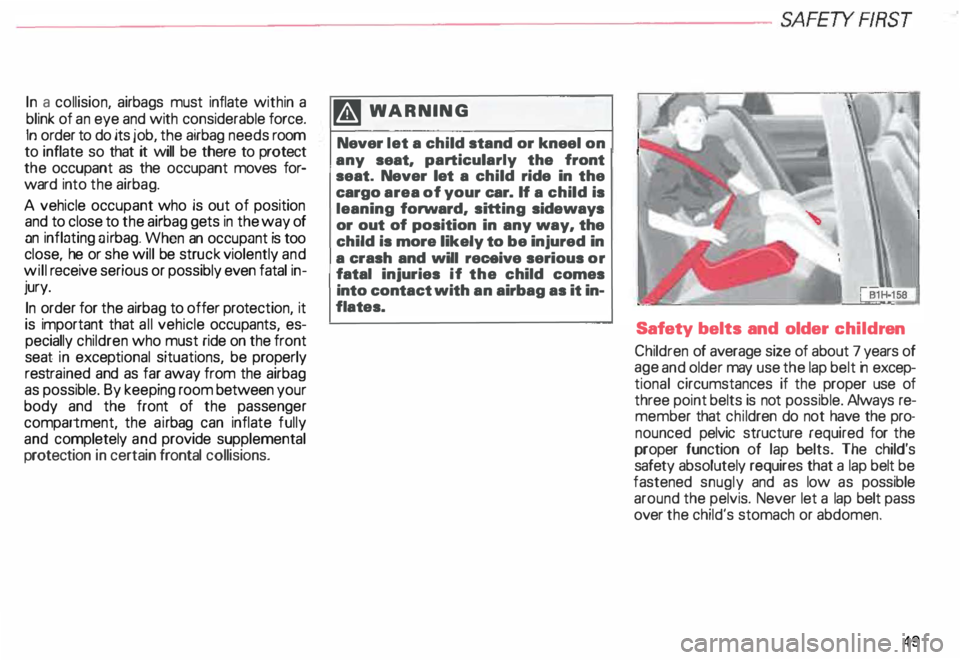
Safety belts and older children
Children of average size of about 7 years of
age and older may use the lap belt in excep
tional circumstances if the proper use of
three point belts is not possible. Always re
member that children do not have the pro
nounced pelvic structure required for the
proper function of lap belts. The child's
safety absolutely requires that a lap belt be
fastened snugly and as low as possible
around the pelvis. Never let a lap belt pass
over the child's stomach or abdomen.
49
Page 52 of 306
Securing a child seat
Convertible Locking Retractor
The retractors for the rear seat three-po int
safety belts and the front passenger three
point safety belt have a conver tible locking
feature in addition to the emergency locking
feature.
If you need to install a child seat at an outer
seating position, you must first activate the
conver tible locking feature. Then secure the
child seat by using the seat belt. �W
ARNING
• Never install rear-facing child
seats or infant carriers on the front
passenger seat. A child will be se
riously injured and can be killed
when the passenger airbag in
flates.
• The inflating airbag will hit the
child seat or infant carrier with
great force and will smash the
child seat and child against the
backrest. center arm rest. or door.
• Always install rear-facing child
seats or infant carriers on the rear
seat if the front passenger airbag
has not been deactivated. SA
FETY FIRST
�W ARNING
• Forward-fa cing child seats or in
fant carriers installed on the front
passenger's seat may interfere
with the deployment of the airbag
and cause serious injury to the
child. Allow a child to travel on the
front passenger's seat only in a for
ward- facing child restraint system
specif ically designed and ap
proved by the child restraint
manufacturer for use in the front
with airbags. Make sure the pas
senger seat is in the rearmost posi
tion. It is always safer to install a
child seat in the rear.
51
Page 55 of 306
SAFETYRRST----------------------------------------------------
These LATCH anchorage points are only in
tended for the installation and attachment
of child restra ints specially certified for use
with LATCH anchorages. Child restraints
that are not equipped with the LATC H an
chorages can still be installed using the ve
hicle seat belts.
Some child restra ints are certified for instal
lation either with LATCH ancho rages or the
vehicle safety belt. It is recommended that
such child restraints be used with the
LATCH anchorages because this system
will provide the easiest and more secure
installation.
LA TCH anchor ages are designed to be used
only with child restraints adapted for them.
Always refer to the child restra int manufac
turer's instructions for proper installation of
the child restra int using the vehicle LATCH
lower anchorage or safety belts. Never use
the LATC H lower ancho rages to attach safe
ty belts or other kinds of occupant re
straints.
54 �W
ARNING
• Do not drive the vehicle without
the head restraints provided. Head
restraints are designed to help re
duce injuries.
• The child restraint anchorages
are only to be used to hold a child
restra int system in its place.
• Child restraint anchorages are
designed to withstand only those
loads imposed by correctly fitted
child restraints. Under no circum
stances are they to be used for
adult seat balta or harnesses.
• Do not mount two child re
straint seats on one anchor point.
• Always follow the instructions
provided by the manufacturer of
the child restraint which you
intend to install in your Audi. Side
airbags and child safety
Yo ur Audi comes equipped with 2 front air
bags (driver and front passenger) and 4 side
airbags (in the front and rear*) which offer
the occu pants increased protection in the
event of a lateral collision.
In or�er t� assure this additional protection,
the s1de a1rbag must inflate within milli-sec
onds during a collision. When the airbag is
a ?tivated, it breaks through a seam on the
s1de of the seatback identified by the AIR
BAG label, and inflates between the pas
senger and side trim panel at very high
speed.
The side airbag inflates with such a high
f ? rce, that it could injure a child seriously if
h1s I her seating position is not proper up
nght, or 1f 1tems are positioned in the area
where the airbag inflates.
Page 56 of 306
�W
ARNING
• To prevent serious injuries, chil
dren must always be secured in a
vehicle by a child restraint system
appropriate for their age and size.
• A child must never rest his I her
head against the side trim panel in
the area where the side airbag in
flates.
An inflati ng alrbag can cause seri
ous or fatal injury!
• Never place items in the area
where the side airbag inflates. This
could cause serious injury!
Note If special situations in your family require,
your authorized Audi Dealer can disconnect
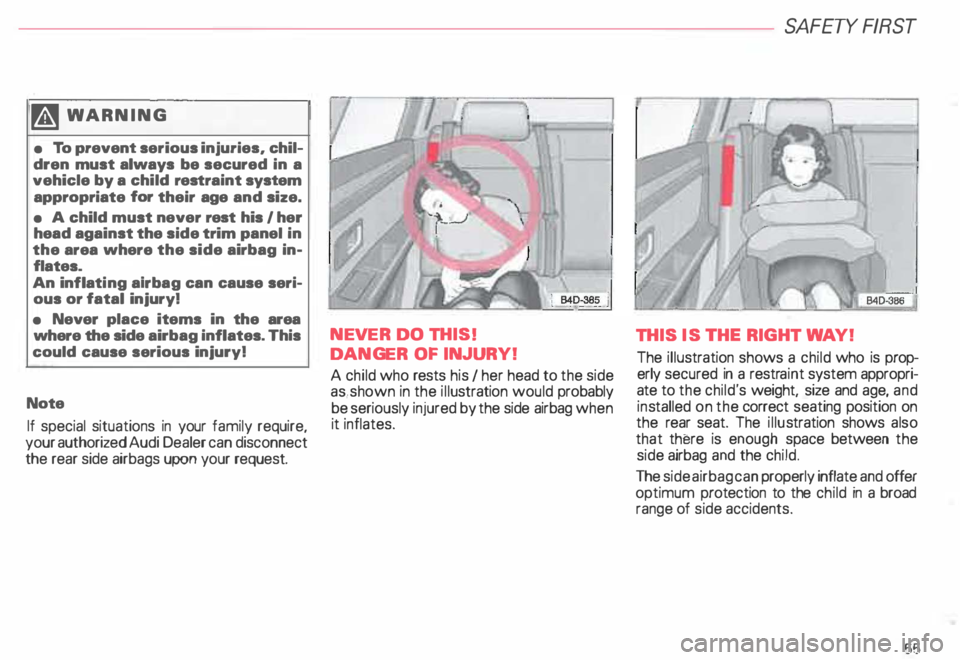
the rear side airbags upon your request. NEVER
DO THIS I
DANGER OF INJ URY !
A child who rests his I her head to the side
as, shown in the illustration would probably
be seriously injured by the side airbag when
it inflates. SA
FETY FIRST
THIS IS THE RIGHT WAY !
The illustration shows a child who is prop
erly secured in a restr aint system appropri
ate to the child' s weight, size and age, and
ins talled on the correct seating position on
the rear seat. The illustration shows also
that there is enough space between the
side airbag and the child.
The side airbag can properly inflate and offer
optimum protection to the child in a broad
range of side accidents.
55
Page 67 of 306
CONT
ROLS AND EQUIPMENT---------------------
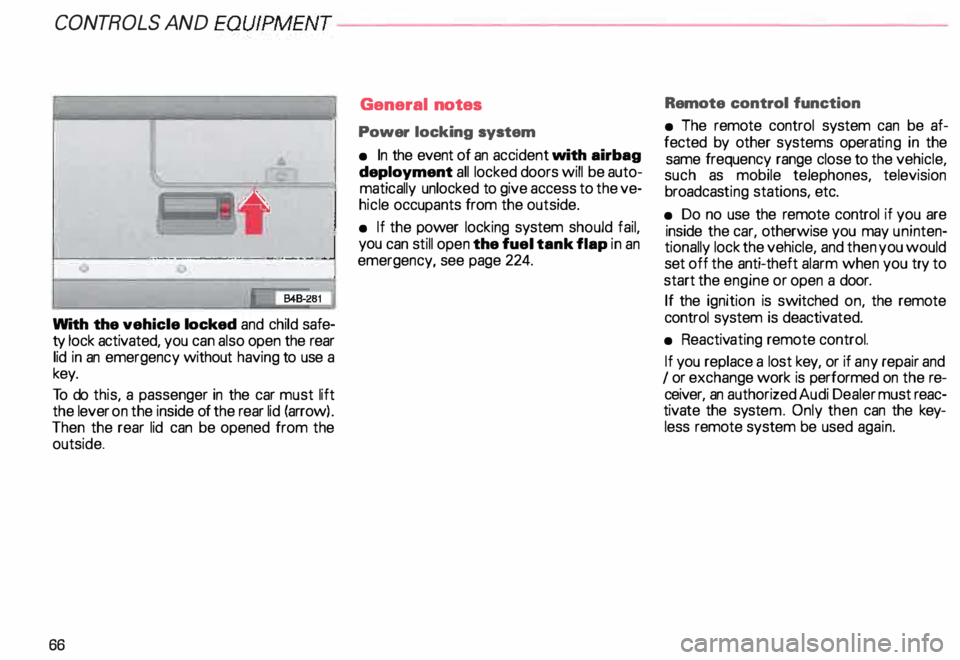
With the vehicle locked and child safe
ty lock activated, you can also open the rear
lid in an emergency without having to use a
key.
To do this, a passenger in the car must lift
the lever on the inside of the rear lid (arrow) .
Then the rear lid can be opened from the
outside.
66 General
notes
Power locking system
• In the event of an accident with airbag
deployment all locked doors will be auto
matically unlocked to give access to the ve
hicle occupants from the outside.
• If the power locking system should fail,
you can still open the fuel tank flap in an
emergency, see page 224. Remote
control function
• The remote control system can be af
fected by other systems operating in the
same frequency range close to the vehicle,
such as mobile telephones, television
broadcas ting stations, etc.
• Do no use the remote control if you are
inside the car, otherwise you may uninten
tionally lock the vehicle, and then you would
set off the anti-theft alarm when you try to
start the engine or open a door.
If the ignition is switched on, the remote
control system is deactiv ated.
• Reactiv ating remote control.
If you replace a lost key, or if any repair and
I or exchange work is performed on the re
ceiver, an authorized Audi Dealer must reac
tivate the syste m. Only then can the key
less remote system be used again.
Page 77 of 306
CONTROLS ANDEOUWMENT-----------------------------------------
Front seats
The correct positioning of the seats is im
porta nt:
so that you can reach all the controls on
the vehicle quickly and safely;
so that you can drive or ride relaxed and
help reduce fatigue;
and for maximum protection of
fered by the safety belts and air
bag system.
Therefore, always adjust the position of the
seat as described on the following pages.
Remember to adjust the seats before fas
tening the safety belts and before driving
off. Always be sure to follow these general
guidelines:
76 m
WARNING
• Always sit as far away from the
stee ring wheel and the instrument
panel as possible.
• Never sit less than 10 inches
(25 em.) from the steering wheel
and the instrument panel.
• Do not adjust seats while the ve
hicle is moving. Your seat may
move unexpectedly, causing sud·
den loss of vehicle control and
personal injury.
• Passengers must always keep
their feet on the floor whenever
the vehicle is moving. Never place
feet on the dashboard or on top of
the seats. In an accident, serious
personal injury can result from an
improper seating position. BSN-163
Driver's seat
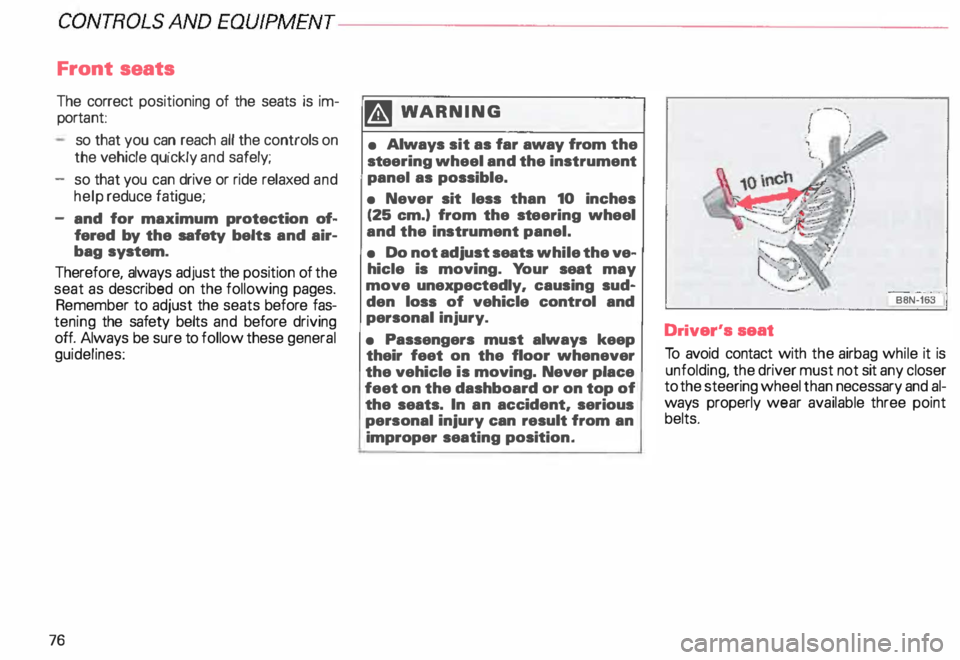
To avoid contact with the airbag while it is
unfolding, the driver must not sit any closer
to the steering wheel than necessary and al
ways properly wear available three point
belts.
Page 78 of 306
·---------------------CONTROLS AND
EQUIPMENT
We recommend that you adjust the driver's
seat as follows:
adjust the seat in fore and aft direction so
that you can easily push the pedals all the
way while keeping your knee slightly
bent.
adjust the seatback so that when you sit
with your back against the seatback, you
can still grasp the top of the steeri ng
wheel.
adjust the steeri ng wheel so that the dis
tance from the center of your breastb one
to the center of the airbag cover on the
steering wheel must be at least
10 inches (25 em) or more.
See illustration on previous page. �W
ARNING
• Navar sit closer than 10 inches
(25 em) to the steering wheal.
• If you cannot sit more than
10 inches (25 em) from the steer
ing wheel, we recommend that
you investigate whether adaptive
equipment may be available to
help you reach the pedals and in
crease your seating distance from
the steering wheal. Front
passenger's seat
To avoid contact with the airbag while it is
unfolding, the adult front seat passenger
must not sit any closer to the instrument
panel than necessary and always properly
wear availaple three point belts.
We recommend that you adjust the passen
ger's seat as follows:
backrest upright (never reclined)
place your feet on the
floor _in front
of the
passenger's seat
adjust the passenger's seat as far as pos
sible to the rear of the fore and aft adjust
ment range.
77
Page 79 of 306
CONT
ROLS AND
EQUIPMENT---------------------
�W ARNING
• Always keep both feet on the
floor in front of the seat.
• Never place your feet on the in
strument panel or on the seat. If
the airbag inflates and your feet
are on the instrument panel or on
the seat, you could receive serious
personal injuries to the legs, hips
and even the head if the airbag in
flates.
For safety information on transporti ng chil
dren on the front passenger seat be sure to
read all the information on"ln fant seats,
Convertible seats and Booster seats", see
page 44.
78 �W
ARNING
• To reduce the risk of personal in
jury in an accident, front seat pas
sengers must never ride in a mov
ing vehicle with the seatback re
clined. Safety belts offer protec
tion only when the seatback is up
right and belts are properly posi
tioned on the body. The more the
seatback is reclined, the greater
the risk of perso nal injury from an
out-of -position safety belt.
• Never store items under the
seats. Loose objects can interfere
with the seat latching mechanism
and can also cause personal injury
in an accident. Seat
adjustment
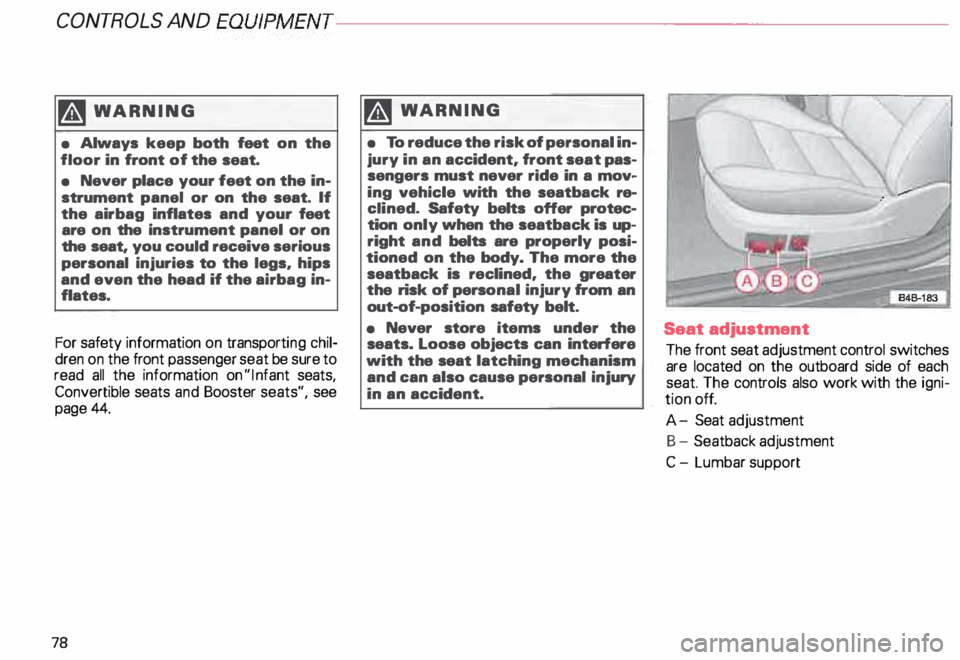
The front seat adjustment control switches
are located on the outboard side of each
seat. The controls also work with the igni
tion off.
A- Seat adjustment
B- Seatback adjustment
C - Lumbar support
Page 99 of 306
CONT
ROLS AND EQUIPMENT---------------------
Adjustable steering column (tilt and telescopic)
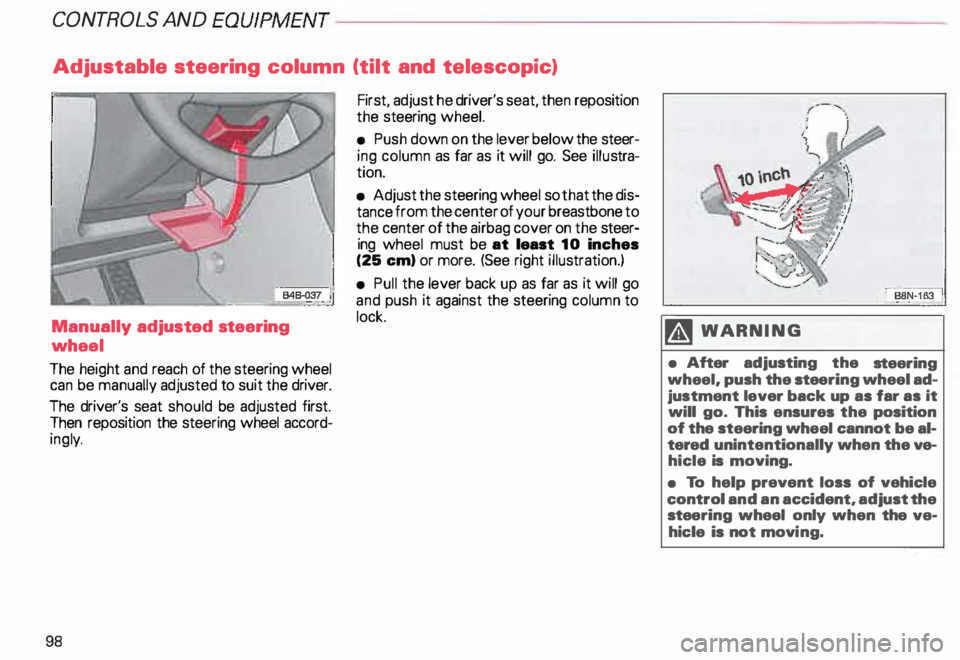
Manually adjusted steering
wheel
The height and reach of the steering wheel
can be manually adjusted to suit the driver.
The driver's seat should be adjusted first.
Then reposition the steering wheel accord
ing ly.
98 First,
adjust he driver's seat, then reposition
the steering wheel.
• Push down on the lever below the steer
ing column as far as it will go. See illustra
tion.
• Adjust the steering wheel so that the dis
tance from the center of your breastbone to
the center of the airbag cover on the steer
ing wheel must be at least 10 inches
(25 em) or more. (See right illustration.)
• Pull the lever back up as far as it will go
and push it against the steering column to
lock. M WARN ING
• After adjusting the steering
wheel, push the stee ring wheel ad
justment lever back up as far as it
will go. This ensures the position
of the steering wheel cannot be al
tered unintentionally when the ve
hicle is moving.
• To help prevent loss of vehicle
control and an accident, adjust the
stee ring wheel only when the ve
hicle is not movi ng.
Page 100 of 306
---------------------CONTROLS
AND EQUIPMEN T
U WARNING continued
• The front seats must not be
pushed too close to the steering
wheel or to the instrument panel.
Never sit closer than 10 inches
(25 em) to the steering wheel.
• If you cannot sit more than
1 0 inches (26 em) from the steer
ing wheel, we recommend that
you investigate whether adaptive
equipment may be available to
help you reach the pedals and in
crease your seating distance from
the stee ring wheel.
• Pointing the stee ring wheel to
ward your face decreases the abil
ity of the supplemental driver's air
bag to protect you in an accident. �
WARNING continued
• Always hold the steering wheel
on the outside of the steering
wheel rim with your hands at the
9 o'clock and 3 o'clock positions
to help reduce the risk of personal
injury if the driver's airbag in
flates.
• Never hold the steering wheel at
the 12 o'clock position or with
your hands at other positions in·
side the steering wheel rim or on
the stee ring wheel hub.
• Holding the steering wheel the
wrong way can cause serious inju
ries to the hands. arms and head if
the driver's airbag inflates. Electrically
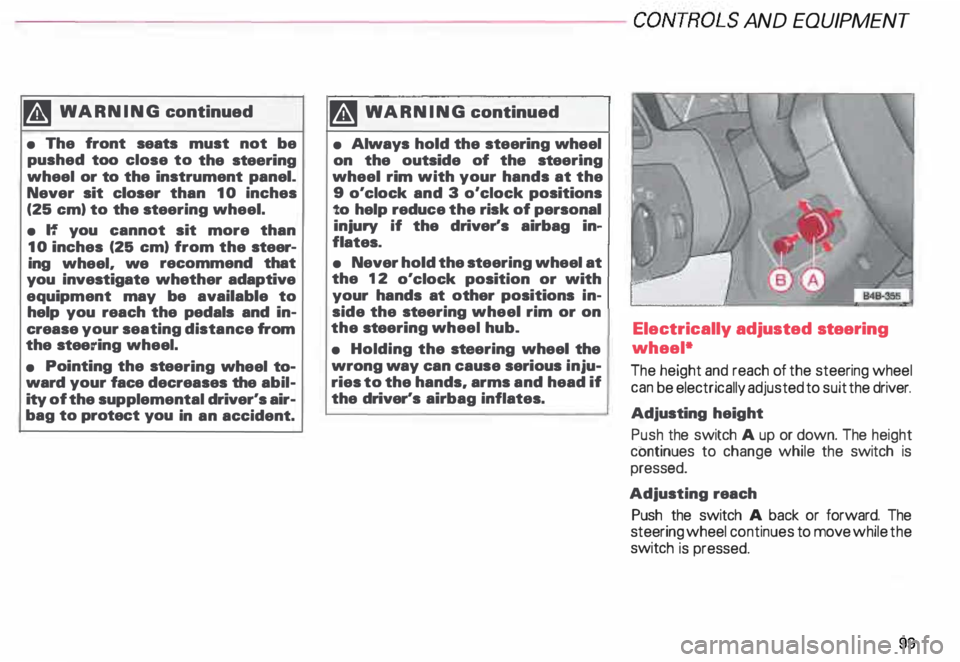
adjusted steering
wheel*
The height and reach of the steering wheel
can be electrically adjusted to suit the driver.
Adjusting height
Push the switch A up or down. The height
continues to change while the switch is
pressed.
Adjusting reach
Push the switch A back or forward. The
steering wheel continues to move while the
switch is pressed.
99