airbag AUDI ALLROAD 2000 User Guide
[x] Cancel search | Manufacturer: AUDI, Model Year: 2000, Model line: ALLROAD, Model: AUDI ALLROAD 2000Pages: 306, PDF Size: 9.95 MB
Page 29 of 306

SAFETYRRST---------------------------------------------------
The triggering of the airbag system de
pends on the vehicle deceleration rate
caused by the collision and registered by
the control unit. If this rate is below the ref
erence value programmed into the control
unit, the airbags will not be triggered, even
though the car may be badly damaged as a
result of the accident.
When the system is activated, the airbags
fill with a propellant gas, break open the
padded covers, and inflate between the
steering wheel and the driver and between
the instrument panel and the front passen
ger.
All this takes place within the blink of an
eye, so fast that many people don't even
realize that the airbags have deployed. The
airbags also inflate with a great deal or force
and nothing should be in their way when
they deploy.
28 Fully
inflated airbags in combination with
properly worn safety belts slow down and
limit the occupant's forward movement and
help to reduce the risk of injury to the head
and upper torso.
The airbags will deflate immediately after
the deployment so that the front occupants
can see through the windshield again.
When the system is activated, fine dust is
released. This is normal and is not caused
by a fire in the vehicle. It could irritate skin. �W
ARNING
• The fine dust created when air
bags deploy can cause breathing
problems for people with a history
of asthma or other breathing con
ditions.
• To reduce the risk of brea thing
problems, those with asthma or
other respiratory conditions
should get fresh air right away by
getting out of the car or opening
windows or doors.
• If you are in an accident in
which airbags deploy, wash your
hands and face with mild soap and
water before eating.
• Be careful not to get the dust
into your eyes or into any cuts or
scratches.
• If the residue should get into
your eyes, flush them with water.
Page 30 of 306
--------------------------SAFETY FIRST
Importance
of proper seating
position
In a collision airbags must inflate within a
blink of an eye and with considerable force.
The supplemental airbags could injure you
if you are not seated properly. Therefore in
order to help the airbag to do its job, it is im
portant, both as a driver and as a passenger
to sit properly at all times. By keeping room
between your body and the front of the pas
senger compartment, the airbag can inflate
fully and completely and provide supple
mental protection in certain frontal colli
sions. See page 76 for information on the
adjustment of the front seats and also
"Front seats" page 78, for details on the op
eration of the seat adjustment controls. It's
especially importantthat children be proper
ly restrained. See chapter "Child safety",
page 44. �W
ARNING
• Sitting too close to the stee ring
wheel or instrument panel will de
crease the effe ctiveness of the air
bags and will increase the risk of
personal injury in an accident.
• If you are unrestrained, leaning
forward, sitting sideways or out of
position in any way. your risk of in
jury is much higher. You will also
receive serious or fatal injuries
from the airbag if you are up
against it or too close to it when it
inflates.
• To reduce the risk of injury
when an alrbag inflates, always
wear safety belts properly.
See "How to wear the safety belts
properly" on page 18. '4
WARNING continued
• Children age 12 or younger
should always ride in the rear seat.
If children are not properly re
strained, they may be severely in
jured or killed when an airbag
inflates. Never let children ride un
restr ained or improperly re
strained in the vehicle.
• Adjust the front seats properly.
- Never ride with the backrest re-
clined.
- Always sit as far as possible
from the the stee ring wheel or
the instrument panel.
Always heed all WA RNINGS
on next page.
29
Page 31 of 306
SAFETY FIRST--------------------------
�
WARNING continued
- Always sit upright with your
back against the backrest of
your seat.
. 30 Never
place your feet on the in
strument panel or on the seat.
Always keep both feet on the
floor in front of the seat to help
prevent serious injuries to the
legs and hips if the airbag in
flates. BBN-163
There is a lot that you and your passengers
can do to help the individual safety features
installed in your Audi work together as a
system. Adjusting
the driver's seat
For detailed steps for adjusting the driver's
seat please see "Front Seats" on page 76.
We recommend that you adjust the driver's
seat as follows:
- adjust the seat in fore and aft direction so
that you can easily push the pedals all the
way while keeping your knee slightly
bent.
- adjust the seatback so that when you sit
with your back against the seatback, you
can still grasp the top of the steering
wheel.
adjust the steering wheel -see chapter
"Adjustable steering column" page 98.
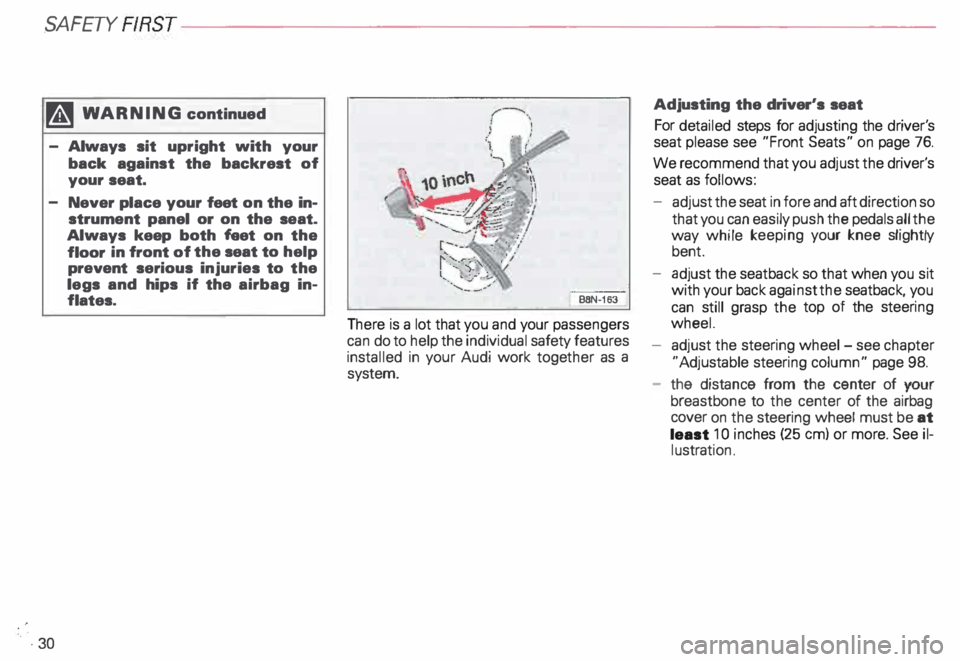
- the distance from the center of your
breastbone to the center of the airbag
cover on the steering wheel must be at
least 1 0 inches (25 em) or more. See il
lustration .
Page 32 of 306
-----------------------------------------------------SAFETY RRST
�W ARNING
• Never sit closer than 10 inches
(25 em) to the stee ring wheel.
• If you cannot sit more than
10 inches (25 em) from the steer
ing wheel, we recommend that
you investigate whether adaptive
equipment may be available to
help you reach the pedals and in
crease your seating distance from
the steering wheel.
Adjusting the steering wheel
For detailed steps for adjusting the steering
wheel please see "Adjustable steering col
umn" page 98.
Adjust the steering wheel so that the steer
ing wheel and airbag cover points at your
chest and not at your face. The steer ing
wheel should be adjusted so that you can
hold the outer rim of the steering wheel
comfortably with your hands at the 3 o'clock
and 9 o'clock positions. �W
ARNING
• Pointing the steering wheel to
ward your face decreases the abil
ity of the supplementa l driver's air
bag to protect you in an accident.
• Holding the steering wheel the
wrong way can cause serious inju
ries to the hands, arms and head if
the driver's airbag inflates.
• Never hold the steering wheel at
the 12 o'clock position or with
your hands at other positions in
side the steering wheel rim or on
the steering wheel hub.
Adjusting the passenger's seat
For detailed steps for adjusting the pas
senger's seat please see "Front Seats" on
page 76.
We recommend that you adjust the passen
ger's seat as follows:
- backrest upright (never reclined)
place your feet on the floor in front of the
passenger's seat adjust
the passenger's seat as far as pos
sible to the rear of the fore and aft adjust-
1)1ent range.
�W ARNING
• Always keep both feet on the
floor in front of the seat.
• Never place your feet on the in
strument panel or on the seat. If
the airbag inflates and your feet
are on the instrument panel or on
the seat, your could receive seri
ous personal injuries.
Some other important points to
know
Because airbags inflate in the blink of an eye
with great force, things you have on your lap
or have placed on the seat could become
dangerous projectiles and be pushed into
you if the airbag inflates.
Always head all WARNINGS
on next page.
31
Page 33 of 306
SAF
ETY RRST---------------------------------------------------
. � WARNING
• Objects between you and the
airbag can increase the risk of in
jury in an accident by interfering
with the way the airbag unfolds or
by being pushed into you as the
airbag inflates.
• Never hold things in your hands
or on your lap when the vehicle is
in use.
• Never place or attach accesso
ries or other objects (such as cup
holders, telephone brackets or
even large and bulky objects) on
the doors, over or near the area
marked ,. Airbag" on the steering
wheel, instrument panel, seat
backrests or between those areas
and yourself. These objects could
cause injury in a crash especially
when the airbags inflate.
32 �,
WARNING continued
• Never transport items on or in
the area of the front passenger
seat. Objects could move into the
area of the front alrbags during
braking or other sudden maneuver
and become dangerous projectiles
that can cause serious personal in
jury if the airbags inflate.
• Never recline the front passen
ger's seat to transport objects.
Items can also move into the area
of the side airbags or the front air
bag during braking or sudden ma
neuver. Objects near the airbags
can become projectiles and cause
injury particularly when the seat is
reclined. Child
restraints on the front seat -
important things to know
All children, especially 12 years old and
younger should always ride in the back seat
properly restrained for their age and size.
The ai rbag on the passenger side makes the
front seat a potentially dangerous place for
a child to ride. The front seat is not the saf
est place for a child in a forward-facing child
seat. It is a very dangerous place for an in
fant or a larger child in a rearward-facing
seat.
• Never install rear-facing child
seats or infant carriers on the front
passenger seat. A child will be se
riously injured and can be killed
when the passenger airbag in
flates.
Page 34 of 306
M
WARNING continued
• The inflating airbag will hit the
child seat or infant carrier with
great force and will smash the
child seat and child against the
backrest, center arm rest, or door.
• Always install rear-fac ing child
seats or infant carriers on the rear
seat.
A child seat or infant carrier installed on the
front seat may be struck and knocked out of
position by the rapidly inflating passenger's
airbag in a frontal collision. The airbag could
greatly reduce the effectiveness of the child
restraint and even seriously injure the child
during inflation. For
this reason, and because children are
generally better protected -when properly
restrained according to their age and size
in a rear seating position, we strongly rec
ommend that children always sit in the back
seat. See "Child Safety" on page 44.
�W ARNING
Forward-fa cing
child seats
installed on the front passenger's
seat may interfere with the deploy
ment of the airbag and cause seri
ous injury to the child. Install for
ward-fa cing child seats on the rear
seat. SA
FETY FIRST
If exceptional circumstances require the
use of a forward-facing child seat on the
front seat, the child's safety and well-being
require that the following special precau
tions be taken:
�W ARNING
If, in exceptional circumstances,
you must install a forward-f acing
child restraint on the front passen
ger's seat:
make sure the forward-fa cing
seat has been designed and cer
tified by its man ufacturer for
usa on a front seat with a pas
senger front and side airbag.
Always follow the manuf actur
er's instructions provided with
the child seat or carrier.
Always heed all WA RNINGS
on next page.
33
Page 35 of 306
SAFETYRRST-----------------------------------------------------
'4 WARNING continued
- Always move the passenger
seat into its rearmost position,
as far away from the airbag as
possible before installing the
child restraint. The backrest
must be adjusted to an upright
position.
- For more important information
on the use of child restraints in
your Audl, see ""child seats"",
page 44.
34 Supplemental
side airbags
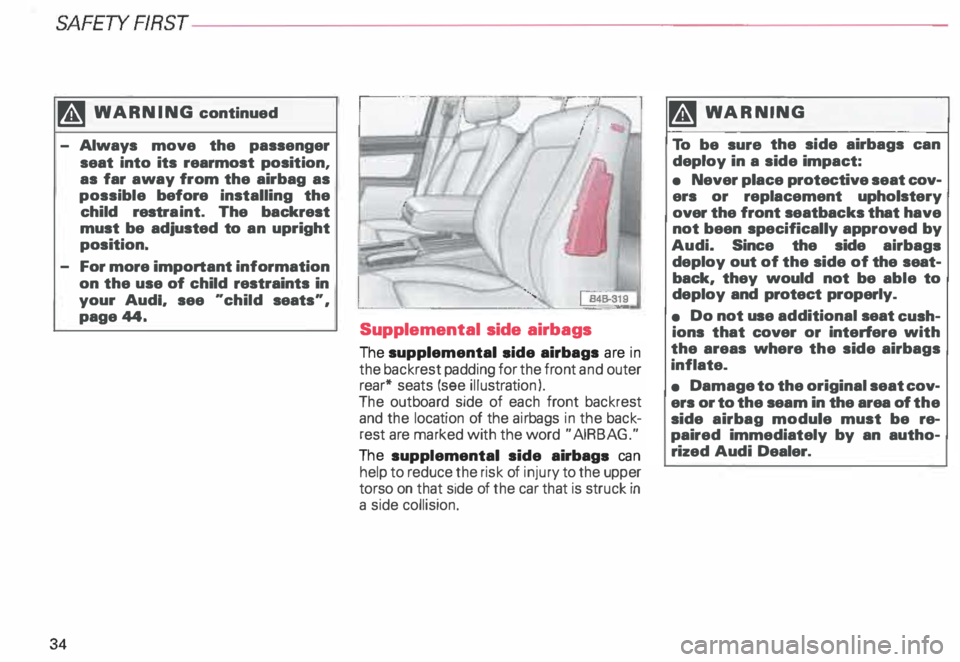
The supplemental aide airbags are in
the backrest padding for the front and outer
rear* seats (see illustration).
The outboard side of each front backrest
and the location of the airbags in the back
rest are marked with the word "AIRBAG."
The supplemental side airbaga can
help to reduce the risk of injury to the upper
torso on that side of the car that is struck in
a side collision. �W
ARNING
To be sure the side airbags can
deploy in a side impact:
• Never place protective seat cov
ers or replacement upholstery
over the front seatbacks that have
not been specifically approved by
Audi. Since the side airbaga
deploy out of the side of the seat
back, they would not be able to
deploy and protect properly.
• Do not use additional seat cush
ions that cover or interfere with
the areas where the side airbags
inflate.
• Damage to the original seat cov
ers or to the seam in the area of the
side airbag module must be re
paired immediately by an autho
rized Audi Dealer.
Page 36 of 306

-----------------------------------------------------SAFETYRRST
The supplemental side airbags inflate only
in severe side collisions occuring on
the impact side of the vehicle.
The supplemental side airbags will
not inflate ...
• if the ignition is switched off
• in frontal collisions
• in side collisions in which vehicle
deceleration is not high enough
• in rear collisions
• in rollovers.
Under some accident conditions, both front
and side airbags may inflate.
Remember too, airbags will deploy only
once and only in certain kinds of accidents
- your safety belts are always there to offer
protection in those accidents in which air
bags are not supposed to deploy or when
they have already deployed. A
side airbag is not a substitute for the
safety belt. It is part of the overall vehicle
safety system. The airbag system works
most effectively when used with the safety
belts. Therefore, always wear your safety
belts. See pages 14 to 24.
It is important to remember that while the
supplemental side airbag system is de
signed to reduce the likelihood of serious in·
juries, it can cause swelling, bruising, and
minor abrasions.
How the supplemental side airbag
system works
In a side collision the supplemental side air
bags can help to reduce the risk of injury to
the upper part of the body on the side of the
car that is struck in a side collision.
In order to assure this additional protection,
the side airbag must inflate within the blink
of an eye during a collision. It
is )'lOt possible to define an airbag trigger
ing range that will cover every possible
angle of impact, since the circumstances
will vary considerably between one acci
dent and another.
Important factors include, for example, the
nature ( hard or soft ) of the object which the
car hits, the angle of impact, vehicle speed,
and etc.
The triggering of the airbag system de
pends on the vehicle deceleration rate
caused by the collision and registered by
the control unit. If this rate is below the ref
erence value programmed into the control
unit, the. airbags will not be triggered, even
though the car may be badly damaged as a
result of the accident.
35
Page 37 of 306

SA
FETY FIRST
When the supplemental side airbag is acti
vated, it breaks through a seam on the side
of the seatback identified by the AIR BAG la
bel. It inflates between the side trim panel
and the passenger within the blink of an eye
at very high speed and with great force. The
supplemental side airbag could injure you if
your seating position is not proper or upright
or if items are located in the area where the
supplemental side airbag inflates. This ap
plies especially to children. See also "Child
Safety". on page 44.
36 ----------------------------
�W ARNING
To reduce the risk of injury when
the supplemental side airbag in
flates.
always sit in an upright position
and do not lean against the area
where the supplemental side
airbag is located.
always make sure that safety
balta are worn properly,
- a child must never rest his/her
head against the side trim panel
in the area where the supple
mental aide airbag inflates. An
inflating airbag can cause seri
ous or fatal injury.
see "Importance of proper seat
ing position .. in this section at
pages 29 and 37 and heed all
WA RNINGS. When
the system is activated, fine dust is
released. This is normal and is not caused
by a fire in the vehicle. It could irritate your
skin.
�W ARNING
• The fine dust created when air
bags deploy can cause breathing
problems for people with a history
of asthma or other breathing con
ditions.
• To reduce the risk of breath ing
problems. those with asthma or
other respiratory conditions
should get fresh air right away by
getti ng out of the car or opening
windows or doors.
• If you are in an accident in
which airbags deploy. wash your
hands and face with mild soap and
water before eating.
Page 38 of 306
-----------------------------------------------------SAFETYRRST
M WARNING continued
• Be careful not to get the dust
into your eyes or into any cuts or
scratc hes.
• If the residue should get into
your eyes, flush them with water.
Importance of proper seating
position
In a collision supplemental side airbags
must inflate within a fraction of a second
and with considerable force. In order to help
the airbag to do its job, it is important, both
as a driver and as a passenger to sit properly
at all times. By keeping room between your
body and the side of the passenger
compartment, the airbag can inflate fully
and completely and provide supplemental
protection in certain side collisions. �W
ARNING
Failure to maintain an upright and
proper seating position will in�
crease the risk of personal injury
when the supplemental side air�
bag inflates. To reduce the risk of
injury that can be caused by an in�
flating supplemental side airbag:
Never lean against the door and
over the area where the side ai�
bag is located.
- Navar let anyone to place their
hand, lag or face near the sup�
plemental side airbag.
- Do not let anyone sitting in the
front seat put their hand out of
the window or lean against the
door.
- Never let anyone sitting in the
rear seat hold onto the sides of
the front seat backrest. Some
other important points to
know
Because airbags inflate in the blink of an eye
with great force, things you have on your lap
or have placed on the seat could become
dangerous projectiles and be pushed into
you if the airbag inflates.
�W ARNING
• Objects between you and the
airbag can increase the risk of in�
jury in an accident by interfering
with the way the airbag unfolds or
by baing pushed into you as the
airbag inflates.
• Never hold things in your hands
or on your lap when the vehicle is
in use.
Always heed all WAR NINGS
on next page.
37