belt AUDI ALLROAD 2000 Service Manual
[x] Cancel search | Manufacturer: AUDI, Model Year: 2000, Model line: ALLROAD, Model: AUDI ALLROAD 2000Pages: 306, PDF Size: 9.95 MB
Page 97 of 306
CONTROLS
AND
EQUIPMENT---------------------
Ski sack
Use the ski sack to transport and protect
skis and other long, light items in the pas
senger compartment.
Loading the ski sack
Load the ski sack from the luggage
compartment.
• Open the luggage compartment lid and
clear a space in tho center.
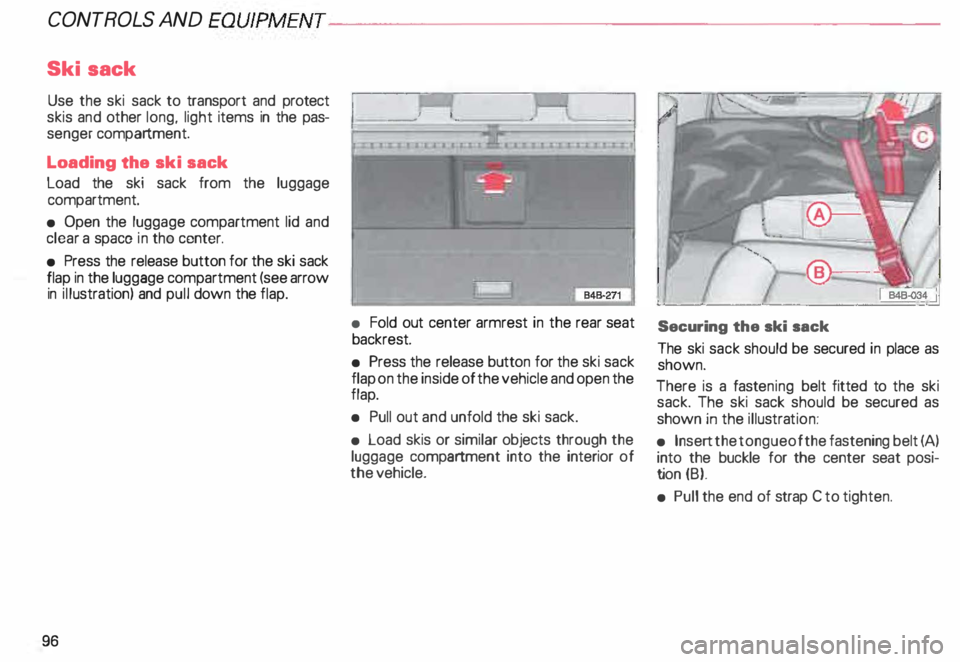
• Press the release button for the ski sack
flap in the luggage compartment (see arrow
in illustration) and pull down the flap.
96 •
Fold out center armrest in the rear seat
backrest.
• Press the release button for the ski sack
flap on the inside of the vehicle and open the
flap.
• Pull out and unfold the ski sack.
• Load skis or similar objects through the
luggage compartment into the interior of
the vehicle. Securing
the ski sack
The ski sack should be secured in place as
shown.
There is a fast ening belt fitted to the ski
sack. The ski sack should be secured as
shown in the illustra tion:
• Insert the tongue of the fastening belt (A)
into the buckle for the center seat posi
ti on (B).
• Pull the end of strap C to tighten.
Page 98 of 306
---------------------CONTROLS
AND EQUIPMENT
Stowing the ski sack
• Close the flap in the luggage compart
ment.
• Fold the ski sack carefully and stow it
away.
• Close the flap inside the passenger's
compartment.
Note
Do not fold and stow away the ski sack if it
is damp (for example, snow melting from
skis). Let it dry completely before you stow
it away. �W
ARNING
• The ski sack is intended only for
the transportation of akis and
other light objects. To reduce the
risk of serious personal injury
never transport heavy or pointed
objects in the ski sack.
• When braking rapidly or during
an accident the load could be dis
placed and cause injury to occu
pants.
• Sharp edges on the load must be
covered for protec tion. Always
fasten the belt tightly around the
sack and its contents (see illustra
tion and description).
97
Page 115 of 306
CONTROLS
AND EQUIPMENT---------------------
Starting procedures
� WARN ING
• Always fasten safety belts be
fore driving.
• Never start or let the engine run
in a confined or enclosed area. Ex
haust fumes from the engine con
tain carbon monoxide, a colorless
and odorless gas. Carbon monox
ide can be fatal if inhaled.
• Never leave the engine idling
unattended. An unattended ve
hicle with a running engine poses
a danger of personal injury or
theft.
114
dib To avoid unnecessary engine
W wear and to reduce exhaust
emissions, do not let your vehicle
stand end warm up. Be ready to
drive off immediately after starting
your vehicle. Maintain moderate
speed until the engine is completely
warm. Remember, the engine per
forms bast at operating tempera
ture.
Manual transmission
Yo ur Audi with manual transmission is
equipped with an "interlock-fea ture".
Start the engine with the gearshift
lever in Neutral and the clutch pedal
fully depressed. Remember, you
must depress and hold the clutch
pedal all the way down, otherwise
the engine will not start.
Automatic transmission
Engine will start with selector lever in N
(Neutral) or P (Park) only. Starting
engine
• Do not depress the gas pedal while
starting. This applies at any outside temper
ature.
• As soon as the engine starts, release the
ignition key.
• If the engine does not start the first time
or stalls, turn the ignition off and restart.
• Operate the starter for no more than
10 seconds.
• Allow about 30 seconds between each
starting attempt.
• When starting a very hot engine, it may
be necessary to slightly depress the gas
pedal after starting the engine.
Page 126 of 306
---------------------CONTROLS AND EQUIPMENT
Turn signals and
emergency flasher
Refer to "Turn signal I headlight d1mmer
switch lever and emergency flasher" on
pages 152 and 156 for details.
High beam �D
The indicator light lights up when the high
beams are switched on or when the head
light flasher is used.
See "Turn signal I headlight dimmer switch
lever" on page 156 for details.
Malfunction Indicator
�
Lamp (MIL) CHECK
The Malfunction Indicator Lamp is part of
the On Board Diagnostic system (OBD).
The lamp comes on when the ignition is
switched on and will go out after the engine
is started and the idle has stabilized. This is
to assure you that the Malfunction Indicator
Lamp is working properly.
For more details, see page 128. Airbag
System AIR
BAG
The ind icator light for the airbag and belt
tensioner system must come on when
the ignition is switched on, and go out after
a few seconds. If the light does not go out,
or if it comes on while you are driving, this
ind icates a fault in the airbag I belt tensioner
syste m.
If the indicator light does not come on when
the ignition is switched on, this also indi
cates a system malfunction. If any of these
conditions occur, have the air bag system in
spected immediately by your authorized
Audi Dealer.
For more details, see page 25. Anti-lock
Brake System
USA models:
Canada models: ABS
8
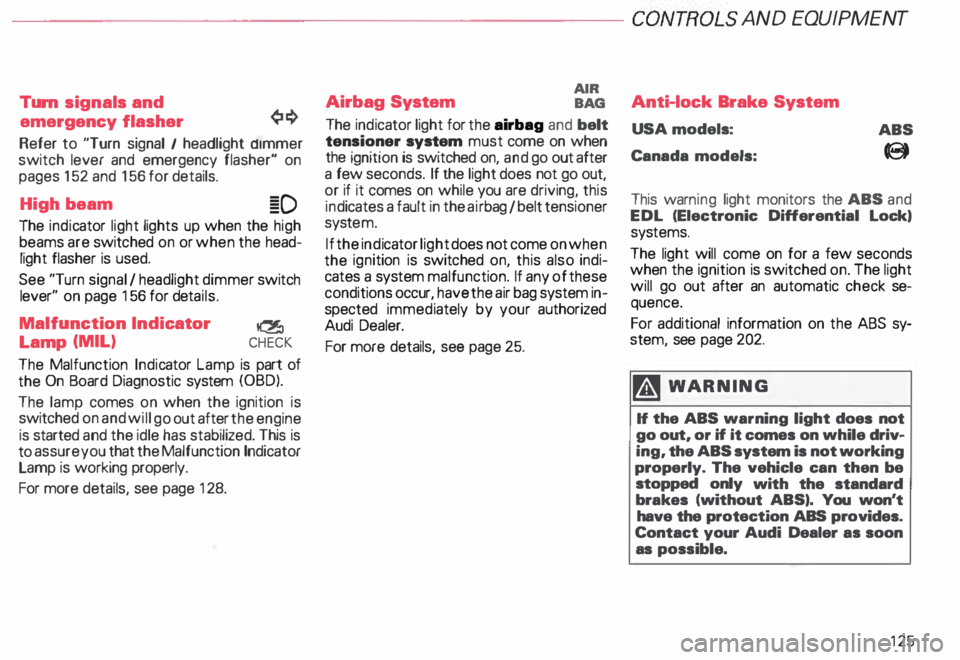
This warn ing light monitors the ABS and
EDL (Electronic Differential Lock,
sys tems.
The light will come on for a few seconds
when the ignition is switched on. The light
will go out after an automatic check se
quence.
For additional information on the ABS sy
stem, see page 202.
� WARNING
If the ABS warning light does not
go out, or if it comes on while driv
ing, the ABS system is not working
properly. The vehicle can then be
stopped only with the standard
brakes (without ABS,. You won't
have the protection ABS provides.
Contact your Audi Dealer as soon
as possible.
125
Page 128 of 306
f4
WARNING continued
• If the brake warning light does
not go out with the engine running
and the parking brake released, or
lights up while you ere driving, the
fluid level in the brake fluid reser
voir is too low.
• If you believe that it Is safe to do
so, proceed immediately at low
speed to the nearest authorized
Audi Dealer or qualified workshop
and have the brake system in
spected.
• Please be very careful and be
sure to remember that after sev
eral brake applications, you will
need greater pressure on the brake
pedal to stop your vehicle. Conse
quently, you must allow for in
creased braking distances. Trying
to brake as quickly as usual could
lead to an accident.
For details see "Brakes.. on page
201. Generator
This
light comes on when the ignition is
turned on and goes out after the engine is
started. If the light does not go out after
star ting and rewing up the engine momen
tarily or lights up while driving, there may be
a malfunc tion in the electrical system, or the
V- belt driving the gener ator may be broken. A If the warning light comes on
V while driving, stop the vehicle
and turn oft the engine. Inspect the
belts.
If the V-belt is not torn, you can still continue
driving to the nearestAudi Dealer. However,
since the battery is no longer being charged,
switch off all unne cessary electrical equip
ment.
If the V- belt is tom, the power steering and
the radiator fan will also not work.
Obtain expert assistance.
g Always heed all WA RNINGS
r!!l on page 232, chapter "En
gine compartment '". CONT
ROLS AND EQ UIPMENT
Safety belts
Yo ur vehicle has a warning light to remind
you to wear your safety belt and to make
sure that others do too.
After switching on the ignition, the warning
light in the instrument cluster will come on
for about 6 seconds along with a war ning
tone. As soon as you fasten your safety belt,
the warning tone will stop.
The warning light, however, will be on for
the entire 6 seconds.
Fasten your safety belt now and ma
ke sure that your passengers also
properly put on their safety belts.
Please be sure to read the chapter
"Safety belts" page 14.
127
Page 143 of 306
CONT
ROLS AND EQUIPMENT---------------------
�W ARNING
• The engine compartment of any
motor vehicle is a potentially haz
ardous area. Before you check any
thing in the engine compartment,
stop the engine and let it cool
down. Always exercise extreme
caution when working under the
engine hood. Heed all of the
WA RNINGS on page 232.
• To reduce the risk of being
burned, never open the hood if you
see or hear steam or coolant es
caping from the engine compart
ment. Wait until no steam or cool
ant can be seen or heard before
carefully opening the hood.
• Never touch the radiator fan.
The auxiliary fan is temperature
controlled and can switch on sud
denly.
14 2 �
WARNING continued
• Reduce the risk of scalding from
hot coolant by following these
steps:
If the coolant reservoir cap must
be removed. wait until the en
gine has cooled down.
- Protect face, hands. and arms
from escaping fluid and steam
by cov ering the cap with a large.
thick rag.
Tu rn the cap slowly and very
carefully in a counter-clockwise
direction while applying light.
downward pressure on the top
of the cap.
- To help avoid being burned. do
not spill antifreeze or coolant on
the exhaust system or hot en
gine parts. Under some condi·
tions. the ethylene glycol in en·
gine coolant can catch fire. •
If a visual check shows the coolant level
and the V-belt normal, and the warning light
still does not go out, do not continue
driving. See your authorized Audi Dealer.
• If the coolant level and the V-belt are nor
mal, the malfunc tion may be in the auxiliary
radiator fan. You can continue driving to the
nearest authorized Audi Dealer. The wind
from the moving vehicle and the main radia
tor fan driven by the V-belt will be enough to
keep the angine cool. However, avoid idling
for a long time or driving very slowly.
If the V-belt is torn, the main radiator fan, the
power steering and the gener ator will also
not work.
Obtain expert assistance.
Refer to "Coolant temperature gauge" on
page 118 for detai ls.
Page 144 of 306
---------------------CONTROLS AND EQUIPMENT
Engine oil pressure
If this warning light comes on, 1t Indi cates
that the engine oil pressure is too low.
• Stop the engine immediately,
check the engine oil level and
add oil if necessary.
If engine oil level is normal but the
light comes on again, do not con
tinua to operate the vehicle. This
could damage the engine.
Tu rn the engine off and contact the nearest
Audi Dealer for assistance.
The oil pressure warning light is not
an indicator for low engine oil level.
To check the oil level, always use
dipstick (sea page 235).
Make it a habit to have the engine oil
level checked with every fuel filling.
A Always heed all WA RNINGS
� on page 232. Brake
pads worn
0
See your Audi Dealer promptly to have front
and rear brake pads checked and replaced
as necessary.
Headlights I tail lights
�
Check, repair or replace:
• Light bulbs
• Fuses
• Electrical connections.
Washer fluid
Replenish the windshield washer
fluid in the container (see page 250).
Fuel Pull into the next filling station and
fill up. Battery
voltage too high
t::::1
or too low
See your Audi Dealer promptly to locate and
correct the problem. The battery may be run
down, the generator may be overcharging,
or the V-belt tension may need adjustment.
The voltage in the electrical system is dis
played on the voltmeter. See page 120 for
additional details.
143
Page 195 of 306
VEHICLE OPERA
TION-----------------------
Operate your vehicle safely
The condition of the vehicle is es
sential for driving safety.
Therefore, always be sure to observe the
following points before you drive off:
• Check lights and turn signals.
• Check fuel level.
• Adjust the mirrors.
• Make sure that all lights and all
windows are clean.
• Make sure the air Intake slot be
tween the engine hood and the
windshield is free of leaves, snow
and ice.
• Check warning and indicator
lights when starting the engine.
For driving safety, always follow the speci
fied maintenance intervals in your Mainte
nance booklet -especially for changing
the brake fluid, see page 242.
Yo ur personal driving style and your
attitude affect driving safety to a
very great extent.
19 4 Therefore,
for your own safety:
• Wear your safety belts and wear
them properly, even if you're just
driving in the city or to the corner
store -see page 14.
• Make sure that all passengers are
wearing their safety belts properly,
even those sitting in the rear -
see page 14.
Passengers not wearing safety belts endan
ger not only themselves in case of an acci
dent, but also the driver and other passen
gers.
• Make sure that children always sit
on the rear seat properly restrained
by a res traint system appropriate
for their size and age.
• Never transport a child in a rear
facing child or infant seat on the
front passenger seat.
• Adjust your seat so that you can
easily reach all controls as far away
from the airbag as possible but no
closer than 10 in. (25 em) -
see page 76. •
The seating position is very im
portant for the airbag performance
- see page 29.
• Always adjust the head restra ints
to the correct height.
For maximum protection, the upper edge of
the head restraints should be at least at
eye level, or higher .
• Always make sure that the move
ment of the pedals is not restricted
In any way-see page 102.
• Store luggage and light items
properly
in the luggage compartment
see page 88.
of the roof - see page 191.
• If you drink, do not drive.
The use of alcohol, drugs and certain medi
cations will seriously impair perception,
reactions and driving ability, and substan
tially increase the risk of an accident and
personal injury.
Page 219 of 306
VE
HICL E CA
RE-------------------------
Dust and small particles of dirt lodging in the
pores, grain and seams can have an abra
sive effect and damage the surface and the
seams. If the vehicle is left standing for a
long time in the sun, cover the upholstery or
use the sun blinds to protect the leather
from direct sunlight and prevent fading or
discoloration.
Depending on the amount of use, clean it
occasionally according to the following
instructions. Never use solvents, wax
polish, shoe cream, spot removers
or similar materials.
For normal cleaning of leather -covered
steering wheels, leather seat upholstery,
etc., slightly moisten a cotton or woollen
cloth with water and wipe over the areas af
fected.
218 More
stubborn dirt can be removed using a
mild soap solution (pure liquid soap: two
tablespoons dissolved in 1 quart of water).
It is very important not to let the wa
ter soak through the leather or pene
trate into the seams. Then wipe off with
a soft, dry cloth.
In addition to this regular cleaning, it is
worth while treating the leather with a suit
able leather -care product. This should be
done about twice a year for uphol stery in
normal use. Apply these products very spar
ingly and follow the manufacturer's direc
tions.
Safety belts
Keep belts clean! Dirty belts may
not retract properly.
For cleaning, use a mild soap and water
solution. Let belts dry thoroughly and away
from direct sunlight.
Do not allow inertia reel safety belts to re
tract before they are completely dry. �W
ARNING
• Any thing that might damage
your safety balta could mean that
you and your passengers would
not be adequately protected in an
accident.
• Do not use chemical cleaning
agents, bleach or dyes. They have
corrosive properties which weak
en the webbing.
• When cleaning your safety
belts, inspect them for damage. If
you discover damage. see your
Audi Dealer.
• Safety belt performance de
pends on correct installation.
Never remove belts from the ve
hicle to clean them.
Page 233 of 306
VEH
ICLE CARE---------------------------------------------------
Engine compartment
�W ARNING
To help avoid injury, before you
check anything under the hood:
• Switch off the engine. Remove
the ignition key.
• Set the parking brake fully.
Move the selector lever toP (Park).
• Always let the engine cool
down. Hot components will burn
skin on contact.
• Never spill fluids on hot engine
components. They can cause a
fire.
• Never touch the radiator fan.
The auxiliary electric fan can
switch on suddenly and injure you.
232 r4
WARNING continued
• If work on the fuel system or the
electrical system is necessary:
- Always disconnect the battery.
Never smoke or work near heat
ers or open flames. Fluids in the
engine compartment could start
a fire.
Keep an approved fire extin
guisher immediately available.
• To avoid electrical shock and
personal injury while the engine is
running or being started, never
touch:
- Ignition cables
- Other components of the high
voltage electronic ignition system. M
WARNING continued
• If you must perform a check or
repair with the engine running:
First, fully apply the parking
brake, move selector lever to
P (Park).
Always use extreme caution to
prevent clothing, jewelry, or
long hair from getting caught in
the radiator fan, V-belts or other
moving parts, or from contact
ing hot parts. Tie back hair be
fore starting, and wear no cloth
ing that will hang or droop into
the engine.