brake AUDI ALLROAD 2000 Service Manual
[x] Cancel search | Manufacturer: AUDI, Model Year: 2000, Model line: ALLROAD, Model: AUDI ALLROAD 2000Pages: 306, PDF Size: 9.95 MB
Page 220 of 306
-------------------------VEHICLE CA
RE
Engine compartment
�W ARNING
• Before working in the engine
compartment. be sure to read the
information on page 232.
I) Before reaching into the front
plenum panel. always re!"ove the
ignition key. Otherw1se. the
windshield wiper system could
unin tentionally be switched on.
possibly causing personal injury
from the moving wiper linkage.
• Do not wash. wax or dry the en�
gine with the engine ru!'l'! ing. Mov
ing or hot parts could 1n1ure you. ,Al
WARNING continued
e Do not clean the underside of
the chassis, fenders. wheel cov
ers. or other hard to reach parts
without protecting your hands and
arms. You may cut yourself on
sharp-edged metal parts.
• Moisture and ice on brakes may
affect braking efficiency. Test the
brakes carefully after each vehicle
wash.
The engine compartment and transmission
have been corrosion protected at the facto
ry.
Remove leaves from the plenum panel in
front of the windshield under the engine
hood. This prevents the water drain holes
from becoming blocked, and it prevents de
bris from entering the vehicle interior
throug h the heating and ventilation ducts. Good
anti-corrosion treatment is very im
porta nt, particularly in the winter. If the ve
hicle is frequently driven on salted roads,
the entire engine compartment and plenum
panel should be thor oughly cleaned at the
end of winter and retreated to prevent salt
damage. At the same time, the underside of
the vehicle should be washed as well.
�W ARNING
Never touch the radiator fan. The
auxiliary electric fan can switch on
suddenly and injure you-
Always switch off the ignition be
fore cleaning the engine _
219
Page 231 of 306
VEHI
CLE CARE
J'4 WARN ING continued
• If you must work underneath
the vehicle with the wheels on the
ground, always make sure the ve
hicle is on level ground. that the
wheels are always securely
blocked and that the engine can
not be started. Always remove the
ignition key before anyone gets
under the vehicle.
Always make sure the transmis
sion selector lever (automatic
transmission) is in "P" (Park posi
tion) and the hand brake is firmly
applied.
• Always be extremely careful
when working on the vehicle. Always follow commonly accepted safety practices and general com
mon sense. Never risk personal in
jury.
230 �
Changing the engine settings
will adversely aHect emission
levels. This Is detrimental to the en
vi ronment and increases fuel con
sumption.
Always observe environmental reg
ulations when disposing of old en
gine oil. used brake fluid, dirty en
gine coolant, spent batteries or
worn out tires.
Page 233 of 306
VEH
ICLE CARE---------------------------------------------------
Engine compartment
�W ARNING
To help avoid injury, before you
check anything under the hood:
• Switch off the engine. Remove
the ignition key.
• Set the parking brake fully.
Move the selector lever toP (Park).
• Always let the engine cool
down. Hot components will burn
skin on contact.
• Never spill fluids on hot engine
components. They can cause a
fire.
• Never touch the radiator fan.
The auxiliary electric fan can
switch on suddenly and injure you.
232 r4
WARNING continued
• If work on the fuel system or the
electrical system is necessary:
- Always disconnect the battery.
Never smoke or work near heat
ers or open flames. Fluids in the
engine compartment could start
a fire.
Keep an approved fire extin
guisher immediately available.
• To avoid electrical shock and
personal injury while the engine is
running or being started, never
touch:
- Ignition cables
- Other components of the high
voltage electronic ignition system. M
WARNING continued
• If you must perform a check or
repair with the engine running:
First, fully apply the parking
brake, move selector lever to
P (Park).
Always use extreme caution to
prevent clothing, jewelry, or
long hair from getting caught in
the radiator fan, V-belts or other
moving parts, or from contact
ing hot parts. Tie back hair be
fore starting, and wear no cloth
ing that will hang or droop into
the engine.
Page 234 of 306
When
adding fluids, always make
sure that they are poured into the
proper container or filler opening,
otherwise serious damage to ve
hicle systems will occur. r:Gb To detect leaks in time, inspect
� the vehicle floor pen from under
neath regular ly. If you see spots
from oil or other vehicle fluids, have
your vehicle inspected by an autho
ri zed Audi Dealer .
D Always heed all WA RNINGS
� on page 232.
Always exercise extreme caution
when working under the engine
hood. -
VE HICLE CARE
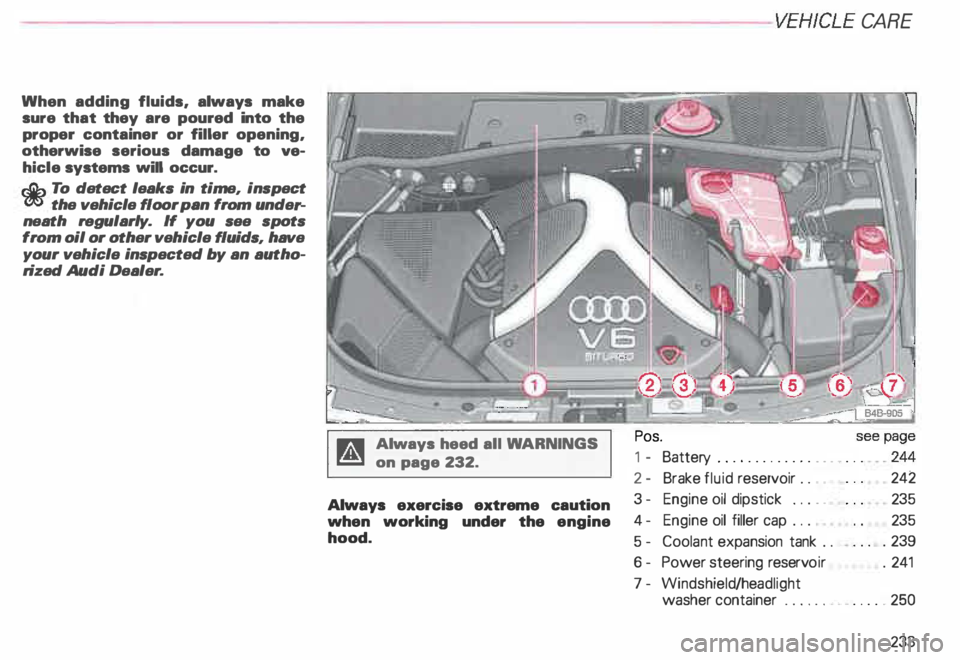
Pos.
1 - Battery ............. . _ .. .. .
2- Brake fluid reservoir . . . 242
3 - Engine oil dipstick ... . _ 235
4- Engine oil filler cap . . . 235
5- Coolant expansion tank . . . 239
6 - Power steering reservoir .
241
7 - Windshield /headlight
washer container ......•• _ .... . 250
233
Page 243 of 306
VE
HICLE CA
RE----------------------------------------------------
Brake fluid
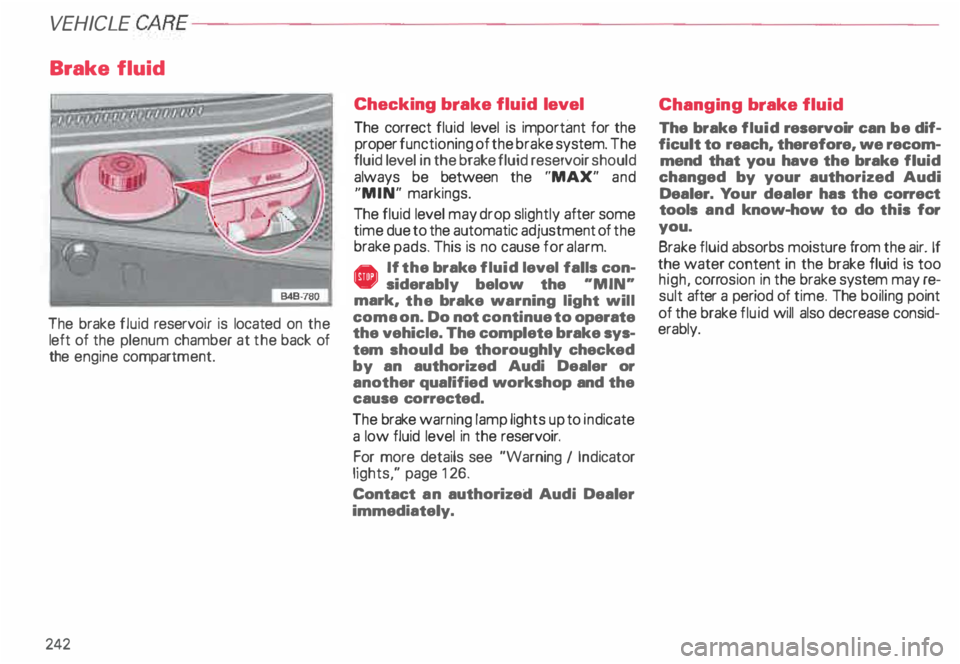
The brake fluid reservo ir is located on the
left of the plenum chamber at the back of
the engine compartm ent.
242 Checking
brake fluid level
The correct fluid level is important for the
proper functioning of the brake system. The
fluid level in the brake fluid reservoir should
always be between the "MAX" and
"MIN" markings.
The fluid level may drop slightly after some
time due to the automatic adjustment of the
brake pads. This is no cause for alarm.
• If the brake fluid level falls con
siderably below the "MIN"
mark, the brake warning light will
coma on. Do not continue to operate
the vehicle. The complete brake sys
tem should be thoroughly checked
by an authorized Audi Dealer or
another qualified workshop and the
cause corrected.
The brake warning lamp lights up to indicate
a low fluid level in the reservoir.
For more details see "Warning I Ind icator
lights," page 126.
Contact an authorized Audi Dealer
immediately. Changing
brake fluid
The brake fluid reservoir can be dif
ficult to reach, therefore, we recom
mend that you have the brake fluid
changed by your authorized Audi
Dealer. Your dealer has the correct
tools and know-how to do this for
you.
Brake fluid absorbs moisture from the air. If
the water content in the brake fluid is too
high, corrosion in the brake system may re
sult after a period of time. The boiling point
of the brake fluid will also decrease consid
erably.
Page 244 of 306
-------------------------VEHICLE CA
RE
Therefore, the brake fluid must be
changed every 2 years.
Note
Remember that brake fluid is harm
ful to the paint of your vehicle.
c£> Because of the problem of pro�
er disposal of brake fluid along
with the special tools required and
the necessary expertise, we recom
mend that you have your brake fluid
changed by your authorized Audi
Dealer.
It is advisable to have the fluid changed dur
ing a Maintenance Service. �W
ARNING
Brake failure can result from old or
inappropriate brake fluid. Observe
these precautions:
• Use only brake fluid that meets
SAE specification J 17 03 and con
forms to Federal Motor Vehicle
Standard 116. Always check with
your authorized Audi Dealer to
make sure you are using the cor
rect brake fluid. The correct type
of brake fluid is also found labeled
on the brake fluid reservoir.
• The brake fluid must be new.
• Brake fluid is poisonous. There
fore, it must be stored only in the
closed original container out of
reach of children.
243
Page 253 of 306
VEHICLE
CARE-------------------------
Tires I Wheels
Tires are important but often abused parts
of a vehicle. They not only influence comfort
and ride, but perform vital safety functio �s.
This section is intended to provide you w1th
imp ortant information regarding their prop
er use, care and replacement.
• Be sure to inspect your tires at least ev
ery 2,000 miles (3 000 kilometres) for wear
and damage.
• Damage to wheels and tires is not always
easy to see. If you believe that a tire or
wheel has been damaged, it is best to have
it replaced as soon as possible. Internal tire
damage can never get better or ': heal" it
self, it can only get worse over t1me. Tire
damage can lead to tire failure and loss of
vehicle control. See your authonzed Aud1
Dealer for advice and assistance.
• Mark tires before removing them. Re
mount tires on the same vehicle side be
cause the rotation direction must stay the
same.
252 •
Store removed tires in a cool, dry and pre
ferably dark place. Tires which are not on
wheels should be stored standing up.
• New tires may have different tread
depths due to the configuration and des!gn
by the tire manufacturers. When replacing
tires, use ones with matching tread depth.
�W ARNING
• Tires age even if they are not be
ing used. Tires which are more
than 6 years should be used only in
an emergency and then with cau
tion.
• Avoid damaging tires and wheel
rims. If you must drive over a curb
or other obstacle, drive slowly and
as nearly as possible at a right
angle. Frequently check tires for
uneven wear and damage. M
WARNIN G continued
• Remove embedded material.
• Replace worn or damaged tires
immediately.
• Replace missing valve dust
caps.
• Keep oil, fuel, brake fluid, etc.
away from tires.
• Keep tires inflated correctly.
New tires
New tires tend to be slippery and cannot of
ferfull traction until they have been properly
broken in.
�W ARNING
To help avoid loss of control, al
ways operate a vehicle with new
tires at lower speeds and with spe
cial caution for the first 300 miles
(480 kilometres).
Page 260 of 306
-------------------------VEHICLE
CARE
Te mperature
The temperature grades are A (the highest),
8, and C, repres enting the tire's resistance to
the generation of heat and its ability to dissi
pate heat when tested under contro lled con
ditions on a specified indoor laboratory test
wheel. Sustained high temJ)erature can
cause the material of the tire to degenerate
and reduce tire life, and excessive tempera
ture can lead to sudden tire failure. The
grade C corres ponds to a level of perfor
mance which all passenger car tires must
meet under the Federal Motor Vehicle Safety
Sta ndard No. 1 09. Grades Band A represent
higher levels of performance on the laborato
ry test wheel than the minimum required by
law.
�W ARNIN G
The temperature grade for this tire
is est ablished for a tire that is
properly inflated and not over
loaded. Excessive speed, under
inflation, or excessive loading, ei
ther separately or in combination,
can causa heat buildup and pos
sible tire failure. Wheel
replacement
If you wish to equip your vehicle with tires
or wheels other than those installed at the
factory, please note the following:
• For technical reasons it is not al
ways possible to use wheels from
other vehicles -under certain condi
tions not even wheels from the same
vehicle model.
• Wheel rims and wheel bolts are
matched to fit your Audi. When
installing different wheels (for ax
ample, wheels with winter tires), the
correct wheel bolts with the proper
length and conical shape of the bolt
head must be used. The secure fit of
the wheels and the proper function
ing of the brake system and safety
are dependent upon this.
• Wheel rims and wheal bolts are
matched to fit your Audi. •
Before you plan on exchanging
steel wheels, light alloy wheals, or
winter tires already mounted on
wheel rims, consult your authorized
Audi Dealer. They have the technical
information necessary to advise you
which wheal rims and wheel bolts
are compatible with the original fac
tory installations.
1ft WARNING
• Incorrect tire/wheel parts may
cause an accident and personal in
jury. Such parts will adversely af
fect the safe operation of your ve
hicle. Always use tires, wheel rims
and wheel bolts that meat specifi
cations of the original factory
installed equipment.
• If wheel trim discs or a front
spoiler are Installed, make sura the
airflow for cooling the brakes is
not obstructed.
259
Page 262 of 306
• Winter tires with studs should be run
only at moderate speeds when new in order
to give the studs time to settle.
Do not drive a vehicle equipped with
winter tires at prolonged high
speed.
Winter tires use a softer rubber compound
and a deeper tread pattern and therefore
have a lower speed rating and reduced trac
tion and durability when used on dry roads.
• When winter tires or all season tires are
mounted, make sure you observe the
speed limitations for which the tire is rated.
The following speed rating code letters are
applicable:
0- up to 1 00 mph (160 km/h)
T- up to 118 mph (190km/h)
H- up to 130 mph (210 lcm/h). �W
ARNING
• Winter tires available for your
vehicle may have a maximum
speed rating which is less than the
maximum speed of your vehicle.
• Driving faster than the maxi
mum speed for which tires are
rated and approved will lead to
sudden tire failure. This can cause
loss of vehicle control and lead to
an accident and personal injury.
• Never operate a vehicle at
speeds greater than the maximum
speed rating of its tires.
• Always observe speed limits
and adjust your vehicle to prevail
ing road and traffic conditions.
Snow chains
• For engineering reasons, snow chains
must only be installed on special winter ti
res• 1).
11 Not available at the time of printing. VEHI
CLE CARE
• If you want to mount snow chains
on your vehicle, consult your Audi
Dealer for proper rim I tire combina
tion.
• Snow chains should only be
installed on the rear wheels, never
on the front wheels.
Where snow chains are mandatory
on certain roads, this normally also
applies to vehicles with All Wheel
Drive.
When you install snow chains,
check the tire air pressure first to
make sure it's correct, otherwise the
chains will not fit the wheel prop
erly.
Only use chains with fine pitch links protrud
ing no more than 1h inch (15 mm), including
tensioner, from tire tread and side walls.
Wheels must rotate freely in all steering
positions with chains mounted to prevent
damage to body, axle or brake components.
Drive slowly and follow the chain
manuf acturer's instructions.
Remove chains when roads are free of
snow. Otherwise, the chains can damage
the tires and impair vehicle handling.
261
Page 268 of 306
•
The deflated full size spare tire cannot be
repaired or mounted using conventional
shop equipment. This work always has to
be performed by the man ufacturer of the
collapsible tire.
• All the air must be let out of the tire after
use before stowing it in the storage area
prov ided for it in the vehicle. Once all the air
is out, the tire will return to its original form.
To let the air out of the tire, either use a
sharp object to press down on the metal pin
in the valve, or use the valve-remo ving tool
on the back side of the dust cap to unscrew
the valve stem. Changing
a wheel
�W ARNING
You or your passengers could be
injured while changing a wheel if
you do not follow safety precau
tions:
• If you have a flat tire, move a
safe distance off the road. Turn off
the engine, turn the emergency
flasher on and use other warning
devices to alert other motorists.
• Passengers must not rema in in
the vehicle when it is jacked up.
This includes children as well as
adults.
• Make sure that passengers wait
in a safe place away from the ve
hicle and well away from the road
way and traffic.
• Before you change a wheel, be
sure the ground is level and firm.
If necessary, use a sturdy board
under the jack. DO-IT-YOURSELF
SERVICE
�� WARN ING continued
• After installing the spare wheel,
make sure that you remount the
flat tire/Wheel in its storage area
properly and tighten the plastic
knurled screw securely.
• To help prevent the vehicle from
moving suddenly and possibly
slipping off the jack, always fully
set the parking brake and block
the wheel diagonally opposite the
wheel being changed. When one
front wheel is lifted off the
ground, placing the automatic
transmission in P (Park) will not
prevent vehicle movement.
267