warning AUDI ALLROAD 2000 Owners Manual
[x] Cancel search | Manufacturer: AUDI, Model Year: 2000, Model line: ALLROAD, Model: AUDI ALLROAD 2000Pages: 306, PDF Size: 9.95 MB
Page 4 of 306
Notes
explaining this manual:
This manual describes all the equip
ment intended at the time of printing.
Some of the equipment may be avail
able at a later date or not at all.
� WARNING S
concern safety and are high
lighted like this througnoui
this manual.
� Texts identified by this sym-
bol and w'itten in italics anJ
important notes l'ega,ding the
environment and how you can
help to p'otect it.
Te xts printed in bold type refer
to possible damage to your ve
hicle, or to other important infor
mation. Please
note that items marked with an
asterisk * may be standard on certain
models, optional on others or not avail
able on your model.
• If one of the Warning and indica
tor lights marked with a STOP
sign comes on while you are driv
ing, move a safe distance off the road,
turn off the engine, turn the emergenc y
flasher on and use other warning de
vices to alert other motorists. Go to
listed page in your manual for explana
tions. VEHIC
LE LITERATURE
Ill ustrat ions
Each illustration in the manual shows a
feature and I or equipment which your
y ehicle may or may not have, depend
rng on the model. The illustrations are
simply to sho w you how a feature looks
and its function.
Alphabetical Index
At the back of this book, you will find an
extensive Alphabetical Index. This will
help you to find information quickly by
using key words.
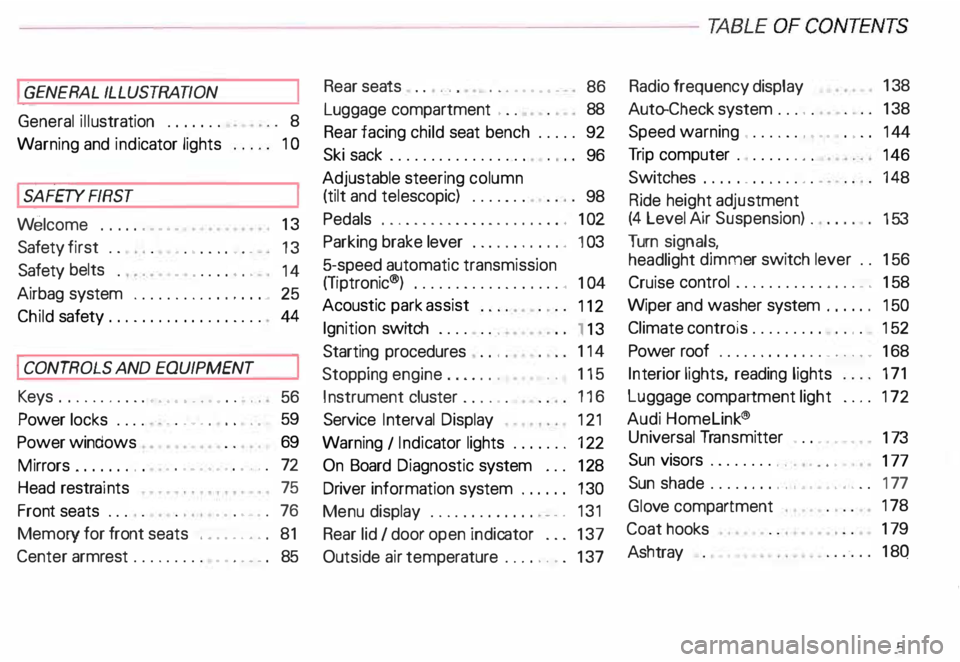
Ta ble of Contents
On the following page, you will find the
Ta ble of Contents which describes all
the features of your vehicle in the order
they appear in this manual.
Page 6 of 306
----------------------------------------------TABLE OFCONT ENTS
I GENERAL ILLUSTRATION
General illustration 0 0 0. • • • 8
Warning and indicator lights 10
I SAFETY
FIRST
W elcome ... 0 0 0 •• •• 13
Safety first 0 0
• 0 • 0 0 0 0 • 0 •
13
Safety belts
• . . 0 0 0 • 0 0
14
Airbag system 0 ••••••• 0 0 • • • • • • • 25
Child safety ........ 0 • 0 0 0 0 0 0 0 0 0 44
I CONTROLS AND EQUIPMENT
Keys 0 0 0 0 0 0 0 0 0 0 0 •••• ••••• 0 0 • • 0
56
Power locks 0 0 0 0
Power windows
Mirrors 0 •• 0 0 0 •••
Head restraints
Front seats 0 0 0 •
0.- . 0 0 0 • • 59
69
• •• - •••• 0 ••• 0 72
75
•• 0 •• 0 76
Memory for front seats , .... 0 •• 0 81
Center armrest 0 0 0 0 0 0 0 0 0 •••••• 0 85 Rear
seats 0 0 •• 0 •• 0 • • • • • •
86
Luggage compartment , 0 0 88
Rear facing child seat bench 0 0 0 0 0 92
Ski sack 0 0 0 0 0 0 0 0 0 0 0 0 0 0 0 0.
96
Adjustable steering column
(tilt and telescopic) 0 0 0 0 • 0 0
98
Pedals 0 0 • 0 0 0 0 0 0 0 0 0 0 0 0 0 0 0 0 0 0 0 , 1 02
Parking brake lever 0 • 0 0 0 0 0 0 0 •• 0 1 03
5-speed automatic transmission
(Trptronic ®) 0 0 0 0 0 0 0 0 0 0 • 0 0 0 0 0. 0 • 104
Acoustic park assist
112
Ignition switch 0 0 0 0 0 0 0
1 13
Starting procedures . 0 • • 114
Stopping engine 0 0 0 0 0 0 • • • 115
Instrument cluster 0 0 0 0 0 0 116
Service Interval Display
121
Warning I Indic ator lights 0 0 0 0 0 0 • 122
On Board Diagnostic system 0 0 0 128
Driver information system 0 • 0 • • • 130
Menu display 0 0 0 0 0 0 0 0 0 0 0 0 0
0 131
Rear lid I door open indicator 0 0 0 137
Outside air temp erature 0 • 0 0 0 0 0 0 137 Radio
frequency display 13
8
Auto-Check system 0 0 0 o 0 138
Speed warning . 0 0 0 • 0 0 • • • • 0 • 0 0 144
Tr ip computer 0 0 0 0 0 0 •• 0
146
Switches 0 • 0 •• 0 0 0 0 • 0 0 0 0 148
Ride height adjustment
(4 Level Air Suspension) 0
153
Turn signals,
headlight dimmer switch lever 0 0 156
Cruise control 0 0 0 0 0 0 0 0 0 0 0 0 0 0 0 • • 158
Wiper and washer system 0 ••• 0 0 150
Climate controls 0 0 0 0 0 0 0 0 0 0 0 • 0 152
Power roof 0 0 0 0 0 0 0 • 0 0 0 0 0 • • • • • • 168
Int erior lights, reading lights 171
Luggage compartment light 0 0 0 0 172
Audi Homelink ®
Uni versal Transmitter . 0 0 • • • •
173
Sun visors 00 00 00 00 ... • .. •
177
Sun shade 0 0 0 0 0 0 0 0 •• , • • • ••• 0 0 177
Glo ve compartment
Coat hooks
Ashtray 178
179
180
5
Page 7 of 306

TABLE OF CO
NTENTS----------------------------------------------
Cigar ette lighter I Socket ....... 181
Storage compartments
Steering wheel with
Audio controls .......••.... 0
Steering wheel with
radio and telephone equipment
in the steering wheel .
Mobile telephones and
CB radios ..
earphone ..•
Roof rack ... ..
I VEHICLE
OPERATION
The first 1,000 miles (1 500 km)-182
18 5
186
189 19 0
191
and afterwa rds ....... ....... .. 193
Operate your vehicle safely . . . . . 194
Operate your vehicle economically
and minimize pollution . . 195
Driving on rough roads or
rugged terrain . . . . . . . . . . 199
Braking . . . . . . . . . . . . . . . . . 201
Ele ctronic differential lock
(EDL) 204
6 Electronic
Stability Program
(ESP) .. .. .. .. .. .. .. .. .. 205
Driving with your quattro® . . . . . . 207
Trailer towing . . . . . . . . _ ... _ . . 208
I VEHICLE
CARE
Cleaning and protection 212
Fuel tank . . . . . . . .
222
Fuel supply . _ .... .. _ . . . . . . . . . . 225
Maintenance ..• •. .
Engine hood .
. . .
Engine compartment
Engine oil ..... ..... .
Engine cooling system
o •• •••
Power steering
Brake fluid ..
Battery ...
Air cleaner
Spark plugs
Belts . . . . .
. __ ..• .. ...
Windshield I
headlight washer container ..... 228
231
232
234
238
241
242
244 248
249
249
250 Wiper
blades
lires I Wheels
Difficult operating
conditions ...... . .
Additional accessories, Modifications and
Parts replacement ...... . .
I DO-IT-YOURSELF
SERVICE
First aid kit ....•.
Emergency
warning triangle . . . . . . . . .
Jack and tools ... .• . _ .. ..• .. ..
Spare wheel .. .. . .. ... . ..
Changing a wheel . . . • . . . . .
Fuses ........ .. . . . .. .. _ .. ..
Replacing bulbs
Installing I
replacing a radio
Emergency starting
Emergency towing with
commercial tow truck
Lifting vehicle .... . 251
252
262
262
263
263
264
266
267 274
277
277
278
281
283
Page 10 of 306
1
2
3
4 5
6
7
8
9
10
11 12
13 14
15
16
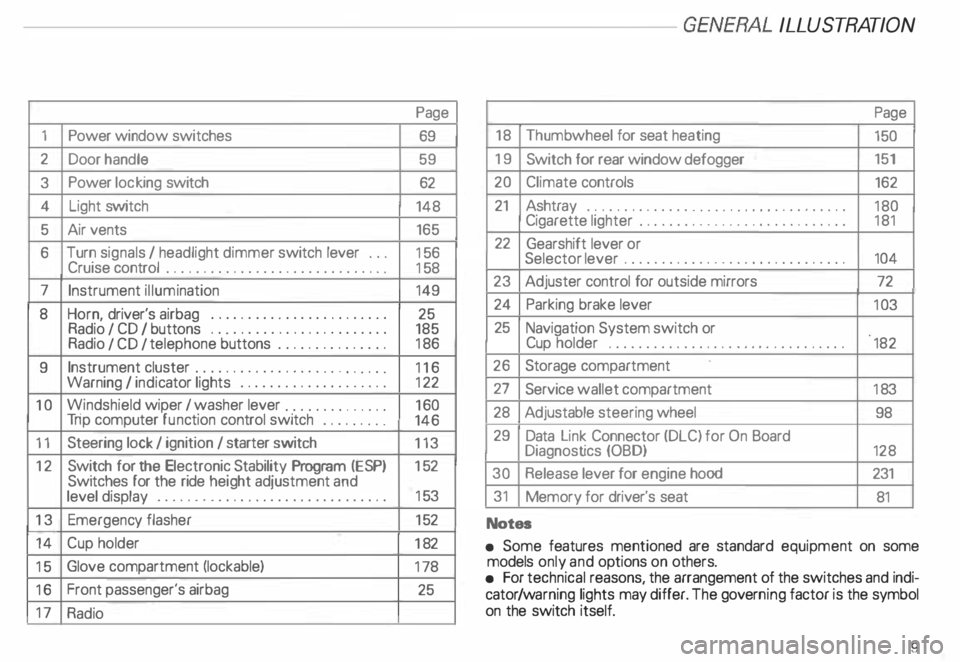
17 Power
window switches
Door handle
Power locking switch
Light switch
Air vents
Turn signals I headlight dimmer switch lever ...
Cruise control ................. .............
Instrument illumination
Horn, driver's airbag •••••
0 •• 0 •• 0 0 •• 0 ••• 0 ••• 0
Radio I CD I buttons ................
........
Radio I CD I telephone buttons ...............
Instrument cluster ....... ... ... ... ... .. .....
Warning I indi cator lights ••••••••
0 0
••••••••••
Windshield wiper I washer lever ..............
Tri p computer function control switch .........
Steering lock I ignition I starter switch
Switch for the Electronic Stability Program (i::SP)
Switches for the ride heigh t adjustment and
level display •••••••••••••••
0 •• 0 •• 0 0 •• 0 0 ••••
Emergenc y flasher
Cup holder
Glove compartment (lockable)
Front passenger's airbag
Radio Page
69
59 62
148 165
15 6
15 8
149
25
185
18 6
11 6
12 2
16 0
146
113
15 2
15 3
15 2
18 2
17 8
25 -------GE NERA L ILLUST
RATION
Page
18 Thumb wheel for seat heating
150
19 Switch for rear window defogger 151
20 Climate controls
162
21 Ashtray ...................................
180
Cigarette lighter ............................ 181
22 Gearshift lever or
Selector lever ..............................
104
23 Adjuster control for outside mirrors
72
24 Parking brake lever
103
25 Navigation System switch or
Cup holder
•••••••••••••••• 0 •••• 0 •••• 0 •••••
182
26 Storage compartment
27 Service wallet compartment
183
28 Adjustable steering wheel
98
29 Data Link Connector (DLC) for On Board
Diagnostics (OBD)
128
30 Release lever for engine hood 231
31 Memory for driver's seat
81
Notes
• Some features mentioned are standard equipment on some
models only and options on others.
• For technical reasons, the arrangement of the switches and indi
cator /warning lights may differ. The govern ing factor is the symbol
on the switch itself.
9
Page 11 of 306
GENERA L
ILL USTR ATION----------------------
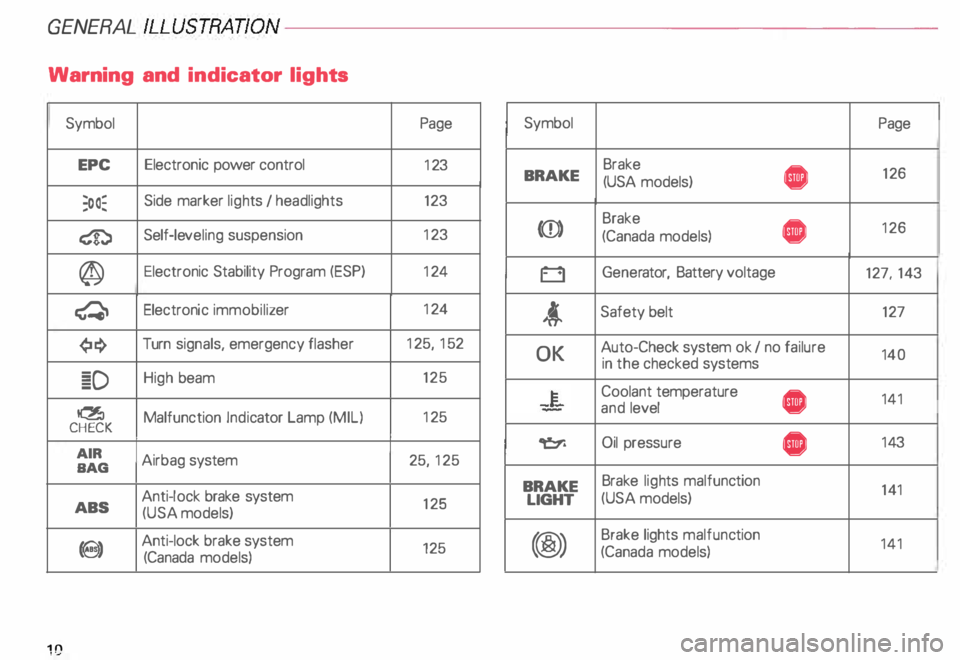
Warning and indicator lights
Symbol Page Symbol
Page
EPC Electronic
power control
123 Brake
• 126
BRAKE
(USA models)
;oo� Side
marker lights I headlights 123
� Self-le
veling suspension 12
3 (CD) Brake
• 12
6
(Canada models)
@ Electronic
Stability Program (ESP) 12
4
0 Gener
ator, Battery voltage
127, 143
� Electronic
immobilizer 12
4
t Safety
belt 127
¢!:} Turn
signals, emergency flasher 12
5, 152
� D High
beam 125
� Malfunction Indicator Lamp (MIL) 12
5
CHECK
AIR Airbag system 25, 125
BAG OK
Auto-Check
system ok I no failure
140
in the checked systems
-�- Coolant
temperature
• 141
and level
� Oil pressure
• 14
3
ABS Anti-lock
brake system
125
(USA models) BRAKE
Brake
lights malfunc tion
141
LIGHT (USA
models)
9) Anti-lock
brake system
125
(Canada models) (@) Brake
lights malfunc tion
141
(Canada models)
10
Page 12 of 306

----------------------------------------------GENERALILLUSTRA nON
Symbol
�
0 rp
w
iU
�N
�ENSOR
8 18
�[) =i•
�D 0$ Headlights
I tail lights
malfunction
Brake pads worn
Washer fluid level low
Fuel level low
Engine oil level low
Engine oil sensor defective
Speed warning
Dynamic headlight dimmer control
not functioning
Front fog lights
Rear fog light Page
14 3
143 143
143
144
144
144
14 4
149
149 Note
If one of the lights marked with 0 comes on suddenly while you
are driving, move a safe distance off the road. Turn off the engine,
turn the emergency flasher on and use other warning devices to
alert other motorists. Go to listed page in your Owner's Manual for
explanations.
11
Page 14 of 306
--------------------------------------------------SAFETYRRST
Welcome Dear Audi Owner,
This chapter contains important informa
tion, tips and suggestions on occupant safe
ty.
We've prepared this chapter in order to
summarize what you need to know about
such topics as safety belts, airbags, child
safety, seats for children and infants.
Please make certain that you follow
the suggestions and warnings given
- it's in your own interest and in the
interest of all your passengers.
However, please note, that impor
tant safety information regarding
your vehicle and its operation will
also be found in all other chapters of
this Owner's Manual.
Remember -safety first! Safety
first
Yo ur safety and the safety of your passen
gers shouldn't be left to chance. Advances
in technology have made a variety of fea
tures available to help reduce the risk of in
jur y in an accident. The following is a listing
of just a few of the safety features in your
Audi:
sophisticated safety belts with tension
ers
optimized safety belt geometry through
safety belt ancho rages on front seats,
safety belt height adjustors front seats,
lateral belt adjustment on outer rear
seats,
safety belt guide for the center rear seat
- front airbags
side airbags in the front and rear* seats
- head airbags left and right above the
doors
special seat pan structure
- adjustable steering column
padded kneebar integrated into the dash
board. These
individual safety features, can work
together as a system to help protect you
and your passengers in a wide range of acci
dents. These features can't work as a sys
tem if they are not always properly adjusted
and properly used!
The following sections provide important in
formation about why these features are im
portant, how they work to help protect you
and your passengers and how they must be
adjusted and used to get the greatest bene
fit and reduce the likelihood of injury.
The sections also contain important
WA RNINGS which you and your passen
gers must always heed in order to reduce
the risk of personal injury.
Safety is everybody's responsibil
ity!
1'> ....
Page 15 of 306
SA
FETY RRST-----------------------------------------------------
Safety belts
J:\. Always wear your
ffi safety belts!
� WARNING
• Safety belts are the single most
effective means available to re
duce the potential for serious in
iury and death in automobile acci
dents. For your protection and
that of your passengers. always
properly wear safety belts when
the vehicle is moving.
• Pregnant women. iniured, or
physically impaired
persons
should also use safety belts. Like
all vehicle occupants, they are
more likely to be seriously iniured
if they do not wear safety belts.
The best way to protect a fetus is
to protect the mother - through
out the entire pregnancy.
1.11. This
section explains why safety belts are
necessary, how they work and how to ad
just and wear them properly.
Please read all the information
given. and always observe the fol
lowing instructions and warnings.
For information on child safety see
page 44.
Why safety belts work
Safety belts can't work unless they
are worn and worn properly.
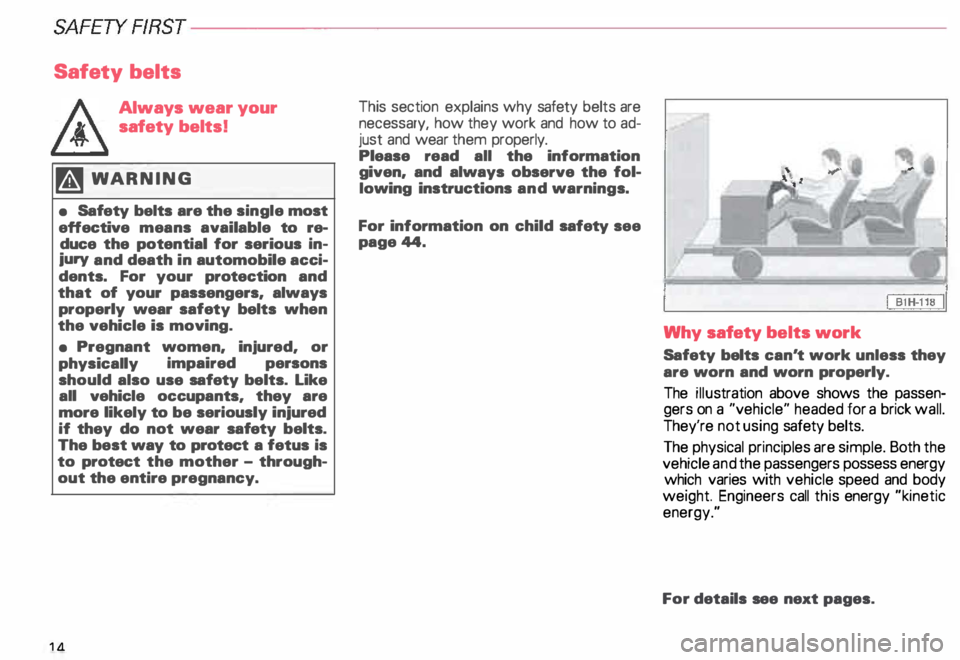
The illustration above shows the passen
gers on a "vehicle" headed for a brick wall.
They're not using safety belts.
The physical principles are simple. Both the
vehicle and the passengers possess energy
which varies with vehicle speed and body
weight. Engineers call this energy "kinetic
energy."
For details see next pages.
Page 18 of 306
--------------------------SAFETY FIRST
Although
these examples are based on a
frontal collision, safety belts can also sub
stantially reduce the risk of injury in other
types of accidents. So, whether you are on
a long trip or just going to the corner store,
always buckle up and make sure others do,
too.
Accident statistics show that vehicle occu
pants properly wearing safety belts have a
lower risk of being injured and a much bet
ter chance of surviving an accident. Prop
erly using safety belts also greatly increases
the ability of the suppleme ntal airbags to do
their job in an accident. For this reason,
wearing a safety belt is legally required in
most countries including much of the
United States and Canada.
The following pages provide important in
structions to enable you to use safety belts
properly. Be aura to read and follow
the instructions carefully. Heed all
WA RNINGS. To
further increase the safety for the front
passengers, the vehicle is equipped with a
supplemen tal airbag system. See page 25.
The safety belts provided must neverthe
less be worn because the front airbags are
activated only in some frontal collisions. The
front airbags are not activated by minor fron
tal collisions, side and rear collisions, in roll
overs or in some cases where there is not
enough deceleration through impact to the
front of the vehicle.
I B1H-124 I
Belt warning system
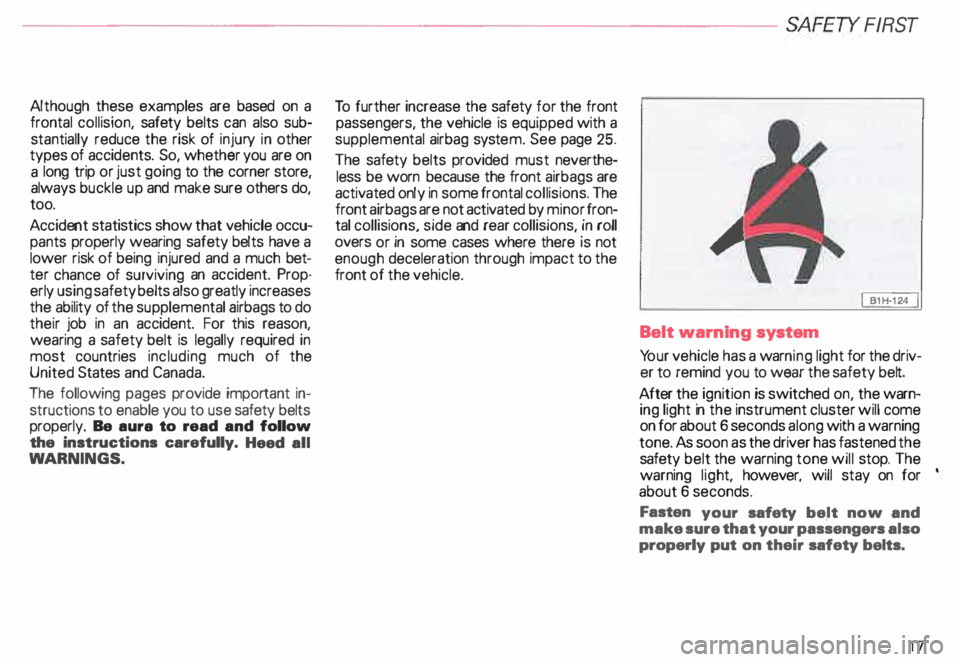
Yo ur vehicle has a warn ing light for the driv-
er to remind you to wear the safety belt
After the ignition is switched on, the warn
ing light in the instrument cluster will come
on for about 6 seconds along with a warning
tone. As soon as the driver has fastened the
safety belt the warning tone will stop. The
warning light, however, will stay on for '
about 6 seconds.
Fasten your safety be.lt now and
make sure that your passengers also
properly put on their safety belts.
17
Page 19 of 306
SAFETY RRST---------------------------------------------------
How to wear safety belts
properly
Safety belts must always be prop
erly positioned across the strongest
bones of your body.
�W ARNING
Always fasten your safety belts
before driving off. Always make
sure your passengers are properly
restra ined -even those sitting in
the rear.
Safety belts can work only when
used properly. Never wear safety
belts in any other way than illus
trated and described in this sec
tion. Always observe the follow
ing precautions:
• Never wear belts twisted.
18 '41
WARNING continued
• Never strap more than one par
son, including small children, into
any belt. It is especially dangerous
to place a safety belt over a child
sitting on your lap.
• Never place your feet on the in
strument panel or on the seat.
Always keep both feet on the floor
in front of the seat.
• Never wear belts over rigid or
breakable objects in or on your
clothing, such as eye glasses,
pens, keys, etc., as these may
cause injury.
• Do not wear the shoulder part of
the belt under your arm or other
wise out of position.
• Several layers of heavy clothing
may interfere with proper posi
tioning of belts and reduce the
overall effectiveness of the sys
tem. �
WARNING continued
• Never allow safety belts to be
come damaged by being caught in
door or seat hardware. Always
keep belt buckles free of any ob
struction that may prevent secure
locking.
• Never use comfort clips or de
vices that create slack in the
shoulder belt portion. However,
clips may be required for the
proper use of some child restraint
systems.
• To rn or frayed safety belts can
tear and damaged belt hardware
can break in an accident. Inspect
belts periodically.
If belts show damage to webbing,
bindings, buckles. or retractors,
have them replaced.