headlights AUDI Q2 2021 Owner´s Manual
[x] Cancel search | Manufacturer: AUDI, Model Year: 2021, Model line: Q2, Model: AUDI Q2 2021Pages: 364, PDF Size: 87.77 MB
Page 55 of 364
Lights and vision
CO
<
O
rN
iv
rN
i—i
o
< 00
Background lighting
Applies
to: vehicles with background lighting
The
background lighting can be adjusted via the
infotainment system.
• Select the following on the infotainment sys
tem:
|MENU| button > Car
>
left control button
> Vehicle settings > Background lighting.
It may be possible to adjust the brightness of the
individual zones, depending on the equipment
fitted in your vehicle:
• Press the right control button and select one of
the zones displayed.
The background lighting will be switched on
when you switch on the headlights with the
igni
tion on.
Instrument lighting
The
background lighting of the instruments and
displays (including the head-up display*) can be
adjusted as required.
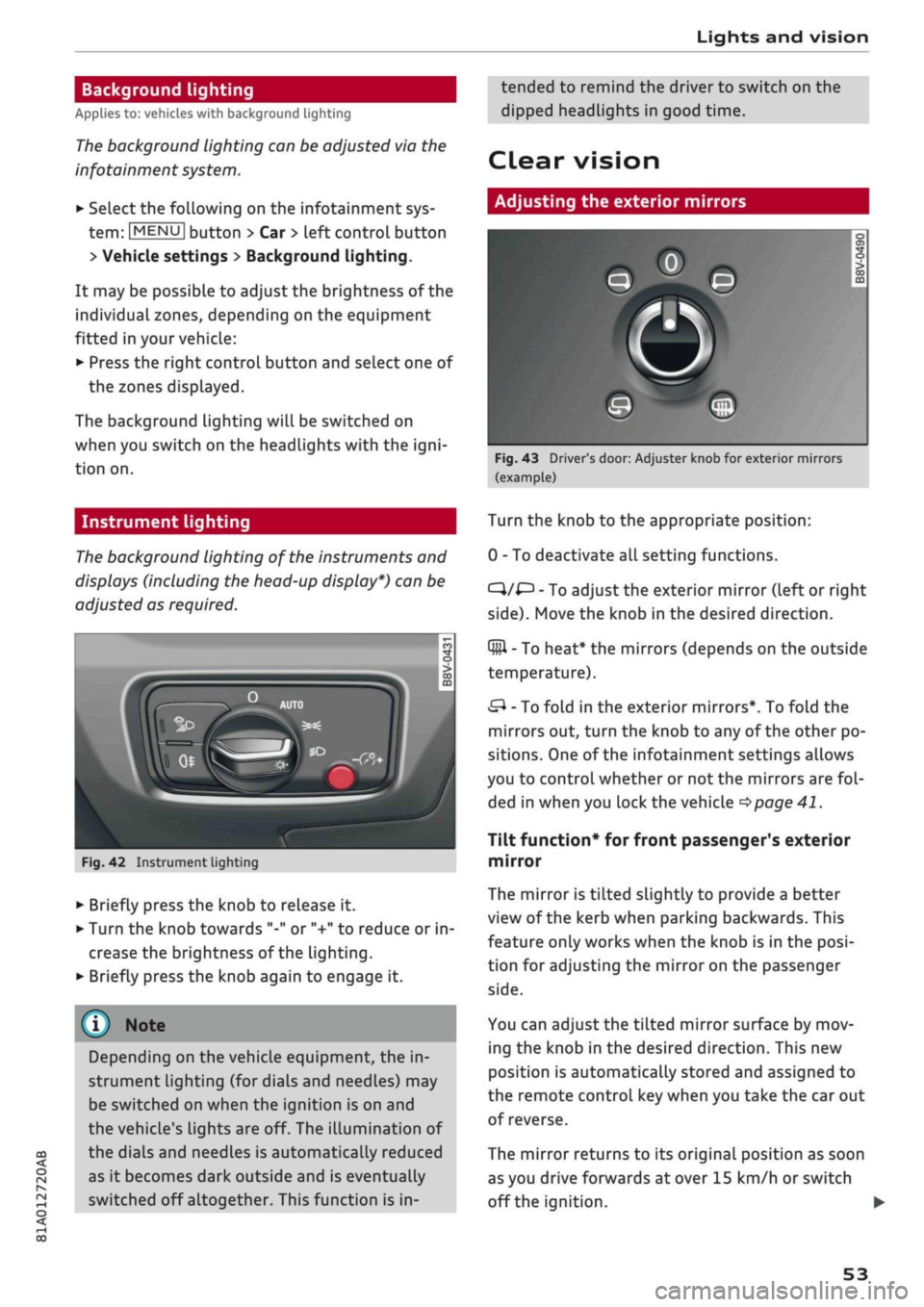
Fig.
42 Instrument lighting
• Briefly press the knob to release it.
• Turn the knob towards "-" or "+" to reduce or in
crease the brightness of the lighting.
• Briefly press the knob again to engage it.
Depending on the vehicle equipment, the in
strument lighting (for dials and needLes) may
be switched on when the ignition is on and
the vehicle's lights are off. The illumination of
the dials and needles is automatically reduced
as it becomes dark outside and is eventually
switched off altogether. This function is in
tended to remind the driver to switch on the
dipped headlights in good time.
dear
vision
Adjusting the exterior mirrors
Fig.
43 Driver's door: Adjuster knob for exterior mirrors
(example)
Turn the knob to the appropriate position:
0 - To deactivate all setting functions.
C}/^
- To adjust the exterior mirror (left or right
side).
Move the knob in the desired direction.
Q#l
- To heat* the mirrors (depends on the outside
temperature).
&
- To fold in the exterior mirrors*. To fold the
mirrors out, turn the knob to any of the other po
sitions. One of the infotainment settings allows
you to control whether or not the mirrors are
fol
ded in when you lock the vehicle
•=>page
41.
Tilt function* for front passenger's exterior
mirror
The mirror is tiLted slightly to provide a better
view of the kerb when parking backwards. This
feature only works when the knob is in the
posi
tion for adjusting the mirror on the passenger
side.
You can adjust the tilted mirror surface by mov
ing the knob in the desired direction. This new
position is automatically stored and assigned to
the remote control key when you take the car out
of reverse.
The mirror returns to its original position as soon
as you drive forwards at over 15 km/h or switch
off the ignition. •
53
Page 56 of 364
Lights and vision
A WARNING
Convex or wide-angle* exterior mirrors give a
larger field of
vision.
However, they make ob
jects look smaller and further away than they
really are. If
you
use these mirrors to
esti
mate the distance to vehicles behind you
when changing Lane, you could misjudge the
distance. Risk of accident!
CAUTION
- Applies to vehicles with electrically retracta
ble exterior mirrors: If one of the mirror
housings is knocked out of position (e.g.
when parking), the mirrors must be fully re
tracted with the electric control. You will
hear
a
loud noise when the mirrors snap
back into place. Do not readjust the mirror
housing by hand, as this will interfere with
the mirror adjuster function.
- Applies to vehicles without electrically re
tractable exterior mirrors: If one of the mir
ror housings is knocked out of position (e.g.
when parking), it must be returned to its
proper position by hand.
- Before washing the vehicle in an automatic
car wash, please make sure to retract the
exterior mirrors to prevent them from being
damaged.
Electrically retractable exterior
mirrors* must NOT be folded in or out by
hand.
Always use the electrical power
con
trol.
©
If the electrical adjustment should fail to op
erate,
both of the mirrors can be adjusted by
hand by Lightly pressing the edge of the mir
ror glass.
Anti-dazzle setting
Your vehicle is equipped with a manual or auto
matic* anti-dazzle interior
mirror.
Manual anti-dazzle interior mirror
•
Pull
the lever
at
the bottom of the mirror to
wards you.
Automatic anti-dazzle mirrors*
• The interior and exterior mirrors will darken
when bright light (e.g. from the headlights of
a
following vehicle) shines on the surface of the
interior mirror.
A
WARNING
Applies to: vehicles with automatic anti-dazzle mirrors
Electrolyte fluid can leak from a broken mir
ror. This fluid can cause irritation to the
skin,
eyes,
and respiratory organs. Wash thorough
ly with clean water should you come into
con
tact with this
fluid.
Seek medical assistance if
needed.
© CAUTION
Applies to: vehicles with automatic anti-dazzle mirrors
Electrolyte fluid can
leak
from a broken mir
ror. This fluid can damage plastic surfaces.
Use a wet sponge or similar to remove the
flu
id as soon as possible.
(T) Note
Applies to: vehicles with automatic anti-dazzle mirrors
-The automatic anti-dazzle mirrors may not
function as intended if the light falling on
the surface of the interior mirror is obstruc
ted.
-The automatic anti-dazzle mirrors do not
darken if the interior lighting is on
or
the car
is in reverse gear.
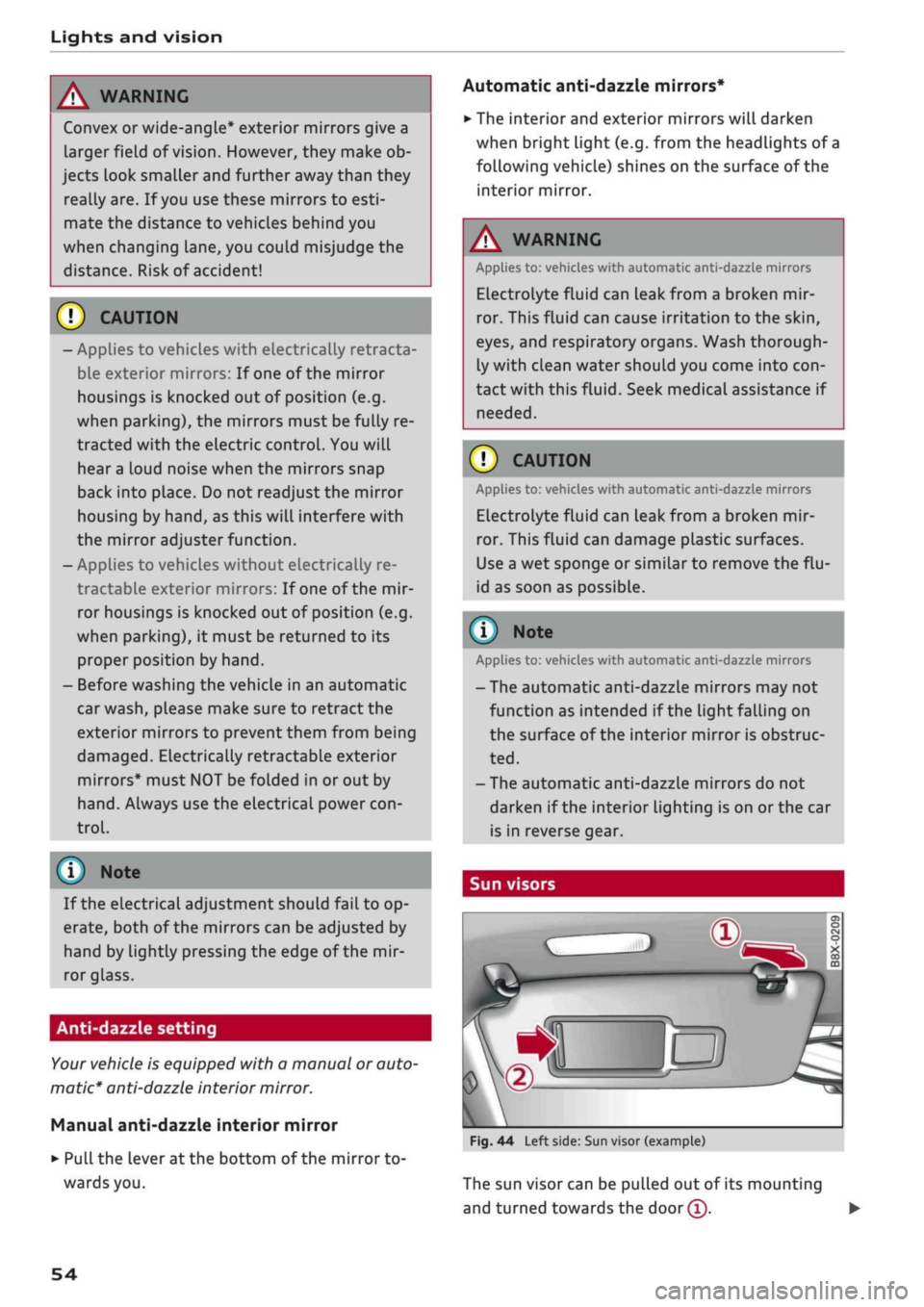
Sun visors
Fig.
44 Left side: Sun visor (example)
The sun visor can be pulled out of its mounting
and turned towards the
door
(T).
•
54
Page 57 of 364

Lights and vision
CO
<
o
rN
iv
rN
t-H
o
< 00
The light* for the make-up mirror comes on auto
matically when you slide open the mirror cover
©•
Windscreen wipers
Switching on the windscreen wipers
V
WJIO
*
Fig. 45
Windscreen
wiper
lever
m®
v
"trj-i
s
to
o > 03 m
Fig.
46 Control lever for rear wiper
Move the windscreen wiper lever to the appropri
ate position:
@-Wipers
off
(Î) - Intermittent wipe. Move switch
®
to the Left
or to the right to increase or reduce the wiper de
lay interval. If your vehicle is equipped with a rain
sensor*, the windscreen wipers will be activated
automatically in the rain as long as the vehicle
has been moving faster than approx. 4 km/h at
Least once. The higher the sensitivity level for the
rain sensor (i.e. the further switch
(Â)
is moved to
the right), the sooner the windscreen wipers re
act to moisture on the windscreen. You can deac
tivate the rain sensor mode on the infotainment
system (this will activate the intermittent wipe
mode). To do so, select: |MENU| button > Car >
left control button > Driver assist
>
Rain sensor.
@-
Slow wipe
(|)-
Fast
wipe
(?) - Single wipe. If
you
hold the lever in this
posi
tion,
the wipers will switch from slow continuous
wiping to fast continuous wiping after
a
while.
(D - Wash/wipe. The screen is given an extra wipe
a few seconds later to remove any dribbles of wa
ter (if the vehicle is moving and the temperature
is above approx. 4
°C).
You can deactivate this
function by moving the lever to position
(s)
again
within 10 seconds after the extra wipe. The ex
tra-wipe function is activated again the next time
you switch on the ignition.
Headlight washers*. The headlight washer sys
tem*
only operates when the dipped headlights
are switched on. The headlights are also auto
matically washed intermittently when you move
the lever to position
(s).
(?) - Rear wipe. The rear window is wiped approxi
mately every 6 seconds.
If the windscreen wipers are on and in operation,
the rear window wiper will also be switched on
automatically when you engage reverse gear.
©-
Rear wash/wipe. The number of wiper cycles
depends on how long you hold the Lever in
posi
tion©.
A WARNING
- The rain sensor* is only intended to assist
the driver. The driver is still obliged to
man
ually operate the windscreen wipers as re
quired depending on visibility.
- Do not use water-repellent coatings on the
windscreen. In bad visibility conditions such
as light
rain,
low sun or when driving at
night these coatings can cause increased
dazzle, which is a serious safety hazard.
Such coatings can aLso cause the wiper
blades to judder.
- Poor visibility can cause accidents. Always
ensure that the wiper blades are in good
condition
^>page
56, Changing the
wind
screen wiper blades.
55
Page 83 of 364

Driving
- The power consumption is
high.
The engine switches off again when the condi
tions for start/stop mode are once again
fulfil
led1).
Ignition is switched off automatically
To prevent the vehicle battery from being dis
charged,
the ignition will be switched off auto
matically if certain conditions are met. For in
stance:
- The start/stop system has switched off the en
gine.
- The vehicle is stationary.
- The driver has left the vehicle.
If the dipped beam headlights are switched on in
this case, the side lights will be turned on in
stead.
After approx. 30 minutes, or when you
lock the vehicle, the side Lights will be switched
off.
If the start/stop system has not stopped the en
gine or if
you
have switched off the start/stop
system manually, the engine will continue
run
ning and the ignition will not be switched off au
tomatically
^A-
A WARNING
Never run the engine in confined spaces. The
exhaust gases are toxic - risk of poisoning!
© Note
If
you
select
D
or
N
after selecting reverse
gear on a vehicle with automatic gearbox, the
car must have been moving at over 10 km/h
before the system can switch off the engine
again.
Switching the start/stop system on/off
manually
Applies to: vehicles with start/stop system
You
can switch the system off manually if you
don't want to use it.
_.
rA^OFF
un
S
o
>
CO CO
Fig.
73 Centre console: Switch for start/stop system
•
To switch the start/stop system off or on
man
ually, press the
\OE1
button. The LED in the but
ton will light up when the system is switched
off.
© Note
If
you
switch off the system during a stop
phase,
the engine will start again automati
cally.
Driver messages in the instrument cluster
display
Applies to: vehicles with start/stop system
H
Automatic
start/stop
deactivated: Please re
start engine manually
This message appears if certain conditions have
not been met during the stop phase and the
start/stop system cannot start the engine again
automatically. In this case, the engine must be
started manually.
2]
Automatic
start/stop:
system fault! Func
tion unavailable
There is a malfunction in the start/stop system.
Drive to a workshop soon and have the fault
recti
fied.
CO
rN
IV
rN
t-H
o <
1)
May vary in different countries
81
Page 99 of 364
Towing a trailer
Tyre pressure
Check the tyre pressures on your car, and adjust
for "full
load"
conditions (refer to the sticker list
ing the tyre pressures)
^>page
307. It may also
be necessary to adjust the tyre pressures on the
trailer according to the recommendations of the
trailer manufacturer.
Exterior mirrors
Check whether you can see enough of the road
behind the trailer with the standard mirrors. If
this is not the case you should have additional
mirrors fitted. Both exterior mirrors should be
mounted on hinged extension brackets. Adjust
the mirrors to give sufficient vision to the rear.
Headlights
Before starting
a
journey, check the headlight
beam settings with the trailer hitched up. Adjust
the headlight settings if necessary.
On vehicles with halogen headlights, the
head
light range control must be adjusted, see
tapage
49.
The headlight range control will be adjusted au
tomatically if your vehicle is equipped with LED
headlights*.
Power supply
To ensure that the engine can be started again
after the ignition is switched off, the power
man
agement system
^>page
149 controls the distri
bution of electrical power and gradually switches
off unnecessary electrical equipment. The trailer
is supplied with power during this period. The
power supply to the trailer is interrupted while
the engine is being started.
Removable ball joint coupling
Vehicles with a factory-fitted towing bracket are
equipped with a removable
ball
joint coupling.
This is stored in the spare wheel well or in a sepa
rate bag on the floor of the luggage compart
ment, together with the necessary fitting instruc
tions.
We recommend having the car serviced be
tween the normal inspection intervals if it
used frequently for towing a trailer.
Trailer stabilisation system
Applies to: vehicles with towing bracket
Trailer stabilisation helps to reduce the risk of
the vehicle skidding when towing a
trailer.
When is the trailer stabilisation
system1'
activated?
Trailer stabilisation is active when the following
requirements are met:
- The ESC must be switched on
^>page
146 and
fully functional (no ESC malfunction).
- The trailer connector must be properly secured
in the vehicle socket.
- The vehicle speed must be higher than approx.
60 km/h.
How trailer stabilisation works
In many cases, the driver can stabilise a swaying
trailer by manually braking the vehicle.
However, if the ESC detects that the trailer is
swaying and this is affecting the towing vehicle,
it will automatically brake the vehicle in order to
stabilise the trailer. The indicator
Lamp Hi
will
flash in the instrument cluster. If possible, do
not turn the steering wheel at this stage.
In order to warn traffic behind you, the brake
lights will come on during this automatic braking
operation.
A trailer may sway quite considerably without the
trailer stabilisation system intervening.
If the system for activating the trailer brake
lights is defective, this will be indicated in the in
strument cluster display
opage
35,
:&
Bulb
monitor.
•
CO
rN
rN
t-H
o <
x)
Not available on vehicles for some markets.
97
Page 317 of 364

Care of vehicle and cleaning
A.
WARNING
- Follow the rules and recommendations of
the car wash operator and do not wash the
vehicLe with the ignition switched on - risk
of accident!
- To avoid cutting yourself on sharp metal
parts,
always wear suitable protection when
cleaning the underside of the car or inside
the wheel arches.
- After the car has been washed, the full brak
ing effect can be delayed by moisture (or in
winter by ice) on the discs and brake pads -
risk of accident! The brakes should be dried
by pressing the pedal to restore full braking
effect.
© CAUTION
- Before washing the vehicle in an automatic
car wash, please make sure to retract the
exterior mirrors to prevent damage. Always
use the electrical power controL to fold the
mirrors in/out on vehicles with electrically
retractable exterior mirrors*.
- Do not wash the vehicle in direct sunlight -
otherwise the paint can be damaged.
- Do not use insect sponges or abrasive
household sponges, etc. - they can damage
the surfaces.
- Matt-painted vehicle parts:
- Do not use polish or wax - otherwise the
paintwork can be damaged.
- Never use car-wash programmes that in
clude wax coatings. This could spoil the
matt finish.
- Do not attach any stickers or magnet la
bels to matt-painted parts as these could
damage the paintwork when they are re
moved.
® For the sake of the environment
The car should only be washed in special wash
bays.
This prevents oily water from getting in
to the public drains.
CO
<
O
rN
iv
rN
•-i
00
Notes on cleaning and care
For cleaning and care of individual components
on the vehicle, please refer to the tables below.
These are recommendations only. If
you
have
Cleaning the exterior
special questions or certain components are not
listed,
please ask your qualified workshop. Please
also refer to the notes
•=> A-
Component(s) Situation
Wiper blades
Headlights/
rear lights
Sensors/
camera lenses
Wheels
Tailpipes
Ornamental trim/
mouldings
Dirt/deposits
Dirt/deposits
Dirt/deposits
Snow/ice
Road salt
Brake dust
Road salt
Dirt/deposits
Remedy
^>page
56, Cleaning the wiper blades
Soft sponge with mild
detergenta)
Sensors: soft cloth with solvent-free cleaning agent
Camera lenses: soft cloth with alcohol-free cleaning agent
Small brush/solvent-free de-icer spray
Water
Acid-free cleaning agent
Water; suitable stainless steel cleaning product if necessa
ry
Mild
detergenta);
suitable stainless steel cleaning product
if necessary
313
Page 319 of 364

Care of vehicLe and cleaning
CO
<
O
rN
r>
rN
•-i
00
Component(s)
Fabrics,
leatherette,
Alcantara
Natural leather
Carbon parts
Situation
Surface dirt
Water-based stains,
e.g.
coffee, tea,
blood,
etc.
Fat-based stains, e.g.
oil,
make-up, etc.
Special dirt/stains,
e.g.
ballpoint pen,
nail varnish, disper
sion paint, shoe
cream,
etc.
Fresh dirt/stains
Water-based stains,
e.g.
coffee, tea,
blood,
etc.
Fat-based stains, e.g.
oil,
make-up, etc.
Special dirt/stains,
e.g.
ballpoint pen,
nail varnish, disper
sion paint, shoe
cream,
etc.
Care of vehicle
Dirt/deposits
Remedy
Vacuum cleaner
Absorbent cloth and mild
detergent3'
Apply mild detergent3', dab off dissolved grease or colour
particles with absorbent cloth; if necessary treat with wa
ter
Special stain remover (dab off with absorbent fabric); if
necessary treat with mild
detergent3'
Cotton cloth with mild
detergent3'
Fresh stains: absorbent cloth
Dried stains: stain remover suitable for leather
Fresh stains: absorbent cloth and suitable stain remover
for leather
Dried stains: grease removal spray
Stain remover suitable for leather
Regularly apply leather-care cream with ultra-violet pro
tection and impregnating compound; if necessary use spe
cial colour leather cream
Same treatment as plastic parts
a^
Mild detergent: not more than two tablespoons of pH-neutral
A WARNING
Do not use water-repellent coatings on the
windscreen. In bad visibility conditions such
as Light
rain,
Low sun or when driving at night
these coatings can cause increased dazzle,
which is a serious safety hazard. Such coat
ings can also cause the wiper blades to
jud
der.
© CAUTION
-
Headlights/rear
lights
- Never clean the headlights/rear lights
with a dry cloth or sponge.
detergent to one litre of water
- Do not use cleaning agents containing al
cohol.
This could cause the glass to crack!
- Wheels
- Do not use paint polish or other abrasive
agents.
- If the protective paint coating on the
wheel rim is scratched or damaged by
stone chips etc., the damaged area should
be touched up without delay.
-Sensors/camera lenses
- Never remove snow and ice from the cam
era lens using warm or hot water - danger
of cracks appearing on the lens.
315
Page 332 of 364

Mobility
7. Connect one end of the black lead preferably
to the earth point or alternatively to the
neg
ative battery terminal © on the vehicle pro
viding assistance®.
8. Connect the other end of the
black
jump lead
only to the earth point © of the jump-start
connection on your vehicle ©
<=>(£).
9. Position the jump leads in such a way that
they cannot come into contact with any mov
ing parts in the engine compartment.
Starting the engine
10.
Start the engine of the vehicle with the
boosting battery and let it run at idling
speed.
11.
Start the engine of the
car
with the dis
charged battery and wait two or three mi
nutes until the engine is running smoothly.
12.
If the engine fails to start: do not operate the
starter for longer than 10 seconds. Wait for
about 30 seconds and try again.
13.
Switch on the blower and the rear window
heating on the vehicle which has been jump-
started in order to offset excessive voltage
which may occur when disconnecting the
leads.
The headlights must be switched off!
14.
Disconnect the leads in exactly the opposite
sequence to that described in
*page
327
with the engines running. Make sure that the
Leads cannot come into contact with any
moving parts in the engine compartment.
15.
Fold the cover back onto the battery in its
correct position.
16.
Switch off the blower and the rear window
heating again.
PLease refer to
<=>
A in Before starting the engine
on page 326 and
•=>©
in Before starting the en
gine on page 327.
© CAUTION
Do not use the negative battery terminal
when jump-starting (this could cause a
mal
function in the on-board electrical system).
- Connect the battery clamps so they have
good metal-to-metal contact with the bat
tery terminals.
- The vehicle battery is vented to the outside
to prevent gases entering the vehicle's inte
rior.
Tow-
start
ing / towing
away
General notes
Some experience is required to tow or tow-start a
vehicle, especially when using a tow-rope. Both
drivers should be familiar with the technique re
quired for towing. Inexperienced drivers should
not attempt to tow-start or tow away another ve
hicle.
Do not pull too hard with the towing vehicle and
take care to avoid jerking the tow-rope. When
towing off-road, there is aLways a risk that the
anchorage points may be overloaded.
Tow-bar / tow-rope
It is easier and safer to tow the vehicle with a
tow-bar. You should only use a tow-rope if you do
not have a tow-bar. It is advisable to use a tow-
rope made of elastic synthetic fibre or similarly
elastic material.
Notes on towing vehicles
The vehicle can be towed with a tow-bar or tow-
rope.
When the engine is not running, the
gear
box will not be adequately lubricated if the
fol
lowing speed/distance restrictions are not ob
served:
- The vehicle must not be towed faster than
50 km/h.
- The vehicle must not be towed further than
50 km. •
328
Page 339 of 364

Fuses and bulbs
CO
rN
IV
rN
•-i
00
- Make sure that the covers are correctly seat
ed on the headlights and the rear lights.
This will ensure that water cannot enter the
housings and cause the lights to malfunc
tion.
- Do not touch the glass part of the bulb with
your bare hands; use a cloth or paper towel
instead.
Otherwise, the fingerprints left on
the glass will vaporise as a result of the heat
generated by the bulb, be deposited on the
reflector and impair its surface.
© CAUTION
When removing or installing the rear light,
take care not to cause any damage.
- Removing the rear light in particular can
lead to the paintwork or rear light becoming
damaged.
This is another reason why we
recommend having the bulbs changed by a
qualified workshop.
- Never use metal tools (e.g. a screwdriver) or
sharp or pointed plastic tools to lever out
the rear light - risk of damaging the paint.
- Make sure you have a soft cloth ready to
place under the glass on the rear light, to
avoid any scratches.
® For the sake of the environment
A qualified workshop can advise you how to
dispose of used bulbs in the proper manner.
© Note
- Please check at regular intervals that
alL
lighting (especially the exterior Lighting) on
your vehicle is functioning properly. This is
not only in the interest of your own safety,
but also in that of all other road users.
- Before changing a bulb, make sure you have
the correct new bulb.
Bulbs at front of vehicle
Applies to: vehicles with halogen headlights
Fig.
279 Halogen headlights: Overview of left side of
vehi
cle
You must only replace a bulb with a bulb of the
same type. Information regarding e.g. the wat
tage can be found on the base of the bulb.
The description for changing the bulb refers to
the left headlight; the procedure for the right
headlight is similar.
Halogen headlights
The following bulbs can be changed:
Bulb (12 V)
(T)Main
beam headlight
© Dipped headlight
© Daytime running light
© Turn signal
Version
H7LL(55
W)
H7LL(55W)
PW24W
PWY24W
Bulbs at rear of vehicle
Applies to: vehicles with bulbs
Fig.
280
Rear
of
vehicle:
Bulbs on
leftside
of vehicle
335
Page 340 of 364
Fuses and bulbs
You must only replace a bulb with a bulb of the
same type. Information regarding e.g. the wat
tage can be found on the glass or base of the
bulb.
The description for changing the bulb refers to
the Left rear light unit; the procedure for the
right rear Light unit is similar.
You can change the
foLLowing
bulbs yourself:
Changing bulb for turn signals
Applies to: vehicles with halogen headlights
Bulb (12 V)
©Tail
light
© Brake light
© Reversing Light
(4)
Turn signal
©Rearfog
light3'
Version
W16W
P21W
W16W
PY21W
W16W
a'
The bulb for the rear fog light is fitted on one side only. It
is located on the left side on LHD vehicles and on the right
side on RHD vehicles.
Changing headlight
bulbs
Removing cover (engine compartment)
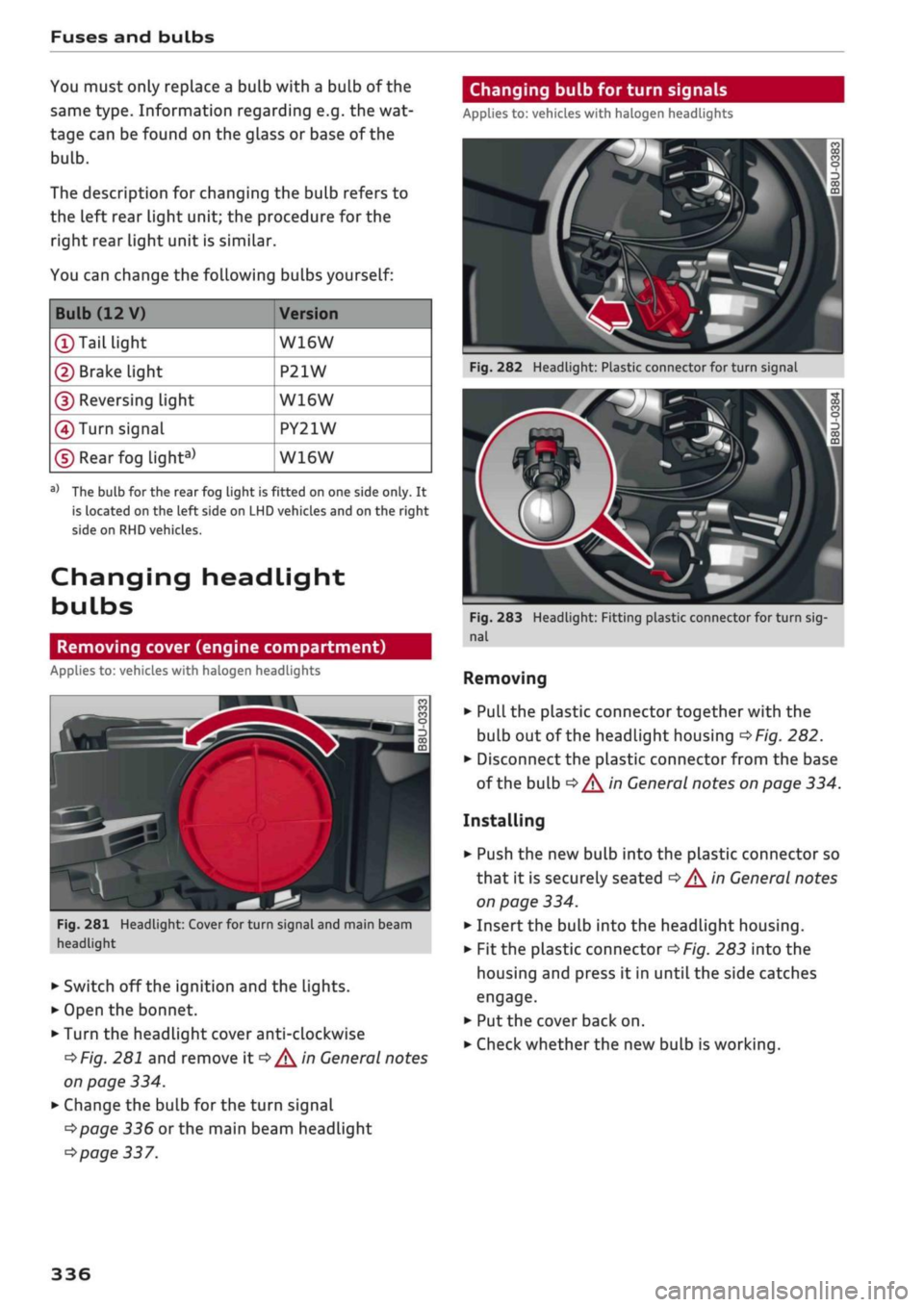
Applies to: vehicles with halogen headlights
^
Fig.
281 Headlight: Cover for turn signal and main beam
headlight
• Switch off the ignition and the lights.
• Open the bonnet.
• Turn the headlight cover anti-clockwise
*Fig.
281 and remove it
*/^
in General notes
on page 334.
• Change the bulb for the turn signal
*page
336 or the main beam headlight
*page
337.
Fig.
282 Headlight: Plastic connector for turn signal
Fig.
283 Headlight: Fitting plastic connector for turn
sig
nal
Removing
• Pull the plastic connector together with the
buLb out of the headlight housing
*Fig.
282.
• Disconnect the plastic connector from the base
of the bulb
*^
in General notes on page 334.
Installing
• Push the new bulb into the plastic connector so
that it is securely seated
*^
in General notes
on page 334.
• Insert the bulb into the headlight housing.
•
Fit
the plastic connector
*Fig.
283 into the
housing and press it in until the side catches
engage.
• Put the cover back on.
• Check whether the new bulb is working.
336