page 51 AUDI Q2 2021 Owner´s Manual
[x] Cancel search | Manufacturer: AUDI, Model Year: 2021, Model line: Q2, Model: AUDI Q2 2021Pages: 364, PDF Size: 87.77 MB
Page 276 of 364
Safe driving
positioning, move the front passenger's seat as
far upwards as possibLe using the seat's height
adjustment. After installing the child seat on the
front passenger's seat, move the front passen
ger's backrest forward until it makes contact
with the child seat.
A WARNING
- Please refer to the important safety notes
•=>
A in Safety notes for using child seats on
page 268,
•=>
A in Child seat categories on
page 269 and the instructions provided by
the child seat manufacturer.
- Never install
a
rearward-facing child seat on
the front passenger's seat unless the front
passenger's airbag has been deactivated -
this can result in potentially fatal injuries to
the
child.
Pedal area
Pedals
The
pedals must always be free to move and
must never be obstructed by floor mats or any
objects in the footwell.
•
Make sure that none of the pedals is obstructed
and all of the pedals can be pressed all the way
down to the floor.
•
Make sure that all pedals are able to return
freely to their original positions.
Only use floor mats which Leave the pedal area
free and can be securely fastened in the footwell.
If one of the brake circuits should
fail,
increased
brake pedal travel will be required to bring the
vehicle safely to a stop.
A WARNING
Any obstructions that restrict pedal travel can
cause loss of vehicLe control and lead to
criti
cal traffic situations.
- Never place objects in the driver's footwell.
Such objects could move under the pedals
and interfere with their proper function. In
the event of sudden braking or
a
change of
direction,
you would not be able to use the
pedals. This could result in a loss of control
and possibly cause an accident.
Floor mats on the driver's side
Use
only floor mats which can be securely fas
tened in the footwell and do not obstruct the
pedals.
•
Make sure that floor mats are securely fastened
and cannot interfere with the pedals
o /\.
Use only floor mats that leave the pedal area un
obstructed and are firmly secured to prevent
them from slipping. You can obtain suitable floor
mats from your dealer or a specialist retailer.
A WARNING
Any obstructions that restrict pedal travel can
cause Loss of vehicle control and increase the
risk of serious personal injury.
- Always make sure that floor mats are prop
erly secured.
- Never lay or
instaLl
additional floor mats or
other floor coverings over the existing floor
mats;
this would restrict the pedal area and
possibly obstruct the pedals, which could
cause an accident.
Stowing Luggage
safely
Luggage compartment
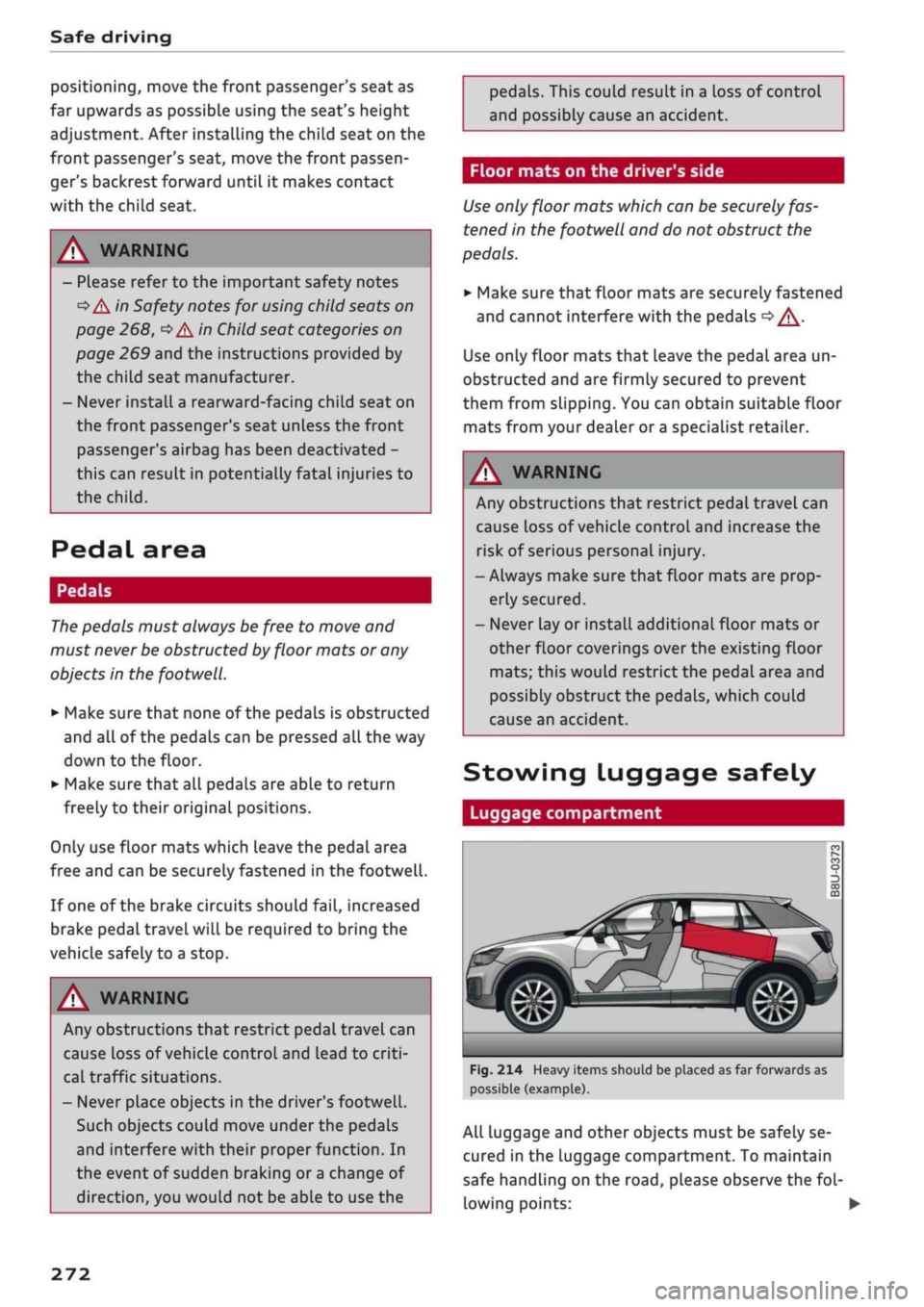
Fig.
214 Heavy items should be placed as far forwards as
possible (example).
All Luggage and other objects must be safely se
cured in the Luggage compartment. To maintain
safe handling on the
road,
please observe the
fol
lowing points: •
272
Page 277 of 364
Safe driving
•
Distribute the load evenly in the luggage com
partment.
•
Place heavy items as far forward as possible in
the luggage compartment and secure them
properly
<^>Fig.
214.
•
Secure the load with the stretch net* or with
non-elastic straps secured to the fastening
rings
^>page
62.
© CAUTION
A WARNING
- Loose items in the luggage compartment
are a safety hazard: they can move suddenly
and impair the handling of the vehicLe as a
result of the change in weight distribution.
- In an accident or a sudden manoeuvre, loose
objects in the passenger compartment can
be flung forward - risk of injury! Always
stow objects safely in the luggage compart
ment and secure them on the fastening
rings.
Use suitable securing straps, particu
larly when transporting heavy objects.
- Transporting heavy objects may affect the
vehicle's handling by shifting the centre of
gravity - this could cause an accident. Take
extra care when driving and adjust your
speed accordingly.
- Never exceed the maximum axle loads or
the maximum gross weight for the vehicLe
^>page
342. Exceeding the permitted axle
loads or gross weight Limit can affect the ve
hicle's handling characteristics, and increase
the risk of accidents, personal injuries or
damage to the vehicle.
- Never leave your vehicLe unattended when
the boot lid is open. Children could climb in
to the boot and close the boot lid from the
inside.
In this case the child would be un
able to get out of the vehicle without help.
This could have fatal consequences.
- Never allow children to play in or around the
vehicle. Always close and lock the boot lid
and all the doors when you leave the
vehi
cle.
- Never let passengers ride in the luggage
compartment. All occupants must be prop
erly restrained by the seat belts at all times
•=>
page
27'5.
Make sure that no hard objects chafe against
the wires of the heating element in the rear
window and damage them.
©
Note
- The tyre pressure must be adjusted accord
ing to the load the vehicle is carrying
<^>page
307.
- Air circulation in the vehicle helps reduce
fogging of the windows. Used air escapes
through ventilation slots in the rear of the
vehicle. Make sure that these ventilation
slots are not obstructed.
- Suitable belts for securing loads to the fas
tening rings* are commercially available.
Fastening rings
Unsecured loads are a hazard to all vehicle occu
pants.
There are fastening rings in the luggage com
partment which can be used to secure luggage
and other objects
^>page
62.
•
Use the fastening rings to secure items safely
in the luggage compartment
<=> A.
During a collision or an accident, even small and
light objects can possess so much energy that
they can cause very severe injuries. The amount
of this "kinetic energy" depends on the speed of
the vehicLe and the weight of the object. The
most significant factor, however, is the speed of
the vehicLe.
For example: an object weighing 4.5 kg is lying
unsecured in the vehicle. During a frontal
colli
sion at a speed of 50 km/h, this object generates
a force corresponding to 20 times its weight.
That means that the effective weight of the ob
ject increases to about 90 kg. You can imagine
the severity of the injuries which might be sus
tained if this "projectile" strikes an occupant as it
flies through the passenger compartment. •
00
273
Page 279 of 364
Seat belts
CO
< o rN
iv
rN
t-H
o < 00
Seat belts
Why is it so important to
use seat belts?
Seat belts provide effective protection
The common belief that passengers can brace
their weight with their hands in a minor collision
is false.
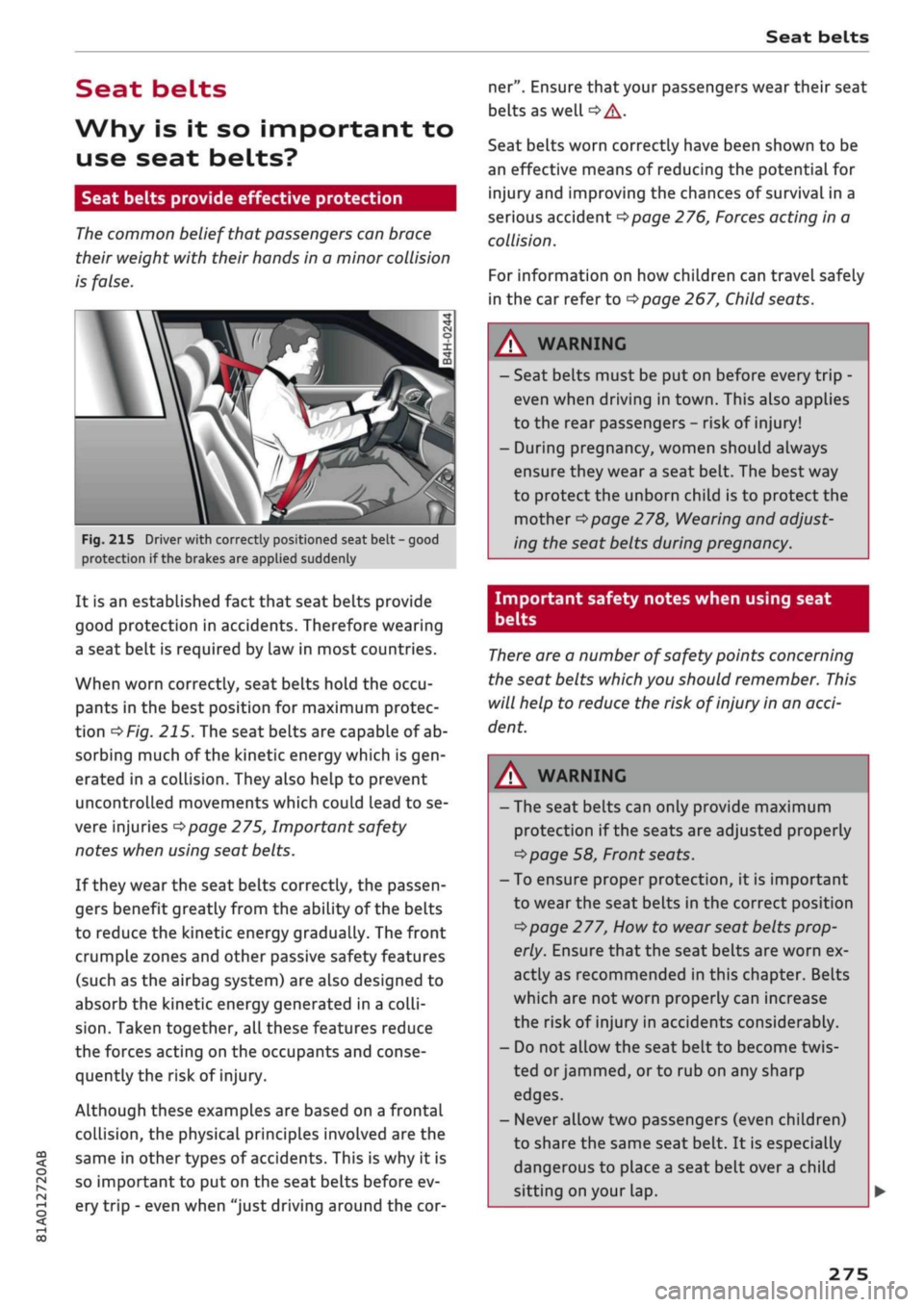
Fig.
215 Driver with correctly positioned seat belt - good
protection if the brakes are applied suddenly
It is an established fact that seat belts provide
good protection in accidents. Therefore wearing
a seat belt is required by law in most countries.
When worn correctly, seat belts hold the occu
pants in the best position for maximum protec
tion
^>Fig.
215. The seat belts are capable of ab
sorbing much of the kinetic energy which is
gen
erated in a collision. They also help to prevent
uncontrolled movements which could Lead to se
vere injuries
^>page
275, Important safety
notes when using seat belts.
If they wear the seat belts correctly, the passen
gers benefit greatly from the ability of the belts
to reduce the kinetic energy gradually. The front
crumple zones and other passive safety features
(such as the airbag system) are also designed to
absorb the kinetic energy generated in a
colli
sion.
Taken together, all these features reduce
the forces acting on the occupants and conse
quently the risk of injury.
Although these examples are based on a frontal
collision,
the physical principles involved are the
same in other types of accidents. This is why it is
so important to put on the seat belts before ev
ery trip - even when "just driving around the cor
ner". Ensure that your passengers wear their seat
belts as well
^A-
Seat belts worn correctly have been shown to be
an effective means of reducing the potential for
injury and improving the chances of survival in a
serious accident
^>page
276, Forces acting in a
collision.
For information on how children can travel safely
in the car refer to
^>page
267, Child seats.
A WARNING
- Seat belts must be put on before every trip -
even when driving in town. This also applies
to the rear passengers - risk of injury!
- During pregnancy, women should always
ensure they wear a seat belt. The best way
to protect the unborn child is to protect the
mother
^>page
278, Wearing and adjust
ing the seat belts during pregnancy.
Important safety notes when using seat
belts
There are a number of safety points concerning
the seat belts which you should remember. This
will help to reduce the risk of injury in an
acci
dent.
A WARNING
- The seat belts can only provide maximum
protection if the seats are adjusted properly
^>page
58, Front seats.
- To ensure proper protection, it is important
to wear the seat belts in the correct position
^>page
277, How to wear seat belts prop
erly.
Ensure that the seat belts are worn ex
actly as recommended in this chapter. Belts
which are
not
worn properly can increase
the risk of injury in accidents considerably.
- Do not allow the seat belt to become twis
ted or jammed, or to rub on any sharp
edges.
- Never allow two passengers (even children)
to share the same seat belt. It is especially
dangerous to place a seat belt over a child
sitting on your lap.
275
Page 280 of 364
Seat belts
- Do not wear the belt over hard or fragile ob
jects (such as glasses or pens, etc.) because
this can cause injuries.
- Loose, bulky clothing (such as an overcoat
over
a
jacket) impairs the proper fit and
function of the belts.
- The belts must be kept clean, otherwise the
retractors may not work properly
•=>
tab. Cleaning the interior on page 314.
- The slot in the seat belt buckle must not be
blocked with paper or other objects, as this
can prevent the latch plate from engaging
properly.
-The latch plate of the belt must always be
engaged in the correct buckle for that seat,
otherwise the belt will not be fully effective.
- Check the condition of the seat beLts at
reg
ular intervals. If
you
notice that the belt
webbing,
fittings, retractor mechanism or
buckle of any of the belts is damaged, the
belt must be replaced by a qualified work
shop.
- The seat belts must not be removed or
modified in any way. Do not attempt to re
pair
a
damaged belt yourself.
- Seat belts which have been worn in an
acci
dent and stretched must be replaced by a
qualified workshop. The belt anchorages
should also be checked.
Forces acting in a
collision
The physical principles involved in a frontal
impact
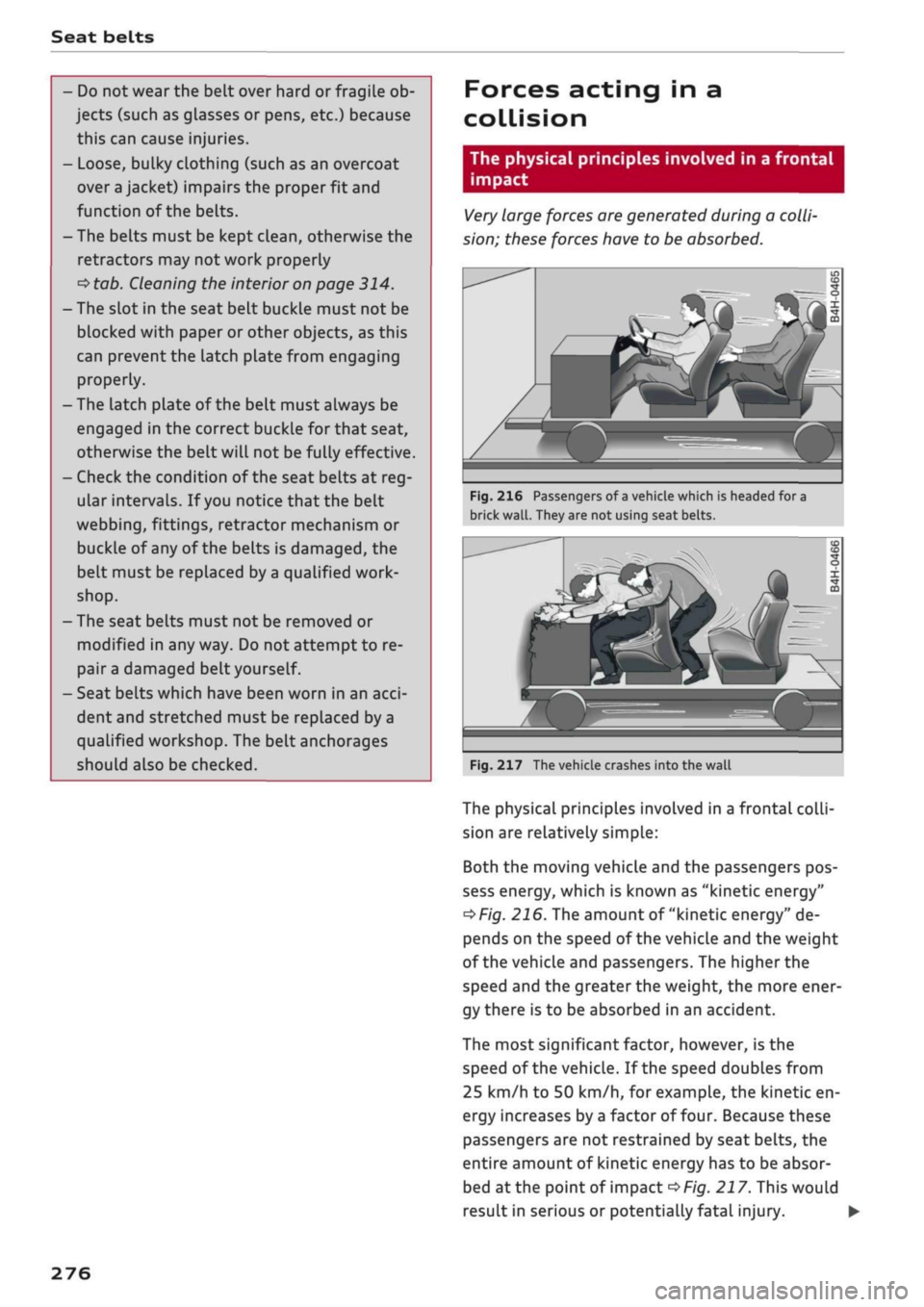
Very
large forces are generated during a
colli
sion; these forces have to be absorbed.
Fig.
216 Passengers of
a
vehicle which is headed for a
brick
wall.
They are not using seat belts.
Fig.
217 The vehicle crashes into the wall
The physical principles involved in a frontal
colli
sion are relatively simple:
Both the moving vehicle and the passengers pos
sess energy, which is known as "kinetic energy"
^>Fig.
216. The amount of "kinetic energy" de
pends on the speed of the vehicle and the weight
of the vehicle and passengers. The higher the
speed and the greater the weight, the more ener
gy there is to be absorbed in an accident.
The most significant factor, however,
is
the
speed of the vehicle. If the speed doubles from
25 km/h to 50 km/h, for example, the kinetic en
ergy increases by
a
factor of four. Because these
passengers are not restrained by seat belts, the
entire amount of kinetic energy has to be absor
bed
at
the point of impact
^>Fig.
217. This would
result in serious or potentially fatal injury.
276
Page 281 of 364
Seat belts
CO
< o rN
iv
rN
t-H
o < 00
Even
at
urban speeds
of
30 km/h to 50 km/h, the
forces acting on the occupants in a collision can
reach the equivalent
of
1 ton (1000 kg)
or
more.
At greater speed these forces are even higher.
Again:
if
the speed doubles, the forces increase
by
a
factor of four.
Passengers who do not wear seat belts are not
"attached"
to the vehicle. In a frontal collision
they will continue to move forward at the speed
their car was travelling just before the impact.
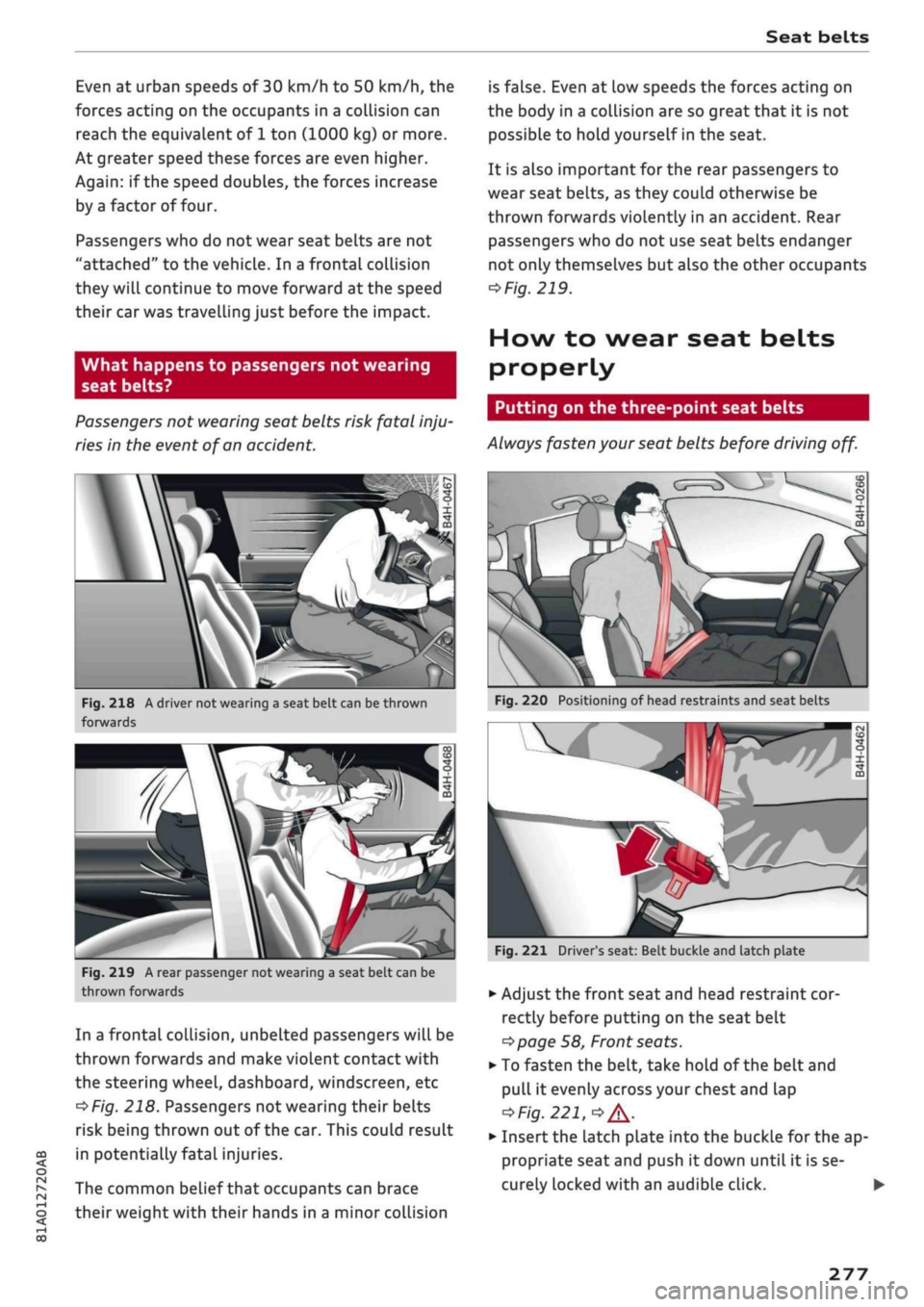
What happens to passengers not wearing
seat belts?
Passengers
not wearing seat belts risk fatal inju
ries in the event
of
an
accident.
Ï
Fig.
218 A driver not wearing
a
seat belt can be thrown
forwards
Fig.
219
A
rear passenger not wearing
a
seat belt can
be
thrown forwards
In a frontal collision, unbelted passengers will be
thrown forwards and make violent contact with
the steering wheel, dashboard, windscreen, etc
^Fig.
218. Passengers not wearing their belts
risk being thrown out of the car. This could result
in potentially fatal injuries.
The common belief that occupants can brace
their weight with their hands in a minor collision
is false. Even
at
low speeds the forces acting
on
the body in a collision are so great that
it
is not
possible to hold yourself in the seat.
It is also important for the rear passengers
to
wear seat belts, as they could otherwise be
thrown forwards violently in an accident. Rear
passengers who do not use seat belts endanger
not only themselves but also the other occupants
*>
Fig.
219.
How to wear seat belts
properly
Putting on the three-point seat belts
Always fasten your seat belts before driving
off.
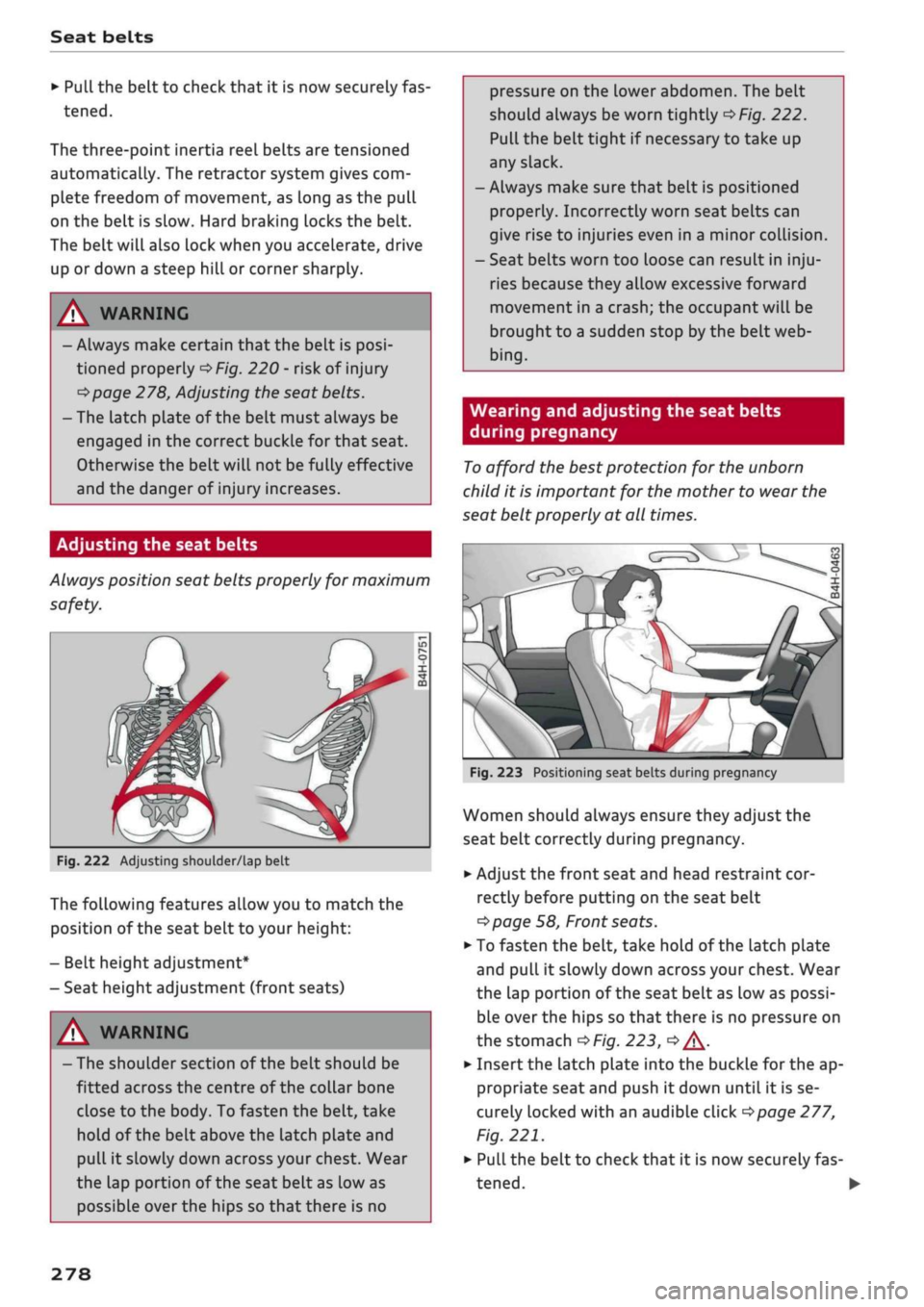
Fig.
220 Positioning
of
head restraints and seat belts
Fig.
221 Driver's seat: Belt buckle and latch plate
•
Adjust the front seat and head restraint cor
rectly before putting on the seat belt
^>page
58, Front seats.
• To fasten the belt, take hold of the belt and
pull
it
evenly across your chest and lap
<*FiQ.
221,
•»
A.
•
Insert the Latch pLate into the buckle for the ap
propriate seat and push
it
down until
it
is se
curely locked with an audible click.
277
Page 282 of 364
Seat belts
•
Pull the belt to check that it is now securely fas
tened.
The three-point inertia reel belts are tensioned
automatically. The retractor system gives com
plete freedom of movement, as long as the pull
on the belt is slow. Hard braking locks the belt.
The belt will also lock when you accelerate, drive
up or down a steep hill or corner sharply.
A WARNING
- Always make certain that the belt is
posi
tioned properly
^>Fig.
220 - risk of injury
<=$page
278, Adjusting the seat belts.
- The latch plate of the belt must always be
engaged in the correct buckle for that seat.
Otherwise the belt will not be fully effective
and the danger of injury increases.
Adjusting the seat belts
Always position seat belts properly for maximum
safety.
Fig.
222 Adjusting shoulder/lap belt
The following features allow you to match the
position of the seat belt to your height:
- Belt height adjustment*
- Seat height adjustment (front seats)
/K WARNING
- The shoulder section of the belt should be
fitted across the centre of the collar bone
close to the body. To fasten the belt, take
hold of the belt above the latch plate and
pull it slowly down across your chest. Wear
the lap portion of the seat belt as low as
possibLe over the hips so that there is no
pressure on the lower abdomen. The belt
should always be worn tightly
^>Fig.
222.
Pull the belt tight if necessary to take up
any slack.
-Always make sure that belt is positioned
properly. Incorrectly worn seat belts can
give rise to injuries even in a minor coLlision.
- Seat belts worn too loose can result in
inju
ries because they allow excessive forward
movement in a crash; the occupant will be
brought to a sudden stop by the belt web
bing.
Wearing and adjusting the seat belts
during pregnancy
To
afford the best protection for the unborn
child it is important for the mother to wear the
seat belt properly at all times.
Fig.
223 Positioning seat belts during pregnancy
Women should always ensure they adjust the
seat belt correctly during pregnancy.
•
Adjust the front seat and head restraint cor
rectly before putting on the seat belt
tapage
58, Front seats.
•
To fasten the belt, take hold of the latch plate
and pull it slowly down across your chest. Wear
the lap portion of the seat belt as low as possi
ble over the hips so that there is no pressure on
the stomach
OF/'g.
223,
<=> A-
•
Insert the latch plate into the buckle for the ap
propriate seat and push it down until it is se
curely locked with an audible click
^>page
277,
Fig.
221.
•
Pull the belt to check that it is now securely fas
tened.
•
278
Page 283 of 364
Seat belts
CO
<
O
rN
iv
rN
•-i
00
A WARNING
During pregnancy, women should especially
make sure to wear the lap portion of the seat
belt as low as possible across the hips so that
there is no pressure on the stomach.
Seat belt height adjustment
Applies to: vehicles with seat belt height adjustment
Seat belt height adjusters can be used to adjust
the height of the shoulder portion of the seat
belt.
V:
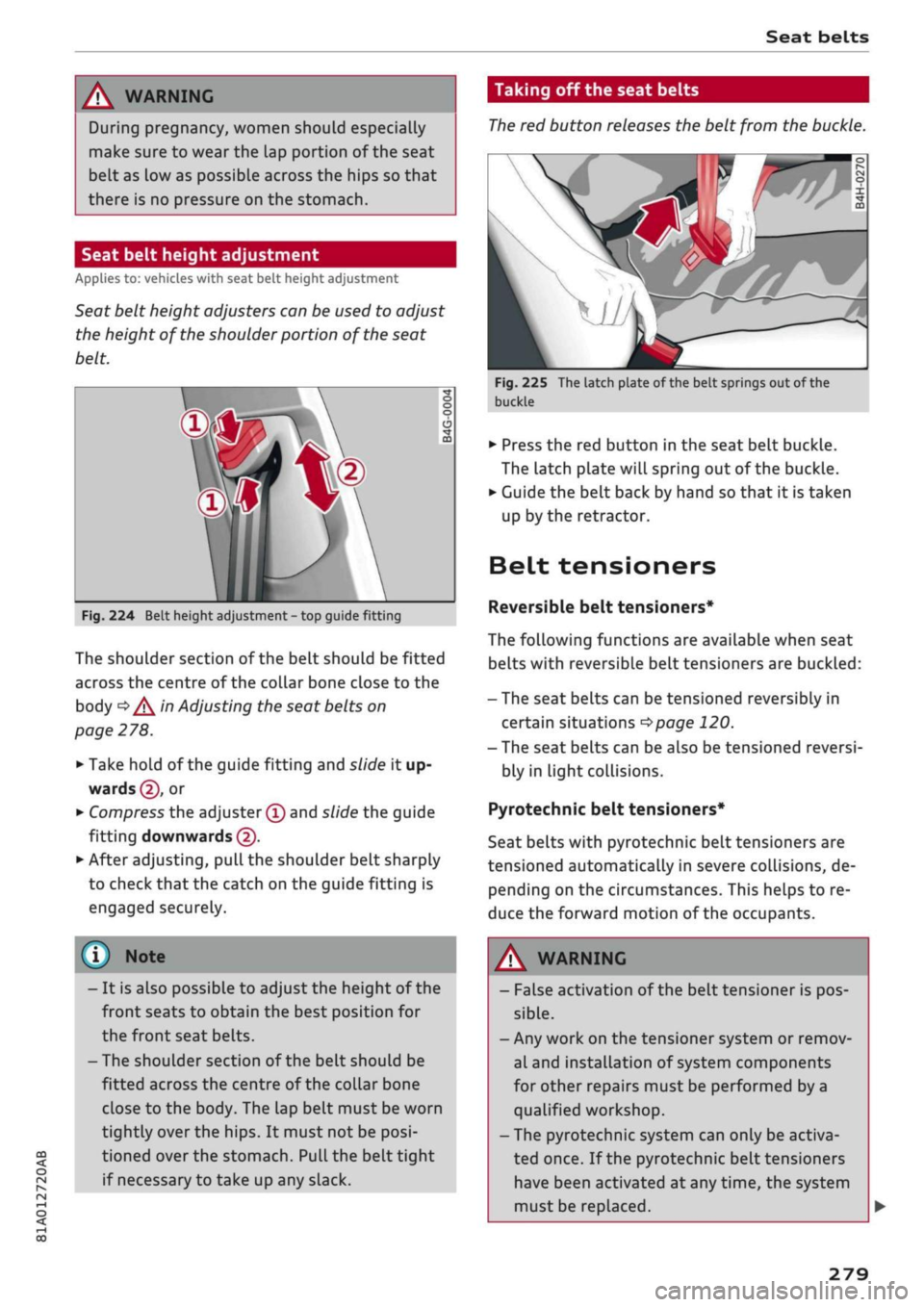
Fig.
224 Belt height adjustment - top guide fitting
The shoulder section of the belt should be fitted
across the centre of the collar bone close to the
body
^^
in Adjusting the seat belts on
page 278.
*•
Take hold of the guide fitting and slide it up
wards
@,
or
•
Compress the adjuster
(T)
and slide the guide
fitting downwards
@.
•
After adjusting, pull the shoulder belt sharply
to check that the catch on the guide fitting is
engaged securely.
(J)
Nol
- It is also possible to adjust the height of the
front seats to obtain the best position for
the front seat belts.
-The shoulder section of the belt should be
fitted across the centre of the collar bone
close to the body. The lap belt must be worn
tightly over the hips. It must not be
posi
tioned over the stomach. Pull the belt tight
if necessary to take up any slack.
Taking off the seat belts
The
red button releases the belt from the buckle.
Fig.
225 The latch plate of the belt springs out of the
buckle
•
Press the red button in the seat belt buckle.
The latch plate will spring out of the buckle.
•
Guide the belt back by hand so that it is taken
up by the retractor.
Belt tensioners
Reversible
belt tensioners*
The following functions are available when seat
belts with reversible belt tensioners are buckled:
- The seat belts can be tensioned reversibly in
certain situations
^>page
120.
- The seat belts can be also be tensioned reversi
bly in light collisions.
Pyrotechnic belt tensioners*
Seat belts with pyrotechnic belt tensioners are
tensioned automatically in severe collisions, de
pending on the circumstances. This helps to re
duce the forward motion of the occupants.
A,
WARNING
- False activation of the
belttensioner
is pos
sible.
- Any work on the tensioner system or remov
al and installation of system components
for other repairs must be performed by a
qualified workshop.
- The pyrotechnic system can only be activa
ted once. If the pyrotechnic belt tensioners
have been activated at any time, the system
must be replaced.
279
Page 285 of 364

Airbag system
Airbag system
Description of airbag
system
General notes on airbag system
The airbag is an integral part of the car's passive
safety system.
In conjunction with the three-point seat belts,
the airbag system gives the front occupants
addi
tional protection for the head and chest in the
event of a severe frontal collision.
In a severe side collision the side airbags and the
head-protection airbags reduce the risk of injury
to the occupants
•=>
A-
In addition to their normal function of protecting
the occupants in a collision, the seat belts also
hold them in a position where the airbags can in
flate properly and provide maximum protection.
The airbag system will only work with the
igni
tion on. The airbag system is monitored electron
ically; the airbag warning lamp indicates whether
the system is functioning properly.
The main parts of the airbag system are:
-The electronic monitoring system (control unit
and sensors)
- The two front airbags
- The front side airbags
-The head-protection airbags
- The indicator Lamp
Q
in the instrument cluster
There is a fault in the airbag system if the
warning lamp
- does not come on when the ignition is switched
on.
- does not go out about 4 seconds after the
igni
tion is switched on.
- goes out and then comes on again after the ig
nition is switched on.
- comes on or flickers while the car is moving.
CO
< o rN
iv
rN
t-H
o <
A WARNING
- The airbags are not a substitute for the seat
belts;
they are an integral part of the car's
overall passive safety system. The airbags
can only offer effective protection if the oc
cupants are wearing their seat belts. For
this reason it is very important to wear the
seat belts at all times
^>page
275, Why is it
so important to use seat belts?.
The seat belts and airbags can only provide
maximum protection if the occupants are
seated correctly
^>page
58, Front seats.
•
If you do not wear a seat belt, if you lean
forward,
or are not seated correctly while
the vehicle is in motion, you are at greater
risk of injury should the airbag system be
triggered in an accident.
Components of the airbag system are loca
ted in various parts of the vehicLe. If repairs
to other vehicle components make it neces
sary to perform work on the airbag system
or to remove or install parts of the airbag
system,
this may cause damage to the air-
bag system. As a result, the airbags may not
inflate correctly or may not be triggered at
all in an accident situation. For this reason,
you should always have the work carried out
by a qualified workshop.
If a fault should occur in the airbag system,
have the system checked immediately by a
qualified workshop. Otherwise the system
may fail to trigger in an accident.
Do not attempt to modify components of
the airbag system in
anyway.
Never make any alterations to the front
bumper
or
the body.
Do not remove the front seats.
The airbag system can only be activated
once;
if the airbag has been triggered, the
system must be replaced. Should the airbag
system or airbag modules have to be re
placed,
the qualified workshop carrying out
the replacement will document all details.
•
If any repair work is required
or
the airbag
and restraint systems have to be replaced,
have the work carried out by your authorised
Audi dealer or a qualified workshop which
adheres to the Audi factory standards. This
will minimise the risk of injury.
If you sell the vehicle, remember to pass on
the complete Service Wallet to the new
owner. If any of the airbags have been
281
Page 286 of 364
Airbag system
deactivated, it is important that the new
owner is also given the relevant documents.
- The relevant safety requirements must be
observed when the vehicLe or components
of the airbag or belt tensioner systems are
scrapped.
When are the airbags triggered?
One or more airbag systems are triggered in se
vere collisions, depending on the circumstances.
Factors determining the triggering response
It is not possible to define the exact triggering
response of the airbag system in all possible sit
uations, since the circumstances in different
types of accident will vary considerably. Impor
tant factors include, for example, the nature
(hard or soft) of the object which the car hits, the
angle of impact, vehicle speed and so on.
Whether the airbags are triggered depends
pri
marily on the vehicle deceleration rate resulting
from the collision. By processing the signals from
the sensors Located in the vehicLe, the electronic
control unit is immediately able to evaluate the
severity of the collision and activate the restraint
systems accordingly. If the deceleration rate is
below the predefined reference value in the
con
trol unit the airbags will not be triggered, even
though the accident may cause extensive damage
to the car. In these situations, the occupants are
protected by wearing the seat belts.
©
Note
The airbag may release a fine dust when it in
flates.
This is quite normal and does not
mean there is a fire in the vehicle.
Front airbags
Important notes on front passenger's
airbag
AIRBAG
B
1<&
W
\fiS
cm
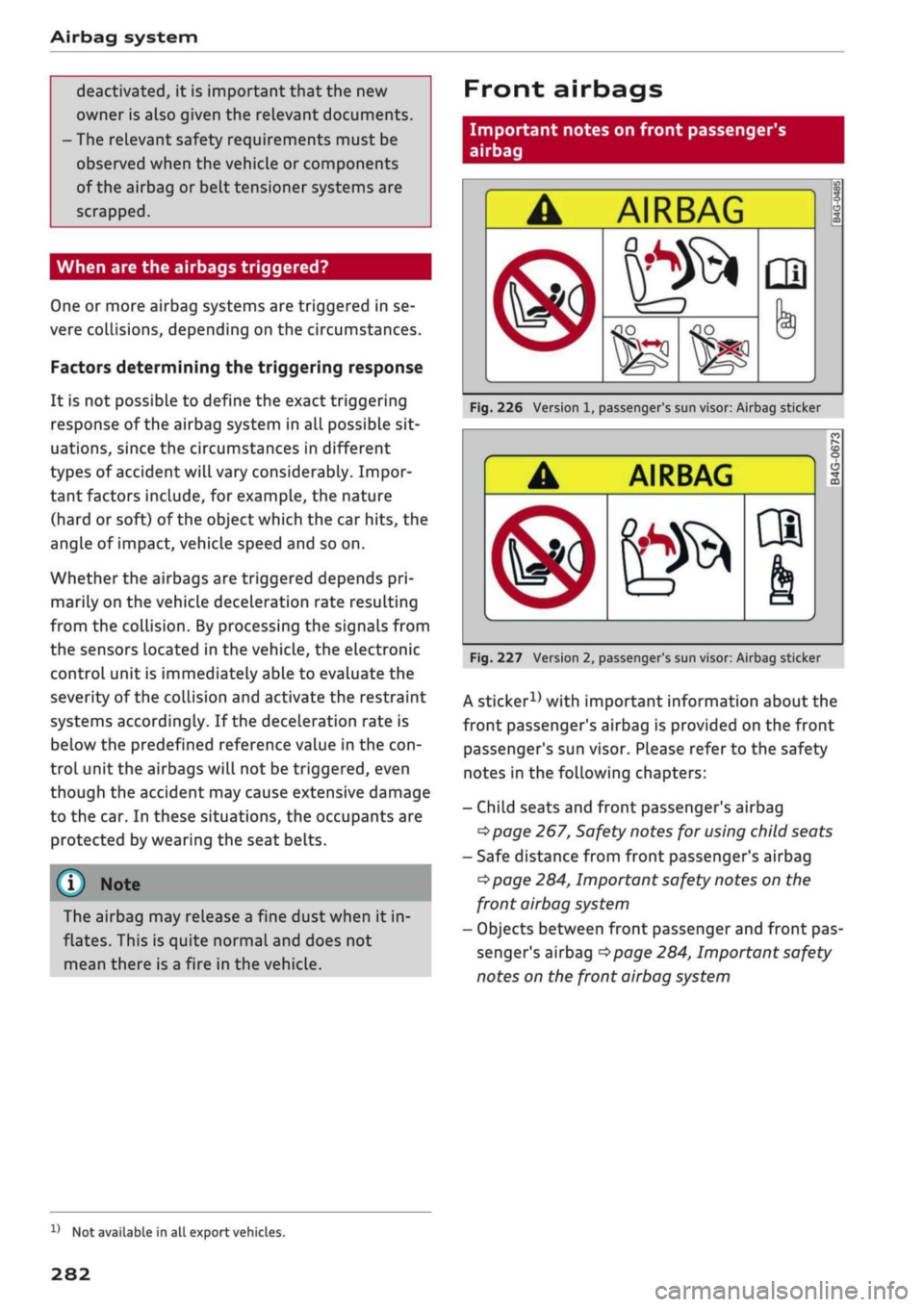
Fig.
226 Version 1, passenger's sun visor: Airbag sticker
AIRBAG
m
S
Fig.
227 Version 2, passenger's sun visor: Airbag sticker
A
sticker1)
with important information about the
front passenger's airbag is provided on the front
passenger's sun visor. Please refer to the safety
notes in the following chapters:
- Child seats and front passenger's airbag
^page
267, Safety notes for using child seats
- Safe distance from front passenger's airbag
tapage
284, Important safety notes on the
front airbag system
- Objects between front passenger and front pas
senger's airbag
•=>page
284, Important safety
notes on the front airbag system
x)
Not available in all export vehicles.
282
Page 287 of 364
Airbag system
Description of front airbags How the
front
airbags work
CO
â
rN
IV
rN
•-i
§
•H
00
The
airbag system is not a substitute for the seat
belts.
When fully inflated, the airbags reduce the risk
of head or chest
injury.
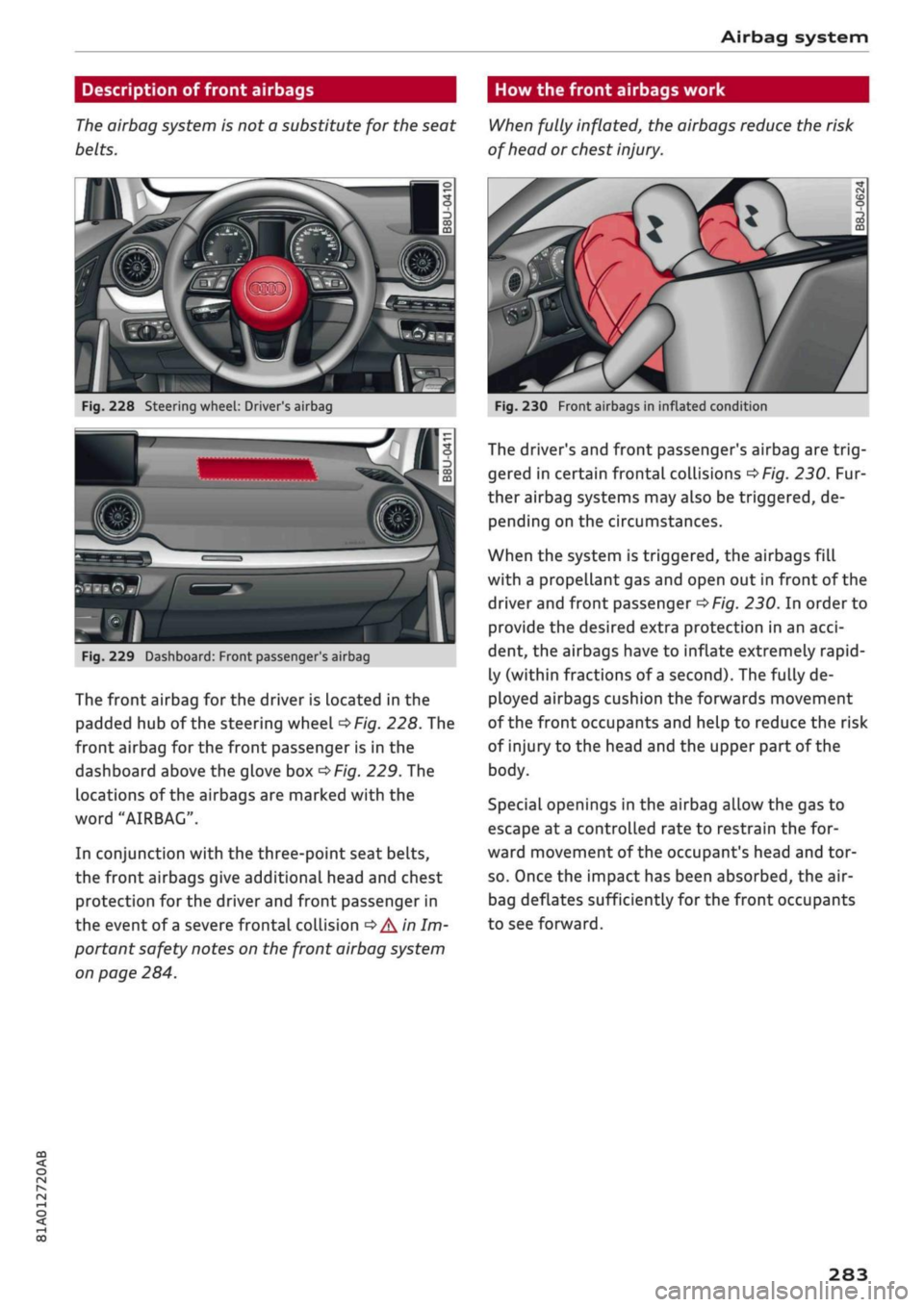
Fig.
228 Steering wheel: Driver's airbag
SiMlP
Fig.
229 Dashboard: Front passenger
s
airbag
The front airbag for the driver is Located in the
padded hub of the steering wheel
^Fig.
228. The
front airbag for the front passenger is in the
dashboard above the glove box
^Fig.
229. The
locations of the airbags are marked with the
word "AIRBAG".
In conjunction with the three-point seat belts,
the front airbags give additional head and chest
protection for the driver and front passenger in
the event of
a
severe frontal collision
•=>
A'n
Im
portant safety notes on the front airbag system
on page 284.
Fig.
230 Front airbags in inflated condition
The driver's and front passenger's airbag are
trig
gered in certain frontal collisions
^>Fig.
230. Fur
ther airbag systems may also be triggered, de
pending on the circumstances.
When the system is triggered, the airbags fill
with a propellant gas and open out in front of the
driver and front passenger
^>Fig.
230. In order to
provide the desired extra protection in an
acci
dent, the airbags have to inflate extremely rapid
ly (within fractions of
a
second). The fully de
ployed airbags cushion the forwards movement
of the front occupants and help to reduce the risk
of injury to the head and the upper part of the
body.
Special openings in the airbag allow the gas to
escape at
a
controlled rate to restrain the for
ward movement of the occupant's head and tor
so.
Once the impact has been absorbed, the air-
bag deflates sufficiently for the front occupants
to see forward.
283