engine oil AUDI Q3 2015 User Guide
[x] Cancel search | Manufacturer: AUDI, Model Year: 2015, Model line: Q3, Model: AUDI Q3 2015Pages: 258, PDF Size: 64.9 MB
Page 164 of 258

162 Driving and en vironm ent
The cata lytic converter is an efficient "clean
up" device built into the exhaust system of
the veh icle. The catalytic converter burns
many of the pollutants in the exhaust gas be
fore they are released into the atmosphere.
The exclusive use of unleaded fuel is critically
important for the life of the catalytic convert
er and proper functioning of the engine.
A WARNING
-The temperature of the exhaust system
is high, both when driv ing and after stop
ping the engine.
- Never touch the exhaust tail p ipes once
they have become hot. This could result
in burns .
- Do not park or operate the veh icle in
areas where the hot exhaust system may
come in contact with dry grass, brush,
fuel spill or other material which can
c ause a fi re.
- Do not apply additional undercoating or
rustproofing on o r near the exhaust
man ifold, exhaus t pipes, catalytic con
verte r o r heat shie lds. D uring driving, the
substance used for undercoating cou ld
overheat and cause a fire.
(D Note
- Be aware th at just one tank fi lling with
leaded fue l will already seriously de
grade the performance of the catalytic
conve rter .
- Do not exceed the correc t engine oil leve l
~page 184.
-Do not drive un til the fue l tank becomes
completely empty . The engine could mis
fire. Unburned f uel could a lso get into
the exhaust system and this could cause
the catalyt ic converter to overheat.
- Do not turn off the ignit ion while the ve
hicle is moving.
- Do not continue to operate yo ur vehicle
u nder these conditions , as otherw ise fuel
can reac h the catalytic converter. This
could result in overheat ing of the con
verter, requ iring its replacement. -
To assu re efficient operation of the Emis
sion Control System :
- Have your vehicle maintained properly and in accordance w ith the service rec
ommendat ions in your Warranty &
M ain tenance book let.
- L ack of prope r maintenance as we ll as
i mproper use of t he vehicle wi ll impair
the function of the em ission cont ro l
sys tem an d could lea d to damage.
~ For the sake of the environment
Eve n when the Emiss io n Control System is
ope rat ing proper ly, the exha ust gas c an
have a sul fur- like ex haust gas smell under
some ope rat ing states . This depends on
the sulfur content of the fuel being used. Using a different brand of fue l may help,
or f illing the tank with lead-free super
grade gasoline.
Shutting down vehicle
If you would like your vehicle to remain inop
erative for a longer per iod of time, contact an
Audi or other specialized dealer. They can ad
vise you on necessary precautions e .g . corro
s ion p revention, maintenance and sto rage .
Pay attent ion to additional info rmat io n con
ce rn in g the battery. Refe r to~
page 190.
Operate your vehicle
economically and
minimize pollution
Gene ral
Your personal style of driving will determine
the economy of your vehicle, as well as ex
haust and noise levels .
Fuel economy, e nvir onme nta l impact, and
we ar on your eng ine, b rakes and tires la rgely
depend on three fac to rs:
- your personal driving style
- operati ng conditions
- technical limitations
Page 166 of 258
164 Driving and en vironm ent
The amount of oil used is related to eng ine
load and speed.
I t is normal for the oil consumption of a new
engine to reach its lowest val ue after a certain
mileage has been driven.
You must drive your vehicle about 3 ,000 miles
(5,000 kilometers) before you can properly
assess o il cons umption .
This a lso applies to fuel consumption and en
g ine output .
0 Note
-Have your vehicle maintained properly
and in accordance with the service rec
ommendations in your War ranty
& Main
tenance booklet. Lack of proper mainte
nance as well as imp roper use of the ve
hicle will impair the function of the
emission control system and could lead
to damage.
- Do not a lter or remove any component of
the Emi ssion Contro l System unless ap
proved
by the manufacturer.
- Do not a lter or remove any device, such
as heat shields, switches, ignition wires,
va lves, which are designed to protect
your vehicle's Emiss ion Control System
and other important veh icle compo
nents .
Fewer short trips
Fuel consumption will always be relatively
high on short trips .
• Try to avo id driving sho rt distances with a
cold eng ine.
The engine and catalytic converter have to reach their optimal
ope rating tempe ratu re to
reduce fuel con sumption and noxious emis
sions effect ively.
Just after starting, a cold engine in a mid-size car on ly achieves a fuel economy of 6-8 miles
per gallon (30-40 l/100 km) . After about a
half a m ile, fuel economy climbs to 12 mpg
(20 l/100 km) . After about
2. 5 miles (4 km), the engine is at its proper operating tempera
ture and fuel economy has reached a normal
l evel. So you can see that you should avo id
short trips whenever possible.
T he
out sid e tempe rature is also critical in this
regard . Your car consumes more fue l in the
winter than in the s ummer.
Driving offroad
General information
When driving off road, the functions fo r the
electron ic stabiliza tion control ( ESC) are ex
panded . The ESC-Offroad-Mode can be activat
ed in driving situations in which a wheel lock
or a differential lock function is needed
c> page 155.
Your Audi i s howev er, n ot an offroad vehicle.
Ne ver dri ve the vehicle in te rrain wh ich i s n ot
suitable for the vehicle , o r w hich ex ceeds
y ou r driv ing skill s. Ne ver tak e an y u nneces
s ar y risk s!
Aft er d riving offroad
-After driving offroad, remove branches and
other debris from the radiator gri lle, under
body, and wheels. Look especially for objects
(stones) that have been caught in the tire
tread.
- Clean the body and the vehicle underbody
and inspect the vehicle for possible damag
es.
- Clean off the dirty windows, headlights, tail
lights and the license plate .
- Pe rform a brake test (especially after driving
through water).
A WARNING
- Be especially aware and attent ive when
driving under difficult condit ions . Dam
ages to the vehicle and injur ies may oc
cur when driv ing at an excessively high
speed or with incor rect driving maneu
vers.
- Always adjust you r speed and hand ling
to the roads, terrain, t raff ic and weather
~
Page 182 of 258
180 Checking and filling
coolant can be seen or heard before
carefully opening the hood.
- Keep children away from the engine com
partment.
- Never spill fluids on hot engine compo
nents. They can cause a fire.
- Never touch the radiator fan. The auxili ary electric fan is temperature controlled
and can switch on suddenly.
- Never open the coolant reservoir cap
when the engine is still warm. The cool
ant system is pressurized and hot cool
ant could spray out .
- Protect your face, hands and arm from
steam or hot engine coolant by placing a
thick rag over the cap when you open the
coolant reservoir .
- Do not remove the engine cover under
any circumstances. This increases the
risk of burns.
- If work on the fuel system or the electri
cal system is necessary:
- Always disconnect the battery .
- Never smoke or work near heaters or
open flames. Fluids in the engine com
partment could start a fire.
- Keep an approved fire extinguisher im
mediately available.
- To avoid electrical shock and personal in
jury while the engine is running or being
started, never touch:
- Ignition cables
- Other components of the high voltage
electronic ignition system.
- If you must perform a check or repair
with the engine running:
- First, fully apply the parking brake,
move selector lever of automatic trans
mission to "P" (Park) .
-Always use extreme caution to prevent
clothing, jewelry, or long hair from get- ting caught in the
radiator fan, V-belts
or other moving parts, or from contact
ing hot parts. Tie back hair before
starting, and do not wear clothing that
will hang or droop into the engine .
- Minimize exposure to emission and
chemical hazards
c> A .
A WARNING
-California Proposition 65 Warning:
- Engine exhaust, some of its constituents,
and certain vehicle components contain
or emit chemicals known to the State of
California to cause cancer and birth de
fects and reproductive harm. In addition,
certain fluids contained in vehicles and
certain products of component wear con
tain or emit chemicals known to the
State of California to cause cancer and
birth defects or other reproductive harm.
- Battery posts, terminals and related ac
cessories contain lead and lead com
pounds, chemicals known to the State of
California to cause cancer and reproduc
tive harms. Wash hands after handling.
(D Note
When adding fluids, always make sure that
they are poured into the proper container
or filler opening, otherwise serious dam
age to vehicle systems will occur.
@ For the sake of the environment
To detect leaks in time, inspect the vehicle
floor pan from underneath regularly. If
you see spots from oil or other vehicle flu
ids, have your vehicle inspected by an au
thorized Audi dealer.
Page 183 of 258
M N M N
0 ::i co
rl I.O
"' rl
"' rl
Checking and fillin g 181
Engine compartment
Engine compartment
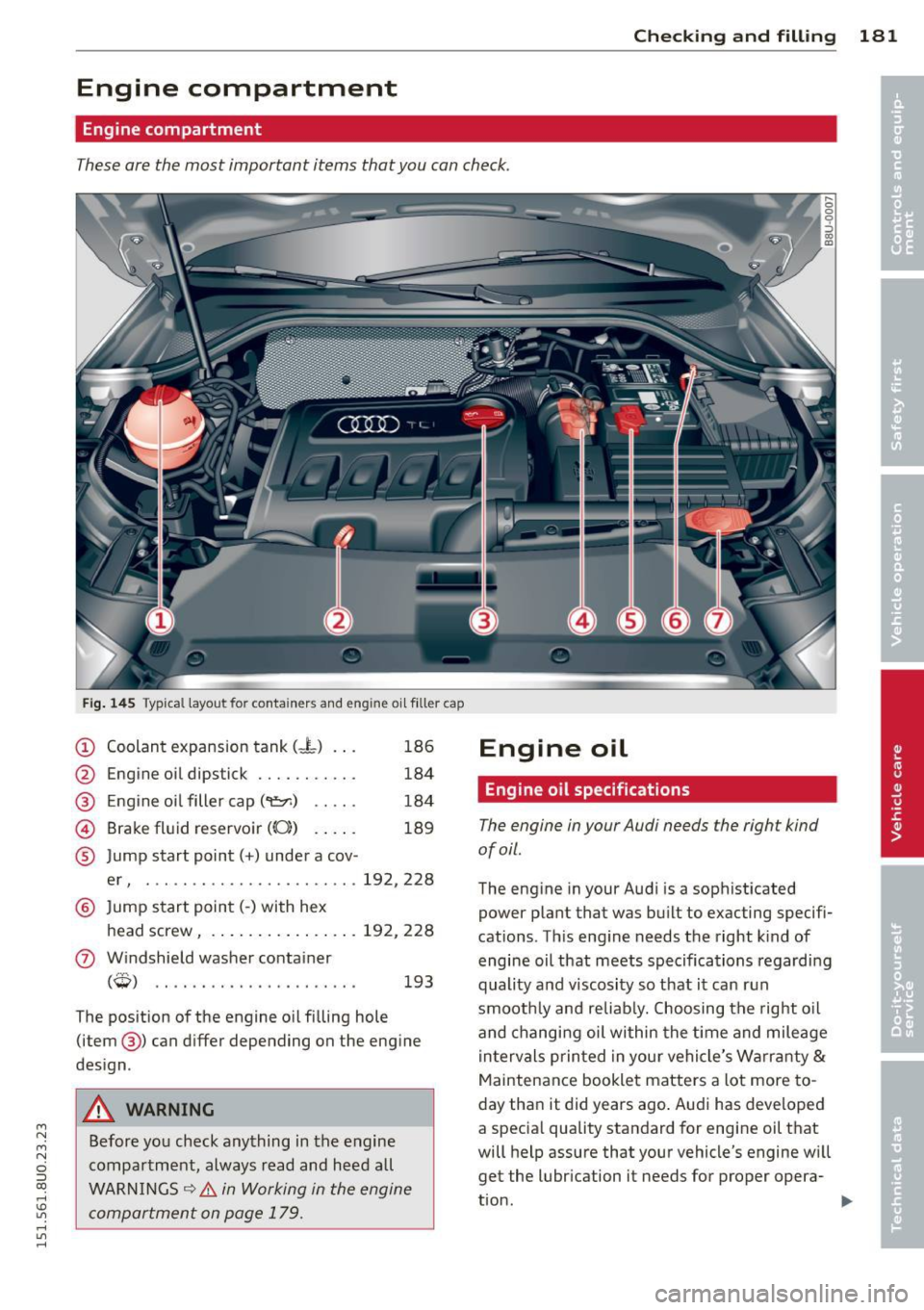
These are the most important items that you can check.
Fig. 14 5 Typical layout for containers and engine oil filler cap
(D Coolant expansion tank (- L) . . . 186
@ Engine oil dipstick . . . . . . . . . . . 184
@ Eng ine oi l filler cap ('t::r.) . . . . . 184
@ Brake fl uid reservoir (0)) . . . . . 189
® Jump start point(+) under a cov-
er, ....................... 192, 228
@ Jump start point(-) with hex
head screw, . .. ..... ... .. .. . 192, 228
(J) Windshield washer conta iner
Cw) . . . . . . . . . . . . . . . . . . . . . . 193
The position of the engine o il filling hole
(item @) can differ depending on the engine
des ign .
A WARNING
Before yo u check anything in the engine
compartment, always read and heed all
WARN INGS
~ .& in Working in the engine
compartment on page 179.
-
Engine oil
Engine oil specifications
The engine in your Audi needs the right kind
of oil.
The eng ine in your Audi is a sophisticated
power p lant that was bu ilt to exacting specifi
cations. This eng ine needs the right k ind of
engine oil that meets specifications regarding
quality and viscosity so that it can run
smooth ly and reliab ly. Choosing the rig ht o il
and changi ng oil within the t ime and mileage
in tervals printed in you r vehicle's Warranty
&
Maintenance booklet matters a lot more to
day than it did years ago . Audi has developed
a specia l quality standard for engine oil that
will help assure that your vehicle's engine w ill
get the lubr ication it needs for proper opera-
tion. .,..
Page 184 of 258
182 Checking and filling
Mo dern engine lubrication has taken a quan
tum leap in the last few years. Many synthetic
oils ava ilable today provide better engine lu
brication that can outlast traditional petrole
um-based o ils, making them a smart choice
for use throughout the life of your Audi .
Whether you use synthetic or petroleum
based engine oil, the oil that yo u use must
conform to Audi 's oil quality standard
VW 502 00 to he lp keep your vehicle's engine
running smoothly and help prevent the for
mat ion of harmfu l deposits, sometimes called
"sludge ", that ove r time can lead to expensive
r epairs .
At the time of pr int ing , engine o ils available in
the U .S . and Canada that meet the exacting
specifi cations of A udi oi l standard VW 502 00
a re synthetic engine oils. This does not mean,
however, that every syn thetic engine oi l wi ll
meet A udi oil standard VW 502 00. So always
be sure that you use an approved oil.
To help prevent the format ion of harmful de
posi ts use only oi l with the fo llow ing spec ifi
cations printed on the oil container :
Audi oil standard VW 502 00
O il container labe ls may carry the specif ica
tion s ingly or in comb inat ion with other des ig
nations and oil qua lity standards .
Viscosity
Engine oi ls are graded according to their vis
cosity. The proper v iscosity grade oil for your
engine depends on cl imactic or seasonal con
d itions where you drive. You can use oil with a
viscosity grade of SA E SW40 across all tem
pe ratu re ranges for normal driving conditions .
However, if eng ine o il viscos ity grade SA E
SW40 is not avai lab le, you ca n also use viscos
ity grade SAE SW -30 or SAE OW-40 as long as
it meets Audi o il quality sta ndard VW 502 00
specif ications .
Because engine oil that meets the Audi oil
standard may not be available everywhere
when you need it, we strongly recommend
that you always carry with you an ext ra quart (
li te r) of oil that exp ress ly con forms to the
VW 502 00 spec ification, in case you have to
top
off the oil while on the road.
Only if the level of the o il is a t or be low the
min imum mark -and no oi l that expressly
conforms to Audi oil standard VW 502 00
specificat ions is available - may you top
off
with a high quality engine o il, preferab ly syn
thet ic-based, tha t mee ts ACEA A3 or API SM
specifications, but even then , only in v iscosity
grades SAE SW-40 , SA E SW-30, o r SA E
OW-40. However, dur ing the entire time be
tween oil change inte rva ls , never top
off with
more than a to ta l of 0.5 q t/ liter engine o il
t h at does not con form to Audi oi l specifica tion
vw 502 00.
For more informa tion about eng ine oi l tha t
has been approved for your veh icle, ple ase
contac t either yo ur authorized Aud i deale r or
Audi C ustome r Re lations at 1 (800) 82 2-2834
or visit o ur web site at www .audiusa.com or
www.aud icanada .ca. Here you w ill also find a
current list of oils (manufacturers, brand
names e tc.) tha t conform to Audi oil s tanda rd
vw 502 00 .
Changing the engine oil
The eng ine oi l and oil fi lter m ust be changed
according to the mileage (kilometers) and
time intervals specified in your ve hicle's War
ranty
& Maintenance booklet. Do not exceed
these intervals -harmful deposits from old
engine oil ca n reduce eng ine performance and
can lead to expensive eng ine repa irs .
Changi ng the oil at the recommended inter
vals is so very important because the lubricat ing proper ties of oil decrease gradually d uring
norma l veh icle use . If you are not sure when
you have your oil changed, ask your author ized Audi Serv ice Adv isor.
Under some circumstances the engine oil
shou ld even be cha nged more frequent ly .
Change oil more often if you drive most ly
sho rt distances, operate the ve hicle in dusty
areas o r most ly unde r stop-and-go t raff ic con-
di tions, o r when you use your vehi cle where .,..
Page 185 of 258
M N
M N
0 ::i co ,...., \!) ..,.,
,...., ..,., ,....,
temperatures stay below freezing point for l ong periods.
Detergent add itives in the o il w il l make fresh
oil look dark after the eng ine has been run
ning fo r a short time . This is norma l and is not
a reason to change the oi l more often than
recommended.
D am ag e or m alfun ction s due to lack of
ma intenanc e
It is essential that you change your oil at the
r ecommended inte rva ls using only engine o il
t hat complies wi th A udi oi l standard
VW 502 00 . Your Limited New Vehicle War
ranty does not cover damage or malfunctions
d ue to fa ilure to fo llow recommended mainte
nance and use requ irements as set forth in
the Audi Owner's Manua l and Warranty
&
Maintenance book let . Your dea ler will have to
deny warranty coverage u nless you present to
the dea ler p roof in the fo rm of Serv ice or Re
pa ir Orde rs that all s chedu led maintenance
wa s pe rformed in a t imely manner .
Engine oil consumption
The engine in your vehicle dep ends on an ade
quate amount of oil to lubricate and cool all
of its moving parts.
In o rder to provide effective lubrication and
cool ing of i nternal engine components, a ll in
ternal comb ustion eng ines consume a cert ain
amo unt of o il. Oil cons umption varies from
engine to engine and may change significantly
over the life of the engine. Typ ica lly, engines
with a specified break-in per iod (see
c::;, page 161) consume more oil during the
break-in per iod than they consume after oil
consumption has stabilized.
Under norma l conditions, the rate of oil con
sumpt ion depends on the quality and viscosity
of the oil, the RPM (revo lutions per m inute) at
which the engine is operated, the amb ient
temperature and road condit ions. Furthe r fac
tors ar e the amount of o il d ilution from wate r
condensation or fuel residue and the ox ida
tion level of the oi l. As any engine is s ubje ct to
Checkin g and fillin g 183
wear as m ileage builds up, the oil consump
tion may increase over time until replacement
of worn components may become necessary.
Wi th a ll these variab les coming into p lay, no
standard rate of oil consumpt ion can be es
tablished or specified. There is no alternative
to regular and frequent check ing of the o il lev
el, see
Note .
If the yellow engine oil leve l warning symbo l
E\I in the instrument cl uster lights up, you
sho uld check the oil leve l as soon as possib le
c::;, page 184. Top off the oil at your earliest
convenience
c::;, page 184.
A WARNING
Before you c heck anythi ng i n the engine
com partment, always read a nd heed all
WARNINGS
c::;, .&. in Working in th e engine
c ompartment on page 179.
(D Note
D riving w ith an insufficient o il level is like
ly to cause sever e damage to the engine .
(D Tips
- The oil pressure warning display. is
not an indicator of the oil le vel. Do not
re ly on it. In stead, check the oil level in
your engine at regular intervals, pref erably ea ch time you refuel, and alway s
before going on a long trip .
-If you have the impression you r engi ne
c ons umes ex ce ss ive amoun ts of o il, we
recommend that you consu lt an author
ized Aud i dea ler to have the cause of
your concern properly d iagnosed. Keep in
m ind that the accurate measu rement of
oil consumption requ ires great care and
may take some t ime. An authorized Aud i
dealer has instructions about how to
measu re oil consumption accurately.
-
•
•
Page 186 of 258
184 Checking and filling
Checking the engine oil level
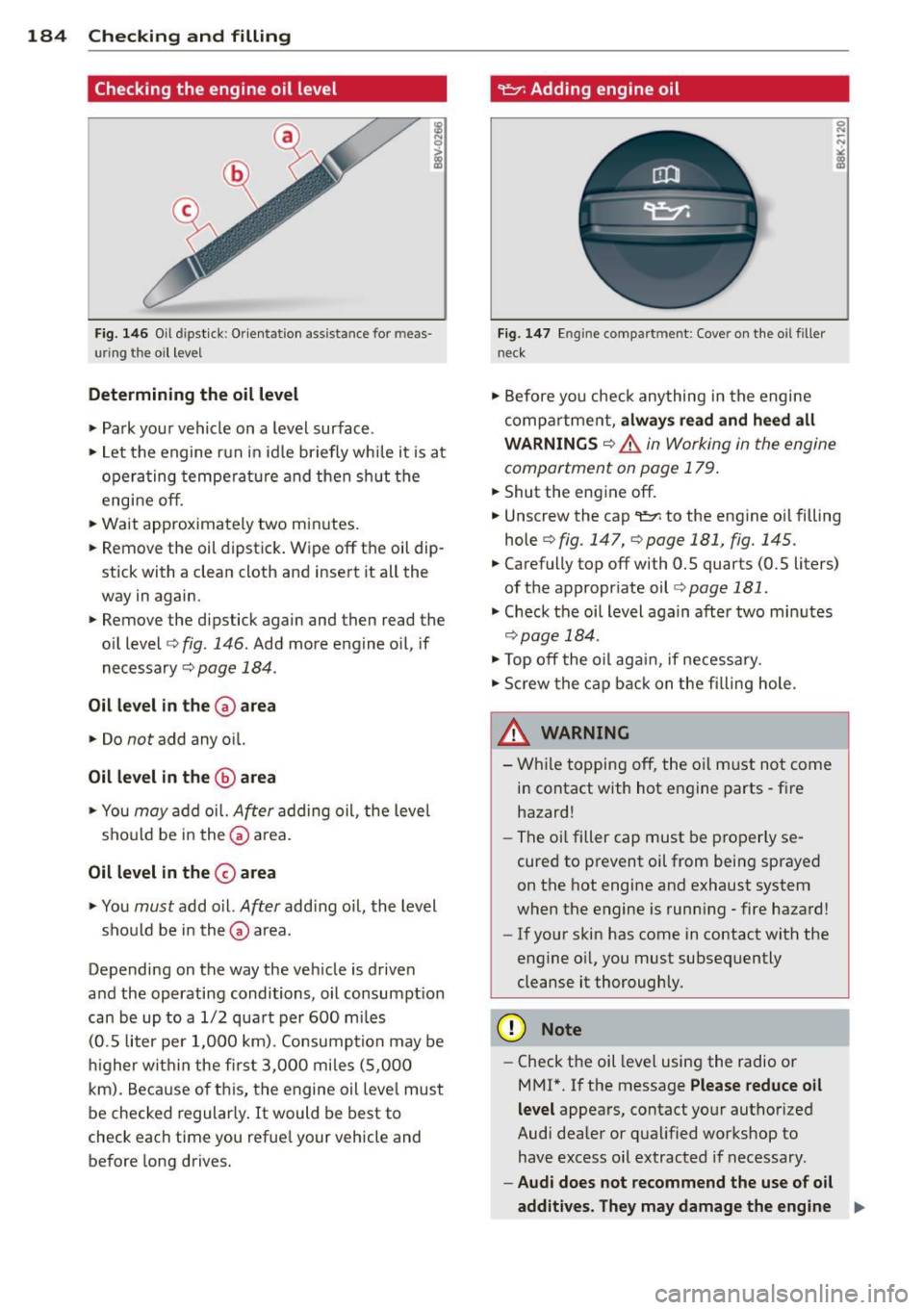
Fig. 1 46 Oil d ipst ick : Or ientat ion ass ista nce for meas
u ri ng the oil level
Determining the oil level
.,. Park your vehicle on a level surface .
.,. Let the engine run in id le briefly while it is at
opera ting tempe ratu re and then sh ut the
engine off.
.,. Wait approximately two minutes .
.,. Remove the oil dipst ick. Wipe off the oil dip
stick with a clean cloth and insert it all the
way in again .
.,. Remove the dipstick again and then read the
oil level
c> fig. 146. Add more engine o il, if
necessary ~
page 184.
Oil level in th e (v are a
.,. Do not add any o il.
Oil level in the @area
.,. You may add oil. After adding oil, the level
sho uld be in the~ area .
Oil level in the 0 a rea
.,. You must add o il. After add ing o il, the level
should be in the~ area.
Depending on the way the vehicle is driven
and the operating conditions, oil consumpt ion
can be up to a 1/2 qua rt per 600 mi les
(0 .5 liter pe r 1,000 km) . Consumption may be
hi gher wit hin the fi rst 3,000 mi les (5,000
km) . Because of this, the engine oil leve l must
be checked regular ly. It would be best to
check each time you refue l your vehicle and
before long drives.
~ Adding engine oil
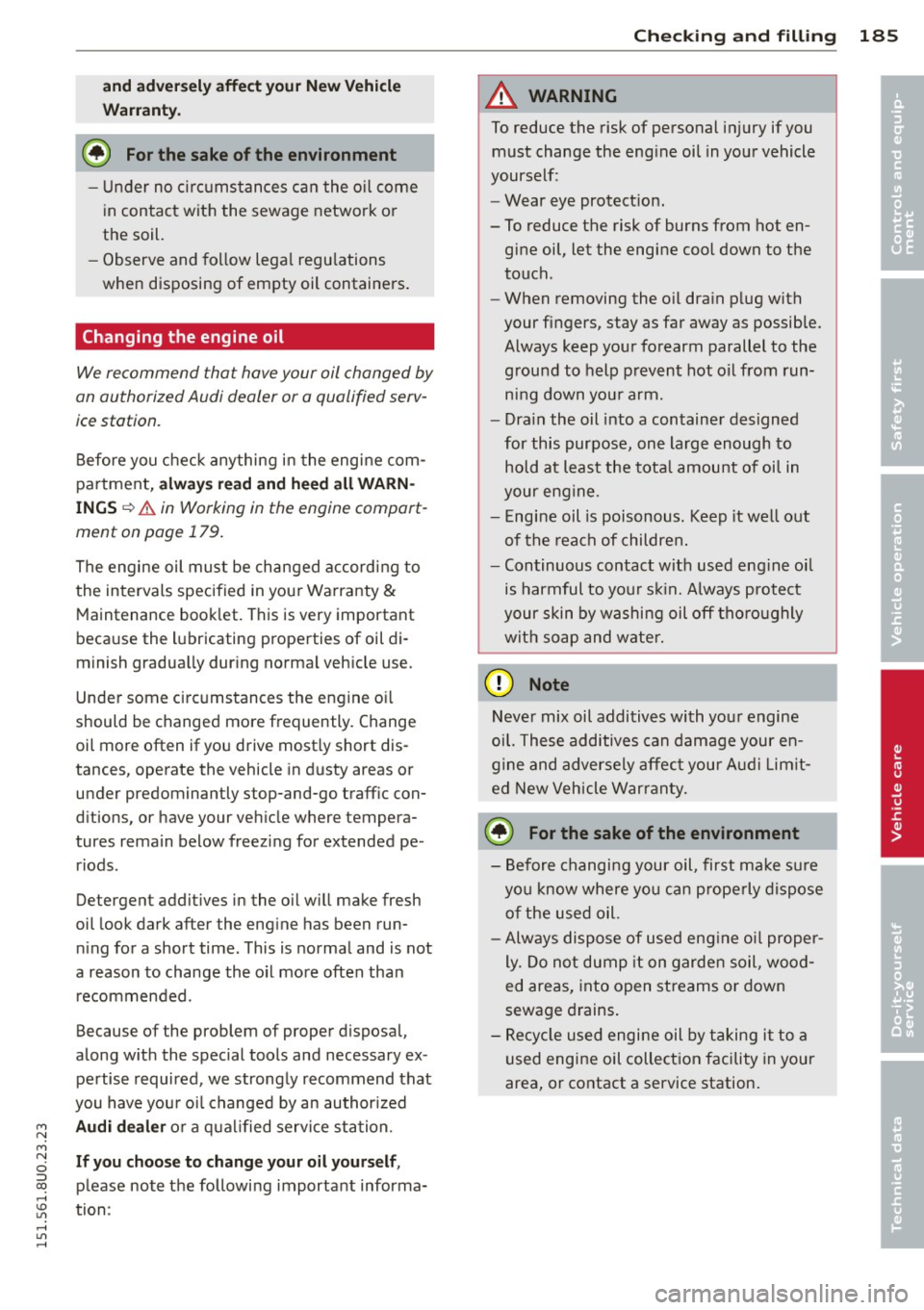
F ig. 147 En g in e compart ment: Cover on the o il filler
n eck
.,. Before yo u check anything in the engine
compa rtme nt,
alwa ys read and h eed all
WARNINGS ~ A in Working in the engine
compartment on page 179 .
.,. Shut the engine off.
.,. Unscrew the cap
't!::?: to the engine oi l filling
hole
c> fig . 147, c> page 181, fig. 145 .
.,. Carefully top off with 0.5 quarts (0.5 liters)
of the appropr iate oil
c> page 181 .
.,. Check the oi l level again after two mi nutes
c> page 184 .
.,. Top off the oil aga in, if necessary .
.,. Screw the cap back on the filling hole .
A WARNING
-Wh ile topping off, the oil m ust not come
in contact with hot engine parts -fire
hazard!
- The oi l filler cap must be properly se
cured to prevent oil from being sprayed
on the hot engine and exhaust system
when the engine is runn ing - fire hazard!
- If your skin has come in contact with the
engine o il, you must subsequently
cleanse it thoroughly.
(D Note
- Check the oil level using the radio o r
MMI*. I f the message
Please redu ce oil
level
appea rs, contact your authorized
Aud i dealer or qualified workshop to
have excess oil extracted if necessary .
-Audi does not recommend the use of o il
additives. They m ay damage the engine ..,.
Page 187 of 258
and adve rsely affect you r New Vehicle
Wa rrant y.
@) For the sake of the environment
-Un der no ci rc u mstances can the o il come
in contact with the sewage network or
the soil.
- Observe and follow lega l regu lations
when disposing of empty oil containers .
Changing the engine oil
We recommend that have your oil changed by
an authorized Audi dealer or a qualified serv
ice station.
Before you check anything in the engine com
par tment,
a lways rea d and he ed all WARN
INGS ~&. in Working in the engine compart
ment on page 179.
The engine oil must be changed according to
the intervals specified in your Warranty
&
Maintenance book let. This is very important
because the lubricating properties of oil di
minish gradua lly during normal vehicle use.
Under some circumstances the engine oi l
should be changed more frequently. Change
oil more often if you drive most ly short dis
tances, operate the vehicle in dusty areas or under predominantly stop-and-go traff ic con
d itions, or have your veh icle where tempera
tures remain below freezing for extended pe
riods.
Detergent additives in the o il w ill make fresh
oil look dark after the engine has been run n ing for a short time. This is normal and is not
a reason to change the oil more often than recommended.
Because of the problem of proper disposa l,
along w ith the special tools and necessary ex
pertise required, we strongly recommend that
you have you r oi l changed by an authorized
~ Au di de ale r o r a qual ified servi ce station.
M N
0 ::i co ,...., \!) 1.1'1 ,...., 1.1'1 ,....,
If you choo se t o c ha ng e y our o il your self ,
please note the followi ng important informa
tion :
Checkin g and fillin g 185
A WARNING
To reduce the risk of personal injury if you
must change the eng ine oil in your vehicle
yourself:
- Wear eye protect ion.
- To reduce the risk of burns from hot en- gine oil, let the engine cool down to the
touch.
- When removing the o il dra in p lug with
your fingers, stay as far away as possible. Always keep your forearm parallel to the
ground to help p revent hot oil from run
ning down you r arm.
- Dra in the oil into a container designed
for this purpose, one la rge enough to
hold at least the tota l amount of oi l in
your eng ine .
- Engine oil is poisonous. Keep it well out
of the reach of children.
- Continuous contact wit h used eng ine o il
is harmful to your s kin. A lways protect
your skin by washing oil off tho ro ughly
with soap and water.
@ Note
Neve r mix oil additives with your engine
oil. These additives can damage your en
g ine and adversely affec t you r Au di L imit
ed New Vehicle Warranty.
@ For the sake of the environment
- Before changing your oil, first make su re
you know where you c an properly dispose
o f the used oil.
- Always dispose of used eng ine oi l proper
ly. Do not dump it on garden soil, wood
ed areas, into open streams or down
sewage drains .
- Recycle used engine oil by taking it to a
used engine oil collect ion facility in your
area, or contact a service station.
•
•
Page 188 of 258
186 Checking and filling
Engine cooling system
Coolant
The engine coolant performs two functions: it
keeps the engine from overheating and it pro
tects the engine from freezing in the winter .
The cooling system is sealed and generally re
qu ires little attention .
The cooling system has been filled at the fac
tory with a permanent coo lant which does not
need to be changed. The coolant consists of a
mixture of spec ially conditioned water and the
manufacturer's glycol-basedcoolant addi-
tive G13 antifreeze with ant icorros ion addi
tives (50% for USA models; 60% for Ca nada
models) . This mixture both assures the neces
sary frost protection and protects metal com
ponents in the engine's cooling system from
corrosion and scaling.
It a lso raises the boil
ing point of the coo lant.
Do not reduce the concentration o f the coo l
ant in the summer by adding plain water .
The
proportion of coolant additive must be at
least 50% but not more than 60%
to main
tain antifree ze protection and cooling efficien
cy. If the coolant frost protect ion is too low,
the coolant could freeze and damage the veh i
cle heating and engine cooling system .
For year-round driving, antifree ze is added at
the factory for temperatures down to:
- -31°F(-35°C)USA
- - 40 °F ( -40 °C) Canada.
I f you must add coo lant, use a mixture of wa
ter and coolant addit ive. Mixing the coolant
additive with distilled water is recommended.
_& WARNING
Before yo u check anything in the engine
compartment, always read and heed all
WARNINGS
~ &. in Working in the engine
compartment on page 179.
(D Note
- Before winter sets in, have the coolant
checked to see if the coolant additive in
-
your vehicle is sufficient to meet the cli mate conditions . This is especia lly impor
tant if you live in a reg ion where the win
ter is extreme ly cold. If necessary, in
crease the proportion of coolant add itive
to 60% .
- When adding coolant additive to your
cooling system, remember:
- We recommend using only coolant ad
ditive G12++ or G13 for your vehicle.
This coolant additive is available at au
thorized Audi dealers. Other types of
antifreeze can significantly reduce cor rosion protection. The resulting corro
sion can cause a loss of coolant and se
rious engine damage .
- Do not add any type of rad iator leak seal
ant to your vehicle's engine coolant.
Adding radiator repair flu id may adverse
ly affect the function and performance of
your cooling system and could result in
damage not covered by your New Vehicle
Limited Warranty.
Checking the engine coolant level
The engine coolant level can be checked with
a quick glance.
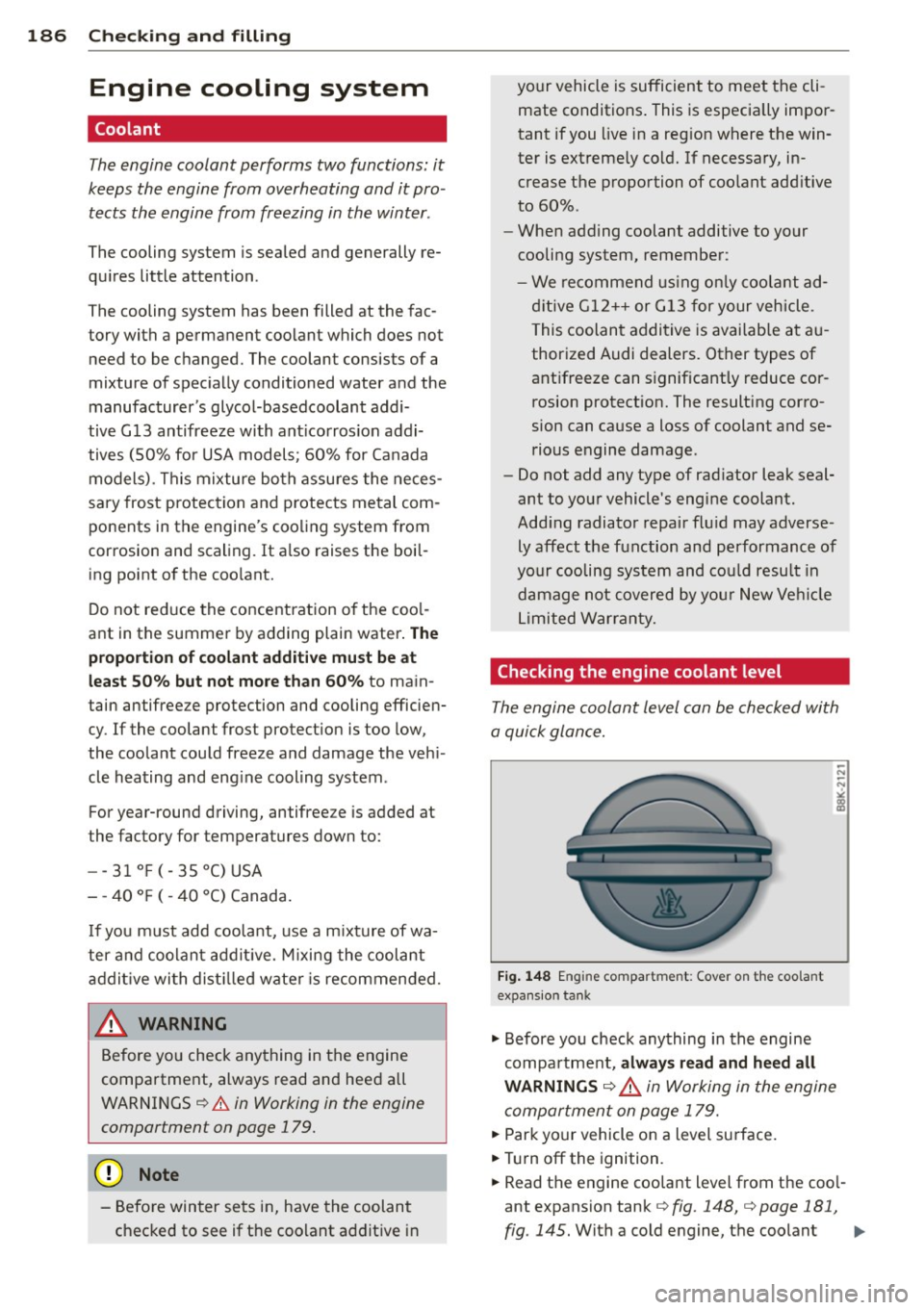
Fig. 148 E n gin e compart men t: Cover on the coo la n t
expans io n tank
.,. Before you check anything in the engine
compa rtment,
always read and heed all
WARNINGS ~ ,& in Working in the engine
compartment on page 179.
.,. Park your vehicle on a level surface .
.,. Tur n off the ignition.
.,. Read the engine coolant level from the coo l
ant expansion tank
c:> fig . 148, c:> page 181,
fig. 145.
With a cold engine, the coolant Iii>-
Page 189 of 258
M N
M N
0 ::i co ,...., \!) ..,.,
,...., ..,., ,....,
level should be between the "MIN" and
"MAX" markings. When the engine is warm,
the level may be slightly above the "MAX"
marking .
The location of the coolant expansion tank
can be seen in the engine compartment illus
tration
<=> page 181.
To obtain an accurate reading , the engine
must be switched
off.
The expansion tank in your vehicle is equipped
with an electric coolant level sensor.
When the coolant level is too low, the warning
light in the Auto-Check System <=>
page 14 will
blink until you add coolant and the level has
been restored to normal. Even though there is
an electric coolant level sensor, we still rec
ommend you check the coolant level from
time to time.
Coolant loss
Coolant loss may indicate a leak in the cooling
system. In the event of coolant loss, the cool
ing system should be inspected immediately
by your authorized Audi dealer.
It is not
enough merely to add coolant.
In a
sealed system, losses can occur only if
the boiling point of the coolant is exceeded as
a result of overheating.
A WARNING
The cooling system is under pressure and
can get very hot. Reduce the risk of scald
ing from hot coolant by following these
steps.
- Turn
off the engine and allow it to cool
down.
- Protect your face, hands and arms from escaping fluid and steam by covering the
cap with a large, thick rag .
- Turn the cap slowly and very carefully in
a counter-clockwise direction while ap
plying light, downward pressure on the
top of the cap .
- To avoid being burned, do not spill anti
freeze or coolant on the exhaust system
Checking and filling 187
or hot engine parts. Under certain condi
tions, the ethylene glycol in engine cool
ant can catch fire.
([) Note
Do not add any type of radiator leak seal
ant to your vehicle's engine coolant. Add- ing radiator repair fluid may adversely af
fect the function and performance of your
cooling system and could result in damage
not covered by your New Vehicle limited
Warranty .
Adding coolant
Be very careful when adding engine coolant.
Before you check anything in the engine com
partment ,
always read and heed all WARN
INGS <=>
A in Working in the engine compart
ment on page 179 .
Requirement: There must be a residual
amount of coolant in the expansion tank
<=> (D.
.,. Turn off the engine.
.,. Let the engine cool down.
.,. Place a thick rag over the coolant expansion
tank
<=> page 186, fig . 148 and carefully turn
the cap counter-clockwise
<=> .&_ .
.,. Add coolant mixed in the correct ratio
<=> page 186, Coolant up to the MAX mark
ing.
.,. Make sure that the fluid level remains sta-
ble. Add more coolant if necessary.
.,. Twist the cap on again
tightly.
Replacement engine coolant must conform to
exact specifications
<=> page 186, Coolant.
We recommend using only coolant additive
G12 ++, G13 or in an emergency G12 +. Do
not
use a different additive. In an emergency use
plain water until you can get the correct addi
tive and can restore the correct ratio. This
should be done as soon as possible.
If you have lost a considerable amount of
coolant , then you should add cold antifreeze
and cold water only when the engine is cold.
Always use
new engine coolant when refilling . .,.
•
•