oil AUDI Q3 2015 User Guide
[x] Cancel search | Manufacturer: AUDI, Model Year: 2015, Model line: Q3, Model: AUDI Q3 2015Pages: 258, PDF Size: 64.9 MB
Page 163 of 258
M N
M N
0 ::i co ,...., \!) 1.1'1 ,...., 1.1'1 ,....,
Driving and
environment
The first 1
1000
miles
(11500 km) and
afterwards
New engine
The engine needs to be run-in during the first
1,000 miles (1 ,500 km) .
For the first 600 mile s (1,000
kilometers ):
.,. Do not use full throttle.
.,. Do not drive at engine speeds that are more
than
2/3 of the max imum permitted RPM .
From 600 to 1 ,000 miles (1,000 to
1,500 kilometers ):
.. Speeds can gradually be increased to the
maximum perm iss ible road or eng ine speed .
During and after br eak-in period
.. Do not rev the eng ine up to h igh speeds
when it is cold. Th is applies whether the
transmission is in N (Neutral) or in gear.
Afte r the break- in peri od
.. Do not exceed max imum eng ine speed un
der any circumstances .
.. Upshift into the next higher gear
before
reaching the red area at the end of the tach
ometer scale
c.> page 10.
During the first few hours of driving, the en
g ine's interna l friction is higher than later
when all the moving parts have been broken in . How well this break -in process is done de
pends to a considerable extent on the way the
ve hicl e is driven du ring the first 1,000 miles
(1,500 k ilome ters).
(D Note
Extremely h igh engine speeds are auto
mat ica lly reduc ed. However , th ese rpm
lim its are programmed for a n engine well
r u n- in, not a new engine.
Driving and environment 161
@) For the sake of the environment
Do not drive with unnecessarily high en
g ine speeds - upshifting ear ly saves f uel,
reduces noise and protects the environ
ment.
New tires
If your vehicle is running on new tires, drive
very carefully for the first 350 miles (500 ki lo
meters) after fitting.
.&, WARNING
N ew tires tend to be sl ippery and mus t al
so be "b roken -in" . Be sure to remember
this dur ing the f irst 350 m iles (500 kilo
meters) . Brake gently . Avoid fo llowing
closely behind other vehicles or other sit
uations that m ight require sudden, hard
b raking .
Avoid damaging the
vehicle
When you are d rivi ng on poo r roads, or over
cu rbs, steep ramps, etc., make certa in that
low- ly in g parts s uch as spo ile rs and ex ha ust
system parts do not bottom o ut and get dam
aged.
Th is is espec ially true for veh icles with low
s lung chassis (spo rts chas sis)* and fully load
ed vehicles.
Catalytic converter
It is very important that your emission con trol system (catalytic converter) is function
ing properly to ensure that your vehicle is run
ning in an environmentally sound manner.
.. Always use lead -free gasoline c'.> page 175,
Fuel supply .
.. Never r un the tank down all the way to emp
ty.
.. Never put too much motor o il in your engine
c.> page 184, 'l::1: Adding engine oil .
.. Never try to push -or tow-sta rt you r vehicle . I),
•
•
Page 164 of 258

162 Driving and en vironm ent
The cata lytic converter is an efficient "clean
up" device built into the exhaust system of
the veh icle. The catalytic converter burns
many of the pollutants in the exhaust gas be
fore they are released into the atmosphere.
The exclusive use of unleaded fuel is critically
important for the life of the catalytic convert
er and proper functioning of the engine.
A WARNING
-The temperature of the exhaust system
is high, both when driv ing and after stop
ping the engine.
- Never touch the exhaust tail p ipes once
they have become hot. This could result
in burns .
- Do not park or operate the veh icle in
areas where the hot exhaust system may
come in contact with dry grass, brush,
fuel spill or other material which can
c ause a fi re.
- Do not apply additional undercoating or
rustproofing on o r near the exhaust
man ifold, exhaus t pipes, catalytic con
verte r o r heat shie lds. D uring driving, the
substance used for undercoating cou ld
overheat and cause a fire.
(D Note
- Be aware th at just one tank fi lling with
leaded fue l will already seriously de
grade the performance of the catalytic
conve rter .
- Do not exceed the correc t engine oil leve l
~page 184.
-Do not drive un til the fue l tank becomes
completely empty . The engine could mis
fire. Unburned f uel could a lso get into
the exhaust system and this could cause
the catalyt ic converter to overheat.
- Do not turn off the ignit ion while the ve
hicle is moving.
- Do not continue to operate yo ur vehicle
u nder these conditions , as otherw ise fuel
can reac h the catalytic converter. This
could result in overheat ing of the con
verter, requ iring its replacement. -
To assu re efficient operation of the Emis
sion Control System :
- Have your vehicle maintained properly and in accordance w ith the service rec
ommendat ions in your Warranty &
M ain tenance book let.
- L ack of prope r maintenance as we ll as
i mproper use of t he vehicle wi ll impair
the function of the em ission cont ro l
sys tem an d could lea d to damage.
~ For the sake of the environment
Eve n when the Emiss io n Control System is
ope rat ing proper ly, the exha ust gas c an
have a sul fur- like ex haust gas smell under
some ope rat ing states . This depends on
the sulfur content of the fuel being used. Using a different brand of fue l may help,
or f illing the tank with lead-free super
grade gasoline.
Shutting down vehicle
If you would like your vehicle to remain inop
erative for a longer per iod of time, contact an
Audi or other specialized dealer. They can ad
vise you on necessary precautions e .g . corro
s ion p revention, maintenance and sto rage .
Pay attent ion to additional info rmat io n con
ce rn in g the battery. Refe r to~
page 190.
Operate your vehicle
economically and
minimize pollution
Gene ral
Your personal style of driving will determine
the economy of your vehicle, as well as ex
haust and noise levels .
Fuel economy, e nvir onme nta l impact, and
we ar on your eng ine, b rakes and tires la rgely
depend on three fac to rs:
- your personal driving style
- operati ng conditions
- technical limitations
Page 166 of 258
164 Driving and en vironm ent
The amount of oil used is related to eng ine
load and speed.
I t is normal for the oil consumption of a new
engine to reach its lowest val ue after a certain
mileage has been driven.
You must drive your vehicle about 3 ,000 miles
(5,000 kilometers) before you can properly
assess o il cons umption .
This a lso applies to fuel consumption and en
g ine output .
0 Note
-Have your vehicle maintained properly
and in accordance with the service rec
ommendations in your War ranty
& Main
tenance booklet. Lack of proper mainte
nance as well as imp roper use of the ve
hicle will impair the function of the
emission control system and could lead
to damage.
- Do not a lter or remove any component of
the Emi ssion Contro l System unless ap
proved
by the manufacturer.
- Do not a lter or remove any device, such
as heat shields, switches, ignition wires,
va lves, which are designed to protect
your vehicle's Emiss ion Control System
and other important veh icle compo
nents .
Fewer short trips
Fuel consumption will always be relatively
high on short trips .
• Try to avo id driving sho rt distances with a
cold eng ine.
The engine and catalytic converter have to reach their optimal
ope rating tempe ratu re to
reduce fuel con sumption and noxious emis
sions effect ively.
Just after starting, a cold engine in a mid-size car on ly achieves a fuel economy of 6-8 miles
per gallon (30-40 l/100 km) . After about a
half a m ile, fuel economy climbs to 12 mpg
(20 l/100 km) . After about
2. 5 miles (4 km), the engine is at its proper operating tempera
ture and fuel economy has reached a normal
l evel. So you can see that you should avo id
short trips whenever possible.
T he
out sid e tempe rature is also critical in this
regard . Your car consumes more fue l in the
winter than in the s ummer.
Driving offroad
General information
When driving off road, the functions fo r the
electron ic stabiliza tion control ( ESC) are ex
panded . The ESC-Offroad-Mode can be activat
ed in driving situations in which a wheel lock
or a differential lock function is needed
c> page 155.
Your Audi i s howev er, n ot an offroad vehicle.
Ne ver dri ve the vehicle in te rrain wh ich i s n ot
suitable for the vehicle , o r w hich ex ceeds
y ou r driv ing skill s. Ne ver tak e an y u nneces
s ar y risk s!
Aft er d riving offroad
-After driving offroad, remove branches and
other debris from the radiator gri lle, under
body, and wheels. Look especially for objects
(stones) that have been caught in the tire
tread.
- Clean the body and the vehicle underbody
and inspect the vehicle for possible damag
es.
- Clean off the dirty windows, headlights, tail
lights and the license plate .
- Pe rform a brake test (especially after driving
through water).
A WARNING
- Be especially aware and attent ive when
driving under difficult condit ions . Dam
ages to the vehicle and injur ies may oc
cur when driv ing at an excessively high
speed or with incor rect driving maneu
vers.
- Always adjust you r speed and hand ling
to the roads, terrain, t raff ic and weather
~
Page 173 of 258
M N
M N
0 ::i co ,...., \!) 1.1'1 ,...., 1.1'1 ,....,
Vehicle care and cleaning 171
Rinse the vehicle thoroughly again and let it
air dry. Remove any water residue using a
shammy .
A WARNING
- Only wash the vehicle when the ignition
is off and follow the instructions from
the car wash operator to reduce the risk
of accidents .
- To reduce the r isk of cuts, protect your
self from sharp metal components when
wash ing the underbody or the inside of
the wheel housings.
- After washing the vehicle, the braking ef
fect may be de layed due to moisture on
the brake rotors or ice in the winter. The
brakes must be dried first with a few
careful brake applications.
([) Note
-If you wash the vehicle in an automatic
car wash, you must fold the exterior m ir
rors in to reduce the ris k of damage to
the mirrors. Power folding exterior mir
rors* must only be folded in and out us
ing the power folding function. -
To prevent paint damage, do not wash
the vehicle in direct sunlight.
- To reduce the risk of damage to the sur
face, do not use insect removing spong
es, kitchen sponges or similar items.
- Matte finish painted vehicle compo
nents:
- To reduce the risk of damage to the
surface, do not use polishing agents or
hard wax.
- Never use car wash cycles that apply
protective wax.
It can destroy the
matte finish effect .
- Do not place any stickers or magnet ic
signs on vehicle parts painted w ith
matte fin ish paint. The paint could be
damaged when the stickers or magnets
are removed.
@ For the sake of the environment
Only wash the vehicle in facilities spec ially
designed for that purpose . This will red uce
the r isk of dirty water contam inated with
oil from entering the sewer system.
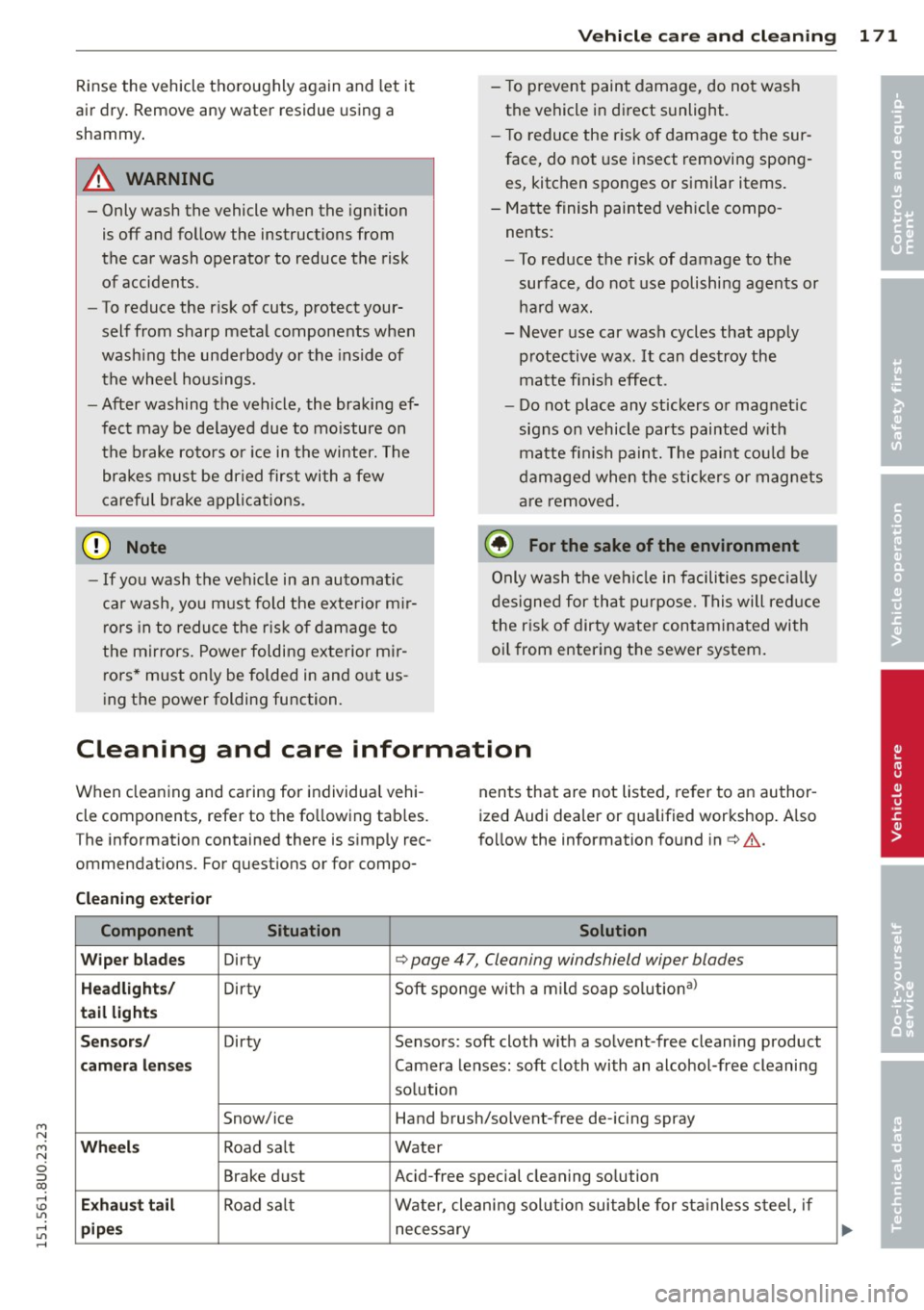
Cleaning and care information
When cleaning and caring for individual vehi
cle components, refer to the following tab les .
The information contained there is simply rec
ommendations . For questions or for compo- nents that are not listed,
refer to an author
ized Audi dealer or qualified workshop. A lso
follow the information found in ¢ ,& .
Cleaning exterior
Component Situation Solution
Wiper blades
Dirty Q page 4 7, Cleaning windshield wiper blades
Headlights/ Dirty Soft sponge with
a m ild soap solutiona>
tail lights
Sensors/
Dirty Sensors: soft cloth with a solvent -free cleaning product
camera lenses Camera lenses: soft cloth with an alcohol-free cleaning
solution
Snow/ice Hand brush/solvent-free de-icing spray
Wheels Road sa lt Water
Brake dust Acid-free special cleaning solution
Exhaust tail Road salt Water, cleaning solut ion suitable for stainless steel, if
pipes necessary
•
•
Page 174 of 258
172 Vehicle care and cleaning
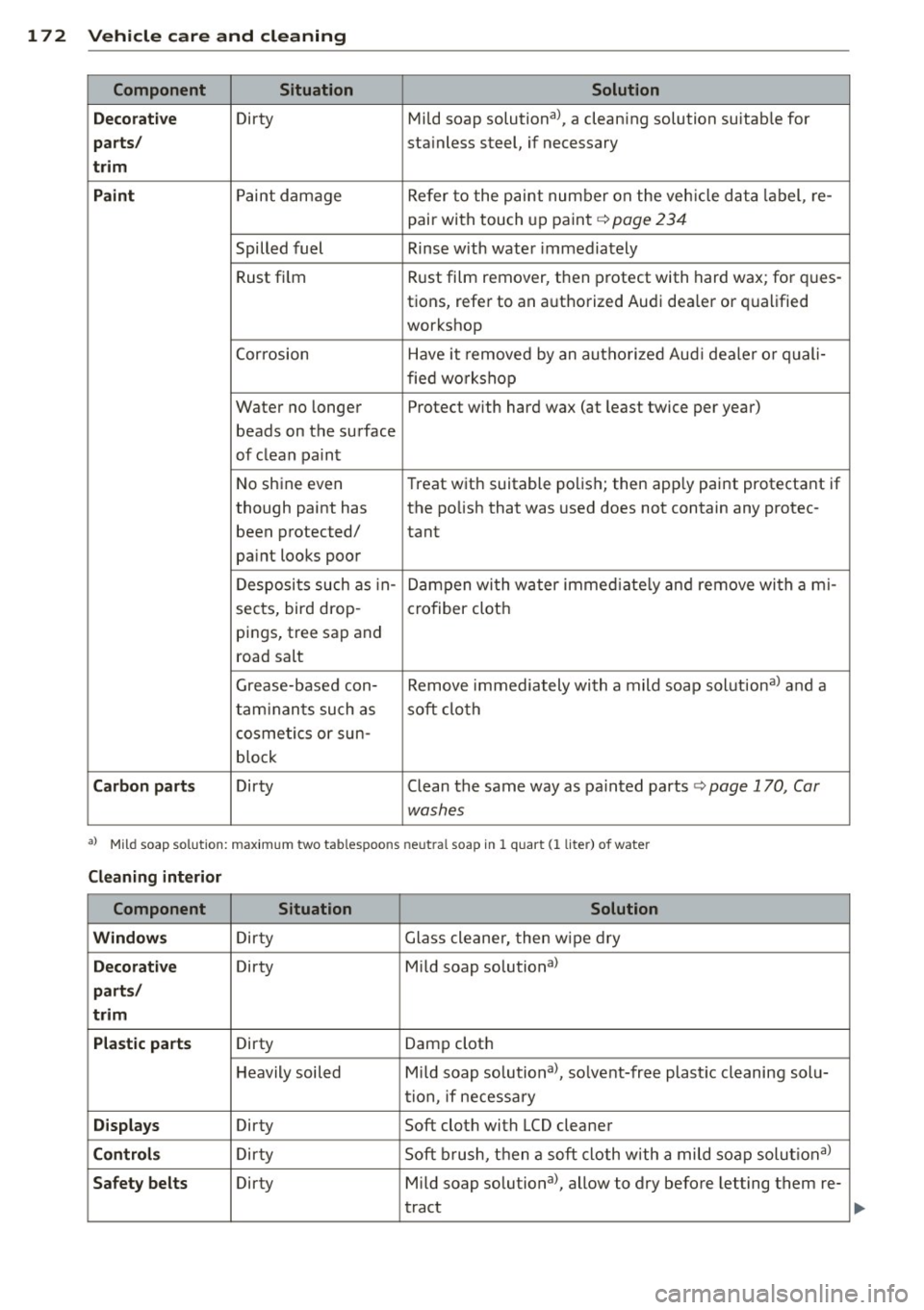
Component Situation Solution
Decorative
Dirty Mild soap solutional, a cleaning solution suitab le for
parts/ sta inless steel, if necessary
trim
Paint
Paint damage Refer to the paint number on the vehicle data label, re-
pair with touch up paint¢
page 234
Spilled fuel Rinse with water immediately
Rust film Rust
film remover, then protect with hard wax; for ques-
tions, refer to an authorized Audi dea ler or qualified
workshop
Corrosion Have it removed by an autho rized Aud i dealer or quali-
fied workshop
Water no longer Protect with hard wax (at least twice per year)
beads on the surface
of clean paint
No shine even T
reat with suitable polish; then app ly paint protectant if
though paint has the polish that was used does not contain any protec-
been protected/
tant
pa int looks poor
Desposits such as in- Dampen with water immed iate ly and remove with a mi-
sects, bird drop- crofiber cloth
pings, tree sap and
road salt
Grease-based con- Remove immediately with a mild soap solutiona> and a
taminants such as soft cloth
cosmetics or sun-
block
Carbon parts Dirty Clean tlhe same way as pa inted parts ¢ page 170, Car
washes
a l Mi ld soap so lution: maximum two tab lespoons neut ra l soap in 1 quart (1 lite r) of water
Cleaning interior
Component Situation Solution
Windows
Dirty Glass cleaner, then wipe dry
Decorative Dirty Mild soap solutional
parts/
trim
Plastic parts
Dirty Damp cloth
Heavily soiled Mild soap solutional, solvent-free plast ic cleaning solu-
t ion, if necessary
Displays Dirty Soft cloth with LCD cleaner
Controls Dirty Soft brush, then a soft cloth with a mild soap solutiona>
Safety belts Dirty Mild soap solutional, allow to dry before letting them re-
tract
Page 175 of 258
M N
M N
0 ::i co ,...., \!) 1.1'1 ,...., 1.1'1 ,....,
Vehicle care and cleaning 173
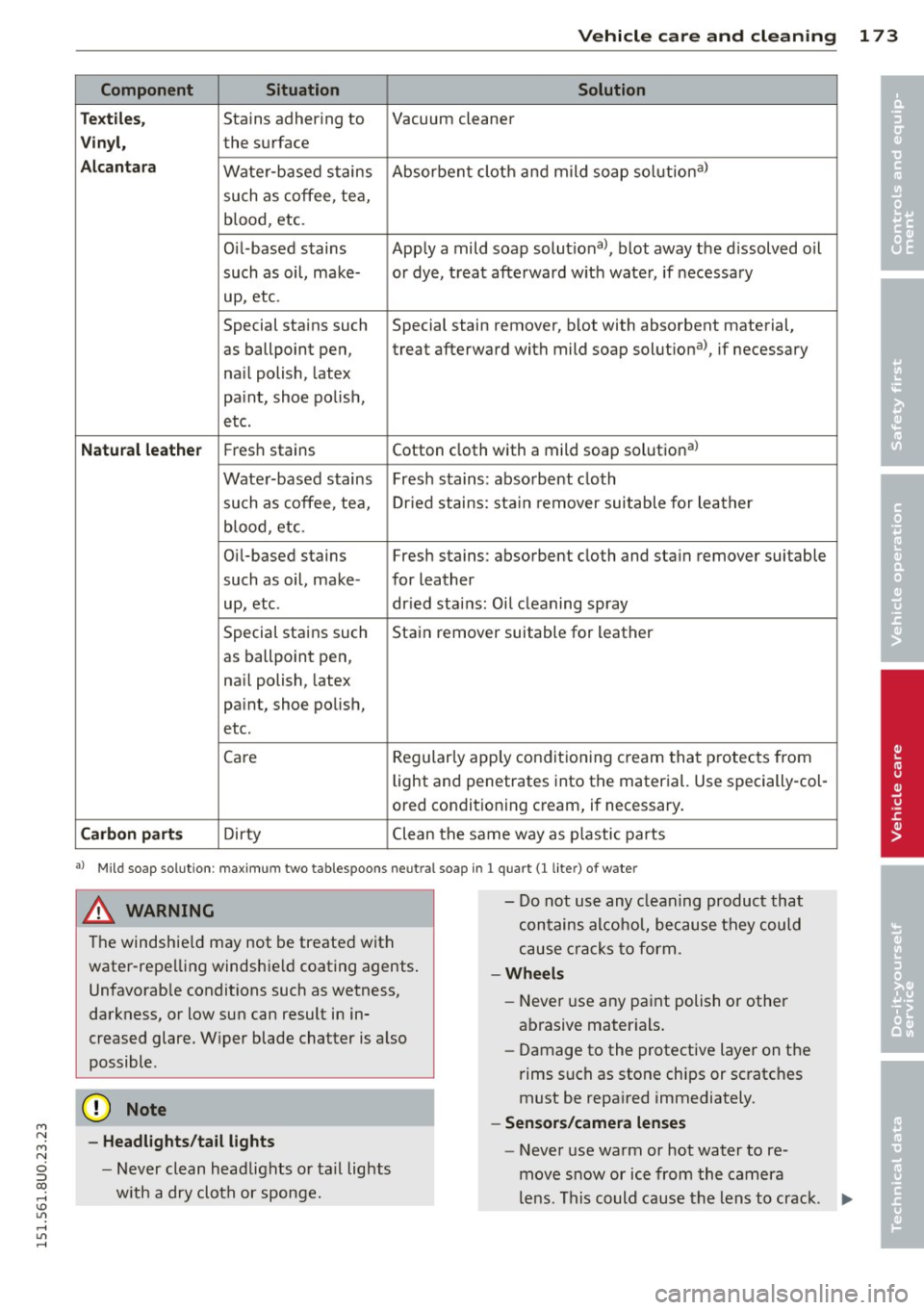
Component Situation Solution
Te xtile s,
Stains adhering to Vacuum cleaner
Vinyl, the surface
Alcantara Water-based stains Absorbent cloth and mild soap solutiona>
such as coffee, tea, blood, etc.
Oil-based stains Apply a mild soap solutiona>, blot away the d issolved oil
such as oil, make- or dye, treat afterward w ith water, if necessary
up, etc.
Special stains such Special stain remover, blot with absorbent material,
as ballpoint pen, treat afterward with mild soap solutiona>, if necessary
na il polish, latex
pa int, shoe polish,
etc.
Natural leather Fr es h stains Cotton cloth with a mild soap solutiona)
Water-based stains Fresh sta ins: absorbent cloth
such as coffee, tea, Dr ied stains: sta in remover suitable for leather
blood, etc.
Oil-based stains Fresh sta ins: absorbent cloth and stain remover suitable
such as oil, make- for leather
up, etc . dried sta ins: Oil cleaning spray
Special stains such Stain remover suitable for leather
as ballpo int pen,
na il polish, latex
pa int, shoe polish,
etc .
Care Regularly
apply conditioning cream that protects from
light and penetrates into the material. Use specially-col-
ored conditioning cream, if necessary.
Carbon parts Dirty Clean the same way as plastic parts
al Mild soap solution: maximum two tablespoons neut ral soap in 1 quart (I liter) of water
& WARNING
The windshie ld may not be treated with
water-repelling windshie ld coating agents .
Unfavorab le conditions such as wetness,
darkness, or low sun can result in in
creased glare. W iper blade chatter is also
possible.
- Headlights/tail lights
- Never clean headlights or tail lights
w ith a dry cloth or sponge. -
Do not use any cleaning product that
contains alcohol, because they could
cause cracks to form .
-Wheels
-Never use any paint polish or other
abrasive mater ials.
- Damage to the protective layer on the
rims such as stone chips or scratches
must be repaired immediately.
- Sensors/camera lenses
- Never use warm or hot water to re-
move snow or ice from the camera
len s. This could cause the lens to crack .
IJII>
•
•
Page 182 of 258
180 Checking and filling
coolant can be seen or heard before
carefully opening the hood.
- Keep children away from the engine com
partment.
- Never spill fluids on hot engine compo
nents. They can cause a fire.
- Never touch the radiator fan. The auxili ary electric fan is temperature controlled
and can switch on suddenly.
- Never open the coolant reservoir cap
when the engine is still warm. The cool
ant system is pressurized and hot cool
ant could spray out .
- Protect your face, hands and arm from
steam or hot engine coolant by placing a
thick rag over the cap when you open the
coolant reservoir .
- Do not remove the engine cover under
any circumstances. This increases the
risk of burns.
- If work on the fuel system or the electri
cal system is necessary:
- Always disconnect the battery .
- Never smoke or work near heaters or
open flames. Fluids in the engine com
partment could start a fire.
- Keep an approved fire extinguisher im
mediately available.
- To avoid electrical shock and personal in
jury while the engine is running or being
started, never touch:
- Ignition cables
- Other components of the high voltage
electronic ignition system.
- If you must perform a check or repair
with the engine running:
- First, fully apply the parking brake,
move selector lever of automatic trans
mission to "P" (Park) .
-Always use extreme caution to prevent
clothing, jewelry, or long hair from get- ting caught in the
radiator fan, V-belts
or other moving parts, or from contact
ing hot parts. Tie back hair before
starting, and do not wear clothing that
will hang or droop into the engine .
- Minimize exposure to emission and
chemical hazards
c> A .
A WARNING
-California Proposition 65 Warning:
- Engine exhaust, some of its constituents,
and certain vehicle components contain
or emit chemicals known to the State of
California to cause cancer and birth de
fects and reproductive harm. In addition,
certain fluids contained in vehicles and
certain products of component wear con
tain or emit chemicals known to the
State of California to cause cancer and
birth defects or other reproductive harm.
- Battery posts, terminals and related ac
cessories contain lead and lead com
pounds, chemicals known to the State of
California to cause cancer and reproduc
tive harms. Wash hands after handling.
(D Note
When adding fluids, always make sure that
they are poured into the proper container
or filler opening, otherwise serious dam
age to vehicle systems will occur.
@ For the sake of the environment
To detect leaks in time, inspect the vehicle
floor pan from underneath regularly. If
you see spots from oil or other vehicle flu
ids, have your vehicle inspected by an au
thorized Audi dealer.
Page 183 of 258
M N M N
0 ::i co
rl I.O
"' rl
"' rl
Checking and fillin g 181
Engine compartment
Engine compartment
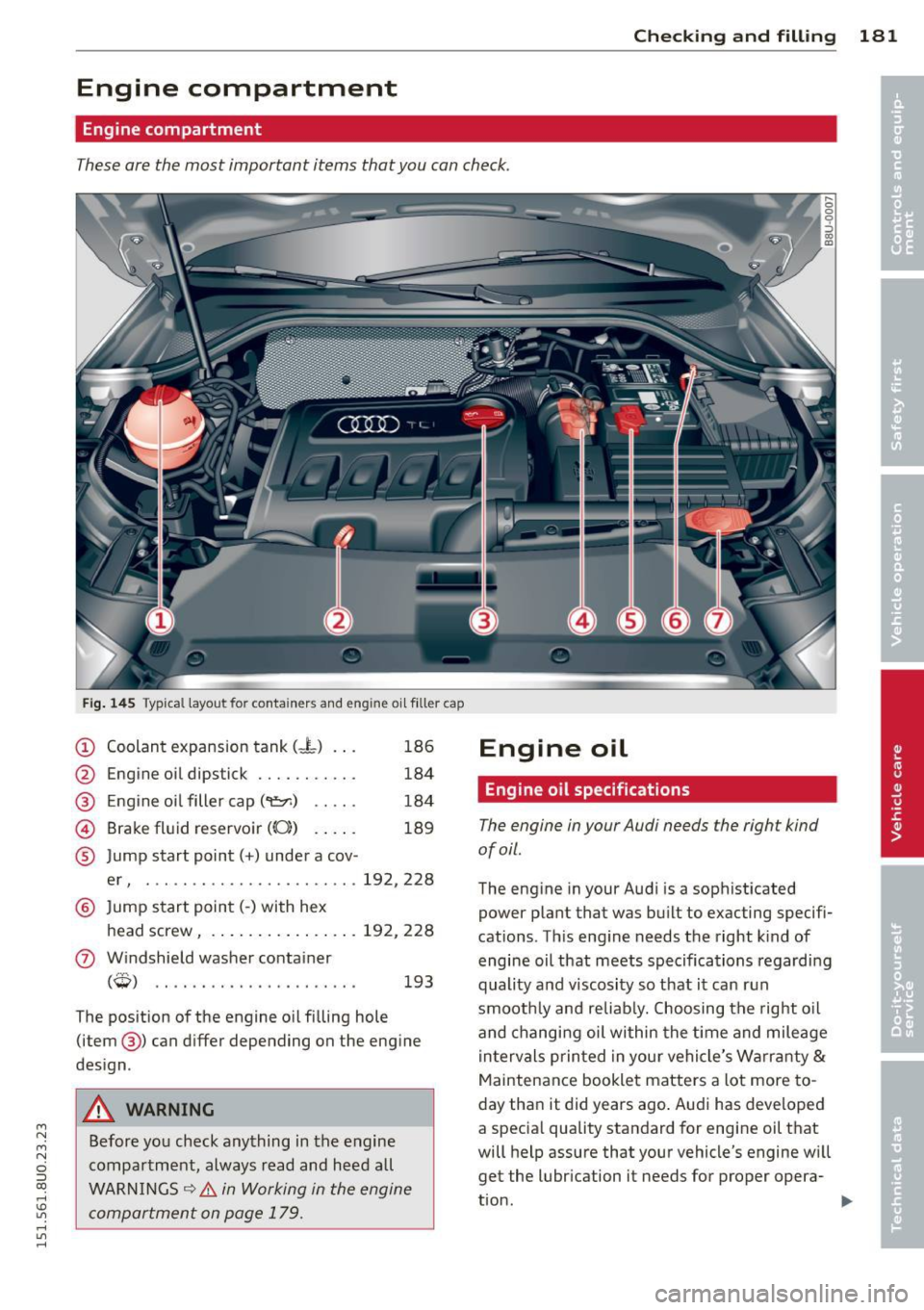
These are the most important items that you can check.
Fig. 14 5 Typical layout for containers and engine oil filler cap
(D Coolant expansion tank (- L) . . . 186
@ Engine oil dipstick . . . . . . . . . . . 184
@ Eng ine oi l filler cap ('t::r.) . . . . . 184
@ Brake fl uid reservoir (0)) . . . . . 189
® Jump start point(+) under a cov-
er, ....................... 192, 228
@ Jump start point(-) with hex
head screw, . .. ..... ... .. .. . 192, 228
(J) Windshield washer conta iner
Cw) . . . . . . . . . . . . . . . . . . . . . . 193
The position of the engine o il filling hole
(item @) can differ depending on the engine
des ign .
A WARNING
Before yo u check anything in the engine
compartment, always read and heed all
WARN INGS
~ .& in Working in the engine
compartment on page 179.
-
Engine oil
Engine oil specifications
The engine in your Audi needs the right kind
of oil.
The eng ine in your Audi is a sophisticated
power p lant that was bu ilt to exacting specifi
cations. This eng ine needs the right k ind of
engine oil that meets specifications regarding
quality and viscosity so that it can run
smooth ly and reliab ly. Choosing the rig ht o il
and changi ng oil within the t ime and mileage
in tervals printed in you r vehicle's Warranty
&
Maintenance booklet matters a lot more to
day than it did years ago . Audi has developed
a specia l quality standard for engine oil that
will help assure that your vehicle's engine w ill
get the lubr ication it needs for proper opera-
tion. .,..
Page 184 of 258
182 Checking and filling
Mo dern engine lubrication has taken a quan
tum leap in the last few years. Many synthetic
oils ava ilable today provide better engine lu
brication that can outlast traditional petrole
um-based o ils, making them a smart choice
for use throughout the life of your Audi .
Whether you use synthetic or petroleum
based engine oil, the oil that yo u use must
conform to Audi 's oil quality standard
VW 502 00 to he lp keep your vehicle's engine
running smoothly and help prevent the for
mat ion of harmfu l deposits, sometimes called
"sludge ", that ove r time can lead to expensive
r epairs .
At the time of pr int ing , engine o ils available in
the U .S . and Canada that meet the exacting
specifi cations of A udi oi l standard VW 502 00
a re synthetic engine oils. This does not mean,
however, that every syn thetic engine oi l wi ll
meet A udi oil standard VW 502 00. So always
be sure that you use an approved oil.
To help prevent the format ion of harmful de
posi ts use only oi l with the fo llow ing spec ifi
cations printed on the oil container :
Audi oil standard VW 502 00
O il container labe ls may carry the specif ica
tion s ingly or in comb inat ion with other des ig
nations and oil qua lity standards .
Viscosity
Engine oi ls are graded according to their vis
cosity. The proper v iscosity grade oil for your
engine depends on cl imactic or seasonal con
d itions where you drive. You can use oil with a
viscosity grade of SA E SW40 across all tem
pe ratu re ranges for normal driving conditions .
However, if eng ine o il viscos ity grade SA E
SW40 is not avai lab le, you ca n also use viscos
ity grade SAE SW -30 or SAE OW-40 as long as
it meets Audi o il quality sta ndard VW 502 00
specif ications .
Because engine oil that meets the Audi oil
standard may not be available everywhere
when you need it, we strongly recommend
that you always carry with you an ext ra quart (
li te r) of oil that exp ress ly con forms to the
VW 502 00 spec ification, in case you have to
top
off the oil while on the road.
Only if the level of the o il is a t or be low the
min imum mark -and no oi l that expressly
conforms to Audi oil standard VW 502 00
specificat ions is available - may you top
off
with a high quality engine o il, preferab ly syn
thet ic-based, tha t mee ts ACEA A3 or API SM
specifications, but even then , only in v iscosity
grades SAE SW-40 , SA E SW-30, o r SA E
OW-40. However, dur ing the entire time be
tween oil change inte rva ls , never top
off with
more than a to ta l of 0.5 q t/ liter engine o il
t h at does not con form to Audi oi l specifica tion
vw 502 00.
For more informa tion about eng ine oi l tha t
has been approved for your veh icle, ple ase
contac t either yo ur authorized Aud i deale r or
Audi C ustome r Re lations at 1 (800) 82 2-2834
or visit o ur web site at www .audiusa.com or
www.aud icanada .ca. Here you w ill also find a
current list of oils (manufacturers, brand
names e tc.) tha t conform to Audi oil s tanda rd
vw 502 00 .
Changing the engine oil
The eng ine oi l and oil fi lter m ust be changed
according to the mileage (kilometers) and
time intervals specified in your ve hicle's War
ranty
& Maintenance booklet. Do not exceed
these intervals -harmful deposits from old
engine oil ca n reduce eng ine performance and
can lead to expensive eng ine repa irs .
Changi ng the oil at the recommended inter
vals is so very important because the lubricat ing proper ties of oil decrease gradually d uring
norma l veh icle use . If you are not sure when
you have your oil changed, ask your author ized Audi Serv ice Adv isor.
Under some circumstances the engine oil
shou ld even be cha nged more frequent ly .
Change oil more often if you drive most ly
sho rt distances, operate the ve hicle in dusty
areas o r most ly unde r stop-and-go t raff ic con-
di tions, o r when you use your vehi cle where .,..
Page 185 of 258
M N
M N
0 ::i co ,...., \!) ..,.,
,...., ..,., ,....,
temperatures stay below freezing point for l ong periods.
Detergent add itives in the o il w il l make fresh
oil look dark after the eng ine has been run
ning fo r a short time . This is norma l and is not
a reason to change the oi l more often than
recommended.
D am ag e or m alfun ction s due to lack of
ma intenanc e
It is essential that you change your oil at the
r ecommended inte rva ls using only engine o il
t hat complies wi th A udi oi l standard
VW 502 00 . Your Limited New Vehicle War
ranty does not cover damage or malfunctions
d ue to fa ilure to fo llow recommended mainte
nance and use requ irements as set forth in
the Audi Owner's Manua l and Warranty
&
Maintenance book let . Your dea ler will have to
deny warranty coverage u nless you present to
the dea ler p roof in the fo rm of Serv ice or Re
pa ir Orde rs that all s chedu led maintenance
wa s pe rformed in a t imely manner .
Engine oil consumption
The engine in your vehicle dep ends on an ade
quate amount of oil to lubricate and cool all
of its moving parts.
In o rder to provide effective lubrication and
cool ing of i nternal engine components, a ll in
ternal comb ustion eng ines consume a cert ain
amo unt of o il. Oil cons umption varies from
engine to engine and may change significantly
over the life of the engine. Typ ica lly, engines
with a specified break-in per iod (see
c::;, page 161) consume more oil during the
break-in per iod than they consume after oil
consumption has stabilized.
Under norma l conditions, the rate of oil con
sumpt ion depends on the quality and viscosity
of the oil, the RPM (revo lutions per m inute) at
which the engine is operated, the amb ient
temperature and road condit ions. Furthe r fac
tors ar e the amount of o il d ilution from wate r
condensation or fuel residue and the ox ida
tion level of the oi l. As any engine is s ubje ct to
Checkin g and fillin g 183
wear as m ileage builds up, the oil consump
tion may increase over time until replacement
of worn components may become necessary.
Wi th a ll these variab les coming into p lay, no
standard rate of oil consumpt ion can be es
tablished or specified. There is no alternative
to regular and frequent check ing of the o il lev
el, see
Note .
If the yellow engine oil leve l warning symbo l
E\I in the instrument cl uster lights up, you
sho uld check the oil leve l as soon as possib le
c::;, page 184. Top off the oil at your earliest
convenience
c::;, page 184.
A WARNING
Before you c heck anythi ng i n the engine
com partment, always read a nd heed all
WARNINGS
c::;, .&. in Working in th e engine
c ompartment on page 179.
(D Note
D riving w ith an insufficient o il level is like
ly to cause sever e damage to the engine .
(D Tips
- The oil pressure warning display. is
not an indicator of the oil le vel. Do not
re ly on it. In stead, check the oil level in
your engine at regular intervals, pref erably ea ch time you refuel, and alway s
before going on a long trip .
-If you have the impression you r engi ne
c ons umes ex ce ss ive amoun ts of o il, we
recommend that you consu lt an author
ized Aud i dea ler to have the cause of
your concern properly d iagnosed. Keep in
m ind that the accurate measu rement of
oil consumption requ ires great care and
may take some t ime. An authorized Aud i
dealer has instructions about how to
measu re oil consumption accurately.
-
•
•