oil AUDI Q3 2015 Owner's Manual
[x] Cancel search | Manufacturer: AUDI, Model Year: 2015, Model line: Q3, Model: AUDI Q3 2015Pages: 258, PDF Size: 64.9 MB
Page 186 of 258
184 Checking and filling
Checking the engine oil level
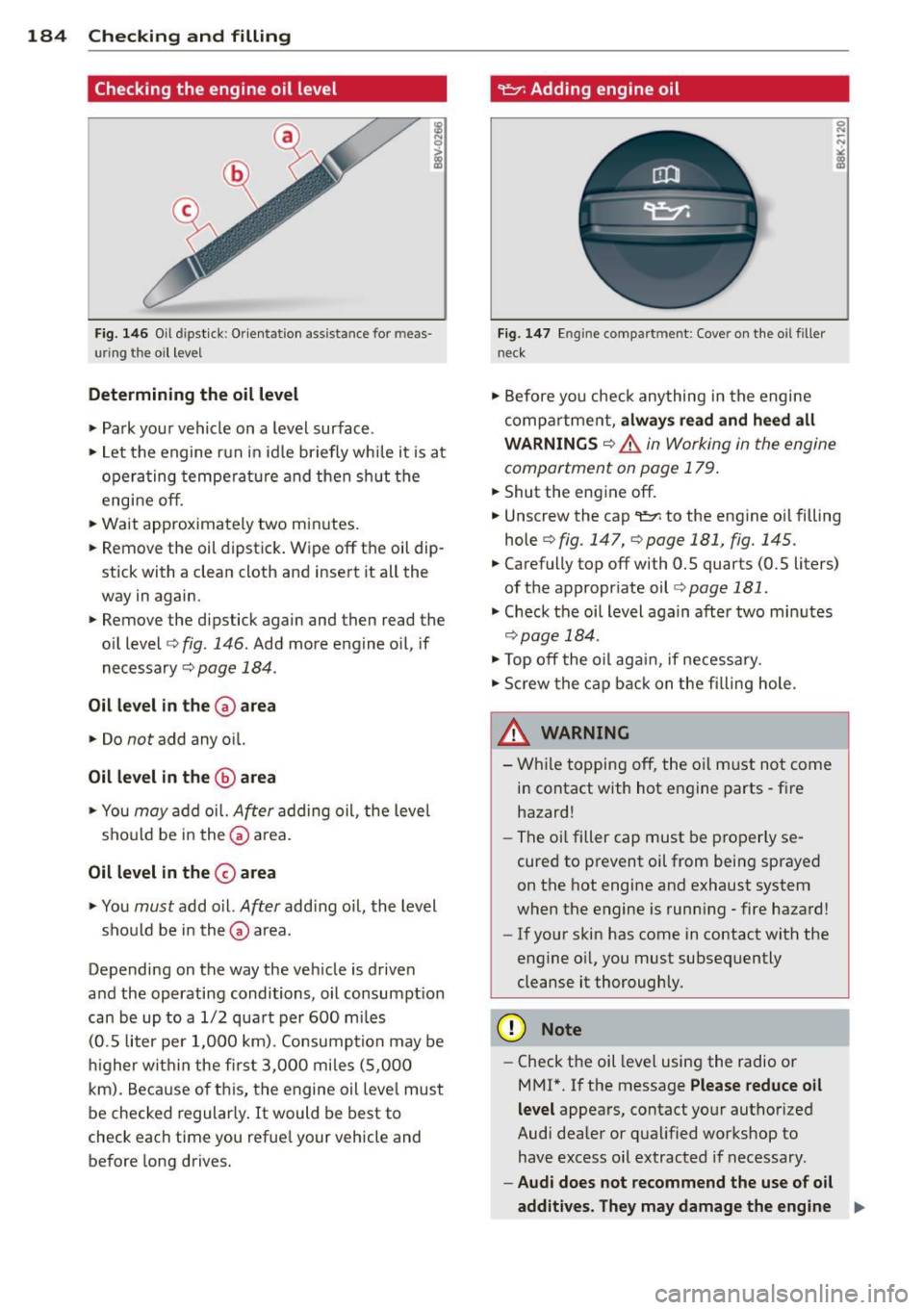
Fig. 1 46 Oil d ipst ick : Or ientat ion ass ista nce for meas
u ri ng the oil level
Determining the oil level
.,. Park your vehicle on a level surface .
.,. Let the engine run in id le briefly while it is at
opera ting tempe ratu re and then sh ut the
engine off.
.,. Wait approximately two minutes .
.,. Remove the oil dipst ick. Wipe off the oil dip
stick with a clean cloth and insert it all the
way in again .
.,. Remove the dipstick again and then read the
oil level
c> fig. 146. Add more engine o il, if
necessary ~
page 184.
Oil level in th e (v are a
.,. Do not add any o il.
Oil level in the @area
.,. You may add oil. After adding oil, the level
sho uld be in the~ area .
Oil level in the 0 a rea
.,. You must add o il. After add ing o il, the level
should be in the~ area.
Depending on the way the vehicle is driven
and the operating conditions, oil consumpt ion
can be up to a 1/2 qua rt per 600 mi les
(0 .5 liter pe r 1,000 km) . Consumption may be
hi gher wit hin the fi rst 3,000 mi les (5,000
km) . Because of this, the engine oil leve l must
be checked regular ly. It would be best to
check each time you refue l your vehicle and
before long drives.
~ Adding engine oil
F ig. 147 En g in e compart ment: Cover on the o il filler
n eck
.,. Before yo u check anything in the engine
compa rtme nt,
alwa ys read and h eed all
WARNINGS ~ A in Working in the engine
compartment on page 179 .
.,. Shut the engine off.
.,. Unscrew the cap
't!::?: to the engine oi l filling
hole
c> fig . 147, c> page 181, fig. 145 .
.,. Carefully top off with 0.5 quarts (0.5 liters)
of the appropr iate oil
c> page 181 .
.,. Check the oi l level again after two mi nutes
c> page 184 .
.,. Top off the oil aga in, if necessary .
.,. Screw the cap back on the filling hole .
A WARNING
-Wh ile topping off, the oil m ust not come
in contact with hot engine parts -fire
hazard!
- The oi l filler cap must be properly se
cured to prevent oil from being sprayed
on the hot engine and exhaust system
when the engine is runn ing - fire hazard!
- If your skin has come in contact with the
engine o il, you must subsequently
cleanse it thoroughly.
(D Note
- Check the oil level using the radio o r
MMI*. I f the message
Please redu ce oil
level
appea rs, contact your authorized
Aud i dealer or qualified workshop to
have excess oil extracted if necessary .
-Audi does not recommend the use of o il
additives. They m ay damage the engine ..,.
Page 187 of 258
and adve rsely affect you r New Vehicle
Wa rrant y.
@) For the sake of the environment
-Un der no ci rc u mstances can the o il come
in contact with the sewage network or
the soil.
- Observe and follow lega l regu lations
when disposing of empty oil containers .
Changing the engine oil
We recommend that have your oil changed by
an authorized Audi dealer or a qualified serv
ice station.
Before you check anything in the engine com
par tment,
a lways rea d and he ed all WARN
INGS ~&. in Working in the engine compart
ment on page 179.
The engine oil must be changed according to
the intervals specified in your Warranty
&
Maintenance book let. This is very important
because the lubricating properties of oil di
minish gradua lly during normal vehicle use.
Under some circumstances the engine oi l
should be changed more frequently. Change
oil more often if you drive most ly short dis
tances, operate the vehicle in dusty areas or under predominantly stop-and-go traff ic con
d itions, or have your veh icle where tempera
tures remain below freezing for extended pe
riods.
Detergent additives in the o il w ill make fresh
oil look dark after the engine has been run n ing for a short time. This is normal and is not
a reason to change the oil more often than recommended.
Because of the problem of proper disposa l,
along w ith the special tools and necessary ex
pertise required, we strongly recommend that
you have you r oi l changed by an authorized
~ Au di de ale r o r a qual ified servi ce station.
M N
0 ::i co ,...., \!) 1.1'1 ,...., 1.1'1 ,....,
If you choo se t o c ha ng e y our o il your self ,
please note the followi ng important informa
tion :
Checkin g and fillin g 185
A WARNING
To reduce the risk of personal injury if you
must change the eng ine oil in your vehicle
yourself:
- Wear eye protect ion.
- To reduce the risk of burns from hot en- gine oil, let the engine cool down to the
touch.
- When removing the o il dra in p lug with
your fingers, stay as far away as possible. Always keep your forearm parallel to the
ground to help p revent hot oil from run
ning down you r arm.
- Dra in the oil into a container designed
for this purpose, one la rge enough to
hold at least the tota l amount of oi l in
your eng ine .
- Engine oil is poisonous. Keep it well out
of the reach of children.
- Continuous contact wit h used eng ine o il
is harmful to your s kin. A lways protect
your skin by washing oil off tho ro ughly
with soap and water.
@ Note
Neve r mix oil additives with your engine
oil. These additives can damage your en
g ine and adversely affec t you r Au di L imit
ed New Vehicle Warranty.
@ For the sake of the environment
- Before changing your oil, first make su re
you know where you c an properly dispose
o f the used oil.
- Always dispose of used eng ine oi l proper
ly. Do not dump it on garden soil, wood
ed areas, into open streams or down
sewage drains .
- Recycle used engine oil by taking it to a
used engine oil collect ion facility in your
area, or contact a service station.
•
•
Page 188 of 258
186 Checking and filling
Engine cooling system
Coolant
The engine coolant performs two functions: it
keeps the engine from overheating and it pro
tects the engine from freezing in the winter .
The cooling system is sealed and generally re
qu ires little attention .
The cooling system has been filled at the fac
tory with a permanent coo lant which does not
need to be changed. The coolant consists of a
mixture of spec ially conditioned water and the
manufacturer's glycol-basedcoolant addi-
tive G13 antifreeze with ant icorros ion addi
tives (50% for USA models; 60% for Ca nada
models) . This mixture both assures the neces
sary frost protection and protects metal com
ponents in the engine's cooling system from
corrosion and scaling.
It a lso raises the boil
ing point of the coo lant.
Do not reduce the concentration o f the coo l
ant in the summer by adding plain water .
The
proportion of coolant additive must be at
least 50% but not more than 60%
to main
tain antifree ze protection and cooling efficien
cy. If the coolant frost protect ion is too low,
the coolant could freeze and damage the veh i
cle heating and engine cooling system .
For year-round driving, antifree ze is added at
the factory for temperatures down to:
- -31°F(-35°C)USA
- - 40 °F ( -40 °C) Canada.
I f you must add coo lant, use a mixture of wa
ter and coolant addit ive. Mixing the coolant
additive with distilled water is recommended.
_& WARNING
Before yo u check anything in the engine
compartment, always read and heed all
WARNINGS
~ &. in Working in the engine
compartment on page 179.
(D Note
- Before winter sets in, have the coolant
checked to see if the coolant additive in
-
your vehicle is sufficient to meet the cli mate conditions . This is especia lly impor
tant if you live in a reg ion where the win
ter is extreme ly cold. If necessary, in
crease the proportion of coolant add itive
to 60% .
- When adding coolant additive to your
cooling system, remember:
- We recommend using only coolant ad
ditive G12++ or G13 for your vehicle.
This coolant additive is available at au
thorized Audi dealers. Other types of
antifreeze can significantly reduce cor rosion protection. The resulting corro
sion can cause a loss of coolant and se
rious engine damage .
- Do not add any type of rad iator leak seal
ant to your vehicle's engine coolant.
Adding radiator repair flu id may adverse
ly affect the function and performance of
your cooling system and could result in
damage not covered by your New Vehicle
Limited Warranty.
Checking the engine coolant level
The engine coolant level can be checked with
a quick glance.
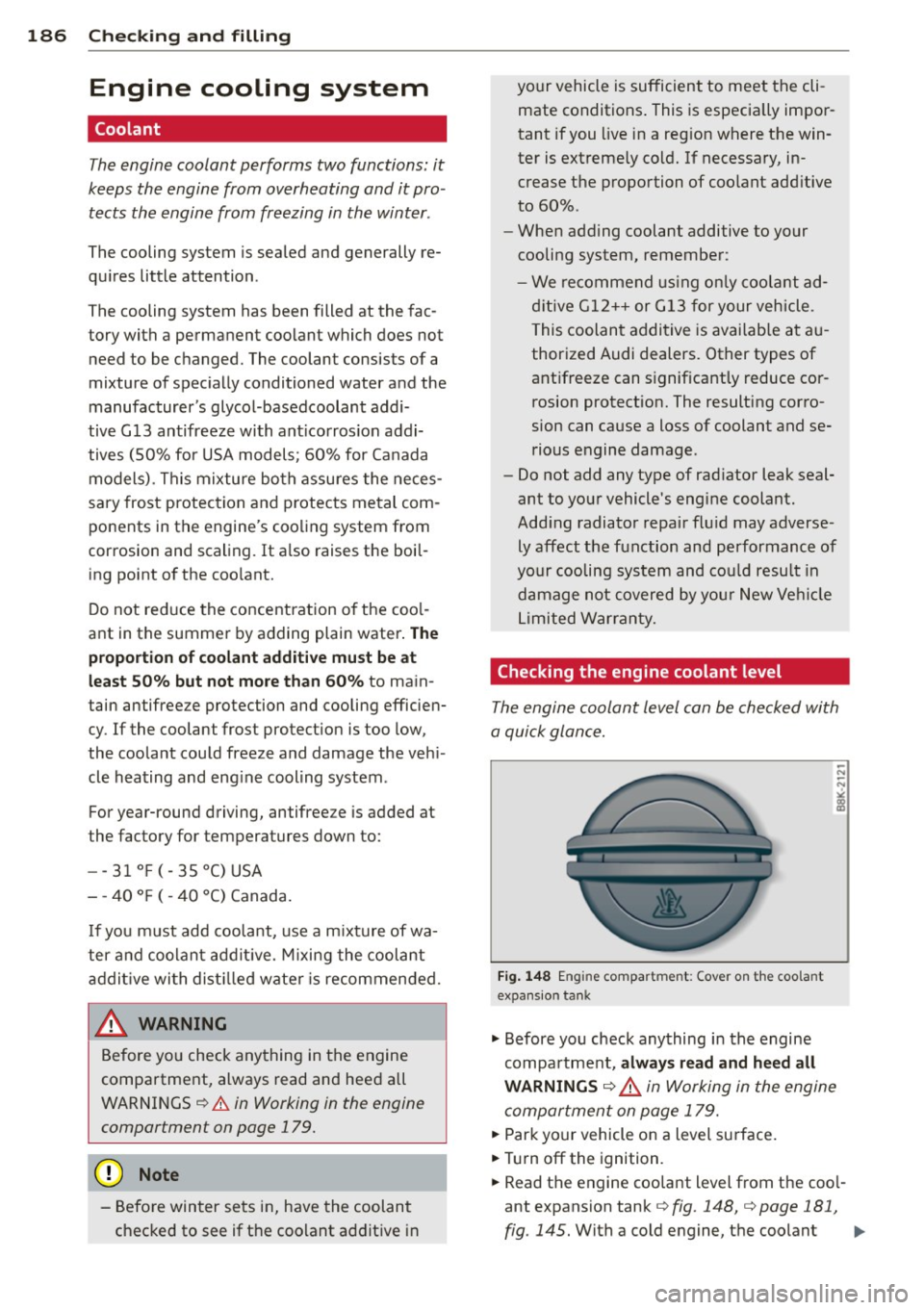
Fig. 148 E n gin e compart men t: Cover on the coo la n t
expans io n tank
.,. Before you check anything in the engine
compa rtment,
always read and heed all
WARNINGS ~ ,& in Working in the engine
compartment on page 179.
.,. Park your vehicle on a level surface .
.,. Tur n off the ignition.
.,. Read the engine coolant level from the coo l
ant expansion tank
c:> fig . 148, c:> page 181,
fig. 145.
With a cold engine, the coolant Iii>-
Page 189 of 258
M N
M N
0 ::i co ,...., \!) ..,.,
,...., ..,., ,....,
level should be between the "MIN" and
"MAX" markings. When the engine is warm,
the level may be slightly above the "MAX"
marking .
The location of the coolant expansion tank
can be seen in the engine compartment illus
tration
<=> page 181.
To obtain an accurate reading , the engine
must be switched
off.
The expansion tank in your vehicle is equipped
with an electric coolant level sensor.
When the coolant level is too low, the warning
light in the Auto-Check System <=>
page 14 will
blink until you add coolant and the level has
been restored to normal. Even though there is
an electric coolant level sensor, we still rec
ommend you check the coolant level from
time to time.
Coolant loss
Coolant loss may indicate a leak in the cooling
system. In the event of coolant loss, the cool
ing system should be inspected immediately
by your authorized Audi dealer.
It is not
enough merely to add coolant.
In a
sealed system, losses can occur only if
the boiling point of the coolant is exceeded as
a result of overheating.
A WARNING
The cooling system is under pressure and
can get very hot. Reduce the risk of scald
ing from hot coolant by following these
steps.
- Turn
off the engine and allow it to cool
down.
- Protect your face, hands and arms from escaping fluid and steam by covering the
cap with a large, thick rag .
- Turn the cap slowly and very carefully in
a counter-clockwise direction while ap
plying light, downward pressure on the
top of the cap .
- To avoid being burned, do not spill anti
freeze or coolant on the exhaust system
Checking and filling 187
or hot engine parts. Under certain condi
tions, the ethylene glycol in engine cool
ant can catch fire.
([) Note
Do not add any type of radiator leak seal
ant to your vehicle's engine coolant. Add- ing radiator repair fluid may adversely af
fect the function and performance of your
cooling system and could result in damage
not covered by your New Vehicle limited
Warranty .
Adding coolant
Be very careful when adding engine coolant.
Before you check anything in the engine com
partment ,
always read and heed all WARN
INGS <=>
A in Working in the engine compart
ment on page 179 .
Requirement: There must be a residual
amount of coolant in the expansion tank
<=> (D.
.,. Turn off the engine.
.,. Let the engine cool down.
.,. Place a thick rag over the coolant expansion
tank
<=> page 186, fig . 148 and carefully turn
the cap counter-clockwise
<=> .&_ .
.,. Add coolant mixed in the correct ratio
<=> page 186, Coolant up to the MAX mark
ing.
.,. Make sure that the fluid level remains sta-
ble. Add more coolant if necessary.
.,. Twist the cap on again
tightly.
Replacement engine coolant must conform to
exact specifications
<=> page 186, Coolant.
We recommend using only coolant additive
G12 ++, G13 or in an emergency G12 +. Do
not
use a different additive. In an emergency use
plain water until you can get the correct addi
tive and can restore the correct ratio. This
should be done as soon as possible.
If you have lost a considerable amount of
coolant , then you should add cold antifreeze
and cold water only when the engine is cold.
Always use
new engine coolant when refilling . .,.
•
•
Page 191 of 258
M N M N
0 ::i co
rl I.O
"' rl
"' rl
Brake fluid
Checking brake fluid level
The brake fluid level can be checked with a
quick glance.
N
N
;:;;
" 03
"'
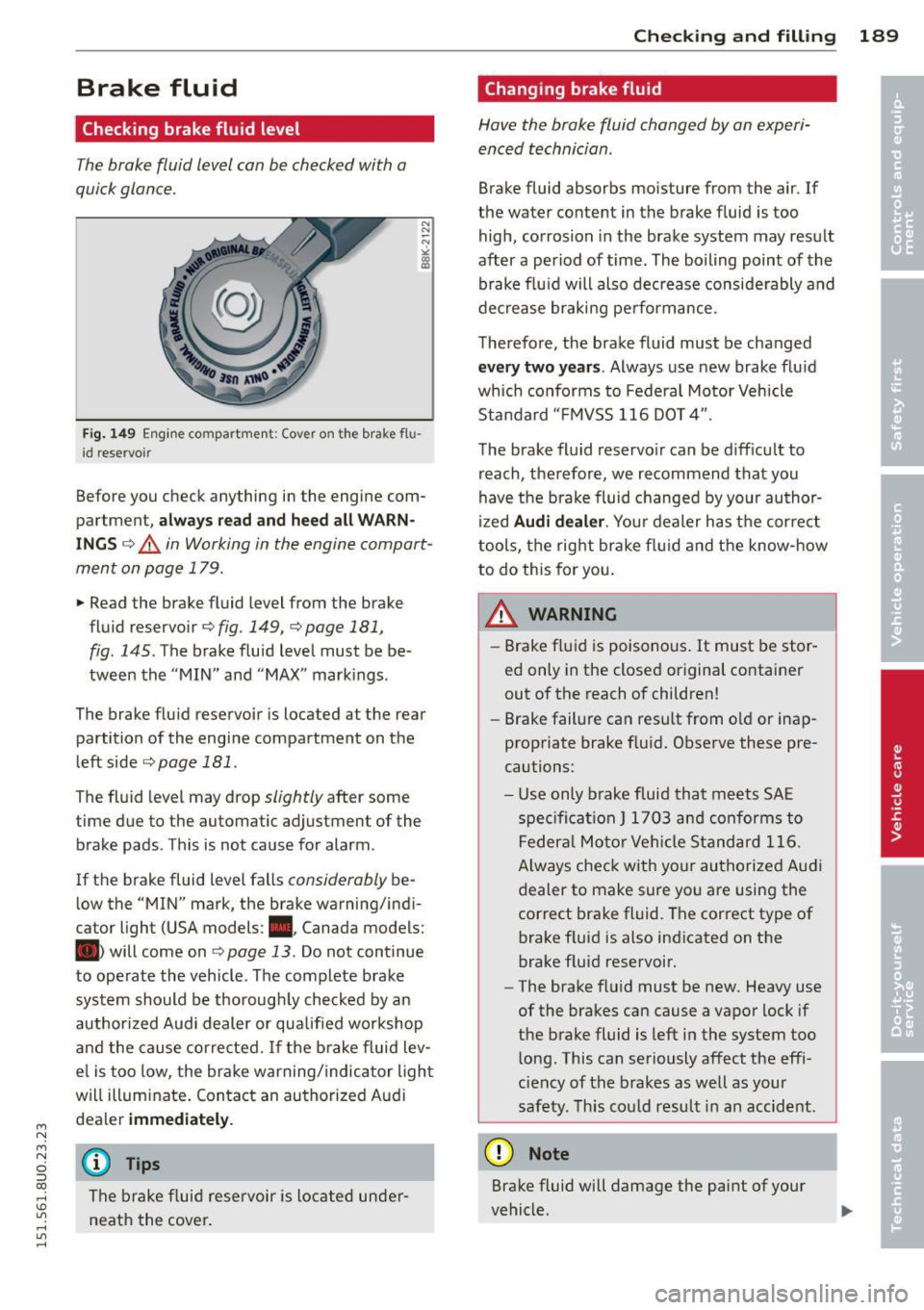
Fi g. 149 Eng ine compartment: Cover on the brake flu
id reservoir
Before you check anything in the engine com
partment,
a lwa ys read and heed all WARN
ING S c:> .&.. in Working in the engine compart
ment on page 179 .
~ Read the brake fluid level from the brake
fluid reservoir
c:> fig. 149, <=> page 181,
fig . 145.
The brake flu id level must be be
tween the "MIN" and "MAX" markings.
The brake fluid reservoir is located at the rear
partition of the engine compartment on the
left side <::;>
page 181 .
The fluid level may drop slightly after some
time due to the automatic adjustment of the
brake pads . This is not cause for alarm .
If the brake fluid level falls
considerably be
low the "MIN" mark, the brake warning/indi
cator light (USA models: ., Canada models:
• will come on
<::;> page 13. Do not continue
to operate the vehicle . The complete brake
system should be thorough ly checked by an
author ized Audi dealer or qua lified workshop
and the cause corrected.
If the brake fluid lev
e l is too low, the brake warning/indicator ligh t
will illuminate . Contact an authorized A ud i
dealer
immediately.
@ Tips
The brake f luid reservoir is located under
neath the cover .
Checking and fillin g 189
Changing brake fluid
Have the brake fluid changed by on experi
enced technician.
Brake fluid absorbs moisture from the air. If
the water content in the brake fluid is too
high, corrosion in the brake system may result
after a period of time . The boiling point of the
brake flu id will also dec rease considerably and
decrease braking pe rformance.
Therefore, the brake fluid must be changed
ev ery two years. Always use new brake flu id
which conforms to Federal Motor Vehicle
Standard "F MVSS 116 DOT 4".
The brake fluid reservo ir can be d iff icult to
reach, the refore, we recommend that you
have the brake fluid changed by your author
i zed
Audi d ealer. Your dealer has t he correct
tools, the right brake fl uid and t he know-how
to do this for you .
A WARNING -.
-Brake fluid is poisonous . It must be stor
ed only in the closed original container
out of the reach of children!
- Brake failure can resu lt from o ld or inap
propriate brake f luid. Observe these pre
cautions:
- Use only brake fluid that meets SAE
spe cificat ion
J 1 7 03 and conforms to
Federa l Moto r Ve hicl e Standard 116.
Always check with yo ur authorized Audi
dealer to make sure yo u are using the
correct bra ke fluid. The correct type of
brake f luid is also indicated on the
brake f luid reservoir.
- The brake fluid must be new. Heavy use
of the brakes can cause a vapor lock if
the brake fluid is left in the system too
l ong . This can seriously affect the effi
c iency of the brakes as well as your
safety. This cou ld resu lt in an accident.
(D Note
Brake fluid will damage the paint of your
vehicle .
Page 205 of 258
M N
M N
0 ::i co ,...., \!) ..,.,
,...., ..,., ,....,
-If the ti re is not flat and y ou do not have
to change a wheel immed iate ly, drive at
reduced speed to the nearest service sta
t ion to check the tire pressure and add
air as required.
(D Note
Dr iving without va lve stem caps can cause
damage to the t ire va lves . To prevent this,
always make sure that factory installed
valve stem caps on all wheels are secu re ly
mounted on the va lve .
@) For the sake of the environment
Underinflated tires will a lso increase the
fue l consumption.
Tires and vehicle load limits
There are limits to the amount of load or
weight t hat any veh icle and any t ire ca n car ry.
A vehicle that is overloaded w ill not handle
well and is more difficult to stop. Overload ing
can not on ly lead to loss of vehicle contro l,
but can a lso damage important parts of the
vehicle and can lead to sudden tire failure, in
cluding a blowout and sudden deflation that
can cause the ve hicle to crash.
Your safety and that of yo ur passenge rs a lso
depends on making sure th at load limits are
no t exceeded. Vehicle load includes everybody
and everyth ing in and on the vehicle. These
load limits a re tech nica lly referred to as the
ve hicle's
Gross Veh icle Weight Rating
("GVWR").
The "GVWR" includes the we ight of the basic
ve hicle, all factory installed accessories, a full
tank of f uel, oil, coo lant and othe r fluids plus
max imum load. The maximum load includes
the number o f passenger s that the ve hicl e is
intended to carry ("se ating capacity") w it h an
assumed weig ht o f 150 lbs. (68 kg) for each
passenger at a designated seating position
and the tota l weight of any luggage in the ve
h icle. If you tow a trailer, the weight of the
trailer hitch and the tong ue weight of the
Tire s an d wheel s 203
loaded tra ile r must be included as part of the
vehicle load .
T he
Gro ss Ax le Weight Rating (" GAWR") is
the max imum load th at can be applied at each
of the vehicle's two axles .
T he Gross Vehicle Weight Rat ing and t he
G ross Ax le Weig ht Ra ting are l iste d on the
s af ety comp liance s tic ke r la bel lo cated on the
driver's side 8 -pillar . Yo ur Audi has 5 seating
positions, 2 in the front and 3 in the rear fo r
total seating capacity of 5. Eac h seating posi
tion has a seat be lt
c::> page 104, Safety bel ts.
T he fac t that there is an upper limit to yo ur
vehicle's G ross Vehicle Weight Rating means
that the total weight of whatever is being car
ried in the vehicle ( includ ing the weight of a
trai ler hitch and the tongue weight of the
l oaded tra ile r) is lim ited . The more passen
gers in the vehicle or passe ngers w ho are
heavi er than the standard we ights assumed
mea n that less we ight can be ca rried as lug
gage.
T he t ire pressure label o n your Aud i also lis ts
the max imum combined weight of a ll of the
occupants and l uggage or o ther cargo t hat
the ve hicl e can carry . Fo r th e lo cat ion of the
l abel
c::> page 199, fig . 152.
A WARNING
-=
Overloading a vehicle can cause loss of ve -
h icle cont ro l, a c rash or other accide nt, se
rious pe rsonal injury, and even death.
- Ca rrying more we ight than your vehicle
was des igned to carry wi ll prevent the
veh icle from handling pr oper ly and in
crease the risk of the loss of vehicle con
trol.
- The brakes on a vehicle that has been
overloaded may not be able to stop the
ve hicle w it hi n a safe distance.
- Tires o n a vehicle that has been over load
ed can fail s uddenly, incl uding a blowout
a nd sudden defla tion, causing loss of
con trol an d a crash . ..,.
•
•
Page 208 of 258
206 Tires and whe els
& WARNING
Sudden tire failure can lead to loss of con
trol, a crash and serious persona l injury!
- Never drive a vehicle when the tread on
any tire is worn down to the wear indica
tors .
- Worn tires are a safety hazard, they do
not grip well on wet roads and increase
yo ur risk of "hydroplan ing" and loss of
control.
- Always keep chemicals that can cause tire damage, such as grease, oil, gasoline and brake fluid away from t ires.
- Tires age even if they are not be ing used
and can fail suddenly , especially at high
speeds . T ir es that are more t han 6 years
o ld can only be used in an emergency
and then with special care and at lower
speeds.
- Never mount used ti res on yo ur vehicle if
yo u are not sure of their "previous histo
ry." Old used tires may have been dam
aged even though the damage cannot be
seen that can lead to sudden tire failure
and loss of vehicle control.
New tires and replacing tires and wheels
New tires and wheels have to be broken in .
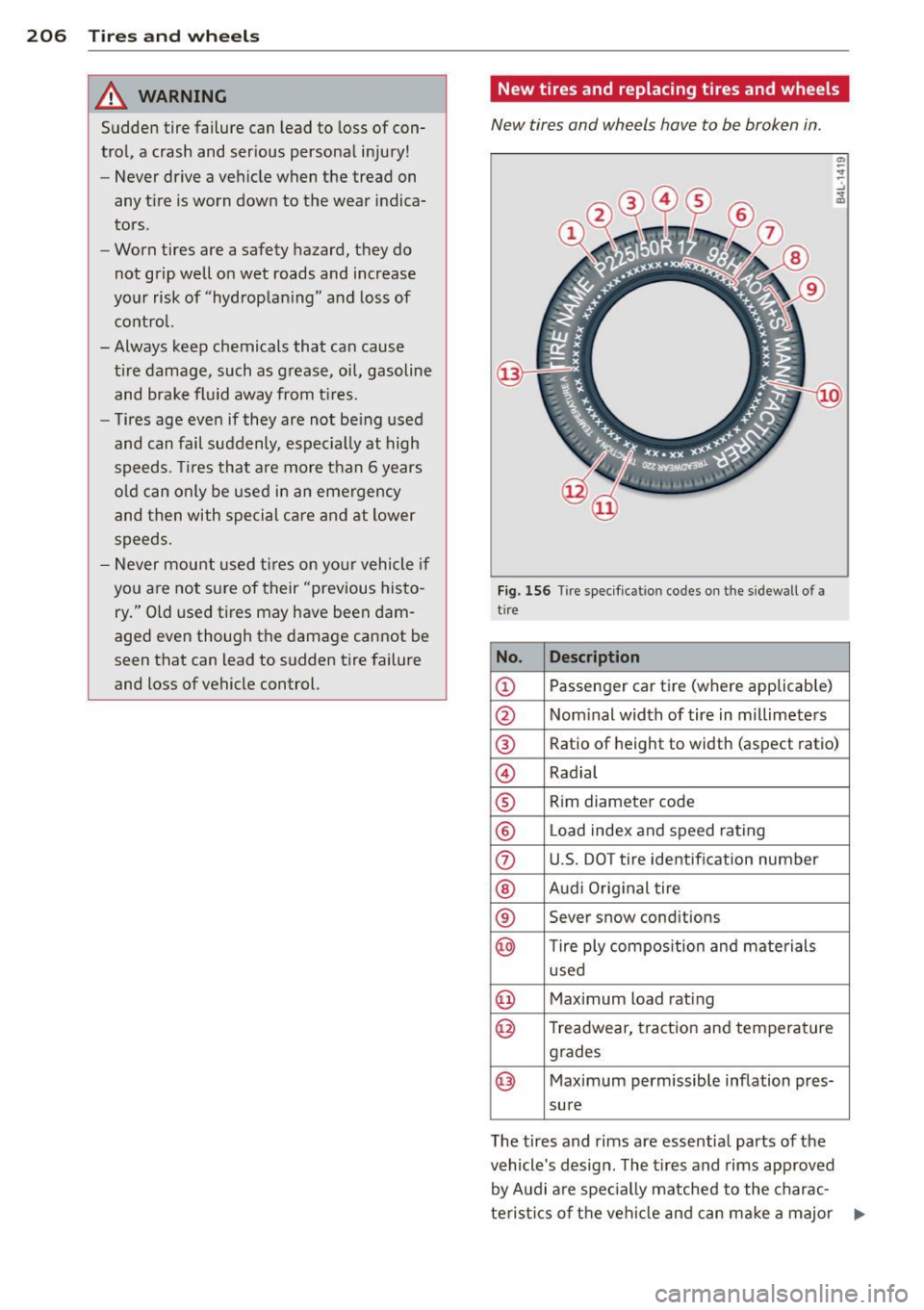
Fig. 156 Tir e specificat ion codes on t he s idew all o f a
t ire
No. De scription
® Ra tio of height to width (aspect ratio)
© Radial
® Rim diameter code
® L oad index and sp eed rating
(J) U.S. DOT tire identifi cation number
® Audi Original tire
® Sever snow cond itions
@ Tire ply compos ition and materials
used
@ Maximum load r ating
@ Treadwear, traction and temperature
grades
@ Maximum permissible inflation pres-
sure
T he t ires and rims are essential parts of the
vehicle 's design . The tires and rims approved
by Audi are spec ially matched to the charac
te ris tics of the vehicle and can ma ke a major .,..
Page 214 of 258
212 Tire s and wheel s
driving a few yards and correct if neces
sary. Follow the instructions from the
snow cha in manufacturer when doing so.
(D Tips
Where snow chains are mandatory oncer
tain roads, this normally also applies to
veh icles with all wheel drive .
Wheel bolts
Wheel bolts must always be tightened to the
correct torque.
The design o f whee l bolts is matched to the
factory insta lled rims . If different rims are fit
ted, the correct wheel bolts with the right l ength and correctly shaped bolt heads must
be used. This ensures that wheels are f itted
securely and that the brake system functions
correctly .
In certain circumstances, you may not use
wheel bolts from a different vehicle -even if it
is the same model¢
page 239.
.&_ WARNING
Improperly tig htened or maintained wheel
bolts can become loose ca using loss of
cont ro l, a co llision and serious p ersona l in
Jury.
- Always keep the wheel bolts and the
threads in t he wheel hubs clea n so the
wheel bolts can tu rn easily and be prop
erly tigh tened.
- N ever grease or oil the wheel bo lts and
the threads in the wheel h ubs. They can
become loose w hile d riving if greased or
oiled, even if tightened to the specified
torq ue.
- O nly use wheel bo lts that be long to the
rim being installed.
- N ever use different whee ls bolts on your
vehicle.
- Alw ays mai nta in the co rrec t tighte ning
tor que fo r the wheel bo lts to reduce the
risk of a wheel loss . If the tightening tor
que of the wheel bo lts is too low, they
can loosen and come out when the veh i- cle is moving.
If the tig
hte ning torq ue is
too high, the wheel bolts and threads
can be damaged and the wheel can be
come loose.
(D Note
The specified torque for the whee l bolts is
105 ft lbs. (140 Nm) with a tolerance of
± 7,4 ft lbs. (± 10 Nm). Torque whee l bolts
diagonally . After changing a wheel, the
torque must be checked as soon as poss i
ble with a to rque wrenc h - preferab ly by an
a uthorized Aud i dea le r or qualified wor k
shop.
Low aspect ratio tires
Your A udi is factory -eq uipped w it h low aspect
ratio tires. These tires have been thoroughly
tested and been se lected specifically for your
model for their superb performance, road fee l
and handling under a variety of driving condi
t ions . Ask your authorized Audi dealer for
more details .
The low aspect ratio of these tires is ind icated
by a numeral of
55 or less in the tire's s ize
designation . The numeral represents the ratio
of the tire's sidewall height in relation to its
t read width exp ressed in percentage. Conven
tiona l tires have a he ight/w idth rat io of 60 or
more.
The performanc e of low-a spect-ratio tire s is
pa rticularly sen sitive to improp er inflation
pre ssure. It i s therefor e important that low
a spe ct ratio tir es are inflated to the spe cified
pre ssure and that the inflation pre ssure i s
regula rly checked and mainta ined. Tire pre s
sure s should be checked at lea st once a
month and always befo re a long trip
¢ page 201, Checking tire pressure.
What you can do to avo id tire and rim
damage
Low aspect ratio tires can be damaged mo re
easily by impact w ith potholes, curbs, gul lies
or ridges on the road, particularly if the tire is
underinflated . ..,.
Page 228 of 258
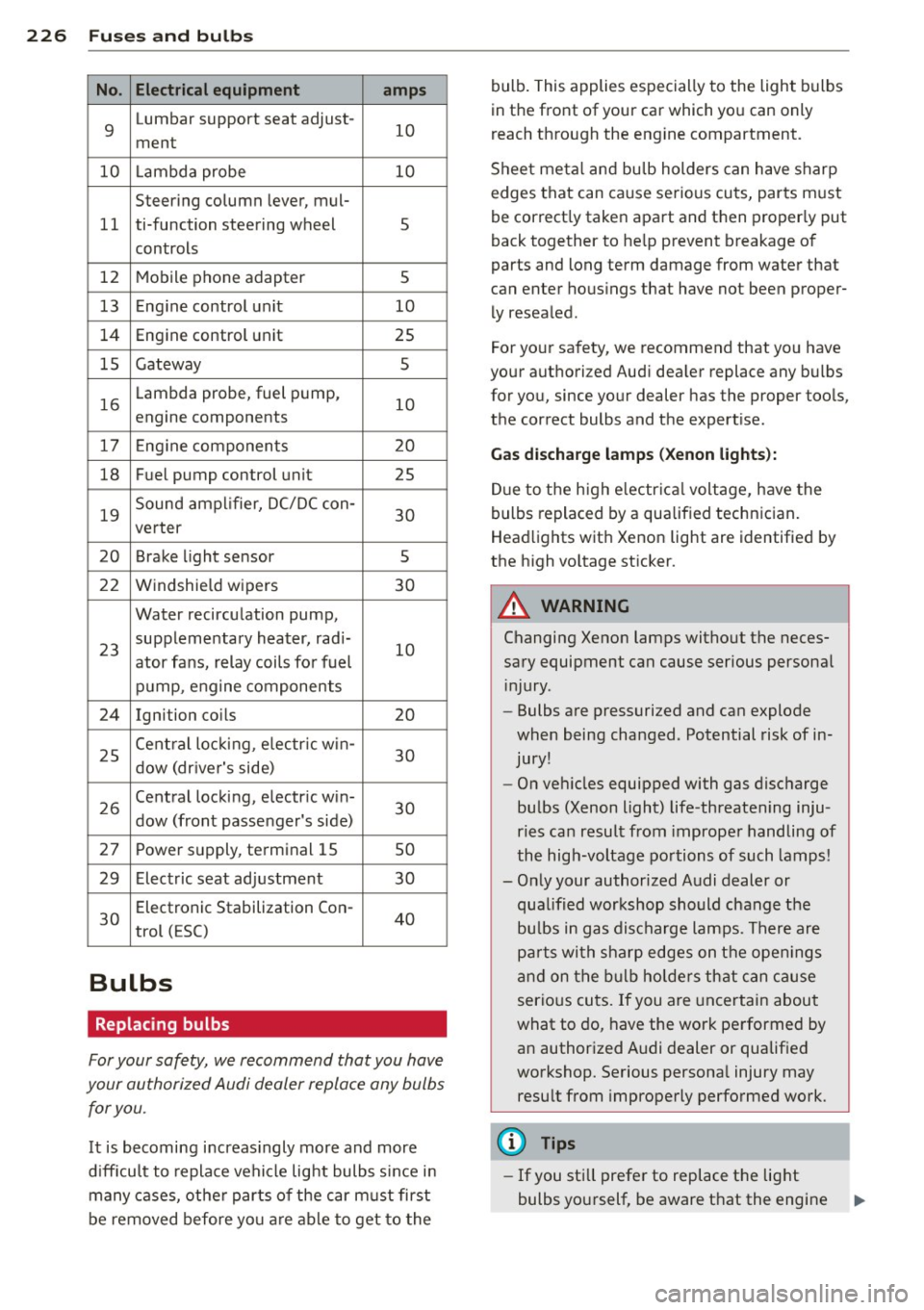
226 Fuses and bulbs
No. Electrical equipment amps
9 Lumbar support seat adjust-
ment
10
10 Lambda probe 10
Steering column lever, mul-
11 ti-function steering wheel
s
controls
12 Mobile phone adapter
s
13 Engine control unit 10
14 Engine control
unit
25
15 Gateway 5
16 Lambda
probe, fuel pump,
10
engine components
17 Eng ine components 20
18 Fuel pump control unit
2S
19 Sound
amplifier, DC/DC con-
verter 30
20 Brake light sensor
s
22 Windshield
wipers
30
Water recirculation pump,
23
supplementary heater, rad i-
10 a tor fans, relay coils for fuel
pump , engine components
24 Ignition coils 20
2S Central locking
, e lectr ic win-
30
dow (driver's side)
26 Central locking, e
lectr ic win-
30
dow (front passenger's side)
27 Power supply, terminal 15
so
29 Electric seat adjustment 30
30 Electronic Stabilization Con-
40
trol (ESC)
Bulbs
Replacing bulbs
For your safety, we recommend that you have
your authorized Audi dealer replace any bulbs for you.
It is becoming increas ingly more and more
difficult to replace vehicle lig ht bulbs s ince in
many cases, other parts of the car must first
be removed before you are able to get to the bulb.
This applies especially to the light bulbs
in the front of your car which you can only
reach through the engine compartment.
Sheet meta l and bulb holders can have sharp
edges that can cause serious cuts, parts must
be correct ly taken apart and then properly put
back together to he lp prevent breakage of
parts and long term damage from water that
can enter housings that have not been proper
ly resealed.
For your safety, we recommend that you have
your authori zed Audi dea ler replace any bulbs
for you, since your dealer has the proper tools,
the correct bulbs and the expertise.
Gas discharge lamps (Xenon lights ):
Due to the high e lectr ica l voltage, have the
bulbs replaced by a qualified technician.
Headlights with Xenon light are identified by
the high voltage st icker.
A WARNING "--
Changing Xenon lamps without the neces-
sary equipment can cause serious persona l
injury.
- Bulbs are pressurized and can explode
when being changed. Potential risk of in
jury!
- On veh icles equipped with gas discharge
bulbs (Xenon light) life-threatening inju
ries can result from improper handling of
the high-voltage portions of such lamps!
- Only your authorized Audi dealer or qualified workshop should change the
bu lbs in gas discharge lamps. There are
pa rts with sharp edges on the openings
and on the bulb holders that can cause
serious cuts. If you are uncertain about
what to do, have the work performed by
an authorized Audi dealer or qualified
workshop. Serious personal injury may
result from improperly performed work.
@ Tips
-If you still prefer to replace the light
bulbs yourself, be aware that the engine ..,.
Page 235 of 258
M N
M N
0 ::i co ,...., \!) 1.1'1 ,...., 1.1'1 ,....,
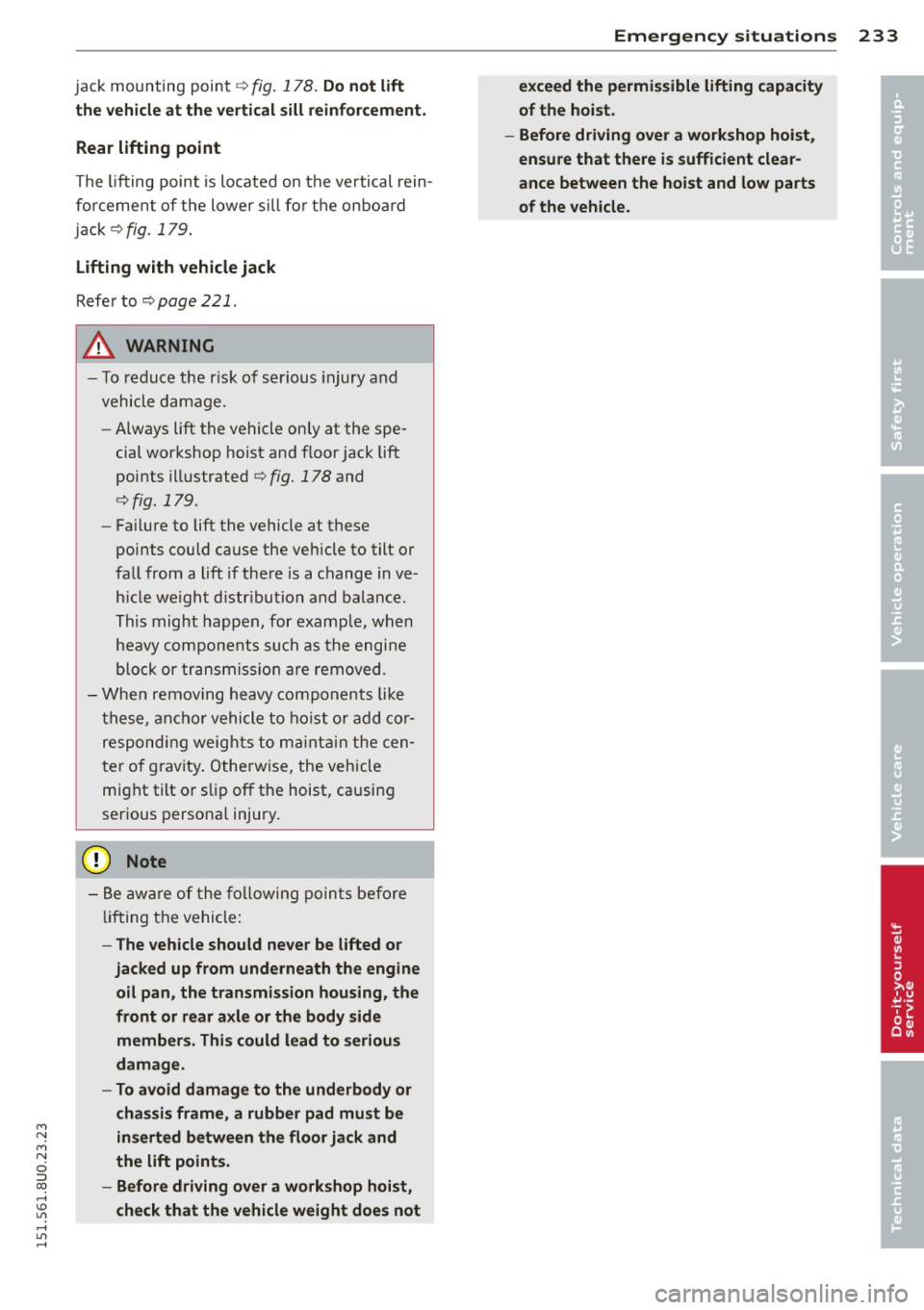
jack mounting point ¢ fig. 178. Do not lift
the vehicle at the vertical sill reinforcement.
Rear lifting point
T h e lift ing poin t is lo cate d on th e vertical rein
fo rc ement o f the lower s ill for th e on boar d
jack
r::!vfig. 1 79 .
Lifting with vehicle jack
Refe r to ¢ page 221 .
A WARNING
- To reduce the r is k o f se rious injury a nd
vehicle damag e.
- Always lift the ve hicle on ly at the spe
cial w ork shop h oist and flo or jack lift
points illustrated
¢ fig. 178 and
¢fig. 179 .
-Fai lure to lift the vehicle at these
poi nts cou ld cause the ve hicle to tilt or
fa ll from a lift if the re is a chang e in ve
h icl e w eigh t distr ibu tion and balance.
This might happen, for e xam ple, w hen
heavy co mpo ne nts su ch as the engi ne
b lo ck or tra nsmi ssion ar e removed .
- W hen removing heavy comp onents like
th ese, a nch or ve hicle to hoist or add cor
resp ond ing weig hts to maintai n the cen
ter o f gravity . Othe rwise, the vehicle
mig ht tilt or s lip off the hoist, causi ng
serious persona l injury .
(D Note
- Be aw ar e of t he fo llow ing poin ts be fore
lift ing t he vehicle:
- The vehicle should never be lifted or
jacked up from underneath the engine oil pan, the transmission housing, the
front or rear axle or the body side members. This could lead to serious
damage.
- To avoid damage to the underbody or
chassis frame, a rubber pad must be
inserted between the floor jack and
the lift points .
- Before driving over a workshop hoist,
check that the vehicle weight does not
-
Emergency situations 233
exceed the permissible lifting capacity
of the hoist .
- Before driving over a workshop hoist ,
ensure that there is sufficient clear
ance between the hoist and low parts
of the vehicle.
•
•