transmission AUDI Q3 2015 User Guide
[x] Cancel search | Manufacturer: AUDI, Model Year: 2015, Model line: Q3, Model: AUDI Q3 2015Pages: 258, PDF Size: 64.9 MB
Page 163 of 258
M N
M N
0 ::i co ,...., \!) 1.1'1 ,...., 1.1'1 ,....,
Driving and
environment
The first 1
1000
miles
(11500 km) and
afterwards
New engine
The engine needs to be run-in during the first
1,000 miles (1 ,500 km) .
For the first 600 mile s (1,000
kilometers ):
.,. Do not use full throttle.
.,. Do not drive at engine speeds that are more
than
2/3 of the max imum permitted RPM .
From 600 to 1 ,000 miles (1,000 to
1,500 kilometers ):
.. Speeds can gradually be increased to the
maximum perm iss ible road or eng ine speed .
During and after br eak-in period
.. Do not rev the eng ine up to h igh speeds
when it is cold. Th is applies whether the
transmission is in N (Neutral) or in gear.
Afte r the break- in peri od
.. Do not exceed max imum eng ine speed un
der any circumstances .
.. Upshift into the next higher gear
before
reaching the red area at the end of the tach
ometer scale
c.> page 10.
During the first few hours of driving, the en
g ine's interna l friction is higher than later
when all the moving parts have been broken in . How well this break -in process is done de
pends to a considerable extent on the way the
ve hicl e is driven du ring the first 1,000 miles
(1,500 k ilome ters).
(D Note
Extremely h igh engine speeds are auto
mat ica lly reduc ed. However , th ese rpm
lim its are programmed for a n engine well
r u n- in, not a new engine.
Driving and environment 161
@) For the sake of the environment
Do not drive with unnecessarily high en
g ine speeds - upshifting ear ly saves f uel,
reduces noise and protects the environ
ment.
New tires
If your vehicle is running on new tires, drive
very carefully for the first 350 miles (500 ki lo
meters) after fitting.
.&, WARNING
N ew tires tend to be sl ippery and mus t al
so be "b roken -in" . Be sure to remember
this dur ing the f irst 350 m iles (500 kilo
meters) . Brake gently . Avoid fo llowing
closely behind other vehicles or other sit
uations that m ight require sudden, hard
b raking .
Avoid damaging the
vehicle
When you are d rivi ng on poo r roads, or over
cu rbs, steep ramps, etc., make certa in that
low- ly in g parts s uch as spo ile rs and ex ha ust
system parts do not bottom o ut and get dam
aged.
Th is is espec ially true for veh icles with low
s lung chassis (spo rts chas sis)* and fully load
ed vehicles.
Catalytic converter
It is very important that your emission con trol system (catalytic converter) is function
ing properly to ensure that your vehicle is run
ning in an environmentally sound manner.
.. Always use lead -free gasoline c'.> page 175,
Fuel supply .
.. Never r un the tank down all the way to emp
ty.
.. Never put too much motor o il in your engine
c.> page 184, 'l::1: Adding engine oil .
.. Never try to push -or tow-sta rt you r vehicle . I),
•
•
Page 167 of 258
M N
M N
0 ::i co ,...., \!) ..,.,
,...., ..,., ,....,
conditions. Drive especially slow if
offroad with low visibility.
- Please note that the wheels can spin and
the vehicle can break away when the ESC
Offroad Mode is switched off, especially
when the road is slippery.
- Driv ing stability is reduced in the ESC
Offroad mode.
@ For the sake of the envi ronment
Avoid harming the environment and take
nature into consideration .
(D Tips
On ly drive where it is allowed and always
stay on the provided roads and paths .
Driver messages
There is only one right way to drive in difficult
conditions: slowly and with caution!
When driv ing offroad, observe the following:
• Never dr ive the veh icle in terra in which is
not suitable for the veh icle, or wh ich ex
ceeds your driving skills. Never take any un
necessary risks!
• Drive slowly and cautiously!
• Pay attention to the
gro und cl earance of
your vehicle! This may vary depending on
the load and composition of the ground and
the environment. The driver is therefore re
spons ible for deciding whether a vehicle can
handle a specific situation .
• Activate the
ESC-Offr oad-Mode Q page 155
as needed.
• Use the
hill desce nt ass is t Q page 155 when
driv ing down steep sections on hi lls.
Difficult terr ain
Never drive in areas that are not familiar to
you and dr ive slowly when offroad and be pre
pared and expect the unexpected (e.g . pot
holes, bou lders, tree stumps, etc.)
To prevent the vehicle from bottoming and
avoid damage to the underbody , you should
drive straight across severe bumps in the
Dri vin g and en vironm ent 165
ground with only one side o f the veh icle so
that only two of your whee ls cross the bumps.
Drive quickly through sandy or marshy offroad
sections and do not stop, if at all possible .
Driving throu gh w ater on road s
Note the following to avoid veh icle damage
when driving through water, for examp le on
flooded roads:
- The water must not be any higher than the
bottom of the vehicle body.
- Do not drive faster than walking speed .
A WARNING
--After driving through water, mud, slush,
etc., the brakes may be slow to take effect because of wet brake rotors and pads. D ry
the bra kes first by braking carefully to re
store the fu ll braking effect.
(D Note
Vehicle components such as the eng ine,
transmission, suspension or electrical sys
tem can be severe ly damaged by dr iv ing
th rough water.
(D Tips
- Check the depth of the water before d riv
ing through it.
- Do not stop the vehicle, drive in reverse
or switch the engine off when driving
thro ugh water.
- Keep i n mind that oncoming veh icles
may create waves that raise the water
level and make it too deep for your vehi
cle to drive through sa fely.
- Avo id d riving through salt wate r because
i t can cause corros ion.
•
•
Page 198 of 258
196 Tire s and wheel s
-Never mount used tires on yo ur vehicle if
yo u are not sure of their "previous histo
ry." Old used tires may have been dam
aged even though the damage cannot be
seen that can lead to sudden t ire failure
and loss of vehicle control.
- If you notice unusual vibration or if the
vehicle pulls to one side when driving, al
ways stop as soon as it is safe to do so
and check the wheels and tires for dam
age.
(D Note
- Please note that summer and winter
tires are designed for the cond itions that
a re typ ica l in those seasons. Aud i recom-
Glossary of tire and loading terminology
Accessory weight
means t he comb ined we ight (in excess of
those sta ndard items wh ich may be rep lace d)
of automa tic transmission, power s teering ,
power brakes, power wi ndows, power seats,
radio, and heater, to the extent that thes e
items are availab le as factory-installed equip
ment (whether ins talled or not) .
Aspect ratio
means the ratio o f the height to the width of
the tire in percent. Numbers of 55 or lower in
d icate a low sidewall for improved steer ing re
sponse and better overall handling on dry
pavement.
Bead
means t he pa rt of the tire that is made of
steel wires, wrapped or reinforced by ply cords
and that is shaped to fit the rim .
Bead separat ion
means a b reakdown of the bond between
components in the bead.
Cord
means the strands forming the plies in the
tire. mends using winter tires during the w
in
ter months. Low temperatures signifi
cantly decrease the elastic ity o f summe r
tires, which affects traction and braking ability . If summer tires are used in very
co ld temperatures, cracks ca n form o n
the tread bars, resu lting in permanent
tire damage that can cause lo ud driving
noise and unbalanced tires. Aud i is no t
responsib le for this type of d amage .
- Burn ished , polished or chromed rims
must not be used in winter road condi
tions. The s urface of the rims does not
have s uff ic ient corrosion protection for
this and could be permanently damaged
by road sa lt o r similar substances .
Cold tire inflation pressure
means the t ire p ress ure recommended by the
vehicle m anufacture r fo r a tire o f a des ign ated
s ize that has not been d riven for more than a
coup le of miles (ki lometers) at low speeds in
the three hour period before the tire p ress ure
is measured or adjusted .
Curb weight
means the we ight of a motor ve hicl e w ith
standard equipment including the maximum
capac ity of fuel, oi l, and coolant, air condi
tion ing and additional weig ht o f optiona l
equipment.
E x tra load tire
means a t ire design to operate at higher loads
and at higher inflation pressures than the cor
responding standa rd tire . Extra load tires may
be identified as "XL", "x l" , "E X TRA LOAD", or
"RF" on the sidewall.
Gross Axle Weight Rating ("GAWR ")
means the load-carrying capa city of a s ingle
axle system, measured at the tire-ground in-
terfaces.
liJJ>
Page 221 of 258
M N
M N
0 ::i co ,...., \!) ..,.,
,...., ..,., ,....,
A WARNING 1=
You or your passengers could be injured
while changing a wheel if you do not fol
low these safety precautions:
- If you have a flat tire, move a safe dis
tance off the road. Turn off the engine,
turn the emergency flashers on and use
other warning devices to alert other mo
torists.
- Make sure that passengers wait in a safe
place away from the vehicle and well
away from the road and traffic.
- To help prevent the vehicle from moving
suddenly and possibly slipping off the
jack, always fully set the parking brake
and block the wheel diagonally opposite
the wheel being changed with the fold
ing chocks or other objects. When one
front wheel is lifted off the ground, plac ing the Automatic Transmission in "P"
(Park) will
not prevent the vehicle from
moving .
- Before you change a wheel, be sure the
ground is level and firm. If necessary,
use a sturdy board under the jack.
- Always store the vehicle tool kit, the jack
and the replaced tire in the luggage com
partment
¢ page 100.
(D Note
If you are changing the wheel on a steep
incline, use the folding chock¢
page 217
to block the opposite wheel to prevent the
vehicle from moving.
(!) Tips
Obey all laws.
Changing a wheel
When you change a wheel, follow the se
quence described below step-by-step and in
exactly that order .
-
1. Remove the decorative wheel cover* or
the
wheel bolt caps*. For more details see
also
¢ page 220.
2. Loosen the wheel bolts<=:> page 220 .
What do I do now? 219
3.
4.
5.
6.
7.
8.
Locate the proper mounting point for the
jack and align the jack below that point
¢ page 221.
Lift the car with the jack ¢ page 221.
Remove the wheel with the flat tire and
then install the
spare tire <=:>page 222.
Tighten all wheel bolts lightly.
Lower the vehicle with the jack .
Use the wheel bolt wrench and
firmly
tighten all wheel bolts in a crisscross pat
tern ¢
page 220.
9. Replace the decorative wheel cover* or
the
wheel bolt caps*.
A WARNING
Always read and follow all WARNINGS and information<=:>
A in Raising the vehicle on
page 221
and <=:> page 223.
After changing a wheel
A wheel change is not complete without the
doing the following.
.,. Always store the vehicle tool kit, the jack4
and the replaced tire in the luggage com
partment
¢ page 100.
.,. Check the tire pressure of the spare tire as
soon as possible .
.,. As soon as possible, have the
tightening
torques
on all wheel bolts checked with a
torque wrench. The correct tightening tor
que is 105 ft lbs. (140 Nm).
.,. Have the flat tire
replaced as soon as possi
ble.
(D Tips
- If you notice that the wheel bolts are
corroded and difficult to turn while
changing a tire, they should be replaced
before you check the tightening torque.
- Drive at reduced speed until you have the
tightening torques checked.
•
•
Page 227 of 258
M N
M N
0 ::i co ,...., \!) 1.1'1 ,...., 1.1'1 ,....,
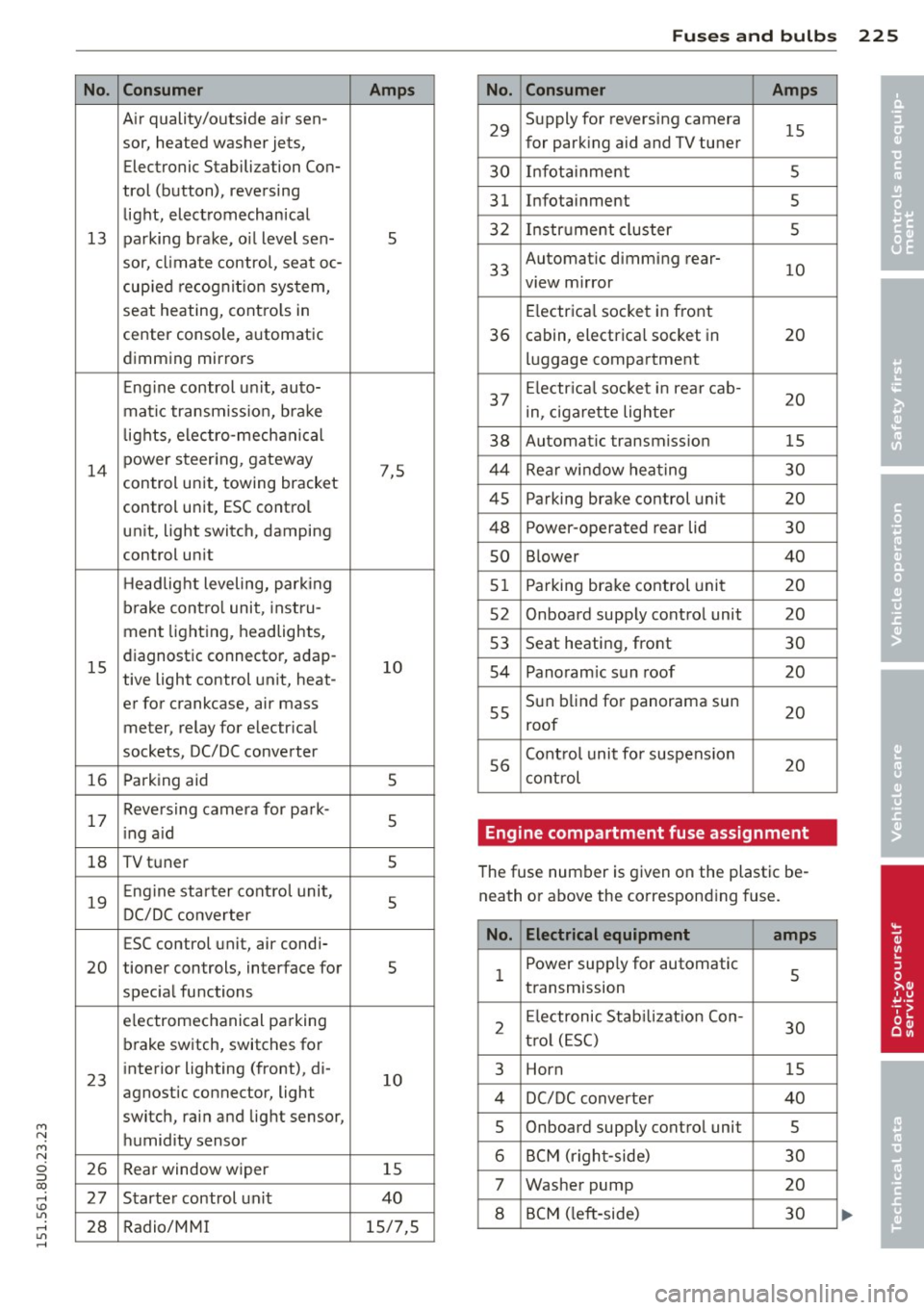
No.
13
14
15
16
17
18
19
20
23
26
27
28
Consumer
A ir quality/outside air sen-
sor, heated washer jets,
Electronic Stabilization Con-
trol (button), reversing
light, electromechanical
parking brake, o il level sen-
sor, climate control, seat oc-
cup ied recognit ion system,
seat heating, contro ls in
center console, automatic
dimming mirrors
Eng ine control u nit, auto-
matic transmiss ion, bra ke
l ights, electro-mechanical
power steer ing, gateway
control un it, towing bracket
control unit, ESC contro l
unit, light switch, damping
control un it
H eadlight leveling, park ing
brake contro l unit, inst ru-
men t lighting, headlights,
diagnostic connector, adap-
tive light control unit, heat-
er for crankcase, air mass
meter, relay for electr ical
sockets, DC/DC converter
Parking aid
Reversing camera for park-
i ng a id
TV tuner
Eng ine starter cont ro l unit,
DC/DC converter
ESC control unit, air condi-
tioner controls, interface for
spec ial functions
e lectromechanical parking
b rake switch, switches for
interior lighting (front), di-
agnostic connector, light
switch, rain and light sensor,
humidity sensor
Rear window wiper
Starter control un it
Radio/MM I
Amps
5
7,5 10 5
5
5 5
s
10
15
40
15/7,5
Fu ses and bulb s 225
No. Consumer Amps
29
Supply for reversing camera
15 for park ing aid and TV tuner
30 Infot ainment 5
31
Infotainment 5
32
Instr ument cluster 5
33
Automatic dimming rear-
view m irror
10
E lectrica l socket in front
36 cabin, electrical socket in 20
luggage compartment
37 Electr ica l soc ket i n rear cab-
20 in, ciga rette lighter
38 Automatic transmission 15
44
Rear window hea ting 30
45
Parking brake control unit 20
48
Power-operated rear lid 30
so B lower 40
51
Parking brake control unit 20
52
On board supply control unit 20
53
Seat heating, front 30
54
Panoram ic sun roof 20
55
Sun b lind for panorama sun 20
roof
56
Contro l unit fo r suspension
20 cont rol
Engine compartment fuse assignment
The fuse number is given on the plastic be
neath or above the correspond ing fuse.
No. Electrical equipment
amps
1 Power supply for automatic 5 transmission
2
E lectronic Stabilizat ion Con-
30 t ro l (E SC)
3 Horn 15
4
DC/DC converter 40
5
Onboard supply control unit 5
6
BCM (righ t-side) 30
7
Washer pump 20
8
BCM ( left -side) 30
•
•
Page 230 of 258
228 Emergency situations
Emergency situations
General
This chapter is intended for trained emer
gency crews and working personnel who
have the necessary tools and equipment to
perform these ope rations.
Starting by pushing or
towing
Q;) Note
Vehicles with an automati c transmission
cannot be started by pushing or towing .
Starting with jumper
cables
If necessary, the engine can be started by
connecting it to the battery of another vehi
cle.
If the engine should fail to start because of a
discharged or weak battery, the battery can be
connected to the battery of
another veh icle,
using a
pair of jumper cables to start the en
g ine .
Jumper cables
Use only jumper cables of sufficiently large
cross section to carry the starter current safe
ly. Refer to the manufacturer's specifications.
Use only jumper cables with
insulated termi
na l clamps which are distinctly marked:
plus(+) cable in most cases colored red
minu s(-) cable
in most cases colored black .
A WARNING
Batteries contain electricity, ac id, and gas .
Any of these can cause very serious or fatal
inju ry. Follow the instructions below for
safe handling of your veh icle's battery.
- Always shield you r eyes and avoid lean
ing over the battery whenever possible.
- A discharged battery can freeze at tem
peratures just be low 32 °F (0 °C). Before connecting a
jumper cable, you must
thaw the frozen battery complete ly, oth
erwise it could explode.
- Do not allow battery acid to contact eyes
or skin . Flush any contacted area with
water immediately .
- Improper use of a booster battery to start a vehicle may cause an explosion.
- Vehicle batteries generate explosive gas
es. Keep sparks, flame and lighted ciga
rettes away from batteries.
- Do not try to jump start any vehicle with a low ac id level in the battery.
- The vo ltage of the booster battery must
also have a 12-Volt rating . The capacity
(Ah) of the booster battery should not be
lower than that of the discharged bat
tery . Use of batteries of d ifferent voltage
or substantially different "Ah" rating
may cause an exp losion and personal in
jury.
- Never charge a frozen batte ry. Gas trap
ped in the ice may cause an explosion.
- Never charge or use a battery that has
been frozen. The battery case may have
be weakened.
- Use of batter ies of different voltage or
substantially different capacity (Ah) rat
ing may cause an exp losion and injury.
The capacity (Ah) of the booster battery
should not be lower than that of the dis
charged battery.
- Before you check anything in the engine
compartment, always read and heed a ll
WARNINGS ¢
page 179.
(D Note
-App lying a higher voltage booster bat
tery will cause expensive damage to sen
sitive electronic components, such as
control units, relays, radio, etc .
- Th ere must be no electrical contact be
tween the vehicles as otherwise current cou ld already start to f low as soon as the
positive(+) terminals are connected. .,.
Page 231 of 258
M N M N
0 :::i co
rl I.O
"' rl
"' rl
@ Tips
- The discharged battery must be properly
connected to the vehicle's electrical sys
tem. When jump start ing or charging the
battery, never connect the negative
ground cable to the battery negative post because the battery manager sys
tem must be able to detect the battery's
state of cha rge . A lways connect the neg
ative g round cab le to the negative
gro und post o f the battery manage r con
trol uni t.
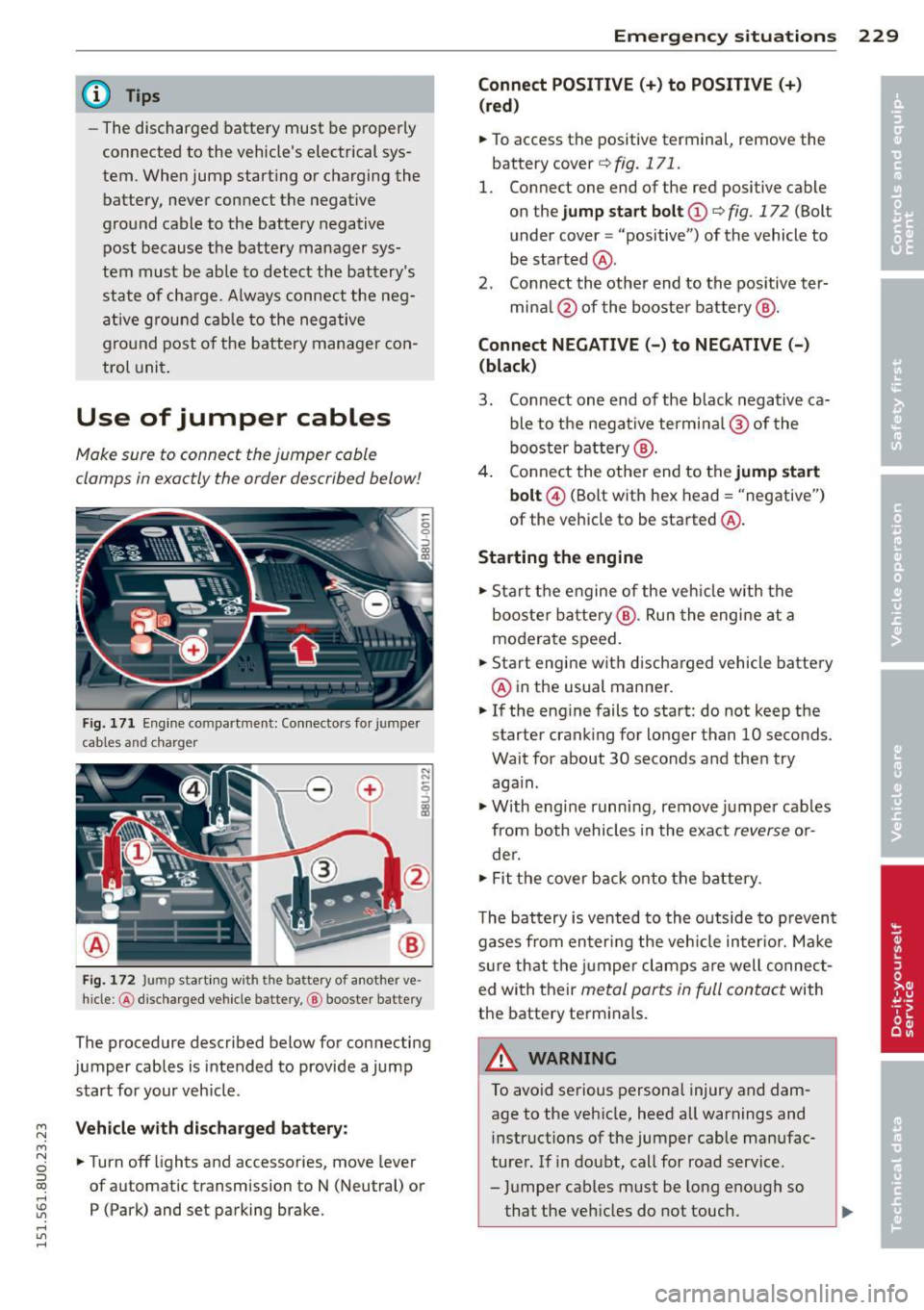
Use of jumper cables
Make sure to connect the jumper cobl e
clomps in exactly the order describ ed b elow!
F ig. 171 Engine co mpartmen t: Con ne ctors fo r jum per
c ables a nd char ger
Fi g. 172 Jump s tart in g w ith t he ba ttery of a not her ve
hi cle :@ disch arged vehicle battery ,@ booster bat tery
The procedure described below for connecting
jumper cables is intended to provide a jump
start for your veh icle .
V ehicle with discharged batter y:
.. Tu rn off lights and accessories, move lever
of automatic transmission to N (Neutral) or P (Park) and set parking brake .
Emergency situ ation s 229
Connect POSITIVE(+ ) to POSITIVE (+ )
(red )
.. To access the positive terminal, remove the
battery cover
c::> fig. 1 71.
1. Connect one end of the red positive cable
on the
jump sta rt bolt (D c::> fig . 172 (Bolt
under cover = "positive") of the vehicle to
be started @.
2 . Connect th e other end to the pos itive ter-
mina l@ of the booster battery @.
Connect NEGATIVE( -) to NEGATIVE(-)
( black )
3. Connect one end of the black negative ca ble to the negat ive termina l@ of the
booster battery @.
4 . Connect the othe r end to the
jump start
bolt @
(Bolt with hex head = "negative")
of the vehicle to be started @.
Starting the engine .,. Sta rt the engine of the veh icle w ith the
booste r ba tte ry @ . Ru n the engine at a
moderate speed .
.. Start engine w it h discharged vehicle battery
@ in the usual manner .
.. If the eng ine fails to start: do not keep the
starter c ranking for longer than 10 seconds.
Wait for about 30 seconds and the n try
aga in .
.. With eng ine runni ng, remove jumpe r cab les
from both vehicles in the exact
reverse o r
de r .
.,. Fit the cover b ack o nto the battery.
T he battery is vented to th e outside to p revent
gases from enter ing the veh icle inter io r. Ma ke
s u re that the j umper clamps are well connec t
ed with their
metal parts in full contact with
the battery term inals.
,8. WARNING
To avoid serious personal injury and dam
age to the veh icle, heed all warnings and
instructions of the jumper cable man ufac
turer. If in doubt, call for road service .
- J umper cables m ust be long enough so
that the veh icles do not touch.
-
Page 235 of 258
M N
M N
0 ::i co ,...., \!) 1.1'1 ,...., 1.1'1 ,....,
jack mounting point ¢ fig. 178. Do not lift
the vehicle at the vertical sill reinforcement.
Rear lifting point
T h e lift ing poin t is lo cate d on th e vertical rein
fo rc ement o f the lower s ill for th e on boar d
jack
r::!vfig. 1 79 .
Lifting with vehicle jack
Refe r to ¢ page 221 .
A WARNING
- To reduce the r is k o f se rious injury a nd
vehicle damag e.
- Always lift the ve hicle on ly at the spe
cial w ork shop h oist and flo or jack lift
points illustrated
¢ fig. 178 and
¢fig. 179 .
-Fai lure to lift the vehicle at these
poi nts cou ld cause the ve hicle to tilt or
fa ll from a lift if the re is a chang e in ve
h icl e w eigh t distr ibu tion and balance.
This might happen, for e xam ple, w hen
heavy co mpo ne nts su ch as the engi ne
b lo ck or tra nsmi ssion ar e removed .
- W hen removing heavy comp onents like
th ese, a nch or ve hicle to hoist or add cor
resp ond ing weig hts to maintai n the cen
ter o f gravity . Othe rwise, the vehicle
mig ht tilt or s lip off the hoist, causi ng
serious persona l injury .
(D Note
- Be aw ar e of t he fo llow ing poin ts be fore
lift ing t he vehicle:
- The vehicle should never be lifted or
jacked up from underneath the engine oil pan, the transmission housing, the
front or rear axle or the body side members. This could lead to serious
damage.
- To avoid damage to the underbody or
chassis frame, a rubber pad must be
inserted between the floor jack and
the lift points .
- Before driving over a workshop hoist,
check that the vehicle weight does not
-
Emergency situations 233
exceed the permissible lifting capacity
of the hoist .
- Before driving over a workshop hoist ,
ensure that there is sufficient clear
ance between the hoist and low parts
of the vehicle.
•
•
Page 236 of 258
234 Technical Data
Technical Data
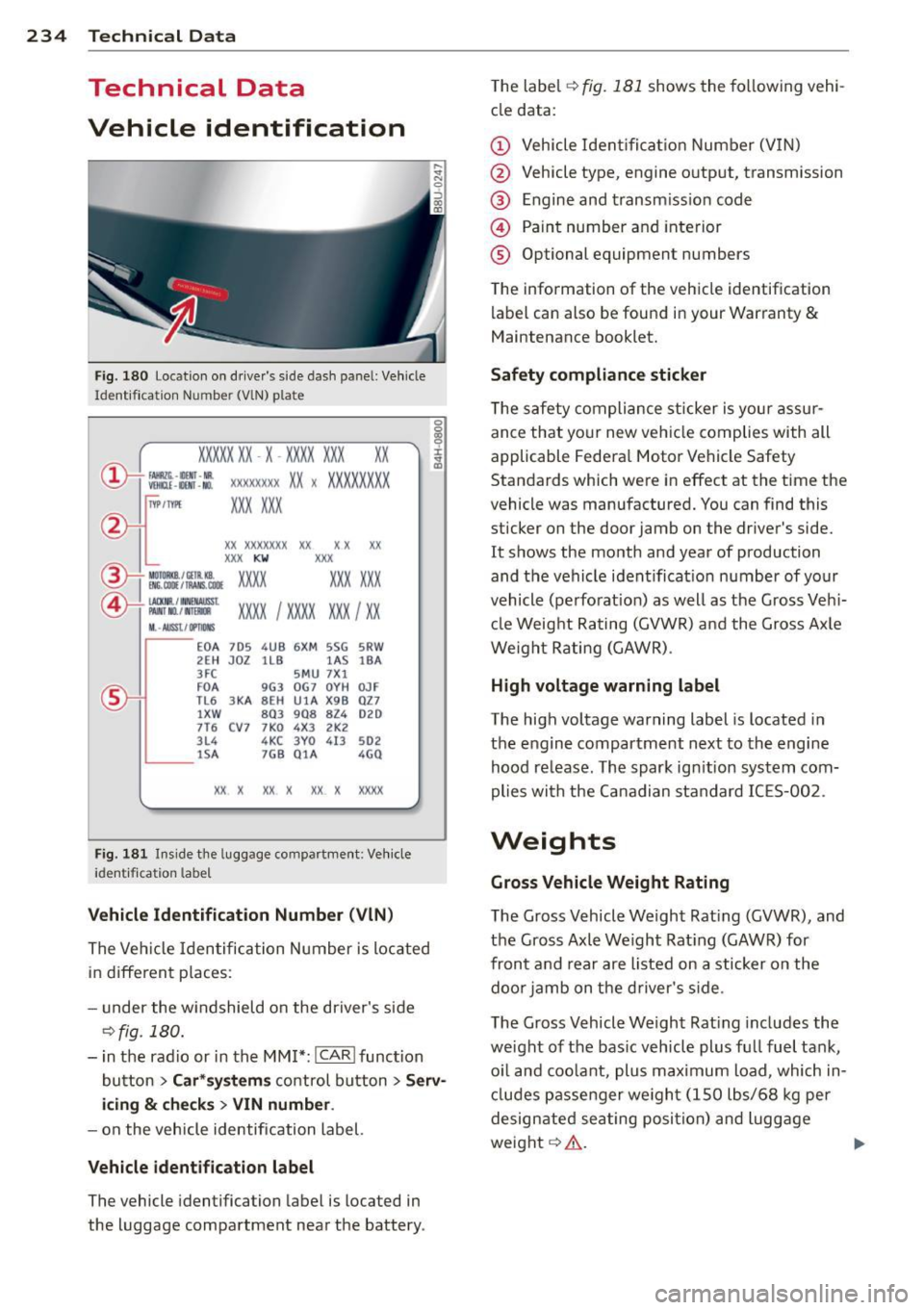
Vehicle identification
Fig . 180 Location on driver 's s ide dash pane l: Vehicle
Identifica tion Numbe r (V IN) p la te
XXXXX XX · X -XXXX XXX xx
r,'\__l f~ -11!11 1 · Nil ~ V!Hlll -llllll . NO.
IYP IT'fl'E
XXXXXXXX XX X XXXXXXXX
XXX XXX
XX XXXX XXX X X X X XX
XXX
KW XXX
®i ~~: f :l~~ XXXX XXX XXX
@+ ~~r= XXXX I XXXX XXX I XX M,. AIIISl. / lflllllS
EO A 7D5 4 UB 6XM SSG 5RW
2E H JDZ llB l AS lBA
3FC 5MU 7X l
FO A
9G3 OG7 OYH OJF
TL6 3
KA BEH
UlA X9B QZ7
l XW
8Q3 9Q8 82 4 020
7T6 CV 7 7KO 4X3 2K2
3 L4 4 KC 3YO 4I3 502
lSA 7GB Q1 A 4GQ
XX X
XX X XX X XXXX
Fig. 181 Inside the luggage compartme nt: Vehicle
i dentifica tion label
Vehicle Identification Number (VlN)
The Vehicl e Identification Number is located
in different p laces :
- under the w indshield on the driver's side
r=v fig . 180.
-in the radio or in the MM!": !CAR ! function
button
> Car"systems control button > Serv
icing
& checks > VIN number.
- on the vehicle identification label.
Vehicle identification label
The vehicle identification label is located in
the luggage compartment near the battery . T
he label
r=v fig. 181 shows the following vehi
cle data:
(D Vehicle Ident ificat ion Number (VIN)
@ . Vehicle type, engine output, transmission
® Engine and transm ission code
@ Paint number and interior
® Optional equipment numbers
The information of the vehicle identification
label can also be found in your Warranty
&
Maintenance booklet.
Safety compliance sticker
The safety compliance sticker is your assur
ance that your new veh icle complies with all
applicable Federal Motor Vehicle Safety
Standards which were in effect at the time the
vehicle was manufactured. You can find this
sticker on the door jamb on the driver's side.
It shows the month and year of production
and the vehicle ident ificat ion number of your
vehicle (perforat ion) as well as the Gross Veh i
cle Weight Rating (GVWR) and the Gross Axle
Weight Rating (GAWR) .
High voltage warning label
The high voltage warning label is located in
the engine compartment next to the engine
hood re lease . The spark ignition sys tem com
plies with the Canadian standard IC ES-002.
Weights
Gross Vehicle Weight Rating
The Gross Vehicle Weight Rat ing (GVWR), and
the Gross Axle Weight Rat ing (GAWR) for
front and rear are listed on a sticker on the
doo r jamb on the driver's s ide .
The Gross Vehicle Weight Rating includes the
weight of the bas ic vehicle plus fu ll fuel tank,
o il and coolant, plus max imum load, which in
cludes passenger weight (lSO lbs/68 kg per
designated seating position) and luggage
weight ~&, . .,.
Page 254 of 258
252 Index
Steering wheel
Adjusting steering co lumn ... ... ... ..
66
Indicator light . ........... ... .... .. 16
Multifunction steering wheel . .. ...... 21
Steer ing whee l w ith tiptronic . .. .. .... .. 84
Steps for determining correct load limit .
204
Stopping the engine . . . . . . . . . . . . . . 67, 69
Storage . .. .... ... .... .... .. .. .. .. .. 54
Cup holder door pockets . . . . . . . . . . . . . . 56
Glove compartment . . . . . . . . . . . . . . . . . 55
Sto rage compartments . . . . . . . . . . . . . . . 56
Sunroof
refer to Panorama sunroof . . . . . . . . . . . 38
Sun shades
Emergency closing (roof) ........... ..
39
Sun visors . . . . . . . . . . . . . . . . . . . . . . . . . . 46
Symbols
refer to Warning/indicato r lights .... .. 11
T
Tachomet er . . . . . . . . . . . . . . . . . . . . . . . . . 11
Tail lights
C leaning . .. .. . .. ..... ..... .. .. .. .
171
Technical Data ................ ... ... 234
Technical modifications ....... .... .. . 240
Tether anchors . ...... ... .. .. .. .. .. . 149
Tether strap ... ...... ..... .. .. .. .. . 149
Textiles
Cleaning ................. ... .... .
173
The first 1,000 miles (1,500 km) and after-
wards . .. .. .... ...... ....... .. .. .. .
161
Tie-down rings ... ..... ...... .. .. .. . 101
Tie-downs . . . . . . . . . . . . . . . . . . . . . . . . . . 60
tiptronic .............. ........ ... .. 81
tiptronic (automatic t ransmission) ...... 84
Tire pressure ....... ... .... .. .. .. .. .
201
Tire pressure monitoring system ....... 213
Loss of air pressure ........ .... .... 214
Malfunction .............. ... .. ... 2 14
Resetting tire p ressures .... .. .. .. .. . 215
Tires .. .. .. .. .... .. ... .. .. .... .. ... 195
Low aspect ratio ti res . . . . . . . . . . . . . . . 212
Service life ...... ........... ... .. . 205
Speed rating letter code ......... ... 207
Tire manufacturing date . .. .. .. .. .. . 207
Tire pressure monitor ing system .. ... 213
r ·f· t · ire spec, 1ca ions ............. .... 207
Tread depth ..... ................. 205
Uniform tire quality grading ......... 209
Winter tires . .. .. ....... ..... .... .
T ires and wheels
Checking tire pressure ............. .
Co ld tire inflation pressure ...... .. . .
o· . 1mens 1ons .... .. ................ .
General notes .. .. ... ... .... ... .. . .
Glossa ry of tire and lo ading terminolo-
gy .......... ... ................ .
210
201
199
206
195
1 96
New tir es and wheels ..... ...... .. .. 206
Replac ing . ...... ................ . 207
Snow chains . .. .. ...... ....... .... 211
T ires and vehicle load limits . .. .. .. .. 203
Wheel bolts ... .. ................. 212
W inter tires ..... ................. 210
Tire service life .. .. ................ . 205
Tool kit .... .. .. .. ...... ....... .... 216
T orn or frayed safety belts
Towing Front eyelet ... .. ....... ...... .. . .
Rear eyelet .. .. .. .. ........ .... .. .
T ow t ruck procedures ............. . .
TPMS 107
231
231
230
Tire pressure monitoring system 2 13, 214
T rai ler towing ..... ................. 166
Ope rating inst ructions .......... .... 1 67
Parking systems .. ... .. .... .... .. .. . 93
Technical requiremen ts . . . . . . . . 166, 167
Tongue load . .. ....... ........... . 16 7
Trailer towing tips ................ . 168
Trailer turn signal assembly
Warning/ indi cator lights . ....... .... .
19
Transmission .. .. .. ... .. .... .... .... . 81
Transmission malfunction (indicator light) 85
Transport Canada .. ................ . 102
Tread Wear Indicator (TWI) ... .... .. .. 205
Trip computer
Fuel consumption . . . . . . . . . . . . . . . . . .
22
Mileage ......... .......... ...... .. 22
Trip odom ete r ... .. ................ .. 23
Trunk
refer to Luggage compartment ... .. .. . 59
Trunk lid
refer to Rear lid . . . . . . . . . . . . . . . . . . . . 34